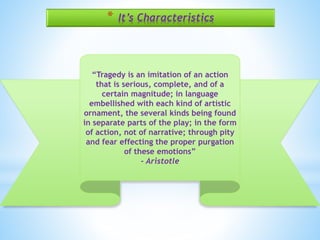
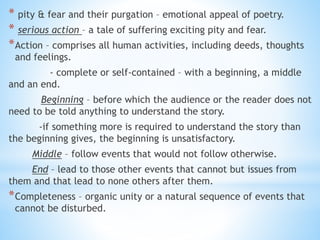
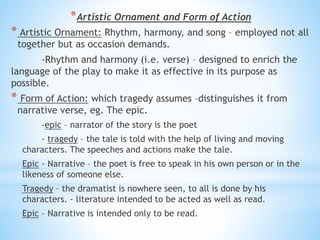
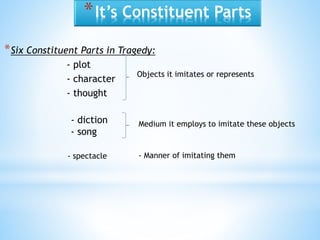
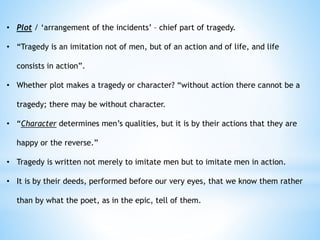
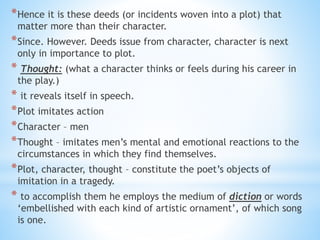
Aristotle was Plato's most famous student. He wrote Poetics, which analyzed Greek literature and established the first principles of literary criticism. In Poetics, Aristotle defines tragedy as an imitation of a serious action that evokes emotions of pity and fear and achieves a catharsis of these emotions. He identifies six elements of tragedy - plot, character, thought, diction, song, and spectacle. Aristotle devotes significant analysis to tragedy, considering it the highest form of poetry. He establishes that tragedy's purpose is to please audiences through an artistic and emotional experience.
![*
*Aristotle [384 B.C. – 322 B.C]
*The most distinguished disciple of Plato.
*Indians- tutor of Alexander the Great, who overran northwestern India in 326 B.C.
*Belief- written half a dozen critical treatise; two are extant – Poetics and
Rhetoric.
- Poetics- deal with the art of poetry.
- Rhetoric- deal with the art of speaking.
* Poetics- deals with many more problems of literature-attracted greater
attention.](https://image.slidesharecdn.com/aristotle-201106101307/85/Aristotle-THE-GREEK-MASTER-2-320.jpg)
![*
*Not a mere enunciation of the principles of the poetic art.
*Conclusions- firmly rooted in the Greek Literature.
*Approach – scientific – observation and analysis
*Deduces conclusions form Greek Literature – apply – varying degrees – literature as a whole.
*Do not cover literature produced later and in other countries.
*There is a considerable force in Dryden’s statement concerning the purpose of tragedy. [if
Aristotle had seen English Tragedy, he might have changed his mind- Dr. Johnson’s Life of
Dryden]
*Many of Aristotle’s conclusions on the nature of poetry and drama are of general application
and are as true today as they were in his own day.
*Purpose- to sort out those principles from established practice that made for a good poet.](https://image.slidesharecdn.com/aristotle-201106101307/85/Aristotle-THE-GREEK-MASTER-3-320.jpg)
![*
*Treatise – 50 pages – 26 small chapters
*Summary of his lectures to his pupils – written either by them or himself.
*Believed to have had a second part – lost
*It is incomplete – omits some important questions he himself raises [eg. Discussion of comedy
and catharsis] which were reserved for a fuller treatment in the second part.
*Chapter - 1-4, 25 – poetry
*Chapter – 5 – comedy, epic and tragedy [general way]
*Chapter – 6 -19 – tragedy [14 chapters]
*Chapter 20-22 – poetic diction
*Chapter 23, 24 – epic poetry
*Chapter 26 – comparison- epic poetry and tragedy.](https://image.slidesharecdn.com/aristotle-201106101307/85/Aristotle-THE-GREEK-MASTER-4-320.jpg)
![*
*Poet – imitator [following Plato]
*Imitates three objects:
- things as they were or are. [what is past or present]
- things as they are said or thought to be. [what is commonly
believed]
- things as they ought to be. [what is ideal]
*Like Plato, he believes that there is a natural pleasure in imitation,
which is an inborn instinct in man, constituting the one difference
between him and the lower animals.
It’s Nature
Its Function
Its Emotional Appeal
Nature ofthePoeticArt](https://image.slidesharecdn.com/aristotle-201106101307/85/Aristotle-THE-GREEK-MASTER-6-320.jpg)
![* CHILD-earliest lesson in speech and conduct- learns from those around
him – pleasure in imitation.
*Poet/artist – grown-up child indulging in imitation for the pleasure it
affords.
*The instinct for harmony and rhythm [metrical composition]- poet.
*Poet’s imitations/pictures of life are not unreal- ‘twice removed from
reality’ – as Plato believed.
*They reveal truths of a permanent or universal kind.
*To prove – Aristotle institutes a comparison between poetry and history.
“The picture of poetry – not mere reproductions of facts but truths
embedded in those facts that apply to all places and times.” -
meaning Aristotle gives to imitation](https://image.slidesharecdn.com/aristotle-201106101307/85/Aristotle-THE-GREEK-MASTER-7-320.jpg)
![Poetry
• Verse
• Relate What may happen
• More philosophical than history
• Express universal
• [how a person of a certain type
will on occasion speak or act
according to the law of
probability or necessity]
• Infuses a universal appeal into
them by stressing what they
have in common with all
persons, all places, or all things
in the same set of
circumstances
History
• Prose
• Relate what has happened
• Express The particular.
• [records particular
persons, places or things]](https://image.slidesharecdn.com/aristotle-201106101307/85/Aristotle-THE-GREEK-MASTER-8-320.jpg)
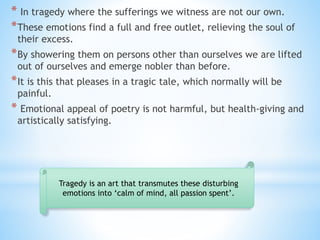
![*
*Poetry – imitative art
*Imitate two kinds of action:
* noble actions of good men – epic [hymns to gods and the praises of
famous men] – the graver spirits imitated - TRAGEDY
* mean actions of bad men – satire – the most trivial sort – COMEDY
*Epic and Tragedy – superior to – Satire and Comedy
*Tragedy superior to Epic
*Big space devoted to Tragedy - POETICS
It’s Origin
It’s Characteristics
It’s Constituent Parts
The structure of the Plot
Simple and Complex Plot
Tragic Hero
It’s Origin](https://image.slidesharecdn.com/aristotle-201106101307/85/Aristotle-THE-GREEK-MASTER-12-320.jpg)
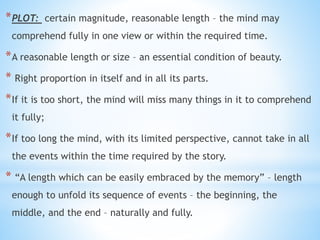
![*The Structure of the Plot
*Unity of Time
*Unity of Place
*Unity of Action
*Arouse the emotion of pity and fear
*Complication [rising action]
*Unravelling/denouemnet [falling action]
Plot – ‘the soul of tragedy’ – artistic arrangement of its incident is of the
prime importance.](https://image.slidesharecdn.com/aristotle-201106101307/85/Aristotle-THE-GREEK-MASTER-21-320.jpg)
![*Unity of Time: [conformity between the time taken by the
events of the play and that taken in their representation on the
stage]
*“Tragedy endeavours to confine itself to a single revolution
of the sun, or but slightly to exceed this limit; whereas the
epic action has no limits of time.”
*The older critics were led to believe that for a good tragic plot it
was necessary to select an event or events that happened within
twenty four hours or so in life, so that when represented in
about one-fourth of that time on the stage they may not appear
unnatural, as they would if the plot-time were longer.
*But Aristotle no where insists on this as a condition of good plot.
*He merely states the prevailing practice but is not unaware of
the fact that, in this particular matter, ‘at first the same
freedom was admitted in tragedy as in epic poetry’.](https://image.slidesharecdn.com/aristotle-201106101307/85/Aristotle-THE-GREEK-MASTER-23-320.jpg)
![*The Unity of Place: [conformity between the scene of the tragic event or
events and the time taken by them to happen] which was deduced as a corollary
from the so-called unity of time, is not mentioned at all.
*A good tragic plot should arouse the emotions of pity and fear in the
spectator or the reader.
*Pity – for the undeserving sufferings of the hero
* Fear – of the worst that may happen to him.
*“The Change of fortune should be not from bad to good, but,
reversely, from good to bad.”
*The unhappy ending is the only right ending, for it is the most
tragic in its effect.
*A happy ending will not afford the true tragic pleasure – that is
aroused by the emotion of pity and fear.](https://image.slidesharecdn.com/aristotle-201106101307/85/Aristotle-THE-GREEK-MASTER-24-320.jpg)
![*Two ways to arouse the emotion of pity and fear:
*Spectacular means or mere theatrical effects, such as physical
torture, piteous lamentation, beggarly appearance, and so on;
*Inner structure of the plot such as a brother unknowingly killing a
brother and discovering the fact later, or intending good and doing
evil, or a little error visited by a too heavy punishment, and so on.
[ indicates a superior poet]
‘For the plot ought to be so constructed that, even without the aid
of the eye, he who hears the tale told will thrill with horror and melt
pity at what takes place.’](https://image.slidesharecdn.com/aristotle-201106101307/85/Aristotle-THE-GREEK-MASTER-25-320.jpg)
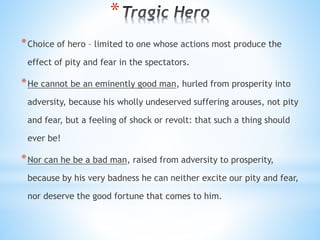
![*Nor, again, can he be an utter villain, because his fall is a matter for
gratification rather than for pity and fear.
* one kind of character can best satisfy this requirement:
“a man who is not eminently good and just, yet whose misfortune is
brought about not by vice or depravity, but by some error or fatality
[hamartia-fatal flaw]”.
* His misfortune excites pity because it is out of all proportion to his
error of judgement, and his overall goodness excites fear for his
doom. No other character answers the tragic purpose so well.](https://image.slidesharecdn.com/aristotle-201106101307/85/Aristotle-THE-GREEK-MASTER-29-320.jpg)
![*Observations on Comedy
* Not much has been said on comedy.
* Roots of comedy lie deep in satirical verse. [tragedy –epic poetry].
* Satirical Verse – owes it’s origin to the earlier phallic songs sung in honour of Dionysus,
the god of fertility.
* Epic poetry – originated from the earlier hymns to the gods and the praises of famous
men.
* Tragedy – follows its parent form – epic poetry and the hymns – represents men as
nobler than they are.
* Comedy – follows its parent forms – satirical verse and phallic songs- represents men as
worse than they are.
* Satire- ridicules personalities. - sinner
* Comedy – ridicules general vices - sin](https://image.slidesharecdn.com/aristotle-201106101307/85/Aristotle-THE-GREEK-MASTER-30-320.jpg)
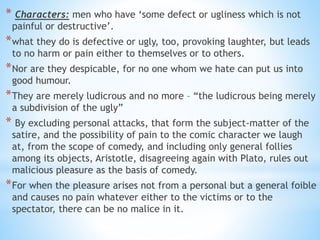
![* Comedy shares the generalising power of poetry.
* equally represents not what has happened but what may happen: what
is probable in the given set of circumstances.
*Characters and conditions – is likely to be what it states.
* borne out of general and not an individual foible for its object.
*The very name it gives to its characters [eg: Brain-worm, Backbite,
Morose] suggest a section of humanity rather than particular men.
*So they represent more or less universal rather than individual frailties:
not how so-and-so behaved but how all men of the same type will
behave in the same circumstances.](https://image.slidesharecdn.com/aristotle-201106101307/85/Aristotle-THE-GREEK-MASTER-32-320.jpg)
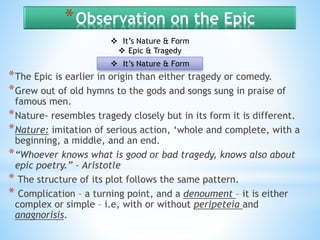
![*It has the same unity of action and produces the same kind of
pleasure, via: that arising from catharsis, since the epic also has
tragic happenings.
*Its characters are also of the nobler sort as those of tragedy.
*Four of its parts are also of the same: plot, character, thought, and
diction.
*The remaining two – song and spectacle – belong to tragedy [and so
to drama] only.
Form: The epic is different from tragedy.
imitates life by narration and not by dramatic action and speech
Admits of much greater length than tragedy.
No use for song and spectacle which form part of acting.
Communicates its meaning in mere reading or recitation.
Its length – it is not restricted like tragedy, where everything
happening everywhere cannot be shown for the simple reason that
the stage represents but one place and so but one set of
characters, I.e., those connected with at that place only.](https://image.slidesharecdn.com/aristotle-201106101307/85/Aristotle-THE-GREEK-MASTER-34-320.jpg)
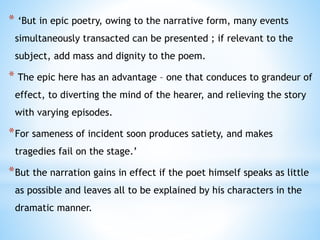
![*The Value of his Criticism
* Plato’s approach to literature – social reformer.
* Aristotle – scientist
* Plato – wanted literature to do the work of morality
* Aristotle – expects it to be no more than what it is – an art.
* Aristotle clearly sees the distinction between the two which Plato
had failed to see.
*“The standard of correctness is not the same in poetry and
politics, any more than in poetry and any other art”.
* Politics- Social Science – is to be judged by the contribution it makes
to social well-being, poetry (literature) is to be judged by its proper
function – pleasure.
* To do this it has to make an appeal to the emotions, which is
cathartic and not harmful in its effect. [as Plato believed]](https://image.slidesharecdn.com/aristotle-201106101307/85/Aristotle-THE-GREEK-MASTER-42-320.jpg)