T S ELIOT
SEMESTER 5
MODULE 4
EN1541 CORE COURSE
LITERARY CRITICISM
SREEKUMAR V. R.
ASSISTANT PROFESSOR
DEPARTMENT OF ENGLISH
NSS COLLEGE NILAMEL
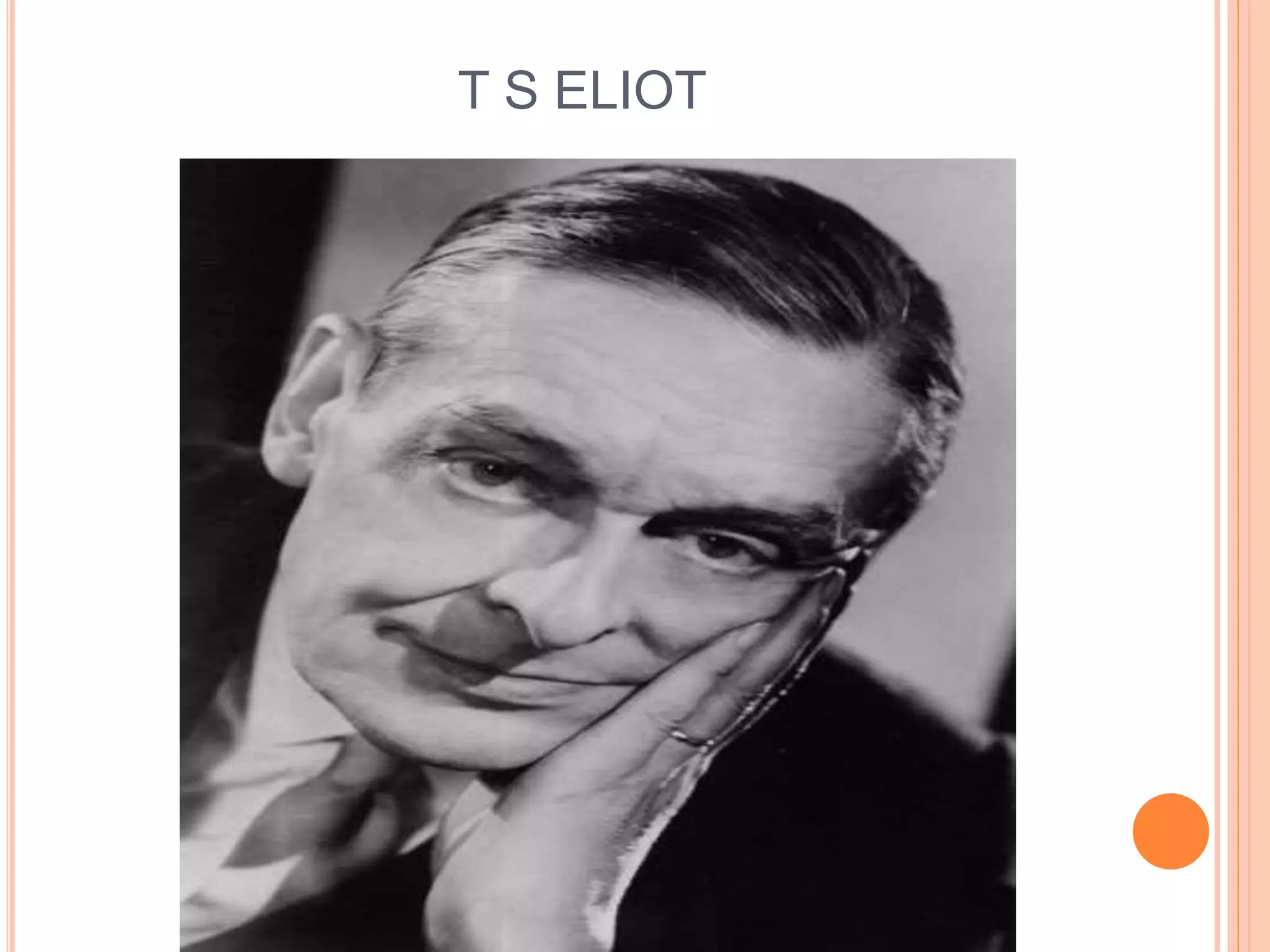
T S ELIOT
IMPORTANT LITERARY WORKS
POEMS
 The love Song of J. Alfred Prufrock
 The Wasteland
 Four Quartets
POETIC DRAMA
 Murder in the Cathedral
 The Cocktail Party
 Elder Statesman
 The Family Reunion
 The Confidential Clerk
CRITICAL WORKS
Eliot’s critical essays falls into 2 categories
 On the nature and function of criticism
 On authors and their works
Important essays
 Tradition and Individual Talent( unofficial critical
manifesto)
 Poetry and Drama
 Function of Criticism
 The English Metaphysical Poets
 The frontiers of Criticism
 Openly declared himself as a Classicist in literature,
Royalist in politics and Anglo-Catholic in religion
 Notions on religion, politics and literature
indistinguishable
 Lifelong commitment to criticism
 His critical works changed the course of English
literary history
 Criticism should be objective
 Critic has a role to review the past of literature and
set the poets and poems in order
THE METAPHYSICAL POETS
 Renewal of interest in Metaphysical poetry which was
neglected for a long time
 Argues metaphysical poetry to be the continuation of a
great tradition
 Contradicts Dr. Johnson’s assumptions-
“heterogeneous ideas yoked by violence together”
metaphysical poets failed to unite dissimilar
ideas into a single whole
too much analysis and dissection of particular
emotional situations
inventive use of conceits
“nature and art ransacked for illustrations”
METAPHYSICAL CONCEIT
 “ A comparison becomes a conceit when we are
made to concede likeness while being strongly
conscious of unlikeness”- Helen Gardner
 John Donne’s A Valediction Forbidding Mourning
a couple faced with absence from each other
is likened to a compass
o Donne’s The Flea
Flea’s blood sucking to convince a possible
lover to join him in physical sexual union
ELIOT’S DEFENSE OF METAPHYSICAL POETS
 Compelling heterogeneous ideas into unity by
operation of poet’s mind is universal in poetry
 Concept of Unification of Sensibility
 Great Elizabethans and early Jacobeans
possessed a developed unified sensibility
 Sensibility- a synthetic faculty which can
amalgamate thought and feeling
 Metaphysical poets possessed this faculty and
were able to fuse dissimilar ideas into a single
whole
DISSOCIATION OF SENSIBILITY
 Poets in the 18th and 19th centuries lacked
unification of sensibility
 Dissociation of sensibility set in
 18th century poets- intellectuals; they thought but
did not feel
 Romantic poets- felt but did not think
 Victorian poets- meditate poetically but cannot
express it
 20th century modern poets similar to metaphysical
poets; uses conceits; bound to be difficult
THEORY OF IMPERSONALITY
 Stated in Tradition and Individual Talent
 Rejected Romantic subjectivist theory of poetic
creation
 “spontaneous overflow of powerful feelings…”
Wordsworth
 Two aspects of Impersonal Theory
Matter of Tradition
Creative process
SENSE OF TRADITION
 Originality of a poet not in inventing anything new or
differing from his predecessors
 Great European tradition flowing from Homer,
Shakespeare and Dante to modern times
 Poet should permit this great tradition to assert
itself on his poem
 Poem should be a recreation and a development of
what his predecessors have created
 Negative impact
Distrusts novelty/originality
Discourages individual attempts
 Positive impact of Traditional sense
Poet should have a sense of the history of poetry
awareness of the presentness of the past
poet surrenders his personality to the superior
authority of Tradition
literature-not self expresion but self surrender
progress of an artist- a continued extinction of
personality
POETIC CREATION
 Poet’s mind- open to all sorts of sensations and
thoughts
 Receptacle of different feelings
 Combined and fused into a new whole by the
creative mind
 Refutes Wordsworth’s definition- “poetry is a
spontaneous overflow of powerful feelings…”
CATALYSIS
 Example to demonstrate the relationship between
process of depersonalisation and tradition
 Platinum as a catalyst for converting Sulphur and
CO2 into Sulphurous acid
 No change happens to the catalyst
 Mind of the poet- catalyst
 Emotions and feelings- Sulphur and CO2
 Artist’s mind keeps forming new compounds
 He remains separate in the whole process of
creation
 Personality of the poet has nothing to do with his
poetry
 Rejects Wordsworth’s theory of emotions
recollected in tranquility
 Poetry- not a turning loose of emotion; but an
escape from emotion
 Not an expression of personality; but an escape
from personality
OBJECTIVE CORRELATIVE
 From the essay Hamlet and his problems
 “the only way of expressing emotion in the form of
art”
 Objective correlative- “a set of objects, a situation,
a chain of events which shall be the formula of that
particular emotion”
 Emotional reaction doesn’t get stimulated from one
particular object/image/word
 It originates in the combination of these when they
appear together
 Objective correlative acts as a medium for the poet
to transmit his emotions to the reader in an
objective way
 Work of art as an artefact; an organic whole
 Successful instance of objective correlative: Sleep
Walking scene in Macbeth
 Hamlet; an artistic failure; lacks objective correlative
SLEEP WALKING SCENE IN MACBETH
PREFERENCE FOR SPOKEN LANGUAGE
 Poetry should approximate to the spoken language
during the poet’s lifetime
 Not in favour of colloquialisms
 Admires Dante’s language
 Advocates prosaic style in poetry
 Rejects poetic style in prose
DEFECTS AS A CRITIC
 Religious attitude in critical pronouncements
 Personal and religious prejudice
 Attack of Milton and Shelley exposes his lack of
objectivity
 Elements of didaticism
CONCLUSION
 Eliot’s critical tenets invaluable aids to
understanding and appreciation of poetry
 In objectivity and scientific attitude Eliot resembles
Aristotle
 New Criticism greatly indebted to T S Eliot
REFERENCES
 Nagarajan M S English Literary Criticism and
Theory, Hyderabad: Orient Blackswan,2006
THANK YOU

T S ELIOT AS A CRITIC

  • 1.
    T S ELIOT SEMESTER5 MODULE 4 EN1541 CORE COURSE LITERARY CRITICISM SREEKUMAR V. R. ASSISTANT PROFESSOR DEPARTMENT OF ENGLISH NSS COLLEGE NILAMEL
  • 2.
  • 3.
    IMPORTANT LITERARY WORKS POEMS The love Song of J. Alfred Prufrock  The Wasteland  Four Quartets POETIC DRAMA  Murder in the Cathedral  The Cocktail Party  Elder Statesman  The Family Reunion  The Confidential Clerk
  • 4.
    CRITICAL WORKS Eliot’s criticalessays falls into 2 categories  On the nature and function of criticism  On authors and their works Important essays  Tradition and Individual Talent( unofficial critical manifesto)  Poetry and Drama  Function of Criticism  The English Metaphysical Poets  The frontiers of Criticism
  • 5.
     Openly declaredhimself as a Classicist in literature, Royalist in politics and Anglo-Catholic in religion  Notions on religion, politics and literature indistinguishable  Lifelong commitment to criticism  His critical works changed the course of English literary history  Criticism should be objective  Critic has a role to review the past of literature and set the poets and poems in order
  • 6.
    THE METAPHYSICAL POETS Renewal of interest in Metaphysical poetry which was neglected for a long time  Argues metaphysical poetry to be the continuation of a great tradition  Contradicts Dr. Johnson’s assumptions- “heterogeneous ideas yoked by violence together” metaphysical poets failed to unite dissimilar ideas into a single whole too much analysis and dissection of particular emotional situations inventive use of conceits “nature and art ransacked for illustrations”
  • 7.
    METAPHYSICAL CONCEIT  “A comparison becomes a conceit when we are made to concede likeness while being strongly conscious of unlikeness”- Helen Gardner  John Donne’s A Valediction Forbidding Mourning a couple faced with absence from each other is likened to a compass o Donne’s The Flea Flea’s blood sucking to convince a possible lover to join him in physical sexual union
  • 8.
    ELIOT’S DEFENSE OFMETAPHYSICAL POETS  Compelling heterogeneous ideas into unity by operation of poet’s mind is universal in poetry  Concept of Unification of Sensibility  Great Elizabethans and early Jacobeans possessed a developed unified sensibility  Sensibility- a synthetic faculty which can amalgamate thought and feeling  Metaphysical poets possessed this faculty and were able to fuse dissimilar ideas into a single whole
  • 9.
    DISSOCIATION OF SENSIBILITY Poets in the 18th and 19th centuries lacked unification of sensibility  Dissociation of sensibility set in  18th century poets- intellectuals; they thought but did not feel  Romantic poets- felt but did not think  Victorian poets- meditate poetically but cannot express it  20th century modern poets similar to metaphysical poets; uses conceits; bound to be difficult
  • 10.
    THEORY OF IMPERSONALITY Stated in Tradition and Individual Talent  Rejected Romantic subjectivist theory of poetic creation  “spontaneous overflow of powerful feelings…” Wordsworth  Two aspects of Impersonal Theory Matter of Tradition Creative process
  • 11.
    SENSE OF TRADITION Originality of a poet not in inventing anything new or differing from his predecessors  Great European tradition flowing from Homer, Shakespeare and Dante to modern times  Poet should permit this great tradition to assert itself on his poem  Poem should be a recreation and a development of what his predecessors have created  Negative impact Distrusts novelty/originality Discourages individual attempts
  • 12.
     Positive impactof Traditional sense Poet should have a sense of the history of poetry awareness of the presentness of the past poet surrenders his personality to the superior authority of Tradition literature-not self expresion but self surrender progress of an artist- a continued extinction of personality
  • 13.
  • 14.
     Poet’s mind-open to all sorts of sensations and thoughts  Receptacle of different feelings  Combined and fused into a new whole by the creative mind  Refutes Wordsworth’s definition- “poetry is a spontaneous overflow of powerful feelings…”
  • 15.
    CATALYSIS  Example todemonstrate the relationship between process of depersonalisation and tradition  Platinum as a catalyst for converting Sulphur and CO2 into Sulphurous acid  No change happens to the catalyst  Mind of the poet- catalyst  Emotions and feelings- Sulphur and CO2  Artist’s mind keeps forming new compounds  He remains separate in the whole process of creation
  • 16.
     Personality ofthe poet has nothing to do with his poetry  Rejects Wordsworth’s theory of emotions recollected in tranquility  Poetry- not a turning loose of emotion; but an escape from emotion  Not an expression of personality; but an escape from personality
  • 17.
    OBJECTIVE CORRELATIVE  Fromthe essay Hamlet and his problems  “the only way of expressing emotion in the form of art”  Objective correlative- “a set of objects, a situation, a chain of events which shall be the formula of that particular emotion”  Emotional reaction doesn’t get stimulated from one particular object/image/word  It originates in the combination of these when they appear together
  • 18.
     Objective correlativeacts as a medium for the poet to transmit his emotions to the reader in an objective way  Work of art as an artefact; an organic whole  Successful instance of objective correlative: Sleep Walking scene in Macbeth  Hamlet; an artistic failure; lacks objective correlative
  • 19.
  • 20.
    PREFERENCE FOR SPOKENLANGUAGE  Poetry should approximate to the spoken language during the poet’s lifetime  Not in favour of colloquialisms  Admires Dante’s language  Advocates prosaic style in poetry  Rejects poetic style in prose
  • 21.
    DEFECTS AS ACRITIC  Religious attitude in critical pronouncements  Personal and religious prejudice  Attack of Milton and Shelley exposes his lack of objectivity  Elements of didaticism
  • 22.
    CONCLUSION  Eliot’s criticaltenets invaluable aids to understanding and appreciation of poetry  In objectivity and scientific attitude Eliot resembles Aristotle  New Criticism greatly indebted to T S Eliot
  • 23.
    REFERENCES  Nagarajan MS English Literary Criticism and Theory, Hyderabad: Orient Blackswan,2006
  • 24.