

ARISTOTLE’S “POETICS”
Background: Born in 384 BC, died 322 BC. Born in
Staqira, Greece, not Athens. Aristotle entered the
Academy but left when Plato died. Served as a tutor to
Alexander. Aristotle’s school in Athens, the Lyceaum, was
founded in 335 BC. Responsible for the first systematic
work of literary criticism.
1. Tragedy: imitation of event
that is
• a. serious
• b. complete
• c. has magnitude
• d. embellished language
• e. uses “pity & fear,” catharsis
2. Constituent parts of Tragedy
• a. Spectacle
• b. Melody
• c. Character
• d. Imitation of Action = Plot
• e. Language
• f. Thought
Aristotle categorizes these into:
• Media
• Manner
• Objects
1. Media– a. Language
– b. Melody
2. Manner
a. Spectacle
3. Objects
a. plot
b. character
c. thought
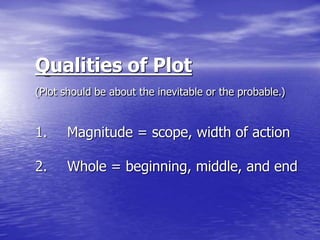
Qualities of Plot
(Plot should be about the inevitable or the probable.)
1. Magnitude = scope, width of action
2. Whole = beginning, middle, and end
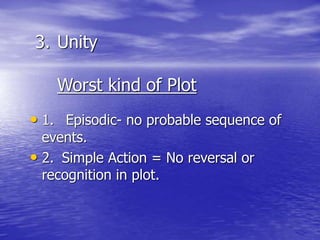
3. Unity
Worst kind of Plot
• 1. Episodic- no probable sequence of
events.
• 2. Simple Action = No reversal or
recognition in plot.
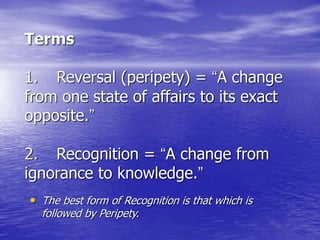
Terms
1. Reversal (peripety) = “A change
from one state of affairs to its exact
opposite.”
2. Recognition = “A change from
ignorance to knowledge.”
• The best form of Recognition is that which is
followed by Peripety.
Characteristics of Good
Tragedy
1. Complex
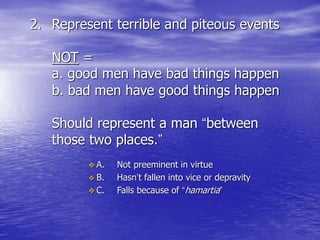
2. Represent terrible and piteous events
NOT =
a. good men have bad things happen
b. bad men have good things happen
Should represent a man “between
those two places.”
 A. Not preeminent in virtue
 B. Hasn’t fallen into vice or depravity
 C. Falls because of “hamartia”
1. Ending should be realistic
and avoid “deus ex machina.”
2. Chorus should be actors
and part of the whole.
Important Terms
Mimesis - Mimesis is the act of creating in
someone's mind, through artistic representation, an idea
or ideas that the person will associate with past
experience.
Roughly translatable as "imitation," mimesis in poetry is
the act of telling stories that are set in the real world.
The events in the story need not have taken place, but
the telling of the story will help the listener or viewer to
imagine the events taking place in the real world.
Hamartia - This word translates almost directly
as "error," though it is often rendered more
elaborately as "tragic flaw." Tragedy, according to
Aristotle, involves the downfall of a hero, and this
downfall is effected by some error on the part of
the hero. This error need not be an overarching
moral failing: it could be a simple matter of not
knowing something or forgetting something.
Anagnorisis - This word translates as
"recognition" or "discovery." In tragedy, it
describes the moment where the hero, or some
other character, passes from ignorance to
knowledge. This could be a recognition of a long
lost friend or family member, or it could be a
sudden recognition of some fact about oneself,
as is the case with Oedipus. Anagnorisis often
occurs at the climax of a tragedy in tandem with
peripeteia.
Mythos - When dealing with tragedy, this word
is usually translated as "plot," but unlike "plot,"
mythos can be applied to all works of art. Not so
much a matter of what happens and in what
order, mythos deals with how the elements of a
tragedy (or a painting, sculpture, etc.) come
together to form a coherent and unified whole.
The overall message or impression that we come
away with is what is conveyed to us by the
mythos of a piece.
Katharsis - This word was normally used in
ancient Greece by doctors to mean "purgation"
or by priests to mean "purification." In the
context of tragedy, Aristotle uses it to talk about
a purgation or purification of emotions.
Presumably, this means that katharsis is a
release of built up emotional energy, much like a
good cry. After katharsis, we reach a more stable
and neutral emotional state.
Peripeteia - A reversal, either from good
to bad or bad to good. Peripeteia often
occurs at the climax of a story, often
prompted by anagnorisis. Indeed, we
might say that the peripeteia is the climax
of a story: it is the turning point in the
action, where things begin to move toward
a conclusion.
Lusis - Literally "untying," the lusis is all
the action in a tragedy from the climax
onward. All the plot threads that have
been woven together in the desis are
slowly unraveled until we reach the
conclusion of the play.
Desis - Literally "tying," the desis is all the
action in a tragedy leading up to the climax.
Plot threads are craftily woven together to
form a more and more complex mess. At the
peripeteia, or turning point, these plot
threads begin to unravel in what is called the
lusis, or denouement.

Aristotle's "The Poetics"

  • 1.
  • 2.
    Background: Born in384 BC, died 322 BC. Born in Staqira, Greece, not Athens. Aristotle entered the Academy but left when Plato died. Served as a tutor to Alexander. Aristotle’s school in Athens, the Lyceaum, was founded in 335 BC. Responsible for the first systematic work of literary criticism.
  • 3.
    1. Tragedy: imitationof event that is • a. serious • b. complete • c. has magnitude • d. embellished language • e. uses “pity & fear,” catharsis
  • 4.
    2. Constituent partsof Tragedy • a. Spectacle • b. Melody • c. Character • d. Imitation of Action = Plot • e. Language • f. Thought
  • 5.
    Aristotle categorizes theseinto: • Media • Manner • Objects
  • 6.
    1. Media– a.Language – b. Melody
  • 7.
  • 8.
    3. Objects a. plot b.character c. thought
  • 9.
    Qualities of Plot (Plotshould be about the inevitable or the probable.) 1. Magnitude = scope, width of action 2. Whole = beginning, middle, and end
  • 10.
    3. Unity Worst kindof Plot • 1. Episodic- no probable sequence of events. • 2. Simple Action = No reversal or recognition in plot.
  • 11.
    Terms 1. Reversal (peripety)= “A change from one state of affairs to its exact opposite.” 2. Recognition = “A change from ignorance to knowledge.” • The best form of Recognition is that which is followed by Peripety.
  • 12.
  • 13.
  • 14.
    2. Represent terribleand piteous events NOT = a. good men have bad things happen b. bad men have good things happen Should represent a man “between those two places.”  A. Not preeminent in virtue  B. Hasn’t fallen into vice or depravity  C. Falls because of “hamartia”
  • 15.
    1. Ending shouldbe realistic and avoid “deus ex machina.”
  • 16.
    2. Chorus shouldbe actors and part of the whole.
  • 17.
  • 18.
    Mimesis - Mimesisis the act of creating in someone's mind, through artistic representation, an idea or ideas that the person will associate with past experience. Roughly translatable as "imitation," mimesis in poetry is the act of telling stories that are set in the real world. The events in the story need not have taken place, but the telling of the story will help the listener or viewer to imagine the events taking place in the real world.
  • 19.
    Hamartia - Thisword translates almost directly as "error," though it is often rendered more elaborately as "tragic flaw." Tragedy, according to Aristotle, involves the downfall of a hero, and this downfall is effected by some error on the part of the hero. This error need not be an overarching moral failing: it could be a simple matter of not knowing something or forgetting something.
  • 20.
    Anagnorisis - Thisword translates as "recognition" or "discovery." In tragedy, it describes the moment where the hero, or some other character, passes from ignorance to knowledge. This could be a recognition of a long lost friend or family member, or it could be a sudden recognition of some fact about oneself, as is the case with Oedipus. Anagnorisis often occurs at the climax of a tragedy in tandem with peripeteia.
  • 21.
    Mythos - Whendealing with tragedy, this word is usually translated as "plot," but unlike "plot," mythos can be applied to all works of art. Not so much a matter of what happens and in what order, mythos deals with how the elements of a tragedy (or a painting, sculpture, etc.) come together to form a coherent and unified whole. The overall message or impression that we come away with is what is conveyed to us by the mythos of a piece.
  • 22.
    Katharsis - Thisword was normally used in ancient Greece by doctors to mean "purgation" or by priests to mean "purification." In the context of tragedy, Aristotle uses it to talk about a purgation or purification of emotions. Presumably, this means that katharsis is a release of built up emotional energy, much like a good cry. After katharsis, we reach a more stable and neutral emotional state.
  • 23.
    Peripeteia - Areversal, either from good to bad or bad to good. Peripeteia often occurs at the climax of a story, often prompted by anagnorisis. Indeed, we might say that the peripeteia is the climax of a story: it is the turning point in the action, where things begin to move toward a conclusion.
  • 24.
    Lusis - Literally"untying," the lusis is all the action in a tragedy from the climax onward. All the plot threads that have been woven together in the desis are slowly unraveled until we reach the conclusion of the play.
  • 25.
    Desis - Literally"tying," the desis is all the action in a tragedy leading up to the climax. Plot threads are craftily woven together to form a more and more complex mess. At the peripeteia, or turning point, these plot threads begin to unravel in what is called the lusis, or denouement.