Archives,
DACS
and
EAD

    A
Basic
Primer

Archives

•  To
understand
archival

   repositories,
holdings
and

   descrip<ve
cataloging,
one
must

   first
understand
what
archives
are

   and
how
they
differ
from
libraries.

Archives
can
be
defined
in
3
ways:


1.

MATERIALS:

Noncurrent
records
of
an

  ins<tu<on/organiza<on
preserved
because
of

  their
enduring
value.

2.
PLACE:
The
repository.

The
building
where

  archived
materials
are
located.

3.
AGENCY:
The
archival
agency/ins<tu<on/
  program
responsible
for
handling
the
archives.


The
Archival
Mission

•  To
iden:fy
records
and
papers
of

   ENDURING
VALUE

•  To
preserve
them

•  To
make
them
accessible
to

   patrons

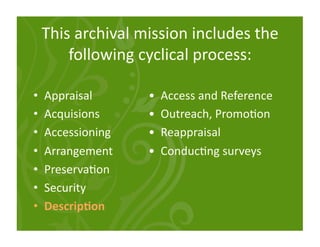
This
archival
mission
includes
the

         following
cyclical
process:


•    Appraisal      
   
•

Access
and
Reference

•    Acquisions     
   
•

Outreach,
Promo<on

•    Accessioning   
   
•

Reappraisal

•    Arrangement    
   
•

Conduc<ng
surveys

•    Preserva<on

•    Security

•    Descrip:on

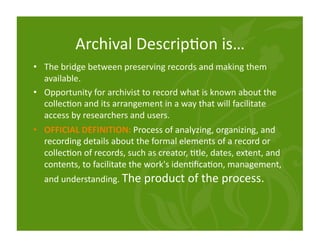
Archival
Descrip<on
is…

•  The
bridge
between
preserving
records
and
making
them

   available.

•  Opportunity
for
archivist
to
record
what
is
known
about
the

   collec<on
and
its
arrangement
in
a
way
that
will
facilitate

   access
by
researchers
and
users.

•  OFFICIAL
DEFINITION:
Process
of
analyzing,
organizing,
and

   recording
details
about
the
formal
elements
of
a
record
or

   collec<on
of
records,
such
as
creator,
<tle,
dates,
extent,
and

   contents,
to
facilitate
the
work's
iden<fica<on,
management,

  and
understanding.
The
product
of
the
process.

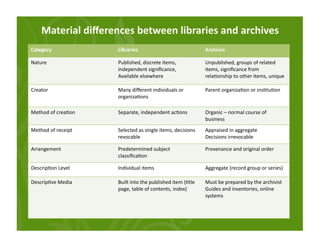
Material
differences
between
libraries
and
archives

Category
            Libraries
                             Archives


Nature
              Published,
discrete
items,
            Unpublished,
groups
of
related

                     independent
significance,
              items,
significance
from

                     Available
elsewhere
                   rela<onship
to
other
items,
unique


Creator
             Many
different
individuals
or
          Parent
organiza<on
or
ins<tu<on

                     organiza<ons


Method
of
crea<on
   Separate,
independent
ac<ons
          Organic
–
normal
course
of

                                                            business

Method
of
receipt
   Selected
as
single
items,
decisions
   Appraised
in
aggregate

                     revocable
                             Decisions
irrevocable


Arrangement
         Predetermined
subject
                 Provenance
and
original
order

                     classifica<on


Descrip<on
Level
    Individual
items
                      Aggregate
(record
group
or
series)


Descrip<ve
Media
    Built
into
the
published
item
(<tle
   Must
be
prepared
by
the
archivist

                     page,
table
of
contents,
index)
       Guides
and
inventories,
online

                                                            systems

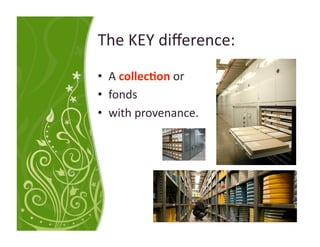
The
KEY
difference:

•  A
collec:on
or

•  fonds


•  with
provenance.

Archives,
DACS
and
EAD

    A
Basic
Primer

Archives,
DACS
and
EAD

    A
Basic
Primer

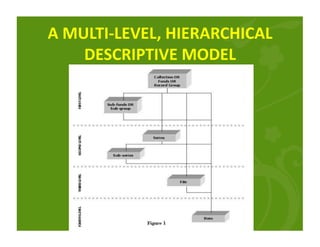
A
MULTI‐LEVEL,
HIERARCHICAL

    DESCRIPTIVE
MODEL

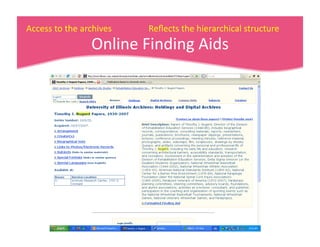
Online
Finding
Aids,


DACS
and
EAD

Access
to
the
archives


Reflects
the
hierarchical
structure

                  Online
Finding
Aids

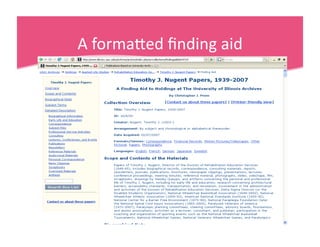
A
forma`ed
finding
aid

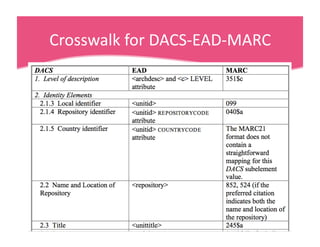
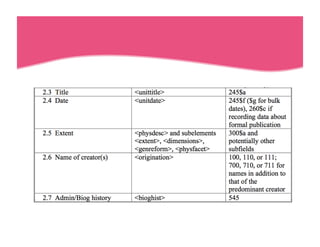
Crosswalk
for
DACS‐EAD‐MARC

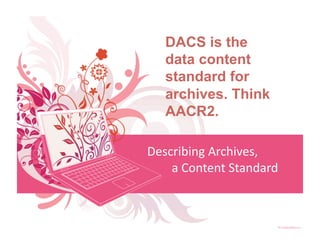
DACS is the
   data content
   standard for
   archives. Think
   AACR2.

Describing
Archives,


a
Content
Standard

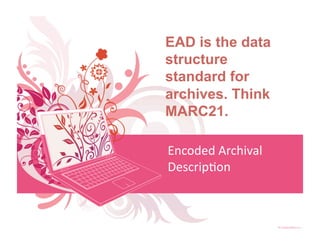
EAD is the data
structure
standard for
archives. Think
MARC21.

Encoded
Archival

Descrip<on

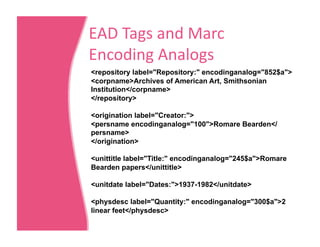
EAD
Tags
and
Marc

Encoding
Analogs

<repository label="Repository:" encodinganalog="852$a">
<corpname>Archives of American Art, Smithsonian
Institution</corpname>
</repository>

<origination label="Creator:">
<persname encodinganalog="100">Romare Bearden</
persname>
</origination>

<unittitle label="Title:" encodinganalog="245$a">Romare
Bearden papers</unittitle>

<unitdate label="Dates:">1937-1982</unitdate>

<physdesc label="Quantity:" encodinganalog="300$a">2
linear feet</physdesc>
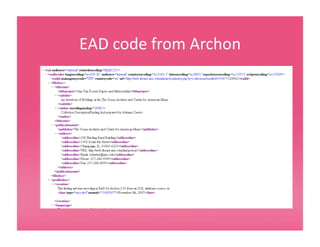
EAD
code
from
Archon

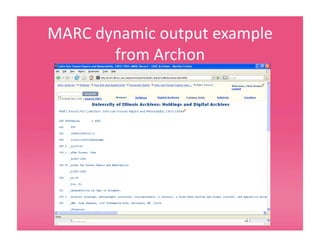
MARC
dynamic
output
example

       from
Archon

DACS
and
its
antecedents

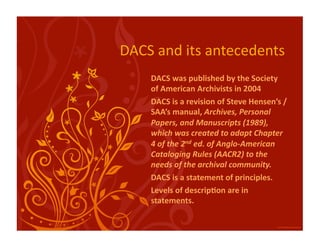
    DACS
was
published
by
the
Society

    of
American
Archivists
in
2004

    DACS
is
a
revision
of
Steve
Hensen’s
/

    SAA’s
manual,
Archives,
Personal

    Papers,
and
Manuscripts
(1989),

    which
was
created
to
adapt
Chapter

    4
of
the
2nd
ed.
of
Anglo‐American

    Cataloging
Rules
(AACR2)
to
the

    needs
of
the
archival
community.

    DACS
is
a
statement
of
principles.

    Levels
of
descrip:on
are
in

    statements.

Minimum
DACS

Requirements

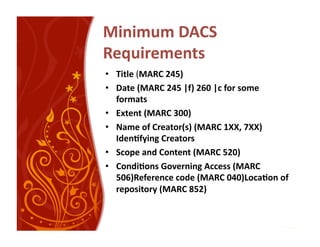
•  Title
(MARC
245)

•  Date
(MARC
245
|f)
260
|c
for
some

   formats

•  Extent
(MARC
300)

•  Name
of
Creator(s)
(MARC
1XX,
7XX)


   Iden:fying
Creators

•  Scope
and
Content
(MARC
520)

•  Condi:ons
Governing
Access
(MARC

   506)Reference
code
(MARC
040)Loca:on
of

   repository
(MARC
852)

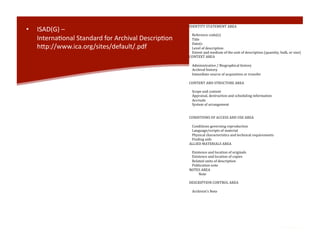
•    ISAD(G)
–


     Interna<onal
Standard
for
Archival
Descrip<on


     h`p://www.ica.org/sites/default/.pdf


DACS
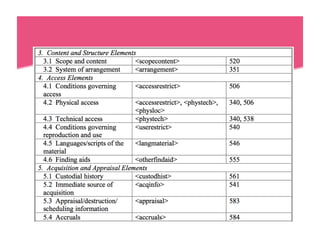
Elements

 •    IDENTITY
ELEMENTS
(chapter
2)

 •    Reference
code

 •    Name
and
Loca<on
of
Repository

 •    Title

 •    Date

 •    Extent

 •    Name
of
Creators

 •    Administra<ve
/
Biographical
history


 •    CONTENT
AND
STRUCTURE
ELEMENTS
(chapter
3)

 •    Scope
and
content

 •    System
of
arrangement


 •    CONDITIONS
OF
ACCESS
AND
USE
ELEMENTS
(chapter
4)

 •    Condi<ons
governing
access

 •    Physical
access

 •    Technical
Access

 •    Condi<ons
Governing
Reproduc<on
and
Use

 •    Languages
and
Scripts
of
the
Material

 •    Finding
Aids

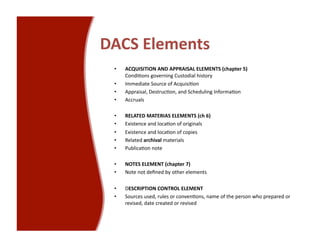
DACS
Elements

 •    ACQUISITION
AND
APPRAISAL
ELEMENTS
(chapter
5)


      Condi<ons
governing
Custodial
history

 •    Immediate
Source
of
Acquisi<on

 •    Appraisal,
Destruc<on,
and
Scheduling
Informa<on

 •    Accruals


 •    RELATED
MATERIAS
ELEMENTS
(ch
6)

 •    Existence
and
loca<on
of
originals

 •    Existence
and
loca<on
of
copies

 •    Related
archival
materials

 •    Publica<on
note


 •    NOTES
ELEMENT
(chapter
7)

 •    Note
not
defined
by
other
elements


 •    DESCRIPTION
CONTROL
ELEMENT

 •    Sources
used,
rules
or
conven<ons,
name
of
the
person
who
prepared
or

      revised,
date
created
or
revised

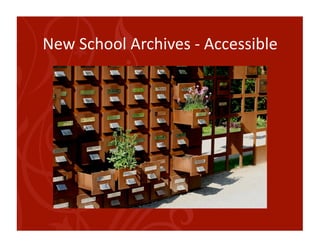
New
School
Archives
‐
Accessible


Archives - DACS and EAD