1© 2010 Pearson Education, Inc. All rights reserved
QUADRATIC FUNCTION
A function of the form
where a, b, and c, are real numbers with a ≠ 0,
is called a quadratic function.
f x( ) = ax2
+ bx + c,
2© 2010 Pearson Education, Inc. All rights reserved
THE STANDARD FORM OF
A QUADRATIC FUNCTION
The quadratic function
is in standard form. The graph of f is a
parabola with vertex (h, k). The parabola is
symmetric with respect to the line x = h, called
the axis of symmetry of the parabola. If a > 0,
the parabola opens up and k is the minimum
value of f, and if a < 0, the parabola opens down
and k is the maximum value of f.
f x( ) = a x − h( )2
+ k, a ≠ 0
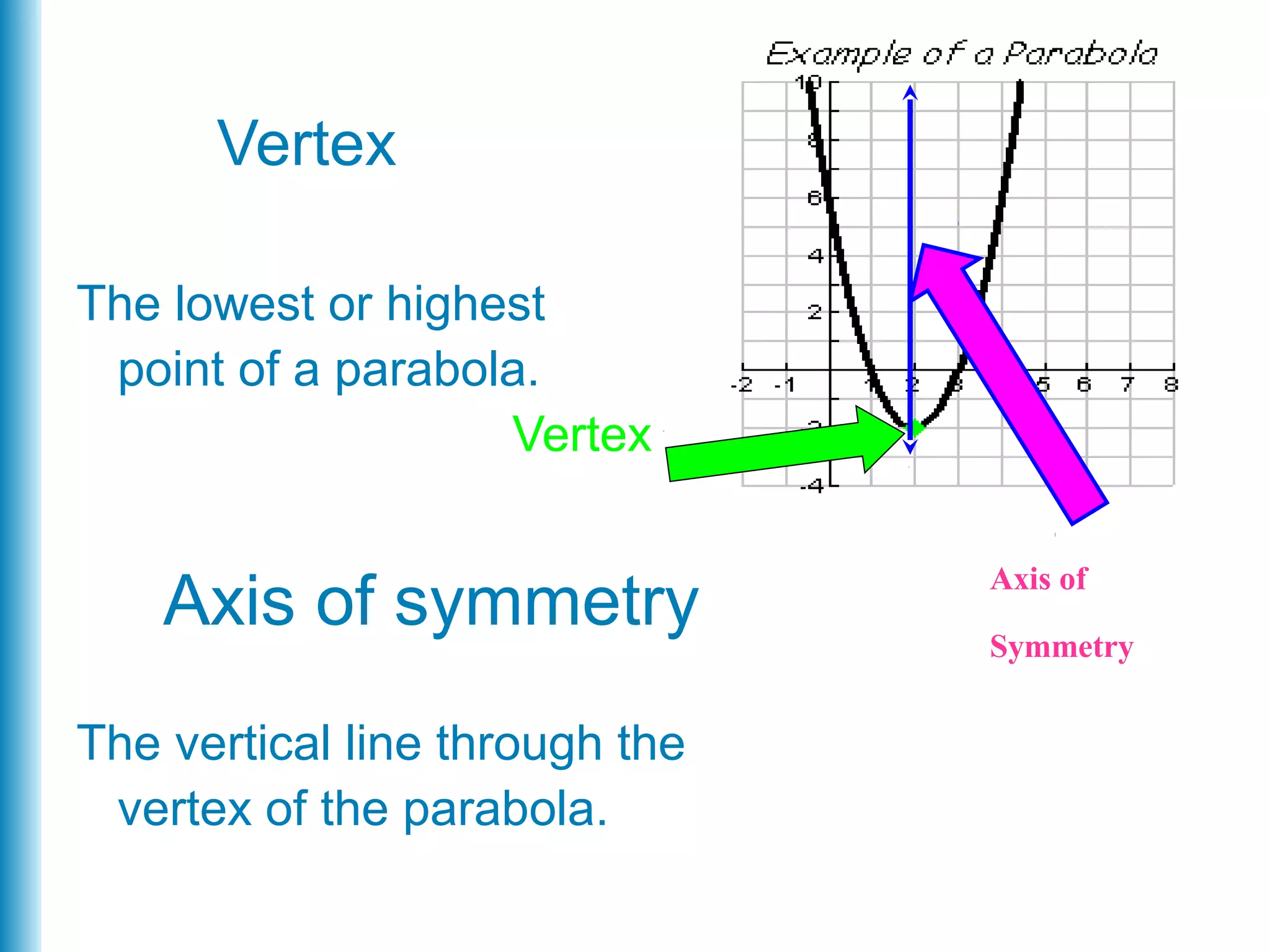
Vertex
The lowest or highest
point of a parabola.
Vertex
Axis of symmetry
The vertical line through the
vertex of the parabola.
Axis of
Symmetry
4© 2010 Pearson Education, Inc. All rights reserved
EXAMPLE 1 Finding a Quadratic Function
Find the standard form of the quadratic
function whose graph has vertex (–3, 4) and
passes through the point (–4, 7).
5© 2010 Pearson Education, Inc. All rights reserved
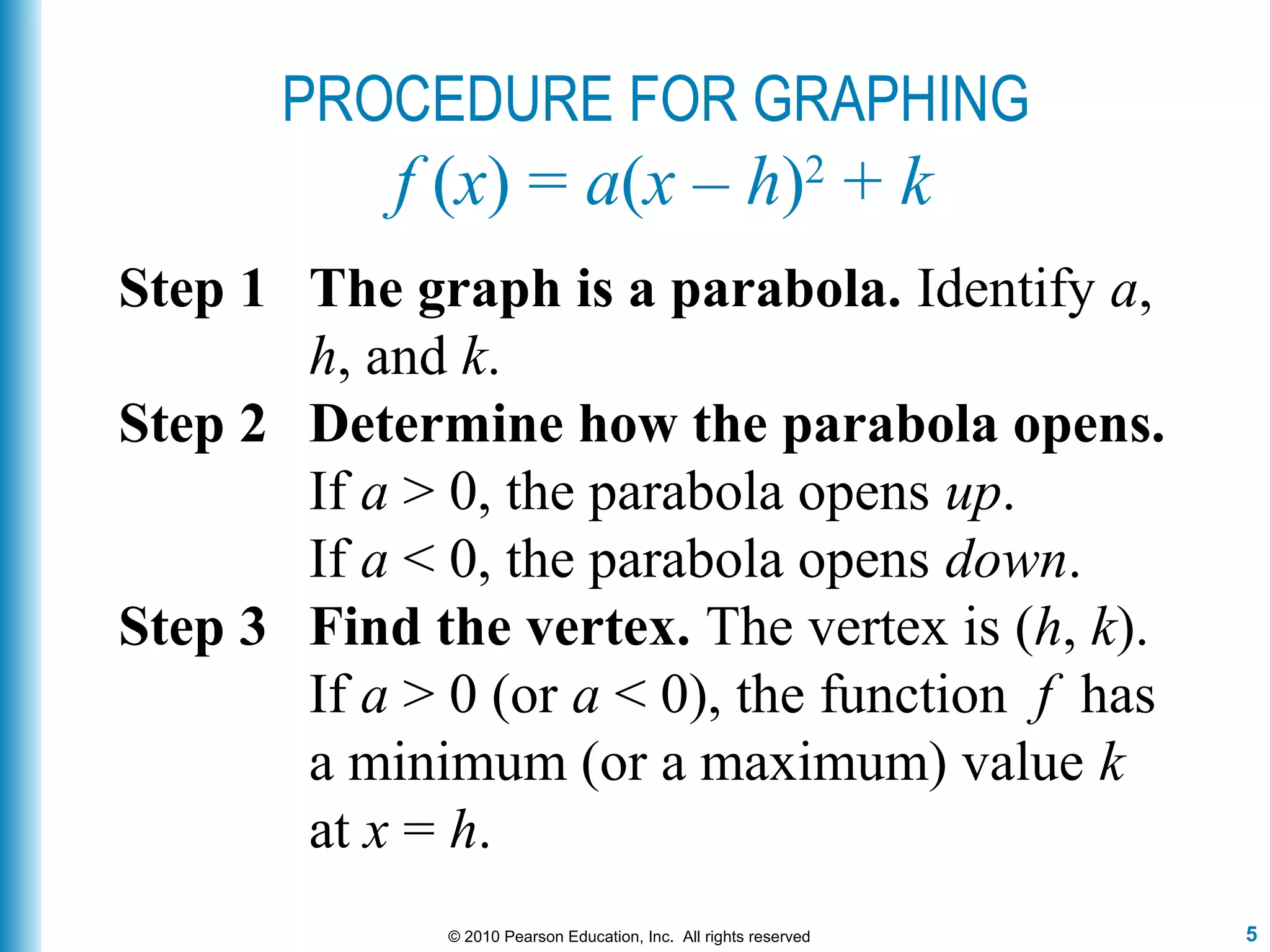
PROCEDURE FOR GRAPHING
f (x) = a(x – h)2
+ k
Step 1 The graph is a parabola. Identify a,
h, and k.
Step 2 Determine how the parabola opens.
If a > 0, the parabola opens up.
If a < 0, the parabola opens down.
Step 3 Find the vertex. The vertex is (h, k).
If a > 0 (or a < 0), the function f has
a minimum (or a maximum) value k
at x = h.
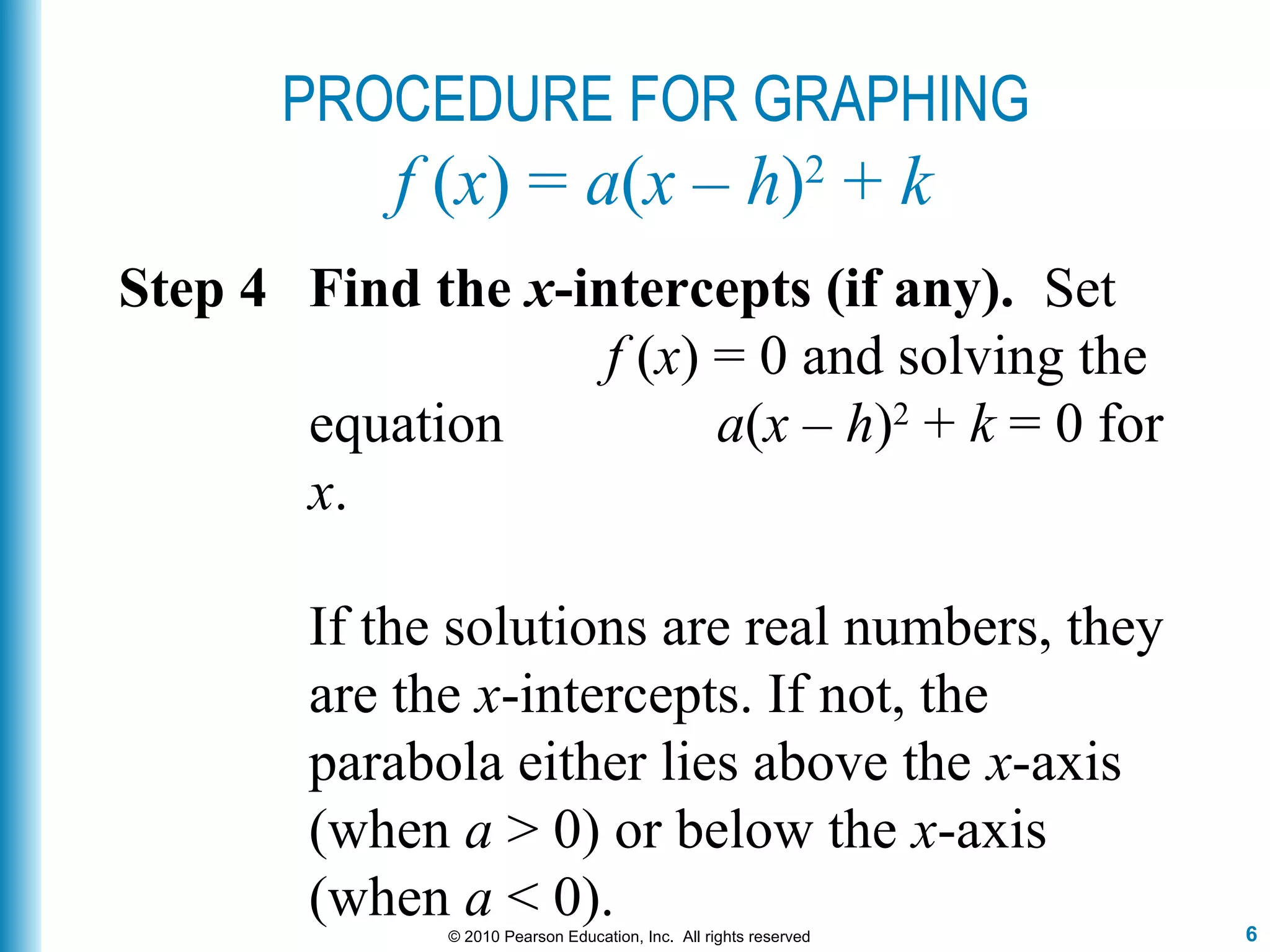
6© 2010 Pearson Education, Inc. All rights reserved
PROCEDURE FOR GRAPHING
f (x) = a(x – h)2
+ k
Step 4 Find the x-intercepts (if any). Set
f (x) = 0 and solving the
equation a(x – h)2
+ k = 0 for
x.
If the solutions are real numbers, they
are the x-intercepts. If not, the
parabola either lies above the x-axis
(when a > 0) or below the x-axis
(when a < 0).
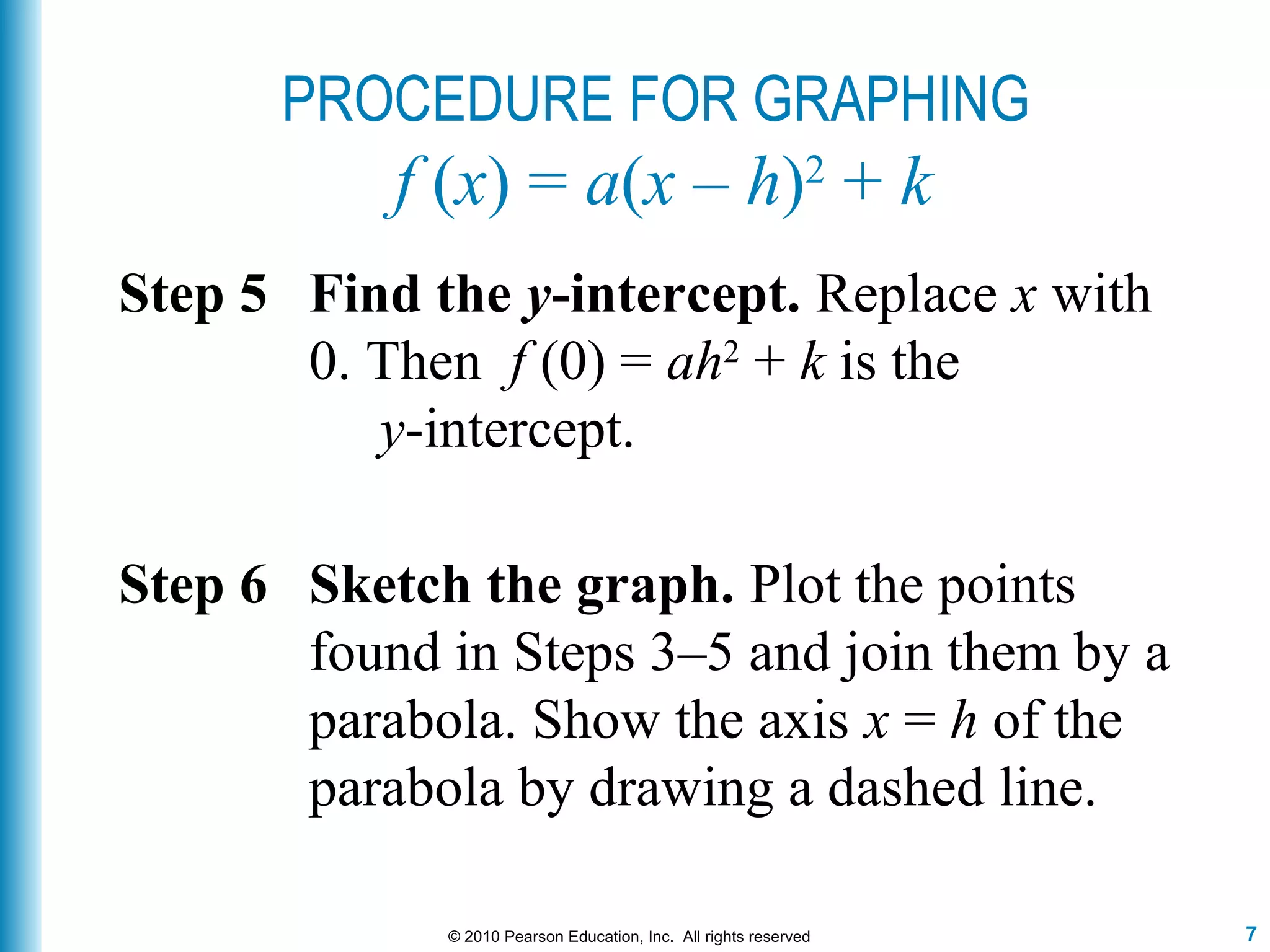
7© 2010 Pearson Education, Inc. All rights reserved
PROCEDURE FOR GRAPHING
f (x) = a(x – h)2
+ k
Step 6 Sketch the graph. Plot the points
found in Steps 3–5 and join them by a
parabola. Show the axis x = h of the
parabola by drawing a dashed line.
Step 5 Find the y-intercept. Replace x with
0. Then f (0) = ah2
+ k is the
y-intercept.
8© 2010 Pearson Education, Inc. All rights reserved
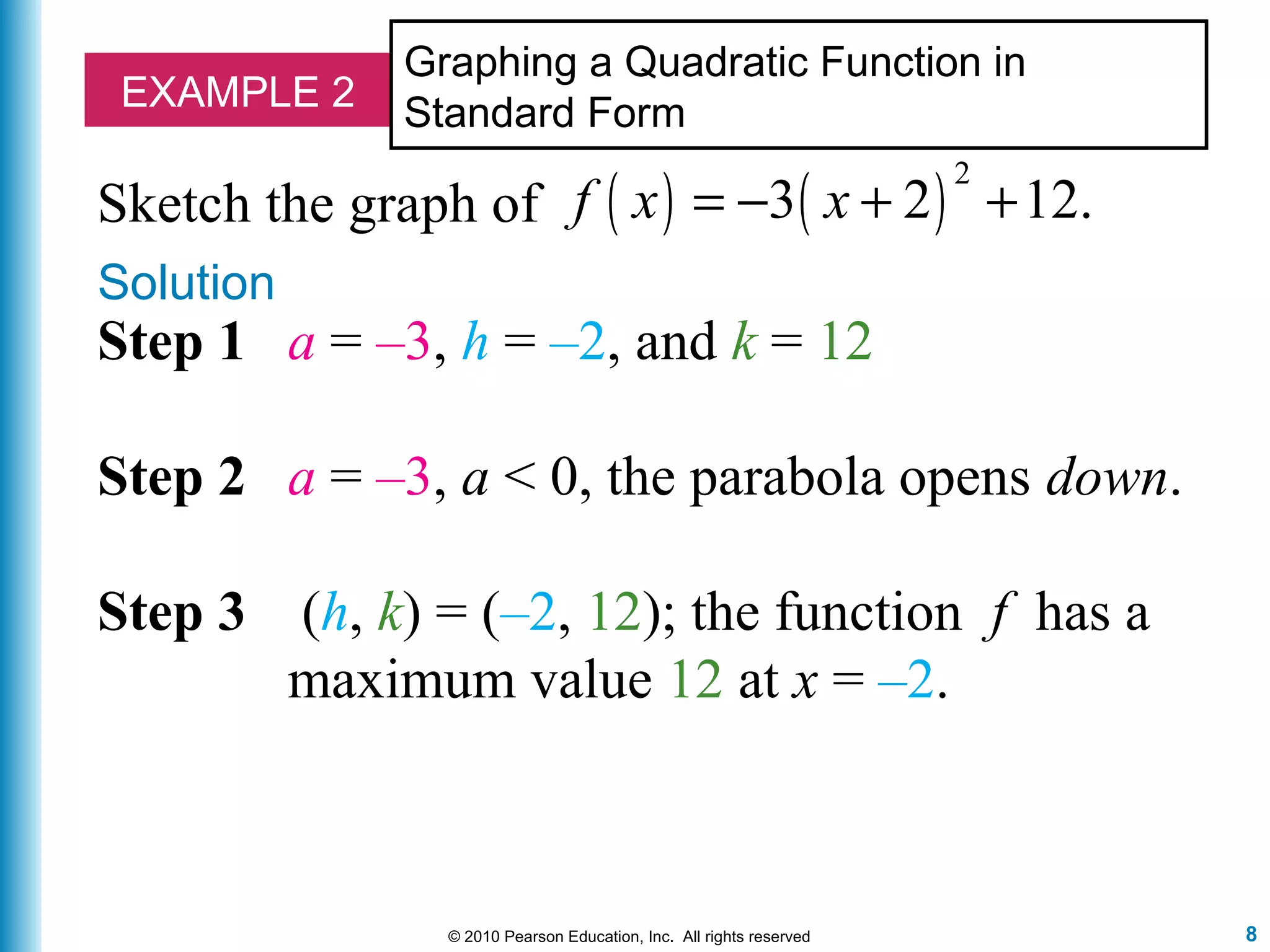
EXAMPLE 2
Graphing a Quadratic Function in
Standard Form
Sketch the graph of ( ) ( )
2
3 2 12.f x x= − + +
Solution
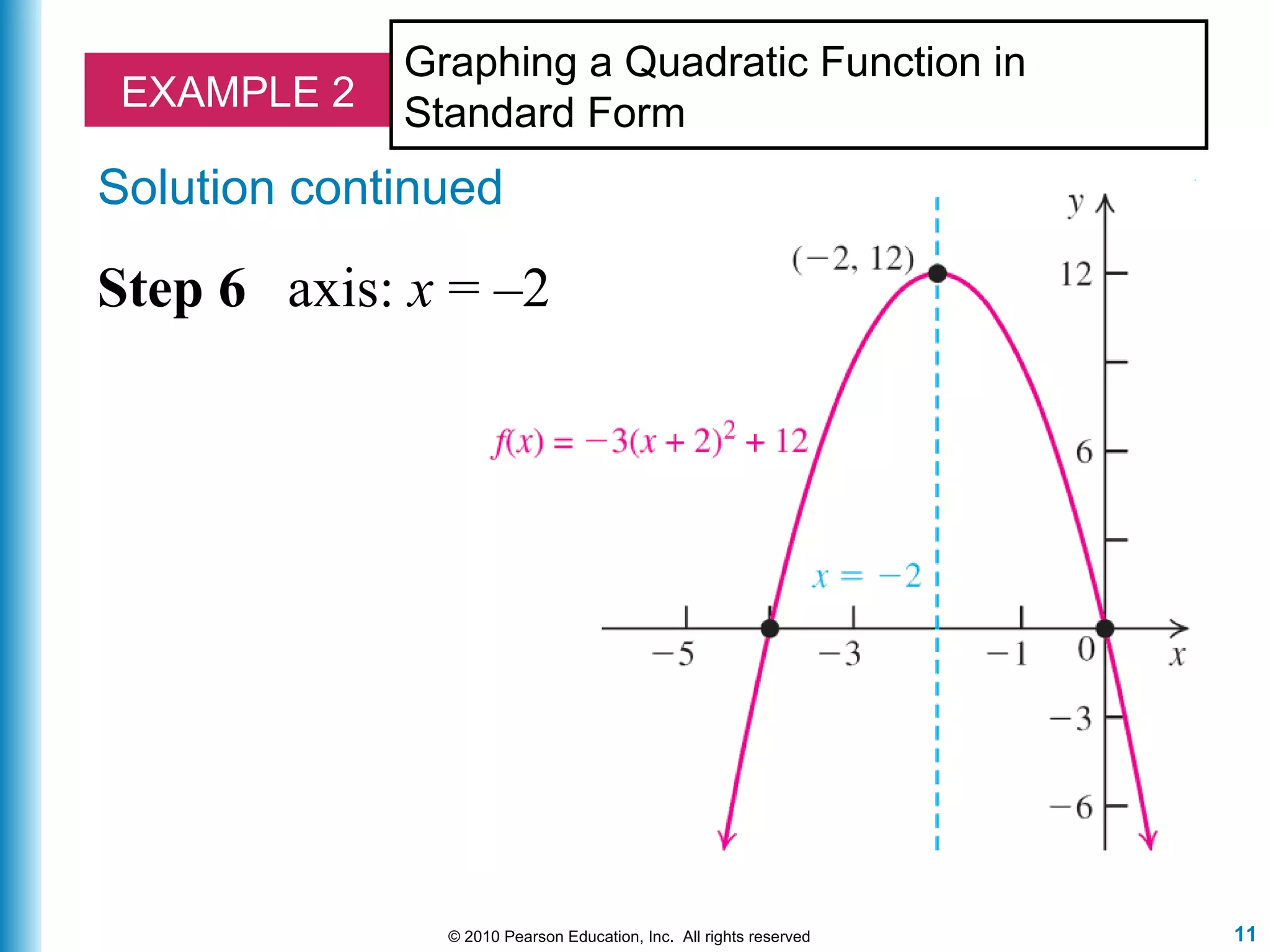
Step 1 a = –3, h = –2, and k = 12
Step 2 a = –3, a < 0, the parabola opens down.
Step 3 (h, k) = (–2, 12); the function f has a
maximum value 12 at x = –2.
9© 2010 Pearson Education, Inc. All rights reserved
EXAMPLE 2
Graphing a Quadratic Function in
Standard Form
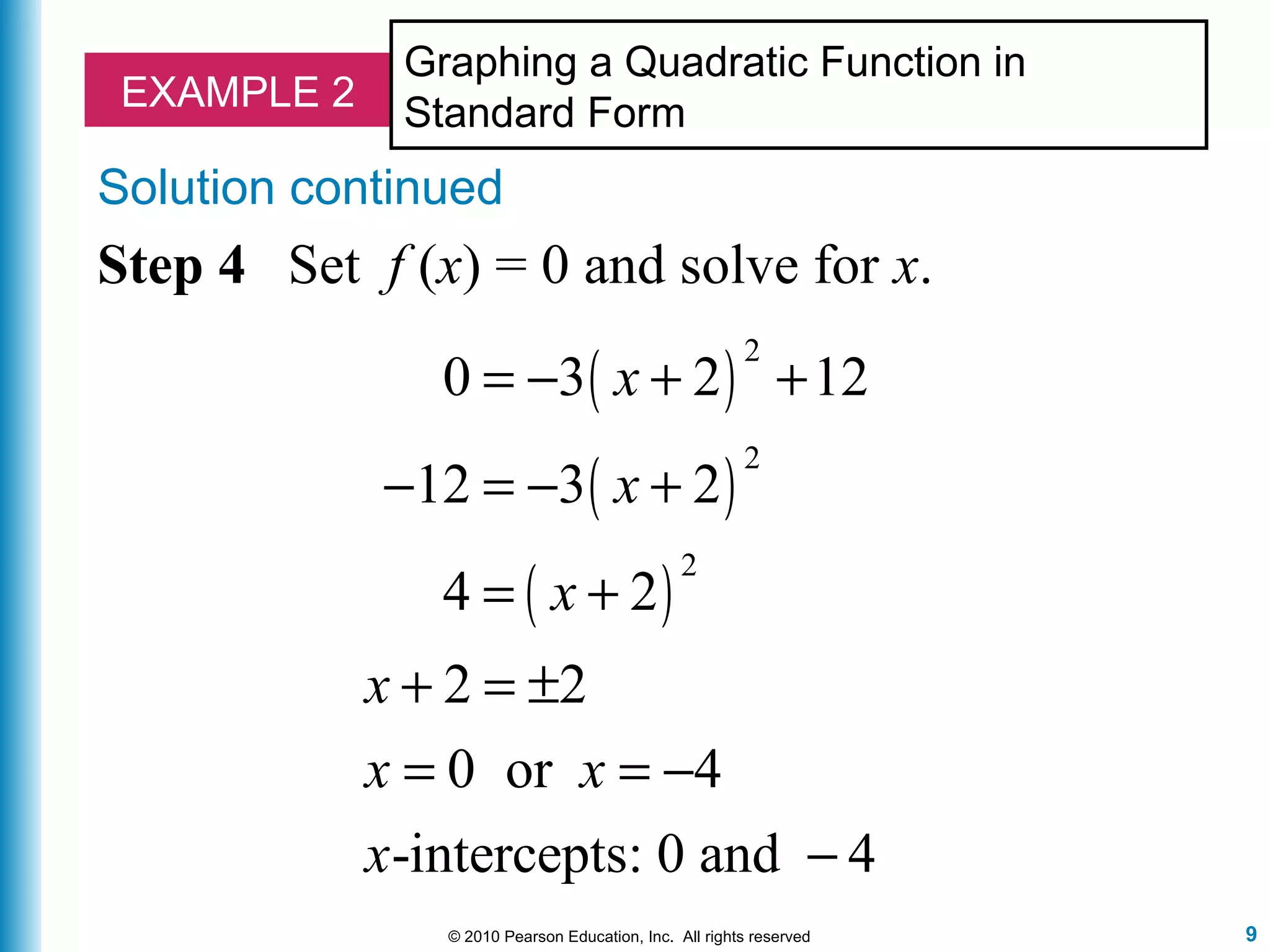
Step 4 Set f (x) = 0 and solve for x.
( )
( )
( )
2
2
2
0 3 2 12
12 3 2
4 2
x
x
x
= − + +
− = − +
= +
2 2
0 or 4
-intercepts: 0 and 4
x
x x
x
+ = ±
= = −
−
Solution continued
10© 2010 Pearson Education, Inc. All rights reserved
EXAMPLE 2
Graphing a Quadratic Function in
Standard Form
Solution continued
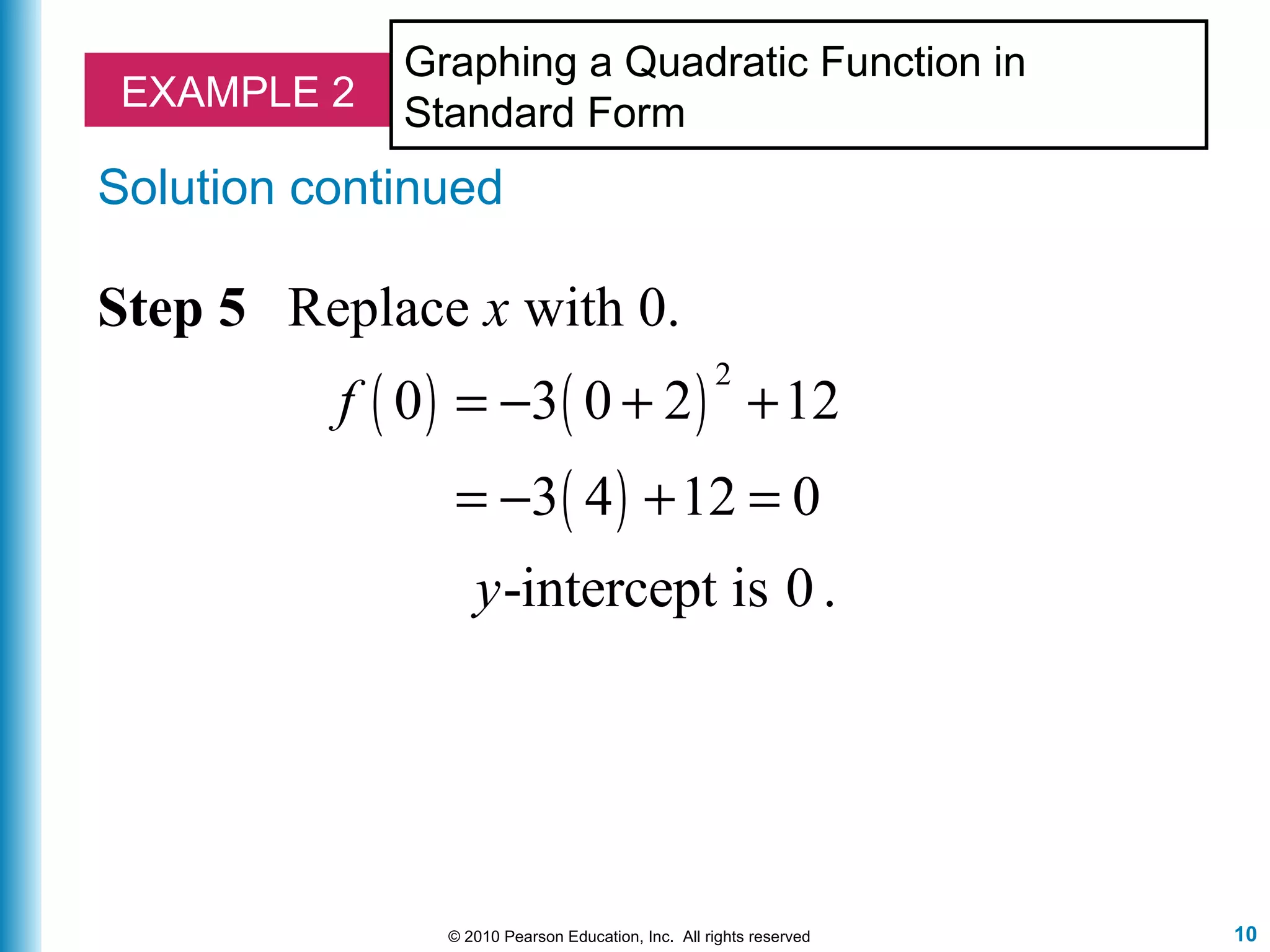
Step 5 Replace x with 0.
( ) ( )
( )
2
0 3 0 2 12
3 4 12 0
-intercept is 0 .
f
y
= − + +
= − + =
11© 2010 Pearson Education, Inc. All rights reserved
EXAMPLE 2
Graphing a Quadratic Function in
Standard Form
Solution continued
Step 6 axis: x = –2
12© 2010 Pearson Education, Inc. All rights reserved
PROCEDURE FOR GRAPHING
f (x) = ax2
+ bx + c
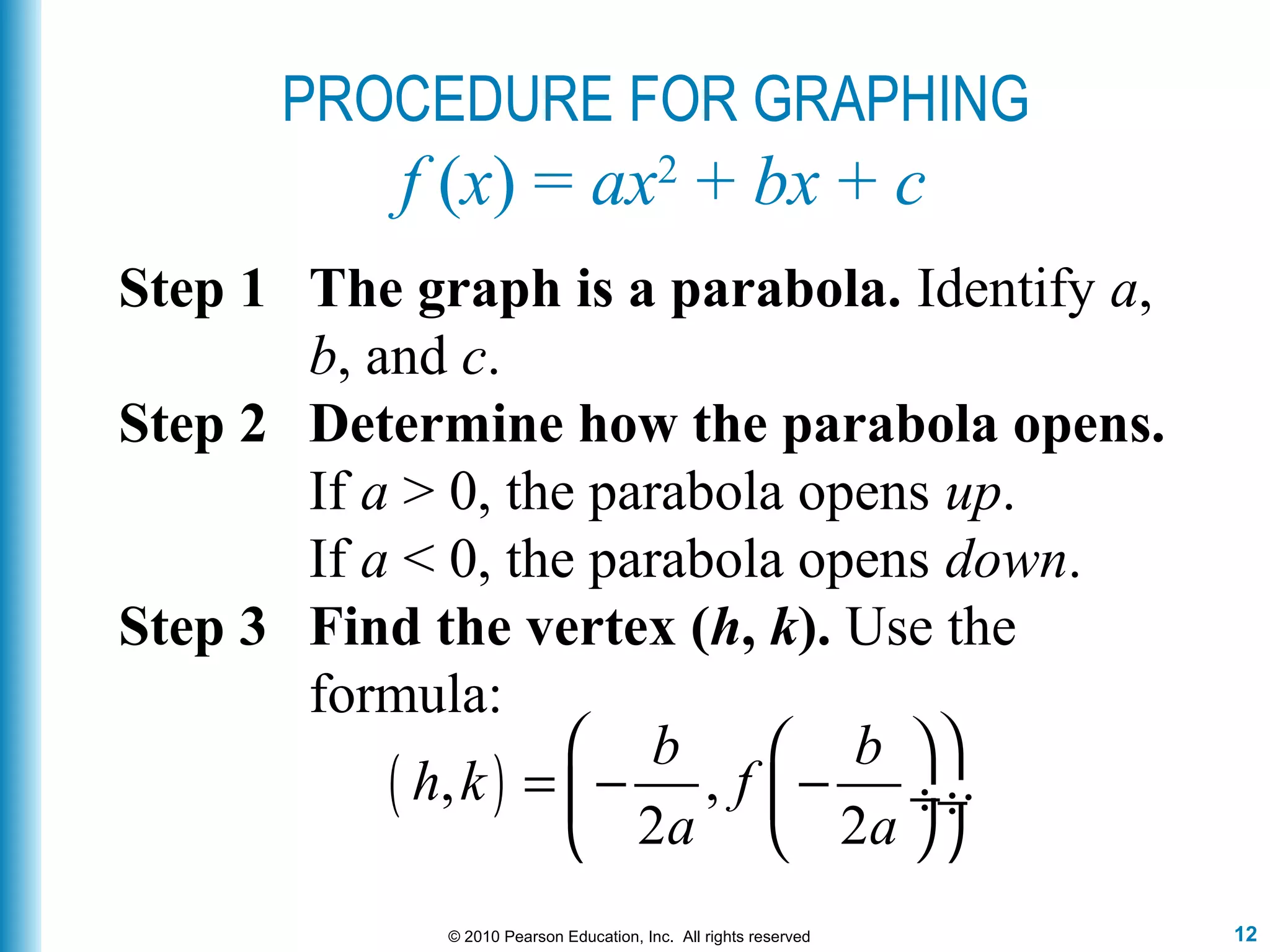
Step 1 The graph is a parabola. Identify a,
b, and c.
Step 2 Determine how the parabola opens.
If a > 0, the parabola opens up.
If a < 0, the parabola opens down.
Step 3 Find the vertex (h, k). Use the
formula:
( ), , .
2 2
b b
h k f
a a
  
= − − ÷ ÷
  
13© 2010 Pearson Education, Inc. All rights reserved
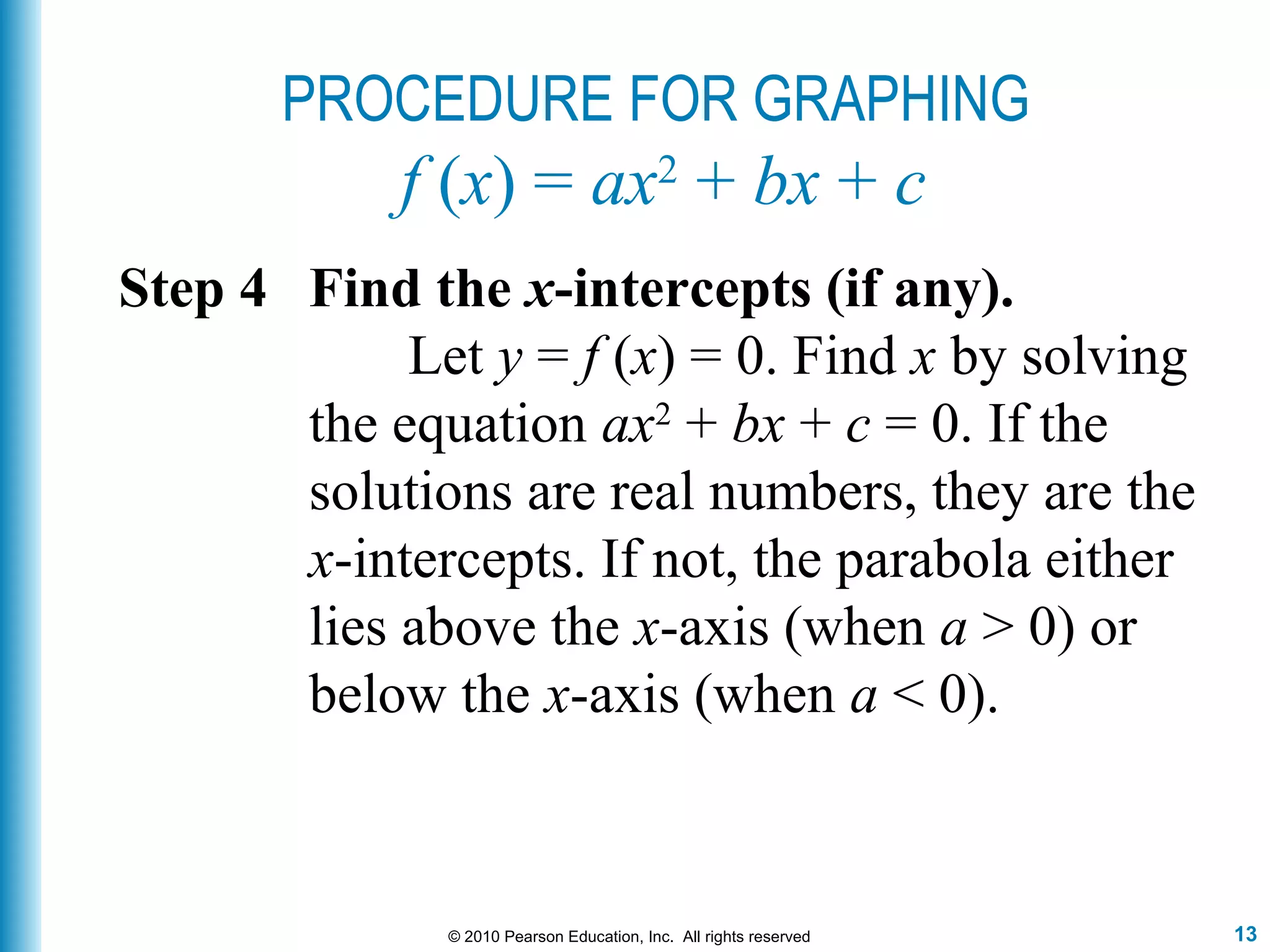
Step 4 Find the x-intercepts (if any).
Let y = f (x) = 0. Find x by solving
the equation ax2
+ bx + c = 0. If the
solutions are real numbers, they are the
x-intercepts. If not, the parabola either
lies above the x-axis (when a > 0) or
below the x-axis (when a < 0).
PROCEDURE FOR GRAPHING
f (x) = ax2
+ bx + c
14© 2010 Pearson Education, Inc. All rights reserved
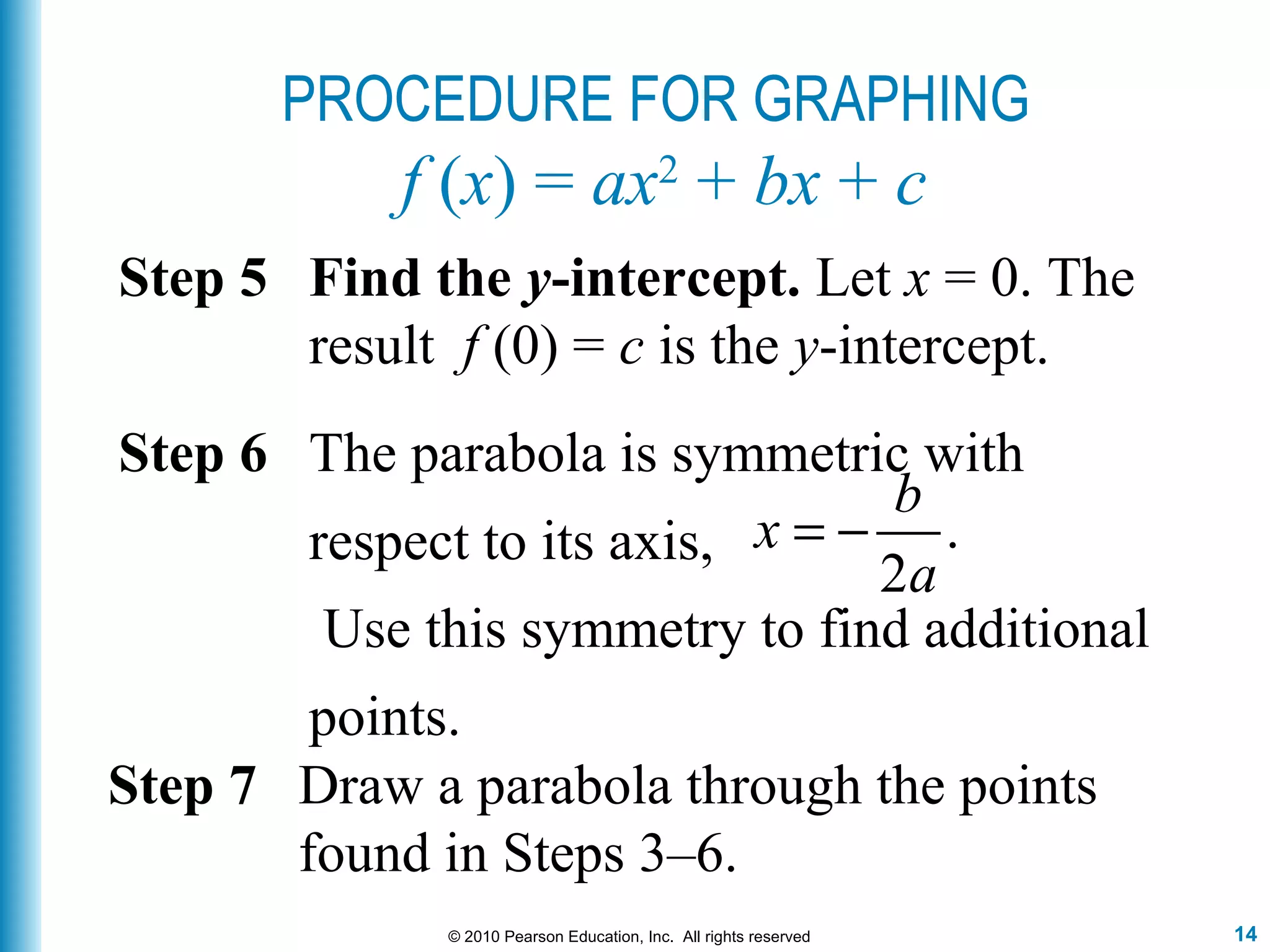
Step 5 Find the y-intercept. Let x = 0. The
result f (0) = c is the y-intercept.
Step 7 Draw a parabola through the points
found in Steps 3–6.
Step 6 The parabola is symmetric with
respect to its axis,
Use this symmetry to find additional
points.
.
2
b
x
a
= −
PROCEDURE FOR GRAPHING
f (x) = ax2
+ bx + c
15© 2010 Pearson Education, Inc. All rights reserved
EXAMPLE 3
Graphing a Quadratic Function
f (x) = ax2
+ bx + c
Solution
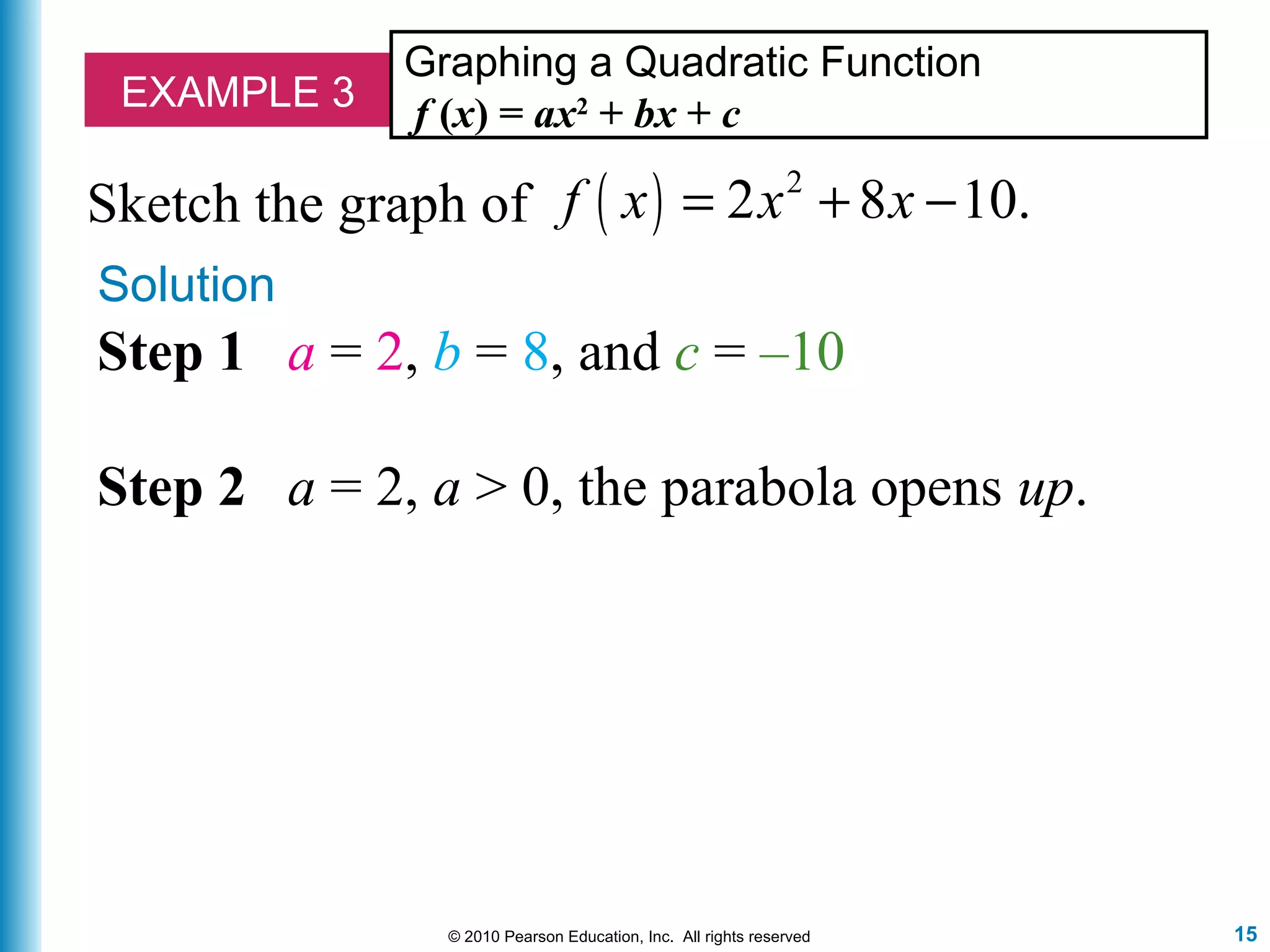
Sketch the graph of ( ) 2
2 8 10.f x x x= + −
Step 1 a = 2, b = 8, and c = –10
Step 2 a = 2, a > 0, the parabola opens up.
16© 2010 Pearson Education, Inc. All rights reserved
EXAMPLE 3
Graphing a Quadratic Function
f (x) = ax2
+ bx + c
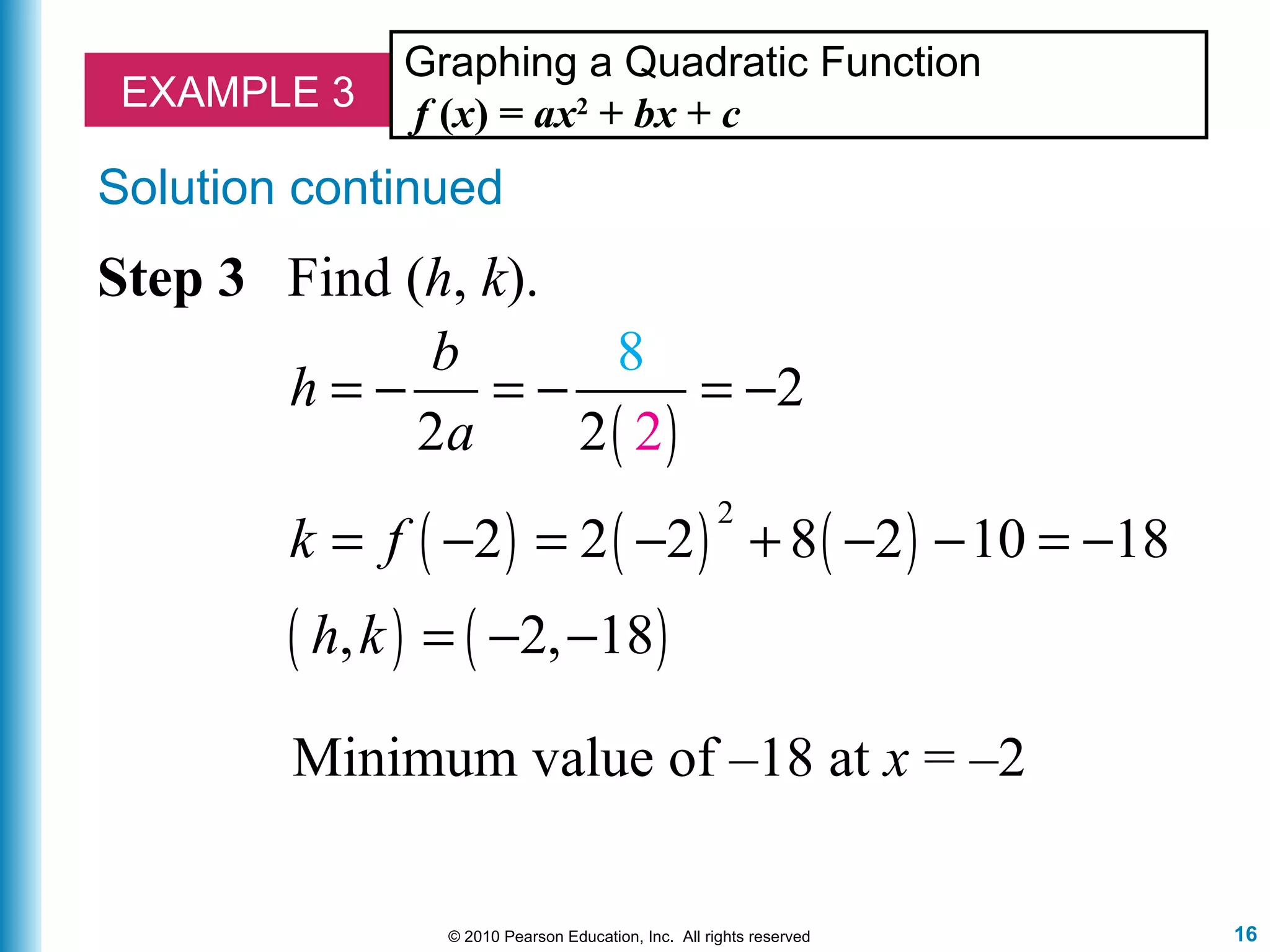
Step 3 Find (h, k).
( )
( ) ( ) ( )
( ) ( )
2
2
2 2
2 2 2 8 2 10 18
, 2, 18
8
2
b
h
a
k f
h k
= − = − = −
= − = − + − − = −
= − −
Minimum value of –18 at x = –2
Solution continued
17© 2010 Pearson Education, Inc. All rights reserved
EXAMPLE 3
Graphing a Quadratic Function
f (x) = ax2
+ bx + c
Solution continued
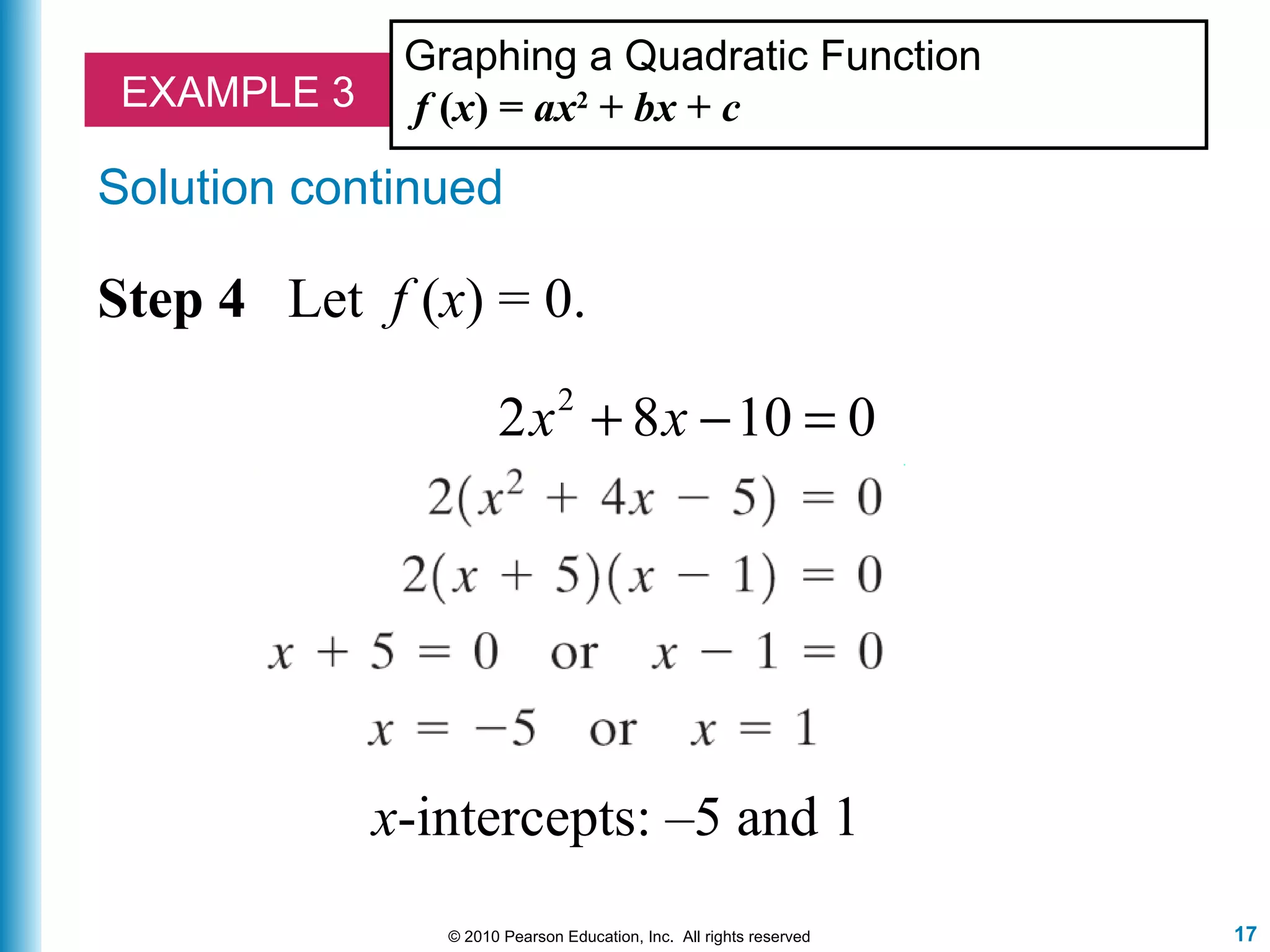
Step 4 Let f (x) = 0.
2
2 8 10 0x x+ − =
x-intercepts: –5 and 1
18© 2010 Pearson Education, Inc. All rights reserved
EXAMPLE 3
Graphing a Quadratic Function
f (x) = ax2
+ bx + c
Solution continued
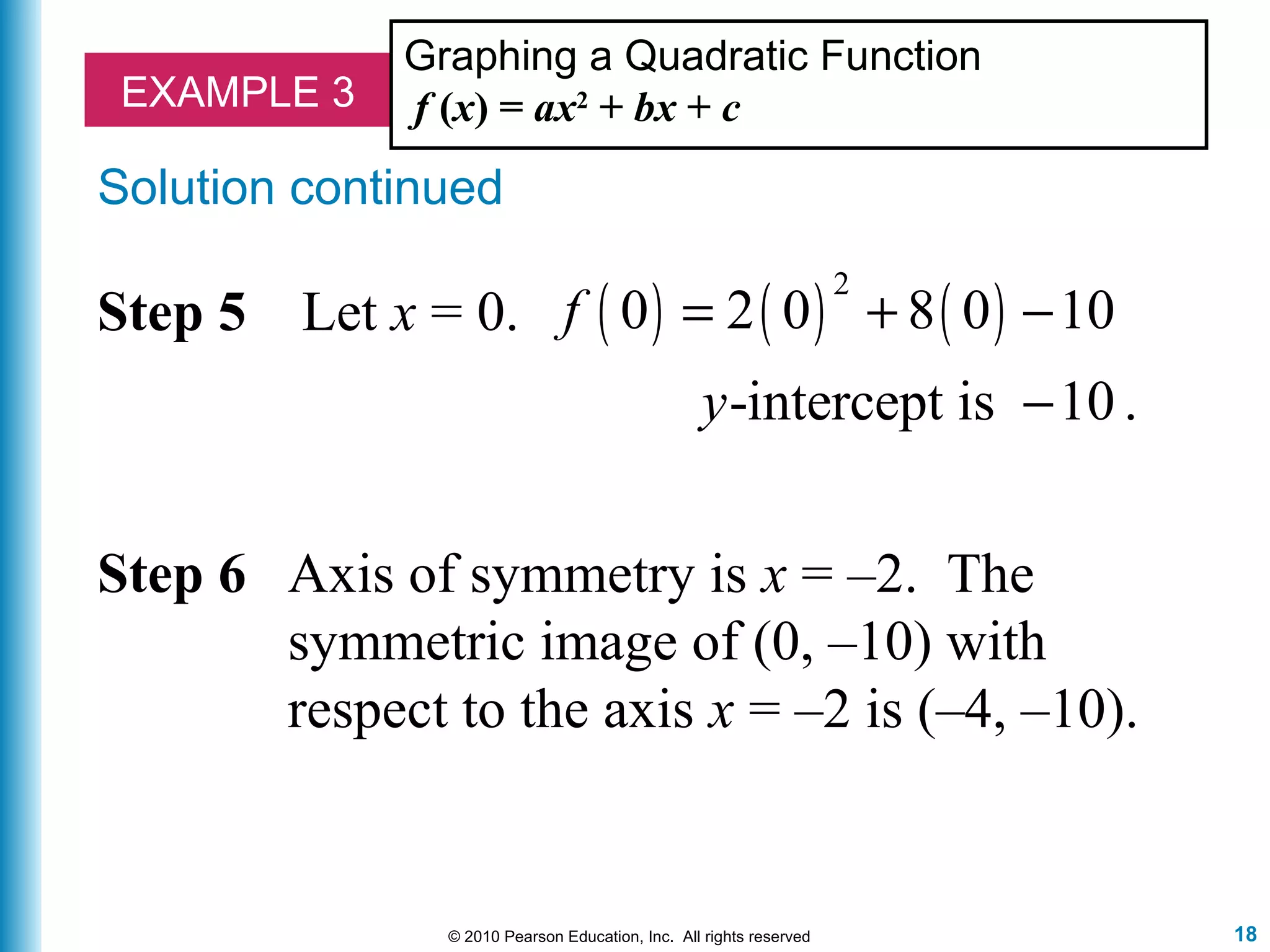
( ) ( ) ( )
2
0 2 0 8 0 10
-intercept is 10 .
f
y
= + −
−
Step 5 Let x = 0.
Step 6 Axis of symmetry is x = –2. The
symmetric image of (0, –10) with
respect to the axis x = –2 is (–4, –10).
19© 2010 Pearson Education, Inc. All rights reserved
EXAMPLE 3
Graphing a Quadratic Function
f (x) = ax2
+ bx + c
Solution continued
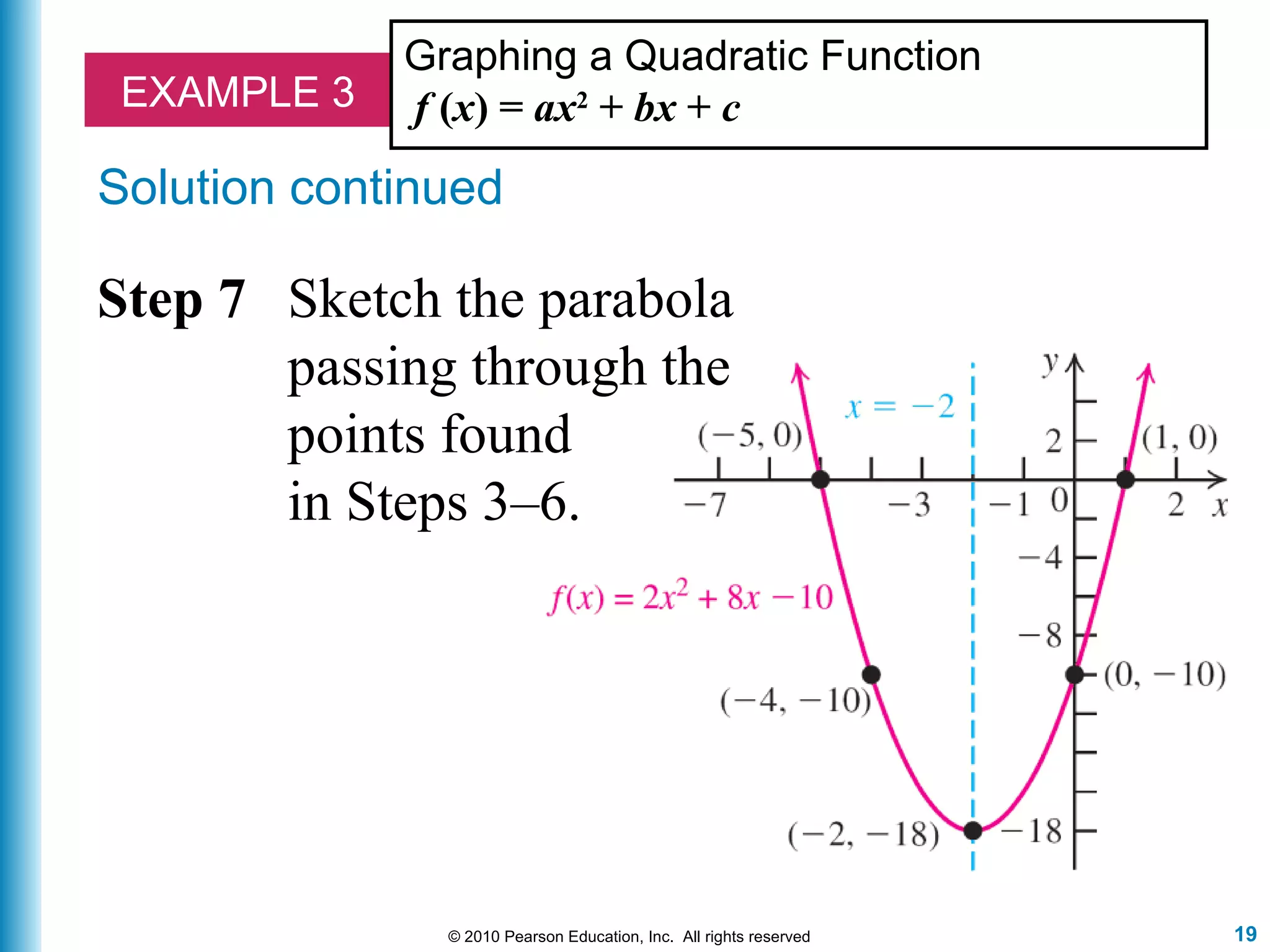
Step 7 Sketch the parabola
passing through the
points found
in Steps 3–6.
20© 2010 Pearson Education, Inc. All rights reserved
EXAMPLE 4
Identifying the Characteristics of a
Quadratic Function from Its Graph
The graph of f (x) = –2x2
+8x – 5 is shown.
Find the domain and range of f.
Solution
The domain is (–∞, ∞).
The range is (–∞, 3].

Lecture 7 quadratic equations

  • 1.
    1© 2010 PearsonEducation, Inc. All rights reserved QUADRATIC FUNCTION A function of the form where a, b, and c, are real numbers with a ≠ 0, is called a quadratic function. f x( ) = ax2 + bx + c,
  • 2.
    2© 2010 PearsonEducation, Inc. All rights reserved THE STANDARD FORM OF A QUADRATIC FUNCTION The quadratic function is in standard form. The graph of f is a parabola with vertex (h, k). The parabola is symmetric with respect to the line x = h, called the axis of symmetry of the parabola. If a > 0, the parabola opens up and k is the minimum value of f, and if a < 0, the parabola opens down and k is the maximum value of f. f x( ) = a x − h( )2 + k, a ≠ 0
  • 3.
    Vertex The lowest orhighest point of a parabola. Vertex Axis of symmetry The vertical line through the vertex of the parabola. Axis of Symmetry
  • 4.
    4© 2010 PearsonEducation, Inc. All rights reserved EXAMPLE 1 Finding a Quadratic Function Find the standard form of the quadratic function whose graph has vertex (–3, 4) and passes through the point (–4, 7).
  • 5.
    5© 2010 PearsonEducation, Inc. All rights reserved PROCEDURE FOR GRAPHING f (x) = a(x – h)2 + k Step 1 The graph is a parabola. Identify a, h, and k. Step 2 Determine how the parabola opens. If a > 0, the parabola opens up. If a < 0, the parabola opens down. Step 3 Find the vertex. The vertex is (h, k). If a > 0 (or a < 0), the function f has a minimum (or a maximum) value k at x = h.
  • 6.
    6© 2010 PearsonEducation, Inc. All rights reserved PROCEDURE FOR GRAPHING f (x) = a(x – h)2 + k Step 4 Find the x-intercepts (if any). Set f (x) = 0 and solving the equation a(x – h)2 + k = 0 for x. If the solutions are real numbers, they are the x-intercepts. If not, the parabola either lies above the x-axis (when a > 0) or below the x-axis (when a < 0).
  • 7.
    7© 2010 PearsonEducation, Inc. All rights reserved PROCEDURE FOR GRAPHING f (x) = a(x – h)2 + k Step 6 Sketch the graph. Plot the points found in Steps 3–5 and join them by a parabola. Show the axis x = h of the parabola by drawing a dashed line. Step 5 Find the y-intercept. Replace x with 0. Then f (0) = ah2 + k is the y-intercept.
  • 8.
    8© 2010 PearsonEducation, Inc. All rights reserved EXAMPLE 2 Graphing a Quadratic Function in Standard Form Sketch the graph of ( ) ( ) 2 3 2 12.f x x= − + + Solution Step 1 a = –3, h = –2, and k = 12 Step 2 a = –3, a < 0, the parabola opens down. Step 3 (h, k) = (–2, 12); the function f has a maximum value 12 at x = –2.
  • 9.
    9© 2010 PearsonEducation, Inc. All rights reserved EXAMPLE 2 Graphing a Quadratic Function in Standard Form Step 4 Set f (x) = 0 and solve for x. ( ) ( ) ( ) 2 2 2 0 3 2 12 12 3 2 4 2 x x x = − + + − = − + = + 2 2 0 or 4 -intercepts: 0 and 4 x x x x + = ± = = − − Solution continued
  • 10.
    10© 2010 PearsonEducation, Inc. All rights reserved EXAMPLE 2 Graphing a Quadratic Function in Standard Form Solution continued Step 5 Replace x with 0. ( ) ( ) ( ) 2 0 3 0 2 12 3 4 12 0 -intercept is 0 . f y = − + + = − + =
  • 11.
    11© 2010 PearsonEducation, Inc. All rights reserved EXAMPLE 2 Graphing a Quadratic Function in Standard Form Solution continued Step 6 axis: x = –2
  • 12.
    12© 2010 PearsonEducation, Inc. All rights reserved PROCEDURE FOR GRAPHING f (x) = ax2 + bx + c Step 1 The graph is a parabola. Identify a, b, and c. Step 2 Determine how the parabola opens. If a > 0, the parabola opens up. If a < 0, the parabola opens down. Step 3 Find the vertex (h, k). Use the formula: ( ), , . 2 2 b b h k f a a    = − − ÷ ÷   
  • 13.
    13© 2010 PearsonEducation, Inc. All rights reserved Step 4 Find the x-intercepts (if any). Let y = f (x) = 0. Find x by solving the equation ax2 + bx + c = 0. If the solutions are real numbers, they are the x-intercepts. If not, the parabola either lies above the x-axis (when a > 0) or below the x-axis (when a < 0). PROCEDURE FOR GRAPHING f (x) = ax2 + bx + c
  • 14.
    14© 2010 PearsonEducation, Inc. All rights reserved Step 5 Find the y-intercept. Let x = 0. The result f (0) = c is the y-intercept. Step 7 Draw a parabola through the points found in Steps 3–6. Step 6 The parabola is symmetric with respect to its axis, Use this symmetry to find additional points. . 2 b x a = − PROCEDURE FOR GRAPHING f (x) = ax2 + bx + c
  • 15.
    15© 2010 PearsonEducation, Inc. All rights reserved EXAMPLE 3 Graphing a Quadratic Function f (x) = ax2 + bx + c Solution Sketch the graph of ( ) 2 2 8 10.f x x x= + − Step 1 a = 2, b = 8, and c = –10 Step 2 a = 2, a > 0, the parabola opens up.
  • 16.
    16© 2010 PearsonEducation, Inc. All rights reserved EXAMPLE 3 Graphing a Quadratic Function f (x) = ax2 + bx + c Step 3 Find (h, k). ( ) ( ) ( ) ( ) ( ) ( ) 2 2 2 2 2 2 2 8 2 10 18 , 2, 18 8 2 b h a k f h k = − = − = − = − = − + − − = − = − − Minimum value of –18 at x = –2 Solution continued
  • 17.
    17© 2010 PearsonEducation, Inc. All rights reserved EXAMPLE 3 Graphing a Quadratic Function f (x) = ax2 + bx + c Solution continued Step 4 Let f (x) = 0. 2 2 8 10 0x x+ − = x-intercepts: –5 and 1
  • 18.
    18© 2010 PearsonEducation, Inc. All rights reserved EXAMPLE 3 Graphing a Quadratic Function f (x) = ax2 + bx + c Solution continued ( ) ( ) ( ) 2 0 2 0 8 0 10 -intercept is 10 . f y = + − − Step 5 Let x = 0. Step 6 Axis of symmetry is x = –2. The symmetric image of (0, –10) with respect to the axis x = –2 is (–4, –10).
  • 19.
    19© 2010 PearsonEducation, Inc. All rights reserved EXAMPLE 3 Graphing a Quadratic Function f (x) = ax2 + bx + c Solution continued Step 7 Sketch the parabola passing through the points found in Steps 3–6.
  • 20.
    20© 2010 PearsonEducation, Inc. All rights reserved EXAMPLE 4 Identifying the Characteristics of a Quadratic Function from Its Graph The graph of f (x) = –2x2 +8x – 5 is shown. Find the domain and range of f. Solution The domain is (–∞, ∞). The range is (–∞, 3].