Parallel &
Perpendicular Lines
Parallel Lines Have the Same Slope
• The lines never touch. Therefore:
• There is no solution to a system of equations
• If you know the slope of one line, you know the
slope of a line parallel to it.
• If you know the slope and a point on the line,
you can use the point-slope formula to find the
equation of, and graph the line.
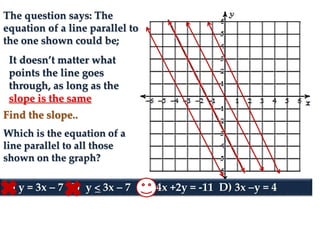
The question says: The
equation of a line parallel to
the one shown could be;
It doesn’t matter what
points the line goes
through, as long as the
slope is the same
Find the slope..
A) y = 3x – 7 B) y < 3x – 7 C) 4x +2y = -11 D) 3x –y = 4
Which is the equation of a
line parallel to all those
shown on the graph?
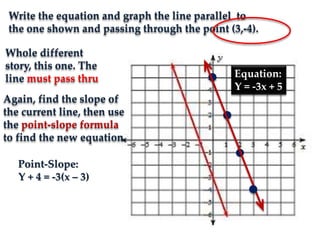
Write the equation and graph the line parallel to
the one shown and passing through the point (3,-4).
Whole different
story, this one. The
line must pass thru
Again, find the slope of
the current line, then use
the point-slope formula
to find the new equation.
Point-Slope:
Y + 4 = -3(x – 3)
Equation:
Y = -3x + 5
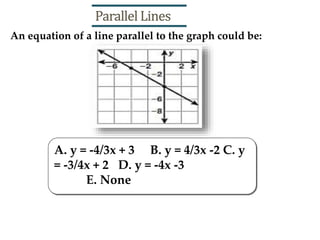
A. y = -4/3x + 3 B. y = 4/3x -2 C. y
= -3/4x + 2 D. y = -4x -3
E. None
An equation of a line parallel to the graph could be:
Parallel Lines
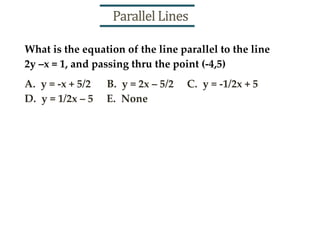
What is the equation of the line parallel to the line
2y –x = 1, and passing thru the point (-4,5)
A. y = -x + 5/2 B. y = 2x – 5/2 C. y = -1/2x + 5
D. y = 1/2x – 5 E. None
Parallel Lines
Perpendicular Lines Have Slopes that are the
opposite inverse of each other
• The lines cross at a 90 degree angle
• There is always one solution
• If you know the slope of one line, change the sign
and use the reciprocal
• If you know the slope and a point on the line, you
can use the point-slope formula to find the
equation of, and graph the line.
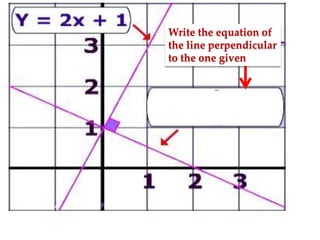
Write the equation of
the line perpendicular
to the one given
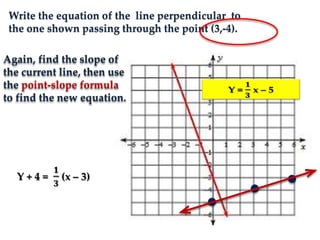
Write the equation of the line perpendicular to
the one shown passing through the point (3,-4).
Again, find the slope of
the current line, then use
the point-slope formula
to find the new equation.
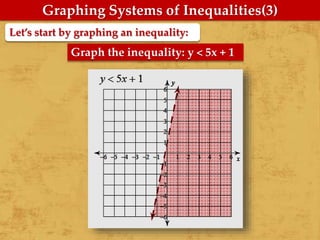
Graph the inequality: y < 5x + 1
Graphing Systems of Inequalities(3)
Let’s start by graphing an inequality:
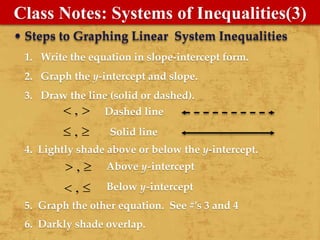
Class Notes: Systems of Inequalities(3)
1. Write the equation in slope-intercept form.
2. Graph the y-intercept and slope.
3. Draw the line (solid or dashed).
 , Dashed line
 , Solid line
• Steps to Graphing Linear System Inequalities
,  Above y-intercept
,  Below y-intercept
4. Lightly shade above or below the y-intercept.
5. Graph the other equation. See #’s 3 and 4
6. Darkly shade overlap.
2
1
3
4
5
3
y x
y x

 

   

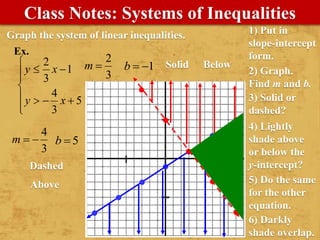
Ex.
Graph the system of linear inequalities.
2) Graph.
Find m and b.
3) Solid or
dashed?
4) Lightly
shade above
or below the
y-intercept?
1) Put in
slope-intercept
form.
5) Do the same
for the other
equation.
6) Darkly
shade overlap.
2
3
m  1b  
4
3
m   5b 
Solid Below
Dashed
Above
Class Notes: Systems of Inequalities
1
5
2
3 2
y x
y x

 

   
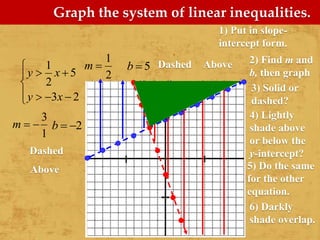
Graph the system of linear inequalities.
2) Find m and
b, then graph
3) Solid or
dashed?
4) Lightly
shade above
or below the
y-intercept?
1) Put in slope-
intercept form.
5) Do the same
for the other
equation.
6) Darkly
shade overlap.
1
2
m  5b 
3
1
m   2b  
Dashed Above
Dashed
Above
.
Solving 3x3 Systems of
Equations
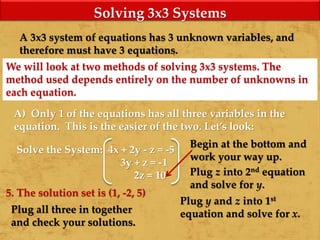
Solving 3x3 Systems
A 3x3 system of equations has 3 unknown variables, and
therefore must have 3 equations.
We will look at two methods of solving 3x3 systems. The
method used depends entirely on the number of unknowns in
each equation.
A) Only 1 of the equations has all three variables in the
equation. This is the easier of the two. Let’s look:
Solve the System: 4x + 2y - z = -5
3y + z = -1
2z = 10
Begin at the bottom and
work your way up.
Plug z into 2nd equation
and solve for y.
Plug y and z into 1st
equation and solve for x.Plug all three in together
and check your solutions.
5. The solution set is (1, -2, 5)
Solving 3x3 Systems
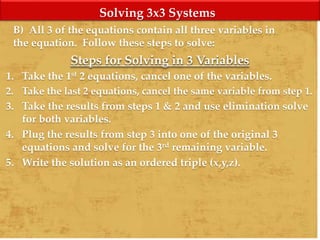
B) All 3 of the equations contain all three variables in
the equation. Follow these steps to solve:
Steps for Solving in 3 Variables
1. Take the 1st 2 equations, cancel one of the variables.
2. Take the last 2 equations, cancel the same variable from step 1.
3. Take the results from steps 1 & 2 and use elimination solve
for both variables.
4. Plug the results from step 3 into one of the original 3
equations and solve for the 3rd remaining variable.
5. Write the solution as an ordered triple (x,y,z).
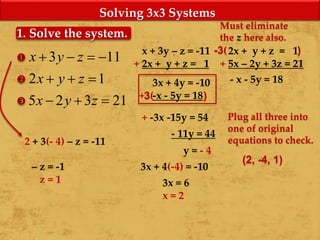
1. Solve the system.
(2, -4, 1)
3 11
2 1
5 2 3 21
x y z
x y z
x y z
   
  
  



Solving 3x3 Systems
x + 3y – z = -11
+ 2x + y + z = 1
2x + y + z = 1
+ 5x – 2y + 3z = 21
Must eliminate
the z here also.
3x + 4y = -10 - x - 5y = 18
+ -x - 5y = 183( )
+ -3x -15y = 54
- 11y = 44
-3( )
y = - 4
3x + 4(-4) = -10
3x = 6
x = 2
2 + 3(- 4) – z = -11
– z = -1
z = 1
Plug all three into
one of original
equations to check.
.
Class Work 3.4:
Show all work on separate
sheet of paper.
February 17, 2015

February 17, 2015

  • 2.
  • 3.
    Parallel Lines Havethe Same Slope • The lines never touch. Therefore: • There is no solution to a system of equations • If you know the slope of one line, you know the slope of a line parallel to it. • If you know the slope and a point on the line, you can use the point-slope formula to find the equation of, and graph the line.
  • 4.
    The question says:The equation of a line parallel to the one shown could be; It doesn’t matter what points the line goes through, as long as the slope is the same Find the slope.. A) y = 3x – 7 B) y < 3x – 7 C) 4x +2y = -11 D) 3x –y = 4 Which is the equation of a line parallel to all those shown on the graph?
  • 5.
    Write the equationand graph the line parallel to the one shown and passing through the point (3,-4). Whole different story, this one. The line must pass thru Again, find the slope of the current line, then use the point-slope formula to find the new equation. Point-Slope: Y + 4 = -3(x – 3) Equation: Y = -3x + 5
  • 6.
    A. y =-4/3x + 3 B. y = 4/3x -2 C. y = -3/4x + 2 D. y = -4x -3 E. None An equation of a line parallel to the graph could be: Parallel Lines
  • 7.
    What is theequation of the line parallel to the line 2y –x = 1, and passing thru the point (-4,5) A. y = -x + 5/2 B. y = 2x – 5/2 C. y = -1/2x + 5 D. y = 1/2x – 5 E. None Parallel Lines
  • 8.
    Perpendicular Lines HaveSlopes that are the opposite inverse of each other • The lines cross at a 90 degree angle • There is always one solution • If you know the slope of one line, change the sign and use the reciprocal • If you know the slope and a point on the line, you can use the point-slope formula to find the equation of, and graph the line. Write the equation of the line perpendicular to the one given
  • 9.
    Write the equationof the line perpendicular to the one shown passing through the point (3,-4). Again, find the slope of the current line, then use the point-slope formula to find the new equation.
  • 11.
    Graph the inequality:y < 5x + 1 Graphing Systems of Inequalities(3) Let’s start by graphing an inequality:
  • 12.
    Class Notes: Systemsof Inequalities(3) 1. Write the equation in slope-intercept form. 2. Graph the y-intercept and slope. 3. Draw the line (solid or dashed).  , Dashed line  , Solid line • Steps to Graphing Linear System Inequalities ,  Above y-intercept ,  Below y-intercept 4. Lightly shade above or below the y-intercept. 5. Graph the other equation. See #’s 3 and 4 6. Darkly shade overlap.
  • 13.
    2 1 3 4 5 3 y x y x         Ex. Graph the system of linear inequalities. 2) Graph. Find m and b. 3) Solid or dashed? 4) Lightly shade above or below the y-intercept? 1) Put in slope-intercept form. 5) Do the same for the other equation. 6) Darkly shade overlap. 2 3 m  1b   4 3 m   5b  Solid Below Dashed Above Class Notes: Systems of Inequalities
  • 14.
    1 5 2 3 2 y x yx         Graph the system of linear inequalities. 2) Find m and b, then graph 3) Solid or dashed? 4) Lightly shade above or below the y-intercept? 1) Put in slope- intercept form. 5) Do the same for the other equation. 6) Darkly shade overlap. 1 2 m  5b  3 1 m   2b   Dashed Above Dashed Above
  • 15.
  • 16.
    Solving 3x3 Systems A3x3 system of equations has 3 unknown variables, and therefore must have 3 equations. We will look at two methods of solving 3x3 systems. The method used depends entirely on the number of unknowns in each equation. A) Only 1 of the equations has all three variables in the equation. This is the easier of the two. Let’s look: Solve the System: 4x + 2y - z = -5 3y + z = -1 2z = 10 Begin at the bottom and work your way up. Plug z into 2nd equation and solve for y. Plug y and z into 1st equation and solve for x.Plug all three in together and check your solutions. 5. The solution set is (1, -2, 5)
  • 17.
    Solving 3x3 Systems B)All 3 of the equations contain all three variables in the equation. Follow these steps to solve: Steps for Solving in 3 Variables 1. Take the 1st 2 equations, cancel one of the variables. 2. Take the last 2 equations, cancel the same variable from step 1. 3. Take the results from steps 1 & 2 and use elimination solve for both variables. 4. Plug the results from step 3 into one of the original 3 equations and solve for the 3rd remaining variable. 5. Write the solution as an ordered triple (x,y,z).
  • 18.
    1. Solve thesystem. (2, -4, 1) 3 11 2 1 5 2 3 21 x y z x y z x y z              Solving 3x3 Systems x + 3y – z = -11 + 2x + y + z = 1 2x + y + z = 1 + 5x – 2y + 3z = 21 Must eliminate the z here also. 3x + 4y = -10 - x - 5y = 18 + -x - 5y = 183( ) + -3x -15y = 54 - 11y = 44 -3( ) y = - 4 3x + 4(-4) = -10 3x = 6 x = 2 2 + 3(- 4) – z = -11 – z = -1 z = 1 Plug all three into one of original equations to check.

  • 19.
    . Class Work 3.4: Showall work on separate sheet of paper.