GENERATIVISM
OR
THEORY OF INNATENESS
Resource Person:Asif Ali Raza
asifalirazzza@yahoo.com
+92-300-4-62-62-34
7/20/2014 1
To whom this term ā€œGENERATIVISMā€ refers?
7/20/2014 2
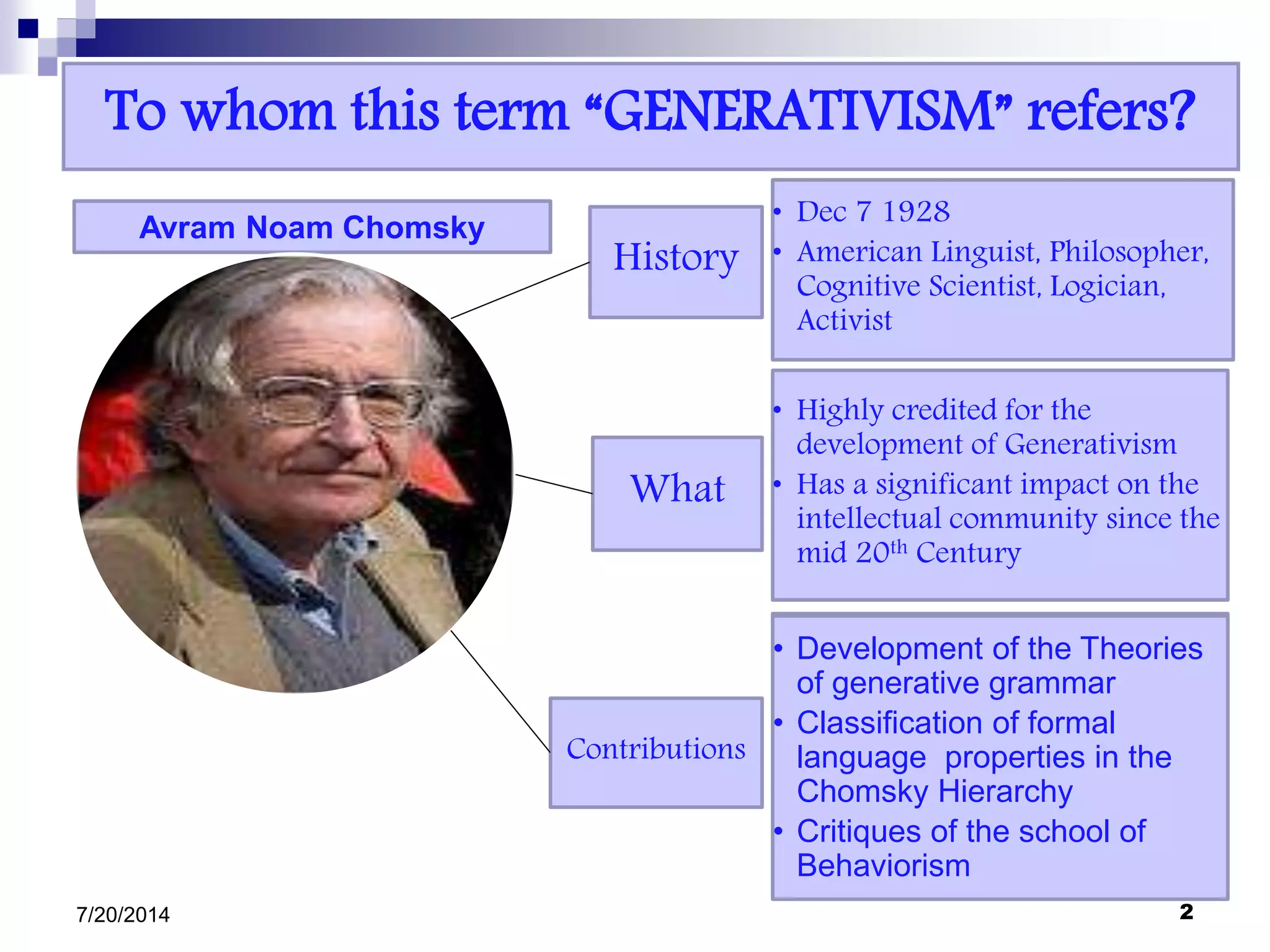
Avram Noam Chomsky • Dec 7 1928
• American Linguist, Philosopher,
Cognitive Scientist, Logician,
Activist
• Highly credited for the
development of Generativism
• Has a significant impact on the
intellectual community since the
mid 20th Century
• Development of the Theories
of generative grammar
• Classification of formal
language properties in the
Chomsky Hierarchy
• Critiques of the school of
Behaviorism
History
What
Contributions
BACKGROUND & DEVELOPMENT
Generativism is rejection of B.F.Skinner’s Behaviourism and
usually presented as having developed out of and in reaction
to the previously dominant school of post-Bloomfieldian
American descriptivism: a particular version of structuralism.
Up to a point, it is historically justifiable to see the origin of
generativism within linguistics in this light. But, as Chomsky
himslef came to realize later, there are many respects in which
generativism constitutes a return to older and more traditional
views about language.
7/20/2014 3
GENERATIVISM
 The term ā€œGenerativismā€ is being used here to refer to the
theory of language that has been developed, over the years or
so, by Avram Noam Chomsky and his followers.
 Indeed, relatively few of the linguists, who were impressed by
the technical advantages and heuristic value of Chmsky’s
system of transformational-generative grammar when he
first put this forward in the late 1950s, have ever explicitly
associated themselves with the body of assumptions and
doctrines that is now identifiable as Generativism.
7/20/2014 4
GENERATIVISM
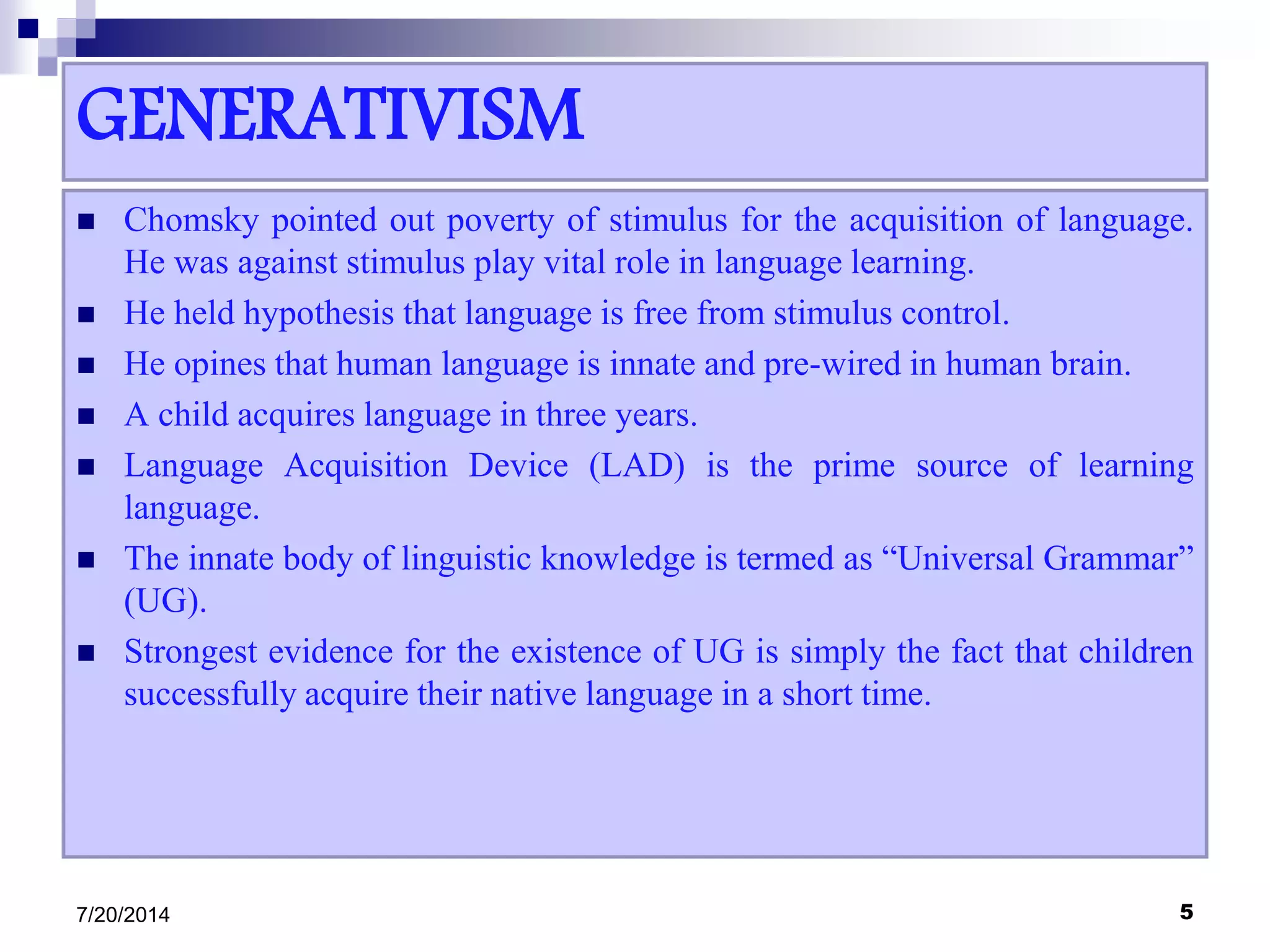
 Chomsky pointed out poverty of stimulus for the acquisition of language.
He was against stimulus play vital role in language learning.
 He held hypothesis that language is free from stimulus control.
 He opines that human language is innate and pre-wired in human brain.
 A child acquires language in three years.
 Language Acquisition Device (LAD) is the prime source of learning
language.
 The innate body of linguistic knowledge is termed as ā€œUniversal Grammarā€
(UG).
 Strongest evidence for the existence of UG is simply the fact that children
successfully acquire their native language in a short time.
7/20/2014 5
GENERATIVISM
7/20/2014 6
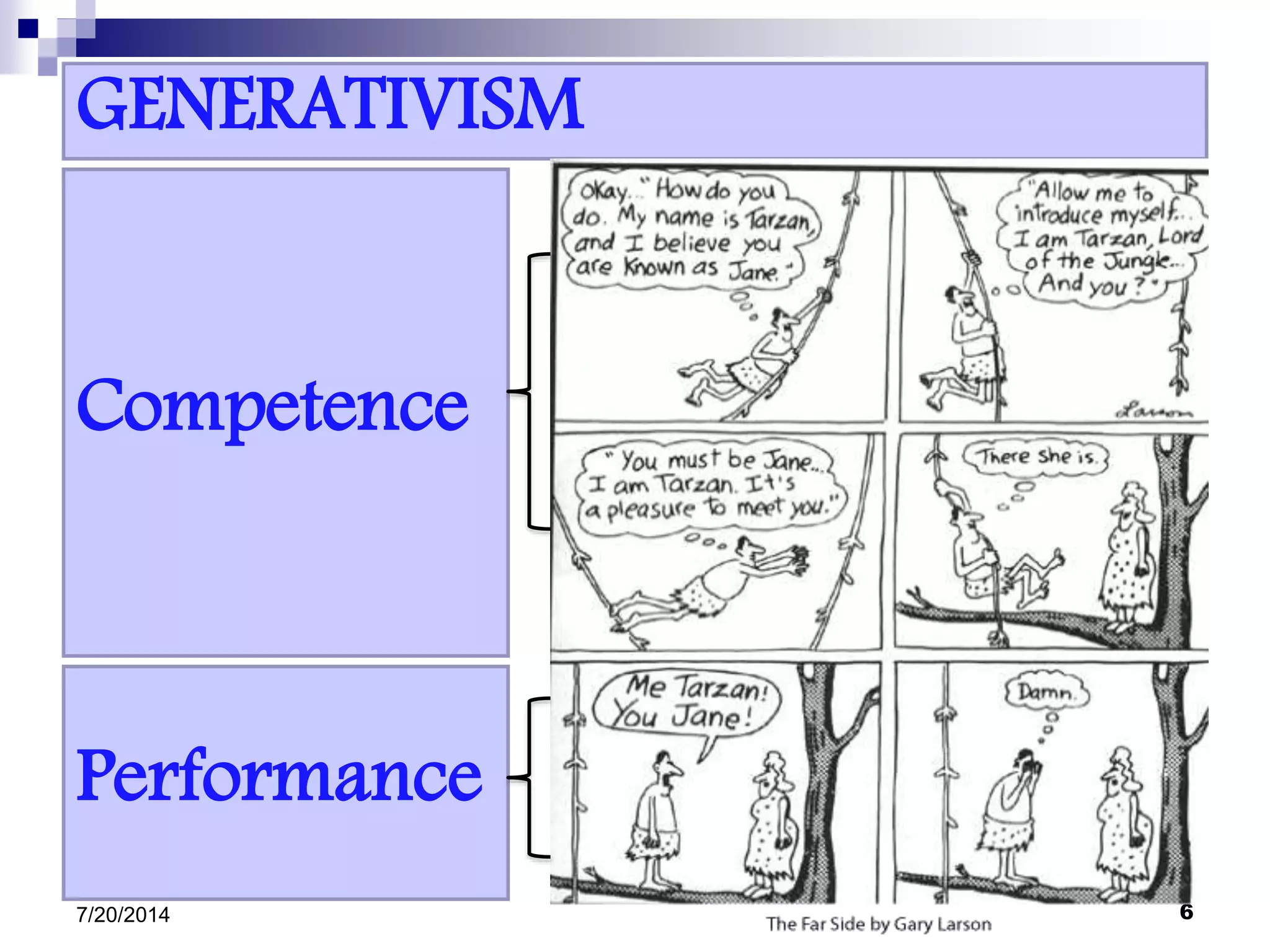
Competence
Performance
GENERATIVISM
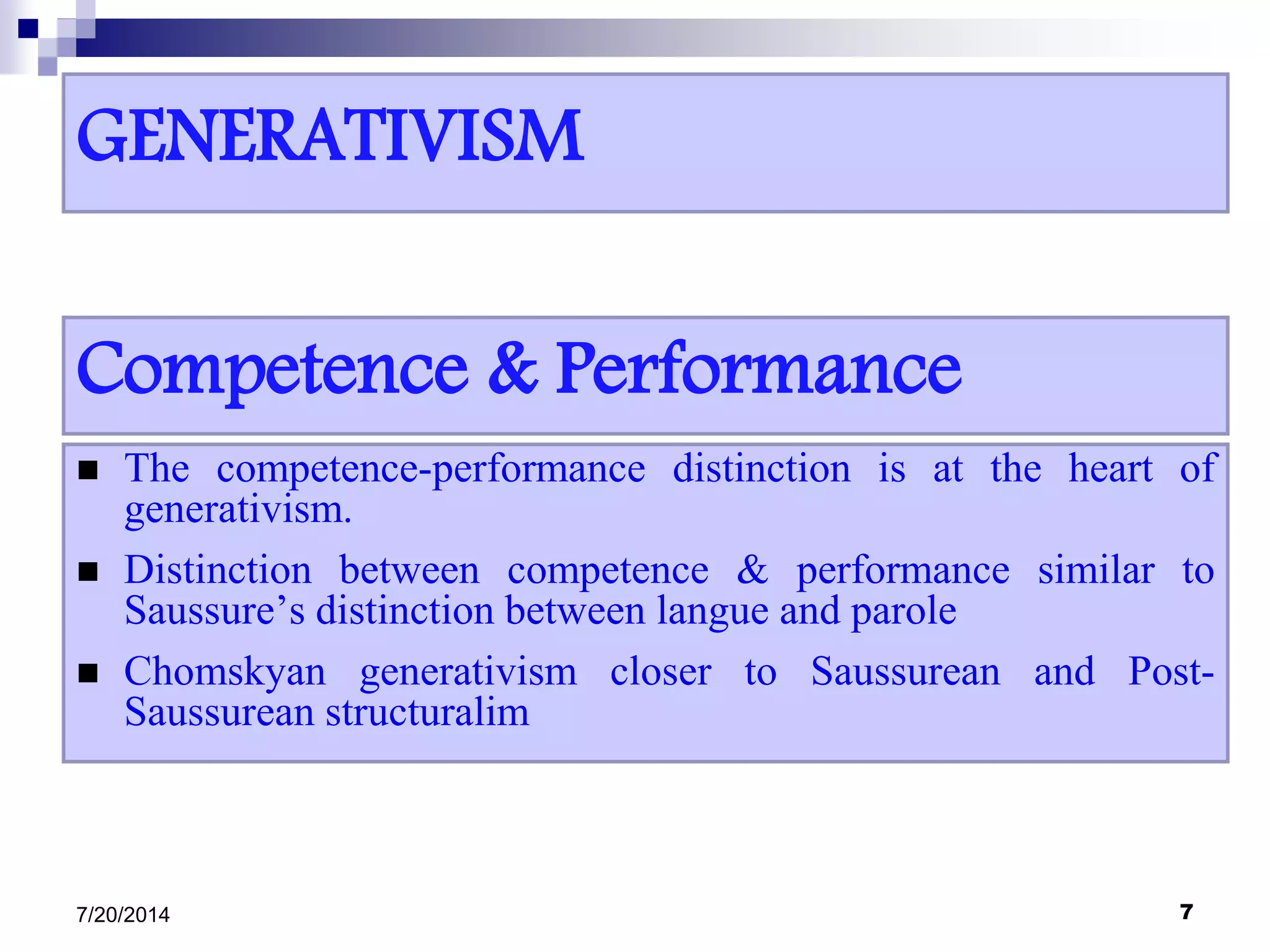
 The competence-performance distinction is at the heart of
generativism.
 Distinction between competence & performance similar to
Saussure’s distinction between langue and parole
 Chomskyan generativism closer to Saussurean and Post-
Saussurean structuralim
7/20/2014 7
Competence & Performance
GENERATIVISM
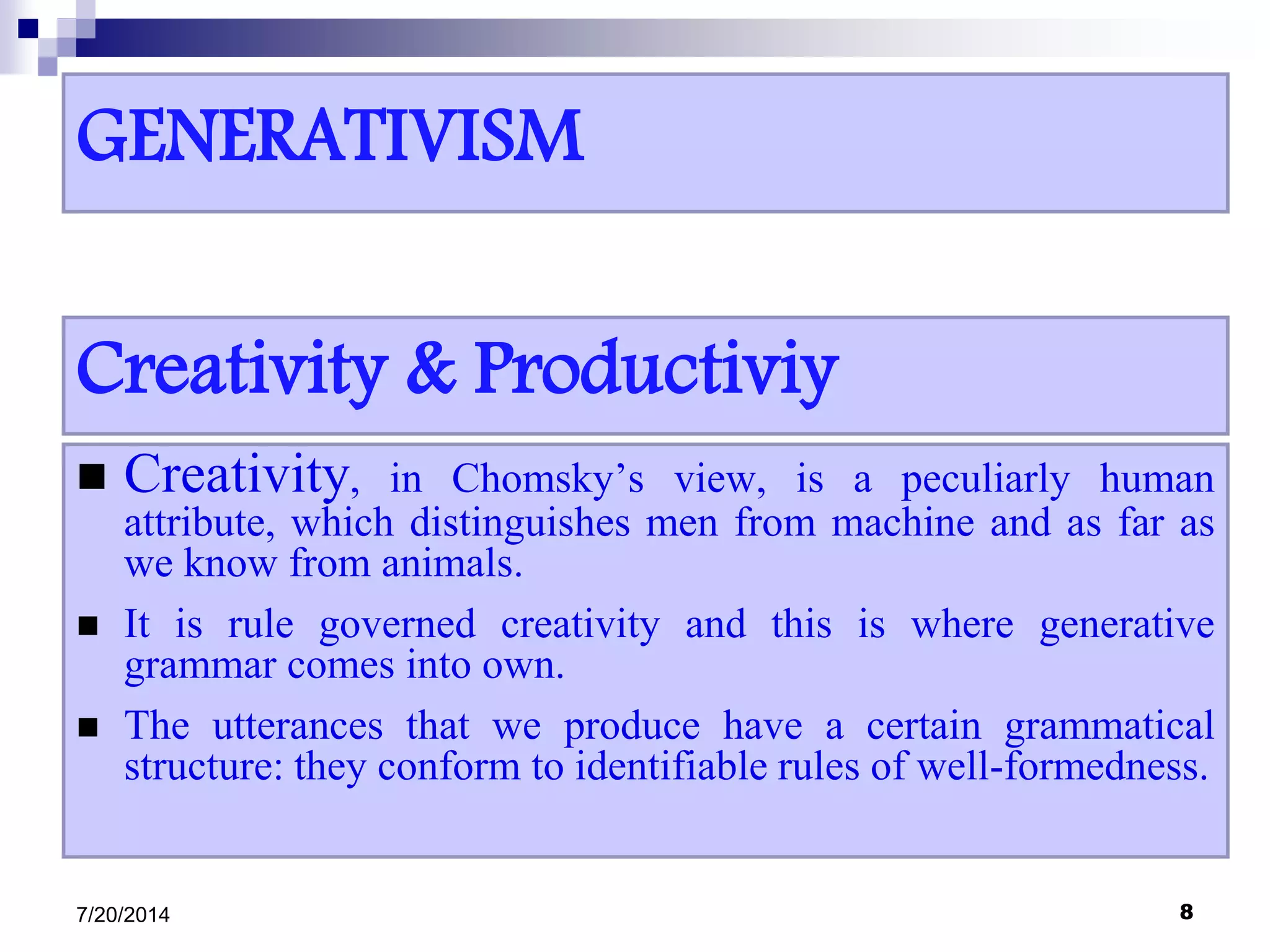
 Creativity, in Chomsky’s view, is a peculiarly human
attribute, which distinguishes men from machine and as far as
we know from animals.
 It is rule governed creativity and this is where generative
grammar comes into own.
 The utterances that we produce have a certain grammatical
structure: they conform to identifiable rules of well-formedness.
7/20/2014 8
Creativity & Productiviy
GENERATIVISM
 Productivitymakes possible exercise of creativity.
 Productivity is not to be identified with creativity but there is an
intrinsic connection between them.
7/20/2014 9
Creatiivity & Productiviy
GENERATIVISM
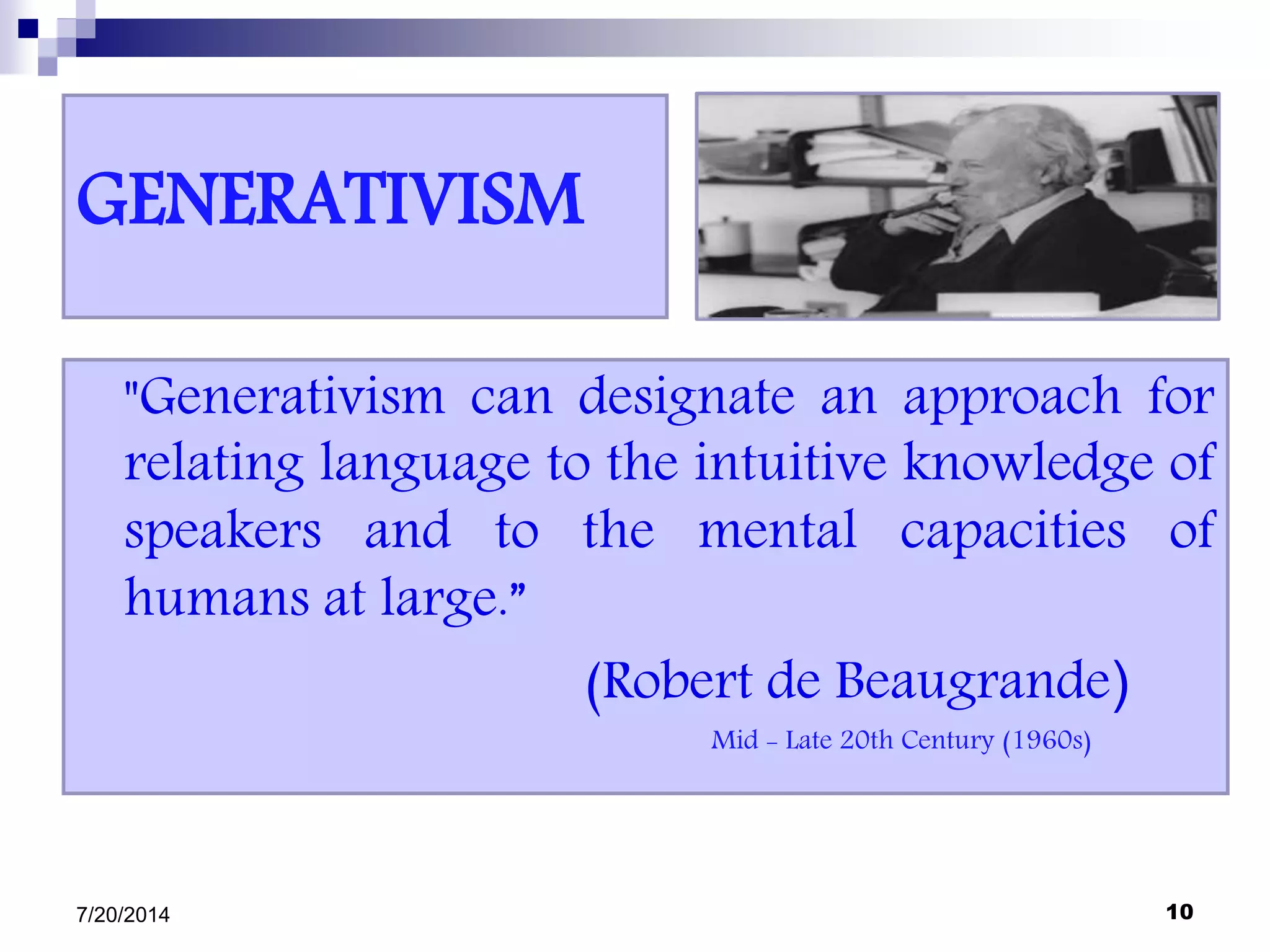
"Generativism can designate an approach for
relating language to the intuitive knowledge of
speakers and to the mental capacities of
humans at large.ā€
(Robert de Beaugrande)
Mid - Late 20th Century (1960s)
7/20/2014 10
GENERATIVE GRAMMAR
ļ‚§ This term was used in 1950s by Chomsky.
 Generative Grammar is a grammar in which a set of formal
rules are used to generate or define the membership of an
infinite set of grammatical sentences in a language. Instead of
analyzing a single sentence, this grammar devises a set of rules
of construction that may help in generating sentences or
structures in an infinitely large number. This grammar attempts
to produce all and only grammatical sentences of language.
(all and only means that our analysis must account for all the
grammatical correct phrases and sentences and only those
grammatical correct phrases and sentences in whatever
language we are analyzing.)
7/20/2014 11
GENERATIVE GRAMMAR
 We have a rule such as ā€œa prepositional phrase in English
consists of a preposition followed by a noun phraseā€. We can
produce a large number of (infinite) phrase using this rule.
e.g. in the zoo, on the table, near the window
7/20/2014 12
EXAMPLE:
BEHAVIOURISM
 Behavioural theory remained dominant in the first half of 20th
century. It is an approach to psychology and learning. It stresses
on observable and measureable behaviours. In behaviourism,
the learners are viewed as passively adopting to their
environment.
 According to the belief of the theory, free will is an illusion. In
other words, human beings are shaped entirely by their external
environment.
 The behaviourists, tried to explain learning without refering to
mental process. This theory sees the language learner as
ā€œTabula Rasaā€ (blank slate).
7/20/2014 13
GENERATIVISM OBJECTS BEHAVIOURISM
 Chomsky has done more than anyone else to demonstrate the
sterility of the behaviourists’ theory of language.
 He has pointed out that much of the technical vocabulary of
behaviourism (ā€˜stimulus’, ā€˜response’, ā€˜conditioning’,
ā€˜reinforcement’ etc.), if taken seriously, cannot be shown to
have any relevance to the acquisition and the use of language.
7/20/2014 14
INFLUENCE OF GENERATIVISM ON
LINGUISTICS AND OTHER DISCIPLINES
 Generativism has been enormously influential, not only in
linguistics, but also in philosophy, psychology and other
disciplines concerned with language.
 Influence of Chomskyan generativism upon all modern
linguistics theory has been so deep and so pervasive that even
those who reject this or that aspects of it tend to do so in terms
that Chomsky has made available to them.
7/20/2014 15
SOURCE
 ā€œLanguage and Linguisticsā€ by John Lyons
 ā€œSyntactic Structuresā€ by Avram Noam Chomsky
 eka1.wordpress.com
 www.ualberta.ca
 www.unm.edu
 www.wikipedia.org
7/20/2014 16
Questions?
7/20/2014 17
Thanks
7/20/2014 18

Theory of innateness

  • 1.
    GENERATIVISM OR THEORY OF INNATENESS ResourcePerson:Asif Ali Raza asifalirazzza@yahoo.com +92-300-4-62-62-34 7/20/2014 1
  • 2.
    To whom thisterm ā€œGENERATIVISMā€ refers? 7/20/2014 2 Avram Noam Chomsky • Dec 7 1928 • American Linguist, Philosopher, Cognitive Scientist, Logician, Activist • Highly credited for the development of Generativism • Has a significant impact on the intellectual community since the mid 20th Century • Development of the Theories of generative grammar • Classification of formal language properties in the Chomsky Hierarchy • Critiques of the school of Behaviorism History What Contributions
  • 3.
    BACKGROUND & DEVELOPMENT Generativismis rejection of B.F.Skinner’s Behaviourism and usually presented as having developed out of and in reaction to the previously dominant school of post-Bloomfieldian American descriptivism: a particular version of structuralism. Up to a point, it is historically justifiable to see the origin of generativism within linguistics in this light. But, as Chomsky himslef came to realize later, there are many respects in which generativism constitutes a return to older and more traditional views about language. 7/20/2014 3
  • 4.
    GENERATIVISM  The termā€œGenerativismā€ is being used here to refer to the theory of language that has been developed, over the years or so, by Avram Noam Chomsky and his followers.  Indeed, relatively few of the linguists, who were impressed by the technical advantages and heuristic value of Chmsky’s system of transformational-generative grammar when he first put this forward in the late 1950s, have ever explicitly associated themselves with the body of assumptions and doctrines that is now identifiable as Generativism. 7/20/2014 4
  • 5.
    GENERATIVISM  Chomsky pointedout poverty of stimulus for the acquisition of language. He was against stimulus play vital role in language learning.  He held hypothesis that language is free from stimulus control.  He opines that human language is innate and pre-wired in human brain.  A child acquires language in three years.  Language Acquisition Device (LAD) is the prime source of learning language.  The innate body of linguistic knowledge is termed as ā€œUniversal Grammarā€ (UG).  Strongest evidence for the existence of UG is simply the fact that children successfully acquire their native language in a short time. 7/20/2014 5
  • 6.
  • 7.
    GENERATIVISM  The competence-performancedistinction is at the heart of generativism.  Distinction between competence & performance similar to Saussure’s distinction between langue and parole  Chomskyan generativism closer to Saussurean and Post- Saussurean structuralim 7/20/2014 7 Competence & Performance
  • 8.
    GENERATIVISM  Creativity, inChomsky’s view, is a peculiarly human attribute, which distinguishes men from machine and as far as we know from animals.  It is rule governed creativity and this is where generative grammar comes into own.  The utterances that we produce have a certain grammatical structure: they conform to identifiable rules of well-formedness. 7/20/2014 8 Creativity & Productiviy
  • 9.
    GENERATIVISM  Productivitymakes possibleexercise of creativity.  Productivity is not to be identified with creativity but there is an intrinsic connection between them. 7/20/2014 9 Creatiivity & Productiviy
  • 10.
    GENERATIVISM "Generativism can designatean approach for relating language to the intuitive knowledge of speakers and to the mental capacities of humans at large.ā€ (Robert de Beaugrande) Mid - Late 20th Century (1960s) 7/20/2014 10
  • 11.
    GENERATIVE GRAMMAR ļ‚§ Thisterm was used in 1950s by Chomsky.  Generative Grammar is a grammar in which a set of formal rules are used to generate or define the membership of an infinite set of grammatical sentences in a language. Instead of analyzing a single sentence, this grammar devises a set of rules of construction that may help in generating sentences or structures in an infinitely large number. This grammar attempts to produce all and only grammatical sentences of language. (all and only means that our analysis must account for all the grammatical correct phrases and sentences and only those grammatical correct phrases and sentences in whatever language we are analyzing.) 7/20/2014 11
  • 12.
    GENERATIVE GRAMMAR  Wehave a rule such as ā€œa prepositional phrase in English consists of a preposition followed by a noun phraseā€. We can produce a large number of (infinite) phrase using this rule. e.g. in the zoo, on the table, near the window 7/20/2014 12 EXAMPLE:
  • 13.
    BEHAVIOURISM  Behavioural theoryremained dominant in the first half of 20th century. It is an approach to psychology and learning. It stresses on observable and measureable behaviours. In behaviourism, the learners are viewed as passively adopting to their environment.  According to the belief of the theory, free will is an illusion. In other words, human beings are shaped entirely by their external environment.  The behaviourists, tried to explain learning without refering to mental process. This theory sees the language learner as ā€œTabula Rasaā€ (blank slate). 7/20/2014 13
  • 14.
    GENERATIVISM OBJECTS BEHAVIOURISM Chomsky has done more than anyone else to demonstrate the sterility of the behaviourists’ theory of language.  He has pointed out that much of the technical vocabulary of behaviourism (ā€˜stimulus’, ā€˜response’, ā€˜conditioning’, ā€˜reinforcement’ etc.), if taken seriously, cannot be shown to have any relevance to the acquisition and the use of language. 7/20/2014 14
  • 15.
    INFLUENCE OF GENERATIVISMON LINGUISTICS AND OTHER DISCIPLINES  Generativism has been enormously influential, not only in linguistics, but also in philosophy, psychology and other disciplines concerned with language.  Influence of Chomskyan generativism upon all modern linguistics theory has been so deep and so pervasive that even those who reject this or that aspects of it tend to do so in terms that Chomsky has made available to them. 7/20/2014 15
  • 16.
    SOURCE  ā€œLanguage andLinguisticsā€ by John Lyons  ā€œSyntactic Structuresā€ by Avram Noam Chomsky  eka1.wordpress.com  www.ualberta.ca  www.unm.edu  www.wikipedia.org 7/20/2014 16
  • 17.
  • 18.