

Section 3. Application
Annisa Ratna
Nurrahma Fatkhia
Dewi Norma
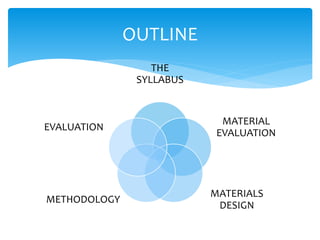
THE
SYLLABUS
MATERIAL
EVALUATION
MATERIALS
DESIGN
METHODOLOGY
EVALUATION
OUTLINE
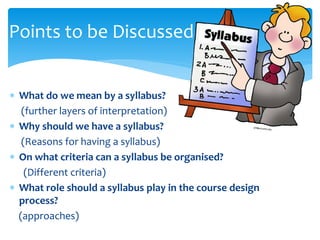
 What do we mean by a syllabus?
(further layers of interpretation)
 Why should we have a syllabus?
(Reasons for having a syllabus)
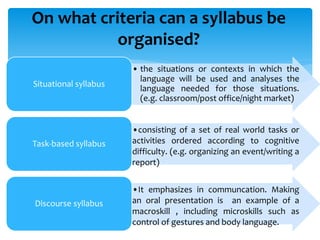
 On what criteria can a syllabus be organised?
(Different criteria)
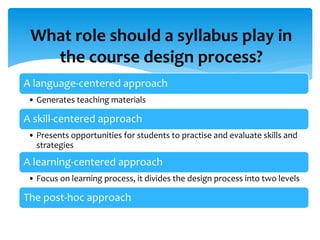
 What role should a syllabus play in the course design
process?
(approaches)
Points to be Discussed
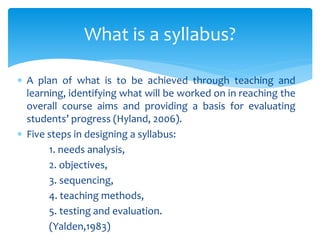
 A plan of what is to be achieved through teaching and
learning, identifying what will be worked on in reaching the
overall course aims and providing a basis for evaluating
students’ progress (Hyland, 2006).
 Five steps in designing a syllabus:
1. needs analysis,
2. objectives,
3. sequencing,
4. teaching methods,
5. testing and evaluation.
(Yalden,1983)
What is a syllabus?
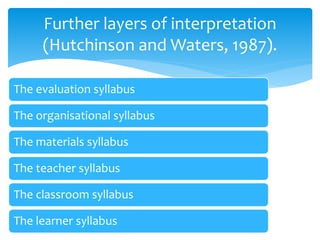
The evaluation syllabus
The organisational syllabus
The materials syllabus
The teacher syllabus
The classroom syllabus
The learner syllabus
Further layers of interpretation
(Hutchinson and Waters, 1987).
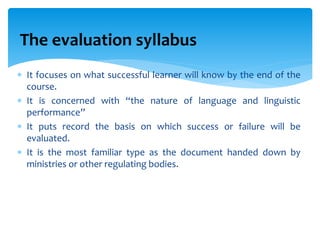
 It focuses on what successful learner will know by the end of the
course.
 It is concerned with “the nature of language and linguistic
performance”
 It puts record the basis on which success or failure will be
evaluated.
 It is the most familiar type as the document handed down by
ministries or other regulating bodies.
The evaluation syllabus
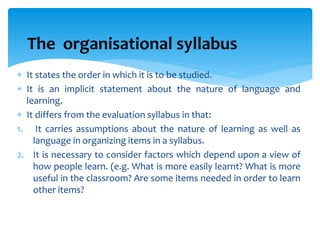
 It states the order in which it is to be studied.
 It is an implicit statement about the nature of language and
learning.
 It differs from the evaluation syllabus in that:
1. It carries assumptions about the nature of learning as well as
language in organizing items in a syllabus.
2. It is necessary to consider factors which depend upon a view of
how people learn. (e.g. What is more easily learnt? What is more
useful in the classroom? Are some items needed in order to learn
other items?
The organisational syllabus
The materials syllabus
• It does not describe how learning will be achieved.
• Interpreted by the materials writer.
• The author adds more assumption about the
nature of language, language learning, and
language use
 The great majority of students in the world learn through the
mediation of a teacher.
 Teacher can influence the clarity, intensity, and frequency of any
item and affect the image that the learner receive.
 Different capability of teachers will bring different result in
conducting the course/classroom.
The teacher syllabus
 What is planned and what actually happens are different things.
 A classroom is a dynamic and interactive environment
 A lesson is a communicative event created by the interactions.
 A classroom creates condition affecting the nature of a planned
lesson. (eg. Hot weather, tired students, noise, interruption, etc)
The classroom syllabus
The learner syllabus
 It is an internal syllabus.
 It is a retrospective record of what has been studied rather than a
prospective plan of what will be studied.
 It crucially influences on whether and how future knowledge is
studied.
 Learners must be taken into account on a continuing basis through
every stage of the course design process.
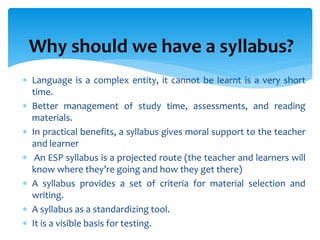
Why should we have a syllabus?
 Language is a complex entity, it cannot be learnt is a very short
time.
 Better management of study time, assessments, and reading
materials.
 In practical benefits, a syllabus gives moral support to the teacher
and learner
 An ESP syllabus is a projected route (the teacher and learners will
know where they’re going and how they get there)
 A syllabus provides a set of criteria for material selection and
writing.
 A syllabus as a standardizing tool.
 It is a visible basis for testing.
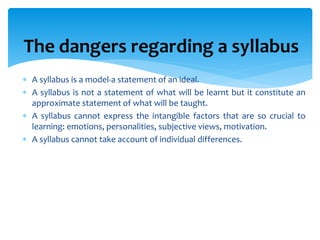
The dangers regarding a syllabus
 A syllabus is a model-a statement of an ideal.
 A syllabus is not a statement of what will be learnt but it constitute an
approximate statement of what will be taught.
 A syllabus cannot express the intangible factors that are so crucial to
learning: emotions, personalities, subjective views, motivation.
 A syllabus cannot take account of individual differences.
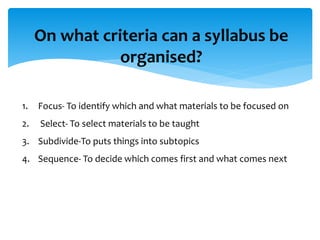
On what criteria can a syllabus be
organised?
1. Focus- To identify which and what materials to be focused on
2. Select- To select materials to be taught
3. Subdivide-To puts things into subtopics
4. Sequence- To decide which comes first and what comes next
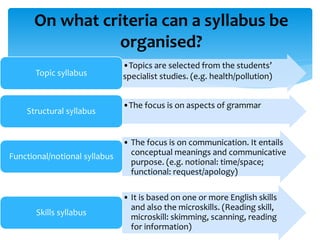
On what criteria can a syllabus be
organised?
•Topics are selected from the students’
specialist studies. (e.g. health/pollution)Topic syllabus
•The focus is on aspects of grammar
Structural syllabus
• The focus is on communication. It entails
conceptual meanings and communicative
purpose. (e.g. notional: time/space;
functional: request/apology)
Functional/notional syllabus
• It is based on one or more English skills
and also the microskills. (Reading skill,
microskill: skimming, scanning, reading
for information)
Skills syllabus
On what criteria can a syllabus be
organised?
• the situations or contexts in which the
language will be used and analyses the
language needed for those situations.
(e.g. classroom/post office/night market)
Situational syllabus
•consisting of a set of real world tasks or
activities ordered according to cognitive
difficulty. (e.g. organizing an event/writing a
report)
Task-based syllabus
•It emphasizes in communcation. Making
an oral presentation is an example of a
macroskill , including microskills such as
control of gestures and body language.
Discourse syllabus
What role should a syllabus play in
the course design process?
A language-centered approach
• Generates teaching materials
A skill-centered approach
• Presents opportunities for students to practise and evaluate skills and
strategies
A learning-centered approach
• Focus on learning process, it divides the design process into two levels
The post-hoc approach
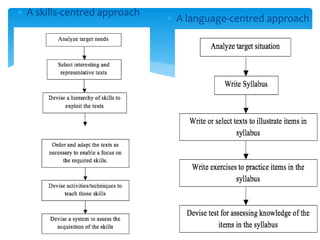
 A language-centred approach
 A skills-centred approach
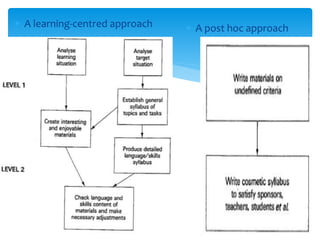
 A learning-centred approach  A post hoc approach
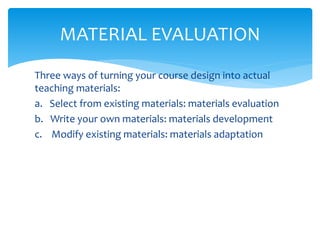
Three ways of turning your course design into actual
teaching materials:
a. Select from existing materials: materials evaluation
b. Write your own materials: materials development
c. Modify existing materials: materials adaptation
MATERIAL EVALUATION
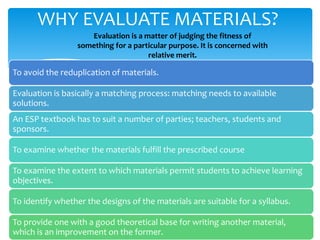
To avoid the reduplication of materials.
Evaluation is basically a matching process: matching needs to available
solutions.
An ESP textbook has to suit a number of parties; teachers, students and
sponsors.
To examine whether the materials fulfill the prescribed course
To examine the extent to which materials permit students to achieve learning
objectives.
To identify whether the designs of the materials are suitable for a syllabus.
To provide one with a good theoretical base for writing another material,
which is an improvement on the former.
WHY EVALUATE MATERIALS?
Evaluation is a matter of judging the fitness of
something for a particular purpose. It is concerned with
relative merit.
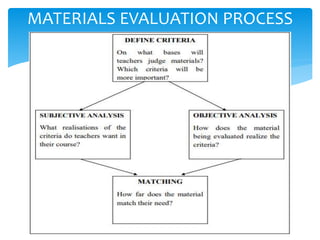
MATERIALS EVALUATION PROCESS
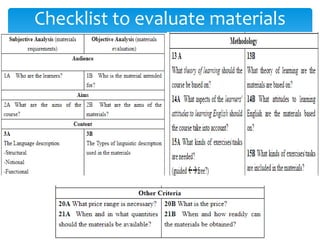
Checklist to evaluate materials
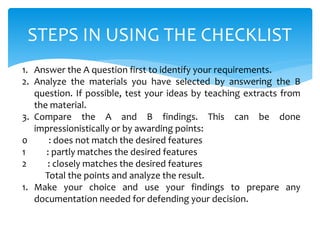
STEPS IN USING THE CHECKLIST
1. Answer the A question first to identify your requirements.
2. Analyze the materials you have selected by answering the B
question. If possible, test your ideas by teaching extracts from
the material.
3. Compare the A and B findings. This can be done
impressionistically or by awarding points:
0 : does not match the desired features
1 : partly matches the desired features
2 : closely matches the desired features
Total the points and analyze the result.
1. Make your choice and use your findings to prepare any
documentation needed for defending your decision.
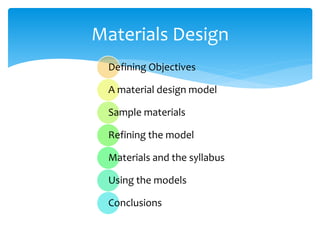
Materials Design
Defining Objectives
A material design model
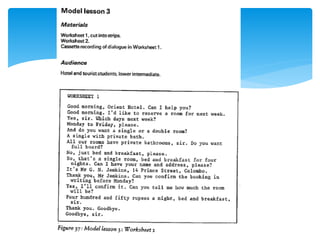
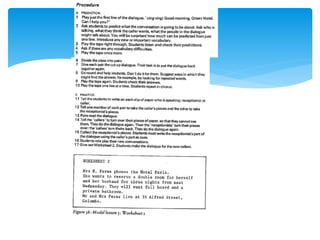
Sample materials
Refining the model
Materials and the syllabus
Using the models
Conclusions
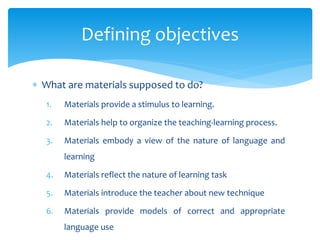
Defining objectives
 What are materials supposed to do?
1. Materials provide a stimulus to learning.
2. Materials help to organize the teaching-learning process.
3. Materials embody a view of the nature of language and
learning
4. Materials reflect the nature of learning task
5. Materials introduce the teacher about new technique
6. Materials provide models of correct and appropriate
language use
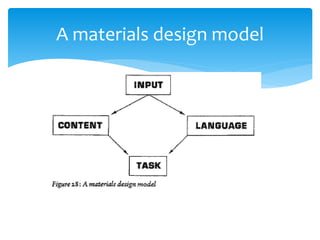
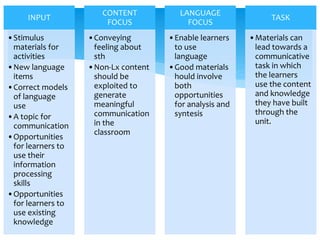
A materials design model
INPUT
•Stimulus
materials for
activities
•New language
items
•Correct models
of language
use
•A topic for
communication
•Opportunities
for learners to
use their
information
processing
skills
•Opportunities
for learners to
use existing
knowledge
CONTENT
FOCUS
•Conveying
feeling about
sth
•Non-Lx content
should be
exploited to
generate
meaningful
communication
in the
classroom
LANGUAGE
FOCUS
•Enable learners
to use
language
•Good materials
hould involve
both
opportunities
for analysis and
syntesis
TASK
•Materials can
lead towards a
communicative
task in which
the learners
use the content
and knowledge
they have built
through the
unit.
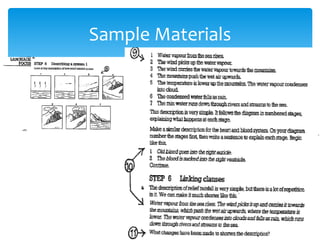
Sample Materials
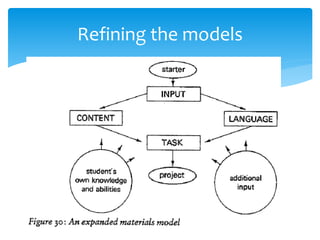
Refining the models
Materials and the syllabus
A model must be able to ensure adequate coverage
through the syllabus of all the features identified as
playing a role in the learning development. There needs
to be a coherence between the unit structure and the
syllabus structure to ensure that the course provides
adequate and appropriate coverage of syllabus items.
Unit interface
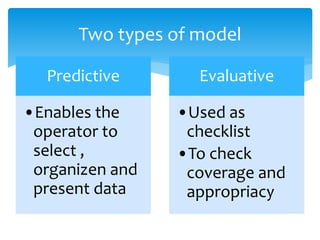
Two types of model
Predictive
•Enables the
operator to
select ,
organizen and
present data
Evaluative
•Used as
checklist
•To check
coverage and
appropriacy
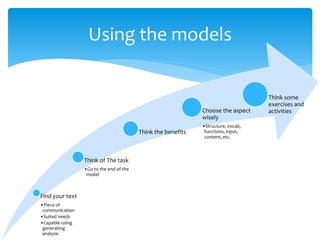
Using the models
Find your text
•Piece of
communication
•Suited needs
•Capable using
generating
analysis
Think of The task
•Go to the end of the
model
Think the benefits
Choose the aspect
wisely
•Structure, vocab,
functions, input,
content, etc.
Think some
exercises and
activities
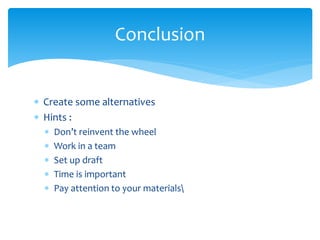
Conclusion
 Create some alternatives
 Hints :
 Don’t reinvent the wheel
 Work in a team
 Set up draft
 Time is important
 Pay attention to your materials
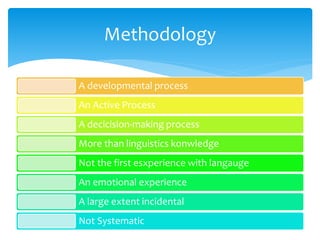
Methodology
Principles of language learning :
A developmental process
An Active Process
A decicision-making process
More than linguistics konwledge
Not the first esxperience with langauge
An emotional experience
A large extent incidental
Not Systematic
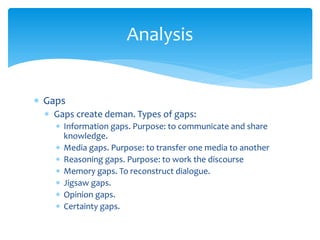
Analysis
 Gaps
 Gaps create deman. Types of gaps:
 Information gaps. Purpose: to communicate and share
knowledge.
 Media gaps. Purpose: to transfer one media to another
 Reasoning gaps. Purpose: to work the discourse
 Memory gaps. To reconstruct dialogue.
 Jigsaw gaps.
 Opinion gaps.
 Certainty gaps.
 Variety
 Spice of learning. How to achieve?
 Variety of medium: text, tape, etc.
 Variety of classroom organization: whole class, pair,
 Variety of learners roles: presenter, evaluator
 Variety of exercise
 Variety of skills: listening, writing
 Variety of topic
 Variety of focus
 Prediction
 A matter of using existing knowledge of a pattern or
system in order to anticipate what is likely in a novel
situation.
 It builds learners confidence
 It enables teacher to discover where the gaps in
knowledge
 It activates the learner’s mind
 It gives the students ego investment.
 Enjoyment
 An integrated method
 Use range of skills
 Coherence
 Should be clear
 Preparations
 Involvement
 Atmosphere
EVALUATION
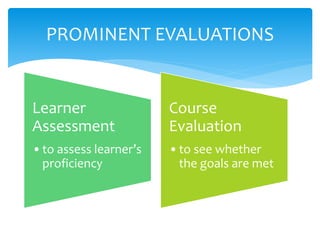
PROMINENT EVALUATIONS
Learner
Assessment
•to assess learner’s
proficiency
Course
Evaluation
•to see whether
the goals are met
Learner Assessment
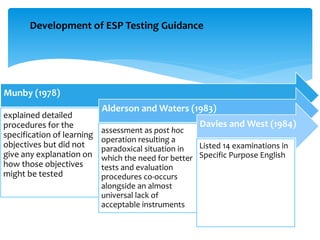
Munby (1978)
explained detailed
procedures for the
specification of learning
objectives but did not
give any explanation on
how those objectives
might be tested
Alderson and Waters (1983)
assessment as post hoc
operation resulting a
paradoxical situation in
which the need for better
tests and evaluation
procedures co-occurs
alongside an almost
universal lack of
acceptable instruments
Davies and West (1984)
Listed 14 examinations in
Specific Purpose English
Development of ESP Testing Guidance
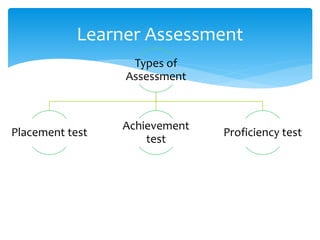
Learner Assessment
Types of
Assessment
Placement test
Achievement
test
Proficiency test
Placement test
 to determine the learner’s state of knowledge before the course begins
 to put learners into the course suitable to their needs
 this test is diagnostic to indicate how far and in what ways the learners
falls short of the proficiency level.
 good placement test should reveal positive factors, not just show the
learner lacks but also his potential that can be exploited in ESP course.
 problems: do the test can accurately diagnose the learner’s needs?
 what’s important is that any placement test can only be approximate
guide and should be treated with due caution.
Achievement test
 to see how well the learners keep up with the syllabus
 principles:
- test what the students have learnt
- test what to test
- no bias in the test
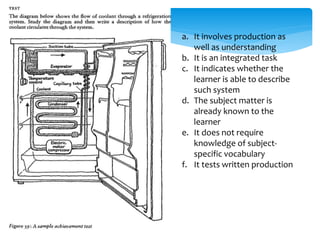
a. It involves production as
well as understanding
b. It is an integrated task
c. It indicates whether the
learner is able to describe
such system
d. The subject matter is
already known to the
learner
e. It does not require
knowledge of subject-
specific vocabulary
f. It tests written production
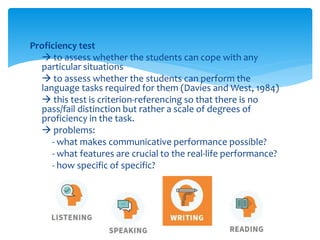
Proficiency test
 to assess whether the students can cope with any
particular situations
 to assess whether the students can perform the
language tasks required for them (Davies and West, 1984)
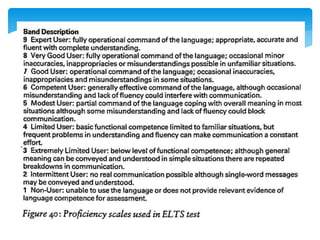
 this test is criterion-referencing so that there is no
pass/fail distinction but rather a scale of degrees of
proficiency in the task.
 problems:
- what makes communicative performance possible?
- what features are crucial to the real-life performance?
- how specific of specific?
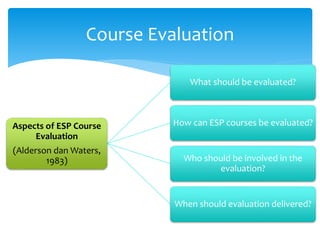
Course Evaluation
Aspects of ESP Course
Evaluation
(Alderson dan Waters,
1983)
What should be evaluated?
How can ESP courses be evaluated?
Who should be involved in the
evaluation?
When should evaluation delivered?
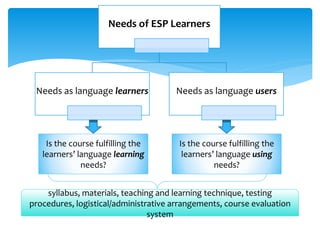
What should be evaluated?
Needs of ESP Learners
Needs as language learners Needs as language users
Is the course fulfilling the
learners’ language learning
needs?
Is the course fulfilling the
learners’ language using
needs?
syllabus, materials, teaching and learning technique, testing
procedures, logistical/administrative arrangements, course evaluation
system
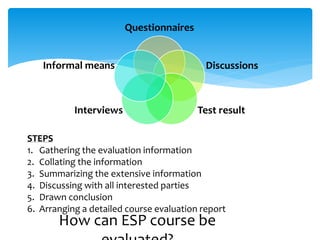
How can ESP course be
Questionnaires
Discussions
Test resultInterviews
Informal means
STEPS
1. Gathering the evaluation information
2. Collating the information
3. Summarizing the extensive information
4. Discussing with all interested parties
5. Drawn conclusion
6. Arranging a detailed course evaluation report
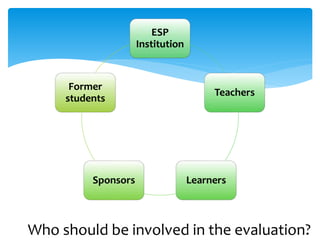
Who should be involved in the evaluation?
ESP
Institution
Teachers
LearnersSponsors
Former
students
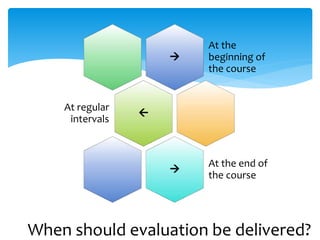
When should evaluation be delivered?

At the
beginning of
the course

At regular
intervals

At the end of
the course
Esp section 3 application

Esp section 3 application

  • 1.
    Section 3. Application AnnisaRatna Nurrahma Fatkhia Dewi Norma
  • 2.
  • 3.
     What dowe mean by a syllabus? (further layers of interpretation)  Why should we have a syllabus? (Reasons for having a syllabus)  On what criteria can a syllabus be organised? (Different criteria)  What role should a syllabus play in the course design process? (approaches) Points to be Discussed
  • 4.
     A planof what is to be achieved through teaching and learning, identifying what will be worked on in reaching the overall course aims and providing a basis for evaluating students’ progress (Hyland, 2006).  Five steps in designing a syllabus: 1. needs analysis, 2. objectives, 3. sequencing, 4. teaching methods, 5. testing and evaluation. (Yalden,1983) What is a syllabus?
  • 5.
    The evaluation syllabus Theorganisational syllabus The materials syllabus The teacher syllabus The classroom syllabus The learner syllabus Further layers of interpretation (Hutchinson and Waters, 1987).
  • 6.
     It focuseson what successful learner will know by the end of the course.  It is concerned with “the nature of language and linguistic performance”  It puts record the basis on which success or failure will be evaluated.  It is the most familiar type as the document handed down by ministries or other regulating bodies. The evaluation syllabus
  • 7.
     It statesthe order in which it is to be studied.  It is an implicit statement about the nature of language and learning.  It differs from the evaluation syllabus in that: 1. It carries assumptions about the nature of learning as well as language in organizing items in a syllabus. 2. It is necessary to consider factors which depend upon a view of how people learn. (e.g. What is more easily learnt? What is more useful in the classroom? Are some items needed in order to learn other items? The organisational syllabus
  • 8.
    The materials syllabus •It does not describe how learning will be achieved. • Interpreted by the materials writer. • The author adds more assumption about the nature of language, language learning, and language use
  • 9.
     The greatmajority of students in the world learn through the mediation of a teacher.  Teacher can influence the clarity, intensity, and frequency of any item and affect the image that the learner receive.  Different capability of teachers will bring different result in conducting the course/classroom. The teacher syllabus
  • 10.
     What isplanned and what actually happens are different things.  A classroom is a dynamic and interactive environment  A lesson is a communicative event created by the interactions.  A classroom creates condition affecting the nature of a planned lesson. (eg. Hot weather, tired students, noise, interruption, etc) The classroom syllabus
  • 11.
    The learner syllabus It is an internal syllabus.  It is a retrospective record of what has been studied rather than a prospective plan of what will be studied.  It crucially influences on whether and how future knowledge is studied.  Learners must be taken into account on a continuing basis through every stage of the course design process.
  • 12.
    Why should wehave a syllabus?  Language is a complex entity, it cannot be learnt is a very short time.  Better management of study time, assessments, and reading materials.  In practical benefits, a syllabus gives moral support to the teacher and learner  An ESP syllabus is a projected route (the teacher and learners will know where they’re going and how they get there)  A syllabus provides a set of criteria for material selection and writing.  A syllabus as a standardizing tool.  It is a visible basis for testing.
  • 13.
    The dangers regardinga syllabus  A syllabus is a model-a statement of an ideal.  A syllabus is not a statement of what will be learnt but it constitute an approximate statement of what will be taught.  A syllabus cannot express the intangible factors that are so crucial to learning: emotions, personalities, subjective views, motivation.  A syllabus cannot take account of individual differences.
  • 14.
    On what criteriacan a syllabus be organised? 1. Focus- To identify which and what materials to be focused on 2. Select- To select materials to be taught 3. Subdivide-To puts things into subtopics 4. Sequence- To decide which comes first and what comes next
  • 15.
    On what criteriacan a syllabus be organised? •Topics are selected from the students’ specialist studies. (e.g. health/pollution)Topic syllabus •The focus is on aspects of grammar Structural syllabus • The focus is on communication. It entails conceptual meanings and communicative purpose. (e.g. notional: time/space; functional: request/apology) Functional/notional syllabus • It is based on one or more English skills and also the microskills. (Reading skill, microskill: skimming, scanning, reading for information) Skills syllabus
  • 16.
    On what criteriacan a syllabus be organised? • the situations or contexts in which the language will be used and analyses the language needed for those situations. (e.g. classroom/post office/night market) Situational syllabus •consisting of a set of real world tasks or activities ordered according to cognitive difficulty. (e.g. organizing an event/writing a report) Task-based syllabus •It emphasizes in communcation. Making an oral presentation is an example of a macroskill , including microskills such as control of gestures and body language. Discourse syllabus
  • 17.
    What role shoulda syllabus play in the course design process? A language-centered approach • Generates teaching materials A skill-centered approach • Presents opportunities for students to practise and evaluate skills and strategies A learning-centered approach • Focus on learning process, it divides the design process into two levels The post-hoc approach
  • 18.
     A language-centredapproach  A skills-centred approach
  • 19.
     A learning-centredapproach  A post hoc approach
  • 20.
    Three ways ofturning your course design into actual teaching materials: a. Select from existing materials: materials evaluation b. Write your own materials: materials development c. Modify existing materials: materials adaptation MATERIAL EVALUATION
  • 21.
    To avoid thereduplication of materials. Evaluation is basically a matching process: matching needs to available solutions. An ESP textbook has to suit a number of parties; teachers, students and sponsors. To examine whether the materials fulfill the prescribed course To examine the extent to which materials permit students to achieve learning objectives. To identify whether the designs of the materials are suitable for a syllabus. To provide one with a good theoretical base for writing another material, which is an improvement on the former. WHY EVALUATE MATERIALS? Evaluation is a matter of judging the fitness of something for a particular purpose. It is concerned with relative merit.
  • 22.
  • 23.
  • 24.
    STEPS IN USINGTHE CHECKLIST 1. Answer the A question first to identify your requirements. 2. Analyze the materials you have selected by answering the B question. If possible, test your ideas by teaching extracts from the material. 3. Compare the A and B findings. This can be done impressionistically or by awarding points: 0 : does not match the desired features 1 : partly matches the desired features 2 : closely matches the desired features Total the points and analyze the result. 1. Make your choice and use your findings to prepare any documentation needed for defending your decision.
  • 25.
    Materials Design Defining Objectives Amaterial design model Sample materials Refining the model Materials and the syllabus Using the models Conclusions
  • 26.
    Defining objectives  Whatare materials supposed to do? 1. Materials provide a stimulus to learning. 2. Materials help to organize the teaching-learning process. 3. Materials embody a view of the nature of language and learning 4. Materials reflect the nature of learning task 5. Materials introduce the teacher about new technique 6. Materials provide models of correct and appropriate language use
  • 27.
  • 28.
    INPUT •Stimulus materials for activities •New language items •Correctmodels of language use •A topic for communication •Opportunities for learners to use their information processing skills •Opportunities for learners to use existing knowledge CONTENT FOCUS •Conveying feeling about sth •Non-Lx content should be exploited to generate meaningful communication in the classroom LANGUAGE FOCUS •Enable learners to use language •Good materials hould involve both opportunities for analysis and syntesis TASK •Materials can lead towards a communicative task in which the learners use the content and knowledge they have built through the unit.
  • 29.
  • 30.
  • 31.
    Materials and thesyllabus A model must be able to ensure adequate coverage through the syllabus of all the features identified as playing a role in the learning development. There needs to be a coherence between the unit structure and the syllabus structure to ensure that the course provides adequate and appropriate coverage of syllabus items.
  • 32.
  • 33.
    Two types ofmodel Predictive •Enables the operator to select , organizen and present data Evaluative •Used as checklist •To check coverage and appropriacy
  • 34.
    Using the models Findyour text •Piece of communication •Suited needs •Capable using generating analysis Think of The task •Go to the end of the model Think the benefits Choose the aspect wisely •Structure, vocab, functions, input, content, etc. Think some exercises and activities
  • 35.
    Conclusion  Create somealternatives  Hints :  Don’t reinvent the wheel  Work in a team  Set up draft  Time is important  Pay attention to your materials
  • 36.
    Methodology Principles of languagelearning : A developmental process An Active Process A decicision-making process More than linguistics konwledge Not the first esxperience with langauge An emotional experience A large extent incidental Not Systematic
  • 39.
    Analysis  Gaps  Gapscreate deman. Types of gaps:  Information gaps. Purpose: to communicate and share knowledge.  Media gaps. Purpose: to transfer one media to another  Reasoning gaps. Purpose: to work the discourse  Memory gaps. To reconstruct dialogue.  Jigsaw gaps.  Opinion gaps.  Certainty gaps.
  • 40.
     Variety  Spiceof learning. How to achieve?  Variety of medium: text, tape, etc.  Variety of classroom organization: whole class, pair,  Variety of learners roles: presenter, evaluator  Variety of exercise  Variety of skills: listening, writing  Variety of topic  Variety of focus
  • 41.
     Prediction  Amatter of using existing knowledge of a pattern or system in order to anticipate what is likely in a novel situation.  It builds learners confidence  It enables teacher to discover where the gaps in knowledge  It activates the learner’s mind  It gives the students ego investment.
  • 42.
     Enjoyment  Anintegrated method  Use range of skills  Coherence  Should be clear  Preparations  Involvement  Atmosphere
  • 43.
  • 44.
    PROMINENT EVALUATIONS Learner Assessment •to assesslearner’s proficiency Course Evaluation •to see whether the goals are met
  • 45.
    Learner Assessment Munby (1978) explaineddetailed procedures for the specification of learning objectives but did not give any explanation on how those objectives might be tested Alderson and Waters (1983) assessment as post hoc operation resulting a paradoxical situation in which the need for better tests and evaluation procedures co-occurs alongside an almost universal lack of acceptable instruments Davies and West (1984) Listed 14 examinations in Specific Purpose English Development of ESP Testing Guidance
  • 46.
    Learner Assessment Types of Assessment Placementtest Achievement test Proficiency test
  • 47.
    Placement test  todetermine the learner’s state of knowledge before the course begins  to put learners into the course suitable to their needs  this test is diagnostic to indicate how far and in what ways the learners falls short of the proficiency level.  good placement test should reveal positive factors, not just show the learner lacks but also his potential that can be exploited in ESP course.  problems: do the test can accurately diagnose the learner’s needs?  what’s important is that any placement test can only be approximate guide and should be treated with due caution. Achievement test  to see how well the learners keep up with the syllabus  principles: - test what the students have learnt - test what to test - no bias in the test
  • 48.
    a. It involvesproduction as well as understanding b. It is an integrated task c. It indicates whether the learner is able to describe such system d. The subject matter is already known to the learner e. It does not require knowledge of subject- specific vocabulary f. It tests written production
  • 49.
    Proficiency test  toassess whether the students can cope with any particular situations  to assess whether the students can perform the language tasks required for them (Davies and West, 1984)  this test is criterion-referencing so that there is no pass/fail distinction but rather a scale of degrees of proficiency in the task.  problems: - what makes communicative performance possible? - what features are crucial to the real-life performance? - how specific of specific?
  • 51.
    Course Evaluation Aspects ofESP Course Evaluation (Alderson dan Waters, 1983) What should be evaluated? How can ESP courses be evaluated? Who should be involved in the evaluation? When should evaluation delivered?
  • 52.
    What should beevaluated? Needs of ESP Learners Needs as language learners Needs as language users Is the course fulfilling the learners’ language learning needs? Is the course fulfilling the learners’ language using needs? syllabus, materials, teaching and learning technique, testing procedures, logistical/administrative arrangements, course evaluation system
  • 53.
    How can ESPcourse be Questionnaires Discussions Test resultInterviews Informal means STEPS 1. Gathering the evaluation information 2. Collating the information 3. Summarizing the extensive information 4. Discussing with all interested parties 5. Drawn conclusion 6. Arranging a detailed course evaluation report
  • 54.
    Who should beinvolved in the evaluation? ESP Institution Teachers LearnersSponsors Former students
  • 55.
    When should evaluationbe delivered?  At the beginning of the course  At regular intervals  At the end of the course