• Pakistani English is heavily influenced by pakistan’s
regional languages as well as English of other
nations.
• According to Mahboob (2004: 1045), says that
Pakistani English (PakE) is one of the less well
researched varieties of English. The largest body of
research on PakE is focuses on its historical and
political status.
 Anthropologist had observed that socio-historical
forces determine cultural patterns, it appears that
culture determine language and language in turn
determines consciousness.
 With this in mind, it is possible to understand the
lexical and semantic changes English has had to
undergo in order to refer to the distinctive culture of
PE as it has taken shape after the separation from
India in 1947.
 Mubina Tallat published an article on lexical
variation in PE (Tallat 1993: 55-62).
 Ahmar Mahboob wrote on the Islamization, a
concept which included borrowing from Arabic
vocabulary of Urdu, in PE (Mahboob 2009).
 some words in PE which are not shared with IE are
those relating to Islam, pakistani culture and history.
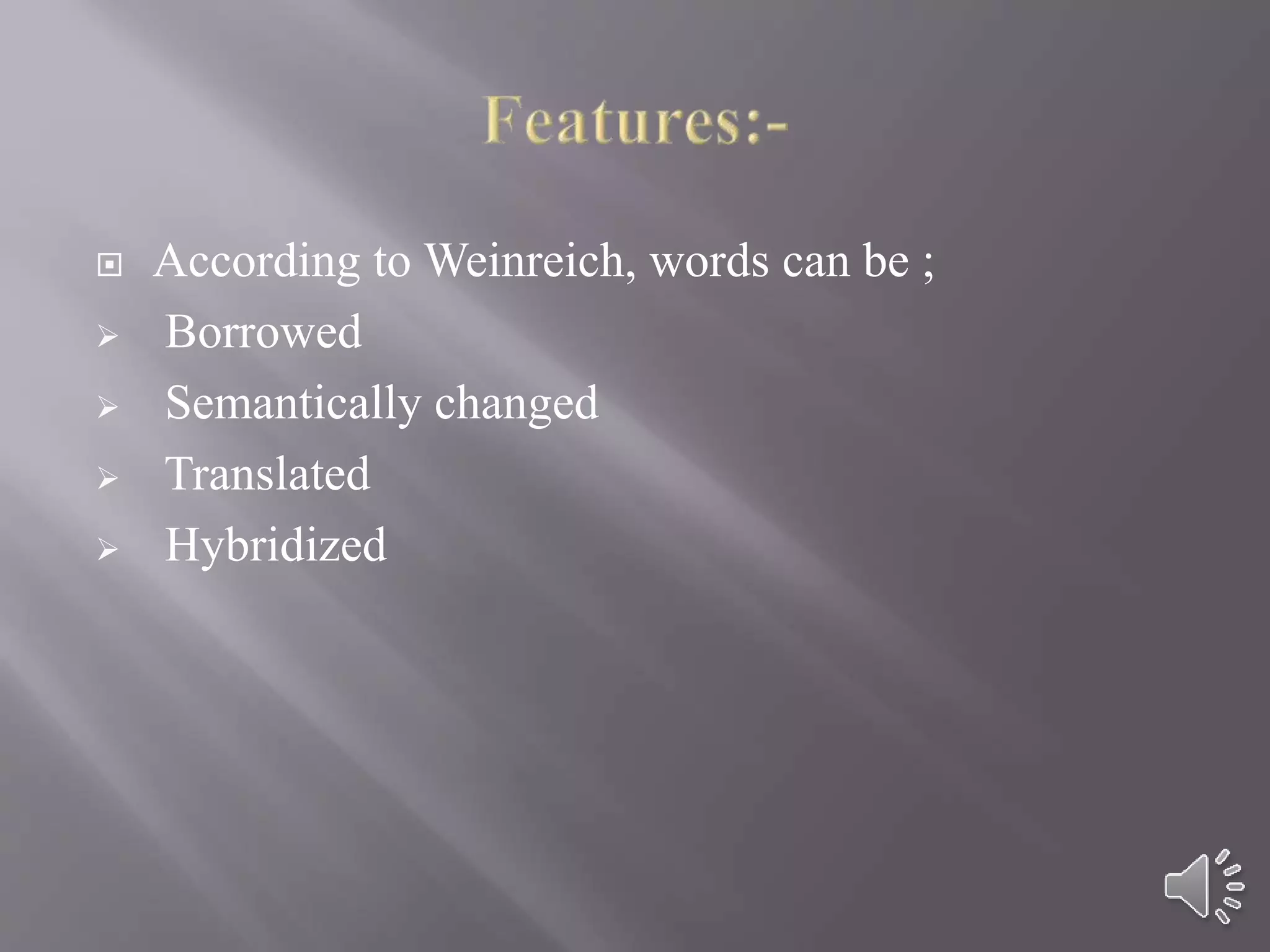
 According to Weinreich, words can be ;
 Borrowed
 Semantically changed
 Translated
 Hybridized
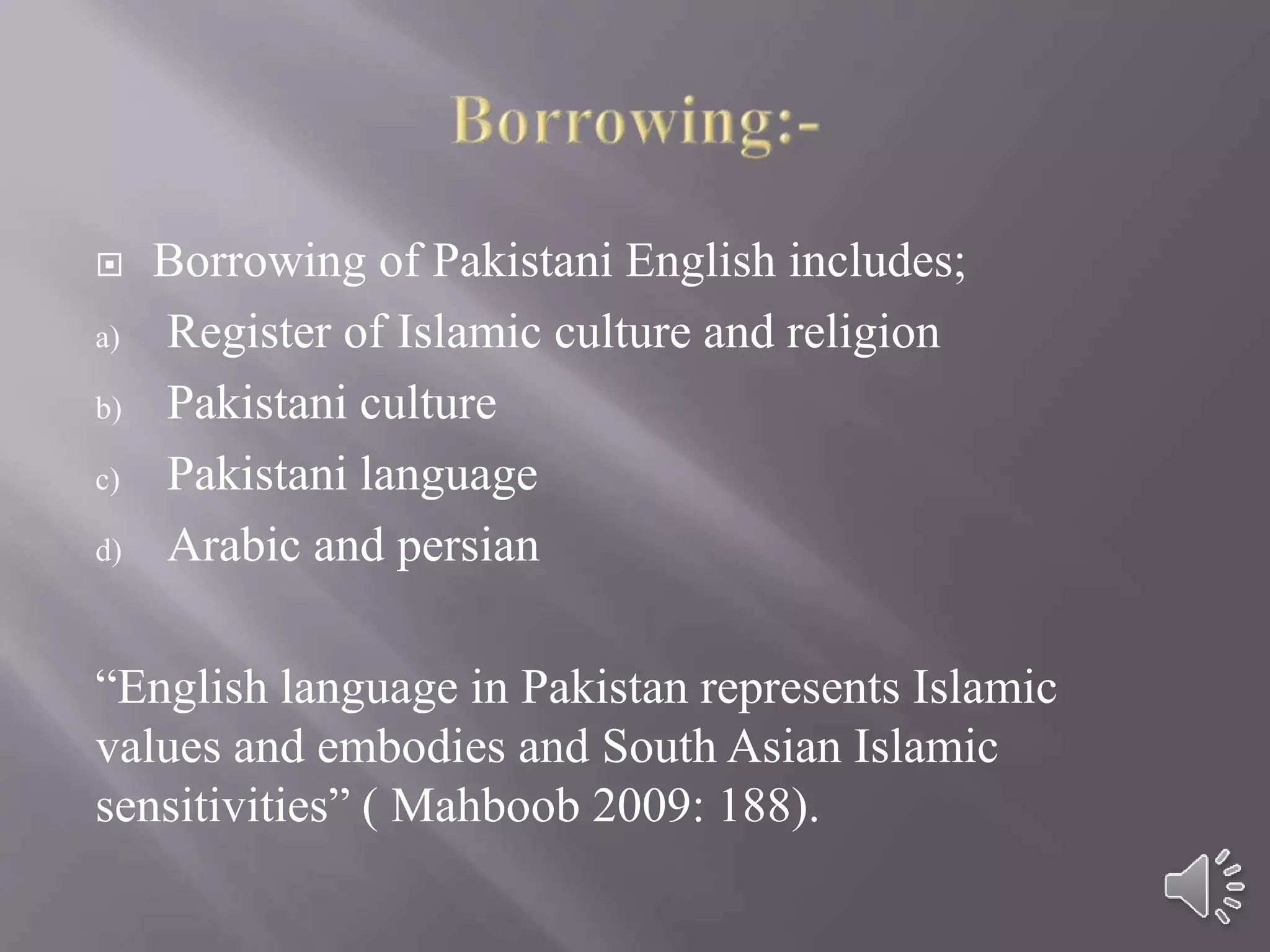
 Borrowing of Pakistani English includes;
a) Register of Islamic culture and religion
b) Pakistani culture
c) Pakistani language
d) Arabic and persian
“English language in Pakistan represents Islamic
values and embodies and South Asian Islamic
sensitivities” ( Mahboob 2009: 188).
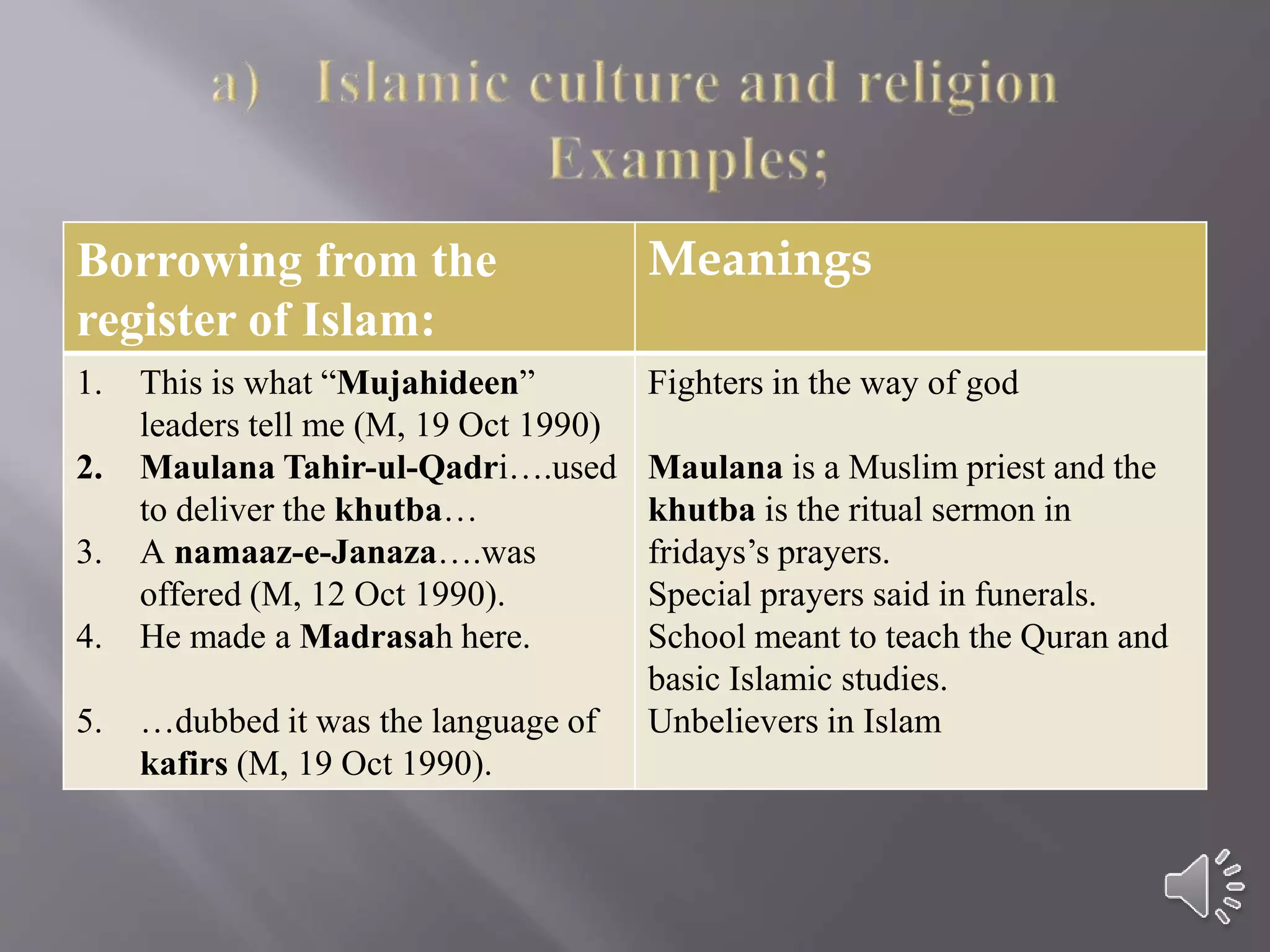
Borrowing from the
register of Islam:
Meanings
1. This is what “Mujahideen”
leaders tell me (M, 19 Oct 1990)
2. Maulana Tahir-ul-Qadri….used
to deliver the khutba…
3. A namaaz-e-Janaza….was
offered (M, 12 Oct 1990).
4. He made a Madrasah here.
5. …dubbed it was the language of
kafirs (M, 19 Oct 1990).
Fighters in the way of god
Maulana is a Muslim priest and the
khutba is the ritual sermon in
fridays’s prayers.
Special prayers said in funerals.
School meant to teach the Quran and
basic Islamic studies.
Unbelievers in Islam
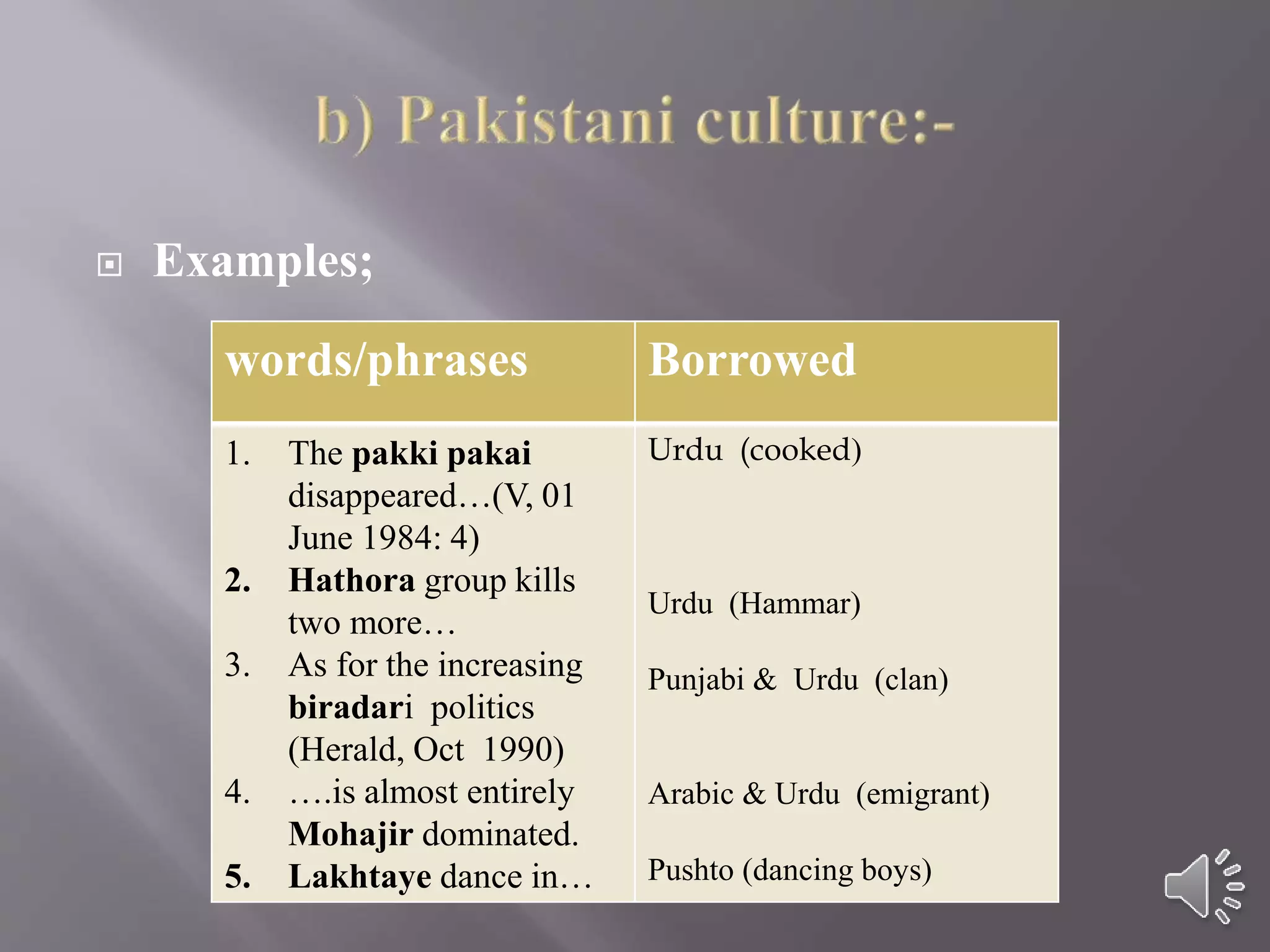
 Examples;
words/phrases Borrowed
1. The pakki pakai
disappeared…(V, 01
June 1984: 4)
2. Hathora group kills
two more…
3. As for the increasing
biradari politics
(Herald, Oct 1990)
4. ….is almost entirely
Mohajir dominated.
5. Lakhtaye dance in…
Urdu (cooked)
Urdu (Hammar)
Punjabi & Urdu (clan)
Arabic & Urdu (emigrant)
Pushto (dancing boys)
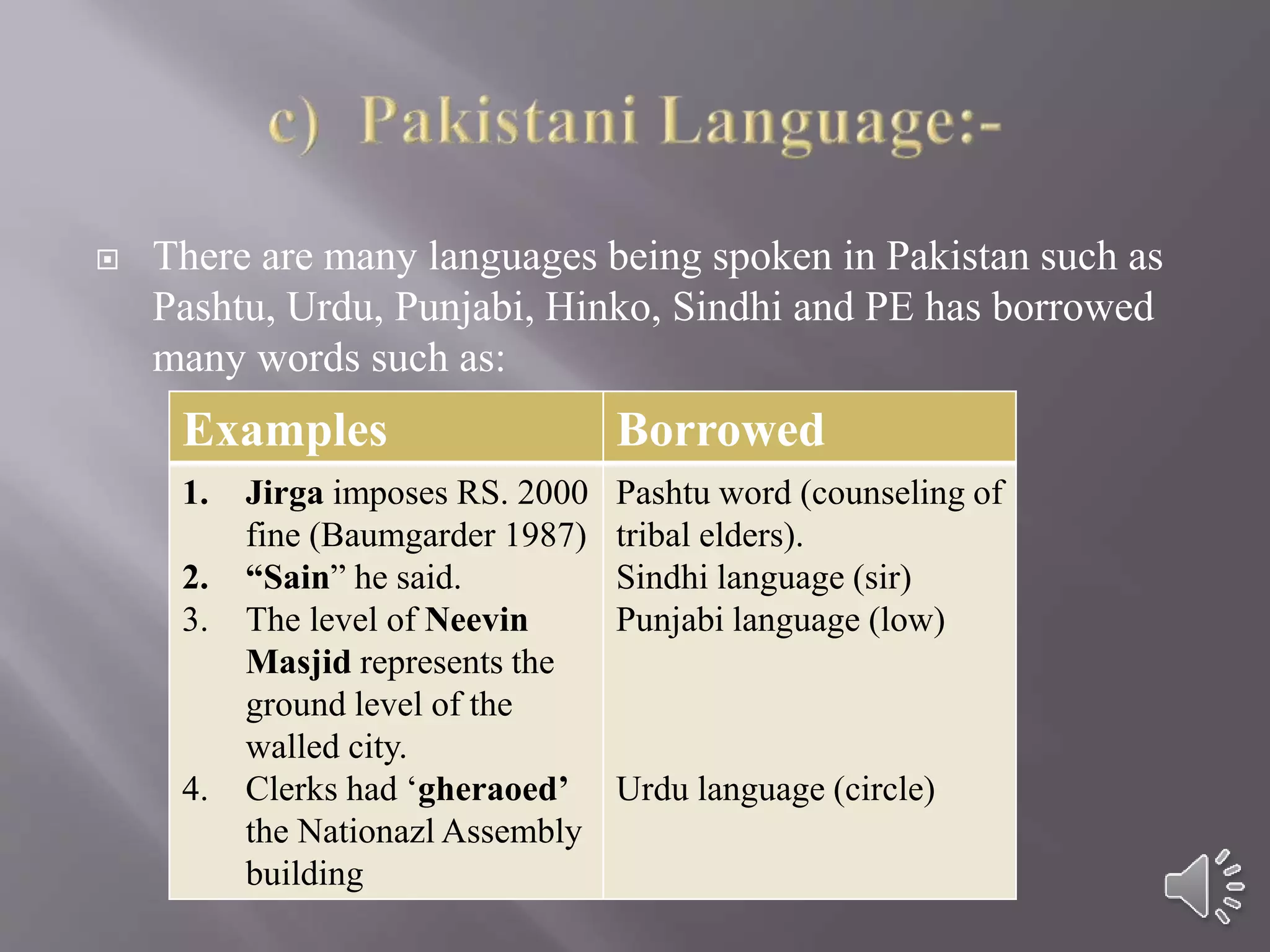
 There are many languages being spoken in Pakistan such as
Pashtu, Urdu, Punjabi, Hinko, Sindhi and PE has borrowed
many words such as:
Examples Borrowed
1. Jirga imposes RS. 2000
fine (Baumgarder 1987)
2. “Sain” he said.
3. The level of Neevin
Masjid represents the
ground level of the
walled city.
4. Clerks had ‘gheraoed’
the Nationazl Assembly
building
Pashtu word (counseling of
tribal elders).
Sindhi language (sir)
Punjabi language (low)
Urdu language (circle)
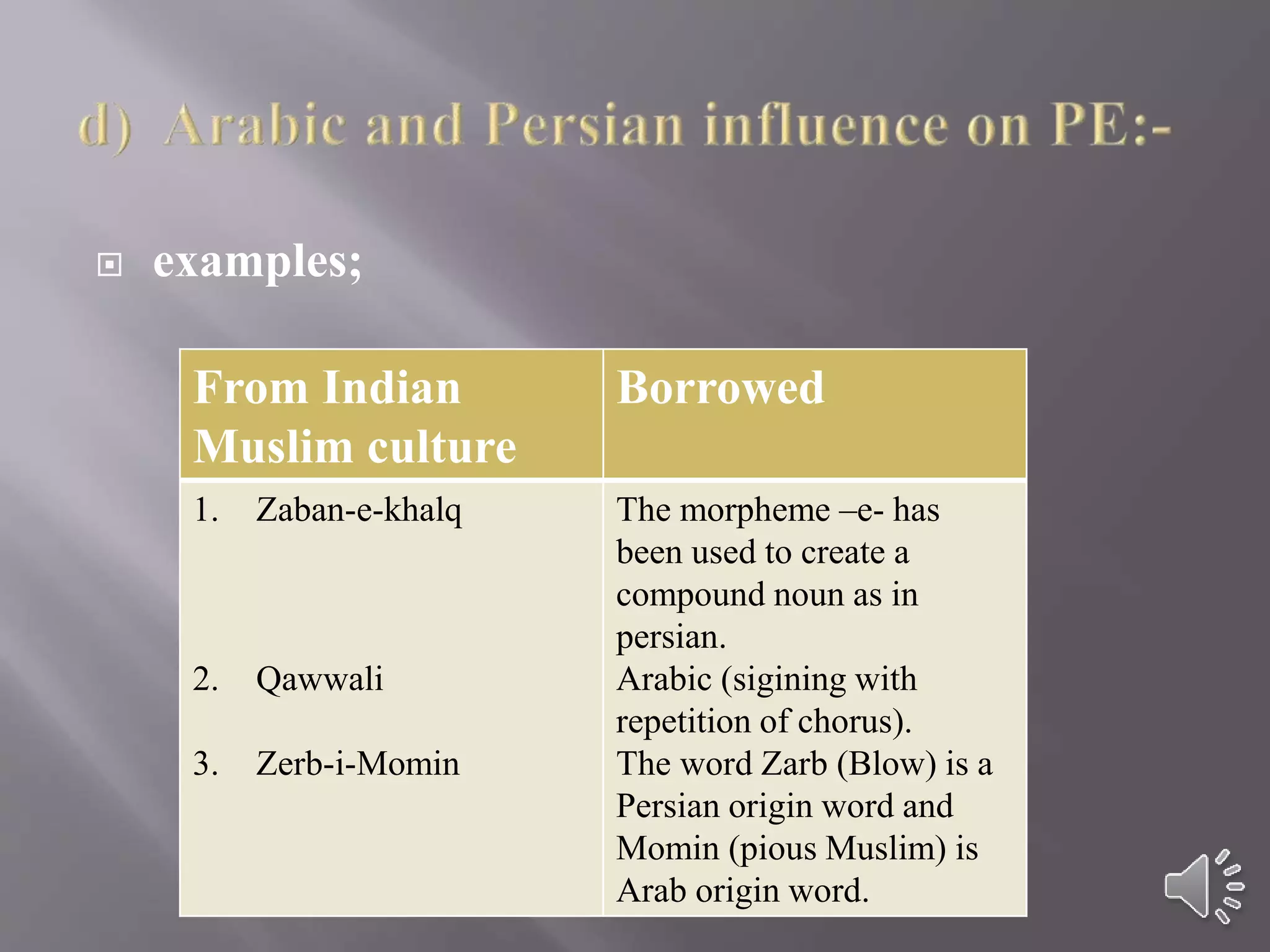
 examples;
From Indian
Muslim culture
Borrowed
1. Zaban-e-khalq
2. Qawwali
3. Zerb-i-Momin
The morpheme –e- has
been used to create a
compound noun as in
persian.
Arabic (sigining with
repetition of chorus).
The word Zarb (Blow) is a
Persian origin word and
Momin (pious Muslim) is
Arab origin word.
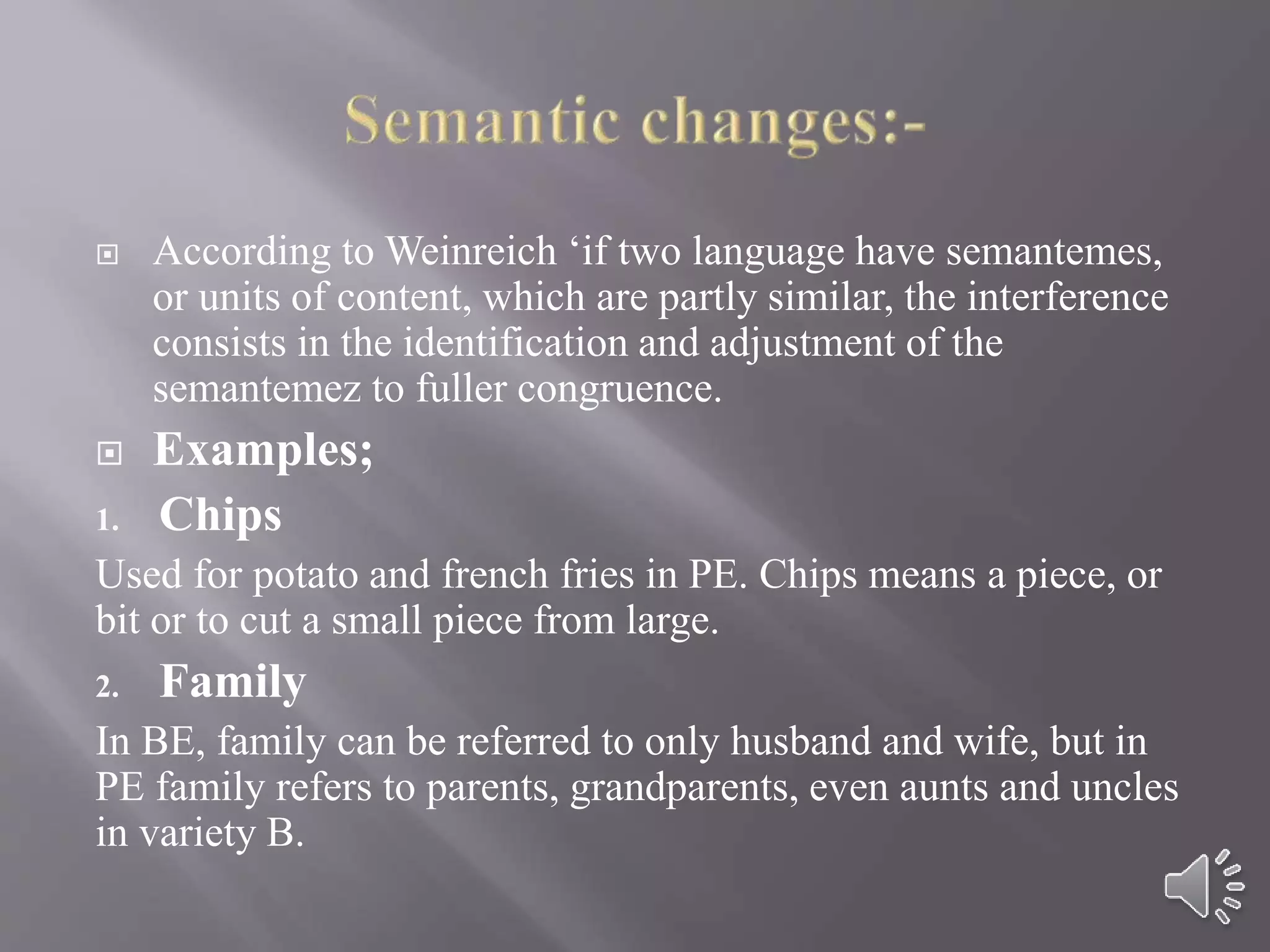
 According to Weinreich ‘if two language have semantemes,
or units of content, which are partly similar, the interference
consists in the identification and adjustment of the
semantemez to fuller congruence.
 Examples;
1. Chips
Used for potato and french fries in PE. Chips means a piece, or
bit or to cut a small piece from large.
2. Family
In BE, family can be referred to only husband and wife, but in
PE family refers to parents, grandparents, even aunts and uncles
in variety B.
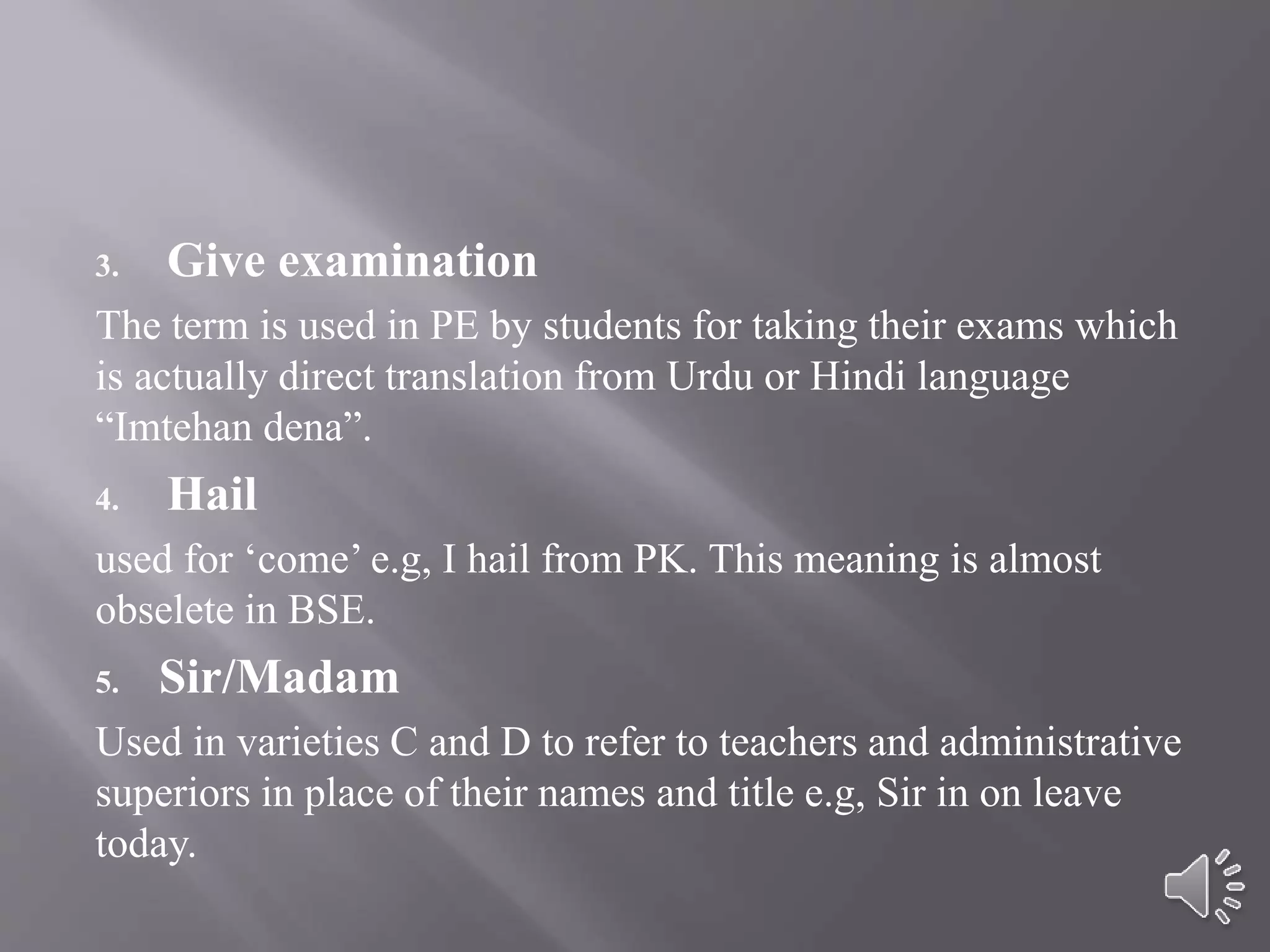
3. Give examination
The term is used in PE by students for taking their exams which
is actually direct translation from Urdu or Hindi language
“Imtehan dena”.
4. Hail
used for ‘come’ e.g, I hail from PK. This meaning is almost
obselete in BSE.
5. Sir/Madam
Used in varieties C and D to refer to teachers and administrative
superiors in place of their names and title e.g, Sir in on leave
today.
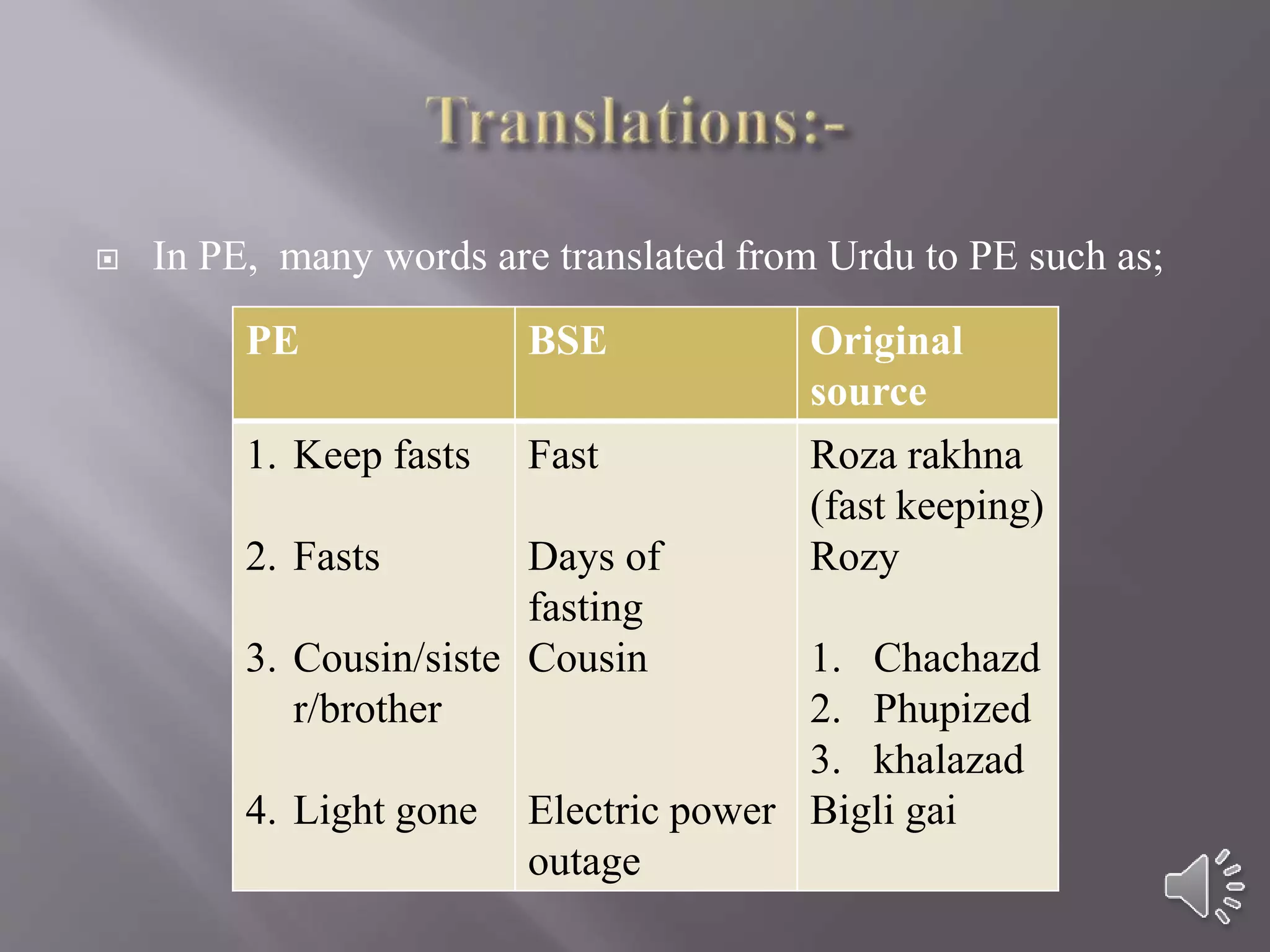
 In PE, many words are translated from Urdu to PE such as;
PE BSE Original
source
1. Keep fasts
2. Fasts
3. Cousin/siste
r/brother
4. Light gone
Fast
Days of
fasting
Cousin
Electric power
outage
Roza rakhna
(fast keeping)
Rozy
1. Chachazd
2. Phupized
3. khalazad
Bigli gai
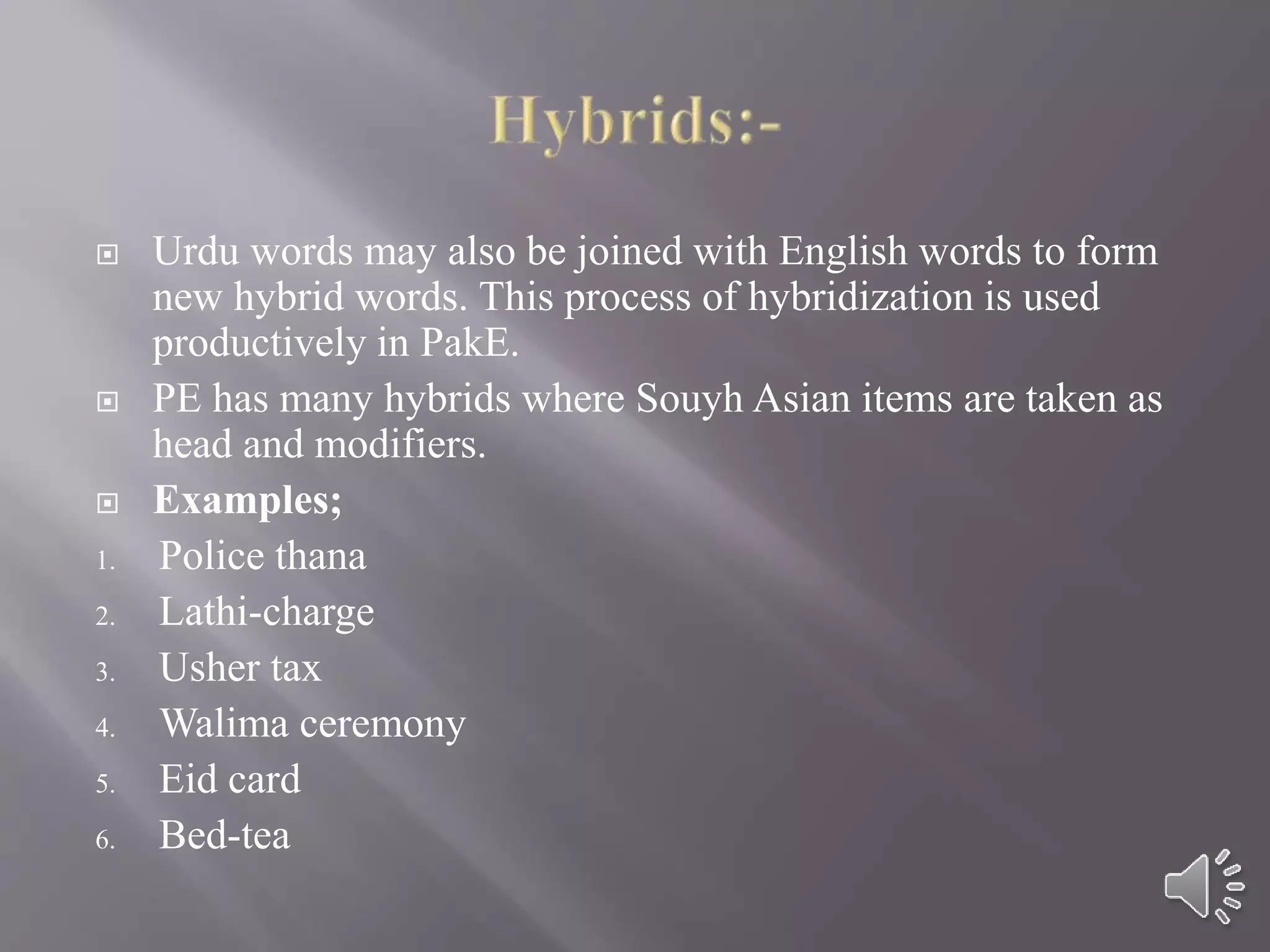
 Urdu words may also be joined with English words to form
new hybrid words. This process of hybridization is used
productively in PakE.
 PE has many hybrids where Souyh Asian items are taken as
head and modifiers.
 Examples;
1. Police thana
2. Lathi-charge
3. Usher tax
4. Walima ceremony
5. Eid card
6. Bed-tea
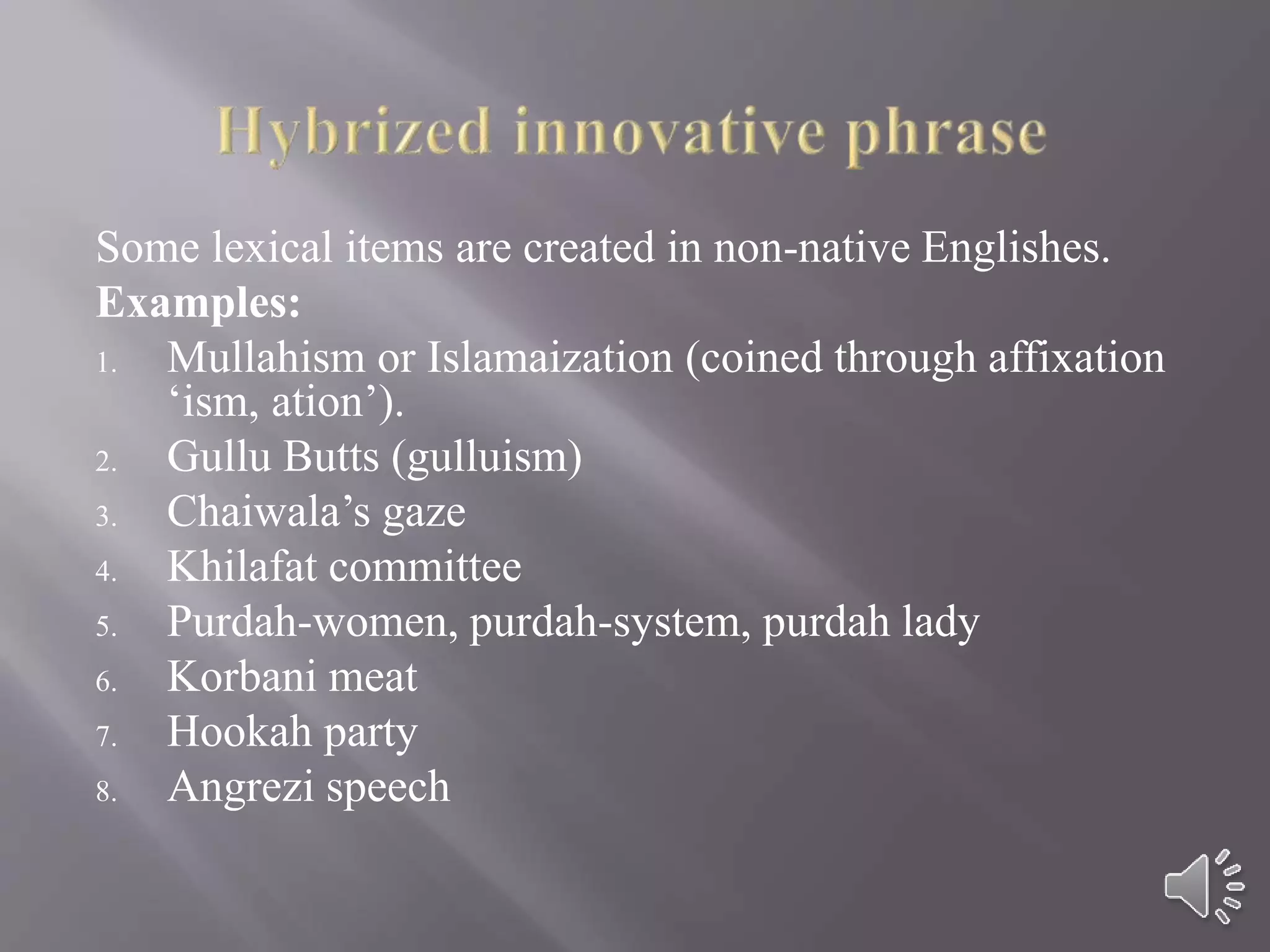
Some lexical items are created in non-native Englishes.
Examples:
1. Mullahism or Islamaization (coined through affixation
‘ism, ation’).
2. Gullu Butts (gulluism)
3. Chaiwala’s gaze
4. Khilafat committee
5. Purdah-women, purdah-system, purdah lady
6. Korbani meat
7. Hookah party
8. Angrezi speech
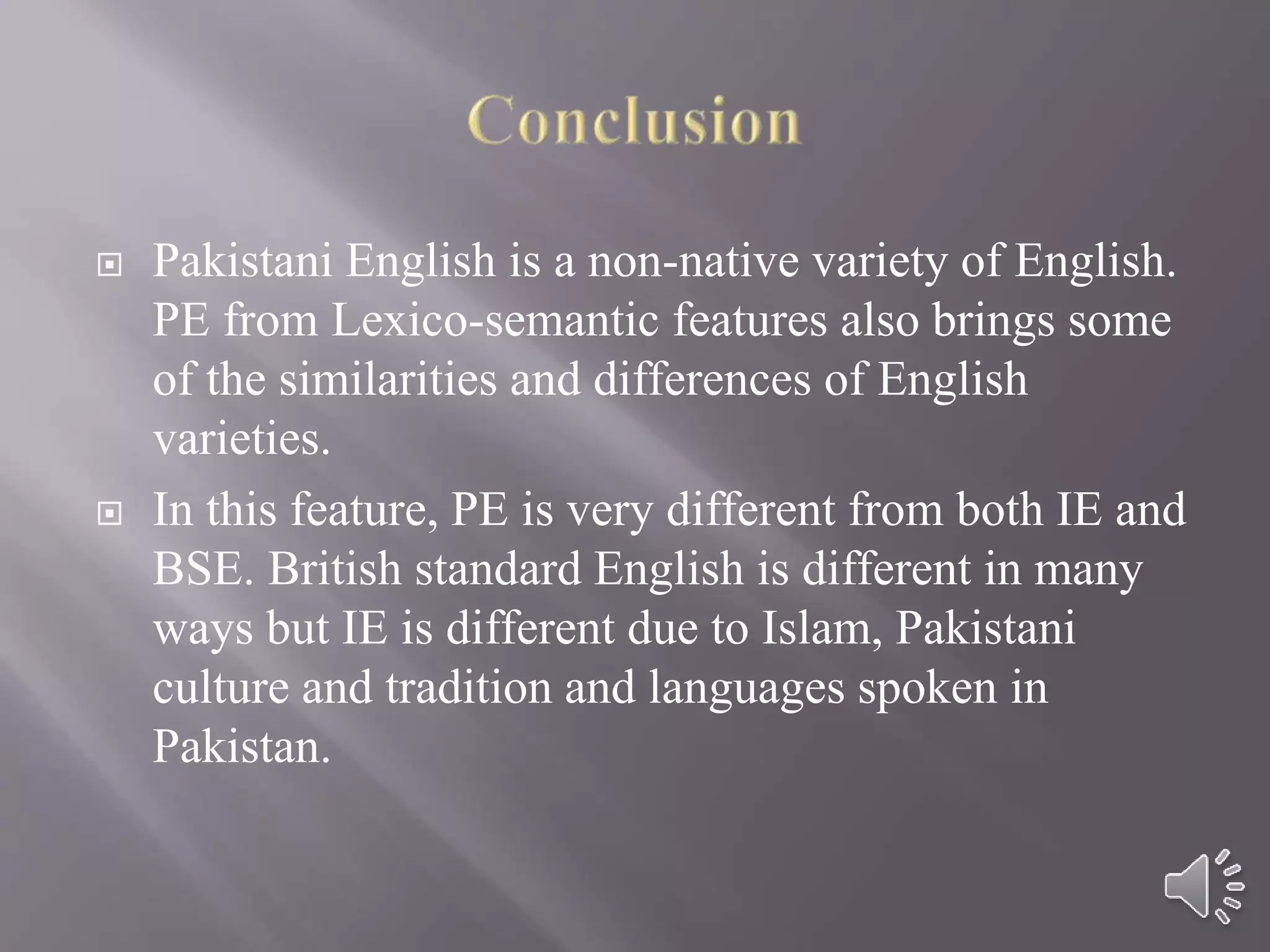
 Pakistani English is a non-native variety of English.
PE from Lexico-semantic features also brings some
of the similarities and differences of English
varieties.
 In this feature, PE is very different from both IE and
BSE. British standard English is different in many
ways but IE is different due to Islam, Pakistani
culture and tradition and languages spoken in
Pakistan.

Lexical and semantic features of Pakistani English

  • 2.
    • Pakistani Englishis heavily influenced by pakistan’s regional languages as well as English of other nations. • According to Mahboob (2004: 1045), says that Pakistani English (PakE) is one of the less well researched varieties of English. The largest body of research on PakE is focuses on its historical and political status.
  • 3.
     Anthropologist hadobserved that socio-historical forces determine cultural patterns, it appears that culture determine language and language in turn determines consciousness.  With this in mind, it is possible to understand the lexical and semantic changes English has had to undergo in order to refer to the distinctive culture of PE as it has taken shape after the separation from India in 1947.
  • 4.
     Mubina Tallatpublished an article on lexical variation in PE (Tallat 1993: 55-62).  Ahmar Mahboob wrote on the Islamization, a concept which included borrowing from Arabic vocabulary of Urdu, in PE (Mahboob 2009).  some words in PE which are not shared with IE are those relating to Islam, pakistani culture and history.
  • 5.
     According toWeinreich, words can be ;  Borrowed  Semantically changed  Translated  Hybridized
  • 6.
     Borrowing ofPakistani English includes; a) Register of Islamic culture and religion b) Pakistani culture c) Pakistani language d) Arabic and persian “English language in Pakistan represents Islamic values and embodies and South Asian Islamic sensitivities” ( Mahboob 2009: 188).
  • 7.
    Borrowing from the registerof Islam: Meanings 1. This is what “Mujahideen” leaders tell me (M, 19 Oct 1990) 2. Maulana Tahir-ul-Qadri….used to deliver the khutba… 3. A namaaz-e-Janaza….was offered (M, 12 Oct 1990). 4. He made a Madrasah here. 5. …dubbed it was the language of kafirs (M, 19 Oct 1990). Fighters in the way of god Maulana is a Muslim priest and the khutba is the ritual sermon in fridays’s prayers. Special prayers said in funerals. School meant to teach the Quran and basic Islamic studies. Unbelievers in Islam
  • 8.
     Examples; words/phrases Borrowed 1.The pakki pakai disappeared…(V, 01 June 1984: 4) 2. Hathora group kills two more… 3. As for the increasing biradari politics (Herald, Oct 1990) 4. ….is almost entirely Mohajir dominated. 5. Lakhtaye dance in… Urdu (cooked) Urdu (Hammar) Punjabi & Urdu (clan) Arabic & Urdu (emigrant) Pushto (dancing boys)
  • 9.
     There aremany languages being spoken in Pakistan such as Pashtu, Urdu, Punjabi, Hinko, Sindhi and PE has borrowed many words such as: Examples Borrowed 1. Jirga imposes RS. 2000 fine (Baumgarder 1987) 2. “Sain” he said. 3. The level of Neevin Masjid represents the ground level of the walled city. 4. Clerks had ‘gheraoed’ the Nationazl Assembly building Pashtu word (counseling of tribal elders). Sindhi language (sir) Punjabi language (low) Urdu language (circle)
  • 10.
     examples; From Indian Muslimculture Borrowed 1. Zaban-e-khalq 2. Qawwali 3. Zerb-i-Momin The morpheme –e- has been used to create a compound noun as in persian. Arabic (sigining with repetition of chorus). The word Zarb (Blow) is a Persian origin word and Momin (pious Muslim) is Arab origin word.
  • 11.
     According toWeinreich ‘if two language have semantemes, or units of content, which are partly similar, the interference consists in the identification and adjustment of the semantemez to fuller congruence.  Examples; 1. Chips Used for potato and french fries in PE. Chips means a piece, or bit or to cut a small piece from large. 2. Family In BE, family can be referred to only husband and wife, but in PE family refers to parents, grandparents, even aunts and uncles in variety B.
  • 12.
    3. Give examination Theterm is used in PE by students for taking their exams which is actually direct translation from Urdu or Hindi language “Imtehan dena”. 4. Hail used for ‘come’ e.g, I hail from PK. This meaning is almost obselete in BSE. 5. Sir/Madam Used in varieties C and D to refer to teachers and administrative superiors in place of their names and title e.g, Sir in on leave today.
  • 13.
     In PE,many words are translated from Urdu to PE such as; PE BSE Original source 1. Keep fasts 2. Fasts 3. Cousin/siste r/brother 4. Light gone Fast Days of fasting Cousin Electric power outage Roza rakhna (fast keeping) Rozy 1. Chachazd 2. Phupized 3. khalazad Bigli gai
  • 14.
     Urdu wordsmay also be joined with English words to form new hybrid words. This process of hybridization is used productively in PakE.  PE has many hybrids where Souyh Asian items are taken as head and modifiers.  Examples; 1. Police thana 2. Lathi-charge 3. Usher tax 4. Walima ceremony 5. Eid card 6. Bed-tea
  • 15.
    Some lexical itemsare created in non-native Englishes. Examples: 1. Mullahism or Islamaization (coined through affixation ‘ism, ation’). 2. Gullu Butts (gulluism) 3. Chaiwala’s gaze 4. Khilafat committee 5. Purdah-women, purdah-system, purdah lady 6. Korbani meat 7. Hookah party 8. Angrezi speech
  • 16.
     Pakistani Englishis a non-native variety of English. PE from Lexico-semantic features also brings some of the similarities and differences of English varieties.  In this feature, PE is very different from both IE and BSE. British standard English is different in many ways but IE is different due to Islam, Pakistani culture and tradition and languages spoken in Pakistan.