A clarification of terms: curriculum and
syllabus
The terms curriculum and syllabus are
sometimes used interchangeably, sometimes
differentiated, and sometimes misused and
misunderstood.
Stern (1983)
Two senses of ‘curriculum’
• the substance of a programme of studies of an
educational institution or system, such as the school
curriculum, the university curriculum;
• the course of study or content in a particular subject,
such as the mathematics curriculum or the history
curriculum, similar to the ‘syllabus’ for a given
subject or course of studies.
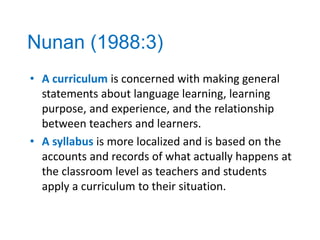
Nunan (1988:3)
• A curriculum is concerned with making general
statements about language learning, learning
purpose, and experience, and the relationship
between teachers and learners.
• A syllabus is more localized and is based on the
accounts and records of what actually happens at
the classroom level as teachers and students
apply a curriculum to their situation.
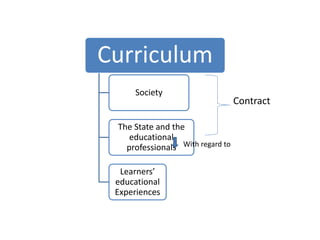
Curriculum
Society
The State and the
educational
professionals
Learners’
educational
Experiences
Contract
With regard to
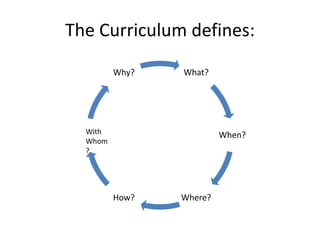
The Curriculum defines:
What?
When?
Where?How?
Why?
With
Whom
?
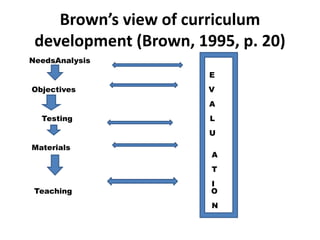
Brown’s view of curriculum
development (Brown, 1995, p. 20)
NeedsAnalysis
E
Objectives V
A
Testing L
U
Materials
A
T
I
Teaching O
N
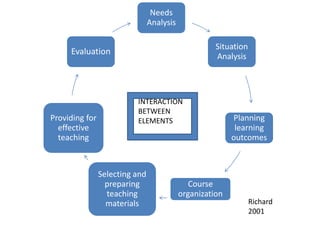
• Richards 2001describes curriculum development as:
the range of planning and implementation processes
involved in developing or renewing a curriculum
Richards’ view of curriculum development
can be summarised in the following Figure :
Needs
Analysis
Situation
Analysis
Planning
learning
outcomes
Course
organization
Selecting and
preparing
teaching
materials
Providing for
effective
teaching
Evaluation
INTERACTION
BETWEEN
ELEMENTS
Richard
2001
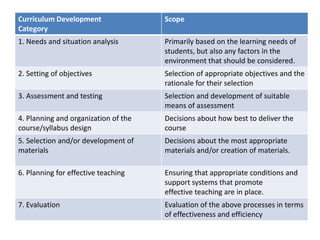
Curriculum Development
Category
Scope
1. Needs and situation analysis Primarily based on the learning needs of
students, but also any factors in the
environment that should be considered.
2. Setting of objectives Selection of appropriate objectives and the
rationale for their selection
3. Assessment and testing Selection and development of suitable
means of assessment
4. Planning and organization of the
course/syllabus design
Decisions about how best to deliver the
course
5. Selection and/or development of
materials
Decisions about the most appropriate
materials and/or creation of materials.
6. Planning for effective teaching Ensuring that appropriate conditions and
support systems that promote
effective teaching are in place.
7. Evaluation Evaluation of the above processes in terms
of effectiveness and efficiency
• Syllabus design concerns the selection of the
items to be learnt and the garding of these
items into appropriate sequence
• It is different from curriculum design since in
the latter the designer is concerrned not just
with lits of what will be taught and in what
order but also the pla&nning the
implementation evaluation and management
and administartion of education programmes
• The syllabus designer has to balance the
competing claims in any design process when
making decisions about selecting and grading:
learnability, frequency, coverage usefulness
• Learnability: Some structural or lexical
items are easier for students to learn than
others.
• Frequency: especially at beginning levels it
would make sense to include items which are
more frequent in the language
• Coverage: some words and structures have
greater coverage (scope for use) than others.
• Usefulness: it is necessary to introduce
items that are useful in given situations
In this paper
• A syllabus is a specification of what takes place in
the classroom, which usually contains the aims
and contents of teaching and sometimes contains
suggestions of methodology.
• A curriculum, however, provides (1) general
statements about the rationale about language,
language learning and language teaching, (2)
detailed specification of aims, objectives and
targets learning purpose, and (3) implementation
of a program.
The relationship between syllabus
and materials
In many parts of the world, language
education programs are designed following a
syllabus-driven approach, that is, the syllabus
determines what kind of materials will be
adopted and in what ways they will be
exploited for the classroom teaching. In
certain educational contexts, the syllabus
even determines how materials should be
designed in the first place.
An overview of types of syllabuses
Grammatical syllabuses: The syllabus input is
selected and graded according to grammatical
notions of simplicity and complexity. These
syllabuses introduce one item at a time and
require mastery of that item before moving on
to the next.
Current trends in syllabus design
Lexical syllabuses: Lexical syllabuses identify a
target vocabulary to be taught normally
arranged according to levels such as the first
500, 1000, 1500, 2000 words.
Skills syllabuses: Skills syllabuses are organized
around the different underlying abilities that
are involved in using a language for purposes
such as reading, writing, listening, or speaking.
Functional-notional syllabuses: In functional-
notional syllabuses, the input is selected and
graded according to the communicative
functions (such as requesting, complaining,
suggesting, agreeing) that language learners
need to perform at the end of the language
programme.
Content syllabuses: In content syllabuses, the
content of language learning might be
defined in terms of situations, topics, themes,
or other academic or school subjects.
Task-based syllabuses: Task-based syllabuses
are more concerned with the classroom
processes which stimulate learning. These
syllabuses consist of a list of specification of
the tasks and activities that the learners
will engage in in class in the target language.
Current trends in syllabus design
• The co-existence of the old and the new
• The emphasis on learning process
• The inclusion of non-linguistic objectives in
syllabus
• The emergence of the multi-syllabus
Current trends in materials development
• Materials themselves have evolved into much
more complex objects.
• Materials development has become a
profession, a wider role division between
materials producers and materials users.
• Commercial materials are designed in such a
way so that they remove much of the
teacher’s burden
• Materials are not just tools, they represent the
aims, values, and methods in teaching a
foreign language.
• British and American publishers have too
much power, and project cultural attitudes
which may be inappropriate to the needs of
the vast majority learners of English as a
foreign language.
• Coursebook publishers expend a great deal of
time, money and effort in promoting and
securing the adoption of their commercial
materials, which may otherwise disappear
from the market.
• Current materials tend to overburden the user
with an embarrassment of riches (abundance
of data).
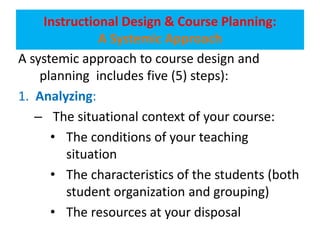
Instructional Design & Course Planning:
A Systemic Approach
A systemic approach to course design and
planning includes five (5) steps):
1. Analyzing:
– The situational context of your course:
• The conditions of your teaching
situation
• The characteristics of the students (both
student organization and grouping)
• The resources at your disposal
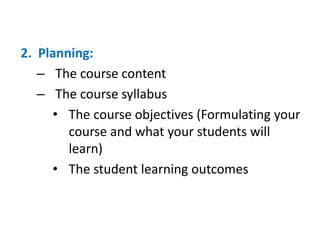
2. Planning:
– The course content
– The course syllabus
• The course objectives (Formulating your
course and what your students will
learn)
• The student learning outcomes
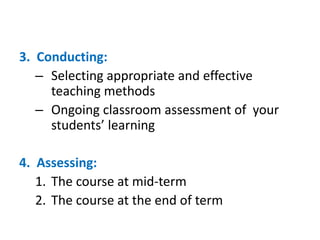
3. Conducting:
– Selecting appropriate and effective
teaching methods
– Ongoing classroom assessment of your
students’ learning
4. Assessing:
1. The course at mid-term
2. The course at the end of term
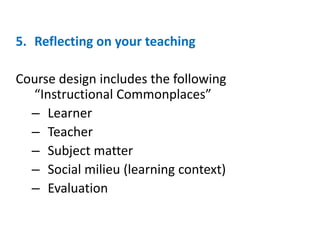
5. Reflecting on your teaching
Course design includes the following
“Instructional Commonplaces”
– Learner
– Teacher
– Subject matter
– Social milieu (learning context)
– Evaluation

ESP materials development

  • 2.
    A clarification ofterms: curriculum and syllabus The terms curriculum and syllabus are sometimes used interchangeably, sometimes differentiated, and sometimes misused and misunderstood.
  • 3.
    Stern (1983) Two sensesof ‘curriculum’ • the substance of a programme of studies of an educational institution or system, such as the school curriculum, the university curriculum; • the course of study or content in a particular subject, such as the mathematics curriculum or the history curriculum, similar to the ‘syllabus’ for a given subject or course of studies.
  • 4.
    Nunan (1988:3) • Acurriculum is concerned with making general statements about language learning, learning purpose, and experience, and the relationship between teachers and learners. • A syllabus is more localized and is based on the accounts and records of what actually happens at the classroom level as teachers and students apply a curriculum to their situation.
  • 5.
    Curriculum Society The State andthe educational professionals Learners’ educational Experiences Contract With regard to
  • 6.
  • 7.
    Brown’s view ofcurriculum development (Brown, 1995, p. 20) NeedsAnalysis E Objectives V A Testing L U Materials A T I Teaching O N
  • 8.
    • Richards 2001describescurriculum development as: the range of planning and implementation processes involved in developing or renewing a curriculum Richards’ view of curriculum development can be summarised in the following Figure :
  • 9.
  • 10.
    Curriculum Development Category Scope 1. Needsand situation analysis Primarily based on the learning needs of students, but also any factors in the environment that should be considered. 2. Setting of objectives Selection of appropriate objectives and the rationale for their selection 3. Assessment and testing Selection and development of suitable means of assessment 4. Planning and organization of the course/syllabus design Decisions about how best to deliver the course 5. Selection and/or development of materials Decisions about the most appropriate materials and/or creation of materials. 6. Planning for effective teaching Ensuring that appropriate conditions and support systems that promote effective teaching are in place. 7. Evaluation Evaluation of the above processes in terms of effectiveness and efficiency
  • 11.
    • Syllabus designconcerns the selection of the items to be learnt and the garding of these items into appropriate sequence • It is different from curriculum design since in the latter the designer is concerrned not just with lits of what will be taught and in what order but also the pla&nning the implementation evaluation and management and administartion of education programmes
  • 12.
    • The syllabusdesigner has to balance the competing claims in any design process when making decisions about selecting and grading: learnability, frequency, coverage usefulness
  • 13.
    • Learnability: Somestructural or lexical items are easier for students to learn than others. • Frequency: especially at beginning levels it would make sense to include items which are more frequent in the language
  • 14.
    • Coverage: somewords and structures have greater coverage (scope for use) than others. • Usefulness: it is necessary to introduce items that are useful in given situations
  • 15.
    In this paper •A syllabus is a specification of what takes place in the classroom, which usually contains the aims and contents of teaching and sometimes contains suggestions of methodology. • A curriculum, however, provides (1) general statements about the rationale about language, language learning and language teaching, (2) detailed specification of aims, objectives and targets learning purpose, and (3) implementation of a program.
  • 16.
    The relationship betweensyllabus and materials In many parts of the world, language education programs are designed following a syllabus-driven approach, that is, the syllabus determines what kind of materials will be adopted and in what ways they will be exploited for the classroom teaching. In certain educational contexts, the syllabus even determines how materials should be designed in the first place.
  • 17.
    An overview oftypes of syllabuses Grammatical syllabuses: The syllabus input is selected and graded according to grammatical notions of simplicity and complexity. These syllabuses introduce one item at a time and require mastery of that item before moving on to the next. Current trends in syllabus design
  • 18.
    Lexical syllabuses: Lexicalsyllabuses identify a target vocabulary to be taught normally arranged according to levels such as the first 500, 1000, 1500, 2000 words.
  • 19.
    Skills syllabuses: Skillssyllabuses are organized around the different underlying abilities that are involved in using a language for purposes such as reading, writing, listening, or speaking.
  • 20.
    Functional-notional syllabuses: Infunctional- notional syllabuses, the input is selected and graded according to the communicative functions (such as requesting, complaining, suggesting, agreeing) that language learners need to perform at the end of the language programme.
  • 21.
    Content syllabuses: Incontent syllabuses, the content of language learning might be defined in terms of situations, topics, themes, or other academic or school subjects.
  • 22.
    Task-based syllabuses: Task-basedsyllabuses are more concerned with the classroom processes which stimulate learning. These syllabuses consist of a list of specification of the tasks and activities that the learners will engage in in class in the target language.
  • 23.
    Current trends insyllabus design • The co-existence of the old and the new • The emphasis on learning process • The inclusion of non-linguistic objectives in syllabus • The emergence of the multi-syllabus
  • 24.
    Current trends inmaterials development • Materials themselves have evolved into much more complex objects. • Materials development has become a profession, a wider role division between materials producers and materials users.
  • 25.
    • Commercial materialsare designed in such a way so that they remove much of the teacher’s burden • Materials are not just tools, they represent the aims, values, and methods in teaching a foreign language.
  • 26.
    • British andAmerican publishers have too much power, and project cultural attitudes which may be inappropriate to the needs of the vast majority learners of English as a foreign language.
  • 27.
    • Coursebook publishersexpend a great deal of time, money and effort in promoting and securing the adoption of their commercial materials, which may otherwise disappear from the market. • Current materials tend to overburden the user with an embarrassment of riches (abundance of data).
  • 28.
    Instructional Design &Course Planning: A Systemic Approach A systemic approach to course design and planning includes five (5) steps): 1. Analyzing: – The situational context of your course: • The conditions of your teaching situation • The characteristics of the students (both student organization and grouping) • The resources at your disposal
  • 29.
    2. Planning: – Thecourse content – The course syllabus • The course objectives (Formulating your course and what your students will learn) • The student learning outcomes
  • 30.
    3. Conducting: – Selectingappropriate and effective teaching methods – Ongoing classroom assessment of your students’ learning 4. Assessing: 1. The course at mid-term 2. The course at the end of term
  • 31.
    5. Reflecting onyour teaching Course design includes the following “Instructional Commonplaces” – Learner – Teacher – Subject matter – Social milieu (learning context) – Evaluation

Editor's Notes

  • #6  In fact, the term curriculum is mostly used to refer to the existing contract between society, the State and educational professionals
  • #7 , the curriculum defines: (i) why; (ii) what; (iii) when; (iv) where; (v) how; and (vi) with whom to learn.