University of Wales Swansea Multidisciplinary Nanotechnology Centre Communication Skills for Engineers Bionanotechnology   Turning Bioscience into a Technology By S. S. Rehman (180049) 27/01/06
Overview Introduction: What is Bionanotechnology ?  Understanding Living Systems. Multidisciplinary/Interdisciplinary. Benefits and Challenges of Bioscience. Applications. Future Research. Summary.
What is Bionanotechnology? Subset of nanotechnology – engineering and manufacturing carried out at an atomic scale via biological precedents . Close relation to biotechnology – adding ability to design and manipulate intricacies at an atomic scale. ‘ True nanomachines’ – characterised by 10,000 working within living system each built to nanoscale spec.
Understanding Living Systems 7 major characteristics Order. Reproduction. Growth & Development. Energy utilization. Response to environment. Homeostasis. Evolution & adaptation.
Multidisciplinary (MD) & Interdisciplinary (ID) conceptual ideas MD = Collective research involving specialists. Specialists contribute expertise from just one discipline. ID = Research where individuals possess and use their expertise from more than one discipline. ID less common but researchers still in demand in academia and industry.
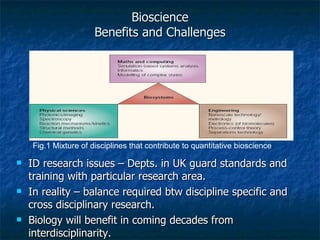
Bioscience Benefits and Challenges ID research issues – Depts. in UK guard standards and training with particular research area. In reality – balance required btw discipline specific and cross disciplinary research. Biology will benefit in coming decades from interdisciplinarity.  Fig.1 Mixture of disciplines that contribute to quantitative bioscience
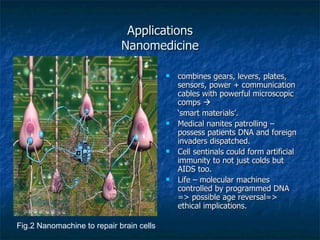
Applications Nanomedicine combines gears, levers, plates, sensors, power + communication cables with powerful microscopic comps   ‘ smart materials’. Medical nanites patrolling – possess patients DNA and foreign invaders dispatched. Cell sentinals could form artificial immunity to not just colds but AIDS too. Life – molecular machines controlled by programmed DNA => possible age reversal=> ethical implications. Fig.2 Nanomachine to repair brain cells
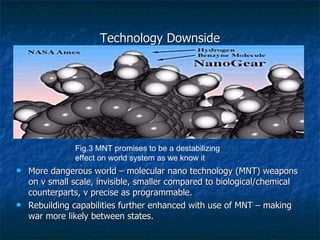
Technology Downside More dangerous world – molecular nano technology (MNT) weapons on v small scale, invisible, smaller compared to biological/chemical counterparts, v precise as programmable.  Rebuilding capabilities further enhanced with use of MNT – making war more likely between states. Fig.3 MNT promises to be a destabilizing effect on world system as we know it
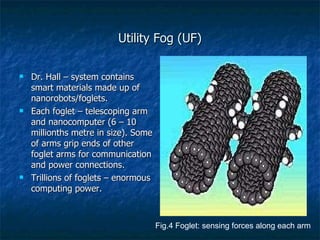
Utility Fog (UF) Dr. Hall – system contains smart materials made up of nanorobots/foglets. Each foglet – telescoping arm and nanocomputer (6 – 10 millionths metre in size). Some of arms grip ends of other foglet arms for communication and power connections. Trillions of foglets – enormous computing power. Fig.4 Foglet: sensing forces along each arm
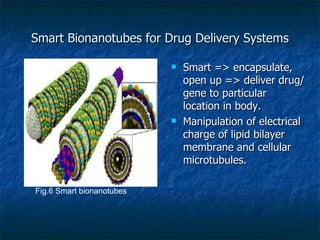
Smart Bionanotubes for Drug Delivery Systems Smart => encapsulate, open up => deliver drug/gene to particular location in body. Manipulation of electrical charge of lipid bilayer membrane and cellular microtubules. Fig.6 Smart bionanotubes
Future Research Material development for innovative nano drug delivery systems (DDS) National Institute for Materials (NIM) + University of Tokyo developing base materials for DDS via material nanotech. Research aims to establish innovative material technology => contribute medical engineering realizing effective therapeutic techniques to treat cancers and other viral diseases.
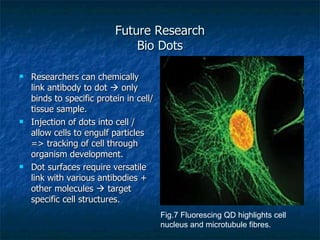
Future Research Bio Dots Researchers can chemically link antibody to dot    only binds to specific protein in cell/tissue sample. Injection of dots into cell / allow cells to engulf particles => tracking of cell through organism development.  Dot surfaces require versatile link with various antibodies + other molecules    target specific cell structures. Fig.7 Fluorescing QD highlights cell nucleus and microtubule fibres.
QDs to act as breast cancer labelling tools on cell external surface Wu  et al   (Quantum Dot and Genentech, San   Fransisco, USA) Streptavidin / Immunoglobulin G + QD => molecules sought antibodies clinging to protein on cells. Intracellular investigation – streptavidin linked QDs fed to cytoplasm of specially prepared dead cells.
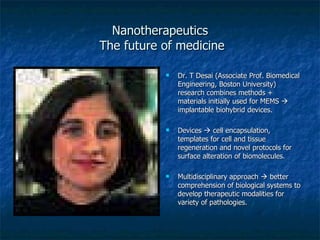
Nanotherapeutics  The future of medicine Dr. T Desai (Associate Prof. Biomedical Engineering, Boston University) research combines methods + materials initially used for MEMS    implantable biohybrid devices. Devices    cell encapsulation, templates for cell and tissue regeneration and novel protocols for surface alteration of biomolecules. Multidisciplinary approach    better comprehension of biological systems to develop therapeutic modalities for variety of pathologies.
Summary Bionanotechnology involves the use of biological processes to manipulation/mimic these processes at the nanoscale to create structures performing particular task. Various applications – predominantly in nanomedicine as vast research being carried out worldwide. Understanding living systems is fundamental before we can fully appreciate the true potential of this technology.

Bionanotechnology Presentation Syed Rehman

  • 1.
    University of WalesSwansea Multidisciplinary Nanotechnology Centre Communication Skills for Engineers Bionanotechnology Turning Bioscience into a Technology By S. S. Rehman (180049) 27/01/06
  • 2.
    Overview Introduction: Whatis Bionanotechnology ? Understanding Living Systems. Multidisciplinary/Interdisciplinary. Benefits and Challenges of Bioscience. Applications. Future Research. Summary.
  • 3.
    What is Bionanotechnology?Subset of nanotechnology – engineering and manufacturing carried out at an atomic scale via biological precedents . Close relation to biotechnology – adding ability to design and manipulate intricacies at an atomic scale. ‘ True nanomachines’ – characterised by 10,000 working within living system each built to nanoscale spec.
  • 4.
    Understanding Living Systems7 major characteristics Order. Reproduction. Growth & Development. Energy utilization. Response to environment. Homeostasis. Evolution & adaptation.
  • 5.
    Multidisciplinary (MD) &Interdisciplinary (ID) conceptual ideas MD = Collective research involving specialists. Specialists contribute expertise from just one discipline. ID = Research where individuals possess and use their expertise from more than one discipline. ID less common but researchers still in demand in academia and industry.
  • 6.
    Bioscience Benefits andChallenges ID research issues – Depts. in UK guard standards and training with particular research area. In reality – balance required btw discipline specific and cross disciplinary research. Biology will benefit in coming decades from interdisciplinarity. Fig.1 Mixture of disciplines that contribute to quantitative bioscience
  • 7.
    Applications Nanomedicine combinesgears, levers, plates, sensors, power + communication cables with powerful microscopic comps  ‘ smart materials’. Medical nanites patrolling – possess patients DNA and foreign invaders dispatched. Cell sentinals could form artificial immunity to not just colds but AIDS too. Life – molecular machines controlled by programmed DNA => possible age reversal=> ethical implications. Fig.2 Nanomachine to repair brain cells
  • 8.
    Technology Downside Moredangerous world – molecular nano technology (MNT) weapons on v small scale, invisible, smaller compared to biological/chemical counterparts, v precise as programmable. Rebuilding capabilities further enhanced with use of MNT – making war more likely between states. Fig.3 MNT promises to be a destabilizing effect on world system as we know it
  • 9.
    Utility Fog (UF)Dr. Hall – system contains smart materials made up of nanorobots/foglets. Each foglet – telescoping arm and nanocomputer (6 – 10 millionths metre in size). Some of arms grip ends of other foglet arms for communication and power connections. Trillions of foglets – enormous computing power. Fig.4 Foglet: sensing forces along each arm
  • 10.
    Smart Bionanotubes forDrug Delivery Systems Smart => encapsulate, open up => deliver drug/gene to particular location in body. Manipulation of electrical charge of lipid bilayer membrane and cellular microtubules. Fig.6 Smart bionanotubes
  • 11.
    Future Research Materialdevelopment for innovative nano drug delivery systems (DDS) National Institute for Materials (NIM) + University of Tokyo developing base materials for DDS via material nanotech. Research aims to establish innovative material technology => contribute medical engineering realizing effective therapeutic techniques to treat cancers and other viral diseases.
  • 12.
    Future Research BioDots Researchers can chemically link antibody to dot  only binds to specific protein in cell/tissue sample. Injection of dots into cell / allow cells to engulf particles => tracking of cell through organism development. Dot surfaces require versatile link with various antibodies + other molecules  target specific cell structures. Fig.7 Fluorescing QD highlights cell nucleus and microtubule fibres.
  • 13.
    QDs to actas breast cancer labelling tools on cell external surface Wu et al (Quantum Dot and Genentech, San Fransisco, USA) Streptavidin / Immunoglobulin G + QD => molecules sought antibodies clinging to protein on cells. Intracellular investigation – streptavidin linked QDs fed to cytoplasm of specially prepared dead cells.
  • 14.
    Nanotherapeutics Thefuture of medicine Dr. T Desai (Associate Prof. Biomedical Engineering, Boston University) research combines methods + materials initially used for MEMS  implantable biohybrid devices. Devices  cell encapsulation, templates for cell and tissue regeneration and novel protocols for surface alteration of biomolecules. Multidisciplinary approach  better comprehension of biological systems to develop therapeutic modalities for variety of pathologies.
  • 15.
    Summary Bionanotechnology involvesthe use of biological processes to manipulation/mimic these processes at the nanoscale to create structures performing particular task. Various applications – predominantly in nanomedicine as vast research being carried out worldwide. Understanding living systems is fundamental before we can fully appreciate the true potential of this technology.