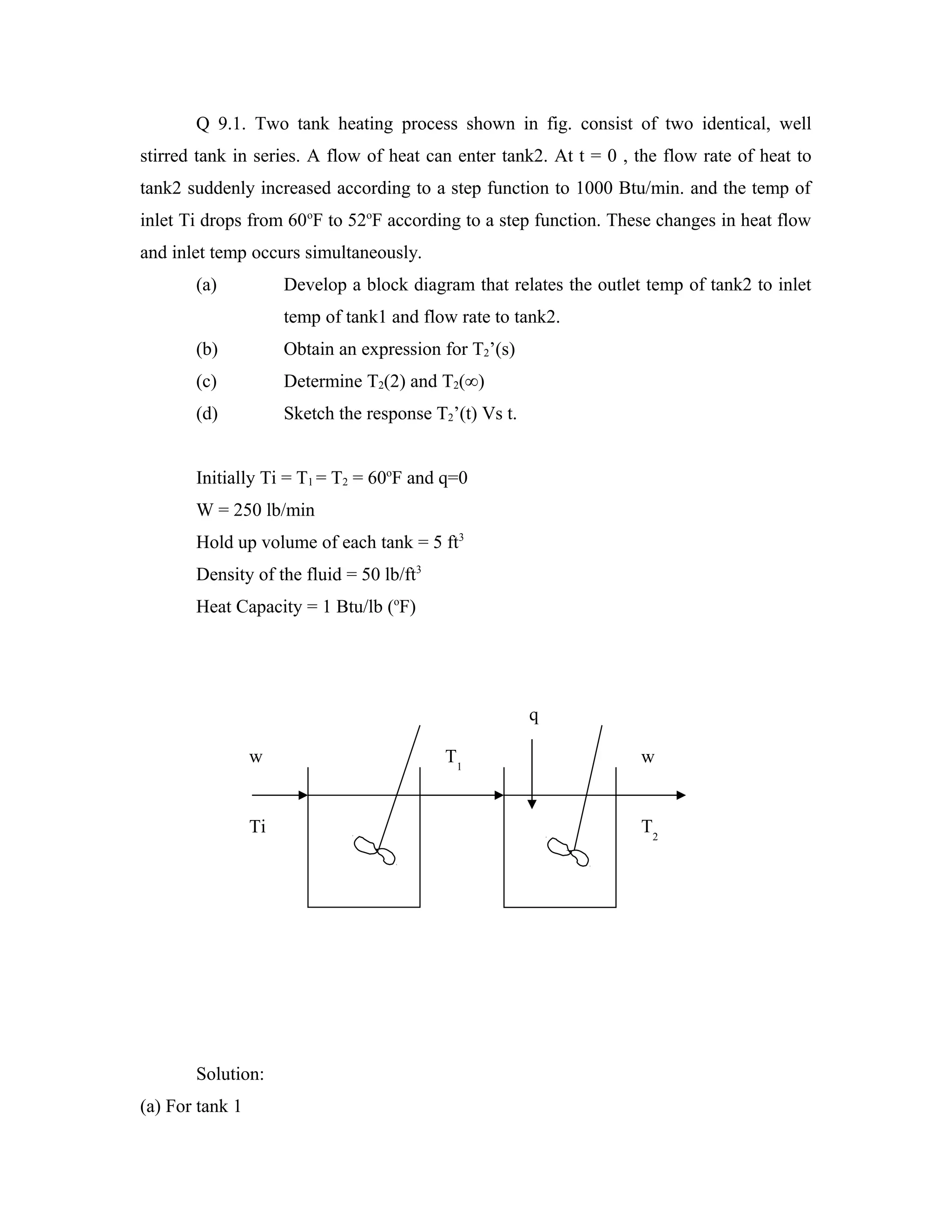
Q 9.1. Two tank heating process shown in fig. consist of two identical, well
stirred tank in series. A flow of heat can enter tank2. At t = 0 , the flow rate of heat to
tank2 suddenly increased according to a step function to 1000 Btu/min. and the temp of
inlet Ti drops from 60oF to 52oF according to a step function. These changes in heat flow
and inlet temp occurs simultaneously.
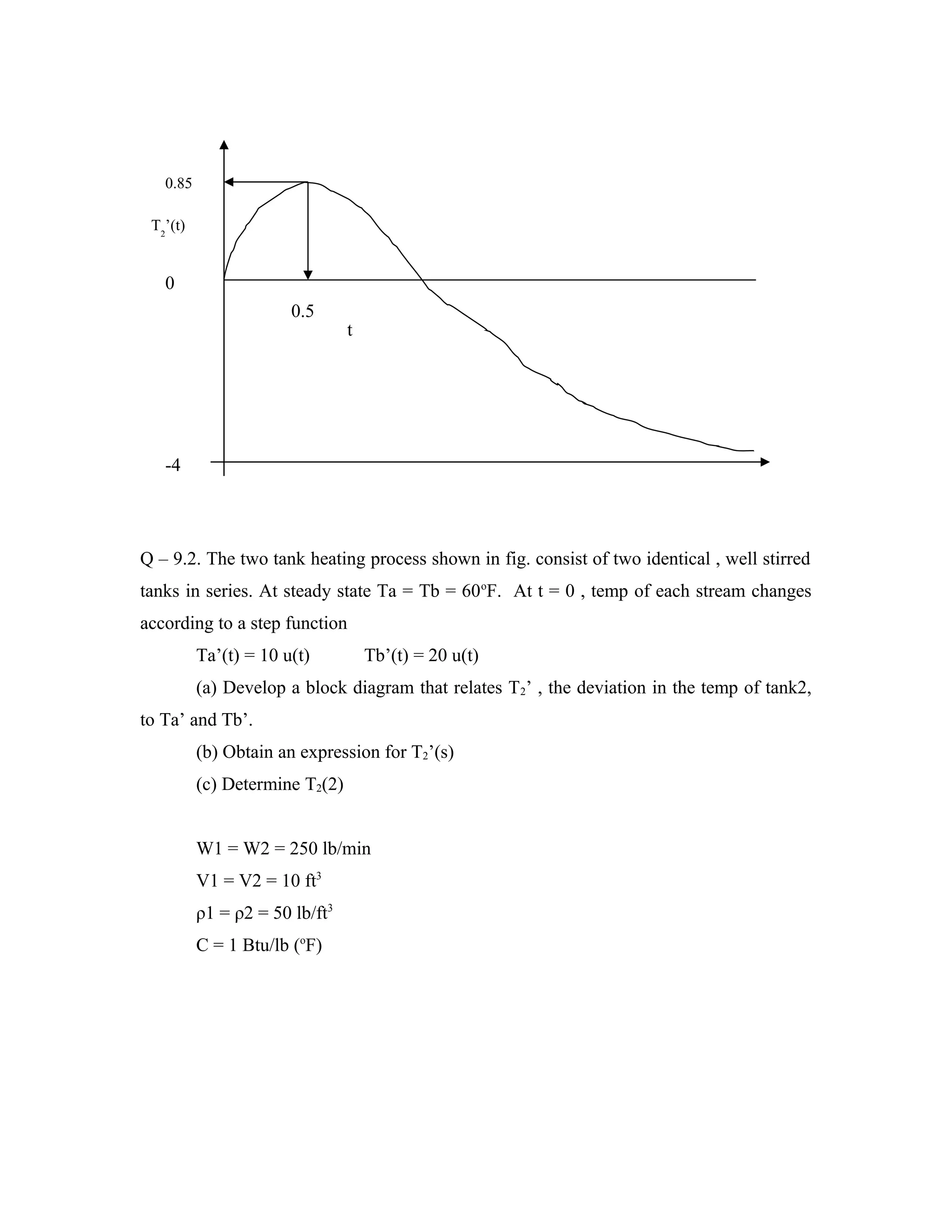
       (a)            Develop a block diagram that relates the outlet temp of tank2 to inlet
                      temp of tank1 and flow rate to tank2.
       (b)            Obtain an expression for T2’(s)
       (c)            Determine T2(2) and T2(∞)
       (d)            Sketch the response T2’(t) Vs t.


       Initially Ti = T1 = T2 = 60oF and q=0
       W = 250 lb/min
       Hold up volume of each tank = 5 ft3
       Density of the fluid = 50 lb/ft3
       Heat Capacity = 1 Btu/lb (oF)


                                                         q

                 w                          T1                       w


                 Ti                                                  T2


       Solution:
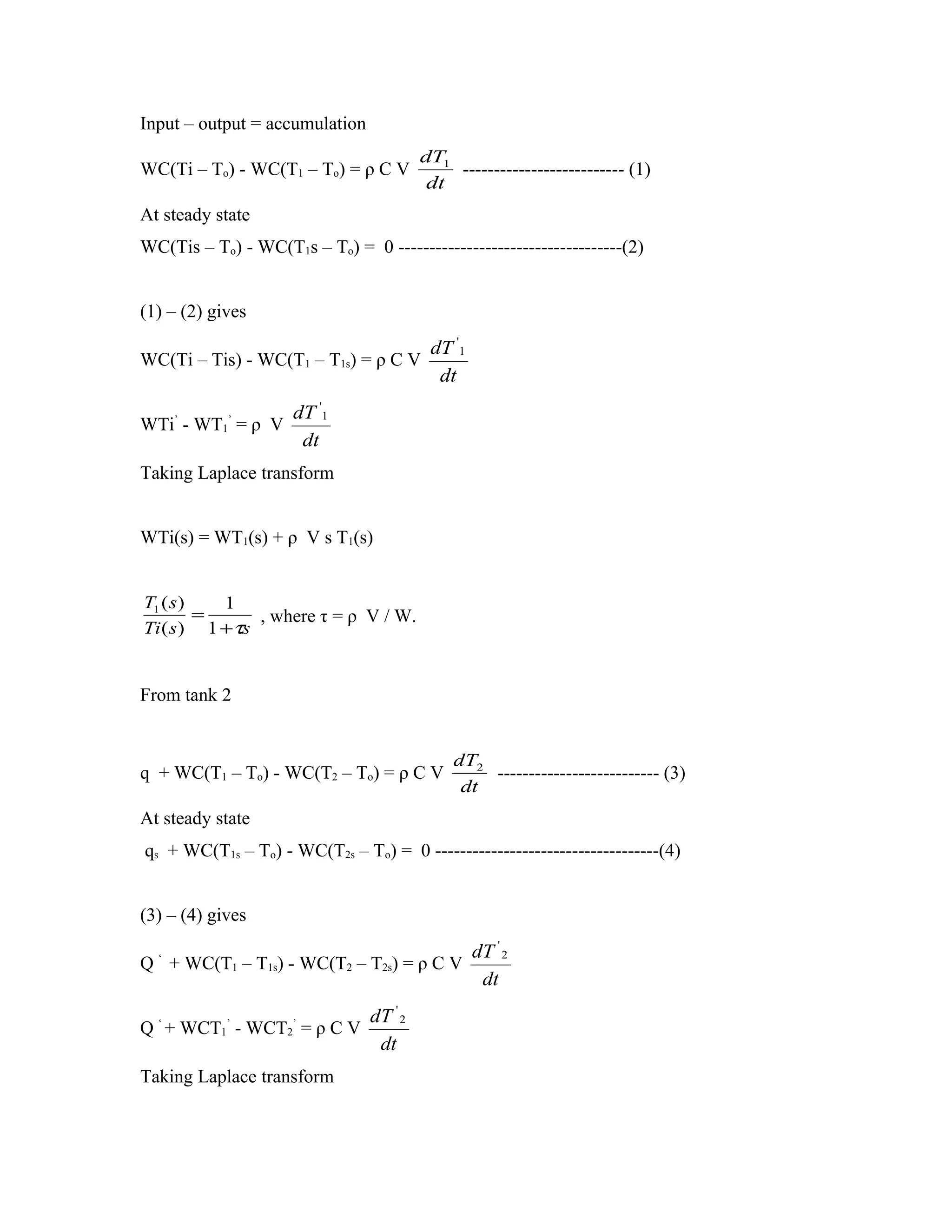
(a) For tank 1
Input – output = accumulation
                                       dT1
WC(Ti – To) - WC(T1 – To) = ρ C V          -------------------------- (1)
                                        dt
At steady state
WC(Tis – To) - WC(T1s – To) = 0 ------------------------------------(2)


(1) – (2) gives
                                        dT '1
WC(Ti – Tis) - WC(T1 – T1s) = ρ C V
                                         dt

      ’     ’   dT '1
WTi - WT1 = ρ V
                 dt
Taking Laplace transform


WTi(s) = WT1(s) + ρ V s T1(s)


T1 ( s )   1
         =     , where τ = ρ V / W.
Ti ( s ) 1 +τs


From tank 2


                                            dT2
q + WC(T1 – To) - WC(T2 – To) = ρ C V           -------------------------- (3)
                                             dt
At steady state
qs + WC(T1s – To) - WC(T2s – To) = 0 ------------------------------------(4)


(3) – (4) gives
                                                dT ' 2
Q ‘ + WC(T1 – T1s) - WC(T2 – T2s) = ρ C V
                                                 dt

  ‘         ’        ’  dT ' 2
Q + WCT1 - WCT2 = ρ C V
                         dt
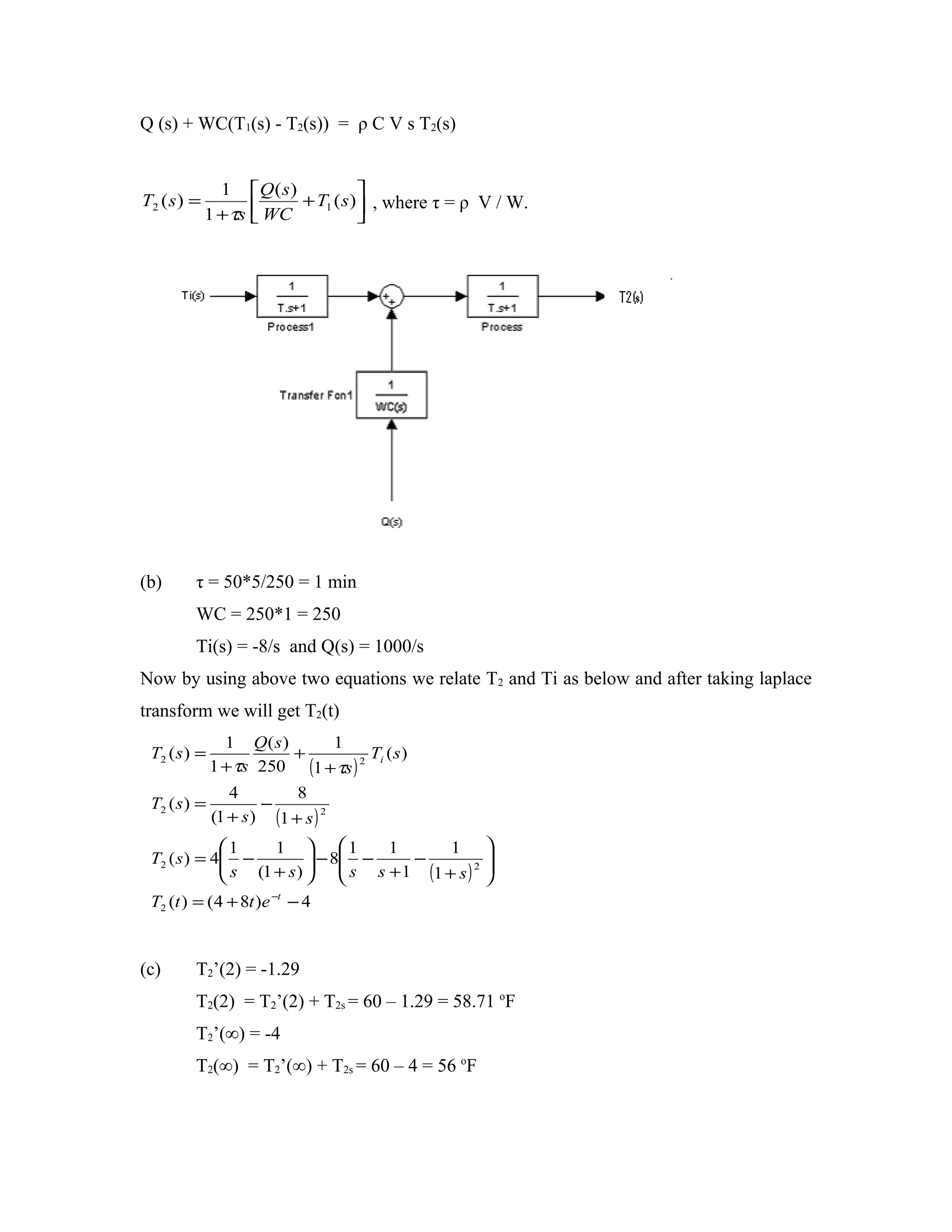
Taking Laplace transform
Q (s) + WC(T1(s) - T2(s)) = ρ C V s T2(s)


               1 Q( s)             
T2 ( s ) =           WC + T1 ( s )  , where τ = ρ V / W.
             1 + τs                


(b)      τ = 50*5/250 = 1 min
         WC = 250*1 = 250
         Ti(s) = -8/s and Q(s) = 1000/s
Now by using above two equations we relate T2 and Ti as below and after taking laplace
transform we will get T2(t)
              1 Q( s)           1
 T2 ( s ) =             +          Ti ( s )
            1 + τs 250 (1 + τs ) 2
               4         8
 T2 ( s ) =         −
            (1 + s ) (1 + s ) 2
             1     1  1             1         1        
              s (1 + s )  − 8 s − s + 1 −
 T2 ( s ) = 4 −                                        
                                                          
                                          (1 + s ) 2   
 T2 (t ) = (4 + 8t )e −t − 4


(c)      T2’(2) = -1.29
         T2(2) = T2’(2) + T2s = 60 – 1.29 = 58.71 oF
         T2’(∞) = -4
         T2(∞) = T2’(∞) + T2s = 60 – 4 = 56 oF
0.85

 T2’(t)


   0
                       0.5
                                t


   -4


Q – 9.2. The two tank heating process shown in fig. consist of two identical , well stirred
tanks in series. At steady state Ta = Tb = 60 oF. At t = 0 , temp of each stream changes
according to a step function
          Ta’(t) = 10 u(t)          Tb’(t) = 20 u(t)
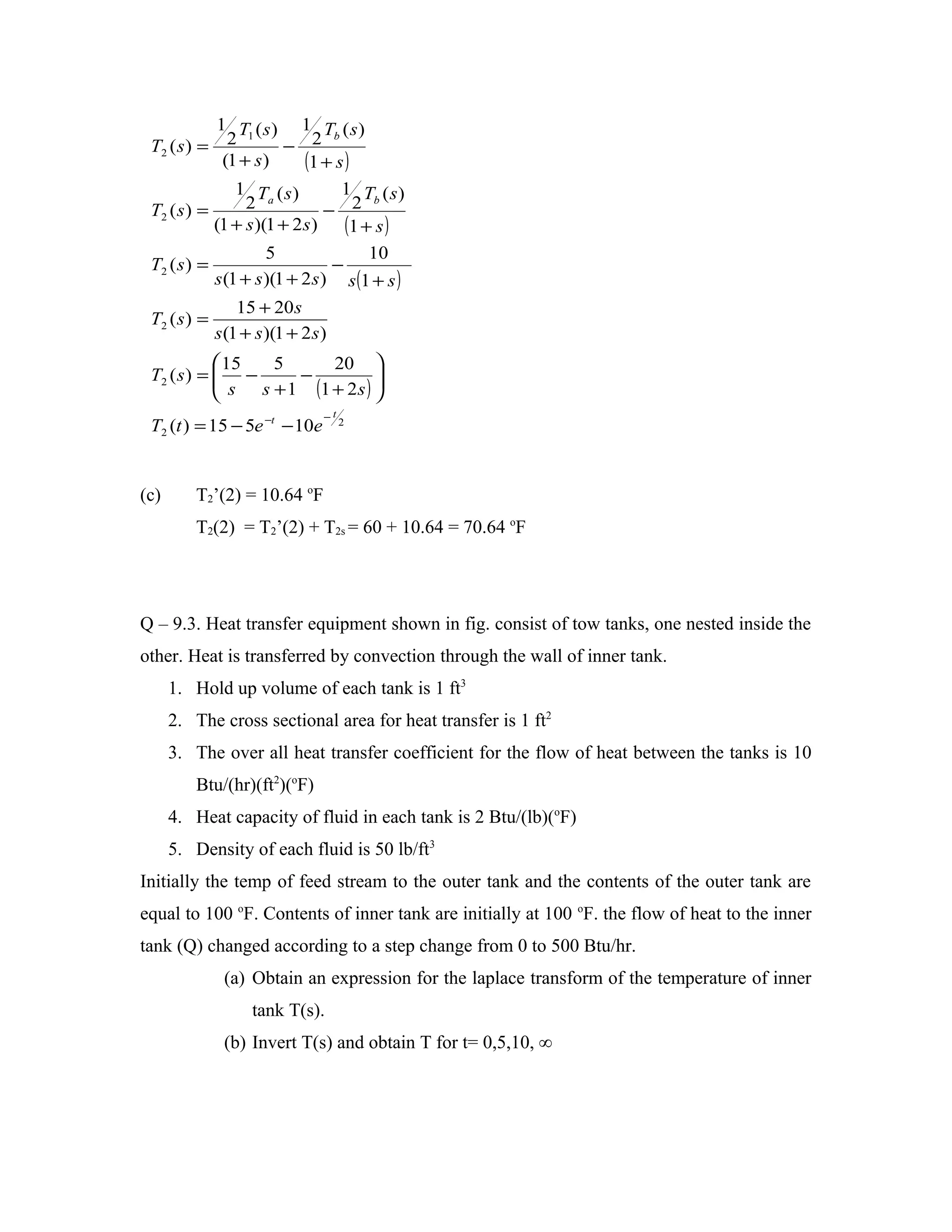
          (a) Develop a block diagram that relates T 2’ , the deviation in the temp of tank2,
to Ta’ and Tb’.
          (b) Obtain an expression for T2’(s)
          (c) Determine T2(2)


          W1 = W2 = 250 lb/min
          V1 = V2 = 10 ft3
          ρ1 = ρ2 = 50 lb/ft3
          C = 1 Btu/lb (oF)
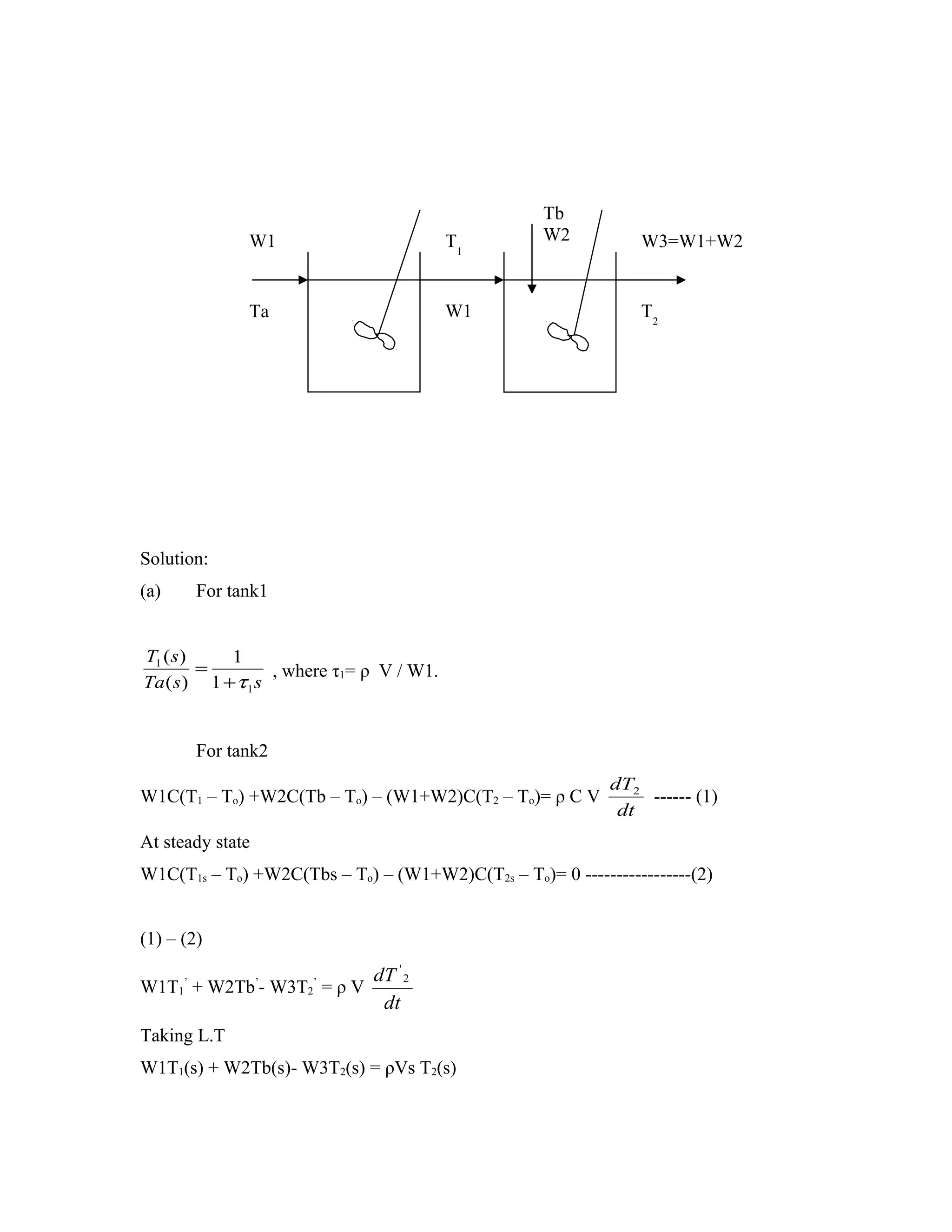
Tb
              W1                           T1      W2          W3=W1+W2


              Ta                           W1                  T2


Solution:
(a)     For tank1


T1 ( s )    1
         =         , where τ1= ρ V / W1.
Ta ( s ) 1 + τ 1 s


        For tank2
                                                           dT2
W1C(T1 – To) +W2C(Tb – To) – (W1+W2)C(T2 – To)= ρ C V          ------ (1)
                                                            dt
At steady state
W1C(T1s – To) +W2C(Tbs – To) – (W1+W2)C(T2s – To)= 0 -----------------(2)


(1) – (2)
                               dT ' 2
W1T1’ + W2Tb’- W3T2’ = ρ V
                                dt
Taking L.T
W1T1(s) + W2Tb(s)- W3T2(s) = ρVs T2(s)
T2 ( s ) =        [
               1 W1
             1 + τs
                      T (S ) + W 2
                    W3 1
                                            ]
                                     T ( S ) where τ= ρ V / W3.
                                   W3 b


(b)      τ1 = 50*10/250 = 2 min
         τ = 50*5/250 = 1 min
         W1/W3 = 1/2 = W2/W3
         Ta(s) = 10/s and Tb(s) = 0/s
Now by using above two equations we relate T 1 and Ta as below and after taking laplace
transform we will get T2(t)
1 T (s) 1 T (s)
 T2 ( s ) = 2           − 2
                  1             b

             (1 + s )      (1 + s )
                1 Ta ( s )        1 Tb ( s )
 T2 ( s ) =       2            − 2
            (1 + s )(1 + 2 s ) (1 + s )
                     5               10
 T2 ( s ) =                     −
            s (1 + s )(1 + 2 s ) s (1 + s )
                  15 + 20 s
 T2 ( s ) =
              s (1 + s )(1 + 2 s )
             15  5        20 
 T2 ( s ) =  −
             s s + 1 − (1 + 2 s ) 
                                   
                                  
                                 −t
 T2 (t ) = 15 − 5e −t − 10e           2


(c)      T2’(2) = 10.64 oF
         T2(2) = T2’(2) + T2s = 60 + 10.64 = 70.64 oF


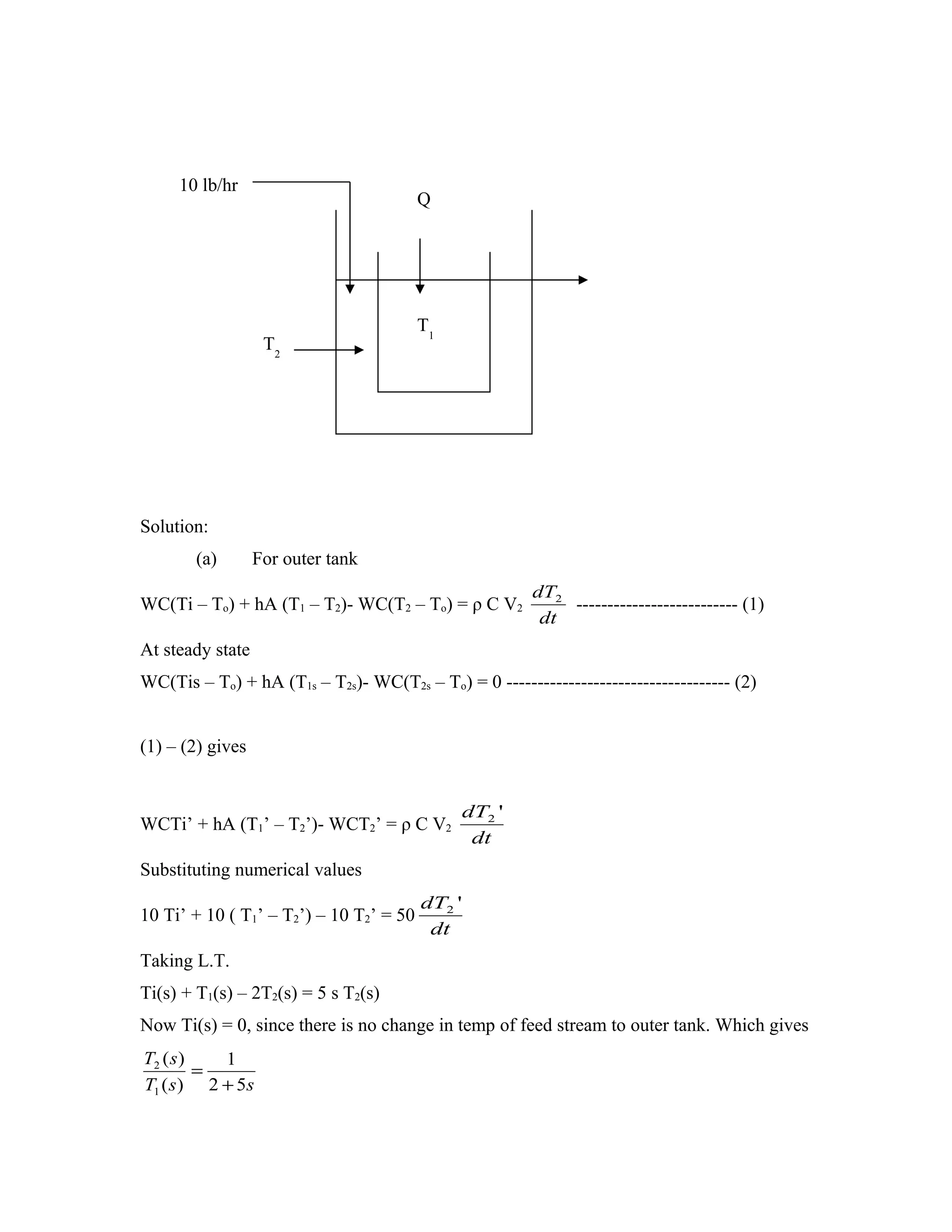
Q – 9.3. Heat transfer equipment shown in fig. consist of tow tanks, one nested inside the
other. Heat is transferred by convection through the wall of inner tank.
      1. Hold up volume of each tank is 1 ft3
      2. The cross sectional area for heat transfer is 1 ft2
      3. The over all heat transfer coefficient for the flow of heat between the tanks is 10
         Btu/(hr)(ft2)(oF)
      4. Heat capacity of fluid in each tank is 2 Btu/(lb)(oF)
      5. Density of each fluid is 50 lb/ft3
Initially the temp of feed stream to the outer tank and the contents of the outer tank are
equal to 100 oF. Contents of inner tank are initially at 100 oF. the flow of heat to the inner
tank (Q) changed according to a step change from 0 to 500 Btu/hr.
               (a) Obtain an expression for the laplace transform of the temperature of inner
                    tank T(s).
               (b) Invert T(s) and obtain T for t= 0,5,10, ∞
10 lb/hr
                                         Q


                                         T1
                   T2


Solution:
       (a)        For outer tank
                                                       dT2
WC(Ti – To) + hA (T1 – T2)- WC(T2 – To) = ρ C V2           -------------------------- (1)
                                                        dt
At steady state
WC(Tis – To) + hA (T1s – T2s)- WC(T2s – To) = 0 ------------------------------------ (2)


(1) – (2) gives


                                              dT2 '
WCTi’ + hA (T1’ – T2’)- WCT2’ = ρ C V2
                                               dt
Substituting numerical values
                                         dT2 '
10 Ti’ + 10 ( T1’ – T2’) – 10 T2’ = 50
                                          dt
Taking L.T.
Ti(s) + T1(s) – 2T2(s) = 5 s T2(s)
Now Ti(s) = 0, since there is no change in temp of feed stream to outer tank. Which gives
T2 ( s )   1
         =
T1 ( s ) 2 + 5s
For inner tank
                                     dT1
Q - hA (T1 – T2) = ρ C V1                --------------------- (3)
                                      dt
Qs - hA (T1s – T2s) = 0 ------------------------------- (4)
(3) – (4) gives
                                           dT1 '
Q’ - hA (T1’– T2’ ) = ρ C V1
                                            dt
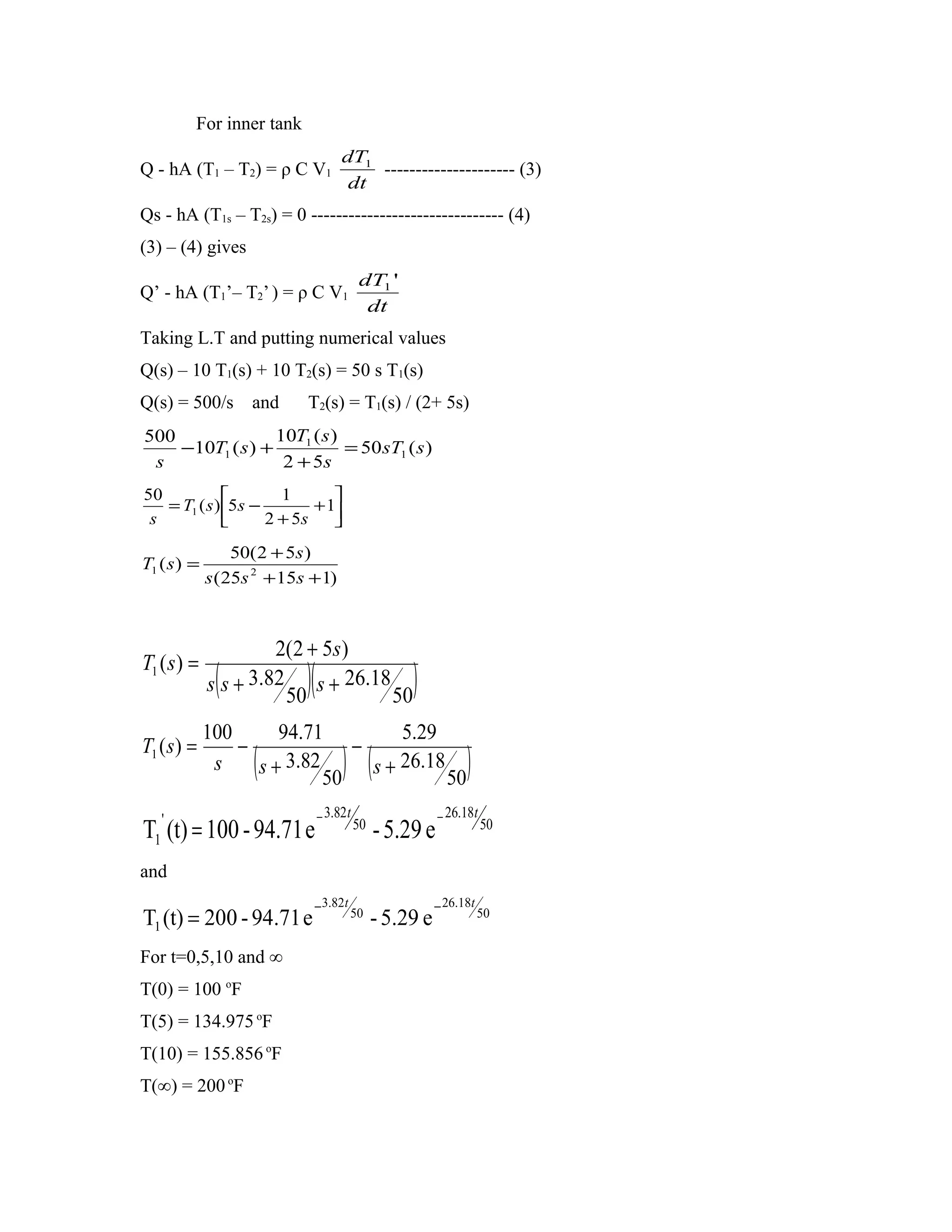
Taking L.T and putting numerical values
Q(s) – 10 T1(s) + 10 T2(s) = 50 s T1(s)
Q(s) = 500/s and           T2(s) = T1(s) / (2+ 5s)
500               10T1 ( s )
    −10T1 ( s ) +            = 50 sT1 ( s )
 s                 2 + 5s
50                   1       
   = T1 ( s ) 5s −        + 1
 s                 2 + 5s    
                 50(2 + 5s )
T1 ( s ) =
             s (25s 2 + 15s + 1)


                      2(2 + 5s )
T1 ( s ) =
              (            )(
             s s + 3.82 s + 26.18
                       50         50
                                                     )
             100      94.71          5.29
T1 ( s ) =       −             −
              s     (
                   s + 3.82
                            50
                                      ) (
                                 s + 26.18
                                           50
                                                                 )
   '                            − 3.82 t                   − 26.18t
T1 (t) = 100 - 94.71 e                     50
                                                - 5.29 e              50


and
                            − 3.82t                        − 26.18t
T1 (t) = 200 - 94.71 e                 50
                                                - 5.29 e              50


For t=0,5,10 and ∞
T(0) = 100 oF
T(5) = 134.975 oF
T(10) = 155.856 oF
T(∞) = 200 oF
Tut09

Tut09

  • 1.
    Q 9.1. Twotank heating process shown in fig. consist of two identical, well stirred tank in series. A flow of heat can enter tank2. At t = 0 , the flow rate of heat to tank2 suddenly increased according to a step function to 1000 Btu/min. and the temp of inlet Ti drops from 60oF to 52oF according to a step function. These changes in heat flow and inlet temp occurs simultaneously. (a) Develop a block diagram that relates the outlet temp of tank2 to inlet temp of tank1 and flow rate to tank2. (b) Obtain an expression for T2’(s) (c) Determine T2(2) and T2(∞) (d) Sketch the response T2’(t) Vs t. Initially Ti = T1 = T2 = 60oF and q=0 W = 250 lb/min Hold up volume of each tank = 5 ft3 Density of the fluid = 50 lb/ft3 Heat Capacity = 1 Btu/lb (oF) q w T1 w Ti T2 Solution: (a) For tank 1
  • 2.
    Input – output= accumulation dT1 WC(Ti – To) - WC(T1 – To) = ρ C V -------------------------- (1) dt At steady state WC(Tis – To) - WC(T1s – To) = 0 ------------------------------------(2) (1) – (2) gives dT '1 WC(Ti – Tis) - WC(T1 – T1s) = ρ C V dt ’ ’ dT '1 WTi - WT1 = ρ V dt Taking Laplace transform WTi(s) = WT1(s) + ρ V s T1(s) T1 ( s ) 1 = , where τ = ρ V / W. Ti ( s ) 1 +τs From tank 2 dT2 q + WC(T1 – To) - WC(T2 – To) = ρ C V -------------------------- (3) dt At steady state qs + WC(T1s – To) - WC(T2s – To) = 0 ------------------------------------(4) (3) – (4) gives dT ' 2 Q ‘ + WC(T1 – T1s) - WC(T2 – T2s) = ρ C V dt ‘ ’ ’ dT ' 2 Q + WCT1 - WCT2 = ρ C V dt Taking Laplace transform
  • 3.
    Q (s) +WC(T1(s) - T2(s)) = ρ C V s T2(s) 1 Q( s)  T2 ( s ) =  WC + T1 ( s )  , where τ = ρ V / W. 1 + τs   (b) τ = 50*5/250 = 1 min WC = 250*1 = 250 Ti(s) = -8/s and Q(s) = 1000/s Now by using above two equations we relate T2 and Ti as below and after taking laplace transform we will get T2(t) 1 Q( s) 1 T2 ( s ) = + Ti ( s ) 1 + τs 250 (1 + τs ) 2 4 8 T2 ( s ) = − (1 + s ) (1 + s ) 2 1 1  1 1 1   s (1 + s )  − 8 s − s + 1 − T2 ( s ) = 4 −        (1 + s ) 2  T2 (t ) = (4 + 8t )e −t − 4 (c) T2’(2) = -1.29 T2(2) = T2’(2) + T2s = 60 – 1.29 = 58.71 oF T2’(∞) = -4 T2(∞) = T2’(∞) + T2s = 60 – 4 = 56 oF
  • 4.
    0.85 T2’(t) 0 0.5 t -4 Q – 9.2. The two tank heating process shown in fig. consist of two identical , well stirred tanks in series. At steady state Ta = Tb = 60 oF. At t = 0 , temp of each stream changes according to a step function Ta’(t) = 10 u(t) Tb’(t) = 20 u(t) (a) Develop a block diagram that relates T 2’ , the deviation in the temp of tank2, to Ta’ and Tb’. (b) Obtain an expression for T2’(s) (c) Determine T2(2) W1 = W2 = 250 lb/min V1 = V2 = 10 ft3 ρ1 = ρ2 = 50 lb/ft3 C = 1 Btu/lb (oF)
  • 5.
    Tb W1 T1 W2 W3=W1+W2 Ta W1 T2 Solution: (a) For tank1 T1 ( s ) 1 = , where τ1= ρ V / W1. Ta ( s ) 1 + τ 1 s For tank2 dT2 W1C(T1 – To) +W2C(Tb – To) – (W1+W2)C(T2 – To)= ρ C V ------ (1) dt At steady state W1C(T1s – To) +W2C(Tbs – To) – (W1+W2)C(T2s – To)= 0 -----------------(2) (1) – (2) dT ' 2 W1T1’ + W2Tb’- W3T2’ = ρ V dt Taking L.T W1T1(s) + W2Tb(s)- W3T2(s) = ρVs T2(s)
  • 6.
    T2 ( s) = [ 1 W1 1 + τs T (S ) + W 2 W3 1 ] T ( S ) where τ= ρ V / W3. W3 b (b) τ1 = 50*10/250 = 2 min τ = 50*5/250 = 1 min W1/W3 = 1/2 = W2/W3 Ta(s) = 10/s and Tb(s) = 0/s Now by using above two equations we relate T 1 and Ta as below and after taking laplace transform we will get T2(t)
  • 7.
    1 T (s)1 T (s) T2 ( s ) = 2 − 2 1 b (1 + s ) (1 + s ) 1 Ta ( s ) 1 Tb ( s ) T2 ( s ) = 2 − 2 (1 + s )(1 + 2 s ) (1 + s ) 5 10 T2 ( s ) = − s (1 + s )(1 + 2 s ) s (1 + s ) 15 + 20 s T2 ( s ) = s (1 + s )(1 + 2 s )  15 5 20  T2 ( s ) =  −  s s + 1 − (1 + 2 s )     −t T2 (t ) = 15 − 5e −t − 10e 2 (c) T2’(2) = 10.64 oF T2(2) = T2’(2) + T2s = 60 + 10.64 = 70.64 oF Q – 9.3. Heat transfer equipment shown in fig. consist of tow tanks, one nested inside the other. Heat is transferred by convection through the wall of inner tank. 1. Hold up volume of each tank is 1 ft3 2. The cross sectional area for heat transfer is 1 ft2 3. The over all heat transfer coefficient for the flow of heat between the tanks is 10 Btu/(hr)(ft2)(oF) 4. Heat capacity of fluid in each tank is 2 Btu/(lb)(oF) 5. Density of each fluid is 50 lb/ft3 Initially the temp of feed stream to the outer tank and the contents of the outer tank are equal to 100 oF. Contents of inner tank are initially at 100 oF. the flow of heat to the inner tank (Q) changed according to a step change from 0 to 500 Btu/hr. (a) Obtain an expression for the laplace transform of the temperature of inner tank T(s). (b) Invert T(s) and obtain T for t= 0,5,10, ∞
  • 8.
    10 lb/hr Q T1 T2 Solution: (a) For outer tank dT2 WC(Ti – To) + hA (T1 – T2)- WC(T2 – To) = ρ C V2 -------------------------- (1) dt At steady state WC(Tis – To) + hA (T1s – T2s)- WC(T2s – To) = 0 ------------------------------------ (2) (1) – (2) gives dT2 ' WCTi’ + hA (T1’ – T2’)- WCT2’ = ρ C V2 dt Substituting numerical values dT2 ' 10 Ti’ + 10 ( T1’ – T2’) – 10 T2’ = 50 dt Taking L.T. Ti(s) + T1(s) – 2T2(s) = 5 s T2(s) Now Ti(s) = 0, since there is no change in temp of feed stream to outer tank. Which gives T2 ( s ) 1 = T1 ( s ) 2 + 5s
  • 9.
    For inner tank dT1 Q - hA (T1 – T2) = ρ C V1 --------------------- (3) dt Qs - hA (T1s – T2s) = 0 ------------------------------- (4) (3) – (4) gives dT1 ' Q’ - hA (T1’– T2’ ) = ρ C V1 dt Taking L.T and putting numerical values Q(s) – 10 T1(s) + 10 T2(s) = 50 s T1(s) Q(s) = 500/s and T2(s) = T1(s) / (2+ 5s) 500 10T1 ( s ) −10T1 ( s ) + = 50 sT1 ( s ) s 2 + 5s 50  1  = T1 ( s ) 5s − + 1 s  2 + 5s  50(2 + 5s ) T1 ( s ) = s (25s 2 + 15s + 1) 2(2 + 5s ) T1 ( s ) = ( )( s s + 3.82 s + 26.18 50 50 ) 100 94.71 5.29 T1 ( s ) = − − s ( s + 3.82 50 ) ( s + 26.18 50 ) ' − 3.82 t − 26.18t T1 (t) = 100 - 94.71 e 50 - 5.29 e 50 and − 3.82t − 26.18t T1 (t) = 200 - 94.71 e 50 - 5.29 e 50 For t=0,5,10 and ∞ T(0) = 100 oF T(5) = 134.975 oF T(10) = 155.856 oF T(∞) = 200 oF