Fundamentals of Finite Difference
Methods
Ashish Ranjan Jha, Electrical Engineering, IIT Roorkee
10th Indo German Winter Academy, 2011
Topics to be covered
 Introduction
 About PDEs(Partial Differential Equations)
 Various Discretization Methods
 FDM - Overview
 Basics of Finite Difference Methods
 Taylor Series Expansion
 Finite Difference Quotients
 Truncation Error
 Finite Difference Methods
 Explicit Method
 Implicit Method – Crank Nicholson Method
 Comparison of the two
 Consistency, Stability and Convergence
 Consistency
 Convergence
 Error and Stability Analysis –Von Neumann Analysis
 Application in Fluid Flow Equations
 Conservative property
 Transportive property
 Upwinding
 Hybrid Scheme
10th Indo German Winter Academy, 2011
Introduction
10th Indo German Winter Academy, 2011
About PDEs :
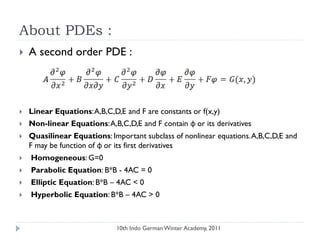
 A second order PDE :
 Linear Equations:A,B,C,D,E and F are constants or f(x,y)
 Non-linear Equations:A,B,C,D,E and F contain φ or its derivatives
 Quasilinear Equations: Important subclass of nonlinear equations.A,B,C,D,E and
F may be function of φ or its first derivatives
 Homogeneous: G=0
 Parabolic Equation: B*B - 4AC = 0
 Elliptic Equation: B*B – 4AC < 0
 Hyperbolic Equation: B*B – 4AC > 0
10th Indo German Winter Academy, 2011
About PDEs :
 Some basic equations :
 Navier Stoke Equation : Elliptical in space ; Parabolic in time
 Laplace and Poisson Equations: Elliptic
 Fluid flow problems have non – linear terms called advection
and convection terms in momentum and energy equations
respectively.
10th Indo German Winter Academy, 2011
Various Discretization Methods
 Finite Difference Method (FDM)
 Finite Element Method (FEM)
 FiniteVolume Method (FVM)
 Spectral Method
 Lattice Gas Cellular Automata (LGCA)
10th Indo German Winter Academy, 2011
FDM - Overview
 Boundary Conditions
 No. of Boundary conditions required is order of highest
derivative appearing in each independent variable
 Unsteady equations governed by a first derivative in time
require initial condition to carry out the time integration
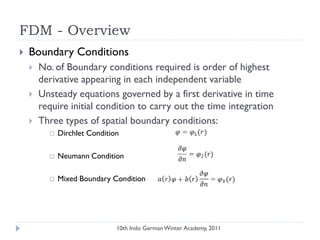
 Three types of spatial boundary conditions:
 Dirchlet Condition
 Neumann Condition
 Mixed Boundary Condition
10th Indo German Winter Academy, 2011
FDM - Overview
 Basic Procedure
 Replace derivatives of governing equations with algebraic
difference quotients
 Results in a system of algebraic equations solvable for
dependent variables at discrete grid points
 Analytical solutions provide closed-form expressions –variation
of dependent variables in the domain
 Numerical solutions (finite difference) - values at discrete
points in the domain
10th Indo German Winter Academy, 2011
FDM - Overview
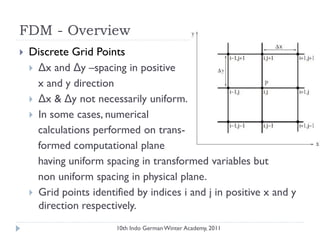
 Discrete Grid Points
 Δx and Δy –spacing in positive
x and y direction
 Δx & Δy not necessarily uniform.
 In some cases, numerical
calculations performed on trans-
formed computational plane
having uniform spacing in transformed variables but
non uniform spacing in physical plane.
 Grid points identified by indices i and j in positive x and y
direction respectively.
10th Indo German Winter Academy, 2011
Basics of Finite Difference Methods
10th Indo German Winter Academy, 2011
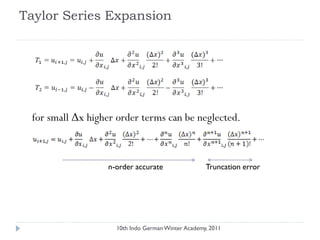
Taylor Series Expansion
for small Δx higher order terms can be neglected.
n-order accurate Truncation error
10th Indo German Winter Academy, 2011
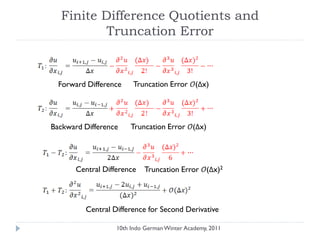
Finite Difference Quotients and
Truncation Error
Forward Difference Truncation Error 𝒪(Δx)
Backward Difference Truncation Error 𝒪(Δx)
Central Difference Truncation Error 𝒪(Δx)2
Central Difference for Second Derivative
10th Indo German Winter Academy, 2011
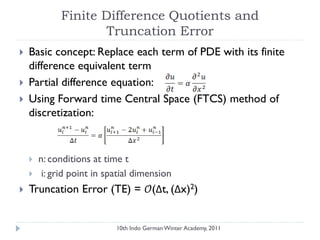
Finite Difference Quotients and
Truncation Error
 Basic concept: Replace each term of PDE with its finite
difference equivalent term
 Partial difference equation:
 Using Forward time Central Space (FTCS) method of
discretization:
 n: conditions at time t
 i: grid point in spatial dimension
 Truncation Error (TE) = 𝒪(Δt, (Δx)2)
10th Indo German Winter Academy, 2011
Finite Difference Methods
10th Indo German Winter Academy, 2011
Explicit Method
 Explicit method uses the fact that we know the
dependent variable, u at all x at time t from initial
conditions
 Since the equation contains only one unknown, (i.e. u
at time t+Δt), it can be obtained directly from known
values of u at t
 The solution takes the form of a “marching” procedure in
steps of time
10th Indo German Winter Academy, 2011
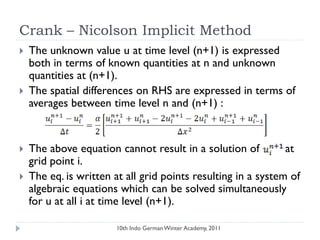
Crank – Nicolson Implicit Method
 The unknown value u at time level (n+1) is expressed
both in terms of known quantities at n and unknown
quantities at (n+1).
 The spatial differences on RHS are expressed in terms of
averages between time level n and (n+1) :
 The above equation cannot result in a solution of at
grid point i.
 The eq. is written at all grid points resulting in a system of
algebraic equations which can be solved simultaneously
for u at all i at time level (n+1).
10th Indo German Winter Academy, 2011
Crank – Nicolson Implicit Method
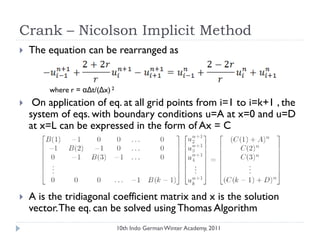
 The equation can be rearranged as
where r = αΔt/(Δx) 2
 On application of eq. at all grid points from i=1 to i=k+1 , the
system of eqs. with boundary conditions u=A at x=0 and u=D
at x=L can be expressed in the form of Ax = C
 A is the tridiagonal coefficient matrix and x is the solution
vector.The eq. can be solved using Thomas Algorithm
10th Indo German Winter Academy, 2011
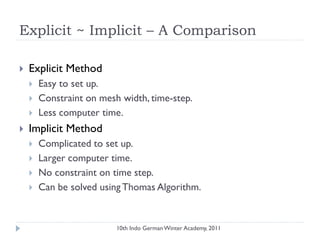
Explicit ~ Implicit – A Comparison
 Explicit Method
 Easy to set up.
 Constraint on mesh width, time-step.
 Less computer time.
 Implicit Method
 Complicated to set up.
 Larger computer time.
 No constraint on time step.
 Can be solved using Thomas Algorithm.
10th Indo German Winter Academy, 2011
Consistency, Stability & Convergence
10th Indo German Winter Academy, 2011
Consistency
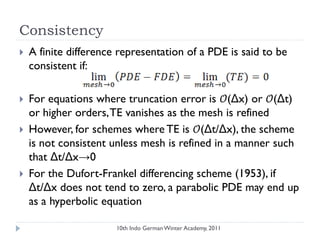
 A finite difference representation of a PDE is said to be
consistent if:
 For equations where truncation error is 𝒪(Δx) or 𝒪(Δt)
or higher orders,TE vanishes as the mesh is refined
 However, for schemes where TE is 𝒪(Δt/Δx), the scheme
is not consistent unless mesh is refined in a manner such
that Δt/Δx→0
 For the Dufort-Frankel differencing scheme (1953), if
Δt/Δx does not tend to zero, a parabolic PDE may end up
as a hyperbolic equation
10th Indo German Winter Academy, 2011
Convergence
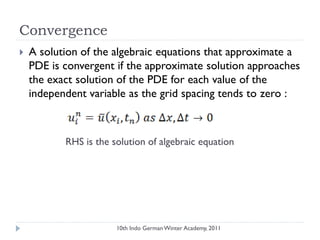
 A solution of the algebraic equations that approximate a
PDE is convergent if the approximate solution approaches
the exact solution of the PDE for each value of the
independent variable as the grid spacing tends to zero :
RHS is the solution of algebraic equation
10th Indo German Winter Academy, 2011
Errors & Stability Analysis
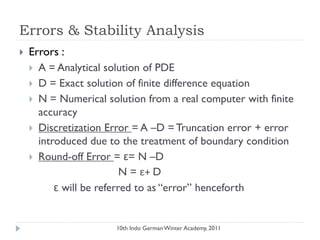
 Errors :
 A = Analytical solution of PDE
 D = Exact solution of finite difference equation
 N = Numerical solution from a real computer with finite
accuracy
 Discretization Error = A –D = Truncation error + error
introduced due to the treatment of boundary condition
 Round-off Error = ε= N –D
N = ε+ D
ε will be referred to as “error” henceforth
10th Indo German Winter Academy, 2011
Errors & Stability Analysis
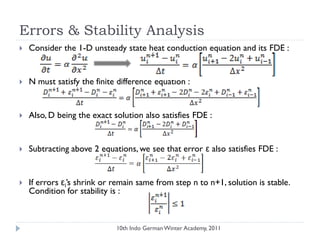
 Consider the 1-D unsteady state heat conduction equation and its FDE :
 N must satisfy the finite difference equation :
 Also, D being the exact solution also satisfies FDE :
 Subtracting above 2 equations, we see that error ε also satisfies FDE :
 If errors εi‟s shrink or remain same from step n to n+1, solution is stable.
Condition for stability is :
10th Indo German Winter Academy, 2011
Application in Fluid Flow Equations
10th Indo German Winter Academy, 2011
Introduction
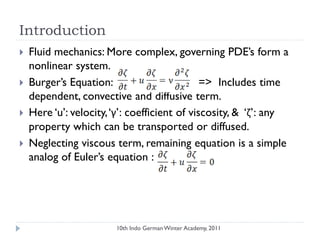
 Fluid mechanics: More complex, governing PDE‟s form a
nonlinear system.
 Burger‟s Equation: => Includes time
dependent, convective and diffusive term.
 Here „u‟: velocity,„γ‟: coefficient of viscosity, & „ζ‟: any
property which can be transported or diffused.
 Neglecting viscous term, remaining equation is a simple
analog of Euler‟s equation :
10th Indo German Winter Academy, 2011
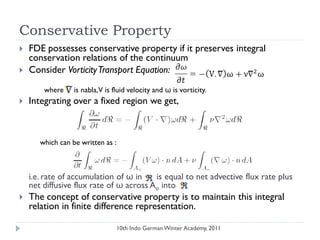
Conservative Property
 FDE possesses conservative property if it preserves integral
conservation relations of the continuum
 Consider VorticityTransport Equation:
where is nabla,V is fluid velocity and ω is vorticity.
 Integrating over a fixed region we get,
which can be written as :
i.e. rate of accumulation of ω in is equal to net advective flux rate plus
net diffusive flux rate of ω across Ao into
 The concept of conservative property is to maintain this integral
relation in finite difference representation.
10th Indo German Winter Academy, 2011
Conservative Property
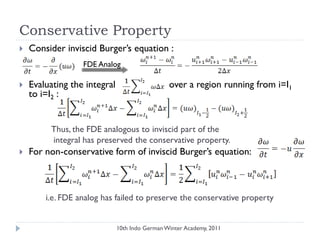
 Consider inviscid Burger‟s equation :
 Evaluating the integral over a region running from i=I1
to i=I2 :
Thus, the FDE analogous to inviscid part of the
integral has preserved the conservative property.
 For non-conservative form of inviscid Burger‟s equation:
i.e. FDE analog has failed to preserve the conservative property
FDE Analog
10th Indo German Winter Academy, 2011
Transportive Property
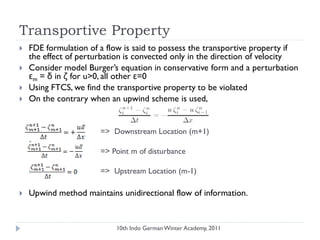
 FDE formulation of a flow is said to possess the transportive property if
the effect of perturbation is convected only in the direction of velocity
 Consider model Burger‟s equation in conservative form and a perturbation
εm = δ in ζ for u>0, all other ε=0
 Using FTCS, we find the transportive property to be violated
 On the contrary when an upwind scheme is used,
 => Downstream Location (m+1)

 => Point m of disturbance
 => Upstream Location (m-1)
 Upwind method maintains unidirectional flow of information.
10th Indo German Winter Academy, 2011
The Upwind Method
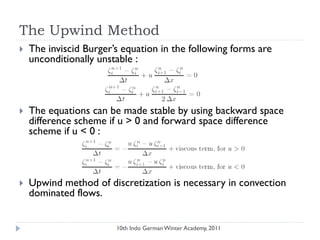
 The inviscid Burger‟s equation in the following forms are
unconditionally unstable :
 The equations can be made stable by using backward space
difference scheme if u > 0 and forward space difference
scheme if u < 0 :
 Upwind method of discretization is necessary in convection
dominated flows.
10th Indo German Winter Academy, 2011
References
 Knabner P., Angerman L. - “Numerical Methods for Elliptic
and Parabolic Partial Differential Equations”
 "Numerical simulation in fluid dynamics: a practical
introduction" by Michael Griebel, Thomas Dornseifer, Tilman
Neunhoeffe
 http://www10.informatik.uni-
erlangen.de/en/Teaching/Courses/WS2011/SiWiR/material/scri
pt.pdf
 "Introduction to Partial Differential Equations (A
ComputationalApproach)" by Aslak Tveito, Ragnar Winther
(Publisher: Springer Berlin)
 “Finite Difference Schemes and Partial Differential
Equations, Second Edition” , John C. Strikwerda
10th Indo German Winter Academy, 2011

Fundamentals of Finite Difference Methods

  • 1.
    Fundamentals of FiniteDifference Methods Ashish Ranjan Jha, Electrical Engineering, IIT Roorkee 10th Indo German Winter Academy, 2011
  • 2.
    Topics to becovered  Introduction  About PDEs(Partial Differential Equations)  Various Discretization Methods  FDM - Overview  Basics of Finite Difference Methods  Taylor Series Expansion  Finite Difference Quotients  Truncation Error  Finite Difference Methods  Explicit Method  Implicit Method – Crank Nicholson Method  Comparison of the two  Consistency, Stability and Convergence  Consistency  Convergence  Error and Stability Analysis –Von Neumann Analysis  Application in Fluid Flow Equations  Conservative property  Transportive property  Upwinding  Hybrid Scheme 10th Indo German Winter Academy, 2011
  • 3.
    Introduction 10th Indo GermanWinter Academy, 2011
  • 4.
    About PDEs : A second order PDE :  Linear Equations:A,B,C,D,E and F are constants or f(x,y)  Non-linear Equations:A,B,C,D,E and F contain φ or its derivatives  Quasilinear Equations: Important subclass of nonlinear equations.A,B,C,D,E and F may be function of φ or its first derivatives  Homogeneous: G=0  Parabolic Equation: B*B - 4AC = 0  Elliptic Equation: B*B – 4AC < 0  Hyperbolic Equation: B*B – 4AC > 0 10th Indo German Winter Academy, 2011
  • 5.
    About PDEs : Some basic equations :  Navier Stoke Equation : Elliptical in space ; Parabolic in time  Laplace and Poisson Equations: Elliptic  Fluid flow problems have non – linear terms called advection and convection terms in momentum and energy equations respectively. 10th Indo German Winter Academy, 2011
  • 6.
    Various Discretization Methods Finite Difference Method (FDM)  Finite Element Method (FEM)  FiniteVolume Method (FVM)  Spectral Method  Lattice Gas Cellular Automata (LGCA) 10th Indo German Winter Academy, 2011
  • 7.
    FDM - Overview Boundary Conditions  No. of Boundary conditions required is order of highest derivative appearing in each independent variable  Unsteady equations governed by a first derivative in time require initial condition to carry out the time integration  Three types of spatial boundary conditions:  Dirchlet Condition  Neumann Condition  Mixed Boundary Condition 10th Indo German Winter Academy, 2011
  • 8.
    FDM - Overview Basic Procedure  Replace derivatives of governing equations with algebraic difference quotients  Results in a system of algebraic equations solvable for dependent variables at discrete grid points  Analytical solutions provide closed-form expressions –variation of dependent variables in the domain  Numerical solutions (finite difference) - values at discrete points in the domain 10th Indo German Winter Academy, 2011
  • 9.
    FDM - Overview Discrete Grid Points  Δx and Δy –spacing in positive x and y direction  Δx & Δy not necessarily uniform.  In some cases, numerical calculations performed on trans- formed computational plane having uniform spacing in transformed variables but non uniform spacing in physical plane.  Grid points identified by indices i and j in positive x and y direction respectively. 10th Indo German Winter Academy, 2011
  • 10.
    Basics of FiniteDifference Methods 10th Indo German Winter Academy, 2011
  • 11.
    Taylor Series Expansion forsmall Δx higher order terms can be neglected. n-order accurate Truncation error 10th Indo German Winter Academy, 2011
  • 12.
    Finite Difference Quotientsand Truncation Error Forward Difference Truncation Error 𝒪(Δx) Backward Difference Truncation Error 𝒪(Δx) Central Difference Truncation Error 𝒪(Δx)2 Central Difference for Second Derivative 10th Indo German Winter Academy, 2011
  • 13.
    Finite Difference Quotientsand Truncation Error  Basic concept: Replace each term of PDE with its finite difference equivalent term  Partial difference equation:  Using Forward time Central Space (FTCS) method of discretization:  n: conditions at time t  i: grid point in spatial dimension  Truncation Error (TE) = 𝒪(Δt, (Δx)2) 10th Indo German Winter Academy, 2011
  • 14.
    Finite Difference Methods 10thIndo German Winter Academy, 2011
  • 15.
    Explicit Method  Explicitmethod uses the fact that we know the dependent variable, u at all x at time t from initial conditions  Since the equation contains only one unknown, (i.e. u at time t+Δt), it can be obtained directly from known values of u at t  The solution takes the form of a “marching” procedure in steps of time 10th Indo German Winter Academy, 2011
  • 16.
    Crank – NicolsonImplicit Method  The unknown value u at time level (n+1) is expressed both in terms of known quantities at n and unknown quantities at (n+1).  The spatial differences on RHS are expressed in terms of averages between time level n and (n+1) :  The above equation cannot result in a solution of at grid point i.  The eq. is written at all grid points resulting in a system of algebraic equations which can be solved simultaneously for u at all i at time level (n+1). 10th Indo German Winter Academy, 2011
  • 17.
    Crank – NicolsonImplicit Method  The equation can be rearranged as where r = αΔt/(Δx) 2  On application of eq. at all grid points from i=1 to i=k+1 , the system of eqs. with boundary conditions u=A at x=0 and u=D at x=L can be expressed in the form of Ax = C  A is the tridiagonal coefficient matrix and x is the solution vector.The eq. can be solved using Thomas Algorithm 10th Indo German Winter Academy, 2011
  • 18.
    Explicit ~ Implicit– A Comparison  Explicit Method  Easy to set up.  Constraint on mesh width, time-step.  Less computer time.  Implicit Method  Complicated to set up.  Larger computer time.  No constraint on time step.  Can be solved using Thomas Algorithm. 10th Indo German Winter Academy, 2011
  • 19.
    Consistency, Stability &Convergence 10th Indo German Winter Academy, 2011
  • 20.
    Consistency  A finitedifference representation of a PDE is said to be consistent if:  For equations where truncation error is 𝒪(Δx) or 𝒪(Δt) or higher orders,TE vanishes as the mesh is refined  However, for schemes where TE is 𝒪(Δt/Δx), the scheme is not consistent unless mesh is refined in a manner such that Δt/Δx→0  For the Dufort-Frankel differencing scheme (1953), if Δt/Δx does not tend to zero, a parabolic PDE may end up as a hyperbolic equation 10th Indo German Winter Academy, 2011
  • 21.
    Convergence  A solutionof the algebraic equations that approximate a PDE is convergent if the approximate solution approaches the exact solution of the PDE for each value of the independent variable as the grid spacing tends to zero : RHS is the solution of algebraic equation 10th Indo German Winter Academy, 2011
  • 22.
    Errors & StabilityAnalysis  Errors :  A = Analytical solution of PDE  D = Exact solution of finite difference equation  N = Numerical solution from a real computer with finite accuracy  Discretization Error = A –D = Truncation error + error introduced due to the treatment of boundary condition  Round-off Error = ε= N –D N = ε+ D ε will be referred to as “error” henceforth 10th Indo German Winter Academy, 2011
  • 23.
    Errors & StabilityAnalysis  Consider the 1-D unsteady state heat conduction equation and its FDE :  N must satisfy the finite difference equation :  Also, D being the exact solution also satisfies FDE :  Subtracting above 2 equations, we see that error ε also satisfies FDE :  If errors εi‟s shrink or remain same from step n to n+1, solution is stable. Condition for stability is : 10th Indo German Winter Academy, 2011
  • 24.
    Application in FluidFlow Equations 10th Indo German Winter Academy, 2011
  • 25.
    Introduction  Fluid mechanics:More complex, governing PDE‟s form a nonlinear system.  Burger‟s Equation: => Includes time dependent, convective and diffusive term.  Here „u‟: velocity,„γ‟: coefficient of viscosity, & „ζ‟: any property which can be transported or diffused.  Neglecting viscous term, remaining equation is a simple analog of Euler‟s equation : 10th Indo German Winter Academy, 2011
  • 26.
    Conservative Property  FDEpossesses conservative property if it preserves integral conservation relations of the continuum  Consider VorticityTransport Equation: where is nabla,V is fluid velocity and ω is vorticity.  Integrating over a fixed region we get, which can be written as : i.e. rate of accumulation of ω in is equal to net advective flux rate plus net diffusive flux rate of ω across Ao into  The concept of conservative property is to maintain this integral relation in finite difference representation. 10th Indo German Winter Academy, 2011
  • 27.
    Conservative Property  Considerinviscid Burger‟s equation :  Evaluating the integral over a region running from i=I1 to i=I2 : Thus, the FDE analogous to inviscid part of the integral has preserved the conservative property.  For non-conservative form of inviscid Burger‟s equation: i.e. FDE analog has failed to preserve the conservative property FDE Analog 10th Indo German Winter Academy, 2011
  • 28.
    Transportive Property  FDEformulation of a flow is said to possess the transportive property if the effect of perturbation is convected only in the direction of velocity  Consider model Burger‟s equation in conservative form and a perturbation εm = δ in ζ for u>0, all other ε=0  Using FTCS, we find the transportive property to be violated  On the contrary when an upwind scheme is used,  => Downstream Location (m+1)   => Point m of disturbance  => Upstream Location (m-1)  Upwind method maintains unidirectional flow of information. 10th Indo German Winter Academy, 2011
  • 29.
    The Upwind Method The inviscid Burger‟s equation in the following forms are unconditionally unstable :  The equations can be made stable by using backward space difference scheme if u > 0 and forward space difference scheme if u < 0 :  Upwind method of discretization is necessary in convection dominated flows. 10th Indo German Winter Academy, 2011
  • 30.
    References  Knabner P.,Angerman L. - “Numerical Methods for Elliptic and Parabolic Partial Differential Equations”  "Numerical simulation in fluid dynamics: a practical introduction" by Michael Griebel, Thomas Dornseifer, Tilman Neunhoeffe  http://www10.informatik.uni- erlangen.de/en/Teaching/Courses/WS2011/SiWiR/material/scri pt.pdf  "Introduction to Partial Differential Equations (A ComputationalApproach)" by Aslak Tveito, Ragnar Winther (Publisher: Springer Berlin)  “Finite Difference Schemes and Partial Differential Equations, Second Edition” , John C. Strikwerda 10th Indo German Winter Academy, 2011
  • 31.
    10th Indo GermanWinter Academy, 2011