8 
1.0 BACKGROUND 
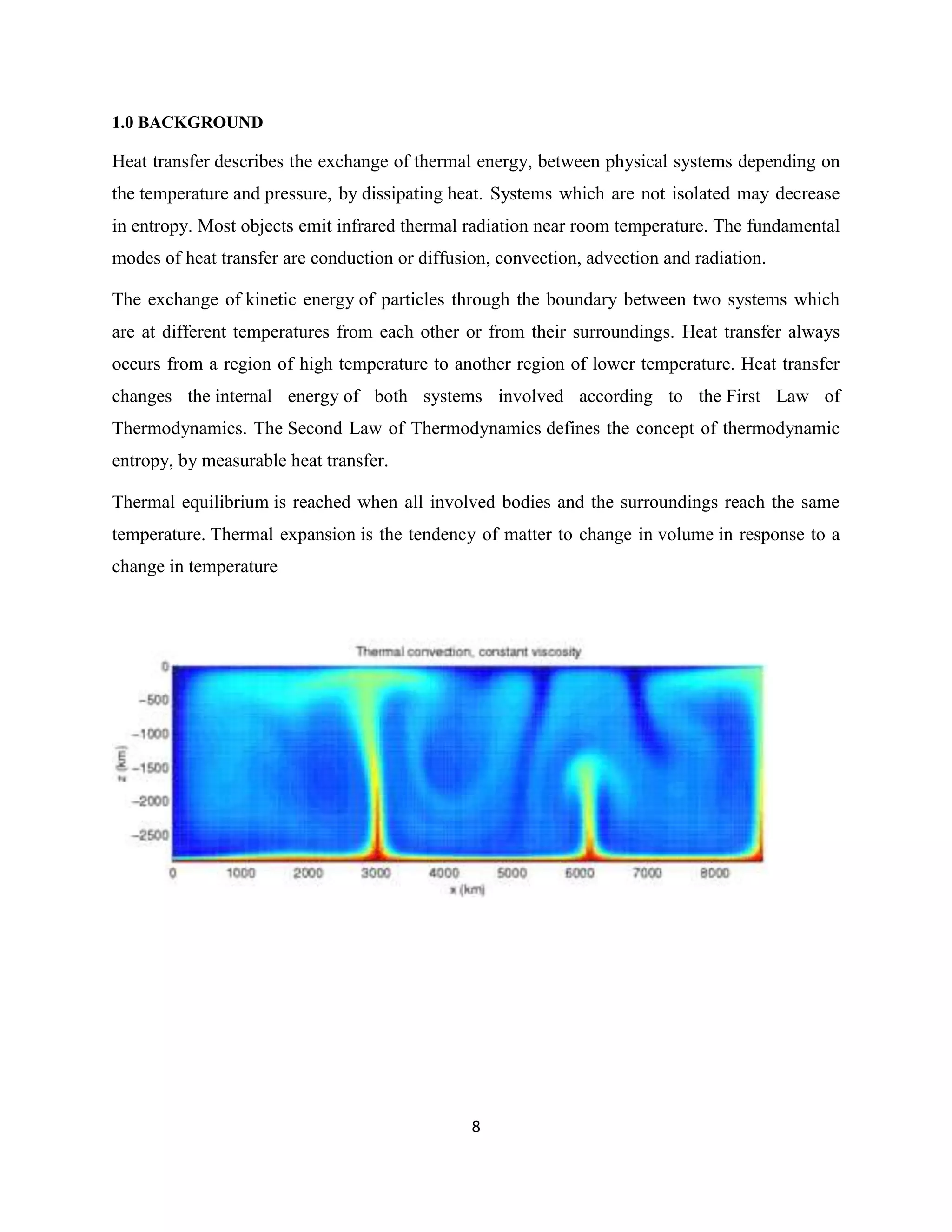
Heat transfer describes the exchange of thermal energy, between physical systems depending on 
the temperature and pressure, by dissipating heat. Systems which are not isolated may decrease 
in entropy. Most objects emit infrared thermal radiation near room temperature. The fundamental 
modes of heat transfer are conduction or diffusion, convection, advection and radiation. 
The exchange of kinetic energy of particles through the boundary between two systems which 
are at different temperatures from each other or from their surroundings. Heat transfer always 
occurs from a region of high temperature to another region of lower temperature. Heat transfer 
changes the internal energy of both systems involved according to the First Law of 
Thermodynamics. The Second Law of Thermodynamics defines the concept of thermodynamic 
entropy, by measurable heat transfer. 
Thermal equilibrium is reached when all involved bodies and the surroundings reach the same 
temperature. Thermal expansion is the tendency of matter to change in volume in response to a 
change in temperature
8 
The fundamental modes of heat transfer are: 
Advection 
Advection is the transport mechanism of a fluid substance or conserved property from one 
location to another, depending on motion and momentum. 
Conduction or diffusion 
The transfer of energy between objects that are in physical contact. Thermal conductivity is the 
property of a material to conduct heat and evaluated primarily in terms of Fourier's Law for heat 
conduction. 
Convection 
The transfer of energy between an object and its environment, due to fluid motion. The average 
temperature, is a reference for evaluating properties related to convective heat transfer. 
Radiation 
The transfer of energy from the movement of charged particles within atoms is converted 
to electromagnetic radiation.
8 
2.0 PROBLEM STATEMENT 
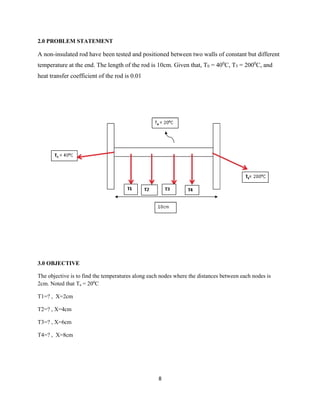
A non-insulated rod have been tested and positioned between two walls of constant but different 
temperature at the end. The length of the rod is 10cm. Given that, T0 = 400C, T5 = 2000C, and 
heat transfer coefficient of the rod is 0.01 
3.0 OBJECTIVE 
The objective is to find the temperatures along each nodes where the distances between each nodes is 
2cm. Noted that Ta = 200C 
T1=? , X=2cm 
T2=? , X=4cm 
T3=? , X=6cm 
T4=? , X=8cm
8 
4.0 ANALYTICAL SOLUTION 
Equation to solve the problem statement was given. By substituting value of x into equation, T1, T2, T3, 
and T4 can be solved. 
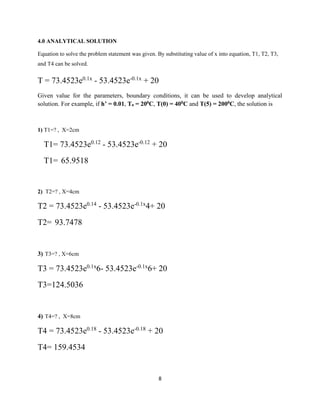
T = 73.4523e0.1x - 53.4523e-0.1x + 20 
Given value for the parameters, boundary conditions, it can be used to develop analytical 
solution. For example, if h’ = 0.01, Ta = 200C, T(0) = 400C and T(5) = 2000C, the solution is 
1) T1=? , X=2cm 
T1= 73.4523e0.12 - 53.4523e-0.12 + 20 
T1= 65.9518 
2) T2=? , X=4cm 
T2 = 73.4523e0.14 - 53.4523e-0.1x4+ 20 
T2= 93.7478 
3) T3=? , X=6cm 
T3 = 73.4523e0.1x6- 53.4523e-0.1x6+ 20 
T3=124.5036 
4) T4=? , X=8cm 
T4 = 73.4523e0.18 - 53.4523e-0.18 + 20 
T4= 159.4534
8 
5.0 NUMERICAL SOLUTION 
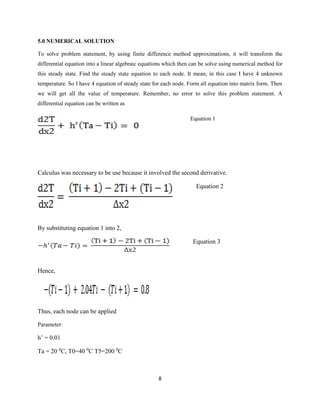
To solve problem statement, by using finite difference method approximations, it will transform the 
differential equation into a linear algebraic equations which then can be solve using numerical method for 
this steady state. Find the steady state equation to each node. It mean, in this case I have 4 unknown 
temperature. So I have 4 equation of steady state for each node. Form all equation into matrix form. Then 
we will get all the value of temperature. Remember, no error to solve this problem statement. A 
differential equation can be written as 
Equation 1 
Calculus was necessary to be use because it involved the second derivative. 
Equation 2 
By substituting equation 1 into 2, 
Equation 3 
Hence, 
Thus, each node can be applied 
Parameter: 
h’ = 0.01 
Ta = 20 0C, T0=40 0C T5=200 0C
8 
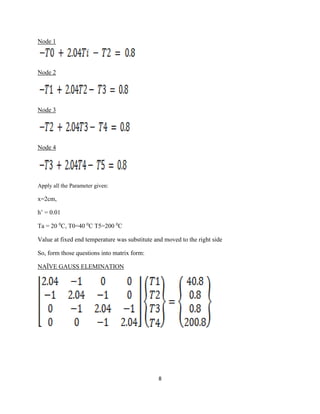
Node 1 
Node 2 
Node 3 
Node 4 
Apply all the Parameter given: 
x=2cm, 
h’ = 0.01 
Ta = 20 0C, T0=40 0C T5=200 0C 
Value at fixed end temperature was substitute and moved to the right side 
So, form those questions into matrix form: 
NAÏVE GAUSS ELEMINATION
8 
6.0 MATLAB 
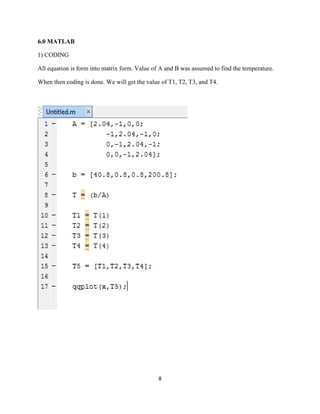
1) CODING 
All equation is form into matrix form. Value of A and B was assumed to find the temperature. 
When then coding is done. We will get the value of T1, T2, T3, and T4.
8 
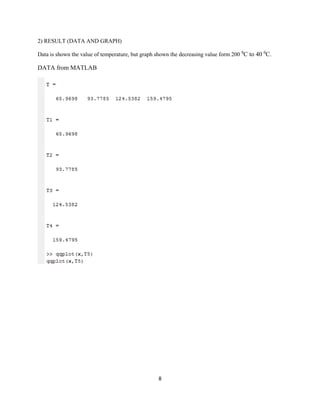
2) RESULT (DATA AND GRAPH) 
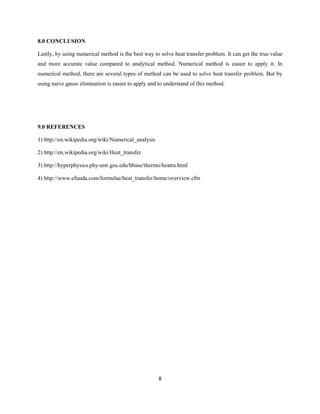
Data is shown the value of temperature, but graph shown the decreasing value form 200 0C to 40 0C. 
DATA from MATLAB
8 
GRAPH
8 
7.0 DISCUSSION 
By using the finite difference approximations, the temperature for the entire node can be easily calculated: 
Which, 
T1= 65.9698 0C, T2= 93.7785 0C, T3= 124.5382 0C, 
T4= 159.4795 0C 
Based on the graph, it can see the true value of the temperature along the distance between 0cm to 10 cm. 
It knows by using numerical approximate is the best way to solve the problem in heat transfer. Simple 
step of numerical solution is very useful to apply it. On the graph, it can see linear graph of the 
temperature slowing down until T0. By using this method, it easy to find the true value along the distance 
compared to the analytical solution. If using the analytical solution it needs to find the equation first and it 
can solve the problem statement but it only can get the temperature at the node only. Example, it can see 
how much reducing of temperature from 0cm to 5 cm in term of temperature base on linear graph but if 
use analytical solution it cannot find the temperature at 5cm unless apply the equation and then repeat the 
same steps. If compared analytical method between numerical methods to the value of temperature, it 
showed the difference value. Example, at node 1, by using analytical solution, value of temperature T1 is 
65.9518 compared to numerical method, value of temperature T1 is 65.9698. By using the numerical 
method, it proved the value of the temperature more accurate compared to analytical method.
8 
8.0 CONCLUSION 
Lastly, by using numerical method is the best way to solve heat transfer problem. It can get the true value 
and more accurate value compared to analytical method. Numerical method is easier to apply it. In 
numerical method, there are several types of method can be used to solve heat transfer problem. But by 
using naive gauss elimination is easier to apply and to understand of this method. 
9.0 REFERENCES 
1) http://en.wikipedia.org/wiki/Numerical_analysis 
2) http://en.wikipedia.org/wiki/Heat_transfer 
3) http://hyperphysics.phy-astr.gsu.edu/hbase/thermo/heatra.html 
4) http://www.efunda.com/formulae/heat_transfer/home/overview.cfm

Numerical report gauss

  • 1.
    8 1.0 BACKGROUND Heat transfer describes the exchange of thermal energy, between physical systems depending on the temperature and pressure, by dissipating heat. Systems which are not isolated may decrease in entropy. Most objects emit infrared thermal radiation near room temperature. The fundamental modes of heat transfer are conduction or diffusion, convection, advection and radiation. The exchange of kinetic energy of particles through the boundary between two systems which are at different temperatures from each other or from their surroundings. Heat transfer always occurs from a region of high temperature to another region of lower temperature. Heat transfer changes the internal energy of both systems involved according to the First Law of Thermodynamics. The Second Law of Thermodynamics defines the concept of thermodynamic entropy, by measurable heat transfer. Thermal equilibrium is reached when all involved bodies and the surroundings reach the same temperature. Thermal expansion is the tendency of matter to change in volume in response to a change in temperature
  • 2.
    8 The fundamentalmodes of heat transfer are: Advection Advection is the transport mechanism of a fluid substance or conserved property from one location to another, depending on motion and momentum. Conduction or diffusion The transfer of energy between objects that are in physical contact. Thermal conductivity is the property of a material to conduct heat and evaluated primarily in terms of Fourier's Law for heat conduction. Convection The transfer of energy between an object and its environment, due to fluid motion. The average temperature, is a reference for evaluating properties related to convective heat transfer. Radiation The transfer of energy from the movement of charged particles within atoms is converted to electromagnetic radiation.
  • 3.
    8 2.0 PROBLEMSTATEMENT A non-insulated rod have been tested and positioned between two walls of constant but different temperature at the end. The length of the rod is 10cm. Given that, T0 = 400C, T5 = 2000C, and heat transfer coefficient of the rod is 0.01 3.0 OBJECTIVE The objective is to find the temperatures along each nodes where the distances between each nodes is 2cm. Noted that Ta = 200C T1=? , X=2cm T2=? , X=4cm T3=? , X=6cm T4=? , X=8cm
  • 4.
    8 4.0 ANALYTICALSOLUTION Equation to solve the problem statement was given. By substituting value of x into equation, T1, T2, T3, and T4 can be solved. T = 73.4523e0.1x - 53.4523e-0.1x + 20 Given value for the parameters, boundary conditions, it can be used to develop analytical solution. For example, if h’ = 0.01, Ta = 200C, T(0) = 400C and T(5) = 2000C, the solution is 1) T1=? , X=2cm T1= 73.4523e0.12 - 53.4523e-0.12 + 20 T1= 65.9518 2) T2=? , X=4cm T2 = 73.4523e0.14 - 53.4523e-0.1x4+ 20 T2= 93.7478 3) T3=? , X=6cm T3 = 73.4523e0.1x6- 53.4523e-0.1x6+ 20 T3=124.5036 4) T4=? , X=8cm T4 = 73.4523e0.18 - 53.4523e-0.18 + 20 T4= 159.4534
  • 5.
    8 5.0 NUMERICALSOLUTION To solve problem statement, by using finite difference method approximations, it will transform the differential equation into a linear algebraic equations which then can be solve using numerical method for this steady state. Find the steady state equation to each node. It mean, in this case I have 4 unknown temperature. So I have 4 equation of steady state for each node. Form all equation into matrix form. Then we will get all the value of temperature. Remember, no error to solve this problem statement. A differential equation can be written as Equation 1 Calculus was necessary to be use because it involved the second derivative. Equation 2 By substituting equation 1 into 2, Equation 3 Hence, Thus, each node can be applied Parameter: h’ = 0.01 Ta = 20 0C, T0=40 0C T5=200 0C
  • 6.
    8 Node 1 Node 2 Node 3 Node 4 Apply all the Parameter given: x=2cm, h’ = 0.01 Ta = 20 0C, T0=40 0C T5=200 0C Value at fixed end temperature was substitute and moved to the right side So, form those questions into matrix form: NAÏVE GAUSS ELEMINATION
  • 7.
    8 6.0 MATLAB 1) CODING All equation is form into matrix form. Value of A and B was assumed to find the temperature. When then coding is done. We will get the value of T1, T2, T3, and T4.
  • 8.
    8 2) RESULT(DATA AND GRAPH) Data is shown the value of temperature, but graph shown the decreasing value form 200 0C to 40 0C. DATA from MATLAB
  • 9.
  • 10.
    8 7.0 DISCUSSION By using the finite difference approximations, the temperature for the entire node can be easily calculated: Which, T1= 65.9698 0C, T2= 93.7785 0C, T3= 124.5382 0C, T4= 159.4795 0C Based on the graph, it can see the true value of the temperature along the distance between 0cm to 10 cm. It knows by using numerical approximate is the best way to solve the problem in heat transfer. Simple step of numerical solution is very useful to apply it. On the graph, it can see linear graph of the temperature slowing down until T0. By using this method, it easy to find the true value along the distance compared to the analytical solution. If using the analytical solution it needs to find the equation first and it can solve the problem statement but it only can get the temperature at the node only. Example, it can see how much reducing of temperature from 0cm to 5 cm in term of temperature base on linear graph but if use analytical solution it cannot find the temperature at 5cm unless apply the equation and then repeat the same steps. If compared analytical method between numerical methods to the value of temperature, it showed the difference value. Example, at node 1, by using analytical solution, value of temperature T1 is 65.9518 compared to numerical method, value of temperature T1 is 65.9698. By using the numerical method, it proved the value of the temperature more accurate compared to analytical method.
  • 11.
    8 8.0 CONCLUSION Lastly, by using numerical method is the best way to solve heat transfer problem. It can get the true value and more accurate value compared to analytical method. Numerical method is easier to apply it. In numerical method, there are several types of method can be used to solve heat transfer problem. But by using naive gauss elimination is easier to apply and to understand of this method. 9.0 REFERENCES 1) http://en.wikipedia.org/wiki/Numerical_analysis 2) http://en.wikipedia.org/wiki/Heat_transfer 3) http://hyperphysics.phy-astr.gsu.edu/hbase/thermo/heatra.html 4) http://www.efunda.com/formulae/heat_transfer/home/overview.cfm