Presented By-
ROHIT
R.K.S.D college of
pharmacy, Kaithal (Hry)
1
DEFINITION
2
The term nutraceutical was coined by Stephen
Defelice .
“A NEUTRACEUTICAL is any substance that
is a food or a part of food and provides medical or
health benefits, including the prevention and
treatmentof disease”
.
CLASSIFICATION
3
Neutraceuticalscan beclassified based on:
 Natural source
 Pharmacological conditions
 Chemical constitution
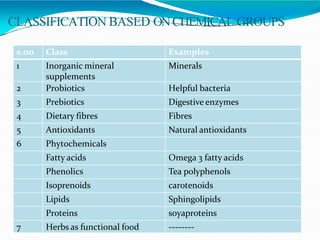
CLASSIFICATION BASED ONCHEMICAL GROUPS
s.no Class Examples
1 Inorganic mineral
supplements
Minerals
2 Probiotics Helpful bacteria
3 Prebiotics Digestive enzymes
4 Dietary fibres Fibres
5 Antioxidants Natural antioxidants
6 Phytochemicals
Fatty acids Omega 3 fatty acids
Phenolics Tea polyphenols
Isoprenoids carotenoids
Lipids Sphingolipids
Proteins soyaproteins
7 Herbs as functional food --------
INORGANIC MINERAL SUPPLEMENT
5
Calcium
Magnesium
Manganese
Boron
Copper
Zinc
Phosphorus
PROBIOTICS
6
Live microorganisms which, when
administered in adequate amounts, confera health
benefiton the host
 Speciesof Lactobacillus
 Bifidobacterium
 yeast Saccharomyces cerevisiae
some E. coli and Bacillus species are also used as
probiotics
PREBIOTICS
7
Nondigestiblesubstances that providea beneficial
physiological effect for the host by selectively
stimulating the favorable growth of a limited
numberof indigenous bacteria.
Commonly known prebiotics are:
 Oligofructose
 Inulin
 Galacto-oligosaccharides
 Lactulose
DIETARY FIBRES
8
Dietary fibers areof two types:
 Water insoluble fibers
 Watersoluble fibers
Daily recommended intake is 30-40 gms.
SOURCES:
Wholegrain cereals, wheat products.
Oats , dried beans, legumes.
ANTIOXIDANTS
9
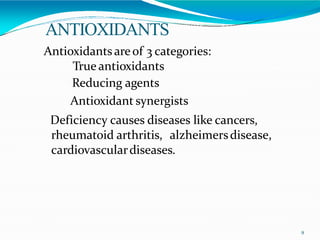
Antioxidants areof 3 categories:
True antioxidants
Reducing agents
Antioxidant synergists
Deficiency causes diseases like cancers,
rheumatoid arthritis, alzheimersdisease,
cardiovasculardiseases.
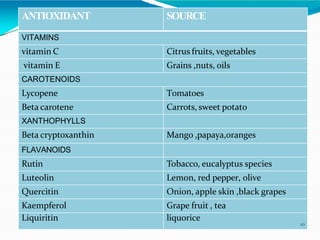
ANTIOXIDANT SOURCE
VITAMINS
vitamin C Citrus fruits, vegetables
vitamin E Grains ,nuts, oils
CAROTENOIDS
Lycopene Tomatoes
Beta carotene Carrots, sweet potato
XANTHOPHYLLS
Beta cryptoxanthin Mango ,papaya,oranges
FLAVANOIDS
Rutin Tobacco, eucalyptus species
Luteolin Lemon, red pepper, olive
Quercitin Onion, apple skin ,black grapes
Kaempferol Grape fruit , tea
Liquiritin liquorice
10
HERBS AS FUNCTIONAL FOODS
11
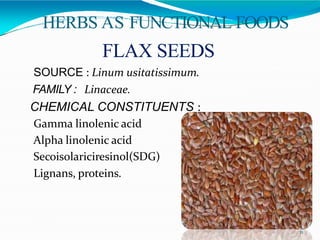
FLAX SEEDS
SOURCE : Linum usitatissimum.
FAMILY : Linaceae.
CHEMICAL CONSTITUENTS :
Gamma linolenic acid
Alpha linolenic acid
Secoisolariciresinol(SDG)
Lignans, proteins.
FLAX SEEDS
12
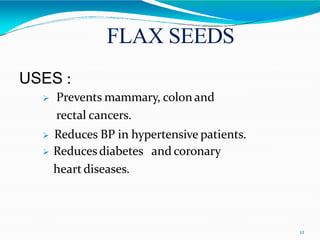
USES :
 Prevents mammary, colon and
rectal cancers.
 Reduces BP in hypertensive patients.
 Reducesdiabetes and coronary
heart diseases.
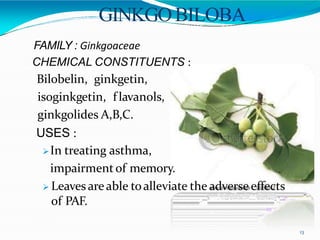
GINKGOBILOBA
13
FAMILY : Ginkgoaceae
CHEMICAL CONSTITUENTS :
Bilobelin, ginkgetin,
isoginkgetin, flavanols,
ginkgolides A,B,C.
USES :
In treating asthma,
impairmentof memory.
 Leavesareable toalleviate the adverse effects
of PAF.
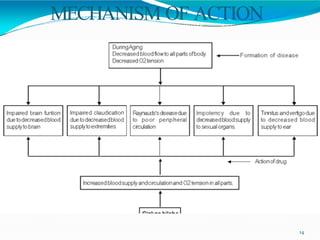
MECHANISM OF ACTION
14
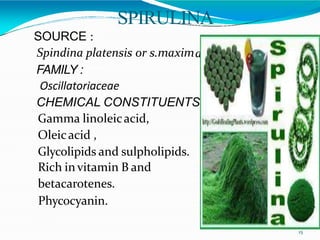
SPIRULINA
a
SOURCE :
Spindina platensis or s.maxim
FAMILY :
Oscillatoriaceae
CHEMICAL CONSTITUENTS
Gamma linoleicacid,
Oleicacid ,
Glycolipids and sulpholipids.
Rich in vitamin B and
betacarotenes.
Phycocyanin.
15
SPIRULINA
16
USES :
Immunostimulant activity.
Management of HIV and other viral
infections such as herpes,
cytomegalovirus, influenza, mumps
To treat arthritis, atherosclerosis, diabetes and
aging process
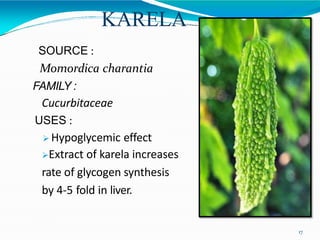
KARELA
SOURCE :
Momordica charantia
FAMILY :
Cucurbitaceae
USES :
 Hypoglycemic effect
Extract of karela increases
rate of glycogen synthesis
by 4-5 fold in liver.
17
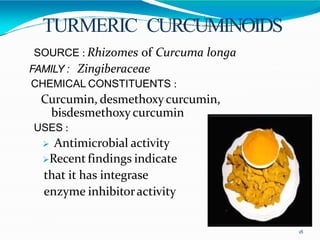
TURMERIC CURCUMINOIDS
SOURCE : Rhizomes of Curcuma longa
FAMILY : Zingiberaceae
CHEMICAL CONSTITUENTS :
Curcumin, desmethoxycurcumin,
bisdesmethoxy curcumin
USES :
 Antimicrobial activity
Recent findings indicate
that it has integrase
enzyme inhibitoractivity
18
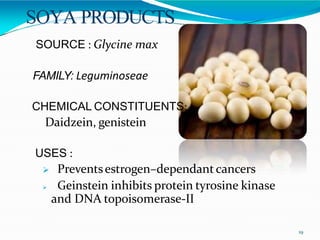
SOYA PRODUCTS
19
SOURCE : Glycine max
FAMILY: Leguminoseae
CHEMICAL CONSTITUENTS:
Daidzein, genistein
USES :
 Preventsestrogen–dependantcancers
 Geinstein inhibits protein tyrosine kinase
and DNA topoisomerase-II
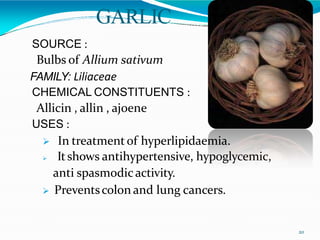
GARLIC
SOURCE :
Bulbs of Allium sativum
FAMILY: Liliaceae
CHEMICAL CONSTITUENTS :
Allicin , allin , ajoene
USES :
 In treatment of hyperlipidaemia.
 Itshows antihypertensive, hypoglycemic,
anti spasmodicactivity.
 Preventscolon and lung cancers.
20
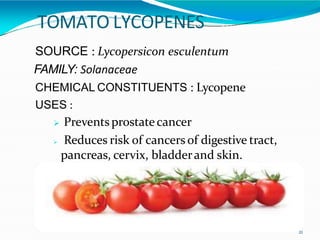
TOMATO LYCOPENES
SOURCE : Lycopersicon esculentum
FAMILY: Solanaceae
CHEMICAL CONSTITUENTS : Lycopene
USES :
 Preventsprostate cancer
 Reduces risk of cancers of digestive tract,
pancreas, cervix, bladderand skin.
21
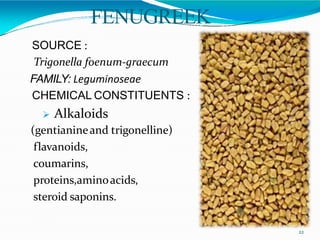
FENUGREEK
22
SOURCE :
Trigonella foenum-graecum
FAMILY: Leguminoseae
CHEMICAL CONSTITUENTS :
 Alkaloids
(gentianineand trigonelline)
flavanoids,
coumarins,
proteins,aminoacids,
steroid saponins.
FENUGREEK
23
USES :
 In treatmentof anorexia,
gastritis.
Fenugreek possess
laxative, expectorant, demulcent
properties.
Shows hypoglycemicand
hypocholesterolemicproperties
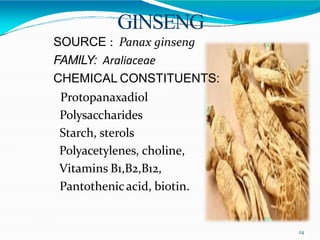
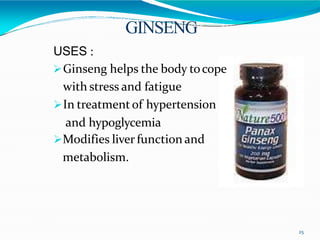
GINSENG
24
SOURCE : Panax ginseng
FAMILY: Araliaceae
CHEMICAL CONSTITUENTS:
Protopanaxadiol
Polysaccharides
Starch, sterols
Polyacetylenes, choline,
Vitamins B1,B2,B12,
Pantothenicacid, biotin.
GINSENG
25
USES :
Ginseng helps the body tocope
with stress and fatigue
In treatment of hypertension
and hypoglycemia
Modifies liver function and
metabolism.
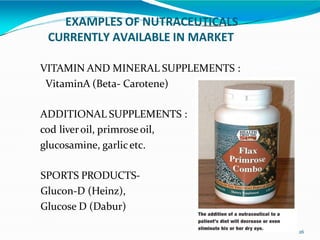
EXAMPLES OF NUTRACEUTICALS
CURRENTLY AVAILABLE IN MARKET
VITAMIN AND MINERAL SUPPLEMENTS :
VitaminA (Beta- Carotene)
ADDITIONAL SUPPLEMENTS :
cod liveroil, primroseoil,
glucosamine, garlicetc.
SPORTS PRODUCTS-
Glucon-D (Heinz),
Glucose D (Dabur)
26
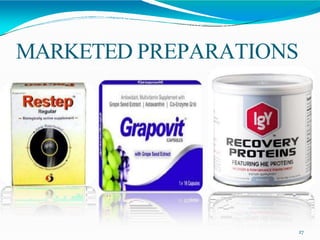
MARKETED PREPARATIONS
27
REFERENCES
28
⚫ Text book of pharmacognosyand phytochemistry by Biren shahand
A.K.Seth, pg.no-471-479.
⚫ Probiotics: Applications in Gastrointestinal Health & Disease Presented
in conjunction with the American College of Gastroenterology’s 72nd
Annual Scientific Meeting, Autumn 2007)
⚫ http://www.fao.org/ag/agn/agns/micro_probiotics_en.asp
⚫ De Felice L Stephen. The nutraceutical revolution, its
impact on food industry. Trends in Food Sci. and Tech
1995; 6:59-61.
⚫ Jack DB. Keep taking the tomatoes - the exciting world of
nutraceuticals. Mol Med Today 1995; 1(3):118-21.
⚫ BrowerB. Nutraceuticals: poised fora healthysliceof the
market. Nat Biotechnology 1998; 16: 728-33.
Mannion M. Nutraceutical revolution continues at
foundation for innovation in medicine conference. Am J
Nat Med 1998; 5:30-3.
29