Presented by :
Kolli Chaitanyalakshmi
M.Pharmacy 1st semister
under the guidance of
Dr. K. Shanta kumari, H.O.D
Department of pharmaceutical analysis
Nirmala college of pharmacy
 Introduction
 instrumentation
 Sample analysis
 Applications
 Conclusion
 References
Attenuated total reflectance (ATR)
spectroscopy is a versatile and powerful
technique for infrared spectroscopy which
enables samples to be examined directly in
the solid or liquid state with out further
preparation
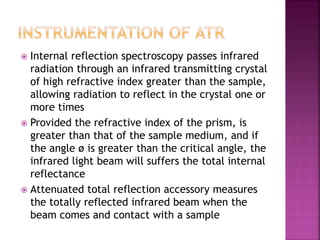
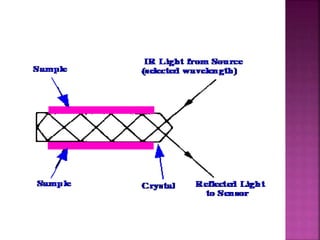
 Internal reflection spectroscopy passes infrared
radiation through an infrared transmitting crystal
of high refractive index greater than the sample,
allowing radiation to reflect in the crystal one or
more times
 Provided the refractive index of the prism, is
greater than that of the sample medium, and if
the angle ø is greater than the critical angle, the
infrared light beam will suffers the total internal
reflectance
 Attenuated total reflection accessory measures
the totally reflected infrared beam when the
beam comes and contact with a sample
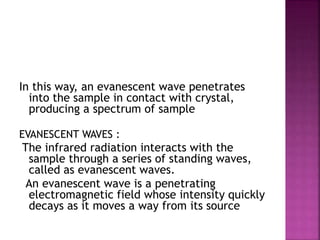
In this way, an evanescent wave penetrates
into the sample in contact with crystal,
producing a spectrum of sample
EVANESCENT WAVES :
The infrared radiation interacts with the
sample through a series of standing waves,
called as evanescent waves.
An evanescent wave is a penetrating
electromagnetic field whose intensity quickly
decays as it moves a way from its source
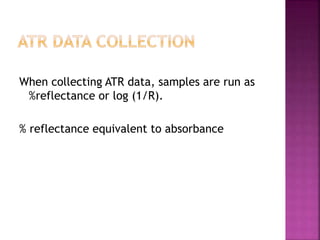
When collecting ATR data, samples are run as
%reflectance or log (1/R).
% reflectance equivalent to absorbance
CRYSTAL COMPOSITION:
Crystals are typically made of
 Germanium (Ge)
 Zinc sulfide (Zs)
 Silicon
 Diamond
 AMTIR: germanium, arsenic, selenium
(GeAsSe)
 Zinc selenide (znse) or mixed thbr and thl
 There are a number of crystal materials
available for ATR. Zinc Selenide (ZnSe) and
Germanium are most commonly used
 ZnSe scratches quite easily and so care must
be taken when cleaning the crystal. It is
recommended that lint free tissue is used.
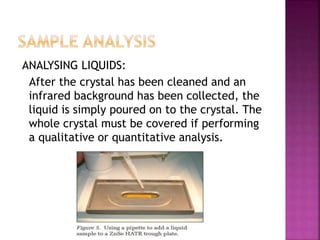
ANALYSING LIQUIDS:
After the crystal has been cleaned and an
infrared background has been collected, the
liquid is simply poured on to the crystal. The
whole crystal must be covered if performing
a qualitative or quantitative analysis.
 ATR is an ideal technique for analysing
liquids.
 Sample preparation is minimal.
 Cleanup is easy and fast.
 ATR can be used to analyse non-aqueous
solutions such as oils, lubricants, paints,
glues, solvents, inks, dyes, gels and pastes.
ANALYSING SOLIDS:
 It is an excellent technique for measuring the
composition of solids.
 Some examples of solids are films, fabrics,
paper, hard polymer sheets, glass, rubber.
 ATR is an ideal technique for measuring dark
coloured which often absorb too much
energy to be measured by IR transmission.
Powder analysis:
 Powders are easier to run by ATR than by IR
transmission, because little or no preparation
is required.
 This category includes pure samples and
mixtures that are available in powdered
form.
 Some examples of pure samples and mixtures
pharmaceuticals and pigments.
 Biological industries
 Pharmaceutical industries
 Medicinal industries
 Chemical industries includes measurement of
drugs during manufactured by fermentation of
methods, following the kinetics of metabolism of
dietary constituents, investigation of detergents
and cosmetics, or identification of contaminants
in waste water, etc.
 Using ATR combined with spectral summation the
infrared spectra of solutes, Very dilute aqueous
solutions can be measured.
 Forensic investigation
 Biomedical applications
 ATR is an easy to use, fast and versatile
technique for IR sampling.
 Solids , pastes, gels, powders, liquid can be
analysed with little or no preparation.
 Organic spectroscopy by william kemp
 http://www.slideserve.com/glenda/attenuat
ed-total-reflection-spectroscopy
 http://www.utsc.utoronto.ca/~traceslab/AT
R_FTIR.pdf
 https://en.wikipedia.org/wiki/Attenuated_t
otal_reflectance
Attenuated total reflectance spectroscopy

Attenuated total reflectance spectroscopy

  • 1.
    Presented by : KolliChaitanyalakshmi M.Pharmacy 1st semister under the guidance of Dr. K. Shanta kumari, H.O.D Department of pharmaceutical analysis Nirmala college of pharmacy
  • 2.
     Introduction  instrumentation Sample analysis  Applications  Conclusion  References
  • 3.
    Attenuated total reflectance(ATR) spectroscopy is a versatile and powerful technique for infrared spectroscopy which enables samples to be examined directly in the solid or liquid state with out further preparation
  • 4.
     Internal reflectionspectroscopy passes infrared radiation through an infrared transmitting crystal of high refractive index greater than the sample, allowing radiation to reflect in the crystal one or more times  Provided the refractive index of the prism, is greater than that of the sample medium, and if the angle ø is greater than the critical angle, the infrared light beam will suffers the total internal reflectance  Attenuated total reflection accessory measures the totally reflected infrared beam when the beam comes and contact with a sample
  • 5.
    In this way,an evanescent wave penetrates into the sample in contact with crystal, producing a spectrum of sample EVANESCENT WAVES : The infrared radiation interacts with the sample through a series of standing waves, called as evanescent waves. An evanescent wave is a penetrating electromagnetic field whose intensity quickly decays as it moves a way from its source
  • 7.
    When collecting ATRdata, samples are run as %reflectance or log (1/R). % reflectance equivalent to absorbance
  • 8.
    CRYSTAL COMPOSITION: Crystals aretypically made of  Germanium (Ge)  Zinc sulfide (Zs)  Silicon  Diamond  AMTIR: germanium, arsenic, selenium (GeAsSe)  Zinc selenide (znse) or mixed thbr and thl
  • 9.
     There area number of crystal materials available for ATR. Zinc Selenide (ZnSe) and Germanium are most commonly used  ZnSe scratches quite easily and so care must be taken when cleaning the crystal. It is recommended that lint free tissue is used.
  • 10.
    ANALYSING LIQUIDS: After thecrystal has been cleaned and an infrared background has been collected, the liquid is simply poured on to the crystal. The whole crystal must be covered if performing a qualitative or quantitative analysis.
  • 11.
     ATR isan ideal technique for analysing liquids.  Sample preparation is minimal.  Cleanup is easy and fast.  ATR can be used to analyse non-aqueous solutions such as oils, lubricants, paints, glues, solvents, inks, dyes, gels and pastes.
  • 12.
    ANALYSING SOLIDS:  Itis an excellent technique for measuring the composition of solids.  Some examples of solids are films, fabrics, paper, hard polymer sheets, glass, rubber.  ATR is an ideal technique for measuring dark coloured which often absorb too much energy to be measured by IR transmission.
  • 13.
    Powder analysis:  Powdersare easier to run by ATR than by IR transmission, because little or no preparation is required.  This category includes pure samples and mixtures that are available in powdered form.  Some examples of pure samples and mixtures pharmaceuticals and pigments.
  • 14.
     Biological industries Pharmaceutical industries  Medicinal industries  Chemical industries includes measurement of drugs during manufactured by fermentation of methods, following the kinetics of metabolism of dietary constituents, investigation of detergents and cosmetics, or identification of contaminants in waste water, etc.  Using ATR combined with spectral summation the infrared spectra of solutes, Very dilute aqueous solutions can be measured.
  • 15.
     Forensic investigation Biomedical applications
  • 16.
     ATR isan easy to use, fast and versatile technique for IR sampling.  Solids , pastes, gels, powders, liquid can be analysed with little or no preparation.
  • 17.
     Organic spectroscopyby william kemp  http://www.slideserve.com/glenda/attenuat ed-total-reflection-spectroscopy  http://www.utsc.utoronto.ca/~traceslab/AT R_FTIR.pdf  https://en.wikipedia.org/wiki/Attenuated_t otal_reflectance