By-KSHITIJ RB SINGH
S.No. Title Remark
1 INTRODUCTION
2 Microscopy:
 Light Microscopy
o Bright-Field.
o Dark-Field.
 Phase Contrast Microscopy.
 Fluorescence Microscopy.
 Electron Microscopy.
3 Spectroscopy:
 Colorimetry.
 UV-Visible.
 Atomic Adsorption.
 Infrared.
4 Chromatography:
 Paper
 TLC
 Size Exclusion.
 Gas.
5 Electrophoresis:
 Agarose Gel.
 Polyacrylamide Gel.
 SDS-PAGE.
6 Conclusion
7 Images
8 References
By-KSHITIJ RB SINGH
What are Biochemical Tools and Techniques?
Biochemical means the chemical processes in living organisms, Tools mean a mechanical device
intended to make a task easier and Technique means the practical aspect to govern a tool.
Now days we are using many biochemical tools for our convenience.
Few examples are listed below:
 Phase Contrast Microscopy.
 Gas chromatography
 Colorimetry.
 SDS-PAGE.
 Agarose Gel Electrophoresis, Etc.
Biochemical analysis techniques refer to a set of methods, assays, and procedures that enable
scientists to analyze the substances found in living organisms and the chemical reactions
underlying life processes. The most sophisticated of these techniques are reserved for specialty
research and diagnostic laboratories, although simplified sets of these techniques are used in
such common events as testing for illegal drug abuse in competitive athletic events and
monitoring of blood sugar by diabetic patients.
To perform a comprehensive biochemical analysis of a biomolecule in a biological process or
system, the biochemist typically needs to design a strategy to detect that biomolecule, isolate it in
pure form from among thousands of molecules that can be found in an extracts from a biological
sample, characterize it, and analyze its function. An assay, the biochemical test that characterizes
a molecule, whether quantitative or semi-quantitative, is important to determine the presence
and quantity of a biomolecule at each step of the study.
By-KSHITIJ RB SINGH
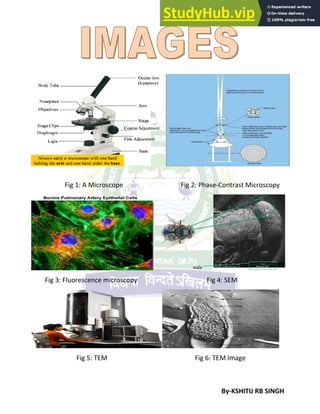
Microscopy is the technical field of using microscopes to view objects and areas of objects that
cannot be seen with the naked eye (objects that are not within the resolution range of the normal
eye). There are three well-known branches of microscopy: optical, electron, and scanning probe
microscopy.
Optical and electron microscopy involve the diffraction, reflection, or refraction of electromagnetic
radiation/electron beams interacting with the specimen, and the collection of the scattered radiation
or another signal in order to create an image. This process may be carried out by wide-field
irradiation of the sample (for example standard light microscopy and transmission electron
microscopy) or by scanning of a fine beam over the sample (for example confocal laser scanning
microscopy and scanning electron microscopy). Scanning probe microscopy involves the interaction
of a scanning probe with the surface of the object of interest.
Light Microscopy:
There are Two Types Light Microscopy:
1) Bright-Field Microscopy, And
2) Dark-Field Microscopy.
Bright-Field Microscopy: Bright field microscopy is the simplest of all the light
microscopy techniques. Sample illumination is via transmitted white light, i.e. illuminated from below
and observed from above. Limitations include low contrast of most biological samples and low
apparent resolution due to the blur of out of focus material. The simplicity of the technique and the
minimal sample preparation required are significant advantages.
By-KSHITIJ RB SINGH
Dark-Field Microscopy:Dark field microscopy is a technique for improving the contrast of
unstained, transparent specimens. Dark field illumination uses a carefully aligned light source to
minimize the quantity of directly transmitted (unscattered) light entering the image plane, collecting
only the light scattered by the sample. Dark field can dramatically improve image contrast –
especially of transparent objects – while requiring little equipment setup or sample preparation.
However, the technique suffers from low light intensity in final image of many biological samples, and
continues to be affected by low apparent resolution.
Phase Contrast Microscopy:
More sophisticated techniques will show proportional differences in optical density. Phase contrast is
a widely used technique that shows differences in refractive index as difference in contrast. It was
developed by the Dutch physicist Frits Zernike in the 1930s (for which he was awarded the Nobel
Prize in 1953). The nucleus in a cell for example will show up darkly against the surrounding
cytoplasm. Contrast is excellent; however it is not for use with thick objects. Frequently, a halo is
formed even around small objects, which obscures detail. The system consists of a circular annulus in
the condenser, which produces a cone of light. This cone is superimposed on a similar sized ring
within the phase-objective. Every objective has a different size ring, so for every objective another
condenser setting has to be chosen. The ring in the objective has special optical properties: it, first of
all, reduces the direct light in intensity, but more importantly, it creates an artificial phase difference
of about a quarter wavelength. As the physical properties of this direct light have changed,
interference with the diffracted light occurs, resulting in the phase contrast image. One disadvantage
of phase-contrast microscopy is halo formation (halo-light ring).
FLUORESCENCE MICROSCOPY:
The most popular contrasting technique now is fluorescence microscopy. It requires the use of so-
called fluorochromes or fluorophores, which absorb light in a specific wavelength range, and re-emit
it with lower energy, that is, shifted to a longer wavelength. A very large number of different dyes
with absorption from the UV to the near-infrared region are available, and more fluorophores with
new properties are still being developed. The principal advantages of this approach are a very high
By-KSHITIJ RB SINGH
contrast, sensitivity, specificity, and selectivity. The use of fluorescently stained antibodies and the
introduction of a variety of fluorescent heterocyclic probes synthesized for specific biological
applications brought about an unprecedented growth in biological applications of fluorescence
microscopy. Specificity of fluorescence labeling of selected molecules of interest as well as specificity
of translating some selected physiological and functional parameters such as membrane potential or
enzyme activity into specific signals in a cell is another important advantage of fluorescence
microscopy. Hundreds of fluorescent molecules are available to be used as specific labels and tags in
fixed and live cells. The advent of highly sensitive light detectors and cameras made it possible to
detect even single molecules in the specimen.
ELECTRON MICROSCOPY:
Until the invention of sub-diffraction microscopy, the wavelength of the light limited the resolution of
traditional microscopy to around 0.2 micrometers. In order to gain higher resolution, the use of an
electron beam with a far smaller wavelength is used in electron microscopes.
 Transmission electron microscopy (TEM) is quite similar to the compound light microscope, by
sending an electron beam through a very thin slice of the specimen. The resolution limit in
2005 was around 0.05 nanometer and has not increased appreciably since that time.
 Scanning electron microscopy (SEM) visualizes details on the surfaces of specimens and gives
a very nice 3D view. It gives results much like those of the stereo light microscope. The best
resolution for SEM in 2011 was 0.4 nanometer.
Electron microscopes equipped for X-ray spectroscopy can provide qualitative and quantitative
elemental analysis.
By-KSHITIJ RB SINGH
It is the study of the interaction between matter and electromagnetic radiation. Historically,
spectroscopy originated through the study of visible light dispersed according to its wavelength, by a
prism. Later the concept was expanded greatly to include any interaction with radiative energy as a
function of its wavelength or frequency. Spectroscopic data is often represented by a spectrum, a
plot of the response of interest as a function of wavelength or frequency.
COLORIMETRY:
It is Measure of amount of light absorbed by the color developed in a sample. It is related to:
(1) The Chemistry involved.
(2) The Length of light traveled [Lamberts Law].
(3) The Amount (concentration) of absorbing material [Beer’s Law].
The Combined Lamberts Law and Beer’s Law is
T=10-abc
Where, a=constant for particular solution, b=Length of absorbing layer, c=Concentration of absorbing
Substance. And (-) sign indicates an Inversion relation.
UV-VISIBLE:
Ultraviolet–visible spectroscopy or ultraviolet-visible spectrophotometry (UV-Vis or UV/Vis) refers to
absorption spectroscopy or reflectance spectroscopy in the ultraviolet-visible spectral region. This
means it uses light in the visible and adjacent (near-UV and near-infrared [NIR]) ranges. The
absorption or reflectance in the visible range directly affects the perceived color of the chemicals
involved. In this region of the electromagnetic spectrum, molecules undergo electronic transitions.
This technique is complementary to fluorescence spectroscopy, in that fluorescence deals with
transitions from the excited state to the ground state, while absorption measures transitions from
By-KSHITIJ RB SINGH
the ground state to the excited state.
UV/Vis spectroscopy is routinely used in analytical chemistry for the quantitative determination of
different analytes, such as transition metal ions, highly conjugated organic compounds, and biological
macromolecules. Spectroscopic analysis is commonly carried out in solutions but solids and gases
may also be studied.
The Beer-Lambert law has implicit assumptions that must be met experimentally for it to apply
otherwise there is a possibility of deviations from the law to be observed. For instance, the chemical
makeup and physical environment of the sample can alter its extinction coefficient. The chemical and
physical conditions of a test sample therefore must match reference measurements for conclusions
to be valid.
ATOMIC ADSORPTION:
Atomic absorption spectroscopy (AAS) is a spectroanalytical procedure for the quantitative
determination of chemical elements using the absorption of optical radiation (light) by free atoms in
the gaseous state. In analytical chemistry the technique is used for determining the concentration of
a particular element (the analyte) in a sample to be analyzed. AAS can be used to determine over 70
different elements in solution or directly in solid samples used in pharmacology, biophysics and
toxicology research. Atomic absorption spectroscopy was first used as an analytical technique, and
the underlying principles were established in the second half of the 19th century by Robert Wilhelm
Bunsen and Gustav Robert Kirchhoff, both professors at the University of Heidelberg, Germany.
Atomic absorption spectrometry has many uses in different areas of chemistry such as:
 Clinical analysis: Analyzing metals in biological fluids and tissues such as whole blood, plasma,
urine, saliva, brain tissue, liver, muscle tissue, semen
 Pharmaceuticals: In some pharmaceutical manufacturing processes, minute quantities of a
catalyst that remain in the final drug product
 Water analysis: Analyzing water for its metal content.
By-KSHITIJ RB SINGH
INFRARED:
Infrared spectroscopy (IR spectroscopy or Vibrational Spectroscopy) is the spectroscopy that deals
with the infrared region of the electromagnetic spectrum, that is light with a longer wavelength and
lower frequency than visible light. It covers a range of techniques, mostly based on absorption
spectroscopy. As with all spectroscopic techniques, it can be used to identify and study chemicals. For
a given sample which may be solid, liquid, or gaseous, the method or technique of infrared
spectroscopy uses an instrument called an infrared spectrometer (or spectrophotometer) to produce
an infrared spectrum. A basic IR spectrum is essentially a graph of infrared light absorbance (or
transmittance) on the vertical axis vs. frequency or wavelength on the horizontal axis. Typical units of
frequency used in IR spectra are reciprocal centimeters (sometimes called wave numbers), with the
symbol cm−1
. Units of IR wavelength are commonly given in micrometers (formerly called "microns"),
symbol μm, which are related to wave numbers in a reciprocal way. A common laboratory instrument
that uses this technique is a Fourier transform infrared (FTIR) spectrometer. Two-dimensional IR is
also possible as discussed below.
By-KSHITIJ RB SINGH
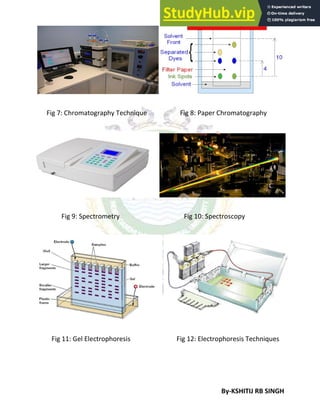
It is the collective term for a set of laboratory techniques for the separation of mixtures. The mixture
is dissolved in a fluid called the mobile phase, which carries it through a structure holding another
material called the stationary phase. The various constituents of the mixture travel at different
speeds, causing them to separate. The separation is based on differential partitioning between the
mobile and stationary phases. Subtle differences in a compound's partition coefficient result in
differential retention on the stationary phase and thus changing the separation.
Chromatography may be preparative or analytical. The purpose of preparative chromatography is to
separate the components of a mixture for more advanced use (and is thus a form of purification).
Analytical chromatography is done normally with smaller amounts of material and is for measuring
the relative proportions of analytes in a mixture. The two are not mutually exclusive.
PAPER:
Paper chromatography is an analytical method that is used to separate colored chemicals or
substances. This can also be used in secondary or primary colors in ink experiments. This method has
been largely replaced by thin layer chromatography, but is still a powerful teaching tool. Double-way
paper chromatography, also called two-dimensional chromatography, involves using two solvents
and rotating the paper 90° in between. This is useful for separating complex mixtures of compounds
having similar polarity, for example, amino acids. If a filter paper is used, it should be of a high quality
paper. The mobile phase is developing solutions that can travel up to the stationary phase carrying
the sample along with it.
Rƒ value:
The retention factor (Rƒ) may be defined as the ratio of the distance traveled by the substance to the
By-KSHITIJ RB SINGH
distance traveled by the solvent. Rƒ values are usually expressed as a fraction of two decimal places. If
Rƒ value of a solution is zero, the solute remains in the stationary phase and thus it is immobile. If Rƒ
value = 1 then the solute has no affinity for the stationary phase and travels with the solvent front. To
calculate the Rƒ value, take the distance traveled by the substance divided by the distance traveled by
the solvent (as mentioned earlier in terms of ratios).
TLC:
Thin-layer chromatography (TLC) is a chromatography technique used to separate non-volatile
mixtures. Thin-layer chromatography is performed on a sheet of glass, plastic, or aluminium foil,
which is coated with a thin layer of adsorbent material, usually silica gel, aluminium oxide (alumina),
or cellulose. This layer of adsorbent is known as the stationary phase.
After the sample has been applied on the plate, a solvent or solvent mixture (known as the mobile
phase) is drawn up the plate via capillary action. Because different analytes ascend the TLC plate at
different rates, separation is achieved. The mobile phase has different properties than the stationary
phase. For example, with silica gel, a very polar substance, non-polar mobile phases such as heptane
are used. The mobile phase may be a mixture, allowing chemists to fine-tune the bulk properties of
the mobile phase.
After the experiment, the spots are visualized. Often this can be done simply by projecting ultraviolet
light onto the sheet; the sheets are treated with a phosphor, and dark spots appear on the sheet
where compounds absorb the light impinging on a certain area. Chemical processes can also be used
to visualize spots; anisaldehyde, for example, forms colored adducts with many compounds, and
sulfuric acid will char most organic compounds, leaving a dark spot on the sheet.
SIZE EXCLUSION:
Size-exclusion chromatography (SEC) is a chromatographic method in which molecules in solution are
separated by their size, and in some cases molecular weight. It is usually applied to large molecules or
macromolecular complexes such as proteins and industrial polymers. Typically, when an aqueous
solution is used to transport the sample through the column, the technique is known as gel-filtration
chromatography, versus the name gel permeation chromatography, which is used when an organic
By-KSHITIJ RB SINGH
solvent is used as a mobile phase. SEC is a widely used polymer characterization method because of its
ability to provide good molar mass distribution (Mw) results for polymers.
The main application of gel-filtration chromatography is the fractionation of proteins and other water-
soluble polymers, while gel permeation chromatography is used to analyze the molecular weight
distribution of organic-soluble polymers. Either technique should not be confused with gel
electrophoresis, where an electric field is used to "pull" or "push" molecules through the gel depending
on their electrical charges.
GAS:
Gas chromatography (GC) is a common type of chromatography used in analytical chemistry for
separating and analyzing compounds that can be vaporized without decomposition. Typical uses of
GC include testing the purity of a particular substance, or separating the different components of a
mixture (the relative amounts of such components can also be determined). In some situations, GC
may help in identifying a compound. In preparative chromatography, GC can be used to prepare pure
compounds from a mixture.
In gas chromatography, the mobile phase (or "moving phase") is a carrier gas, usually an inert gas
such as helium or an unreactive gas such as nitrogen. The stationary phase is a microscopic layer of
liquid or polymer on an inert solid support, inside a piece of glass or metal tubing called a column (an
homage to the fractionating column used in distillation). The instrument used to perform gas
chromatography is called a gas chromatograph (or "aerograph", "gas separator").
The gaseous compounds being analyzed interact with the walls of the column, which is coated with a
stationary phase. This causes each compound to elute at a different time, known as the retention
time of the compound. The comparison of retention times is what gives GC its analytical usefulness.
By-KSHITIJ RB SINGH
It is the motion of dispersed particles relative to a fluid under the influence of a spatially uniform
electric field. This electro kinetic phenomenon was observed for the first time in 1807 by Ferdinand
Frederic Reuss (Moscow State University), who noticed that the application of a constant electric field
caused clay particles dispersed in water to migrate. It is ultimately caused by the presence of a
charged interface between the particle surface and the surrounding fluid. It is the basis for a number
of analytical techniques used in biochemistry for separating molecules by size, charge, or binding
affinity.
Electrophoresis of positively charged particles (cations) is called cataphoresis, while electrophoresis
of negatively charged particles (anions) is called anaphoresis. Electrophoresis is a technique used in
laboratories in order to separate macromolecules based on size. The technique applies a negative
charge so proteins move towards a positive charge. This is used for both DNA and RNA analysis.
AGAROSE GEL
Agarose gel electrophoresis is a method of gel electrophoresis used in biochemistry, molecular
biology, genetics, and clinical chemistry to separate a mixed population of DNA or proteins in a matrix
of agarose. The proteins may be separated by charge and/or size (isoelectric focusing agarose
electrophoresis is essentially size independent), and the DNA and RNA fragments by length.
Biomolecules are separated by applying an electric field to move the charged molecules through an
agarose matrix, and the biomolecules are separated by size in the agarose gel matrix.
 Estimation of the size of DNA molecules following restriction enzyme digestion, e.g. in
restriction mapping of cloned DNA.
By-KSHITIJ RB SINGH
 Analysis of PCR products, e.g. in molecular genetic diagnosis or genetic fingerprinting
 Separation of DNA fragments for extraction and purification.
 Separation of restricted genomic DNA prior to Southern transfer, or of RNA prior to Northern
transfer.
Agarose gels are easily cast and handled compared to other matrices and nucleic acids are not
chemically altered during electrophoresis. Samples are also easily recovered. After the experiment is
finished, the resulting gel can be stored in a plastic bag in a refrigerator.
POLYACRYLAMIDE GEL
Polyacrylamide gel electrophoresis (PAGE), describes a technique widely used in biochemistry,
forensics, genetics, molecular biology and biotechnology to separate biological macromolecules,
usually proteins or nucleic acids, according to their electrophoretic mobility. Mobility is a function of
the length, conformation and charge of the molecule.
As with all forms of gel electrophoresis, molecules may be run in their native state, preserving the
molecules' higher-order structure, or a chemical denaturant may be added to remove this structure
and turn the molecule into an unstructured linear chain whose mobility depends only on its length
and mass-to-charge ratio. For nucleic acids, urea is the most commonly used denaturant. For
proteins, sodium dodecyl sulfate (SDS) is an anionic detergent applied to protein samples to linearize
proteins and to impart a negative charge to linearized proteins. This procedure is called SDS-PAGE. In
most proteins, the binding of SDS to the polypeptide chain imparts an even distribution of charge per
unit mass, thereby resulting in a fractionation by approximate size during electrophoresis. Proteins
that have a greater hydrophobic content, for instance many membrane proteins, and those that
By-KSHITIJ RB SINGH
interact with surfactants in their native environment, are intrinsically harder to treat accurately using
this method, due to the greater variability in the ratio of bound SDS.
SDS-PAGE
Sodium dodecyl sulfate (SDS) is an amphipathic detergent. It has an anionic headgroup and a
lipophilic tail. It binds non-covalently to proteins, with a stoichiometry of around one SDS molecule
per two amino acids. SDS causes proteins to denature and dissassociate from each other (excluding
covalent cross-linking). It also confers negative charge. In the presence of SDS, the intrinsic charge of
a protein is masked. During SDS PAGE, all proteins migrate toward the anode (the positively charged
electrode). SDS-treated proteins have very similar charge-to-mass ratios, and similar shapes. During
PAGE, the rate of migration of SDS-treated proteins is effectively determined by molecular weight.
Sodium Dodecyl Sulfate (SDS) (C12H25NaO4S; mW: 288.38). (only used in denaturing protein gels)
SDS is a strong detergent agent used to denature native proteins to unfolded, individual
polypeptides. When a protein mixture is heated to 100 °C in presence of SDS, the detergent wraps
around the polypeptide backbone. It binds to polypeptides in a constant weight ratio of 1.4 g SDS/g of
polypeptide. In this process, the intrinsic charges of polypeptides becomes negligible when compared
to the negative charges contributed by SDS.
By-KSHITIJ RB SINGH
After going through the topic “Application Biochemical Tools and Techniques”, we can
conclude that using of tools make our bio-molecular detection and estimation easier
and we got to know that a single tool cannot be used for detection of each and every
type of molecule. In this assignment I have gone through use of Microscopy,
Spectroscopy, Chromatography, and Electrophoresis.
Application of bio-molecular tools and techniques helps to develop understanding and
provide scientific basics of the life processes at the molecular level and explain the
structure, function and inter-relationships of bio-molecules and their deviation from
normal and their consequences for interpreting and solving clinical problems.
After completion of the assignment, we will get a better understanding of
spectroscopy, Microscopy, Chromatography, Electrophoresis and the separation
techniques used for biological products. We will get a practical hand on experience of
biochemical and biophysical methods. We will be able to understand the principles and
mechanism of purification of biomolecules, and finally we will be able to analyse
structure, function, localization and interaction of various biomolecules using these
techniques.
Fig 1: A Microscope Fig 2:
Fig 3: Fluorescence microscopy
Fig 5: TEM Fig 6: TEM Image
By-KSHITIJ RB SINGH
Fig 1: A Microscope Fig 2: Phase-Contrast Microscopy
Fluorescence microscopy Fig 4: SEM
Fig 5: TEM Fig 6: TEM Image
KSHITIJ RB SINGH
Contrast Microscopy
Fig 5: TEM Fig 6: TEM Image
By-KSHITIJ RB SINGH
Fig 7: Chromatography Technique Fig 8: Paper Chromatography
Fig 9: Spectrometry Fig 10: Spectroscopy
Fig 11: Gel Electrophoresis Fig 12: Electrophoresis Techniques
By-KSHITIJ RB SINGH
 Dr. Prashant Kumar Singh
Dr. Ravindra Pratap Singh
 Wikipedia(https://en.wikipedia.org/wiki/Wikipedia)
 Manuel Fernandeas.
 Book:Principles of Laboratory Techniques and Methods.
 Book:Principles and Techniques of Biochemistry and
Molecular Biology- Wilson and Walker,7th Ed.
 Dr. Naveen Kumar Sharma.
 Dr. B.N. Tripathi.

Application Of Biochemical Tools And Techniques.

  • 2.
    By-KSHITIJ RB SINGH S.No.Title Remark 1 INTRODUCTION 2 Microscopy:  Light Microscopy o Bright-Field. o Dark-Field.  Phase Contrast Microscopy.  Fluorescence Microscopy.  Electron Microscopy. 3 Spectroscopy:  Colorimetry.  UV-Visible.  Atomic Adsorption.  Infrared. 4 Chromatography:  Paper  TLC  Size Exclusion.  Gas. 5 Electrophoresis:  Agarose Gel.  Polyacrylamide Gel.  SDS-PAGE. 6 Conclusion 7 Images 8 References
  • 3.
    By-KSHITIJ RB SINGH Whatare Biochemical Tools and Techniques? Biochemical means the chemical processes in living organisms, Tools mean a mechanical device intended to make a task easier and Technique means the practical aspect to govern a tool. Now days we are using many biochemical tools for our convenience. Few examples are listed below:  Phase Contrast Microscopy.  Gas chromatography  Colorimetry.  SDS-PAGE.  Agarose Gel Electrophoresis, Etc. Biochemical analysis techniques refer to a set of methods, assays, and procedures that enable scientists to analyze the substances found in living organisms and the chemical reactions underlying life processes. The most sophisticated of these techniques are reserved for specialty research and diagnostic laboratories, although simplified sets of these techniques are used in such common events as testing for illegal drug abuse in competitive athletic events and monitoring of blood sugar by diabetic patients. To perform a comprehensive biochemical analysis of a biomolecule in a biological process or system, the biochemist typically needs to design a strategy to detect that biomolecule, isolate it in pure form from among thousands of molecules that can be found in an extracts from a biological sample, characterize it, and analyze its function. An assay, the biochemical test that characterizes a molecule, whether quantitative or semi-quantitative, is important to determine the presence and quantity of a biomolecule at each step of the study.
  • 4.
    By-KSHITIJ RB SINGH Microscopyis the technical field of using microscopes to view objects and areas of objects that cannot be seen with the naked eye (objects that are not within the resolution range of the normal eye). There are three well-known branches of microscopy: optical, electron, and scanning probe microscopy. Optical and electron microscopy involve the diffraction, reflection, or refraction of electromagnetic radiation/electron beams interacting with the specimen, and the collection of the scattered radiation or another signal in order to create an image. This process may be carried out by wide-field irradiation of the sample (for example standard light microscopy and transmission electron microscopy) or by scanning of a fine beam over the sample (for example confocal laser scanning microscopy and scanning electron microscopy). Scanning probe microscopy involves the interaction of a scanning probe with the surface of the object of interest. Light Microscopy: There are Two Types Light Microscopy: 1) Bright-Field Microscopy, And 2) Dark-Field Microscopy. Bright-Field Microscopy: Bright field microscopy is the simplest of all the light microscopy techniques. Sample illumination is via transmitted white light, i.e. illuminated from below and observed from above. Limitations include low contrast of most biological samples and low apparent resolution due to the blur of out of focus material. The simplicity of the technique and the minimal sample preparation required are significant advantages.
  • 5.
    By-KSHITIJ RB SINGH Dark-FieldMicroscopy:Dark field microscopy is a technique for improving the contrast of unstained, transparent specimens. Dark field illumination uses a carefully aligned light source to minimize the quantity of directly transmitted (unscattered) light entering the image plane, collecting only the light scattered by the sample. Dark field can dramatically improve image contrast – especially of transparent objects – while requiring little equipment setup or sample preparation. However, the technique suffers from low light intensity in final image of many biological samples, and continues to be affected by low apparent resolution. Phase Contrast Microscopy: More sophisticated techniques will show proportional differences in optical density. Phase contrast is a widely used technique that shows differences in refractive index as difference in contrast. It was developed by the Dutch physicist Frits Zernike in the 1930s (for which he was awarded the Nobel Prize in 1953). The nucleus in a cell for example will show up darkly against the surrounding cytoplasm. Contrast is excellent; however it is not for use with thick objects. Frequently, a halo is formed even around small objects, which obscures detail. The system consists of a circular annulus in the condenser, which produces a cone of light. This cone is superimposed on a similar sized ring within the phase-objective. Every objective has a different size ring, so for every objective another condenser setting has to be chosen. The ring in the objective has special optical properties: it, first of all, reduces the direct light in intensity, but more importantly, it creates an artificial phase difference of about a quarter wavelength. As the physical properties of this direct light have changed, interference with the diffracted light occurs, resulting in the phase contrast image. One disadvantage of phase-contrast microscopy is halo formation (halo-light ring). FLUORESCENCE MICROSCOPY: The most popular contrasting technique now is fluorescence microscopy. It requires the use of so- called fluorochromes or fluorophores, which absorb light in a specific wavelength range, and re-emit it with lower energy, that is, shifted to a longer wavelength. A very large number of different dyes with absorption from the UV to the near-infrared region are available, and more fluorophores with new properties are still being developed. The principal advantages of this approach are a very high
  • 6.
    By-KSHITIJ RB SINGH contrast,sensitivity, specificity, and selectivity. The use of fluorescently stained antibodies and the introduction of a variety of fluorescent heterocyclic probes synthesized for specific biological applications brought about an unprecedented growth in biological applications of fluorescence microscopy. Specificity of fluorescence labeling of selected molecules of interest as well as specificity of translating some selected physiological and functional parameters such as membrane potential or enzyme activity into specific signals in a cell is another important advantage of fluorescence microscopy. Hundreds of fluorescent molecules are available to be used as specific labels and tags in fixed and live cells. The advent of highly sensitive light detectors and cameras made it possible to detect even single molecules in the specimen. ELECTRON MICROSCOPY: Until the invention of sub-diffraction microscopy, the wavelength of the light limited the resolution of traditional microscopy to around 0.2 micrometers. In order to gain higher resolution, the use of an electron beam with a far smaller wavelength is used in electron microscopes.  Transmission electron microscopy (TEM) is quite similar to the compound light microscope, by sending an electron beam through a very thin slice of the specimen. The resolution limit in 2005 was around 0.05 nanometer and has not increased appreciably since that time.  Scanning electron microscopy (SEM) visualizes details on the surfaces of specimens and gives a very nice 3D view. It gives results much like those of the stereo light microscope. The best resolution for SEM in 2011 was 0.4 nanometer. Electron microscopes equipped for X-ray spectroscopy can provide qualitative and quantitative elemental analysis.
  • 7.
    By-KSHITIJ RB SINGH Itis the study of the interaction between matter and electromagnetic radiation. Historically, spectroscopy originated through the study of visible light dispersed according to its wavelength, by a prism. Later the concept was expanded greatly to include any interaction with radiative energy as a function of its wavelength or frequency. Spectroscopic data is often represented by a spectrum, a plot of the response of interest as a function of wavelength or frequency. COLORIMETRY: It is Measure of amount of light absorbed by the color developed in a sample. It is related to: (1) The Chemistry involved. (2) The Length of light traveled [Lamberts Law]. (3) The Amount (concentration) of absorbing material [Beer’s Law]. The Combined Lamberts Law and Beer’s Law is T=10-abc Where, a=constant for particular solution, b=Length of absorbing layer, c=Concentration of absorbing Substance. And (-) sign indicates an Inversion relation. UV-VISIBLE: Ultraviolet–visible spectroscopy or ultraviolet-visible spectrophotometry (UV-Vis or UV/Vis) refers to absorption spectroscopy or reflectance spectroscopy in the ultraviolet-visible spectral region. This means it uses light in the visible and adjacent (near-UV and near-infrared [NIR]) ranges. The absorption or reflectance in the visible range directly affects the perceived color of the chemicals involved. In this region of the electromagnetic spectrum, molecules undergo electronic transitions. This technique is complementary to fluorescence spectroscopy, in that fluorescence deals with transitions from the excited state to the ground state, while absorption measures transitions from
  • 8.
    By-KSHITIJ RB SINGH theground state to the excited state. UV/Vis spectroscopy is routinely used in analytical chemistry for the quantitative determination of different analytes, such as transition metal ions, highly conjugated organic compounds, and biological macromolecules. Spectroscopic analysis is commonly carried out in solutions but solids and gases may also be studied. The Beer-Lambert law has implicit assumptions that must be met experimentally for it to apply otherwise there is a possibility of deviations from the law to be observed. For instance, the chemical makeup and physical environment of the sample can alter its extinction coefficient. The chemical and physical conditions of a test sample therefore must match reference measurements for conclusions to be valid. ATOMIC ADSORPTION: Atomic absorption spectroscopy (AAS) is a spectroanalytical procedure for the quantitative determination of chemical elements using the absorption of optical radiation (light) by free atoms in the gaseous state. In analytical chemistry the technique is used for determining the concentration of a particular element (the analyte) in a sample to be analyzed. AAS can be used to determine over 70 different elements in solution or directly in solid samples used in pharmacology, biophysics and toxicology research. Atomic absorption spectroscopy was first used as an analytical technique, and the underlying principles were established in the second half of the 19th century by Robert Wilhelm Bunsen and Gustav Robert Kirchhoff, both professors at the University of Heidelberg, Germany. Atomic absorption spectrometry has many uses in different areas of chemistry such as:  Clinical analysis: Analyzing metals in biological fluids and tissues such as whole blood, plasma, urine, saliva, brain tissue, liver, muscle tissue, semen  Pharmaceuticals: In some pharmaceutical manufacturing processes, minute quantities of a catalyst that remain in the final drug product  Water analysis: Analyzing water for its metal content.
  • 9.
    By-KSHITIJ RB SINGH INFRARED: Infraredspectroscopy (IR spectroscopy or Vibrational Spectroscopy) is the spectroscopy that deals with the infrared region of the electromagnetic spectrum, that is light with a longer wavelength and lower frequency than visible light. It covers a range of techniques, mostly based on absorption spectroscopy. As with all spectroscopic techniques, it can be used to identify and study chemicals. For a given sample which may be solid, liquid, or gaseous, the method or technique of infrared spectroscopy uses an instrument called an infrared spectrometer (or spectrophotometer) to produce an infrared spectrum. A basic IR spectrum is essentially a graph of infrared light absorbance (or transmittance) on the vertical axis vs. frequency or wavelength on the horizontal axis. Typical units of frequency used in IR spectra are reciprocal centimeters (sometimes called wave numbers), with the symbol cm−1 . Units of IR wavelength are commonly given in micrometers (formerly called "microns"), symbol μm, which are related to wave numbers in a reciprocal way. A common laboratory instrument that uses this technique is a Fourier transform infrared (FTIR) spectrometer. Two-dimensional IR is also possible as discussed below.
  • 10.
    By-KSHITIJ RB SINGH Itis the collective term for a set of laboratory techniques for the separation of mixtures. The mixture is dissolved in a fluid called the mobile phase, which carries it through a structure holding another material called the stationary phase. The various constituents of the mixture travel at different speeds, causing them to separate. The separation is based on differential partitioning between the mobile and stationary phases. Subtle differences in a compound's partition coefficient result in differential retention on the stationary phase and thus changing the separation. Chromatography may be preparative or analytical. The purpose of preparative chromatography is to separate the components of a mixture for more advanced use (and is thus a form of purification). Analytical chromatography is done normally with smaller amounts of material and is for measuring the relative proportions of analytes in a mixture. The two are not mutually exclusive. PAPER: Paper chromatography is an analytical method that is used to separate colored chemicals or substances. This can also be used in secondary or primary colors in ink experiments. This method has been largely replaced by thin layer chromatography, but is still a powerful teaching tool. Double-way paper chromatography, also called two-dimensional chromatography, involves using two solvents and rotating the paper 90° in between. This is useful for separating complex mixtures of compounds having similar polarity, for example, amino acids. If a filter paper is used, it should be of a high quality paper. The mobile phase is developing solutions that can travel up to the stationary phase carrying the sample along with it. Rƒ value: The retention factor (Rƒ) may be defined as the ratio of the distance traveled by the substance to the
  • 11.
    By-KSHITIJ RB SINGH distancetraveled by the solvent. Rƒ values are usually expressed as a fraction of two decimal places. If Rƒ value of a solution is zero, the solute remains in the stationary phase and thus it is immobile. If Rƒ value = 1 then the solute has no affinity for the stationary phase and travels with the solvent front. To calculate the Rƒ value, take the distance traveled by the substance divided by the distance traveled by the solvent (as mentioned earlier in terms of ratios). TLC: Thin-layer chromatography (TLC) is a chromatography technique used to separate non-volatile mixtures. Thin-layer chromatography is performed on a sheet of glass, plastic, or aluminium foil, which is coated with a thin layer of adsorbent material, usually silica gel, aluminium oxide (alumina), or cellulose. This layer of adsorbent is known as the stationary phase. After the sample has been applied on the plate, a solvent or solvent mixture (known as the mobile phase) is drawn up the plate via capillary action. Because different analytes ascend the TLC plate at different rates, separation is achieved. The mobile phase has different properties than the stationary phase. For example, with silica gel, a very polar substance, non-polar mobile phases such as heptane are used. The mobile phase may be a mixture, allowing chemists to fine-tune the bulk properties of the mobile phase. After the experiment, the spots are visualized. Often this can be done simply by projecting ultraviolet light onto the sheet; the sheets are treated with a phosphor, and dark spots appear on the sheet where compounds absorb the light impinging on a certain area. Chemical processes can also be used to visualize spots; anisaldehyde, for example, forms colored adducts with many compounds, and sulfuric acid will char most organic compounds, leaving a dark spot on the sheet. SIZE EXCLUSION: Size-exclusion chromatography (SEC) is a chromatographic method in which molecules in solution are separated by their size, and in some cases molecular weight. It is usually applied to large molecules or macromolecular complexes such as proteins and industrial polymers. Typically, when an aqueous solution is used to transport the sample through the column, the technique is known as gel-filtration chromatography, versus the name gel permeation chromatography, which is used when an organic
  • 12.
    By-KSHITIJ RB SINGH solventis used as a mobile phase. SEC is a widely used polymer characterization method because of its ability to provide good molar mass distribution (Mw) results for polymers. The main application of gel-filtration chromatography is the fractionation of proteins and other water- soluble polymers, while gel permeation chromatography is used to analyze the molecular weight distribution of organic-soluble polymers. Either technique should not be confused with gel electrophoresis, where an electric field is used to "pull" or "push" molecules through the gel depending on their electrical charges. GAS: Gas chromatography (GC) is a common type of chromatography used in analytical chemistry for separating and analyzing compounds that can be vaporized without decomposition. Typical uses of GC include testing the purity of a particular substance, or separating the different components of a mixture (the relative amounts of such components can also be determined). In some situations, GC may help in identifying a compound. In preparative chromatography, GC can be used to prepare pure compounds from a mixture. In gas chromatography, the mobile phase (or "moving phase") is a carrier gas, usually an inert gas such as helium or an unreactive gas such as nitrogen. The stationary phase is a microscopic layer of liquid or polymer on an inert solid support, inside a piece of glass or metal tubing called a column (an homage to the fractionating column used in distillation). The instrument used to perform gas chromatography is called a gas chromatograph (or "aerograph", "gas separator"). The gaseous compounds being analyzed interact with the walls of the column, which is coated with a stationary phase. This causes each compound to elute at a different time, known as the retention time of the compound. The comparison of retention times is what gives GC its analytical usefulness.
  • 13.
    By-KSHITIJ RB SINGH Itis the motion of dispersed particles relative to a fluid under the influence of a spatially uniform electric field. This electro kinetic phenomenon was observed for the first time in 1807 by Ferdinand Frederic Reuss (Moscow State University), who noticed that the application of a constant electric field caused clay particles dispersed in water to migrate. It is ultimately caused by the presence of a charged interface between the particle surface and the surrounding fluid. It is the basis for a number of analytical techniques used in biochemistry for separating molecules by size, charge, or binding affinity. Electrophoresis of positively charged particles (cations) is called cataphoresis, while electrophoresis of negatively charged particles (anions) is called anaphoresis. Electrophoresis is a technique used in laboratories in order to separate macromolecules based on size. The technique applies a negative charge so proteins move towards a positive charge. This is used for both DNA and RNA analysis. AGAROSE GEL Agarose gel electrophoresis is a method of gel electrophoresis used in biochemistry, molecular biology, genetics, and clinical chemistry to separate a mixed population of DNA or proteins in a matrix of agarose. The proteins may be separated by charge and/or size (isoelectric focusing agarose electrophoresis is essentially size independent), and the DNA and RNA fragments by length. Biomolecules are separated by applying an electric field to move the charged molecules through an agarose matrix, and the biomolecules are separated by size in the agarose gel matrix.  Estimation of the size of DNA molecules following restriction enzyme digestion, e.g. in restriction mapping of cloned DNA.
  • 14.
    By-KSHITIJ RB SINGH Analysis of PCR products, e.g. in molecular genetic diagnosis or genetic fingerprinting  Separation of DNA fragments for extraction and purification.  Separation of restricted genomic DNA prior to Southern transfer, or of RNA prior to Northern transfer. Agarose gels are easily cast and handled compared to other matrices and nucleic acids are not chemically altered during electrophoresis. Samples are also easily recovered. After the experiment is finished, the resulting gel can be stored in a plastic bag in a refrigerator. POLYACRYLAMIDE GEL Polyacrylamide gel electrophoresis (PAGE), describes a technique widely used in biochemistry, forensics, genetics, molecular biology and biotechnology to separate biological macromolecules, usually proteins or nucleic acids, according to their electrophoretic mobility. Mobility is a function of the length, conformation and charge of the molecule. As with all forms of gel electrophoresis, molecules may be run in their native state, preserving the molecules' higher-order structure, or a chemical denaturant may be added to remove this structure and turn the molecule into an unstructured linear chain whose mobility depends only on its length and mass-to-charge ratio. For nucleic acids, urea is the most commonly used denaturant. For proteins, sodium dodecyl sulfate (SDS) is an anionic detergent applied to protein samples to linearize proteins and to impart a negative charge to linearized proteins. This procedure is called SDS-PAGE. In most proteins, the binding of SDS to the polypeptide chain imparts an even distribution of charge per unit mass, thereby resulting in a fractionation by approximate size during electrophoresis. Proteins that have a greater hydrophobic content, for instance many membrane proteins, and those that
  • 15.
    By-KSHITIJ RB SINGH interactwith surfactants in their native environment, are intrinsically harder to treat accurately using this method, due to the greater variability in the ratio of bound SDS. SDS-PAGE Sodium dodecyl sulfate (SDS) is an amphipathic detergent. It has an anionic headgroup and a lipophilic tail. It binds non-covalently to proteins, with a stoichiometry of around one SDS molecule per two amino acids. SDS causes proteins to denature and dissassociate from each other (excluding covalent cross-linking). It also confers negative charge. In the presence of SDS, the intrinsic charge of a protein is masked. During SDS PAGE, all proteins migrate toward the anode (the positively charged electrode). SDS-treated proteins have very similar charge-to-mass ratios, and similar shapes. During PAGE, the rate of migration of SDS-treated proteins is effectively determined by molecular weight. Sodium Dodecyl Sulfate (SDS) (C12H25NaO4S; mW: 288.38). (only used in denaturing protein gels) SDS is a strong detergent agent used to denature native proteins to unfolded, individual polypeptides. When a protein mixture is heated to 100 °C in presence of SDS, the detergent wraps around the polypeptide backbone. It binds to polypeptides in a constant weight ratio of 1.4 g SDS/g of polypeptide. In this process, the intrinsic charges of polypeptides becomes negligible when compared to the negative charges contributed by SDS.
  • 16.
    By-KSHITIJ RB SINGH Aftergoing through the topic “Application Biochemical Tools and Techniques”, we can conclude that using of tools make our bio-molecular detection and estimation easier and we got to know that a single tool cannot be used for detection of each and every type of molecule. In this assignment I have gone through use of Microscopy, Spectroscopy, Chromatography, and Electrophoresis. Application of bio-molecular tools and techniques helps to develop understanding and provide scientific basics of the life processes at the molecular level and explain the structure, function and inter-relationships of bio-molecules and their deviation from normal and their consequences for interpreting and solving clinical problems. After completion of the assignment, we will get a better understanding of spectroscopy, Microscopy, Chromatography, Electrophoresis and the separation techniques used for biological products. We will get a practical hand on experience of biochemical and biophysical methods. We will be able to understand the principles and mechanism of purification of biomolecules, and finally we will be able to analyse structure, function, localization and interaction of various biomolecules using these techniques.
  • 17.
    Fig 1: AMicroscope Fig 2: Fig 3: Fluorescence microscopy Fig 5: TEM Fig 6: TEM Image By-KSHITIJ RB SINGH Fig 1: A Microscope Fig 2: Phase-Contrast Microscopy Fluorescence microscopy Fig 4: SEM Fig 5: TEM Fig 6: TEM Image KSHITIJ RB SINGH Contrast Microscopy Fig 5: TEM Fig 6: TEM Image
  • 18.
    By-KSHITIJ RB SINGH Fig7: Chromatography Technique Fig 8: Paper Chromatography Fig 9: Spectrometry Fig 10: Spectroscopy Fig 11: Gel Electrophoresis Fig 12: Electrophoresis Techniques
  • 19.
    By-KSHITIJ RB SINGH Dr. Prashant Kumar Singh Dr. Ravindra Pratap Singh  Wikipedia(https://en.wikipedia.org/wiki/Wikipedia)  Manuel Fernandeas.  Book:Principles of Laboratory Techniques and Methods.  Book:Principles and Techniques of Biochemistry and Molecular Biology- Wilson and Walker,7th Ed.  Dr. Naveen Kumar Sharma.  Dr. B.N. Tripathi.