Axonal transport system
• The axon comprises a major portion of the total volume and
surface area of most mature neurons.
• The genetic material and nearly all of the protein synthesis
machinery are localized to the cell body.
• A supply line needs to be maintained to provide structural and
functional materials to discrete functional compartments along the
length of the axon.
AXONAL TRANSPORT
• The life cycle of the organelles, their kinetics, their molecular cargo,
the molecular motors driving their transport, and the substrates along
which these movements track .
• Protein synthesis for the entire neuron - cell body
• The growth and maintenance of neuronal processes requires timely,
efficient delivery of material to axonal and dendritic domains.
• The idea that materials must be transferred from cell body to axon
was first suggested by Ramony Cajal
• Neuronal protein synthesis - completely restricted to the cytoplasm
surrounding the nucleus and, to some extent, to dendrites.
• All materials necessary for axonal function have to be supplied by
mechanisms involving transport from the neuronal cell body.
• Axonal transport is a normal ongoing process in neurons.
Fast and slow components of axonal transport
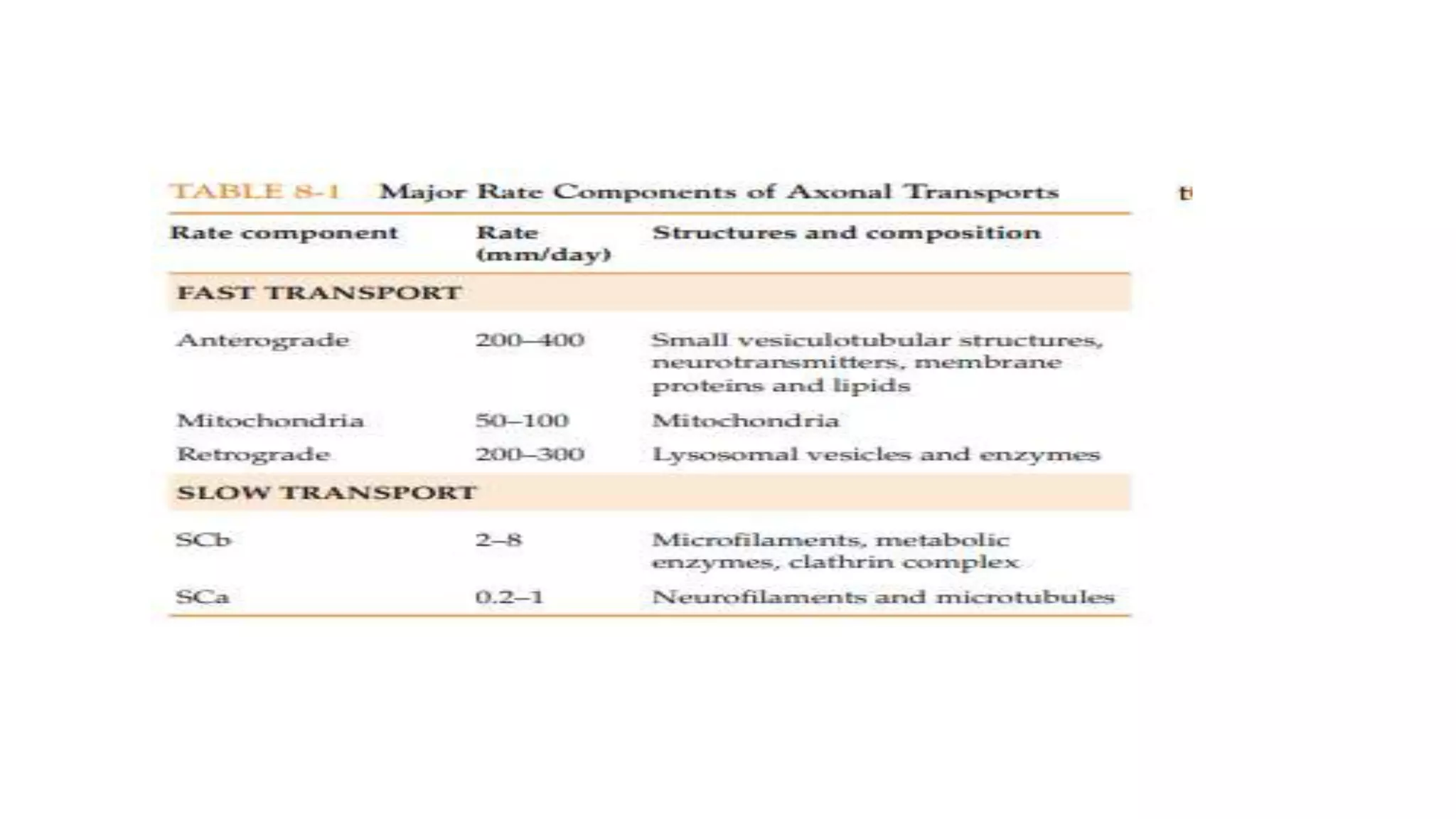
• Fast transport is bidirectional: many proteins that are distributed by
fast anterograde transport are also returned in the retrograde
direction.
• predominantly membrane associated
• 240-400mm/day
Slow transport
• Proteins transported at slow rates are degraded when they reach
their destination .
• not detected in the retrograde component.
• proteins are recovered in soluble fractions or in cytoskeletal pellets
• 1mm/day
• Polypeptides traveling in the axon - five distinct rate components .
• proteins that have common functions or interact with each other
tend to be moved together.
• Structural Hypothesis
• proteins and other molecules move down the axon as component
parts of discrete subcellular structures rather than as individual
molecules
Fast axonal transport
• Newly synthesized membrane and secretory proteins destined for
the axon travel by fast anterograde transport.
• first stage of transport - synthesis, sorting and packaging of organelle.
• assembled and packaged with the appropriate lipid and protein
components, membrane bounded organelles (MBOs), including
transport vesicles and tubulomembrane structures  transport
machinery  moved down the axon.
• membrane proteins delivered to functionally heterogeneous
domains in the axon.
• Axonal constituents include integral membrane proteins, secretory
products, membrane phospholipids, cholesterol and gangliosides
• Passage through the golgi apparatus is obligatory for most proteins
destined for fast axonal transport.
• Secretory and integral membrane proteins are synthesized on
polysomes bound to the endoplasmic reticulum.
• Secretory proteins enter the lumen of the reticulum
• Membrane proteins become oriented within the membrane bilayer
• fast-transported proteins leave the endoplasmic reticulum in
association with transfer vesicles
• They bud off and undergo Ca 2 -dependent fusion with the Golgi
apparatus.
• Undergoes processing and post-translational modification.
• includes glycosylation, sulfation, and proteolytic cleavage, and
sorting to selected neuronal compartments
• Clathrin-coated vesicles mediate transfer from the Golgi apparatus to
the fast axonal transport system.
• Golgi-derived coated vesicles shed their coats prior to undergoing
fast transport.
• travel down the axon either as individual uncoated vesicles or other
MBO structures .
• Transport of MBOs along MTs to their various axonal destinations 
kinesin and dynein superfamilies of motor proteins .
• fast axonal transport depends on de novo synthesis and assembly of
membrane components
• Anterograde fast axonal transport moves synaptic vesicles,
axolemmal precursors, and mitochondria down the axon
• Fast anterograde axonal transport - 200–400 mm/day or 2–10
µm/second in mammalian neurons .
• Anterograde fast axonal transport provides newly synthesized
components essential for neuronal membrane function and
maintenance
• Material moving in fast anterograde transport - small vesicles,
tubulovesicular structures, mitochondria,dense core vesicles,
membrane-associated enzymes, neurotransmitters, neuropeptides
and membrane lipids
• needed for supply and turnover of intracellular membrane
compartments , secretory products, and proteins required for the
maintenance of axonal metabolism.
• The net rate – determined by size
• smallest MBOs in almost constant motion
• mitochondria and larger structures frequently pause, giving a lower
average rate
• Retrograde transport returns trophic factors, exogenous material,
and old membrane constituents to the cell body.
• MBOs moving in retrograde transport are structurally heterogeneous
and larger than the structures observed in anterograde transport.
• Multivesicular or multilamellar bodies are common in retrograde
transport.
• Delivered to lysosomes in the neuronal cell body.
• The larger size of most retrogradely moving MBOs - rate of transport
reduces.
• Uptake of exogenous materials by endocytosis in distal regions of the
axon results in the return of trophic substances and growth factors to
the cell body .
• These factors assure survival of the neuron and modulate neuronal
gene expression .
• Retrograde transport also provides a pathway for viral agents to enter the
CNS .
• Once retrogradely transported material reaches the cell body
 lysosomal system for degradation
to nuclear compartments for regulation of gene expression
 or to the Golgi complex for repackaging
• Molecular sorting mechanisms ensure delivery of proteins to
discrete membrane compartments.
• destination signals are there- “added on” as post-translational
modifications or “built in,” in the form of discrete amino acid
sequences.
• For example,
• addition of mannose-6-phosphate to proteins lysosomes
• specific amino acid sequences- that direct nucleus or into
mitochondria.
• The targeting signals are likely to direct proteins to specific organelles
• Attachment of specific motor proteins to selected MBOs, appear to
direct organelles to the appropriate neuronal subdomain
• One mechanism for targeting of MBOs to synaptic terminals involves
the synapsin family of phosphoproteins.
• The dephosphorylated form of synapsin I binds tightly to both
synaptic vesicles and actin microfilaments (MFs).
• inhibits axonal transport of MBOs in isolated axoplasm
• Phosphorylated synapsin I does not bind to MF and synaptic vesicles.
• while phosphorylated synapsin has no effect on axonal transport .
• When a synaptic vesicle passes through a region rich in dephosphorylated
synapsin, it may be cross-linked to the available MF matrix by synapsin I.
• Cross-linked vesicles are removed from fast axonal transport
• Targeted to the presynaptic terminals
SLOW AXONAL TRANSPORT
• Cytoplasmic and cytoskeletal elements move coherently at slow
transport rates.
• Two major rate components -cytoskeletal elements and soluble
enzymes of intermediary metabolism .
• Two orders of magnitude slower than fast transport
• Slow Component a (SCa) - cytoskeletal proteins that form NFs and
MTs.
• Rates of transport for SCa proteins - 0.2–0.5 mm/ day in optic axons
to 1 mm/day in motor neurons of the sciatic nerve.
• Slow Component b (SCb) represents a complex and heterogeneous
rate component
• includes hundreds of distinct polypeptides
• Ranging from cytoskeletal proteins like actin to soluble enzymes of
intermediary metabolism (such as glycolytic enzymes).
• Axonal growth and regeneration are limited by rates of slow axonal
transport.
• The rate of axonal growth during development and regeneration of a
nerve is roughly equivalent to the rate of SCb in that neuron .
• critical roles are played by slow axonal transport in growth and
regeneration.
• Axonal regeneration involves a complex set of cell body and axonal
responses to a lesion.
• Downregulation of NF triplet proteins and upregulation of specific
tubulin isotypes are hallmarks of cell body responses to a lesion.
MOLECULAR MOTORS: KINESIN, DYNEIN AND
MYOSIN
• Kinesin – fast axonal transport
• Dynein and myosin – muscle contraction and flagellar beating
Kinesin
• The holoenzyme is a heterotetramer .
• Two heavy chains of 115–130 kDa and two light chains of 62–70 kDa.
• kinesin is a rod-shaped protein approximately 80 nm long, with two
globular heads connected to a fanlike tail by a long stalk.
• The kinesin heavy chain heads (also known as kinesin-1 or KIFs)
comprise the motor domains, containing both ATP and MT binding
motifs.
• highly conserved region within the kinesin family.
• Binding of kinesin to MTs is stabilized by AMP-PNP, and this property
remains a major hallmark of kinesins.
• Kinesin light chains (KLCs) localize to the fan-like tail and may also
contribute to part of the stalk.
• The α-helical coil–coiled domains that are present in both heavy and
light chains form the stalk itself.
• These subunits are thought to be involved in organelle binding and
may also play a role in targeting to different types of MBO
• Three kinesin heavy chain genes (also known as kinesin-1 or KIF5)-
ubiquitously expressed one (kinesin-1b) and two kinesin heavy chain
genes (kinesin1a and c) mainly enriched in neuronal tissues .
• Two different genes exist for KLCs (KLC1 and KLC2) in nerve cells and
differential splicing for one of these genes generates various isoforms
differentially expressed in tissues.
• Heterogeneity in kinesin heavy and light chain subunits may allow for
transport of different MBO types
• Ensure organelles are delivered at their correct destinations in the
axon.
• Multiple members of the kinesin superfamily are expressed in the
nervous system .
• Motor proteins of the kinesin superfamily all have well conserved
motor domains
• Kinesin related peptides ( KRPs) are highly variable in sequence and
structure.
• Kinesin-1 and many other family members have amino terminal
motor domains
• KRPs have motor domains at their carboxyl termini and some have
centrally located motor domains.
• Most motor proteins tested featuring amino and central motor
domains - move toward the MT plus end
• motor domain located at the carboxy terminus move toward the MT
minus end.
• Cytoplasmic dyneins have multiple roles in the neuron .
• flagellar dynein was known to be a minus end–directed motor
• Dynein holoenzyme is a high–molecular weight protein complex
• comprises two heavy chains, two dynein intermediate chains, four
light intermediate chains and various light chains that form a complex
of more than 1,200 kDa
• dynein heavy chains are a multigene family with multiple flagellar and
cytoplasmic dynein genes
• The 530 kDa dynein heavy chain contains the ATPase activity and MT
binding domains of dynein.
• dynein genes are grouped as members of either flagellar or
cytoplasmic dynein subfamilies.
• The three intermediate (74 kDa), four light intermediate (55 kDa) and
a variable number of light chains present in dyneins may also have
flagellar and cytoplasmic forms
• dynein functional diversity is due to associated polypeptides.
• The intermediate and light chains of cytoplasmic dynein are
important both for regulation and for interactions with specific
cellular structures.
• Has a role in mitosis and in anchoring and localizing the Golgi
complex
• In the nervous system, the most frequent role proposed for dynein is
a motor for retrograde axonal transport
• its properties are also consistent with a motor for slow axonal
transport
• Different classes of myosin are important for neuronal function
• Myosins are remarkably diverse in structure and function.
• 15 subfamilies of myosin
• Myosin I is a singleheaded myosin with a short tail that uses
calmodulin as a light chain .
• Role in both endocytosis and exocytosis, so it may play an important
role in delivery and recycling of receptors.
• Myosin I is involved in some aspects of growth cone motility, along
with myosins from other subfamilies.
• Involved in mechanotransduction by the stereocilia of hair cells in the
inner ear and vestibular apparatus
• Axonal transport and neuropathology
• defects in fast axonal transport leads to synaptic dysfunction and
neurodegeneration in a variety of diseases.
• Inhibition of fast axonal transport results in loss of synaptic function
and “dying-back” degeneration of axons.
• A loss-of-function mutation in the kinesin heavy chain isoform
kinesin-1a - hereditary form of spastic paraplegia.
• mutations in dynein - “dying back” degeneration as well.
axonal transport.pptx

axonal transport.pptx

  • 1.
  • 2.
    • The axoncomprises a major portion of the total volume and surface area of most mature neurons. • The genetic material and nearly all of the protein synthesis machinery are localized to the cell body. • A supply line needs to be maintained to provide structural and functional materials to discrete functional compartments along the length of the axon.
  • 3.
    AXONAL TRANSPORT • Thelife cycle of the organelles, their kinetics, their molecular cargo, the molecular motors driving their transport, and the substrates along which these movements track .
  • 4.
    • Protein synthesisfor the entire neuron - cell body • The growth and maintenance of neuronal processes requires timely, efficient delivery of material to axonal and dendritic domains. • The idea that materials must be transferred from cell body to axon was first suggested by Ramony Cajal
  • 5.
    • Neuronal proteinsynthesis - completely restricted to the cytoplasm surrounding the nucleus and, to some extent, to dendrites. • All materials necessary for axonal function have to be supplied by mechanisms involving transport from the neuronal cell body. • Axonal transport is a normal ongoing process in neurons.
  • 6.
    Fast and slowcomponents of axonal transport • Fast transport is bidirectional: many proteins that are distributed by fast anterograde transport are also returned in the retrograde direction. • predominantly membrane associated • 240-400mm/day
  • 7.
    Slow transport • Proteinstransported at slow rates are degraded when they reach their destination . • not detected in the retrograde component. • proteins are recovered in soluble fractions or in cytoskeletal pellets • 1mm/day
  • 8.
    • Polypeptides travelingin the axon - five distinct rate components . • proteins that have common functions or interact with each other tend to be moved together.
  • 9.
    • Structural Hypothesis •proteins and other molecules move down the axon as component parts of discrete subcellular structures rather than as individual molecules
  • 11.
  • 12.
    Fast axonal transport •Newly synthesized membrane and secretory proteins destined for the axon travel by fast anterograde transport. • first stage of transport - synthesis, sorting and packaging of organelle. • assembled and packaged with the appropriate lipid and protein components, membrane bounded organelles (MBOs), including transport vesicles and tubulomembrane structures  transport machinery  moved down the axon.
  • 13.
    • membrane proteinsdelivered to functionally heterogeneous domains in the axon. • Axonal constituents include integral membrane proteins, secretory products, membrane phospholipids, cholesterol and gangliosides
  • 14.
    • Passage throughthe golgi apparatus is obligatory for most proteins destined for fast axonal transport. • Secretory and integral membrane proteins are synthesized on polysomes bound to the endoplasmic reticulum. • Secretory proteins enter the lumen of the reticulum • Membrane proteins become oriented within the membrane bilayer
  • 15.
    • fast-transported proteinsleave the endoplasmic reticulum in association with transfer vesicles • They bud off and undergo Ca 2 -dependent fusion with the Golgi apparatus. • Undergoes processing and post-translational modification. • includes glycosylation, sulfation, and proteolytic cleavage, and sorting to selected neuronal compartments
  • 16.
    • Clathrin-coated vesiclesmediate transfer from the Golgi apparatus to the fast axonal transport system. • Golgi-derived coated vesicles shed their coats prior to undergoing fast transport. • travel down the axon either as individual uncoated vesicles or other MBO structures .
  • 17.
    • Transport ofMBOs along MTs to their various axonal destinations  kinesin and dynein superfamilies of motor proteins . • fast axonal transport depends on de novo synthesis and assembly of membrane components
  • 18.
    • Anterograde fastaxonal transport moves synaptic vesicles, axolemmal precursors, and mitochondria down the axon • Fast anterograde axonal transport - 200–400 mm/day or 2–10 µm/second in mammalian neurons . • Anterograde fast axonal transport provides newly synthesized components essential for neuronal membrane function and maintenance
  • 19.
    • Material movingin fast anterograde transport - small vesicles, tubulovesicular structures, mitochondria,dense core vesicles, membrane-associated enzymes, neurotransmitters, neuropeptides and membrane lipids • needed for supply and turnover of intracellular membrane compartments , secretory products, and proteins required for the maintenance of axonal metabolism.
  • 20.
    • The netrate – determined by size • smallest MBOs in almost constant motion • mitochondria and larger structures frequently pause, giving a lower average rate
  • 21.
    • Retrograde transportreturns trophic factors, exogenous material, and old membrane constituents to the cell body. • MBOs moving in retrograde transport are structurally heterogeneous and larger than the structures observed in anterograde transport. • Multivesicular or multilamellar bodies are common in retrograde transport. • Delivered to lysosomes in the neuronal cell body.
  • 22.
    • The largersize of most retrogradely moving MBOs - rate of transport reduces. • Uptake of exogenous materials by endocytosis in distal regions of the axon results in the return of trophic substances and growth factors to the cell body . • These factors assure survival of the neuron and modulate neuronal gene expression .
  • 23.
    • Retrograde transportalso provides a pathway for viral agents to enter the CNS . • Once retrogradely transported material reaches the cell body  lysosomal system for degradation to nuclear compartments for regulation of gene expression  or to the Golgi complex for repackaging
  • 24.
    • Molecular sortingmechanisms ensure delivery of proteins to discrete membrane compartments. • destination signals are there- “added on” as post-translational modifications or “built in,” in the form of discrete amino acid sequences. • For example, • addition of mannose-6-phosphate to proteins lysosomes • specific amino acid sequences- that direct nucleus or into mitochondria.
  • 25.
    • The targetingsignals are likely to direct proteins to specific organelles • Attachment of specific motor proteins to selected MBOs, appear to direct organelles to the appropriate neuronal subdomain
  • 26.
    • One mechanismfor targeting of MBOs to synaptic terminals involves the synapsin family of phosphoproteins. • The dephosphorylated form of synapsin I binds tightly to both synaptic vesicles and actin microfilaments (MFs). • inhibits axonal transport of MBOs in isolated axoplasm
  • 27.
    • Phosphorylated synapsinI does not bind to MF and synaptic vesicles. • while phosphorylated synapsin has no effect on axonal transport . • When a synaptic vesicle passes through a region rich in dephosphorylated synapsin, it may be cross-linked to the available MF matrix by synapsin I. • Cross-linked vesicles are removed from fast axonal transport • Targeted to the presynaptic terminals
  • 28.
  • 29.
    SLOW AXONAL TRANSPORT •Cytoplasmic and cytoskeletal elements move coherently at slow transport rates. • Two major rate components -cytoskeletal elements and soluble enzymes of intermediary metabolism . • Two orders of magnitude slower than fast transport
  • 30.
    • Slow Componenta (SCa) - cytoskeletal proteins that form NFs and MTs. • Rates of transport for SCa proteins - 0.2–0.5 mm/ day in optic axons to 1 mm/day in motor neurons of the sciatic nerve.
  • 31.
    • Slow Componentb (SCb) represents a complex and heterogeneous rate component • includes hundreds of distinct polypeptides • Ranging from cytoskeletal proteins like actin to soluble enzymes of intermediary metabolism (such as glycolytic enzymes).
  • 32.
    • Axonal growthand regeneration are limited by rates of slow axonal transport. • The rate of axonal growth during development and regeneration of a nerve is roughly equivalent to the rate of SCb in that neuron . • critical roles are played by slow axonal transport in growth and regeneration.
  • 33.
    • Axonal regenerationinvolves a complex set of cell body and axonal responses to a lesion. • Downregulation of NF triplet proteins and upregulation of specific tubulin isotypes are hallmarks of cell body responses to a lesion.
  • 34.
    MOLECULAR MOTORS: KINESIN,DYNEIN AND MYOSIN • Kinesin – fast axonal transport • Dynein and myosin – muscle contraction and flagellar beating
  • 35.
    Kinesin • The holoenzymeis a heterotetramer . • Two heavy chains of 115–130 kDa and two light chains of 62–70 kDa. • kinesin is a rod-shaped protein approximately 80 nm long, with two globular heads connected to a fanlike tail by a long stalk. • The kinesin heavy chain heads (also known as kinesin-1 or KIFs) comprise the motor domains, containing both ATP and MT binding motifs. • highly conserved region within the kinesin family.
  • 36.
    • Binding ofkinesin to MTs is stabilized by AMP-PNP, and this property remains a major hallmark of kinesins. • Kinesin light chains (KLCs) localize to the fan-like tail and may also contribute to part of the stalk. • The α-helical coil–coiled domains that are present in both heavy and light chains form the stalk itself. • These subunits are thought to be involved in organelle binding and may also play a role in targeting to different types of MBO
  • 37.
    • Three kinesinheavy chain genes (also known as kinesin-1 or KIF5)- ubiquitously expressed one (kinesin-1b) and two kinesin heavy chain genes (kinesin1a and c) mainly enriched in neuronal tissues . • Two different genes exist for KLCs (KLC1 and KLC2) in nerve cells and differential splicing for one of these genes generates various isoforms differentially expressed in tissues.
  • 38.
    • Heterogeneity inkinesin heavy and light chain subunits may allow for transport of different MBO types • Ensure organelles are delivered at their correct destinations in the axon.
  • 39.
    • Multiple membersof the kinesin superfamily are expressed in the nervous system . • Motor proteins of the kinesin superfamily all have well conserved motor domains • Kinesin related peptides ( KRPs) are highly variable in sequence and structure.
  • 40.
    • Kinesin-1 andmany other family members have amino terminal motor domains • KRPs have motor domains at their carboxyl termini and some have centrally located motor domains. • Most motor proteins tested featuring amino and central motor domains - move toward the MT plus end • motor domain located at the carboxy terminus move toward the MT minus end.
  • 41.
    • Cytoplasmic dyneinshave multiple roles in the neuron . • flagellar dynein was known to be a minus end–directed motor • Dynein holoenzyme is a high–molecular weight protein complex • comprises two heavy chains, two dynein intermediate chains, four light intermediate chains and various light chains that form a complex of more than 1,200 kDa
  • 42.
    • dynein heavychains are a multigene family with multiple flagellar and cytoplasmic dynein genes • The 530 kDa dynein heavy chain contains the ATPase activity and MT binding domains of dynein. • dynein genes are grouped as members of either flagellar or cytoplasmic dynein subfamilies. • The three intermediate (74 kDa), four light intermediate (55 kDa) and a variable number of light chains present in dyneins may also have flagellar and cytoplasmic forms
  • 43.
    • dynein functionaldiversity is due to associated polypeptides. • The intermediate and light chains of cytoplasmic dynein are important both for regulation and for interactions with specific cellular structures. • Has a role in mitosis and in anchoring and localizing the Golgi complex
  • 44.
    • In thenervous system, the most frequent role proposed for dynein is a motor for retrograde axonal transport • its properties are also consistent with a motor for slow axonal transport
  • 45.
    • Different classesof myosin are important for neuronal function • Myosins are remarkably diverse in structure and function. • 15 subfamilies of myosin • Myosin I is a singleheaded myosin with a short tail that uses calmodulin as a light chain .
  • 46.
    • Role inboth endocytosis and exocytosis, so it may play an important role in delivery and recycling of receptors. • Myosin I is involved in some aspects of growth cone motility, along with myosins from other subfamilies. • Involved in mechanotransduction by the stereocilia of hair cells in the inner ear and vestibular apparatus
  • 47.
    • Axonal transportand neuropathology • defects in fast axonal transport leads to synaptic dysfunction and neurodegeneration in a variety of diseases. • Inhibition of fast axonal transport results in loss of synaptic function and “dying-back” degeneration of axons. • A loss-of-function mutation in the kinesin heavy chain isoform kinesin-1a - hereditary form of spastic paraplegia.
  • 48.
    • mutations indynein - “dying back” degeneration as well.