RIGHT GENES
BEING
EXPRESSED AT
THE RIGHT
TIME
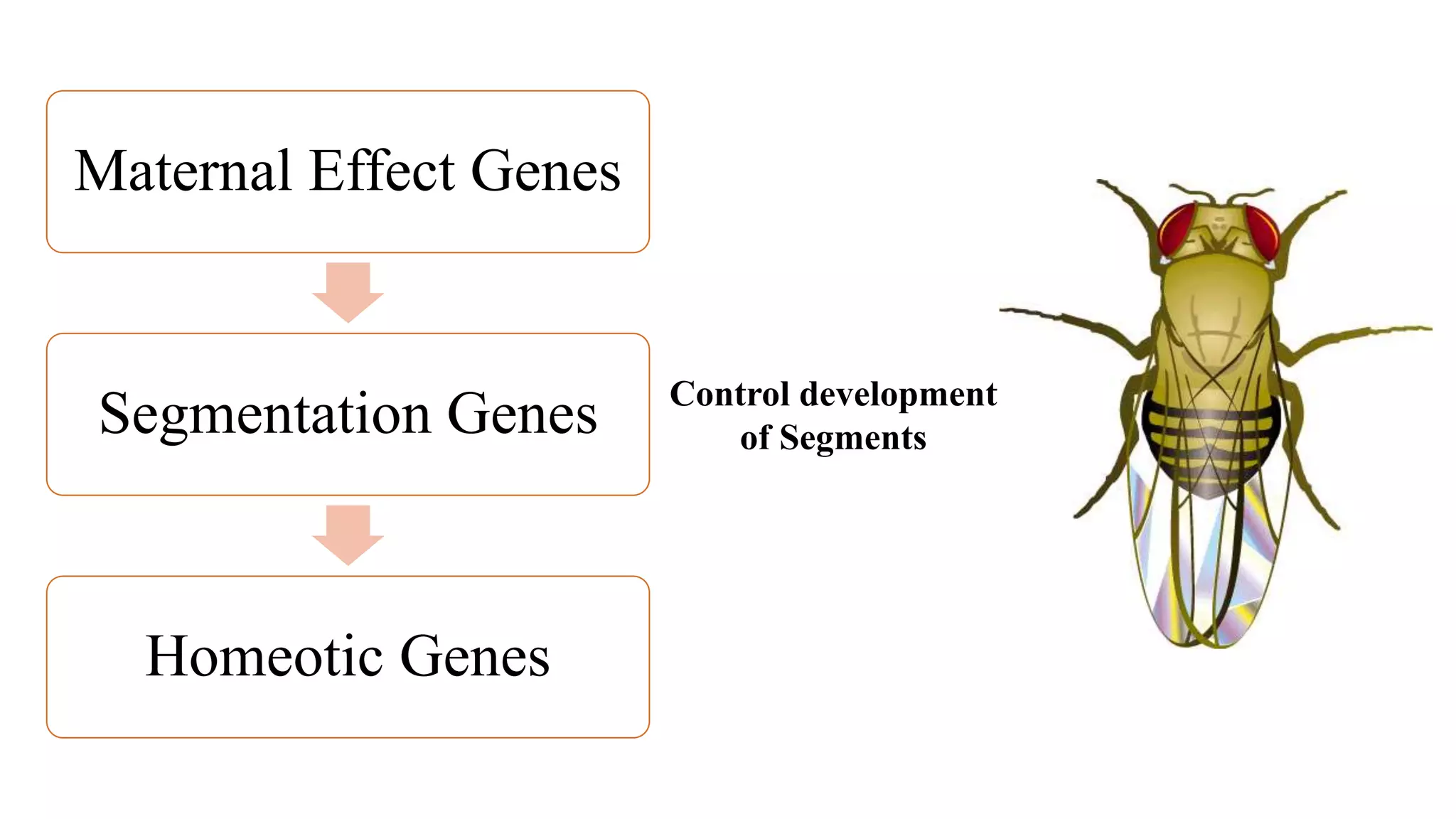
Maternal Effect Genes
Segmentation Genes
Homeotic Genes
Control development
of Segments
• Genes that control development in Drosophila are very similar to those that control development in
vertebrates
• Early patterning occurs in the syncytial blastoderm and it becomes multicellular at the beginning of
segmentation
• Concentration gradients of proteins (transcription factors) can diffuse, enter nuclei & provide positional
information
• The process of cell fate commitment in Drosophila has two steps: Specification and Determination
Drosophila Development
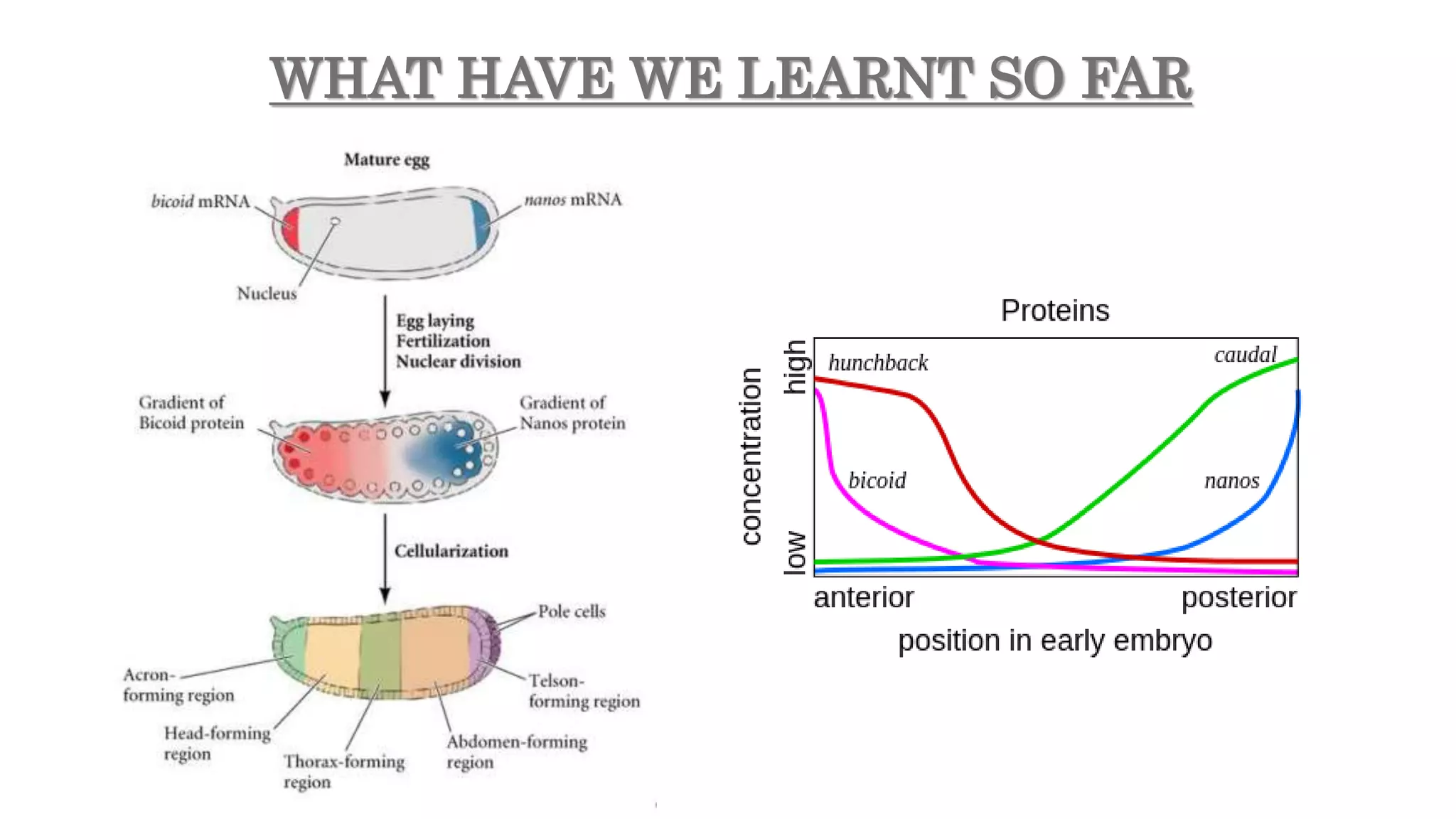
WHAT HAVE WE LEARNT SO FAR
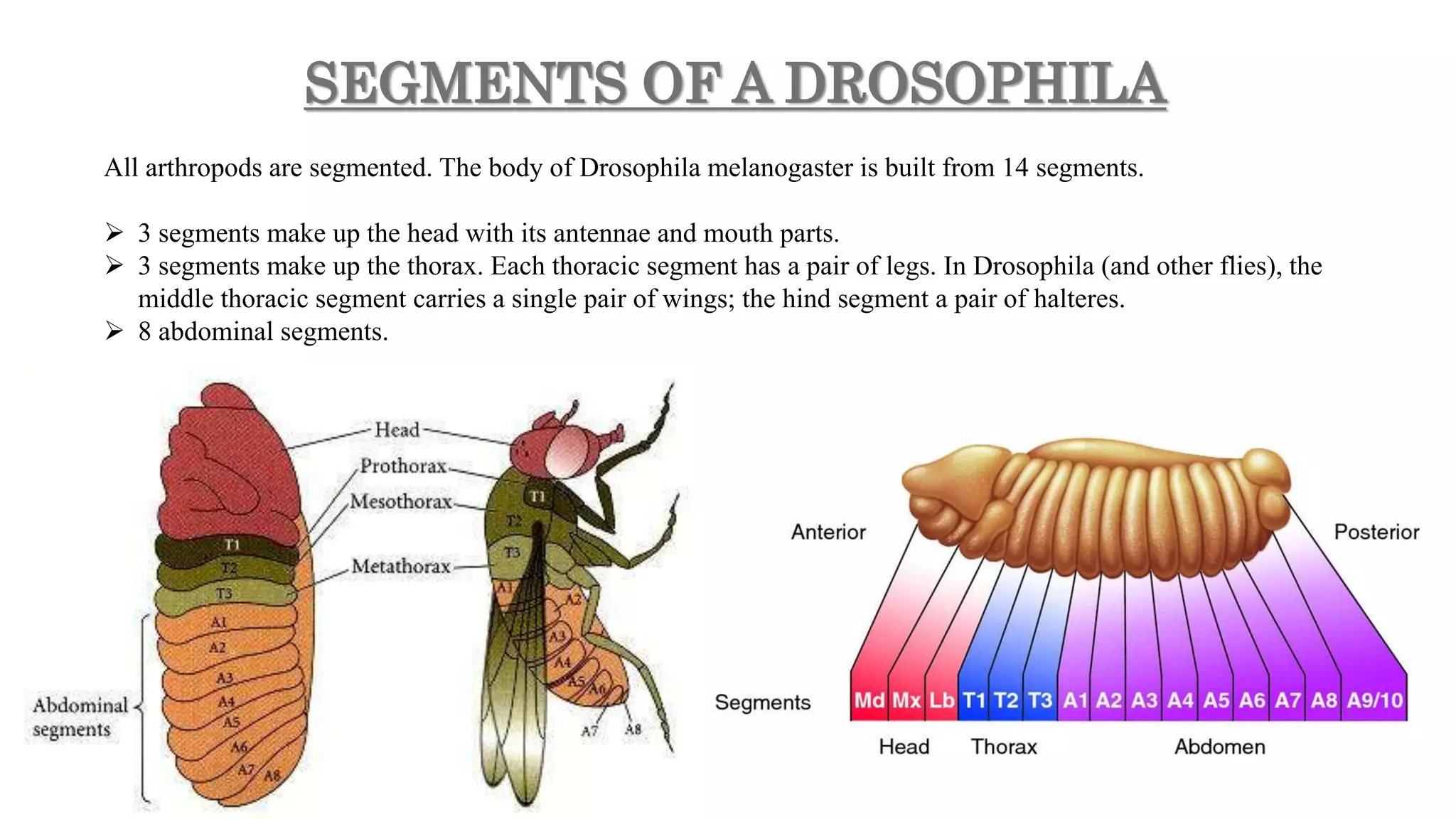
All arthropods are segmented. The body of Drosophila melanogaster is built from 14 segments.
 3 segments make up the head with its antennae and mouth parts.
 3 segments make up the thorax. Each thoracic segment has a pair of legs. In Drosophila (and other flies), the
middle thoracic segment carries a single pair of wings; the hind segment a pair of halteres.
 8 abdominal segments.
SEGMENTS OF A DROSOPHILA
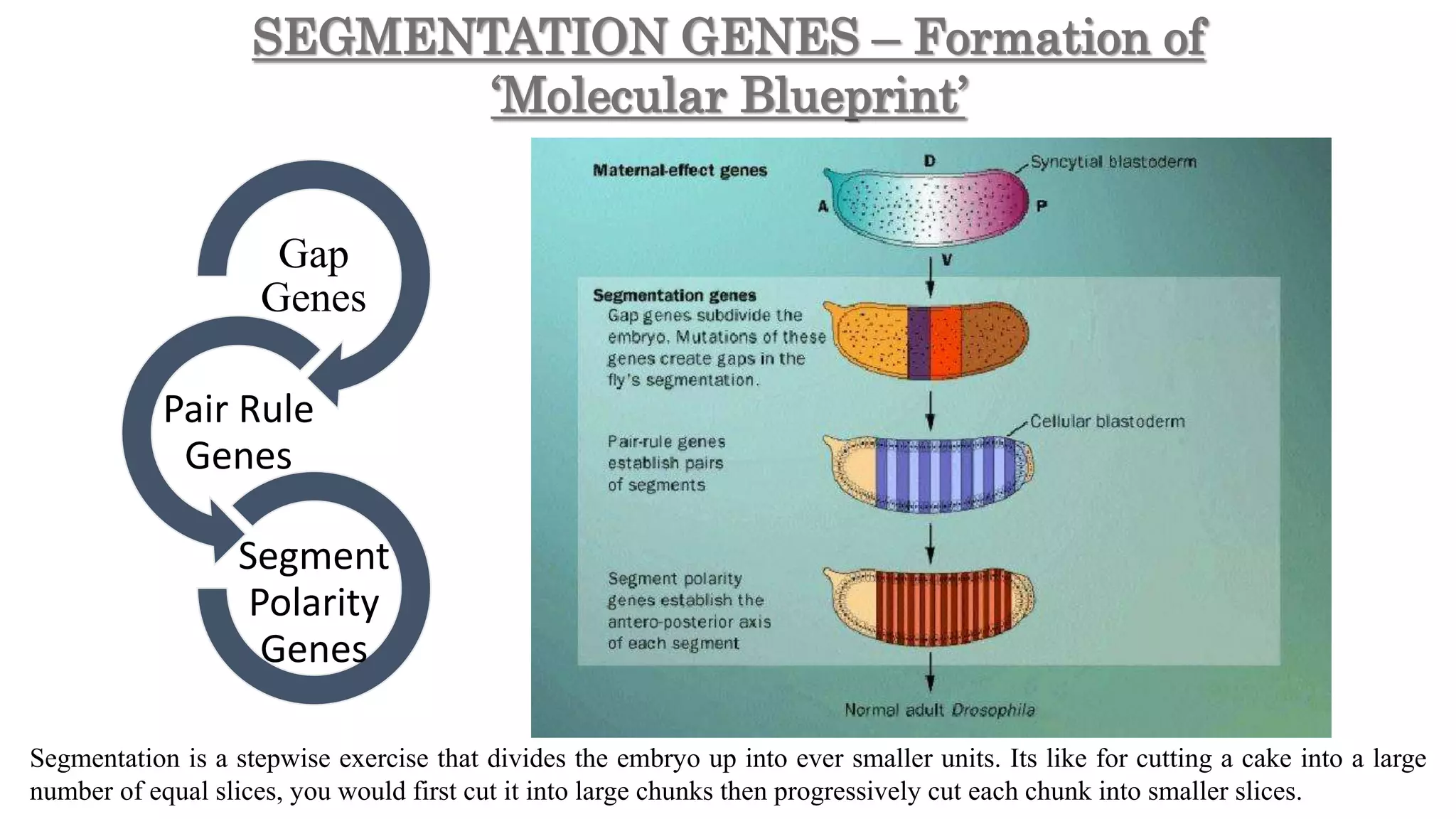
SEGMENTATION GENES – Formation of
‘Molecular Blueprint’
Gap
Genes
Pair Rule
Genes
Segment
Polarity
Genes
Segmentation is a stepwise exercise that divides the embryo up into ever smaller units. Its like for cutting a cake into a large
number of equal slices, you would first cut it into large chunks then progressively cut each chunk into smaller slices.
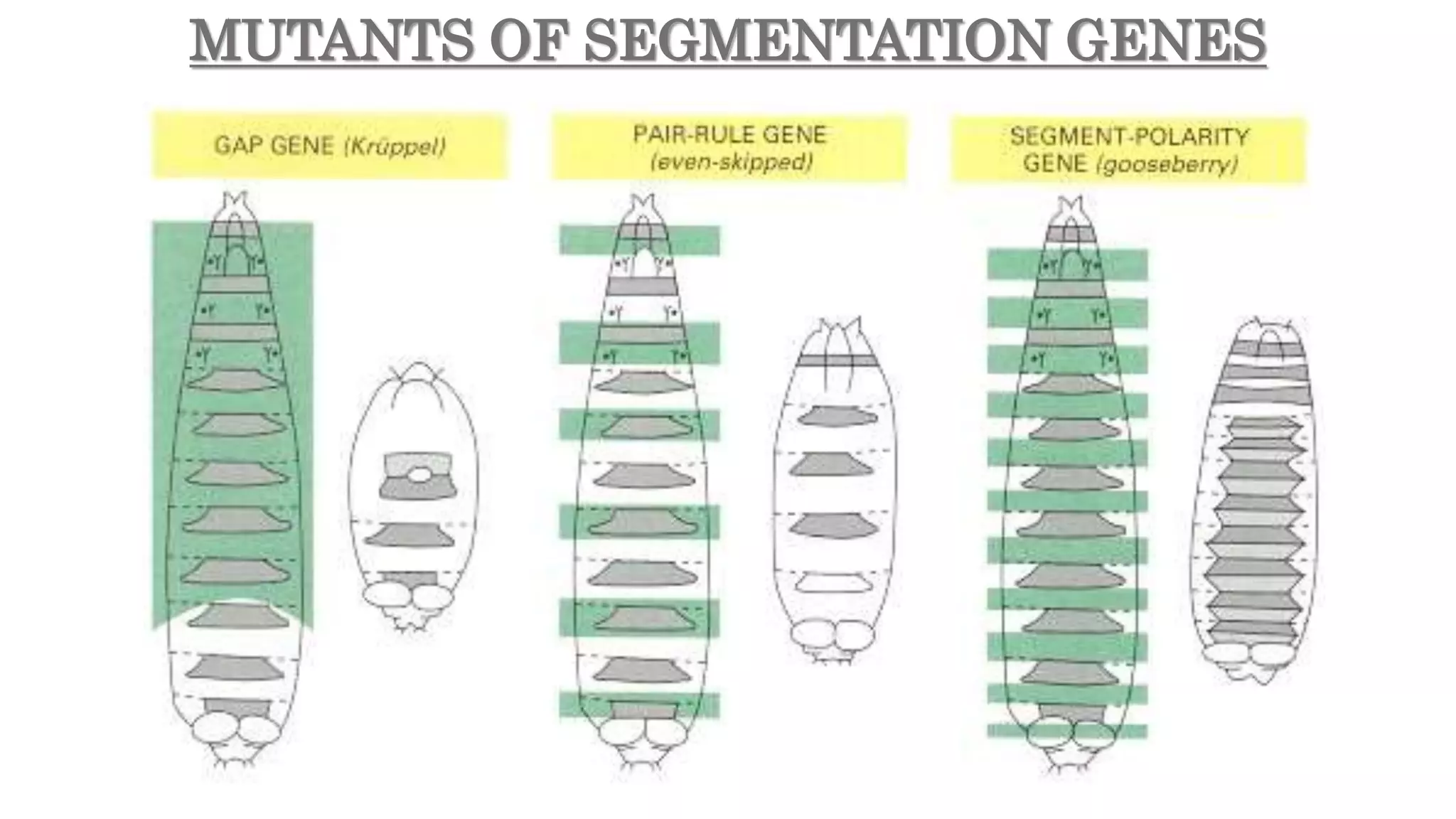
MUTANTS OF SEGMENTATION GENES
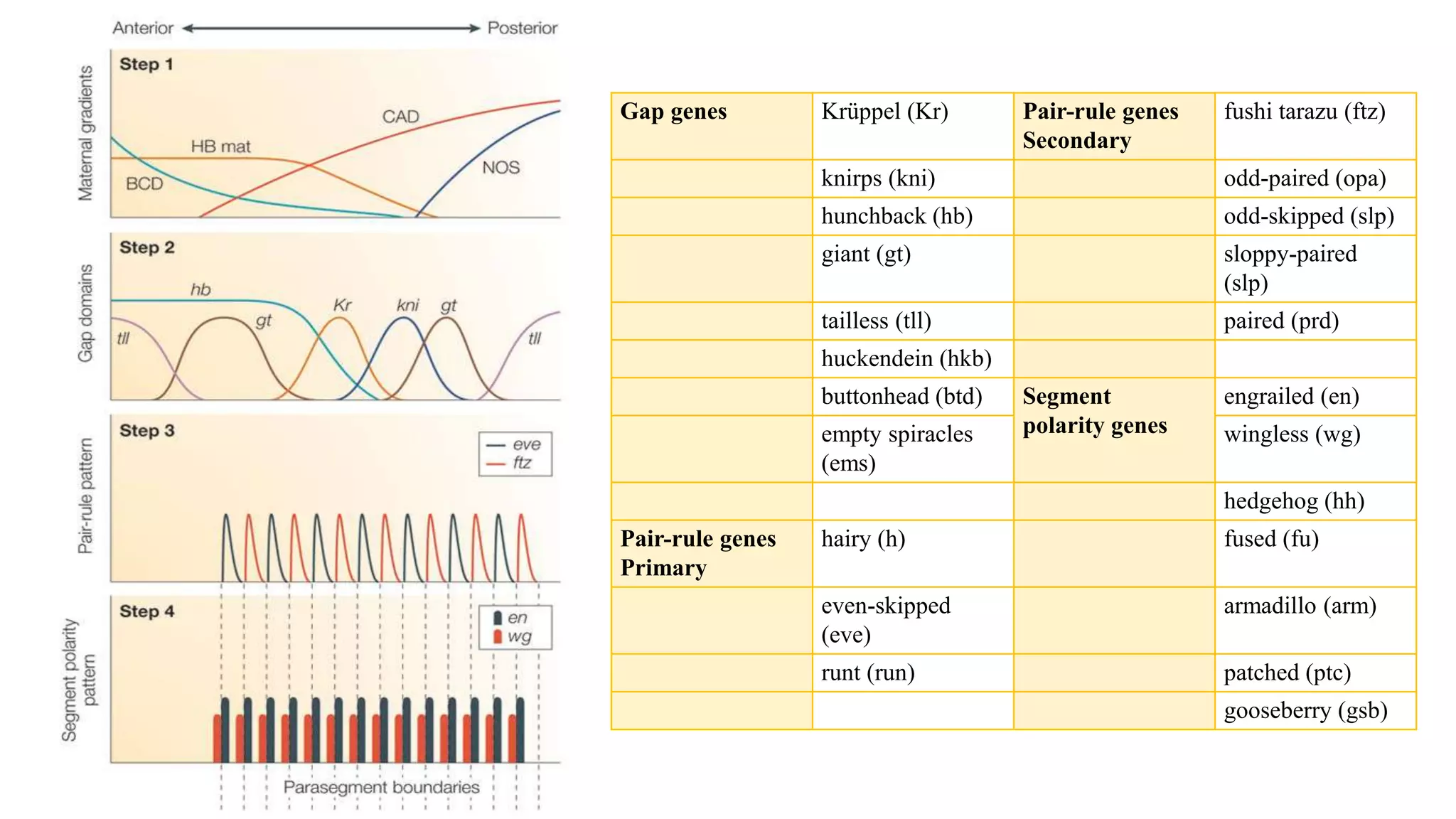
Gap genes Krüppel (Kr) Pair-rule genes
Secondary
fushi tarazu (ftz)
knirps (kni) odd-paired (opa)
hunchback (hb) odd-skipped (slp)
giant (gt) sloppy-paired
(slp)
tailless (tll) paired (prd)
huckendein (hkb)
buttonhead (btd) Segment
polarity genes
engrailed (en)
empty spiracles
(ems)
wingless (wg)
hedgehog (hh)
Pair-rule genes
Primary
hairy (h) fused (fu)
even-skipped
(eve)
armadillo (arm)
runt (run) patched (ptc)
gooseberry (gsb)
PAIR RULE GENES
First Indication of Segmentation
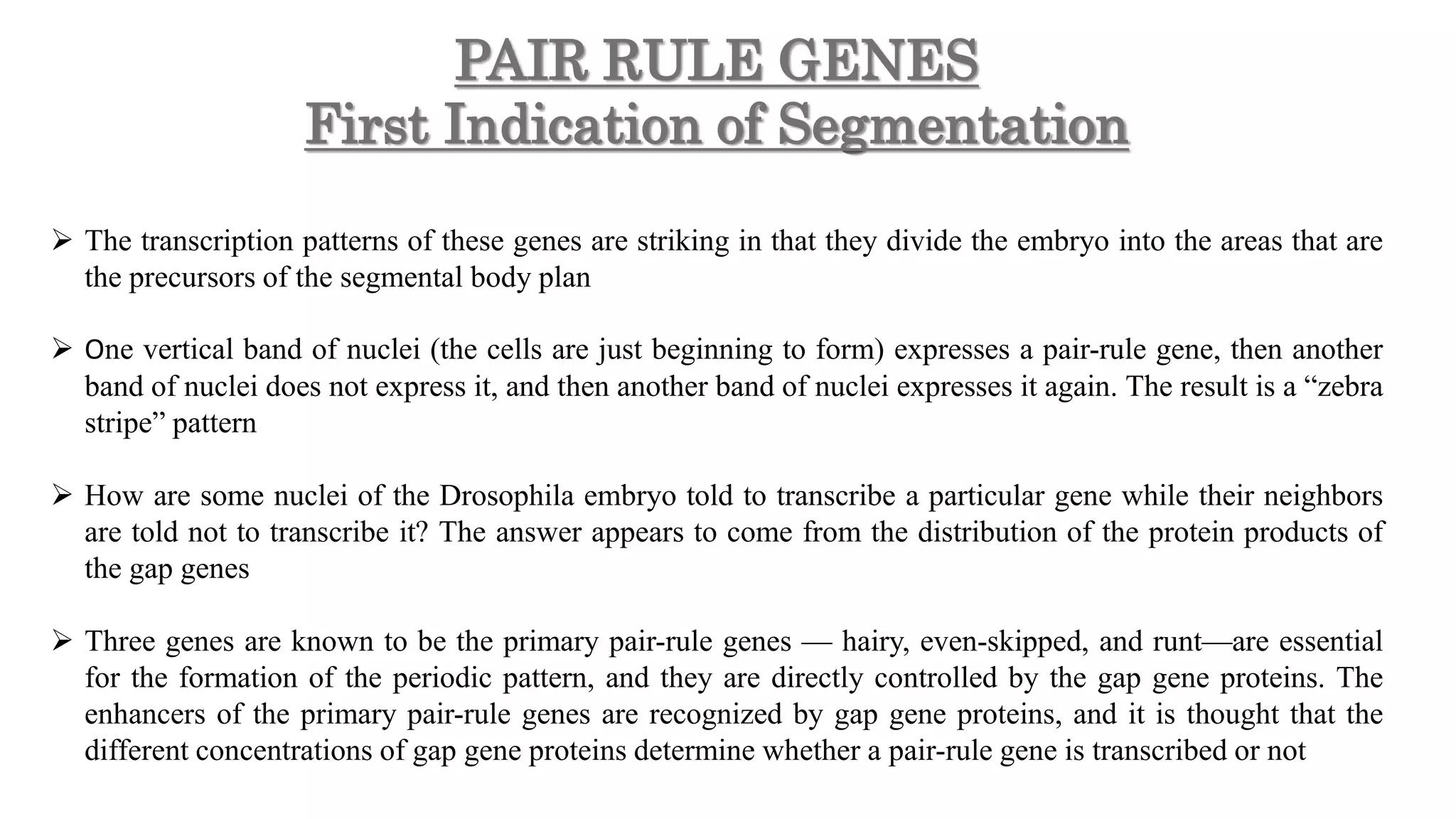
 The transcription patterns of these genes are striking in that they divide the embryo into the areas that are
the precursors of the segmental body plan
 One vertical band of nuclei (the cells are just beginning to form) expresses a pair-rule gene, then another
band of nuclei does not express it, and then another band of nuclei expresses it again. The result is a “zebra
stripe” pattern
 How are some nuclei of the Drosophila embryo told to transcribe a particular gene while their neighbors
are told not to transcribe it? The answer appears to come from the distribution of the protein products of
the gap genes
 Three genes are known to be the primary pair-rule genes — hairy, even-skipped, and runt—are essential
for the formation of the periodic pattern, and they are directly controlled by the gap gene proteins. The
enhancers of the primary pair-rule genes are recognized by gap gene proteins, and it is thought that the
different concentrations of gap gene proteins determine whether a pair-rule gene is transcribed or not
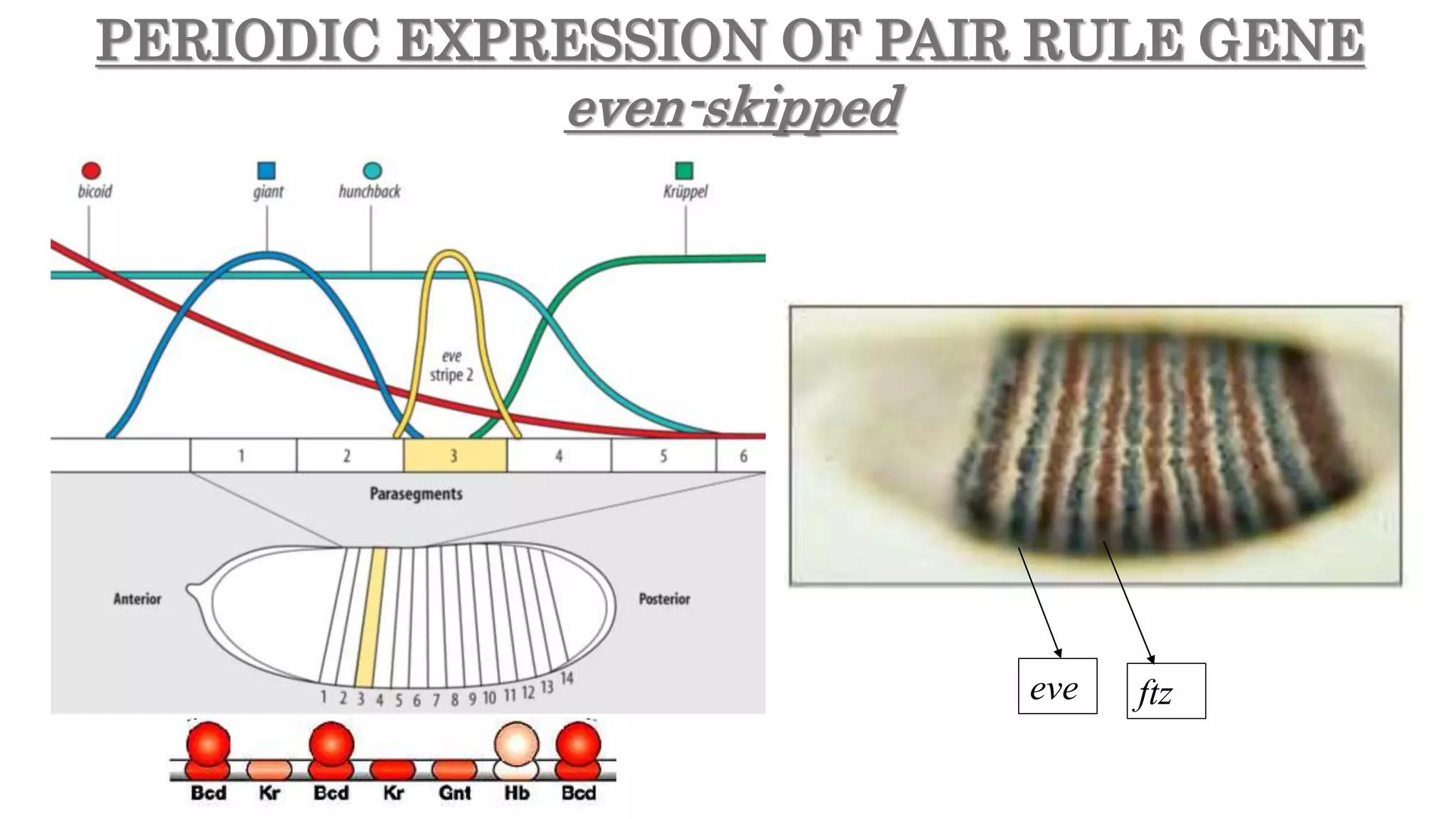
eve ftz
PERIODIC EXPRESSION OF PAIR RULE GENE
even-skipped
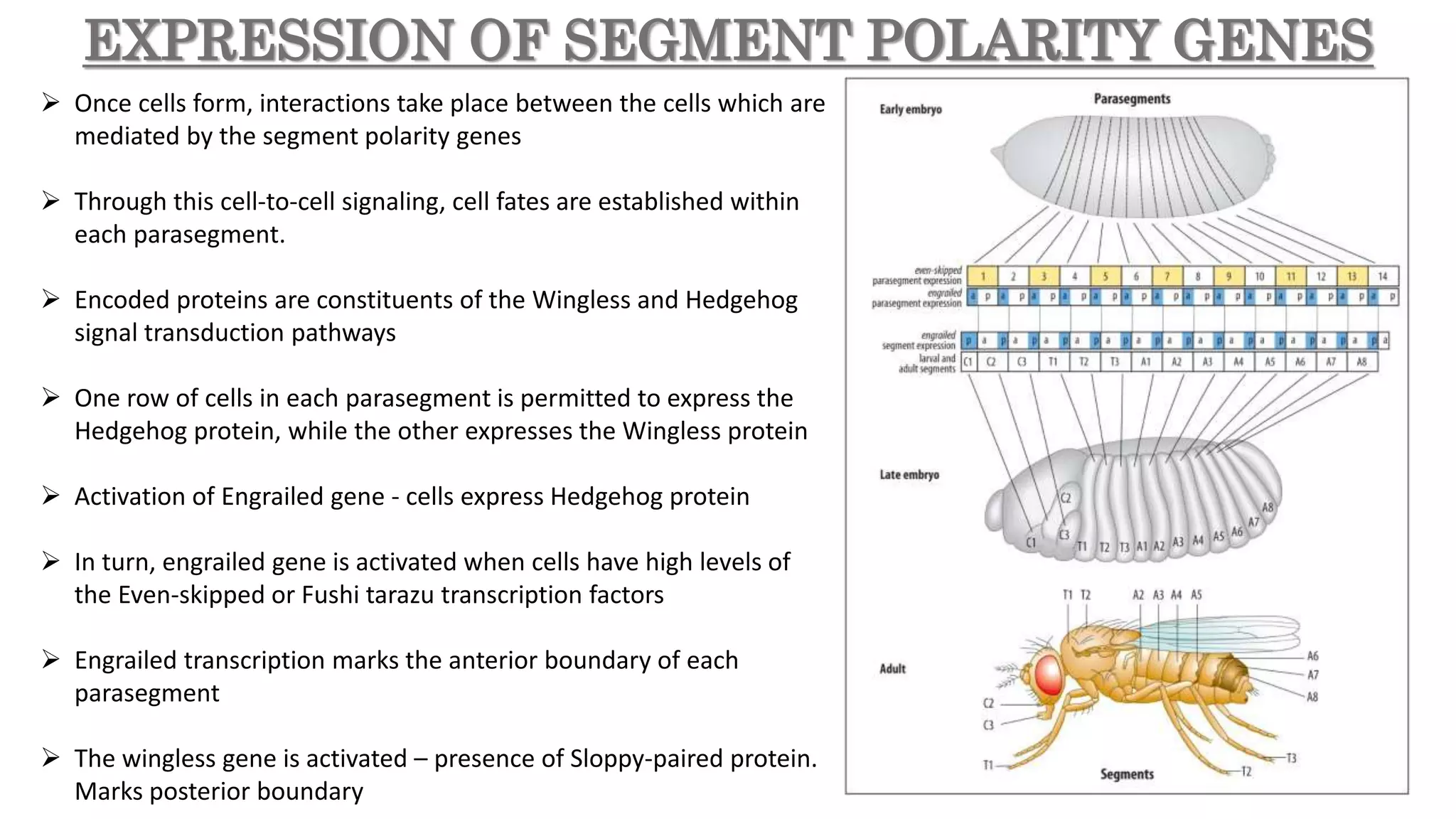
EXPRESSION OF SEGMENT POLARITY GENES
 Once cells form, interactions take place between the cells which are
mediated by the segment polarity genes
 Through this cell-to-cell signaling, cell fates are established within
each parasegment.
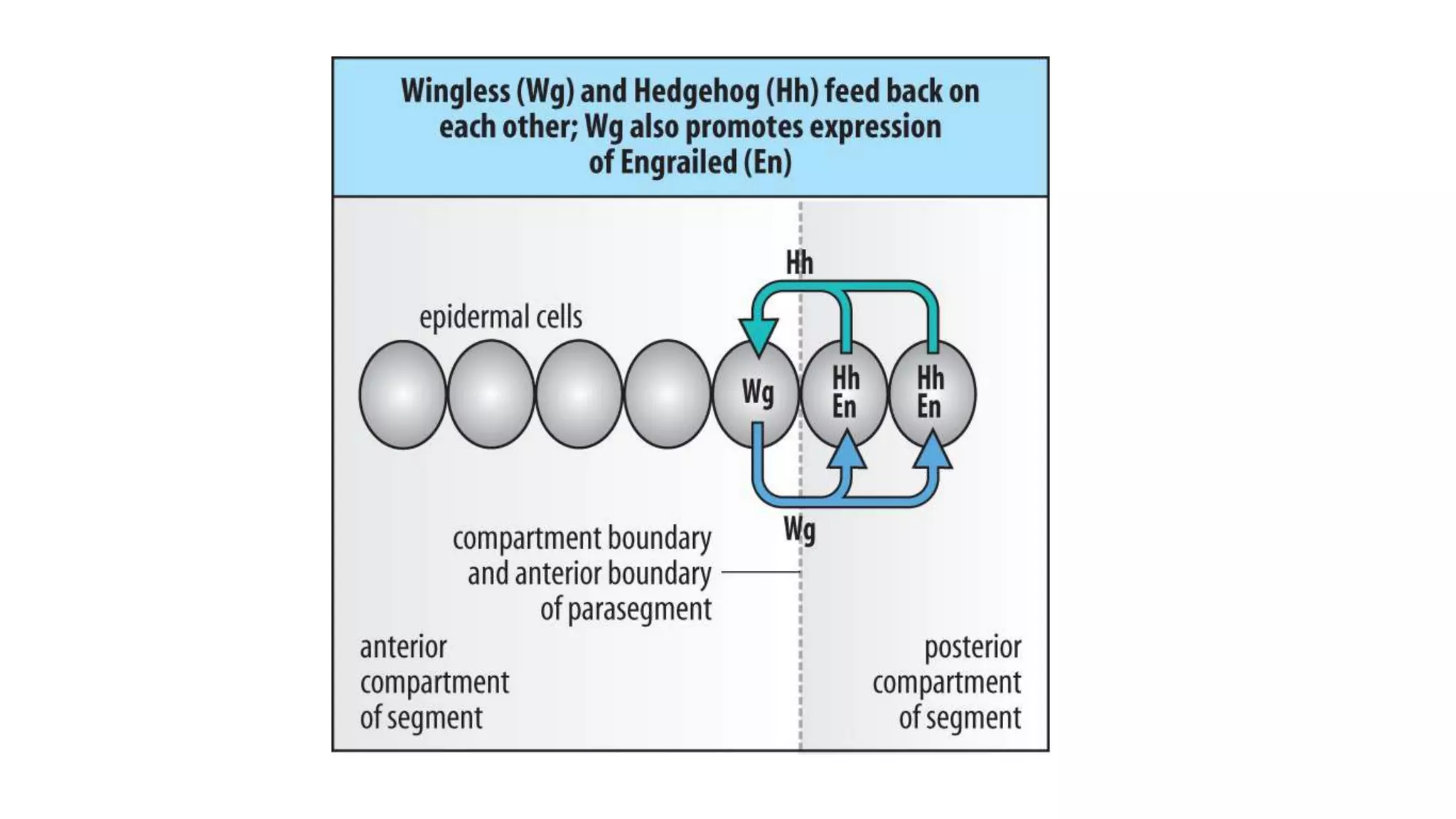
 Encoded proteins are constituents of the Wingless and Hedgehog
signal transduction pathways
 One row of cells in each parasegment is permitted to express the
Hedgehog protein, while the other expresses the Wingless protein
 Activation of Engrailed gene - cells express Hedgehog protein
 In turn, engrailed gene is activated when cells have high levels of
the Even-skipped or Fushi tarazu transcription factors
 Engrailed transcription marks the anterior boundary of each
parasegment
 The wingless gene is activated – presence of Sloppy-paired protein.
Marks posterior boundary
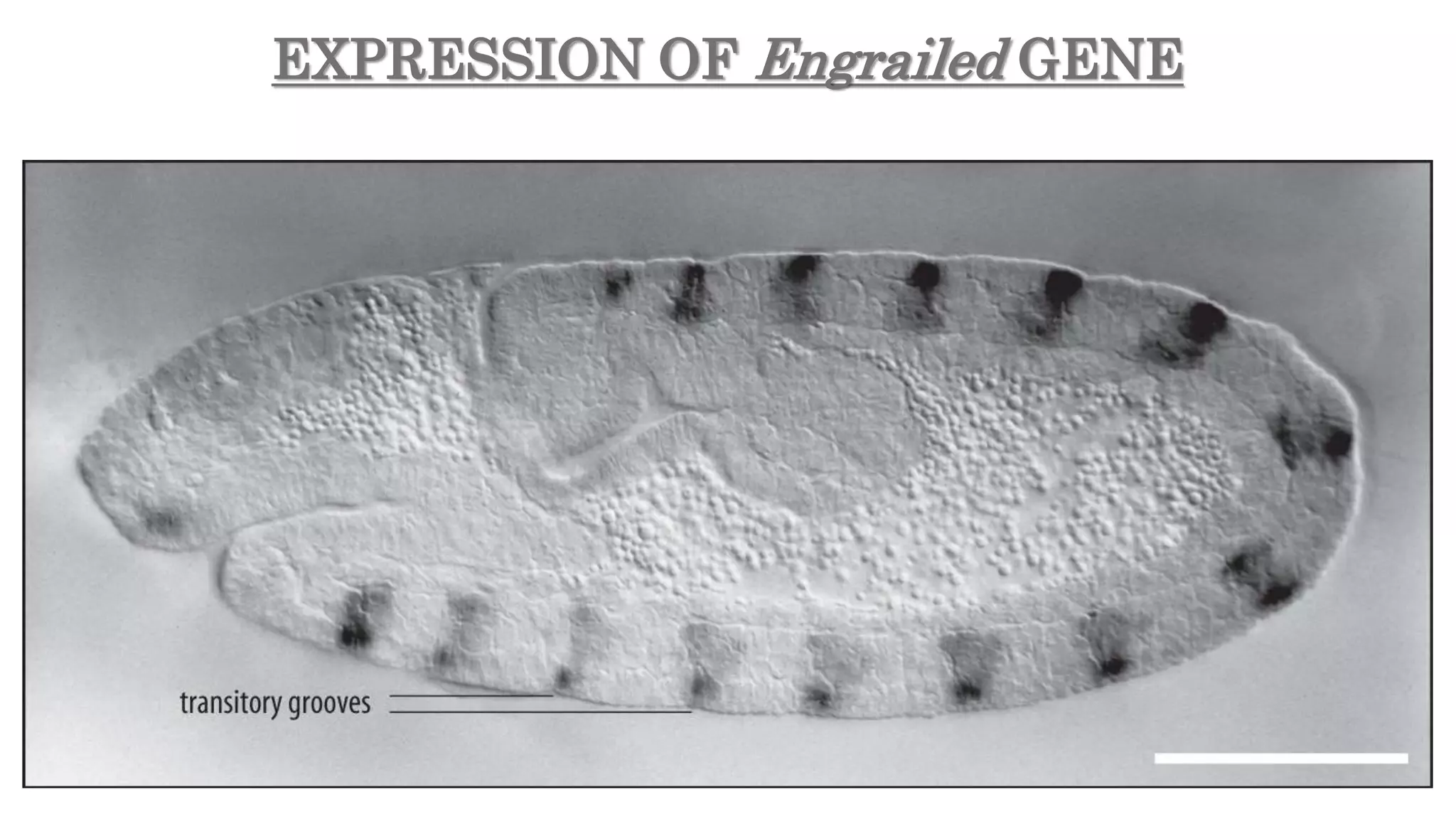
EXPRESSION OF Engrailed GENE
REFERENCES
• http://study.com/academy/lesson/segmentation-genes-in-drosophila-development-pair-rule-segment-polarity-
gap-genes.html
• http://www.ncbi.nlm.nih.gov/books/NBK10039/
• http://www.ncbi.nlm.nih.gov/books/NBK26906/
• http://www.mun.ca/biology/desmid/brian/BIOL3530/DB_02/DBNDros.html
• http://www.dnaftb.org/37/animation.html
Segmentation in Drosophila melanogaster

Segmentation in Drosophila melanogaster

  • 2.
  • 3.
    Maternal Effect Genes SegmentationGenes Homeotic Genes Control development of Segments
  • 4.
    • Genes thatcontrol development in Drosophila are very similar to those that control development in vertebrates • Early patterning occurs in the syncytial blastoderm and it becomes multicellular at the beginning of segmentation • Concentration gradients of proteins (transcription factors) can diffuse, enter nuclei & provide positional information • The process of cell fate commitment in Drosophila has two steps: Specification and Determination Drosophila Development
  • 5.
    WHAT HAVE WELEARNT SO FAR
  • 6.
    All arthropods aresegmented. The body of Drosophila melanogaster is built from 14 segments.  3 segments make up the head with its antennae and mouth parts.  3 segments make up the thorax. Each thoracic segment has a pair of legs. In Drosophila (and other flies), the middle thoracic segment carries a single pair of wings; the hind segment a pair of halteres.  8 abdominal segments. SEGMENTS OF A DROSOPHILA
  • 7.
    SEGMENTATION GENES –Formation of ‘Molecular Blueprint’ Gap Genes Pair Rule Genes Segment Polarity Genes Segmentation is a stepwise exercise that divides the embryo up into ever smaller units. Its like for cutting a cake into a large number of equal slices, you would first cut it into large chunks then progressively cut each chunk into smaller slices.
  • 8.
  • 9.
    Gap genes Krüppel(Kr) Pair-rule genes Secondary fushi tarazu (ftz) knirps (kni) odd-paired (opa) hunchback (hb) odd-skipped (slp) giant (gt) sloppy-paired (slp) tailless (tll) paired (prd) huckendein (hkb) buttonhead (btd) Segment polarity genes engrailed (en) empty spiracles (ems) wingless (wg) hedgehog (hh) Pair-rule genes Primary hairy (h) fused (fu) even-skipped (eve) armadillo (arm) runt (run) patched (ptc) gooseberry (gsb)
  • 11.
    PAIR RULE GENES FirstIndication of Segmentation  The transcription patterns of these genes are striking in that they divide the embryo into the areas that are the precursors of the segmental body plan  One vertical band of nuclei (the cells are just beginning to form) expresses a pair-rule gene, then another band of nuclei does not express it, and then another band of nuclei expresses it again. The result is a “zebra stripe” pattern  How are some nuclei of the Drosophila embryo told to transcribe a particular gene while their neighbors are told not to transcribe it? The answer appears to come from the distribution of the protein products of the gap genes  Three genes are known to be the primary pair-rule genes — hairy, even-skipped, and runt—are essential for the formation of the periodic pattern, and they are directly controlled by the gap gene proteins. The enhancers of the primary pair-rule genes are recognized by gap gene proteins, and it is thought that the different concentrations of gap gene proteins determine whether a pair-rule gene is transcribed or not
  • 12.
    eve ftz PERIODIC EXPRESSIONOF PAIR RULE GENE even-skipped
  • 13.
    EXPRESSION OF SEGMENTPOLARITY GENES  Once cells form, interactions take place between the cells which are mediated by the segment polarity genes  Through this cell-to-cell signaling, cell fates are established within each parasegment.  Encoded proteins are constituents of the Wingless and Hedgehog signal transduction pathways  One row of cells in each parasegment is permitted to express the Hedgehog protein, while the other expresses the Wingless protein  Activation of Engrailed gene - cells express Hedgehog protein  In turn, engrailed gene is activated when cells have high levels of the Even-skipped or Fushi tarazu transcription factors  Engrailed transcription marks the anterior boundary of each parasegment  The wingless gene is activated – presence of Sloppy-paired protein. Marks posterior boundary
  • 15.
  • 17.
    REFERENCES • http://study.com/academy/lesson/segmentation-genes-in-drosophila-development-pair-rule-segment-polarity- gap-genes.html • http://www.ncbi.nlm.nih.gov/books/NBK10039/ •http://www.ncbi.nlm.nih.gov/books/NBK26906/ • http://www.mun.ca/biology/desmid/brian/BIOL3530/DB_02/DBNDros.html • http://www.dnaftb.org/37/animation.html

Editor's Notes

  • #3 Right genes being expressed at the right time for pattern formation to occur.
  • #5 Early in development, the fate of a cell depends on environmental cues, such as those provided by the protein gradients mentioned above. This specification of cell fate is flexible and can still be altered in response to signals from other cells. Eventually, the cells undergo a transition from this loose type of commitment to an irreversible determination. At this point, the fate of a cell becomes cell-intrinsic
  • #8 The gap genes include hunchback, kruppel and knirps, which define relatively broad regions of the embryo - two to four future segments. The pair-rule genes are activated in a series of seven separate stripes around the embryo. The segment-polarity genes are activated in every segment (14 in all) and define the anterior and posterior of each individual parasegment.
  • #9 Gap genes, whose products mark out coarse subdivisions of the embryo. Mutations in a gap gene eliminate one or more groups of adjacent segments, and mutations in different gap genes cause different but partially overlapping defects. In the mutant Krüppel, for example, the larva lacks eight segments, from T1 to A5 inclusive. The next segmentation genes to act are a set of eight pair-rule genes. Mutations in these cause a series of deletions affecting alternate segments, leaving the embryo with only half as many segments as usual. While all the pair-rule mutants display this two-segment periodicity, they differ in the precise positioning of the deletions relative to the segmental or parasegmental borders. Finally, there are at least 10 segment-polarity genes. Mutations in these genes produce larvae with a normal number of segments but with a part of each segment deleted and replaced by a mirror-image duplicate of all or part of the rest of the segment. In gooseberry mutants, for example, the posterior half of each segment (that is, the anterior half of each parasegment) is replaced by an approximate mirror image of the adjacent anterior half-segment
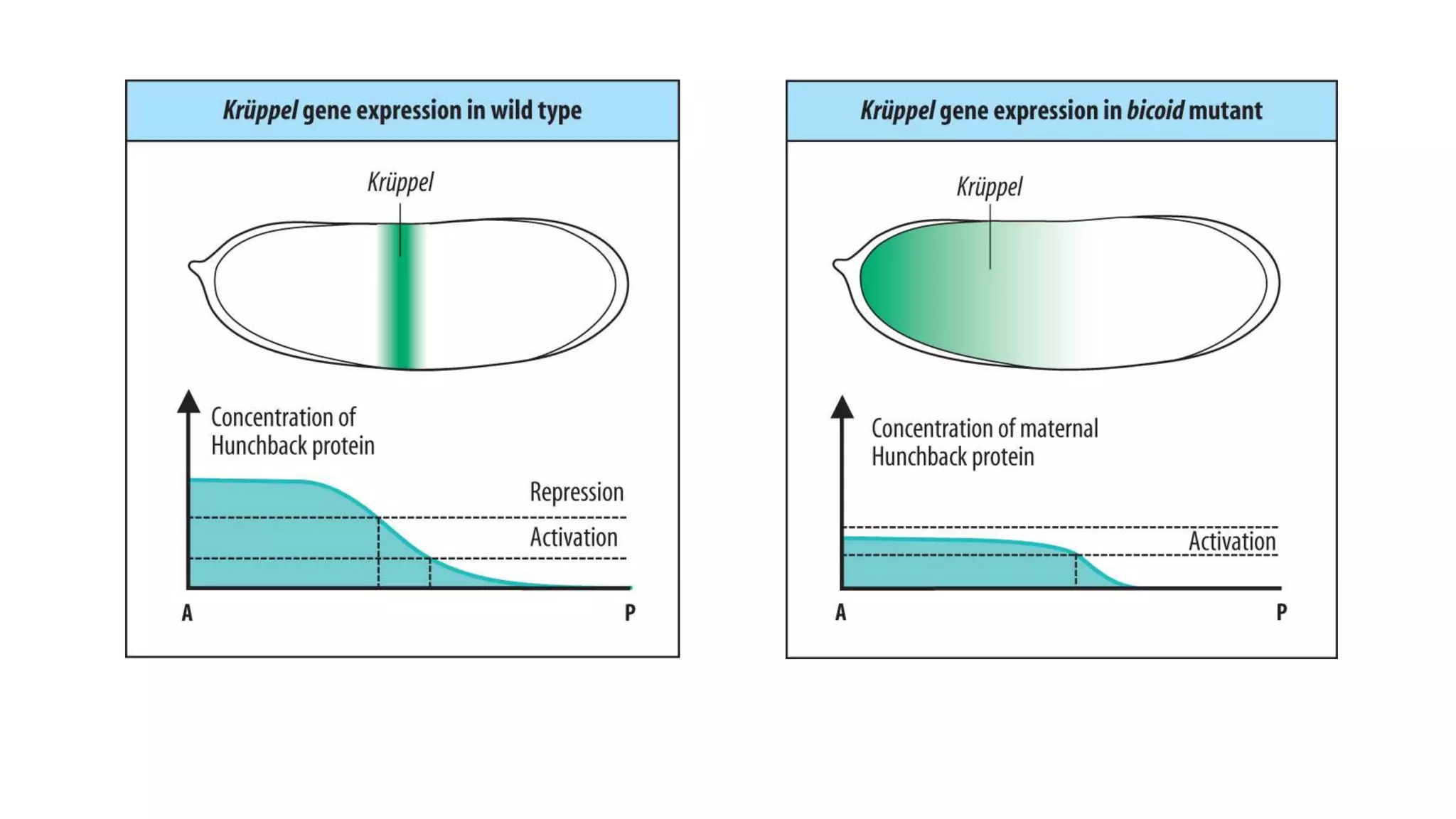
  • #10 Kruppel is activated by a combination of bicoid and low levels of hunchback but is repressed by high levels of hunchback. This locates Kruppel expression to the centre of the embryo.  Knirps is repressed by high levels of hunchback .  In this way the initial gradients of morphogens can lead to the establishment of regions within the syncytial blastoderm which themselves lead to the beginning of segmentation
  • #13 The 2nd stripe of even-skipped (eve) requires bicoid & hunchback.  giant represses eve to form a sharp anterior border.  Kruppel represses eve to form a sharp posterior border.  Since each stripe is independently controlled by combinations of transcription factors (gap genes).  Each pair-rule gene has complex control regions with multiple binding sites for each of the different factors.  Some factors activate and other inactivate.  Some require the activity of the primary pair-rule genes (such as eve and hairy).
  • #14 Parasegments arise first & each segment is made from the posterior part of one PS and the anterior of the next. Parasegments are delimited by  periodic expression pair-rule (PR) genes. Transient grooves on embryo surface (after gastrulation) define the 14 PS. Parasegments act as developmental units
  • #15 The Engrailed protein activates the transcription of the hedgehog gene in the engrailed-expressing cells. The Hedgehog protein can bind to the Hedgehog receptor (the Patched protein) on neighboring cells. When it binds to the adjacent posterior cells, it stimulates the expression of the wingless gene. The result is a reciprocal loop wherein the Engrailed-synthesizing cells secrete the Hedgehog protein, which maintains the expression of the wingless gene in the neighboring cells, while the Wingless-secreting cells maintain the expression of the engrailed and hedgehog genes in their neighbors in turn. In this way, the transcription pattern of these two types of cells is stabilized. This interaction creates a stable boundary, as well as a signaling center from which Hedgehog and Wingless proteins diffuse across the parasegment.