Aplastic anemia

•       approach
    –
    –
Diagnosis
• Pancytopenia          • Exclude
• Hypocellular marrow     – Acute leukemia
  – Aspiration            – Myelodysplastic
  – Biopsy                  syndrome
                          – Paroxysmal nocturnal
                            hemoglobinuria
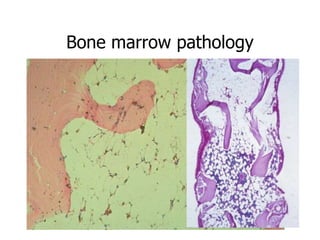
Bone marrow pathology
aplastic
       anemia
• exposure to
  – nonbottled water
  – certain animals (ducks and geese)
  – animal fertilizer
  – pesticides
aplastic anemia
              historical studies
•   Drugs
•   Chemicals
•   Pregnancy
•   Eosinophilic fasciitis
•   Hepatitis - seronegative
•         occupational exposure
•
•
•                         bone
    marrow transplantation)
Proper Investigations
•   CBC, blood smear
•   Bone marrow aspiration and biopsy
•   Chromosome study (in elderly patients)
•   PNH work up
•   Hepatitis viruses
•   Complete blood typing
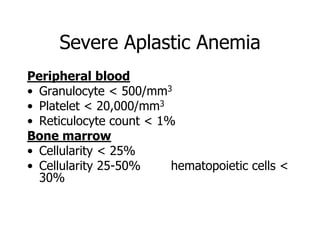
Severe Aplastic Anemia
Peripheral blood
• Granulocyte < 500/mm3
• Platelet < 20,000/mm3
• Reticulocyte count < 1%
Bone marrow
• Cellularity < 25%
• Cellularity 25-50%     hematopoietic cells <
  30%
Aplastic anemia is an immune process

• What else could be so effective and
  selective?
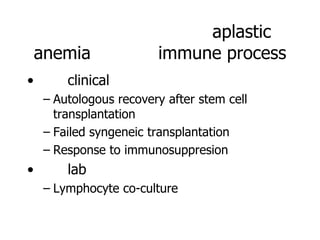
aplastic
    anemia              immune process
•       clinical
    – Autologous recovery after stem cell
      transplantation
    – Failed syngeneic transplantation
    – Response to immunosuppresion
•       lab
    – Lymphocyte co-culture
Cell  , cytokine
 mechanism
• Th1 lymphocytes
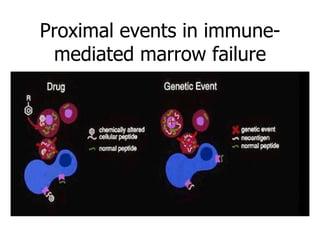
Proximal events in immune-
 mediated marrow failure
Apoptosis
•           apoptosis             stem cell

•     upregulation       gene
    apoptosis
•                       cell    expose
    gamma interferon
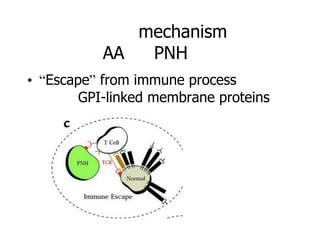
mechanism
           AA  PNH
• “Escape” from immune process
        GPI-linked membrane proteins
MDS     presentation     respond to
 treatment       AA     mutation
• Trisomy 8
• Upregulation   anti-apoptosis genes
Management of Severe AA
• BMT or ATG or
                  > 70%
• Antithymocyte globulin
  – Better results when combined with cyclosporin
  – Anticipated response > 3
• Allogeneic bone marrow transplantation, esp.
  in
  – Young patient
  – Patient with very severe AA
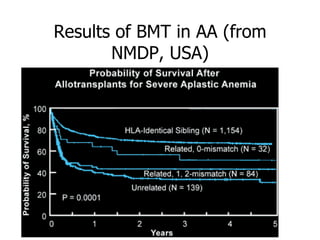
Results of BMT in AA (from
       NMDP, USA)
BMT       AA
                 2
• Chronic GVHD
  – Irradiation
  – Heavy cell dose
  – Increasing age
• Rejection
  – Heavy previous transfusion
  – Low cell dose
long tem surivival        AA
   ATG CsA 3          11

• 3 65-70%
• 11 39%
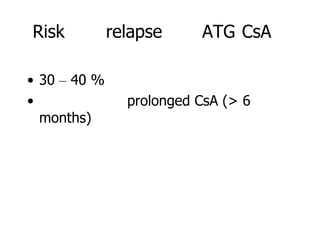
Risk          relapse     ATG CsA

• 30 – 40 %
•               prolonged CsA (> 6
  months)
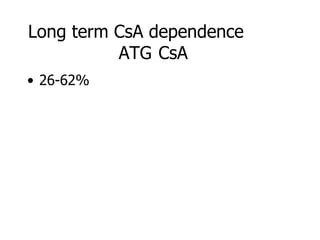
Long term CsA dependence
          ATG CsA
• 26-62%
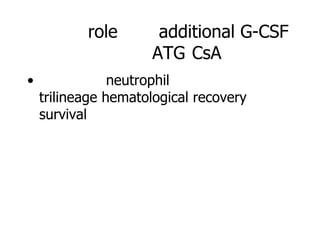
role       additional G-CSF
                     ATG CsA
•               neutrophil
    trilineage hematological recovery
    survival
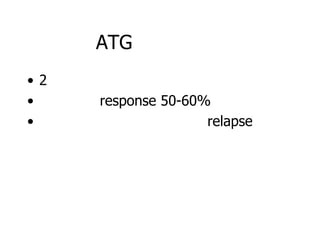
ATG
•2
•    response 50-60%
•                   relapse
Management of non-severe
           AA
• Anabolic hormones
  – Anticipated response > 3
• Cyclosporin alone
supportive
               treatment
•   AA
•
•   Decreased quality of life
•   Loss of work opportunity
•   High expense of treatment
Transfusion guidelines
•          BMT
•        leukodepleted blood products
• Platelet transfusion
  Prophylactic vs. Therapeutics

Aplastic anemia 2011

  • 1.
    Aplastic anemia • approach – –
  • 2.
    Diagnosis • Pancytopenia • Exclude • Hypocellular marrow – Acute leukemia – Aspiration – Myelodysplastic – Biopsy syndrome – Paroxysmal nocturnal hemoglobinuria
  • 3.
  • 5.
    aplastic anemia • exposure to – nonbottled water – certain animals (ducks and geese) – animal fertilizer – pesticides
  • 6.
    aplastic anemia historical studies • Drugs • Chemicals • Pregnancy • Eosinophilic fasciitis • Hepatitis - seronegative
  • 7.
    occupational exposure • • • bone marrow transplantation)
  • 8.
    Proper Investigations • CBC, blood smear • Bone marrow aspiration and biopsy • Chromosome study (in elderly patients) • PNH work up • Hepatitis viruses • Complete blood typing
  • 9.
    Severe Aplastic Anemia Peripheralblood • Granulocyte < 500/mm3 • Platelet < 20,000/mm3 • Reticulocyte count < 1% Bone marrow • Cellularity < 25% • Cellularity 25-50% hematopoietic cells < 30%
  • 10.
    Aplastic anemia isan immune process • What else could be so effective and selective?
  • 11.
    aplastic anemia immune process • clinical – Autologous recovery after stem cell transplantation – Failed syngeneic transplantation – Response to immunosuppresion • lab – Lymphocyte co-culture
  • 12.
    Cell ,cytokine mechanism • Th1 lymphocytes
  • 13.
    Proximal events inimmune- mediated marrow failure
  • 14.
    Apoptosis • apoptosis stem cell • upregulation gene apoptosis • cell expose gamma interferon
  • 15.
    mechanism AA PNH • “Escape” from immune process GPI-linked membrane proteins
  • 16.
    MDS presentation respond to treatment AA mutation • Trisomy 8 • Upregulation anti-apoptosis genes
  • 17.
    Management of SevereAA • BMT or ATG or > 70% • Antithymocyte globulin – Better results when combined with cyclosporin – Anticipated response > 3 • Allogeneic bone marrow transplantation, esp. in – Young patient – Patient with very severe AA
  • 18.
    Results of BMTin AA (from NMDP, USA)
  • 19.
    BMT AA 2 • Chronic GVHD – Irradiation – Heavy cell dose – Increasing age • Rejection – Heavy previous transfusion – Low cell dose
  • 20.
    long tem surivival AA ATG CsA 3 11 • 3 65-70% • 11 39%
  • 21.
    Risk relapse ATG CsA • 30 – 40 % • prolonged CsA (> 6 months)
  • 22.
    Long term CsAdependence ATG CsA • 26-62%
  • 23.
    role additional G-CSF ATG CsA • neutrophil trilineage hematological recovery survival
  • 24.
    ATG •2 • response 50-60% • relapse
  • 25.
    Management of non-severe AA • Anabolic hormones – Anticipated response > 3 • Cyclosporin alone
  • 26.
    supportive treatment • AA • • Decreased quality of life • Loss of work opportunity • High expense of treatment
  • 27.
    Transfusion guidelines • BMT • leukodepleted blood products • Platelet transfusion Prophylactic vs. Therapeutics