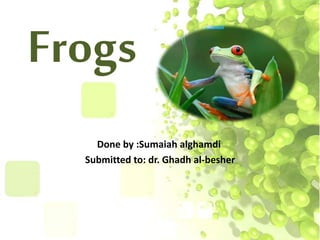
Frogs
Done by :Sumaiah alghamdi
Submitted to: dr. Ghadh al-besher
Content:
• Frogs classification.
• Characteristic.
• Habitat .
• Eating .
• Life cycle
• Movement
• Camouflage
• Poison
• Behavior and communication
• Types
• benefits
Introduction :
• The frogs are some of the few remaining
members of the amphibian are group which
flourished 250 million years ago .
• (Am-fib-ee-anz )Tow life
• The amphibian are adapted to live on land as
well as in fresh water. At certain times of their
life history or at particular seasons, however,
they show a dependence on, or preference for
one or the other.
• about 88% of amphibians are frogs .
Classification
• Kingdom - Animalia
• Phylum - Chordata
• Subphylum - Verebrata
• Class – Amphibia
Characteristic
• The frog is cold-blooded
• Smooth or slimy skin.
• strong, long webbed hind feet that are
adapted for leaping and swimming have
fingers or toes .
Characteristic
• The eyes have movable lids but ,Its nostrils
are situated so that air can be breathed while
the frog is swimming at the surface; they can
also be closed .
• Behind the eyes are circular ear-drums for
hearing.
Characteristic
• They breath dissolved oxygen in water ,when
they are young using gill
• They breath air when they are adult
using lungs.
• Have short body no
tail ,are excellent jumpers.
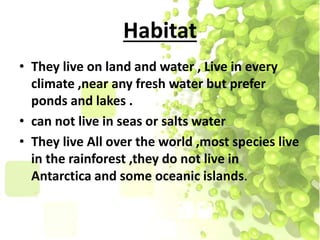
Habitat
• They live on land and water , Live in every
climate ,near any fresh water but prefer
ponds and lakes .
• can not live in seas or salts water
• They live All over the world ,most species live
in the rainforest ,they do not live in
Antarctica and some oceanic islands.
Habitat
Eating
• Frogs is carnivores
• frogs have teeth used to grind food ,frogs have
sticky tongue use it to catch food
• ,most eat flies and insects
• Some large frogs eat small mammals ,fishs and
small frogs –very few eat just plants.
Movement
• They have number of movements to
adaption with environment such as:
• Climbing
• Jumping
• Walking Running
• Swimming
Movement
Life cycle
• includes four basic stages , egg tadpole , a
transitional stage , then adult
1-egg most female frogs
lay eggs in early spring
2-tadpole (or polliwog )
3-metamorphosis
4-adult
Captive frogs and toads
com live up to 40 years
Life cycle
Tadpole :born with gill like fish ..they can
breath under water ,they had big head large
tail tough life but fast swimmers and Favorite
food to fish and water beetles .
Life cycle
Camouflage
• Is common in frogs ,most with camouflage
,are nocturnal ,awake at night ,this helps
them hide ,some can change colors.
• Temperature and humidity play a part in
causing color changes.
Poison
• Many frogs have toxins so other animals will
not eat them ,they taste bad.
• Some frogs are very poisonous ,they usually
have bright colors ,some frogs get their poison
from the animals they eat .
Behavior and communication
• Some are so loud they con be heard a mile
away ,many have deep calls or croaks ,they
call by passing air through their throat ,the
main reason they call is:
1- So males can attract females
2- To guard territory to forecast rain
3- When under stress (if a predator is near)
Behavior and communication
Romantic picture
Protect her
wife from rain .
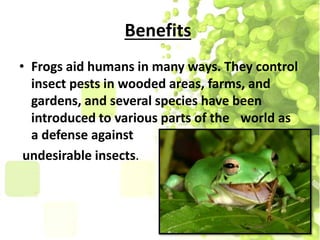
Benefits
• Frogs aid humans in many ways. They control
insect pests in wooded areas, farms, and
gardens, and several species have been
introduced to various parts of the world as
a defense against
undesirable insects.
Types
• You may think that all frogs look the same-
ugly and filthy but you will be surprised to
know that this amphibian also has numerous
varieties. In fact, North America alone consists
of over ninety different
species of frogs
Types
Bullfrog
Gray tree frog
Types
Green tree frog
Amazon Milk Frog
Types
Transparencies frog
Moss frog
References:
• http://www.naturehaven.com/Frog/frog.html
•Handbook of frogs and toads by albert hazeN
Thanks

Aquatic animals - frogs

  • 1.
    Frogs Done by :Sumaiahalghamdi Submitted to: dr. Ghadh al-besher
  • 2.
    Content: • Frogs classification. •Characteristic. • Habitat . • Eating . • Life cycle • Movement • Camouflage • Poison • Behavior and communication • Types • benefits
  • 3.
    Introduction : • Thefrogs are some of the few remaining members of the amphibian are group which flourished 250 million years ago . • (Am-fib-ee-anz )Tow life • The amphibian are adapted to live on land as well as in fresh water. At certain times of their life history or at particular seasons, however, they show a dependence on, or preference for one or the other. • about 88% of amphibians are frogs .
  • 4.
    Classification • Kingdom -Animalia • Phylum - Chordata • Subphylum - Verebrata • Class – Amphibia
  • 5.
    Characteristic • The frogis cold-blooded • Smooth or slimy skin. • strong, long webbed hind feet that are adapted for leaping and swimming have fingers or toes .
  • 6.
    Characteristic • The eyeshave movable lids but ,Its nostrils are situated so that air can be breathed while the frog is swimming at the surface; they can also be closed . • Behind the eyes are circular ear-drums for hearing.
  • 7.
    Characteristic • They breathdissolved oxygen in water ,when they are young using gill • They breath air when they are adult using lungs. • Have short body no tail ,are excellent jumpers.
  • 8.
    Habitat • They liveon land and water , Live in every climate ,near any fresh water but prefer ponds and lakes . • can not live in seas or salts water • They live All over the world ,most species live in the rainforest ,they do not live in Antarctica and some oceanic islands.
  • 9.
  • 10.
    Eating • Frogs iscarnivores • frogs have teeth used to grind food ,frogs have sticky tongue use it to catch food • ,most eat flies and insects • Some large frogs eat small mammals ,fishs and small frogs –very few eat just plants.
  • 11.
    Movement • They havenumber of movements to adaption with environment such as: • Climbing • Jumping • Walking Running • Swimming
  • 12.
  • 13.
    Life cycle • includesfour basic stages , egg tadpole , a transitional stage , then adult 1-egg most female frogs lay eggs in early spring 2-tadpole (or polliwog ) 3-metamorphosis 4-adult Captive frogs and toads com live up to 40 years
  • 14.
    Life cycle Tadpole :bornwith gill like fish ..they can breath under water ,they had big head large tail tough life but fast swimmers and Favorite food to fish and water beetles .
  • 15.
  • 16.
    Camouflage • Is commonin frogs ,most with camouflage ,are nocturnal ,awake at night ,this helps them hide ,some can change colors. • Temperature and humidity play a part in causing color changes.
  • 17.
    Poison • Many frogshave toxins so other animals will not eat them ,they taste bad. • Some frogs are very poisonous ,they usually have bright colors ,some frogs get their poison from the animals they eat .
  • 18.
    Behavior and communication •Some are so loud they con be heard a mile away ,many have deep calls or croaks ,they call by passing air through their throat ,the main reason they call is: 1- So males can attract females 2- To guard territory to forecast rain 3- When under stress (if a predator is near)
  • 19.
  • 20.
    Behavior and communication Romanticpicture Protect her wife from rain .
  • 21.
    Benefits • Frogs aidhumans in many ways. They control insect pests in wooded areas, farms, and gardens, and several species have been introduced to various parts of the world as a defense against undesirable insects.
  • 22.
    Types • You maythink that all frogs look the same- ugly and filthy but you will be surprised to know that this amphibian also has numerous varieties. In fact, North America alone consists of over ninety different species of frogs
  • 23.
  • 24.
  • 25.
  • 26.
  • 27.