CLASSIFICATION
Kingdom: Animalia
   Phylum: Chordata

           AMPHIBIANS
        Subphylum: Vertebrata
            Class: Amphibia (anamniote tetrapods)
                Subclass: Labyrinthodontia (earliest tetrapods)
             first terrestrial vertebrates
                Subclass: Lepospondyli
                Subclass: Lissamphibia
CLASS AMPHIBIA
- The earliest amphibians evolved in the Devonian Period from
sarcopterygian fish with lungs and bony-limbed fins, features that were
helpful in adapting to dry land.

 - They diversified and became dominant during the
 Carboniferous and Permian periods, but were later
 displaced by reptiles and other vertebrates.

 - Over time, amphibians shrank in size and
 decreased in diversity, leaving only the modern
 subclass Lissamphibia.
SUPERCLASS LABYRINTHODONTIA

→ Ichthyostegalia—primitive ancestral forms Late Devonian
 only.
→ Temnospondyli—common, small to large, flat-headed forms
 with either strong or secondarily weak vertebrae and limbs;
 mainly Carboniferous to Triassic. May or may not be ancestral
 to all modern amphibians
→Anthracosauria—deep skulls, strong vertebrae but weak
 limbs, evolving towards and ancestral to reptiles; Carboniferous
 and Permian (Now considered to be reptile-like tetrapods
 separate from true amphibians)
SUPERCLASS LABYRINTHODONTIA

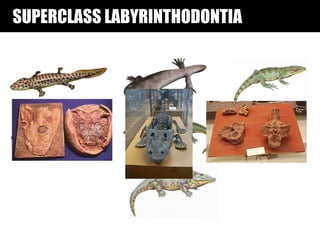
→ oldest amphibians; earliest tetrapods
→ considered to include the first vertebrates known to
 live on solid ground, and to have been ancestral to at
 least some of the groups of modern amphibians and a
 bridge to the reptiles.
→ constituted some of the dominant animals of Late
 Paleozoic and Early Mesozoic times (350-210 mya).
SUBCLASS LABYRINTHODONTIA
→ Greek for "maze-toothed,"
→ up to four meters long.
→ They were short-legged and large headed
→ skulls were deep and massive
→ jaws lined with small, sharp, conical teeth. There
 was a second row of teeth on the roof of the mouth.
→ vertebrae made of four pieces: an intercentrum, two
 pleurocentra, and a neural arch/spine.
SUBCLASS LABYRINTHODONTIA

→ special sense organs in the skin, that formed a
 system for perception of water fluctuations
→ some of them possessed well developed gills and
 many seemingly had primitive lungs.
→ labyrinthodonts were probably similar to fishes. They
 laid eggs in the water.
SUBCLASS LABYRINTHODONTIA


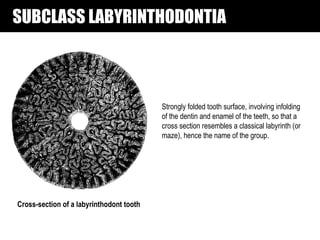
                                          Strongly folded tooth surface, involving infolding
                                          of the dentin and enamel of the teeth, so that a
                                          cross section resembles a classical labyrinth (or
                                          maze), hence the name of the group.


Cross-section of a labyrinthodont tooth
LIMBS
LIMBS
SIMILARITIES TO FISHES
→ anamniotic eggs
→ tail fins
→ lateral line system

SIMILARITIES TO REPTILES
→ vertebral column was strengthened, notochord
 replaced by bony rings
→ limbs developed (more adapted for terrestrial
 habitat)
→ development of lung structures
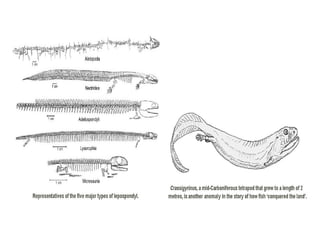
Lepospondyls
What are Lepospondyls?
 Small salamander-like amphibians from the
  Carboniferous.


•   Cardiocephalus             Salamander (Eastern Mud)
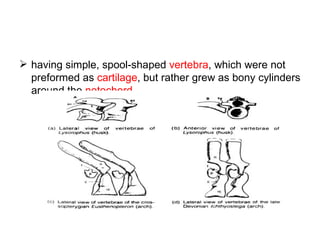
 having simple, spool-shaped vertebra, which were not
  preformed as cartilage, but rather grew as bony cylinders
  around the notochord
   Six different groups are known, the
   Acherontiscidae,
   Adelospondyli,
   Aïstopoda,
   Lysorophia,
   Microsauria and
   Nectridea,

 between them they include newt-like, eel- or snake-like, and
  lizard-like forms,

 Various species were aquatic, semi-aquatic, or terrestrial
• BRIEF OVERVIEW OF THE
  DIFFERENT ORDERS
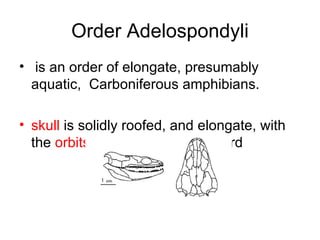
Order Adelospondyli
• is an order of elongate, presumably
  aquatic, Carboniferous amphibians.

• skull is solidly roofed, and elongate, with
  the orbits located very far forward
• limbs are well developed


• Adelospondylus.
Order Aïstopoda
• an order of highly specialized snake-
  like amphibians.

• no trace of limbs or even limb girdles in
  any known fossil

• the tail was short and primitive
• bones at the back of the skull were
  reduced or absent.
Order Nectridea
• resembled modern newts or aquatic
  salamanders.

• long flattened tails to aid in swimming,

• and well-developed hind limbs, with a full
  set of five toes each.
Diplocaulus
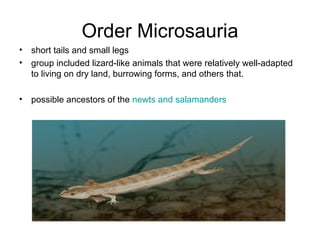
Order Microsauria
•   short tails and small legs
•   group included lizard-like animals that were relatively well-adapted
    to living on dry land, burrowing forms, and others that.

•   possible ancestors of the newts and salamanders
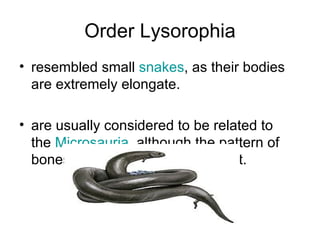
Order Lysorophia
• resembled small snakes, as their bodies
  are extremely elongate.

• are usually considered to be related to
  the Microsauria, although the pattern of
  bones of the skull is very different.
• Some features prompt the concept that at
  least some specimens classified as
  lepospondyls may have arisen directly
  from crossoptergian ancestor.

• Some Urodeles may be descendants of
  those specific lepospondyls.

Group 5 amphibia

  • 1.
    CLASSIFICATION Kingdom: Animalia Phylum: Chordata AMPHIBIANS Subphylum: Vertebrata Class: Amphibia (anamniote tetrapods) Subclass: Labyrinthodontia (earliest tetrapods) first terrestrial vertebrates Subclass: Lepospondyli Subclass: Lissamphibia
  • 3.
    CLASS AMPHIBIA - Theearliest amphibians evolved in the Devonian Period from sarcopterygian fish with lungs and bony-limbed fins, features that were helpful in adapting to dry land. - They diversified and became dominant during the Carboniferous and Permian periods, but were later displaced by reptiles and other vertebrates. - Over time, amphibians shrank in size and decreased in diversity, leaving only the modern subclass Lissamphibia.
  • 4.
    SUPERCLASS LABYRINTHODONTIA → Ichthyostegalia—primitiveancestral forms Late Devonian only. → Temnospondyli—common, small to large, flat-headed forms with either strong or secondarily weak vertebrae and limbs; mainly Carboniferous to Triassic. May or may not be ancestral to all modern amphibians →Anthracosauria—deep skulls, strong vertebrae but weak limbs, evolving towards and ancestral to reptiles; Carboniferous and Permian (Now considered to be reptile-like tetrapods separate from true amphibians)
  • 5.
  • 6.
    SUPERCLASS LABYRINTHODONTIA → oldestamphibians; earliest tetrapods → considered to include the first vertebrates known to live on solid ground, and to have been ancestral to at least some of the groups of modern amphibians and a bridge to the reptiles. → constituted some of the dominant animals of Late Paleozoic and Early Mesozoic times (350-210 mya).
  • 7.
    SUBCLASS LABYRINTHODONTIA → Greekfor "maze-toothed," → up to four meters long. → They were short-legged and large headed → skulls were deep and massive → jaws lined with small, sharp, conical teeth. There was a second row of teeth on the roof of the mouth. → vertebrae made of four pieces: an intercentrum, two pleurocentra, and a neural arch/spine.
  • 8.
    SUBCLASS LABYRINTHODONTIA → specialsense organs in the skin, that formed a system for perception of water fluctuations → some of them possessed well developed gills and many seemingly had primitive lungs. → labyrinthodonts were probably similar to fishes. They laid eggs in the water.
  • 9.
    SUBCLASS LABYRINTHODONTIA Strongly folded tooth surface, involving infolding of the dentin and enamel of the teeth, so that a cross section resembles a classical labyrinth (or maze), hence the name of the group. Cross-section of a labyrinthodont tooth
  • 10.
  • 11.
  • 12.
    SIMILARITIES TO FISHES →anamniotic eggs → tail fins → lateral line system SIMILARITIES TO REPTILES → vertebral column was strengthened, notochord replaced by bony rings → limbs developed (more adapted for terrestrial habitat) → development of lung structures
  • 13.
  • 14.
    What are Lepospondyls? Small salamander-like amphibians from the Carboniferous. • Cardiocephalus Salamander (Eastern Mud)
  • 15.
     having simple,spool-shaped vertebra, which were not preformed as cartilage, but rather grew as bony cylinders around the notochord
  • 17.
    Six different groups are known, the  Acherontiscidae,  Adelospondyli,  Aïstopoda,  Lysorophia,  Microsauria and  Nectridea,  between them they include newt-like, eel- or snake-like, and lizard-like forms,  Various species were aquatic, semi-aquatic, or terrestrial
  • 18.
    • BRIEF OVERVIEWOF THE DIFFERENT ORDERS
  • 19.
    Order Adelospondyli • isan order of elongate, presumably aquatic, Carboniferous amphibians. • skull is solidly roofed, and elongate, with the orbits located very far forward
  • 20.
    • limbs arewell developed • Adelospondylus.
  • 21.
    Order Aïstopoda • anorder of highly specialized snake- like amphibians. • no trace of limbs or even limb girdles in any known fossil • the tail was short and primitive
  • 22.
    • bones atthe back of the skull were reduced or absent.
  • 23.
    Order Nectridea • resembledmodern newts or aquatic salamanders. • long flattened tails to aid in swimming, • and well-developed hind limbs, with a full set of five toes each.
  • 24.
  • 25.
    Order Microsauria • short tails and small legs • group included lizard-like animals that were relatively well-adapted to living on dry land, burrowing forms, and others that. • possible ancestors of the newts and salamanders
  • 26.
    Order Lysorophia • resembledsmall snakes, as their bodies are extremely elongate. • are usually considered to be related to the Microsauria, although the pattern of bones of the skull is very different.
  • 28.
    • Some featuresprompt the concept that at least some specimens classified as lepospondyls may have arisen directly from crossoptergian ancestor. • Some Urodeles may be descendants of those specific lepospondyls.