

Diapsids
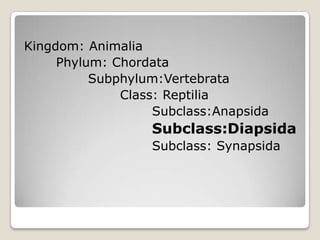
Kingdom: Animalia
     Phylum: Chordata
          Subphylum:Vertebrata
              Class: Reptilia
                   Subclass:Anapsida
                  Subclass:Diapsida
                  Subclass: Synapsida
   It’s a subclass of class reptilia

   It includes all living reptiles

   Turtles are excepted

   It also includes reptiles that ruled the
    land, air and sea during the Mesozoic era


What are diapsids?
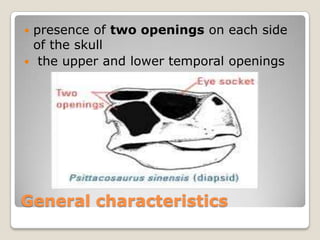
presence of two openings on each side
 of the skull
 the upper and lower temporal openings


General characteristics
   allows for the attachment of
    larger, stronger jaw muscles, and enables
    the jaw to open more widely

   long slender feet with overlap in the bases
    of the wrist and toe bones


General Characteristics
   relatively long lower arm bone
    (the radius) compared to the upper arm
    bone (humerus).
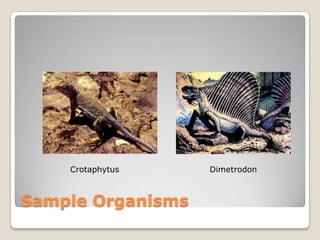
Crotaphytus    Dimetrodon


Sample Organisms
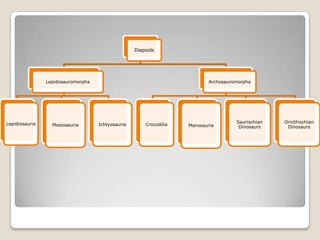
Diapsids


                Lepidosauromorpha                                           Archosauromorpha


Lepidiosauria                                                                         Saurischian   Ornithischian
                  Plesiosauria      Ichtyosauria       Crocodilia   Pterosauria        Dinosaurs     Dinosaurs
Lepidosuria
   Lepidosauria has 2 extant groups:

    ◦ Rhynchocephalia

    ◦ Squamata
 Primitive lizard-like reptiles
 They have quite different
  scales, teeth, and internal morphology
  than modern lizards.
 Retained the Diaspid skulls from their
  ancestors
 Acrodont dentition (teeth fused to
  jawbones)
 The only surviving Rhynchocephalian is
  Sphenodon


Rhynchocephalia
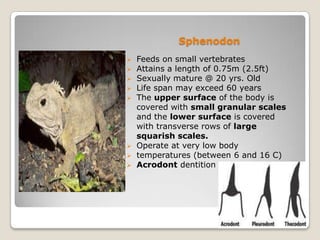
Sphenodon
   Feeds on small vertebrates
   Attains a length of 0.75m (2.5ft)
   Sexually mature @ 20 yrs. Old
   Life span may exceed 60 years
   The upper surface of the body is
    covered with small granular scales
    and the lower surface is covered
    with transverse rows of large
    squarish scales.
   Operate at very low body
   temperatures (between 6 and 16 C)
   Acrodont dentition
   Composed of lizards , snakes and amphisbaenians

   2 Characteristics that unite squamates:

   Periodic shedding of skin
    ◦ snakes shed their skin in one piece
    ◦ Lizards and amphisbaenians shed their skin in patches

   uniquely jointed skulls and jaws
    ◦ both strong and flexible
    ◦ extraordinary jaw mobility of squamates enables them
      to open their mouths very wide
    ◦ consume large prey


Squamata
 Well developed appendicular muscles
 Suitably constructed skeleton
 Run agilely on their hind limbs
 Some are broad jumpers


   Suction discs on toes
    ◦ Adhere to smooth vertical surfaces
    ◦ Geckoes


Other Characteristics
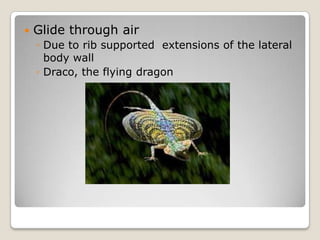
   Glide through air
    ◦ Due to rib supported extensions of the lateral
      body wall
    ◦ Draco, the flying dragon
   Few lizards are either limbless or have only
    vestiges of limbs

   Some lizards are blind

   Spectacles-transparent eyelids

   Nicitating membrane – 3rd eyelid

    ◦ Protection and moisture for the eye w/o blocking
      vision
   Snakes evolved from lizards
    ◦ Lost limbs
    ◦ Acquired other modes of locomotion
      Lateral progression- lashing of body back and
       forth causing lateral waves that force longitudinal
       motion. To put it another way: They go forward
       by moving sideways.
    ◦ Large ventral scales or scutes
    ◦ Viviparous
      Giving birth to living offspring that develop within
       the mother's body.
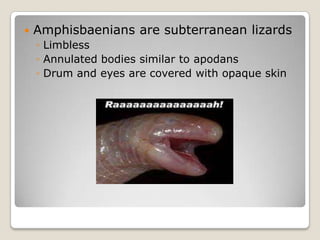
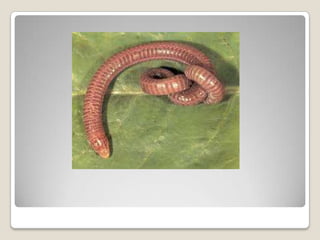
   Amphisbaenians are subterranean lizards
    ◦ Limbless
    ◦ Annulated bodies similar to apodans
    ◦ Drum and eyes are covered with opaque skin
   much greater degree of bone in the skull
    Internally, their right lung is reduced in
    size to fit their narrow bodies
    distinctive single median tooth in the
    upper jaw.
    carnivorous
   They move using an accordion-like
    motion
Diapsids

Diapsids

  • 1.
  • 2.
    Kingdom: Animalia Phylum: Chordata Subphylum:Vertebrata Class: Reptilia Subclass:Anapsida Subclass:Diapsida Subclass: Synapsida
  • 3.
    It’s a subclass of class reptilia  It includes all living reptiles   Turtles are excepted  It also includes reptiles that ruled the land, air and sea during the Mesozoic era What are diapsids?
  • 4.
    presence of twoopenings on each side of the skull  the upper and lower temporal openings General characteristics
  • 5.
    allows for the attachment of larger, stronger jaw muscles, and enables the jaw to open more widely  long slender feet with overlap in the bases of the wrist and toe bones General Characteristics
  • 6.
    relatively long lower arm bone (the radius) compared to the upper arm bone (humerus).
  • 7.
    Crotaphytus Dimetrodon Sample Organisms
  • 8.
    Diapsids Lepidosauromorpha Archosauromorpha Lepidiosauria Saurischian Ornithischian Plesiosauria Ichtyosauria Crocodilia Pterosauria Dinosaurs Dinosaurs
  • 9.
  • 10.
    Lepidosauria has 2 extant groups: ◦ Rhynchocephalia ◦ Squamata
  • 11.
     Primitive lizard-likereptiles  They have quite different scales, teeth, and internal morphology than modern lizards.  Retained the Diaspid skulls from their ancestors  Acrodont dentition (teeth fused to jawbones)  The only surviving Rhynchocephalian is Sphenodon Rhynchocephalia
  • 12.
    Sphenodon  Feeds on small vertebrates  Attains a length of 0.75m (2.5ft)  Sexually mature @ 20 yrs. Old  Life span may exceed 60 years  The upper surface of the body is covered with small granular scales and the lower surface is covered with transverse rows of large squarish scales.  Operate at very low body  temperatures (between 6 and 16 C)  Acrodont dentition
  • 13.
    Composed of lizards , snakes and amphisbaenians  2 Characteristics that unite squamates:  Periodic shedding of skin ◦ snakes shed their skin in one piece ◦ Lizards and amphisbaenians shed their skin in patches  uniquely jointed skulls and jaws ◦ both strong and flexible ◦ extraordinary jaw mobility of squamates enables them to open their mouths very wide ◦ consume large prey Squamata
  • 14.
     Well developedappendicular muscles  Suitably constructed skeleton  Run agilely on their hind limbs  Some are broad jumpers  Suction discs on toes ◦ Adhere to smooth vertical surfaces ◦ Geckoes Other Characteristics
  • 15.
    Glide through air ◦ Due to rib supported extensions of the lateral body wall ◦ Draco, the flying dragon
  • 16.
    Few lizards are either limbless or have only vestiges of limbs  Some lizards are blind  Spectacles-transparent eyelids  Nicitating membrane – 3rd eyelid ◦ Protection and moisture for the eye w/o blocking vision
  • 17.
    Snakes evolved from lizards ◦ Lost limbs ◦ Acquired other modes of locomotion  Lateral progression- lashing of body back and forth causing lateral waves that force longitudinal motion. To put it another way: They go forward by moving sideways. ◦ Large ventral scales or scutes ◦ Viviparous  Giving birth to living offspring that develop within the mother's body.
  • 19.
    Amphisbaenians are subterranean lizards ◦ Limbless ◦ Annulated bodies similar to apodans ◦ Drum and eyes are covered with opaque skin
  • 20.
    much greater degree of bone in the skull  Internally, their right lung is reduced in size to fit their narrow bodies  distinctive single median tooth in the upper jaw.  carnivorous  They move using an accordion-like motion