Screening of Anti- ulcer agents 
Divya Krishnan
Contents 
• Introduction 
• Requirements of an ideal screening model 
• Ideal animal for screening 
• Animal models 
• Summary
Introduction 
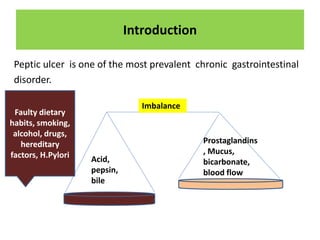
Peptic ulcer is one of the most prevalent chronic gastrointestinal 
disorder. 
Acid, 
pepsin, 
bile 
Prostaglandins 
, Mucus, 
bicarbonate, 
blood flow 
Imbalance 
Faulty dietary 
habits, smoking, 
alcohol, drugs, 
hereditary 
factors, H.Pylori
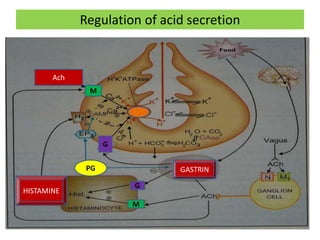
Regulation of acid secretion 
GASTRIN 
Ach 
HISTAMINE 
PG 
M 
M 
G 
G
Approaches to treatment 
1. Reduction of gastric acid secretion 
2. Neutralization of gastric acid 
3. Ulcer protectives 
4. Anti H. Pylori drugs
Screening of anti ulcer agents
Requirements of an ideal model 
• Should be simple, reproducible & allow for easy quantification 
of results 
• Should induce characteristic ulceration in specific locations. 
• Should involve different mechanisms by which ulceration is 
produced. 
• Ulcers produced should not spontaneously heal during 
observation period
Ideal animal for screening anti ulcer agents…..? 
RATS 
Because………… 
• Continuous secretion of acid 
• Glandular portion of rat stomach analogous to body of stomach 
in man both anatomically and functionally. 
• Being omnivorous resembles man nutritionally 
*** Guinea pigs are used when histamine is used to induce ulcers.
Animal models for screening 
• Pylorus ligation induced gastric ulcers in rats (Shay rat) 
• Drug (NSAID ) induced gastric ulcers in rats 
• Ethanol induced gastric ulcers in rats 
• Acetic acid induced gastric ulcers in rats 
• Stress induced ulcers in rats 
• Histamine induced duodenal ulcers in guinea pigs.
Pylorus ligation induced ulcers in rats 
Principle 
• Pyloric ligation in rats leads to accumulation of gastric acid in 
the stomach leading to acute gastric ulceration. 
First demonstrated by Shay and co-workers in 1945.
Requirements 
• Albino Wistar Rats (150-200 g) 
• Drugs : Ether (Anesthetic) 
Saline (control) 
Omeprazole (standard) 
Test drug (3 different concentrations x, 2x, 4x) 
• Reagents : NaOH (0.01N) 
Topfer’s reagent (dimethyl amino azo benzene) 
Phenolphthalein 
• Dissecting microscope (10x magnification), pH meter, burette, 
surgical instruments.
Procedure 
• Rats fasted for 24 hrs prior to pyloric ligation. 
• Randomly divided into 5 groups of 3 animals each. 
Group I : Control vehicle 
Group II : Standard drug (Omeprazole) 
Group III : ‘x’ concentration of test drug 
Group IV : ‘2x’ concentration of test drug 
Group V : ‘4x’ concentration of test drug 
• Drugs administered once for 2 days and 30 mins prior to ligation
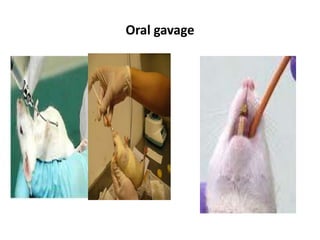
Oral gavage
•Rats anesthetized with ether. 
•Pyloric ligation procedure done. 
•Rats placed in separate cages and allowed to recover. 
•19 hrs after pyloric ligation, animals sacrificed by decapitation.
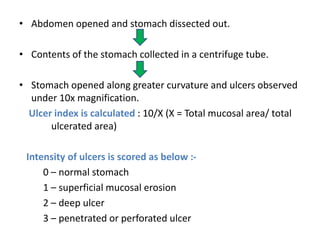
• Abdomen opened and stomach dissected out. 
• Contents of the stomach collected in a centrifuge tube. 
• Stomach opened along greater curvature and ulcers observed 
under 10x magnification. 
Ulcer index is calculated : 10/X (X = Total mucosal area/ total 
ulcerated area) 
Intensity of ulcers is scored as below :- 
0 – normal stomach 
1 – superficial mucosal erosion 
2 – deep ulcer 
3 – penetrated or perforated ulcer
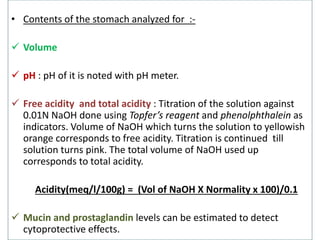
• Contents of the stomach analyzed for :- 
 Volume 
 pH : pH of it is noted with pH meter. 
 Free acidity and total acidity : Titration of the solution against 
0.01N NaOH done using Topfer’s reagent and phenolphthalein as 
indicators. Volume of NaOH which turns the solution to yellowish 
orange corresponds to free acidity. Titration is continued till 
solution turns pink. The total volume of NaOH used up 
corresponds to total acidity. 
Acidity(meq/l/100g) = (Vol of NaOH X Normality x 100)/0.1 
 Mucin and prostaglandin levels can be estimated to detect 
cytoprotective effects.
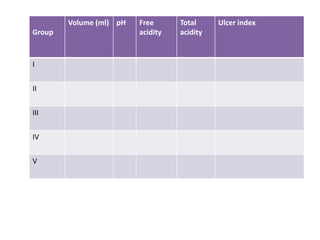
Group 
Volume (ml) pH Free 
acidity 
Total 
acidity 
Ulcer index 
I 
II 
III 
IV 
V
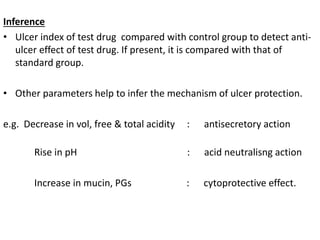
Inference 
• Ulcer index of test drug compared with control group to detect anti-ulcer 
effect of test drug. If present, it is compared with that of 
standard group. 
• Other parameters help to infer the mechanism of ulcer protection. 
e.g. Decrease in vol, free & total acidity : antisecretory action 
Rise in pH : acid neutralisng action 
Increase in mucin, PGs : cytoprotective effect.
Drug induced ulcers in rats 
Gastric ulceration is produced in rats by certain drugs. The ability of 
the test drug to protect against the ulceration is observed. 
NSAIDs like Aspirin, Indomethacin, Ibuprofen 
Principle : inhibition of endogenous prostaglandin production and 
consequent loss of gastric mucosal defence. 
Important model for identifying drugs that could be effective in 
NSAID induced gastropathy.
Procedure 
• Rats fasted for 24 hrs in separate cages and randomly divided 
into 5 groups 
• The control, standard, test drug are administered once daily for 
2 days and 30 mins prior to administration of ulcerogenic agent. 
• Ulcerogens administered by oral gavage. 
• Rats sacrificed 4 - 6hrs later 
• Ulcer index, analysis of stomach contents done.
Ethanol induced gastric ulcer in rats 
Principle : Ethanol damages superficial epithelial layers & inhibits 
prostaglandin release. 
An agent that protects against ethanol induced ulcers might be 
cytoprotective & exert its action by stimulating release of 
endogenous prostaglandins & mucin. 
However, anti secretory agents also are effective in this model.
Acetic acid induced gastric ulcers in rats 
Model mimics the chronic pattern seen with peptic ulcer. 
Procedure 
• Overnight fasted rats operated under ether anesthesia 
• Anterior & posterior walls of stomach clamped with forceps 
• 0.2 ml of 40% acetic acid injected into clamped portion. 
• After 45 secs , acid removed. 
• Deep round ulcers develop on the anterior & posterior walls. 
• Respective treatments( control, standard, test) started from 3rd 
to 10 th day. Rats sacrificed on 10th day. 
• Ulcers respond well to most anti ulcer drugs like PPI, H2 
blockers, cytoprotectives.
Stress induced ulcer in rats 
Model of restraint ulcer 
• Drugs (control, standard, test) administered once daily for 2 
days & 30 mins prior to applying restraint. 
• Fasted & lightly anesthetized rats placed on galvanized steel 
window screen. Limbs are held together in pairs & tightened 
with adhesives. 
• After 24 hrs, animal removed, sacrificed and degree of 
ulceration noted. 
Modified method 
-Water immersion induced restraint ulcer.
Histamine induced duodenal ulcers in guinea pigs 
• Guinea pigs fasted for 48 hrs. 
• Drugs (control, standard, test) once daily for 2 days & 30 mins 
before administration of histamine. 
• Ulceration induced by injecting 1ml of histamine solution 
intraperitoneally. 
• Promethazine 5mg injected intraperitoneally 15 mins before and 
after histamine . 
• Animals sacrificed after 4 hrs 
• Degree of ulceration & gastric contents assessed.
Recent advances 
• Gastrin transgenic mice 
• H.pylori infected mice models : Mice infected with type I & II 
strains of H.pylori showed delayed healing of acetic acid induced 
chronic ulcers.
Summary 
• Ideal model requirements 
• Ideal animal for screening 
• Different animal models : - 
- Shay rat model – one of the first models 
- Drug induced models – study of drugs effective in NSAID 
induced gastropathy. 
- Acetic acid induced model – mimics chronic disease pattern 
- Stress induced model mimics stress induced ulcer in man. 
- Histamine induced duodenal ulcers in guinea pigs 
• Recent advances – Gastrin transgenic mice & H.Pylori infected mice 
models.
THANK YOU