ANTIHYPERTENSIVE
DRUGS
Dr. Ankita Bist
Assistant Professor
Department of Pharmacology
 48-year-old male presented to OPD and was diagnosed
with essential HTN. He was prescribed captopril for it. He
reported after 2 weeks with persistent brassy cough, BP
was 124/84, with no other problems. What could be the
cause and how will you manage.
Introduction
Types of
Hypertension
Essential Secondary
A disorder of unknown origin affecting the
Blood Pressure regulating mechanisms
Secondary to other disease processes
Normal Blood Pressure Regulation
• Blood Pressure = Cardiac output (CO) X TPR. Physiologically CO
and PVR is maintained by arterioles, postcapillary venules &
Heart .
• Baroreflex : Baroreceptors regulate BP. When there is stretch in the vessel
wall brought about by rise in pressure, baroreceptor stimulation occurs and
inhibits sympathetic discharge. When there is fall in BP, there is reduction
in stretch leading to increased baroreceptor activity and increase in TPR and
CO thereby restoring normal blood pressure.
• Renin-angiotensin- aldosterone system (RAAS)(role of kidney)
• Local agents like Nitric oxide
All antihypertensives act via interfering with one or more of the
normal mechanisms
Classification
1. Diuretics:
 Thiazides: Hydrochlorothiazide, Chlorthalidone,
Indapamide
 High ceiling: Furosemide
 K+ sparing: Spironolactone, Triamterene, Amiloride
2. Angiotensin-converting Enzyme (ACE) inhibitors:
 Captopril, Lisinopril., Enalapril, Ramipril , Fosinopril
3. Angiotensin (AT1 receptor) blockers:
 Losartan, Candesartan, Valsartan, Telmisartan
4. Direct renin inhibitor
ļ‚§ Aliskiren
5. Calcium Channel Blockers (CCB):
 Verapamil, Diltiazem, Nifedipine, Amlodipine,
6. ß-adrenergic blockers:
 Non-selective: Propranolol
 Cardioselective: Metoprolol, atenolol
7. ß and α – adrenergic blockers:
 Labetolol, carvedilol
8. α – adrenergic blockers:
 Prazosin, terazosin, doxazosin, phenoxybenzamine,
phentolamine
9. Centrally acting:
 Clonidine, methyldopa
10.Vasodilators:
 Arteriolar : Hydralazine, Minoxidil, Diazoxide
 Arteriolar + venous: Sodium Nitroprusside
RAAS
 Renin is produced by JG cells of kidney in response to
 Fall in BP or blood volume
 Decrease Na+ in macula densa
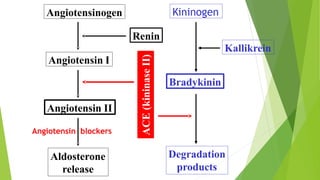
 Renin acts on a plasma protein Angiotensinogen to convert it to Angiotensin-I
 Angiotensin-I is rapidly converted to Angiotensin-II by ACE
 Angiotensin-II is degraded by peptidases to produce Angiotensin-III
 Extrinsic and intrinsic local RAAS
 Angiotensin II causes vasoconstriction (increased TPR)
leading to rise in diastolic BP.
 Both Angiotensin-II and Angiotensin-III stimulates
Aldosterone secretion from Adrenal Cortex . Aldosterone
promotes Na+ & water reabsorption by the kidneys leading
to increased blood volume & increased COP & systolic BP.
Angiotensinogen
Angiotensin I
Angiotensin II
Aldosterone
release
Kininogen
Bradykinin
Degradation
products
Renin
Kallikrein
ACE
(kininase
II)
Angiotensin blockers
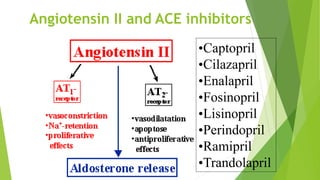
Angiotensin II and ACE inhibitors
•Captopril
•Cilazapril
•Enalapril
•Fosinopril
•Lisinopril
•Perindopril
•Ramipril
•Trandolapril
ACE inhibitors
• MOA : Inhibit synthesis of Angiotensin II by inhibiting ACE –> decrease
in (tpr) and blood volume, fall in diastolic and systolic BP.
• ACEinhibitors reduce both cardiac preload and afterload,
thereby decreasing cardiac work.
• Recommended as first-line treatment of hypertension
ACE inhibitors
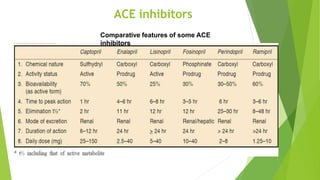
Comparative features of some ACE
inhibitors
Desirable properties of ACEI as antihypertensives
• No postural hypotension
• Not much electrolyte imbalance
• Renal perfusion well maintained
• Reverses the ventricular hypertrophy
• No hyperuricemia
• No deleterious effect on plasma lipid profile
• No rebound hypertension
• Only minimal worsening of quality of life like general wellbeing, sleep
and work performance.
• Cough –inhibition of bradykinin breakdown in lungs
• Hyperkalemia (in renal failure patients, those with K+ sparing diuretics, NSAID and beta
blockers (routine check of K+ level))
• First dose Hypotension – sharp fall may occur
• Angioedema: swelling of lips, mouth, nose etc.
• Rashes, urticaria
• Dysgeusia: loss or alteration of taste
• Foetopathic: hypoplasia of organs, growth retardation etc
• Neutropenia
• Proteinuria
• Acute renal failure ( occurs in patients with bilateral renal artery stenosis)
Drawbacks/ adverse effects
Current status
• 1st line antihypertensive Drug
• Used in relatively young patients
• Most appropriate antihypertensives in patients with: Diabetes, Chronic kidney
disease, CHF, Left ventricular hypertrophy, Angina, post MI, stroke,
Dyslipidemia, Gout
 Avoid in : Pregnancy, bilateral renal artery stenosis, hypersensitivity ,
hyperkalaemia , Preexisting dry cough
Angiotensin Receptor Blockers (ARBs)
Losartan, Candesartan, Valsartan,Telmisartan
Mechanism of antihypertensive action
• Angiotensin Receptors (AT1 & AT2) are present on target cells. Most of
the physiological actions of angiotensin are mediated via AT1 receptor.
• ARBs are competitive antagonists and inverse agonist of AT1 receptor.
Blocks all the actions of A-II mediated by AT1 like vasoconstriction,
aldosterone release and renal actions of salt & water reabsorption.
• USES: HTN, MI, Diabetic nephropathy
Current status
 Similar to ACEI BUT theoretical superiority over ACEIs is claimed due to
following reasons:
• Cough is rare – no interference with bradykinin degradation.
• Complete inhibition of AT1 & action of angiotensin II is fully blocked
• AT1 blockade results in indirect activation of AT2 – vasodilatation
(additional benefit)
• Rare 1st dose hypotension
• Low dysgeusia & angioedema
• Fetopathic like ACEI & hence should not be used in pregnancy.
Direct renin inhibitor-Aliskiren
• Inhibits production of Angiotensin I & II.
• Equally effective as ACEI & ARBs.
• Since experience with it is limited, so it is used only as a second line
antihypertensive when more established ACEI & ARBs cannot be used.
• Can cause abdominal pain, diarrhea, especially at higher doses, and
rarely also cause cough and angioedema, but probably less often than
ACE inhibitors.
• Contraindicated during pregnancy.
THANK YOU
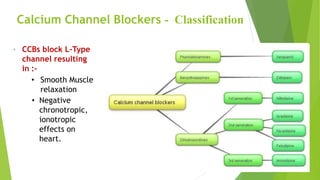
Calcium Channel Blockers - Classification
• CCBs block L-Type
channel resulting
in :-
• Smooth Muscle
relaxation
• Negative
chronotropic,
ionotropic
effects on
heart.
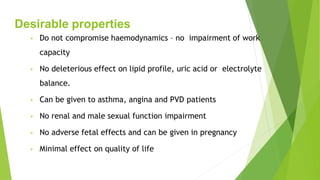
Desirable properties
• Do not compromise haemodynamics – no impairment of work
capacity
• No deleterious effect on lipid profile, uric acid or electrolyte
balance.
• Can be given to asthma, angina and PVD patients
• No renal and male sexual function impairment
• No adverse fetal effects and can be given in pregnancy
• Minimal effect on quality of life
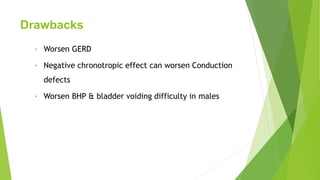
Drawbacks
• Worsen GERD
• Negative chronotropic effect can worsen Conduction
defects
• Worsen BHP & bladder voiding difficulty in males