ANTIGENS
an antigen (the generator) when
introduced into a host induces the
formation of specific antibodies and
sensitize T lymphocytes that are
reactive against that specific antigen
Definitions
TWO IMPORTANT CHARACTERISTICS 0F AN ANTIGEN
1) IMMUNOGENICITY: The ability of a substance to
stimulate a specific immune response
2) ANTIGENICITY : The ability of a substance to react
specifically with antibodies/ sensitized T cells
• HAPTEN: are small molecules that cannot induce an
immune response by themselves unless complexed
with a large carrier molecule like protein/
polysaccharide
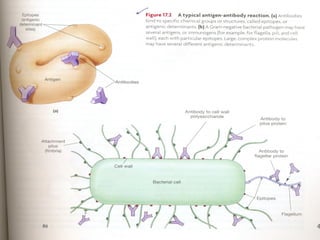
• EPITOPE or Antigenic Determinant: that portion
of an antigen that combines with the product of a
specific Immune response
• ANTIBODY (Ab): a specific protein produced in
response to an immunogen
Factors Influencing
Immunogenicity
• Foreignness
• Size- Macromolcule
• Chemical Composition
Complexity of structure
• Physical Form
Particulate / Soluble
Denatured / Native
Biodegradability
Ag processing by Ag Presenting Cells (APC)
CLASSIFICATION OF ANTIGEN
• FOREIGN (OUTSIDE THE HOST)
MICROBE COMPONENTS/ PRODUCTS,
DRUGS
ENVIRONMENTAL ANTIGENS
• AUTOANTIGENS
THYROGLOBULIN, NUCLEIC ACID,
CORNEA COMPONENTS
• ISOANTIGENS
HISTCOMPATIBILITY TISSUE ANTIGENS
BLOOD GROUP ANTIGENS
• HETROANTIGENS
HETROPHILE ANTIGENS
CROSS REACTING MICROBIAL ANTIGENS
eg. Streptococcal cell wall antigen cross react
with human cardiac and glomerular tissue
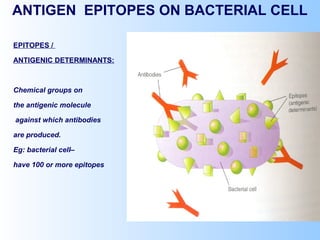
ANTIGEN EPITOPES ON BACTERIAL CELL
EPITOPES /
ANTIGENIC DETERMINANTS:
Chemical groups on
the antigenic molecule
against which antibodies
are produced.
Eg: bacterial cell–
have 100 or more epitopes
Chemical Nature of
Immunogens
• Proteins– pure or glycoproteins or lipoproteins
• Polysaccharides– pure or lipopolysac
• Nucleic Acids- poor immunogens or
become immunogen when single stranded
or complexed with proteins
• Lipids– generally non immunogens
Some glycolipids and phosopholipids
can be immunogenic for T cells and
illicit a cell mediated immune response
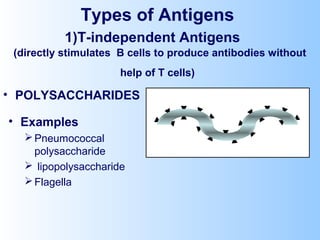
Types of Antigens
1)T-independent Antigens
(directly stimulates B cells to produce antibodies without
help of T cells)
• POLYSACCHARIDES
• Examples
Pneumococcal
polysaccharide
 lipopolysaccharide
Flagella
Types of Antigens
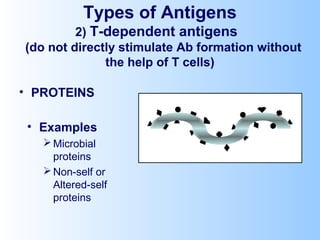
2) T-dependent antigens
(do not directly stimulate Ab formation without
the help of T cells)
• PROTEINS
• Examples
Microbial
proteins
Non-self or
Altered-self
proteins
ANTIGENS
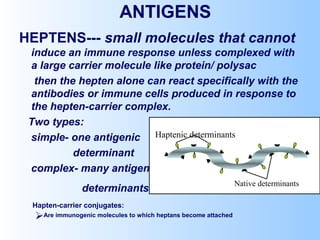
HEPTENS--- small molecules that cannot
induce an immune response unless complexed with
a large carrier molecule like protein/ polysac
then the hepten alone can react specifically with the
antibodies or immune cells produced in response to
the hepten-carrier complex.
Two types:
simple- one antigenic
determinant
complex- many antigenic
determinants
Native determinants
Haptenic determinants
Are immunogenic molecules to which heptans become attached
Hapten-carrier conjugates:
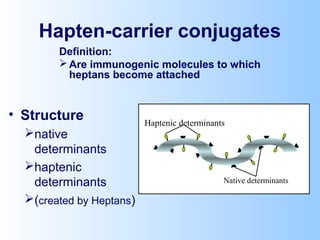
Hapten-carrier conjugates
Definition:
Are immunogenic molecules to which
heptans become attached
Native determinants
Haptenic determinants
• Structure
native
determinants
haptenic
determinants
(created by Heptans)
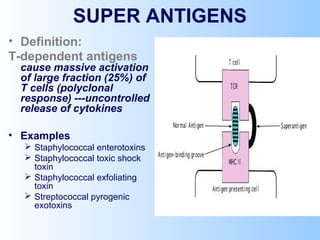
SUPER ANTIGENS
• Definition:
T-dependent antigens
cause massive activation
of large fraction (25%) of
T cells (polyclonal
response) ---uncontrolled
release of cytokines
• Examples
 Staphylococcal enterotoxins
 Staphylococcal toxic shock
toxin
 Staphylococcal exfoliating
toxin
 Streptococcal pyrogenic
exotoxins
IMMUNOGLOBULINS:
Structure and Function
Immunoglobulins:Structure and
Function
• DEFINITION: Glycoprotein molecules that are
produced by plasma cells in response to an
immunogen and which function as antibodies
• FUNCTIONS:
• Recognizing and binding to foreign substances
and facilitating their removal
• Binding to various cells– phagocytic, lymphocytes
mast cells, basophils, placental trophoblast
• Increase phagocytosis
• Neutralizing toxins and viruses
• Activating complement
Immunoglobulin Structure
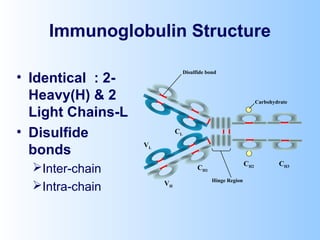
• Identical : 2-
Heavy(H) & 2
Light Chains-L
• Disulfide
bonds
Inter-chain
Intra-chain
CH1
VL
CL
VH
CH2 CH3
Hinge Region
Carbohydrate
Disulfide bond
Immunoglobulin Structure: on
basis of their A. acid sequence.
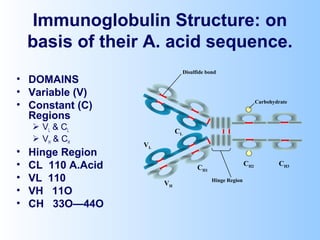
• DOMAINS
• Variable (V)
• Constant (C)
Regions
 VL & CL
 VH & CH
• Hinge Region
• CL 110 A.Acid
• VL 110
• VH 11O
• CH 33O—44O
CH1
VL
CL
VH
CH2 CH3
Hinge Region
Carbohydrate
Disulfide bond
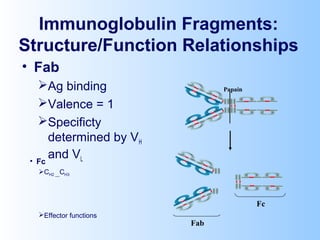
Immunoglobulin Fragments:
Structure/Function Relationships
• Fab
Ag binding
Valence = 1
Specificty
determined by VH
and VL
Papain
Fc
Fab
• Fc
CH2 __CH3
Effector functions
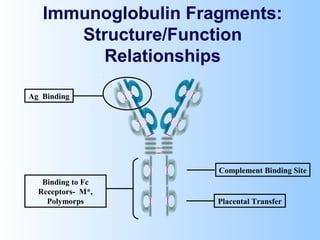
Immunoglobulin Fragments:
Structure/Function
Relationships
Ag Binding
Complement Binding Site
Placental Transfer
Binding to Fc
Receptors- M*,
Polymorps
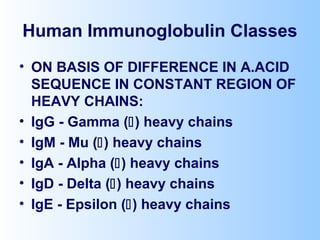
Human Immunoglobulin Classes
• ON BASIS OF DIFFERENCE IN A.ACID
SEQUENCE IN CONSTANT REGION OF
HEAVY CHAINS:
• IgG - Gamma () heavy chains
• IgM - Mu () heavy chains
• IgA - Alpha () heavy chains
• IgD - Delta () heavy chains
• IgE - Epsilon () heavy chains
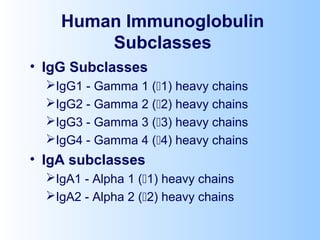
Human Immunoglobulin
Subclasses
• IgG Subclasses
IgG1 - Gamma 1 (1) heavy chains
IgG2 - Gamma 2 (2) heavy chains
IgG3 - Gamma 3 (3) heavy chains
IgG4 - Gamma 4 (4) heavy chains
• IgA subclasses
IgA1 - Alpha 1 (1) heavy chains
IgA2 - Alpha 2 (2) heavy chains
Human Immunoglobulin
Light Chain Types
• Kappa ()
• Lambda ()
• Subtypes Lambda light chain:
Lambda 1 (1)
Lambda 2 (2)
Lambda 3 (3)
Lambda 4 (4)
IgG
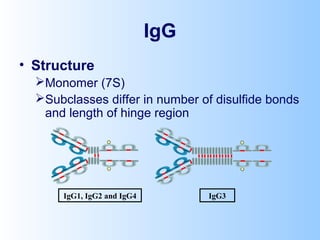
• Structure
Monomer (7S)
Subclasses differ in number of disulfide bonds
and length of hinge region
IgG1, IgG2 and IgG4 IgG3
IgG
• Properties
• Most versatile immunoglobulin
Major serum Ig- 75% of serum Ig
Major Ig in extravascular spaces
Placental transfer – Does not require Ag
binding ( IgG2)
Fixes complement ( IgG4)
Binds to Fc receptors ( IgG2, IgG4)
 Phagocytes - opsonization
 K cells - ADCC
IgM
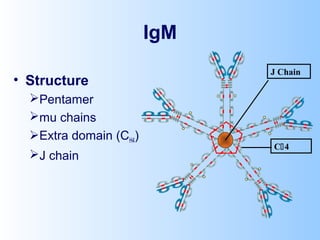
• Structure
Pentamer
mu chains
Extra domain (CH4)
J chain
C4
J Chain
IgM
Properties
3rd highest serum Ig
First Ig made by
fetus and B cells
Fixes complement
Agglutinating
antibody
Binds to Fc
receptors
IgA
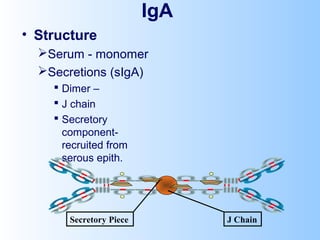
• Structure
Serum - monomer
Secretions (sIgA)
 Dimer –
 J chain
 Secretory
component-
recruited from
serous epith.
J ChainSecretory Piece
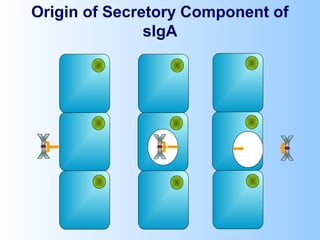
Origin of Secretory Component of
sIgA
IgA
Properties
2nd highest serum Ig
1ST
line of defense in mucous membrane
pathogen
Major secretory Ig (Mucosal or Local Immunity)
 Tears, saliva, gastric and pulmonary secretions
Does not fix complement (unless aggregated)
Binds to Fc receptors on some cells
Neutralizes viruses and toxins
IgD
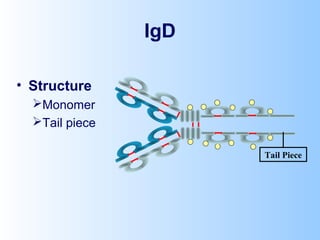
• Structure
Monomer
Tail piece
Tail Piece
IgD
Properties
4th highest serum Ig
B cell surface Ig
Does not bind complement
Increased levels in AIDS
IgE
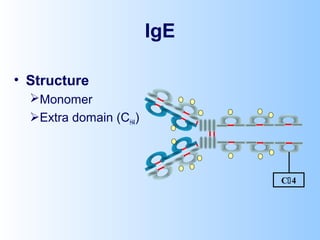
• Structure
Monomer
Extra domain (CH4)
C4
IgE
Properties
Least common serum Ig
 Binds to basophils and mast cells (does not require
Ag binding)
Allergic reactions
Parasitic infections (Helminths)
 Binds to Fc receptor on Eosinophils
 Activation of macrophages--- ADCC
Does not fix complement
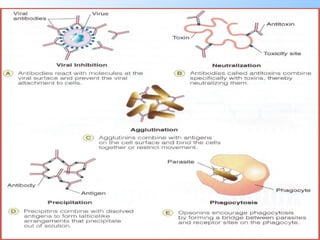
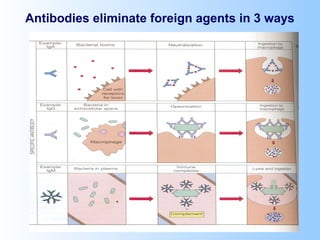
Antibodies eliminate foreign agents in 3 ways
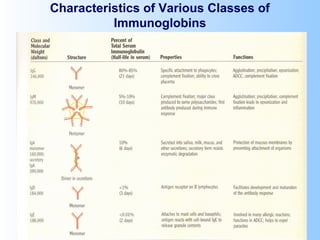
Characteristics of Various Classes of
Immunoglobins
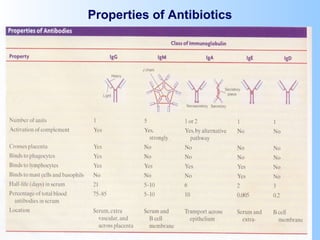
Properties of Antibiotics
MHC COMPLEX
MAJOR HISTOCOMPATIBLE -MHC
COMPLEX
• MHC complex defines uniqueness of the individual
• Part of the genome encoding for MHC antigens– clustered on a
small segment of chromosome 6– CONSTITUTE HLA
COMPLEX
• At least 20 different genes encode for MHC PROTEINS
• Variety of MHC proteins exist in humans
• Identical twins have same MHC molecules
• All family members have a mixture of similar and different MHC
molecules
• Functions:
• The principle function is to bind peptide fragments
of foreign proteins and present it to antigen specific
T cell.
• Immune recognition
• Interaction between B and T and other cells
• Rejection of allograft
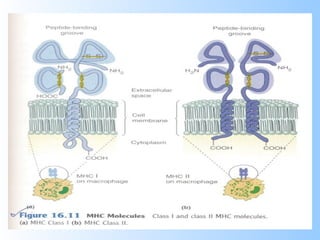
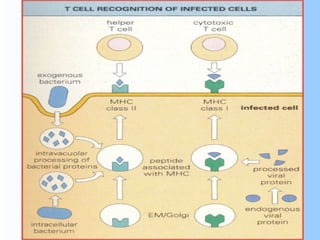
MHC COMPLEX
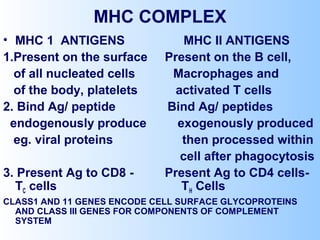
• MHC 1 ANTIGENS MHC II ANTIGENS
1.Present on the surface Present on the B cell,
of all nucleated cells Macrophages and
of the body, platelets activated T cells
2. Bind Ag/ peptide Bind Ag/ peptides
endogenously produce exogenously produced
eg. viral proteins then processed within
cell after phagocytosis
3. Present Ag to CD8 - Present Ag to CD4 cells-
TC cells TH Cells
CLASS1 AND 11 GENES ENCODE CELL SURFACE GLYCOPROTEINS
AND CLASS III GENES FOR COMPONENTS OF COMPLEMENT
SYSTEM
CYTOKINES
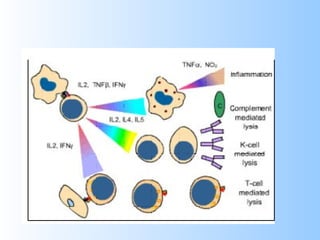
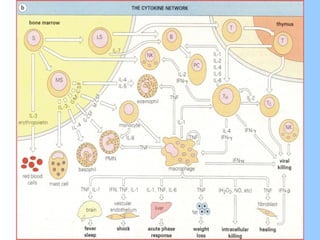
CYTOKINES
• Short acting soluble mediators released during
interaction between lymphocytes, monocytes,
macrophages, inflammatory cells and endothelial cells
• Concerned with induction and regulation of immune
response
• Hormone like peptides or glycopeptides with wide
spectrum of effects
• PROPERTIES
• Individual cytokines produced by different cell types eg.
IL-I,TNF -- PRODUCED BY VIRTUALLY ALL CELLS
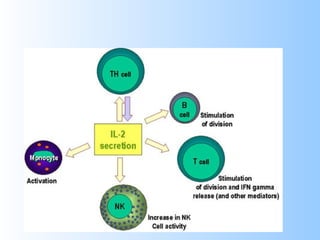
• Cytokines have PLEOTROPIC effect– act on many cell
types—IL2 ---T cells, B, NK CELLS
• Cytokines produce their effect by combining with high
affinity receptors on the target cell eg:IL2 activate T cells
by binding to IL2 receptor
• They can act on the same cell that produces it eg IL 2
produced by activated T cell promote T cell growth
Important Cytokines
Antigen done
Antigen done
Antigen done

Antigen done

  • 1.
    ANTIGENS an antigen (thegenerator) when introduced into a host induces the formation of specific antibodies and sensitize T lymphocytes that are reactive against that specific antigen
  • 2.
    Definitions TWO IMPORTANT CHARACTERISTICS0F AN ANTIGEN 1) IMMUNOGENICITY: The ability of a substance to stimulate a specific immune response 2) ANTIGENICITY : The ability of a substance to react specifically with antibodies/ sensitized T cells • HAPTEN: are small molecules that cannot induce an immune response by themselves unless complexed with a large carrier molecule like protein/ polysaccharide • EPITOPE or Antigenic Determinant: that portion of an antigen that combines with the product of a specific Immune response • ANTIBODY (Ab): a specific protein produced in response to an immunogen
  • 3.
    Factors Influencing Immunogenicity • Foreignness •Size- Macromolcule • Chemical Composition Complexity of structure • Physical Form Particulate / Soluble Denatured / Native Biodegradability Ag processing by Ag Presenting Cells (APC)
  • 4.
    CLASSIFICATION OF ANTIGEN •FOREIGN (OUTSIDE THE HOST) MICROBE COMPONENTS/ PRODUCTS, DRUGS ENVIRONMENTAL ANTIGENS • AUTOANTIGENS THYROGLOBULIN, NUCLEIC ACID, CORNEA COMPONENTS • ISOANTIGENS HISTCOMPATIBILITY TISSUE ANTIGENS BLOOD GROUP ANTIGENS • HETROANTIGENS HETROPHILE ANTIGENS CROSS REACTING MICROBIAL ANTIGENS eg. Streptococcal cell wall antigen cross react with human cardiac and glomerular tissue
  • 5.
    ANTIGEN EPITOPES ONBACTERIAL CELL EPITOPES / ANTIGENIC DETERMINANTS: Chemical groups on the antigenic molecule against which antibodies are produced. Eg: bacterial cell– have 100 or more epitopes
  • 7.
    Chemical Nature of Immunogens •Proteins– pure or glycoproteins or lipoproteins • Polysaccharides– pure or lipopolysac • Nucleic Acids- poor immunogens or become immunogen when single stranded or complexed with proteins • Lipids– generally non immunogens Some glycolipids and phosopholipids can be immunogenic for T cells and illicit a cell mediated immune response
  • 8.
    Types of Antigens 1)T-independentAntigens (directly stimulates B cells to produce antibodies without help of T cells) • POLYSACCHARIDES • Examples Pneumococcal polysaccharide  lipopolysaccharide Flagella
  • 9.
    Types of Antigens 2)T-dependent antigens (do not directly stimulate Ab formation without the help of T cells) • PROTEINS • Examples Microbial proteins Non-self or Altered-self proteins
  • 10.
    ANTIGENS HEPTENS--- small moleculesthat cannot induce an immune response unless complexed with a large carrier molecule like protein/ polysac then the hepten alone can react specifically with the antibodies or immune cells produced in response to the hepten-carrier complex. Two types: simple- one antigenic determinant complex- many antigenic determinants Native determinants Haptenic determinants Are immunogenic molecules to which heptans become attached Hapten-carrier conjugates:
  • 11.
    Hapten-carrier conjugates Definition: Are immunogenicmolecules to which heptans become attached Native determinants Haptenic determinants • Structure native determinants haptenic determinants (created by Heptans)
  • 12.
    SUPER ANTIGENS • Definition: T-dependentantigens cause massive activation of large fraction (25%) of T cells (polyclonal response) ---uncontrolled release of cytokines • Examples  Staphylococcal enterotoxins  Staphylococcal toxic shock toxin  Staphylococcal exfoliating toxin  Streptococcal pyrogenic exotoxins
  • 13.
  • 14.
    Immunoglobulins:Structure and Function • DEFINITION:Glycoprotein molecules that are produced by plasma cells in response to an immunogen and which function as antibodies • FUNCTIONS: • Recognizing and binding to foreign substances and facilitating their removal • Binding to various cells– phagocytic, lymphocytes mast cells, basophils, placental trophoblast • Increase phagocytosis • Neutralizing toxins and viruses • Activating complement
  • 15.
    Immunoglobulin Structure • Identical: 2- Heavy(H) & 2 Light Chains-L • Disulfide bonds Inter-chain Intra-chain CH1 VL CL VH CH2 CH3 Hinge Region Carbohydrate Disulfide bond
  • 16.
    Immunoglobulin Structure: on basisof their A. acid sequence. • DOMAINS • Variable (V) • Constant (C) Regions  VL & CL  VH & CH • Hinge Region • CL 110 A.Acid • VL 110 • VH 11O • CH 33O—44O CH1 VL CL VH CH2 CH3 Hinge Region Carbohydrate Disulfide bond
  • 17.
    Immunoglobulin Fragments: Structure/Function Relationships •Fab Ag binding Valence = 1 Specificty determined by VH and VL Papain Fc Fab • Fc CH2 __CH3 Effector functions
  • 18.
    Immunoglobulin Fragments: Structure/Function Relationships Ag Binding ComplementBinding Site Placental Transfer Binding to Fc Receptors- M*, Polymorps
  • 19.
    Human Immunoglobulin Classes •ON BASIS OF DIFFERENCE IN A.ACID SEQUENCE IN CONSTANT REGION OF HEAVY CHAINS: • IgG - Gamma () heavy chains • IgM - Mu () heavy chains • IgA - Alpha () heavy chains • IgD - Delta () heavy chains • IgE - Epsilon () heavy chains
  • 20.
    Human Immunoglobulin Subclasses • IgGSubclasses IgG1 - Gamma 1 (1) heavy chains IgG2 - Gamma 2 (2) heavy chains IgG3 - Gamma 3 (3) heavy chains IgG4 - Gamma 4 (4) heavy chains • IgA subclasses IgA1 - Alpha 1 (1) heavy chains IgA2 - Alpha 2 (2) heavy chains
  • 21.
    Human Immunoglobulin Light ChainTypes • Kappa () • Lambda () • Subtypes Lambda light chain: Lambda 1 (1) Lambda 2 (2) Lambda 3 (3) Lambda 4 (4)
  • 22.
    IgG • Structure Monomer (7S) Subclassesdiffer in number of disulfide bonds and length of hinge region IgG1, IgG2 and IgG4 IgG3
  • 23.
    IgG • Properties • Mostversatile immunoglobulin Major serum Ig- 75% of serum Ig Major Ig in extravascular spaces Placental transfer – Does not require Ag binding ( IgG2) Fixes complement ( IgG4) Binds to Fc receptors ( IgG2, IgG4)  Phagocytes - opsonization  K cells - ADCC
  • 24.
    IgM • Structure Pentamer mu chains Extradomain (CH4) J chain C4 J Chain
  • 25.
    IgM Properties 3rd highest serumIg First Ig made by fetus and B cells Fixes complement Agglutinating antibody Binds to Fc receptors
  • 26.
    IgA • Structure Serum -monomer Secretions (sIgA)  Dimer –  J chain  Secretory component- recruited from serous epith. J ChainSecretory Piece
  • 27.
    Origin of SecretoryComponent of sIgA
  • 28.
    IgA Properties 2nd highest serumIg 1ST line of defense in mucous membrane pathogen Major secretory Ig (Mucosal or Local Immunity)  Tears, saliva, gastric and pulmonary secretions Does not fix complement (unless aggregated) Binds to Fc receptors on some cells Neutralizes viruses and toxins
  • 29.
  • 30.
    IgD Properties 4th highest serumIg B cell surface Ig Does not bind complement Increased levels in AIDS
  • 31.
  • 32.
    IgE Properties Least common serumIg  Binds to basophils and mast cells (does not require Ag binding) Allergic reactions Parasitic infections (Helminths)  Binds to Fc receptor on Eosinophils  Activation of macrophages--- ADCC Does not fix complement
  • 34.
  • 35.
    Characteristics of VariousClasses of Immunoglobins
  • 36.
  • 37.
  • 38.
    MAJOR HISTOCOMPATIBLE -MHC COMPLEX •MHC complex defines uniqueness of the individual • Part of the genome encoding for MHC antigens– clustered on a small segment of chromosome 6– CONSTITUTE HLA COMPLEX • At least 20 different genes encode for MHC PROTEINS • Variety of MHC proteins exist in humans • Identical twins have same MHC molecules • All family members have a mixture of similar and different MHC molecules • Functions: • The principle function is to bind peptide fragments of foreign proteins and present it to antigen specific T cell. • Immune recognition • Interaction between B and T and other cells • Rejection of allograft
  • 39.
    MHC COMPLEX • MHC1 ANTIGENS MHC II ANTIGENS 1.Present on the surface Present on the B cell, of all nucleated cells Macrophages and of the body, platelets activated T cells 2. Bind Ag/ peptide Bind Ag/ peptides endogenously produce exogenously produced eg. viral proteins then processed within cell after phagocytosis 3. Present Ag to CD8 - Present Ag to CD4 cells- TC cells TH Cells CLASS1 AND 11 GENES ENCODE CELL SURFACE GLYCOPROTEINS AND CLASS III GENES FOR COMPONENTS OF COMPLEMENT SYSTEM
  • 42.
  • 43.
    CYTOKINES • Short actingsoluble mediators released during interaction between lymphocytes, monocytes, macrophages, inflammatory cells and endothelial cells • Concerned with induction and regulation of immune response • Hormone like peptides or glycopeptides with wide spectrum of effects • PROPERTIES • Individual cytokines produced by different cell types eg. IL-I,TNF -- PRODUCED BY VIRTUALLY ALL CELLS • Cytokines have PLEOTROPIC effect– act on many cell types—IL2 ---T cells, B, NK CELLS • Cytokines produce their effect by combining with high affinity receptors on the target cell eg:IL2 activate T cells by binding to IL2 receptor • They can act on the same cell that produces it eg IL 2 produced by activated T cell promote T cell growth
  • 45.