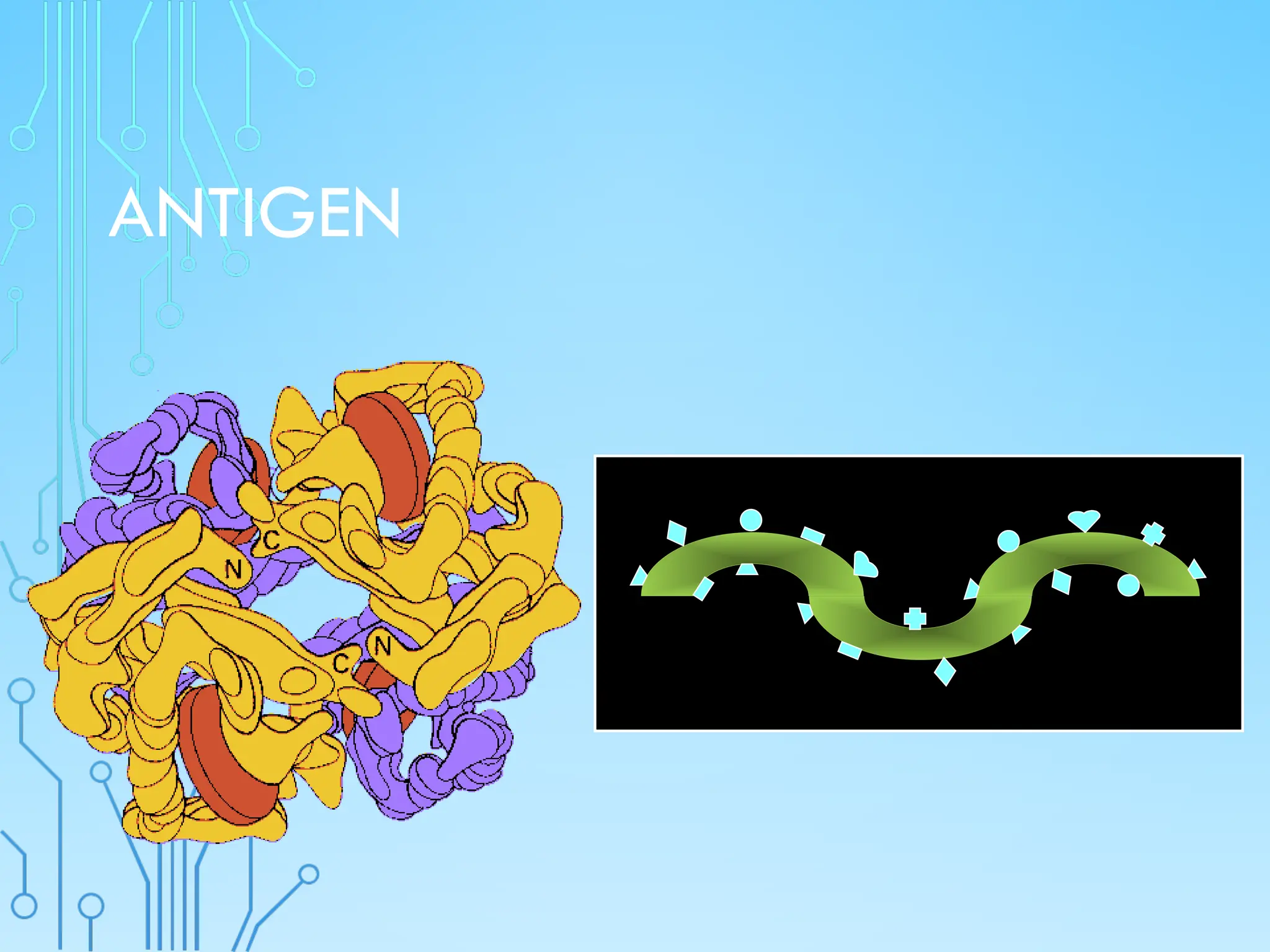
ANTIGEN
CONCEPT OF ANTIGEN AND
IMMUNOGEN
•Antigen is a substances that can react with antigen
specific receptors found on the surface of certain
white blood cells
• An immunogen is any molecule (or group of
molecules) that can induce an immune response
• An antigen differs from an immunogen in that
although an antigen can interact in a specific way
with the immune system, it cannot by itself stimulate
an immune response; other stimuli are required.
• Thus, all immunogens are antigens but not all
antigens are immunogens.
• Although these terms are interchangeable, it is
• common to refer to molecules as antigens even if
they are immunogens.
• Tolerogen - An antigen that cannot invokes a specific immune
response due to its molecular form. If its molecular form is
changed, a tolerogen can become an immunogen.
• Allergen - An allergen is a substance that causes the allergic
reaction.
• The (detrimental) reaction may result after exposure via
ingestion, inhalation, injection or contact with skin.
ANTIGENS CAN BE CLASSIFIED IN ORDER OF THEIR
ORIGINS
•Exogenous antigens
Exogenous antigens are antigens that have
entered the body from the outside, for example by
inhalation, ingestion, or injection. By endocytosis or
phagocytosis.
These antigens are taken into the antigen-
presenting cells (APCs) and processed into
fragments.
• Endogenous antigens
Endogenous antigens are antigens that have been
generated within the cell, as a result of normal cell
metabolism, or because of viral or intracellular
bacterial infection.
• Autoantigens
An autoantigen is usually a normal
protein or complex of proteins (and
sometimes DNA or RNA) that is
recognized by the immune system of
patients suffering from a specific
autoimmune disease.
These antigens should under normal conditions not be
the target of the immune system, but due to mainly
genetic and environmental factors the normal
immunological tolerance for such an antigen has been
lost in these patients.
• Tumor antigens
Tumor antigens are those antigens that are
presented by the MHC I molecules on the surface
of tumor cells. These antigens can sometimes be
presented only by tumor cells and never by the
normal ones. In this case, they are called tumor-
specific antigens (TSAs) and typically result from a
tumor specific mutation.
CHARACTERISTICS OF ANTIGEN
★1) Immunogenicity
The capacity to stimulate the production of antibodies or
cell-mediated immune responses.
★2) Antigenicity: The ability to bind antibody.
♣a) Complete antigen
♣ b) Incomplete antigen, also known as
hapten.
Incomplete antigens have antigenic determinants, but
cannot induce immune responses because they lack one or
more of the important attributes needed for this function
(one example of an incomplete antigen is a hapten,
which is an artificial monovalent epitope)
PROPERTIES OF ANTIGEN
• Foreignness
• This is an essential to immunogenicity because self-
responsive cells are eliminated during lymphocyte
ontogeny, leaving only cells that respond to non-self, so-
called "foreign" epitopes.
• It is important to remember that although a
molecule may not be immunogenic in the normal
host, if it is introduced into a different host, it may
become so.
• For example, rabbit serum albumin injected into
a rabbit will not be immunogenic.
• The same molecule injected into a dog will
stimulate an immune response.
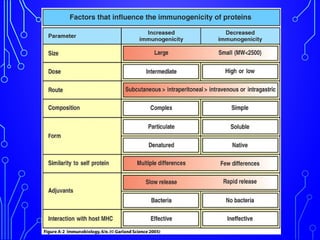
Molecular weight
• The size of a molecule appears to affect its
immunogenicity. Generally,
• substances with molecular weights greater than 100 kDa
are potent immunogens.
• whilst those of less than 10 kDa may not stimulate an
immune response at all.
• Although some small molecules may contain antigenic
determinants and can bind antigen-specific receptors on cells,
they are not large enough to stimulate an effective immune
response.
• However, these molecules may be made immunogenic by
attaching them to a larger molecule known as a carrier.
• Under these circumstances, the small antigenic molecule is known
as a hapten.
Chemical complexity
• The chemical complexity of a molecule may affect its
ability to stimulate an immune response.
• Large polymers of amino acids might be expected to be
good immunogens (because of their size) but only prove
to be so when they consist of a mixture of amino acids.
• The type of amino acids present in a peptide also affects
its immunogenicity.
• Aromatic amino acids make a molecule more
immunogenic than non-aromatic molecules because non-
covalent, hydrophobic, forces govern the interaction
between an antigen and its specific receptor on a cell.
Route of administration
• The type of immune response elicited by an
immunogen may be very different at one
particular site in the body compared to another.
• For example an organism that normally causes
infection when introduced in the lungs (a
respiratory pathogen) may be destroyed by the
acid in the gut if swallowed.
Dose
• The dose of an antigen may also affect its ability to be
immunogenic.
• Given at too high or too low a dose, the immune system
may fail to respond to an antigen, which at the correct
dose is immunogenic.
• This failure to respond is known as immunological
tolerance.
Host genetic make-up
• This is demonstrated by the fact that some
antigens, which stimulate an immune response in
man are non-immunogenic in other animals.
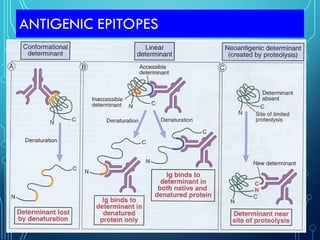
ANTIGENIC EPITOPES
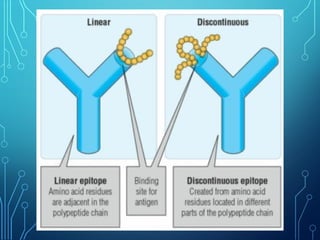
Epitope, or, Antigenic determinants, are the portions
of antigen molecules that physically interact with
paratopes (combining sites) of immune response
molecules and therefore actually "determine"
antigen specificity
F
e
ANTIGENIC EPITOPES
TYPES OF EPITOPES
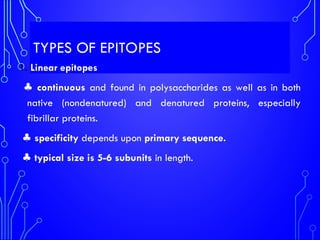
1. Linear epitopes
♣ continuous and found in polysaccharides as well as in both
native (nondenatured) and denatured proteins, especially
fibrillar proteins.
♣ specificity depends upon primary sequence.
♣ typical size is 5-6 subunits in length.
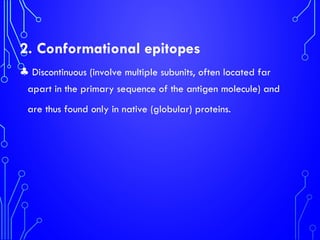
2. Conformational epitopes
♣ Discontinuous (involve multiple subunits, often located far
apart in the primary sequence of the antigen molecule) and
are thus found only in native (globular) proteins.
Two different epitopes
• B cell epitope, a portion
of antigen molecule that
is recognized by B cell
receptors.
• T cell epitope, the region
of antigen molecules that
are recognized by T cell
receptors.
Mitogen
•An agent that induces mitosis.
Here means to activate T cells and/or B
cells without help from APCs. E.g.
•Lectin, for example, concanavalin A
(ConA).
•LPS(lipopolysaccharide)
•Staphylococcal protein A(SPA)
Adjuvant
•An adjuvant is a substance that helps and
enhances the pharmacological effect of a drug
or increases the ability of an antigen to
stimulate the immune system.
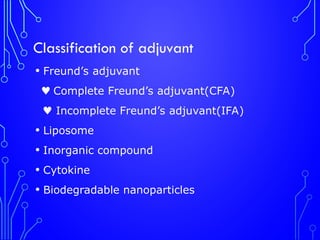
Classification of adjuvant
• Freund’s adjuvant
♥ Complete Freund’s adjuvant(CFA)
♥ Incomplete Freund’s adjuvant(IFA)
• Liposome
• Inorganic compound
• Cytokine
• Biodegradable nanoparticles
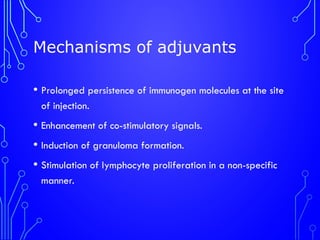
Mechanisms of adjuvants
• Prolonged persistence of immunogen molecules at the site
of injection.
• Enhancement of co-stimulatory signals.
• Induction of granuloma formation.
• Stimulation of lymphocyte proliferation in a non-specific
manner.
IMMUNOGLOBULINS
• Immunoglobulins are glycoproteins that function as
antibodies.
• In fact, the terms antibodies and immunoglobulins are
usually used indistinctly.
• Immunoglobulins can be found attached to the B-cell
membranes, in secretions or circulating in blood.
• Immunoglobulins are produced as a response to the
detection of foreign molecules in our body.
• These foreign substances that trigger the production of
antibodies are called antigens.
STRUCTURE OF IMMUNOGLOBULINS
• There are different types of immunoglobulins: IgG, IgM, IgA, IgD and
IgE.
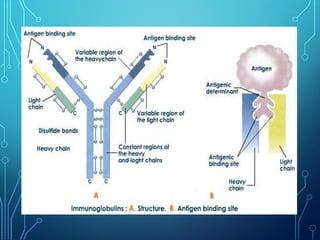
• All of them have in common, a basic unit is formed by two pairs of
peptide chains: a pair of Light chains or L chains (approximately 220
amino acids each) and a pair of Heavy chains or H chains (around
440 amino acids each).
• These four chains in the basic structure are linked through disulfide
bridges between cysteine residues in the backbone of the peptide
chains.
• Each Light chain is linked to one Heavy chain and each Heavy chain is
associated to a Light chain and to the other Heavy chain.
Classifications of immunoglobulins
•IgA
• Immunoglobulin A is the major antibody found in the
membranes of the respiratory and gastrointestinal tract.
• The second most common immunoglobulin in the human
body.
• IgA can also be found in tears, saliva, mucus, and
colostrums.
• IgA is one of the most important immonoglobulins in local
immunity. The two subclasses of IgA are IgA1 and IgA2.
IgD
• This immunoglobulin class is present in the blood serum
in tiny amounts.
• Immunoglobulin D can be found on B cell surfaces and
it is used as a receptor for antigen.
• It helps to anchor to cell membranes with its
abundance of amino acids.
IgE
• Immunoglobulin E can be found protecting the body in the
mucous membranes and skin.
• IgE is the least common antibody found in the blood
stream.
• It is the antibody that triggers allergic reactions, which
occur when IgE bind to cells to which the body is allergic.
• IgE also functions during problems with parasites, and the
amount of IgE is sometimes measured to determine if the
body has a parasitic infection.
IgG
• This major class of immunoglobulins is the body’s main
defense against bacteria.
• IgG makes up around 75 percent of all human
immunoglobulins and this is the only class that can cross
the placenta to protect newborns against infections.
• Immunogloblin G is the most versatile of all the
antibodies because it can carry out functions of the
other types of antibodies as well.
• The four subclasses of IgG are IgG1, IgG2, IgG3,
IgG4.
IGM
• These immunoglobulins fight blood infections and help to
trigger additional production of immunoglobulin G.
• Like IgD, these antibodies are present on lymphocyte cells.
• Of all immunoglobulins, 10 percent are IgM.
• Immunoglobulin M is the first antibody made by the fetus.
• These immunoglobulins are well-suited for clumping
microorganisms and helping them to be removed from the
body.
THANK YOU!

Immunology: Power Point slides on Antigen

  • 1.
  • 2.
    CONCEPT OF ANTIGENAND IMMUNOGEN •Antigen is a substances that can react with antigen specific receptors found on the surface of certain white blood cells • An immunogen is any molecule (or group of molecules) that can induce an immune response
  • 3.
    • An antigendiffers from an immunogen in that although an antigen can interact in a specific way with the immune system, it cannot by itself stimulate an immune response; other stimuli are required. • Thus, all immunogens are antigens but not all antigens are immunogens. • Although these terms are interchangeable, it is • common to refer to molecules as antigens even if they are immunogens.
  • 4.
    • Tolerogen -An antigen that cannot invokes a specific immune response due to its molecular form. If its molecular form is changed, a tolerogen can become an immunogen.
  • 5.
    • Allergen -An allergen is a substance that causes the allergic reaction. • The (detrimental) reaction may result after exposure via ingestion, inhalation, injection or contact with skin.
  • 6.
    ANTIGENS CAN BECLASSIFIED IN ORDER OF THEIR ORIGINS •Exogenous antigens Exogenous antigens are antigens that have entered the body from the outside, for example by inhalation, ingestion, or injection. By endocytosis or phagocytosis. These antigens are taken into the antigen- presenting cells (APCs) and processed into fragments.
  • 7.
    • Endogenous antigens Endogenousantigens are antigens that have been generated within the cell, as a result of normal cell metabolism, or because of viral or intracellular bacterial infection.
  • 8.
    • Autoantigens An autoantigenis usually a normal protein or complex of proteins (and sometimes DNA or RNA) that is recognized by the immune system of patients suffering from a specific autoimmune disease.
  • 9.
    These antigens shouldunder normal conditions not be the target of the immune system, but due to mainly genetic and environmental factors the normal immunological tolerance for such an antigen has been lost in these patients.
  • 10.
    • Tumor antigens Tumorantigens are those antigens that are presented by the MHC I molecules on the surface of tumor cells. These antigens can sometimes be presented only by tumor cells and never by the normal ones. In this case, they are called tumor- specific antigens (TSAs) and typically result from a tumor specific mutation.
  • 11.
    CHARACTERISTICS OF ANTIGEN ★1)Immunogenicity The capacity to stimulate the production of antibodies or cell-mediated immune responses.
  • 12.
    ★2) Antigenicity: Theability to bind antibody. ♣a) Complete antigen ♣ b) Incomplete antigen, also known as hapten.
  • 13.
    Incomplete antigens haveantigenic determinants, but cannot induce immune responses because they lack one or more of the important attributes needed for this function (one example of an incomplete antigen is a hapten, which is an artificial monovalent epitope)
  • 14.
    PROPERTIES OF ANTIGEN •Foreignness • This is an essential to immunogenicity because self- responsive cells are eliminated during lymphocyte ontogeny, leaving only cells that respond to non-self, so- called "foreign" epitopes.
  • 15.
    • It isimportant to remember that although a molecule may not be immunogenic in the normal host, if it is introduced into a different host, it may become so. • For example, rabbit serum albumin injected into a rabbit will not be immunogenic. • The same molecule injected into a dog will stimulate an immune response.
  • 16.
    Molecular weight • Thesize of a molecule appears to affect its immunogenicity. Generally, • substances with molecular weights greater than 100 kDa are potent immunogens. • whilst those of less than 10 kDa may not stimulate an immune response at all.
  • 17.
    • Although somesmall molecules may contain antigenic determinants and can bind antigen-specific receptors on cells, they are not large enough to stimulate an effective immune response. • However, these molecules may be made immunogenic by attaching them to a larger molecule known as a carrier. • Under these circumstances, the small antigenic molecule is known as a hapten.
  • 18.
    Chemical complexity • Thechemical complexity of a molecule may affect its ability to stimulate an immune response. • Large polymers of amino acids might be expected to be good immunogens (because of their size) but only prove to be so when they consist of a mixture of amino acids.
  • 19.
    • The typeof amino acids present in a peptide also affects its immunogenicity. • Aromatic amino acids make a molecule more immunogenic than non-aromatic molecules because non- covalent, hydrophobic, forces govern the interaction between an antigen and its specific receptor on a cell.
  • 20.
    Route of administration •The type of immune response elicited by an immunogen may be very different at one particular site in the body compared to another. • For example an organism that normally causes infection when introduced in the lungs (a respiratory pathogen) may be destroyed by the acid in the gut if swallowed.
  • 21.
    Dose • The doseof an antigen may also affect its ability to be immunogenic. • Given at too high or too low a dose, the immune system may fail to respond to an antigen, which at the correct dose is immunogenic. • This failure to respond is known as immunological tolerance.
  • 22.
    Host genetic make-up •This is demonstrated by the fact that some antigens, which stimulate an immune response in man are non-immunogenic in other animals.
  • 23.
    ANTIGENIC EPITOPES Epitope, or,Antigenic determinants, are the portions of antigen molecules that physically interact with paratopes (combining sites) of immune response molecules and therefore actually "determine" antigen specificity F e
  • 24.
  • 25.
    TYPES OF EPITOPES 1.Linear epitopes ♣ continuous and found in polysaccharides as well as in both native (nondenatured) and denatured proteins, especially fibrillar proteins. ♣ specificity depends upon primary sequence. ♣ typical size is 5-6 subunits in length.
  • 26.
    2. Conformational epitopes ♣Discontinuous (involve multiple subunits, often located far apart in the primary sequence of the antigen molecule) and are thus found only in native (globular) proteins.
  • 28.
    Two different epitopes •B cell epitope, a portion of antigen molecule that is recognized by B cell receptors. • T cell epitope, the region of antigen molecules that are recognized by T cell receptors.
  • 29.
    Mitogen •An agent thatinduces mitosis. Here means to activate T cells and/or B cells without help from APCs. E.g. •Lectin, for example, concanavalin A (ConA). •LPS(lipopolysaccharide) •Staphylococcal protein A(SPA)
  • 30.
    Adjuvant •An adjuvant isa substance that helps and enhances the pharmacological effect of a drug or increases the ability of an antigen to stimulate the immune system.
  • 31.
    Classification of adjuvant •Freund’s adjuvant ♥ Complete Freund’s adjuvant(CFA) ♥ Incomplete Freund’s adjuvant(IFA) • Liposome • Inorganic compound • Cytokine • Biodegradable nanoparticles
  • 32.
    Mechanisms of adjuvants •Prolonged persistence of immunogen molecules at the site of injection. • Enhancement of co-stimulatory signals. • Induction of granuloma formation. • Stimulation of lymphocyte proliferation in a non-specific manner.
  • 34.
    IMMUNOGLOBULINS • Immunoglobulins areglycoproteins that function as antibodies. • In fact, the terms antibodies and immunoglobulins are usually used indistinctly. • Immunoglobulins can be found attached to the B-cell membranes, in secretions or circulating in blood. • Immunoglobulins are produced as a response to the detection of foreign molecules in our body. • These foreign substances that trigger the production of antibodies are called antigens.
  • 35.
    STRUCTURE OF IMMUNOGLOBULINS •There are different types of immunoglobulins: IgG, IgM, IgA, IgD and IgE. • All of them have in common, a basic unit is formed by two pairs of peptide chains: a pair of Light chains or L chains (approximately 220 amino acids each) and a pair of Heavy chains or H chains (around 440 amino acids each). • These four chains in the basic structure are linked through disulfide bridges between cysteine residues in the backbone of the peptide chains. • Each Light chain is linked to one Heavy chain and each Heavy chain is associated to a Light chain and to the other Heavy chain.
  • 37.
    Classifications of immunoglobulins •IgA •Immunoglobulin A is the major antibody found in the membranes of the respiratory and gastrointestinal tract. • The second most common immunoglobulin in the human body. • IgA can also be found in tears, saliva, mucus, and colostrums. • IgA is one of the most important immonoglobulins in local immunity. The two subclasses of IgA are IgA1 and IgA2.
  • 38.
    IgD • This immunoglobulinclass is present in the blood serum in tiny amounts. • Immunoglobulin D can be found on B cell surfaces and it is used as a receptor for antigen. • It helps to anchor to cell membranes with its abundance of amino acids.
  • 39.
    IgE • Immunoglobulin Ecan be found protecting the body in the mucous membranes and skin. • IgE is the least common antibody found in the blood stream. • It is the antibody that triggers allergic reactions, which occur when IgE bind to cells to which the body is allergic. • IgE also functions during problems with parasites, and the amount of IgE is sometimes measured to determine if the body has a parasitic infection.
  • 40.
    IgG • This majorclass of immunoglobulins is the body’s main defense against bacteria. • IgG makes up around 75 percent of all human immunoglobulins and this is the only class that can cross the placenta to protect newborns against infections. • Immunogloblin G is the most versatile of all the antibodies because it can carry out functions of the other types of antibodies as well. • The four subclasses of IgG are IgG1, IgG2, IgG3, IgG4.
  • 41.
    IGM • These immunoglobulinsfight blood infections and help to trigger additional production of immunoglobulin G. • Like IgD, these antibodies are present on lymphocyte cells. • Of all immunoglobulins, 10 percent are IgM. • Immunoglobulin M is the first antibody made by the fetus. • These immunoglobulins are well-suited for clumping microorganisms and helping them to be removed from the body.
  • 42.