Antigens
Definition of Antigen/Immunogen
Antigens
Substances capable of inducing a specific immune
response are commonly referred to as antigens.
Immunogens
The term immunogen refers to an antigen when it is
more appropriate to develop an effective immune
response.
All immunogens are antigens but some antigens
(Haptens) are not immunogens.
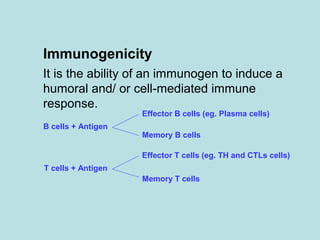
Immunogenicity
It is the ability of an immunogen to induce a
humoral and/ or cell-mediated immune
response.
Effector B cells (eg. Plasma cells)
Memory B cells
B cells + Antigen
Effector T cells (eg. TH and CTLs cells)
Memory T cells
T cells + Antigen
Antigenicity
It is the ability of an antigen to be recognized by
or combine specifically with the final products
of the immune responses (antibodies and / or
cell surface receptors)
Proteins → most potent immunogens
Polysaccharide → ranks second
Lipids and nucleic acids → do not serve as
immunogens unless complexed to proteins or
polysaccharides.
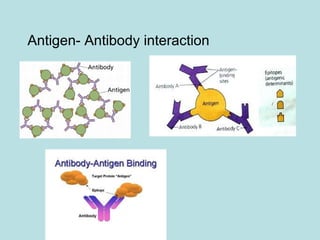
Antigen- Antibody interaction
Antigen-Antibody interaction, Cont,d
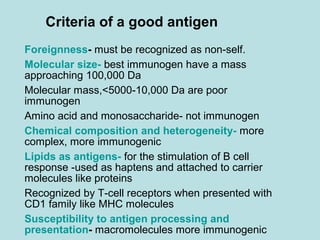
Foreignness- must be recognized as non-self.
Molecular size- best immunogen have a mass
approaching 100,000 Da
Molecular mass,<5000-10,000 Da are poor
immunogen
Amino acid and monosaccharide- not immunogen
Chemical composition and heterogeneity- more
complex, more immunogenic
Lipids as antigens- for the stimulation of B cell
response -used as haptens and attached to carrier
molecules like proteins
Recognized by T-cell receptors when presented with
CD1 family like MHC molecules
Susceptibility to antigen processing and
presentation- macromolecules more immunogenic
Criteria of a good antigen
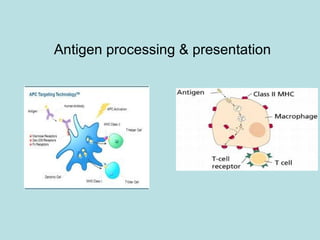
Antigen processing & presentation
• Genotype of the recipient
• The dose of the antigen
• The route of administration of antigen
• Adjuvant
Factors influencing immunogenicity
Immunogens generally administerd parenterally
• Intravenous (iv)- into a vein
• Intradermal (id)- into the skin
• Subcutaneous (sc)- beneath the skin
• Intramuscular (im)- into a muscle
• Intraperitoneal (ip)- into the peritoneal cavity
Route of administration of antigen
Definition
Adjuvants are substances that when mixed with
an antigen and injected with it, serve to enhance
the immunogenicity of that antigen.
Adjuvants
Purpose of adjuvant use
• To boost the immune response of an Ag
• To increase the immunogenicity of small
amounts of an antigen.
• Prolong antigen persistence
• Enhance co-stimulatory signal.
• Increase local inflammation
• Non-specifically stimulate lymphocyte
proliferation
Effects of adjuvant
 Increase antigen persistence
 Salt precipitates antigen
 Causes slower release of antigen from the site
of injection.
 Enhances the phagocytic process by increasing
the size of the antigen
Aluminum potassium sulfate
Freund’s incomplete adjuvant contains
• Antigen in aqueous solution
• Mineral oil
• Mannide monooleate (Emulsifying agent)
Freund’s adjuvant
Mechanism of action
• Emulsifying agent disperses the oil into small droplets
surrounding the antigen; the Ag is then released very
slowly from the site of injection and thus prolongs Ag
persistence.
Mechanism of action
 A muramyl dipeptide component of the mycobacterial
cell wall activates macrophages
 Activated macrophages are more phagocytic, express
higher level of class II MHC molecules and the B7
membrane molecule and secrete increased level of IL-
1
 Both B7 and IL-1 bind to CD28 of TH cells, triggering
co-stimulatory signal necessary for TH cell activation
Freund’s complete adjuvant
Heat- killed Mycobacteria in the water-in oil emulsion.
Freund’s complete adjuvant Cont’d
• Alum and both Freund’s adjuvants also stimulate
a local, chronic inflammatory response, the cellular
infiltration at the site of injection of adjuvant
induces granuloma formation
• Synthetic polyribonucleotides and bacterial LPS
stimulate nonspecific lymphocyte proliferation and
thus increase Ag-induced clonal selection of
lymphocytes.
Epitopes are the immunologically active regions
of an immunogen/antigen that bind to Ag
specific membrane receptors on lymphocytes
or to secreted antibodies.
Studies with a small Ag revealed that B and T
cells recognize different epitopes on the same
antigenic molecule.
Epitopes/ Antigenic determinant
Schematic diagram
of ternary complex
formed between the
TCR, an antigen and
MHC molecule
Characteristic B cells T cells
Interaction with Ag Involves binary complex of
membrane Ig and Ag.
Involves ternary complex of T-
cell receptor, Ag and MHC
molecule
Binding of soluble Ag Yes No
Involvement of MHC
molecules
Not required Required to display processed
Ag
Chemical nature of Ag Protein, polysaccharide or lipid Only protein
Epitope properties Accessible, hydrophilic, mobile
peptides containing sequential
or non-sequential amino acids
Internal linear peptides
produced by processing of Ag
and capable of binding to MHC
molecules
Comparison of Ag recognition by B cells and T cells
Common haptens are
• Dinitrophenol (DNP)
• Drugs
• Peptide hormones
• Steroid hormones
Haptens
A low molecular weight compound that is not
immunogenic by itself but when coupled to a
carrier can elicit anti-hapten antibodies.
• Hapten determinant
• Unaltered epitopes on the carrier protein
• New epitopes formed by combined parts of
both the hapten and carrier
Animal immunized with Hapten- carrier
conjugate produce antibodies specific
for
Haptens Cont’d
Induction of Ab by hapten
A condition when some of the determinants of an
Ag are shared by similar antigenic determinants on
the surface of apparently unrelated molecules and
a proportion of these antigens interact with the
other kind of Ag.
Cross-reactivity is the ability of a particular Ab or
TCR to react with two or more antigens that
possess a common epitope.
Cross-reaction
Any substance that is capable of inducing DNA
synthesis and cell division in a nonspecific way,
especially of T and B lymphocytes.
Mitogen can activate many clones of T or B cells
irrespective of their antigen specificity, for which
mitogens are known as polyclonal activators.
Mitogens
Lectins (sugar-binding proteins)
It binds to different glycoproteins on the surface of
various cells, including lymphocytes.
• Binding of lectin molecules to membrane
glycoproteins often leads to agglutination or
clustering of the cells, which may trigger cellular
activation and proliferation.
• Some mitogens , preferentially activate B cells,
some preferentially activate T cells and some
activate both populations.
Common mitogens
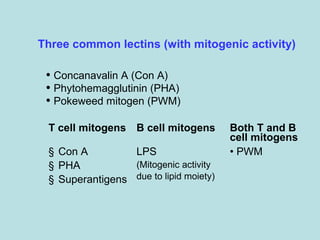
• Concanavalin A (Con A)
• Phytohemagglutinin (PHA)
• Pokeweed mitogen (PWM)
Three common lectins (with mitogenic activity)
T cell mitogens B cell mitogens Both T and B
cell mitogens
§ Con A
§ PHA
§ Superantigens
LPS
(Mitogenic activity
due to lipid moiety)
• PWM
Super-antigens
The most potent T-cell mitogens which
bind to residues in the variable domain
of the T-cell receptor and to residues in
class II MHC molecules outside of the
antigen-binding cleft.
E.g. staphylococcal enterotoxins (SE)
and toxic shock syndrome toxin 1
(TSST1)
Schematic diagram of
ternary complex formed
between the TCR,
superantigen and MHC
molecule

Antigens ms

  • 1.
  • 2.
    Definition of Antigen/Immunogen Antigens Substancescapable of inducing a specific immune response are commonly referred to as antigens. Immunogens The term immunogen refers to an antigen when it is more appropriate to develop an effective immune response. All immunogens are antigens but some antigens (Haptens) are not immunogens.
  • 4.
    Immunogenicity It is theability of an immunogen to induce a humoral and/ or cell-mediated immune response. Effector B cells (eg. Plasma cells) Memory B cells B cells + Antigen Effector T cells (eg. TH and CTLs cells) Memory T cells T cells + Antigen
  • 5.
    Antigenicity It is theability of an antigen to be recognized by or combine specifically with the final products of the immune responses (antibodies and / or cell surface receptors) Proteins → most potent immunogens Polysaccharide → ranks second Lipids and nucleic acids → do not serve as immunogens unless complexed to proteins or polysaccharides.
  • 6.
  • 7.
  • 8.
    Foreignness- must berecognized as non-self. Molecular size- best immunogen have a mass approaching 100,000 Da Molecular mass,<5000-10,000 Da are poor immunogen Amino acid and monosaccharide- not immunogen Chemical composition and heterogeneity- more complex, more immunogenic Lipids as antigens- for the stimulation of B cell response -used as haptens and attached to carrier molecules like proteins Recognized by T-cell receptors when presented with CD1 family like MHC molecules Susceptibility to antigen processing and presentation- macromolecules more immunogenic Criteria of a good antigen
  • 9.
  • 10.
    • Genotype ofthe recipient • The dose of the antigen • The route of administration of antigen • Adjuvant Factors influencing immunogenicity
  • 11.
    Immunogens generally administerdparenterally • Intravenous (iv)- into a vein • Intradermal (id)- into the skin • Subcutaneous (sc)- beneath the skin • Intramuscular (im)- into a muscle • Intraperitoneal (ip)- into the peritoneal cavity Route of administration of antigen
  • 12.
    Definition Adjuvants are substancesthat when mixed with an antigen and injected with it, serve to enhance the immunogenicity of that antigen. Adjuvants Purpose of adjuvant use • To boost the immune response of an Ag • To increase the immunogenicity of small amounts of an antigen.
  • 13.
    • Prolong antigenpersistence • Enhance co-stimulatory signal. • Increase local inflammation • Non-specifically stimulate lymphocyte proliferation Effects of adjuvant
  • 14.
     Increase antigenpersistence  Salt precipitates antigen  Causes slower release of antigen from the site of injection.  Enhances the phagocytic process by increasing the size of the antigen Aluminum potassium sulfate
  • 15.
    Freund’s incomplete adjuvantcontains • Antigen in aqueous solution • Mineral oil • Mannide monooleate (Emulsifying agent) Freund’s adjuvant Mechanism of action • Emulsifying agent disperses the oil into small droplets surrounding the antigen; the Ag is then released very slowly from the site of injection and thus prolongs Ag persistence.
  • 16.
    Mechanism of action A muramyl dipeptide component of the mycobacterial cell wall activates macrophages  Activated macrophages are more phagocytic, express higher level of class II MHC molecules and the B7 membrane molecule and secrete increased level of IL- 1  Both B7 and IL-1 bind to CD28 of TH cells, triggering co-stimulatory signal necessary for TH cell activation Freund’s complete adjuvant Heat- killed Mycobacteria in the water-in oil emulsion.
  • 17.
    Freund’s complete adjuvantCont’d • Alum and both Freund’s adjuvants also stimulate a local, chronic inflammatory response, the cellular infiltration at the site of injection of adjuvant induces granuloma formation • Synthetic polyribonucleotides and bacterial LPS stimulate nonspecific lymphocyte proliferation and thus increase Ag-induced clonal selection of lymphocytes.
  • 18.
    Epitopes are theimmunologically active regions of an immunogen/antigen that bind to Ag specific membrane receptors on lymphocytes or to secreted antibodies. Studies with a small Ag revealed that B and T cells recognize different epitopes on the same antigenic molecule. Epitopes/ Antigenic determinant
  • 19.
    Schematic diagram of ternarycomplex formed between the TCR, an antigen and MHC molecule
  • 20.
    Characteristic B cellsT cells Interaction with Ag Involves binary complex of membrane Ig and Ag. Involves ternary complex of T- cell receptor, Ag and MHC molecule Binding of soluble Ag Yes No Involvement of MHC molecules Not required Required to display processed Ag Chemical nature of Ag Protein, polysaccharide or lipid Only protein Epitope properties Accessible, hydrophilic, mobile peptides containing sequential or non-sequential amino acids Internal linear peptides produced by processing of Ag and capable of binding to MHC molecules Comparison of Ag recognition by B cells and T cells
  • 21.
    Common haptens are •Dinitrophenol (DNP) • Drugs • Peptide hormones • Steroid hormones Haptens A low molecular weight compound that is not immunogenic by itself but when coupled to a carrier can elicit anti-hapten antibodies.
  • 22.
    • Hapten determinant •Unaltered epitopes on the carrier protein • New epitopes formed by combined parts of both the hapten and carrier Animal immunized with Hapten- carrier conjugate produce antibodies specific for Haptens Cont’d
  • 23.
    Induction of Abby hapten
  • 24.
    A condition whensome of the determinants of an Ag are shared by similar antigenic determinants on the surface of apparently unrelated molecules and a proportion of these antigens interact with the other kind of Ag. Cross-reactivity is the ability of a particular Ab or TCR to react with two or more antigens that possess a common epitope. Cross-reaction
  • 25.
    Any substance thatis capable of inducing DNA synthesis and cell division in a nonspecific way, especially of T and B lymphocytes. Mitogen can activate many clones of T or B cells irrespective of their antigen specificity, for which mitogens are known as polyclonal activators. Mitogens
  • 26.
    Lectins (sugar-binding proteins) Itbinds to different glycoproteins on the surface of various cells, including lymphocytes. • Binding of lectin molecules to membrane glycoproteins often leads to agglutination or clustering of the cells, which may trigger cellular activation and proliferation. • Some mitogens , preferentially activate B cells, some preferentially activate T cells and some activate both populations. Common mitogens
  • 27.
    • Concanavalin A(Con A) • Phytohemagglutinin (PHA) • Pokeweed mitogen (PWM) Three common lectins (with mitogenic activity) T cell mitogens B cell mitogens Both T and B cell mitogens § Con A § PHA § Superantigens LPS (Mitogenic activity due to lipid moiety) • PWM
  • 28.
    Super-antigens The most potentT-cell mitogens which bind to residues in the variable domain of the T-cell receptor and to residues in class II MHC molecules outside of the antigen-binding cleft. E.g. staphylococcal enterotoxins (SE) and toxic shock syndrome toxin 1 (TSST1)
  • 29.
    Schematic diagram of ternarycomplex formed between the TCR, superantigen and MHC molecule