Immunoglobulins &
Antigen
By
Soma Ghosh
ANTIGENS
An Antigen can be defined as any foreign
substance ( living & non living) that may
elicit any one or more of the following
responces inside an individual.
• Formation of specific antibodies.
• Activation of specific T- Lymphocytes.
• Reacting very specifically with the
produced immune molecules or cell
• Inducing the immune tolerance
HALLMARKS OF
ANTIGENICITY
• IMMUNOGENICITY
• IMMUNOLOGICAL REACTIVITY
• IMMUNITOLERANCE
FEATURES OF ANTIGENS
• NATURE
• SOURCE
• ALIENITY
• MOLECULAR WEIGHT
• SUCCEPTIBILITY/RESISTANT
• SPECIFICITY
CLASSIFICATION OF
ANTIGENS
ON THE BASIS OF SIZE:
• COMPLETE
• INCOMPLETE/ HAPTEN
• EPITOPE
BIOLOGICAL BASIS:
• T CELL DEPENDENT ANTIGEN
• T CELL INDEPENDENT ANTIGEN
ON THE BASIS OF ORIGIN
ALLOANTIGEN
AUTOANTIGEN
ON THE BASIS OF ALIENITY
• IMMUNOGENS
• ALLERTGEN
Immunoglobulin
Immunoglobulin is a glycoprotein that is
made in response to an antigen and can
recognize and bind to the antigen that
caused its production.
• Are gamma globulins
• Synthesized by plasma cells
• Constitute 25-30 % of total serum proteins
• Antibodies are present in serum, tissue fluids
and mucosal surfaces.
• All antibodies are immunoglobulins, but all
immunoglobulins may not be antibodies
As cryoglobulin, macroglobulin, myeloma protein
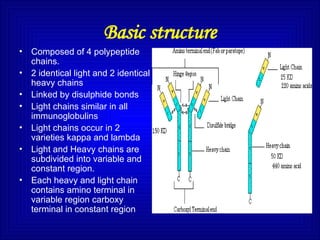
Basic structure
• Composed of 4 polypeptide
chains.
• 2 identical light and 2 identical
heavy chains
• Linked by disulphide bonds
• Light chains similar in all
immunoglobulins
• Light chains occur in 2
varieties kappa and lambda
• Light and Heavy chains are
subdivided into variable and
constant region.
• Each heavy and light chain
contains amino terminal in
variable region carboxy
terminal in constant region
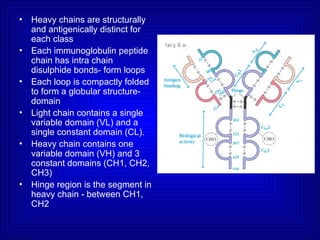
• Heavy chains are structurally
and antigenically distinct for
each class
• Each immunoglobulin peptide
chain has intra chain
disulphide bonds- form loops
• Each loop is compactly folded
to form a globular structure-
domain
• Light chain contains a single
variable domain (VL) and a
single constant domain (CL).
• Heavy chain contains one
variable domain (VH) and 3
constant domains (CH1, CH2,
CH3)
• Hinge region is the segment in
heavy chain - between CH1,
CH2
TYPES
ON THE BASIS OF OBSERVABLE
REACTION
• AGGLUTININS
• PRECIPITATION
• LYSINS
• OPSONIN
• ANTITOXIN
• C- FIXATIVES
Classification
• Based on structure and antigenic nature of H
chain the immunoglobulins are classified into 5
classes.
• Ig G- (gamma)
• Ig A- (alpha)
• Ig M- (mu)
• Ig D- (delta)
• Ig E - (epsilon)
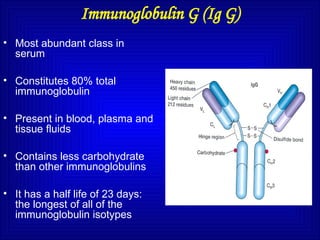
Immunoglobulin G (Ig G)
• Most abundant class in
serum
• Constitutes 80% total
immunoglobulin
• Present in blood, plasma and
tissue fluids
• Contains less carbohydrate
than other immunoglobulins
• It has a half life of 23 days:
the longest of all of the
immunoglobulin isotypes
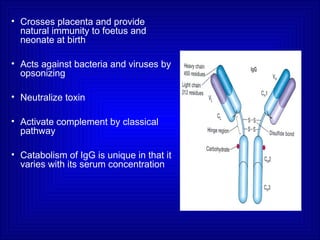
• Crosses placenta and provide
natural immunity to foetus and
neonate at birth
• Acts against bacteria and viruses by
opsonizing
• Neutralize toxin
• Activate complement by classical
pathway
• Catabolism of IgG is unique in that it
varies with its serum concentration
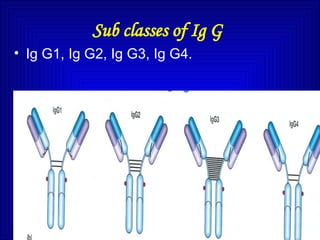
Sub classes of Ig G
• Ig G1, Ig G2, Ig G3, Ig G4.
Biological function of subclasses
• IgG1, IgG3, IgG4 – cross placenta and
protect foetus
• IgG3 activates complement
• IgG1 and IgG3 binds to Fc receptor on
phagocytic cells, monocytes and
macrophages and mediate opsinization.
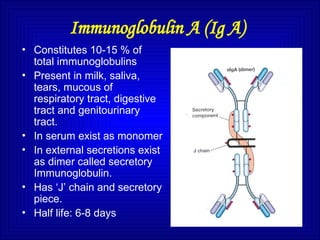
Immunoglobulin A (Ig A)
• Constitutes 10-15 % of
total immunoglobulins
• Present in milk, saliva,
tears, mucous of
respiratory tract, digestive
tract and genitourinary
tract.
• In serum exist as monomer
• In external secretions exist
as dimer called secretory
Immunoglobulin.
• Has ‘J’ chain and secretory
piece.
• Half life: 6-8 days
Functions
• Provides local immunity.
• Secretory Ig A binds to surface antigens of microorganism and
prevent its attachment and invasion of the mucosal surfaces of
respiratory and digestive tract- immune elimination.
• Secretory IgA provides important line of defense against
salmonella, Vibrio cholerae, N. gonorrhoeae, influenza virus and
poliovirus.
• Secretory IgA present in breast milk protects newborn during first
months of life.
• Activates complement by the alternative pathway
• Promotes phagocytosis and intracellular killing of microorganisms
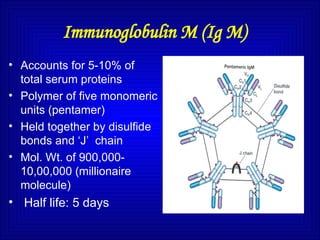
Immunoglobulin M (Ig M)
• Accounts for 5-10% of
total serum proteins
• Polymer of five monomeric
units (pentamer)
• Held together by disulfide
bonds and ‘J’ chain
• Mol. Wt. of 900,000-
10,00,000 (millionaire
molecule)
• Half life: 5 days
• Most of IgM (80%) present intravascularly
• Present in low concentration in intercellular tissue
fluids
• Cannot cross placenta
• Presence of IgM antibody in serum of newborn
indicate congenital infection.
• Earliest immunoglobulin to be synthesized by foetus
(20 weeks)
• First immunoglobulin to be produced in primary
response to antigen
• Relatively short-lived hence it’s demonstration in the
serum indicates recent infection
Functions
• It agglutinates bacteria
• Causes opsonization and immune
heamolysis
• Believed to be responsible for protection
against blood invasion by microorganisms
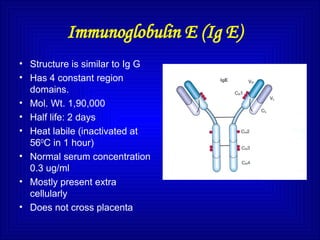
Immunoglobulin E (Ig E)
• Structure is similar to Ig G
• Has 4 constant region
domains.
• Mol. Wt. 1,90,000
• Half life: 2 days
• Heat labile (inactivated at
560
C in 1 hour)
• Normal serum concentration
0.3 ug/ml
• Mostly present extra
cellularly
• Does not cross placenta
• Produced in the lining of respiratory and intestinal
tract
• Known as reagin antibody
• Does not activate complement nor agglutinate
antigens
• Binds to the Fc receptors on the membranes of
blood basophils and tissue mast cells
• Mediates immediate hypersensitivity reaction and
P.K. reaction
• Responsible for symptoms of anaphylactic shock,
hay fever and asthma.
• Play a role in immunity against helminthic parasites
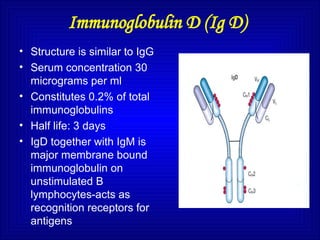
Immunoglobulin D (Ig D)
• Structure is similar to IgG
• Serum concentration 30
micrograms per ml
• Constitutes 0.2% of total
immunoglobulins
• Half life: 3 days
• IgD together with IgM is
major membrane bound
immunoglobulin on
unstimulated B
lymphocytes-acts as
recognition receptors for
antigens
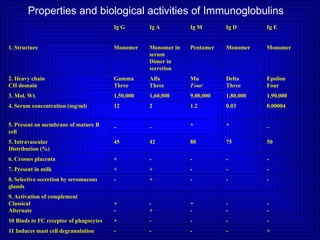
Properties and biological activities of Immunoglobulins
Ig G Ig A Ig M Ig D Ig E
1. Structure Monomer Monomer in
serum
Dimer in
secretion
Pentamer Monomer Monomer
2. Heavy chain
CH domain
Gamma
Three
Alfa
Three
Mu
Four
Delta
Three
Epsilon
Four
3. Mol. Wt. 1,50,000 1,60,000 9,00,000 1,80,000 1,90,000
4. Serum concentration (mg/ml) 12 2 1.2 0.03 0.00004
5. Present on membrane of mature B
cell
_ _ + + _
5. Intravascular
Distribution (%)
45 42 80 75 50
6. Crosses placenta + - - - -
7. Present in milk + + - - -
8. Selective secretion by seromucous
glands
- + - - -
9. Activation of complement
Classical
Alternate
+
-
-
+
+
-
-
-
-
-
10 Binds to FC receptor of phagocytes + - - - -
11 Induces mast cell degranulation - - - - +
Take home message
Role of different immunoglobulin classes
IgG: Protects the body fluids
IgA: Protects the body surfaces
IgM: Protects the blood stream
IgE: Mediates type I hypersensitivity
IgD: Role not known
immunoglobulins-140309015431-phpapp01.ppt

immunoglobulins-140309015431-phpapp01.ppt

  • 1.
  • 2.
    ANTIGENS An Antigen canbe defined as any foreign substance ( living & non living) that may elicit any one or more of the following responces inside an individual.
  • 3.
    • Formation ofspecific antibodies. • Activation of specific T- Lymphocytes. • Reacting very specifically with the produced immune molecules or cell • Inducing the immune tolerance
  • 4.
    HALLMARKS OF ANTIGENICITY • IMMUNOGENICITY •IMMUNOLOGICAL REACTIVITY • IMMUNITOLERANCE
  • 5.
    FEATURES OF ANTIGENS •NATURE • SOURCE • ALIENITY • MOLECULAR WEIGHT • SUCCEPTIBILITY/RESISTANT • SPECIFICITY
  • 6.
    CLASSIFICATION OF ANTIGENS ON THEBASIS OF SIZE: • COMPLETE • INCOMPLETE/ HAPTEN • EPITOPE
  • 7.
    BIOLOGICAL BASIS: • TCELL DEPENDENT ANTIGEN • T CELL INDEPENDENT ANTIGEN ON THE BASIS OF ORIGIN ALLOANTIGEN AUTOANTIGEN ON THE BASIS OF ALIENITY • IMMUNOGENS • ALLERTGEN
  • 8.
    Immunoglobulin Immunoglobulin is aglycoprotein that is made in response to an antigen and can recognize and bind to the antigen that caused its production.
  • 9.
    • Are gammaglobulins • Synthesized by plasma cells • Constitute 25-30 % of total serum proteins • Antibodies are present in serum, tissue fluids and mucosal surfaces. • All antibodies are immunoglobulins, but all immunoglobulins may not be antibodies As cryoglobulin, macroglobulin, myeloma protein
  • 10.
    Basic structure • Composedof 4 polypeptide chains. • 2 identical light and 2 identical heavy chains • Linked by disulphide bonds • Light chains similar in all immunoglobulins • Light chains occur in 2 varieties kappa and lambda • Light and Heavy chains are subdivided into variable and constant region. • Each heavy and light chain contains amino terminal in variable region carboxy terminal in constant region
  • 11.
    • Heavy chainsare structurally and antigenically distinct for each class • Each immunoglobulin peptide chain has intra chain disulphide bonds- form loops • Each loop is compactly folded to form a globular structure- domain • Light chain contains a single variable domain (VL) and a single constant domain (CL). • Heavy chain contains one variable domain (VH) and 3 constant domains (CH1, CH2, CH3) • Hinge region is the segment in heavy chain - between CH1, CH2
  • 12.
    TYPES ON THE BASISOF OBSERVABLE REACTION • AGGLUTININS • PRECIPITATION • LYSINS • OPSONIN • ANTITOXIN • C- FIXATIVES
  • 13.
    Classification • Based onstructure and antigenic nature of H chain the immunoglobulins are classified into 5 classes. • Ig G- (gamma) • Ig A- (alpha) • Ig M- (mu) • Ig D- (delta) • Ig E - (epsilon)
  • 14.
    Immunoglobulin G (IgG) • Most abundant class in serum • Constitutes 80% total immunoglobulin • Present in blood, plasma and tissue fluids • Contains less carbohydrate than other immunoglobulins • It has a half life of 23 days: the longest of all of the immunoglobulin isotypes
  • 15.
    • Crosses placentaand provide natural immunity to foetus and neonate at birth • Acts against bacteria and viruses by opsonizing • Neutralize toxin • Activate complement by classical pathway • Catabolism of IgG is unique in that it varies with its serum concentration
  • 16.
    Sub classes ofIg G • Ig G1, Ig G2, Ig G3, Ig G4.
  • 17.
    Biological function ofsubclasses • IgG1, IgG3, IgG4 – cross placenta and protect foetus • IgG3 activates complement • IgG1 and IgG3 binds to Fc receptor on phagocytic cells, monocytes and macrophages and mediate opsinization.
  • 18.
    Immunoglobulin A (IgA) • Constitutes 10-15 % of total immunoglobulins • Present in milk, saliva, tears, mucous of respiratory tract, digestive tract and genitourinary tract. • In serum exist as monomer • In external secretions exist as dimer called secretory Immunoglobulin. • Has ‘J’ chain and secretory piece. • Half life: 6-8 days
  • 19.
    Functions • Provides localimmunity. • Secretory Ig A binds to surface antigens of microorganism and prevent its attachment and invasion of the mucosal surfaces of respiratory and digestive tract- immune elimination. • Secretory IgA provides important line of defense against salmonella, Vibrio cholerae, N. gonorrhoeae, influenza virus and poliovirus. • Secretory IgA present in breast milk protects newborn during first months of life. • Activates complement by the alternative pathway • Promotes phagocytosis and intracellular killing of microorganisms
  • 20.
    Immunoglobulin M (IgM) • Accounts for 5-10% of total serum proteins • Polymer of five monomeric units (pentamer) • Held together by disulfide bonds and ‘J’ chain • Mol. Wt. of 900,000- 10,00,000 (millionaire molecule) • Half life: 5 days
  • 21.
    • Most ofIgM (80%) present intravascularly • Present in low concentration in intercellular tissue fluids • Cannot cross placenta • Presence of IgM antibody in serum of newborn indicate congenital infection. • Earliest immunoglobulin to be synthesized by foetus (20 weeks) • First immunoglobulin to be produced in primary response to antigen • Relatively short-lived hence it’s demonstration in the serum indicates recent infection
  • 22.
    Functions • It agglutinatesbacteria • Causes opsonization and immune heamolysis • Believed to be responsible for protection against blood invasion by microorganisms
  • 23.
    Immunoglobulin E (IgE) • Structure is similar to Ig G • Has 4 constant region domains. • Mol. Wt. 1,90,000 • Half life: 2 days • Heat labile (inactivated at 560 C in 1 hour) • Normal serum concentration 0.3 ug/ml • Mostly present extra cellularly • Does not cross placenta
  • 24.
    • Produced inthe lining of respiratory and intestinal tract • Known as reagin antibody • Does not activate complement nor agglutinate antigens • Binds to the Fc receptors on the membranes of blood basophils and tissue mast cells • Mediates immediate hypersensitivity reaction and P.K. reaction • Responsible for symptoms of anaphylactic shock, hay fever and asthma. • Play a role in immunity against helminthic parasites
  • 25.
    Immunoglobulin D (IgD) • Structure is similar to IgG • Serum concentration 30 micrograms per ml • Constitutes 0.2% of total immunoglobulins • Half life: 3 days • IgD together with IgM is major membrane bound immunoglobulin on unstimulated B lymphocytes-acts as recognition receptors for antigens
  • 26.
    Properties and biologicalactivities of Immunoglobulins Ig G Ig A Ig M Ig D Ig E 1. Structure Monomer Monomer in serum Dimer in secretion Pentamer Monomer Monomer 2. Heavy chain CH domain Gamma Three Alfa Three Mu Four Delta Three Epsilon Four 3. Mol. Wt. 1,50,000 1,60,000 9,00,000 1,80,000 1,90,000 4. Serum concentration (mg/ml) 12 2 1.2 0.03 0.00004 5. Present on membrane of mature B cell _ _ + + _ 5. Intravascular Distribution (%) 45 42 80 75 50 6. Crosses placenta + - - - - 7. Present in milk + + - - - 8. Selective secretion by seromucous glands - + - - - 9. Activation of complement Classical Alternate + - - + + - - - - - 10 Binds to FC receptor of phagocytes + - - - - 11 Induces mast cell degranulation - - - - +
  • 27.
    Take home message Roleof different immunoglobulin classes IgG: Protects the body fluids IgA: Protects the body surfaces IgM: Protects the blood stream IgE: Mediates type I hypersensitivity IgD: Role not known