 An antigen is defined as a substance capable of triggering the
synthesis of antibodies in a host
 The word antigen is a shortened form of the words “antibody
generator
 They react with both T-cell recognition receptors and with
antibodies.
 These antigenic molecules may have several antigenic determinants,
called epitopes,
 The each epitope can bind with a specific antibody.
 Thus, a single antigen can bind to many different antibodies with
different binding sites.
Properties of antigens
1. Immunogenicity : It means the ability of an antigen to elicit an
immune reaction in the form of a B-cell or T-cell response,
2. Antigenicity: It means just the ability to combine specifically with
the products of the above responses.
All molecules that are immunogenic are antigenic too, but all
antigenic molecules cannot be considered immunogenic.
Ex: haptens can be said to lack immunogenicity.
Requirements for Immunogenecity
Foreigness: The antigenic substance must be genetically foreign to the
host.
Molecular size: The most potent immunogens are macromolecular
proteins with MW of 10,000 D and more. <10,000 -weakly immunogenic
or not immunogenic at all.
Chemical complexity: An immunogenic molecule needs to possess a
certain degree of chemical complexity. Proteins, lipoproteins, lipo-
polysaccharides and polysaccharides are all good examples for antigens.
Residues: The amino acid sequence is important to the antigenicity of
antigens.
Stability: Highly stable and nondegradable substances (e.g., some
plastics, metals, or chains of D-amino acids) are not immunogenic.
Other factors
 Biological system:
Some substances are immunogenic in one individual but not in others (i.e.,
responders and nonresponders and age factors)
 Dosage and route of the antigen:
 Very low dose do not stimulate immune response either because too few
lymphocytes are contacted or because a nonresponsive state is elicited.
 Repeated administration of antigens (booster doses) may be required to enhance
immune response of the host to certain antigens. This is particularly important in
case of vaccines where a prerequisite immune level needs to be attained
 Generally, antigens are administered by the (a) intravenous, (b) subcutaneous,
(c) intradermal, (d) intramuscular, (e) intraperitoneal, and (f) mucosal routes.
 Adjuvants:
They are the substances that when mixed with an antigen and injected with it boost
the immunogenicity of the antigen.
Ex: Alum , Freund’s adjuvants, Lipopolysaccharides, mineral oil
Antigenic specificity
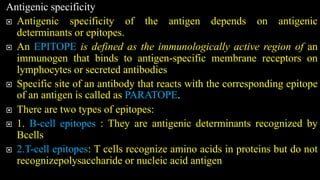
 Antigenic specificity of the antigen depends on antigenic
determinants or epitopes.
 An EPITOPE is defined as the immunologically active region of an
immunogen that binds to antigen-specific membrane receptors on
lymphocytes or secreted antibodies
 Specific site of an antibody that reacts with the corresponding epitope
of an antigen is called as PARATOPE.
 There are two types of epitopes:
 1. B-cell epitopes : They are antigenic determinants recognized by
Bcells
 2.T-cell epitopes: T cells recognize amino acids in proteins but do not
recognizepolysaccharide or nucleic acid antigen
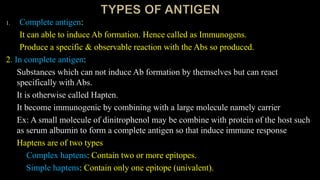
1. Complete antigen:
It can able to induce Ab formation. Hence called as Immunogens.
Produce a specific & observable reaction with the Abs so produced.
2. In complete antigen:
Substances which can not induce Ab formation by themselves but can react
specifically with Abs.
It is otherwise called Hapten.
It become immunogenic by combining with a large molecule namely carrier
Ex: A small molecule of dinitrophenol may be combine with protein of the host such
as serum albumin to form a complete antigen so that induce immune response
Haptens are of two types
Complex haptens: Contain two or more epitopes.
Simple haptens: Contain only one epitope (univalent).
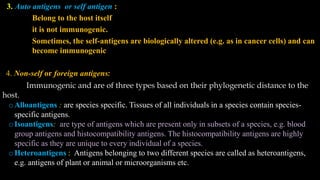
3. Auto antigens or self antigen :
Belong to the host itself
it is not immunogenic.
Sometimes, the self-antigens are biologically altered (e.g. as in cancer cells) and can
become immunogenic
4. Non-self or foreign antigens:
Immunogenic and are of three types based on their phylogenetic distance to the
host.
oAlloantigens : are species specific. Tissues of all individuals in a species contain species-
specific antigens.
oIsoantigens: are type of antigens which are present only in subsets of a species, e.g. blood
group antigens and histocompatibility antigens. The histocompatibility antigens are highly
specific as they are unique to every individual of a species.
oHeteroantigens : Antigens belonging to two different species are called as heteroantigens,
e.g. antigens of plant or animal or microorganisms etc.
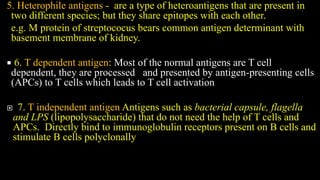
5. Heterophile antigens - are a type of heteroantigens that are present in
two different species; but they share epitopes with each other.
e.g. M protein of streptococus bears common antigen determinant with
basement membrane of kidney.
 6. T dependent antigen: Most of the normal antigens are T cell
dependent, they are processed and presented by antigen-presenting cells
(APCs) to T cells which leads to T cell activation
 7. T independent antigen Antigens such as bacterial capsule, flagella
and LPS (lipopolysaccharide) that do not need the help of T cells and
APCs. Directly bind to immunoglobulin receptors present on B cells and
stimulate B cells polyclonally
 Superantigens are the third variety of biological class of antigens, recently
described in the last decade.
 Unique feature of superantigens is, they can activate T cells directly without
being processed by antigen presenting cells (APCs).
 Examples of superantigens are staphylococcal enterotoxins, toxic shock
syndrome toxin and also some viral proteins.
11