AUTACOIDS
(I)
HISTAMINE
AND
ANTI HISTAMINES
Aims and Objectives
The term autacoid is used for a group of
hormone like substances, which
originate from tissues, and produce
effects at the site of release.
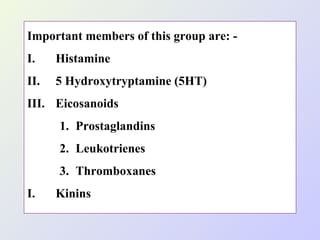
Important members of this group are: I.

Histamine

II.

5 Hydroxytryptamine (5HT)

III. Eicosanoids
1. Prostaglandins
2. Leukotrienes
3. Thromboxanes
I.

Kinins
Autacoids play an important role in
the causation of inflammatory
reactions, and a variety of other
clinical disorders.
The agonists and antagonists belonging to this
group of substances are of considerable clinical
importance, and will, therefore, be discussed in
detail.
This lecture deals with Histamine and
Antihistamines.
HISTAMINE
Histamine is derived from amino acid
Histidine. It is found in lungs, skin and GIT.
Present in high concentrations in mast cells.
Also a component of venoms and secretions
from insect stings.
In the mast cells histamine is stored in
granules. The release of histamine from the
granules is responsible for inflammatory
and allergic reactions.
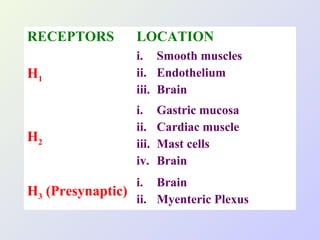
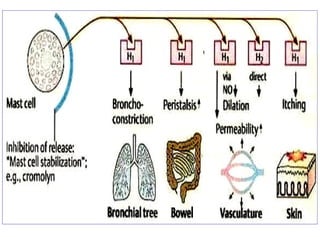
RECEPTORS

LOCATION

H1

i. Smooth muscles
ii. Endothelium
iii. Brain

H2

i.
ii.
iii.
iv.

Gastric mucosa
Cardiac muscle
Mast cells
Brain

i. Brain
H3 (Presynaptic)
ii. Myenteric Plexus
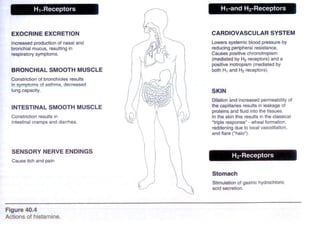
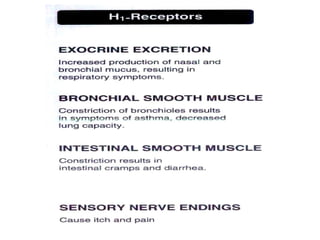
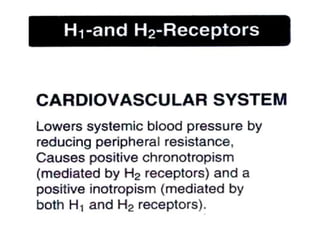
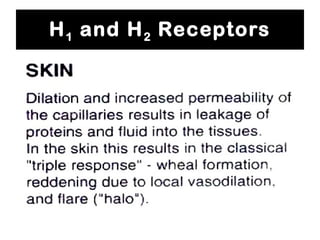
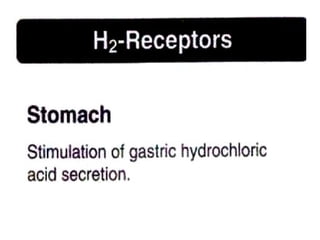
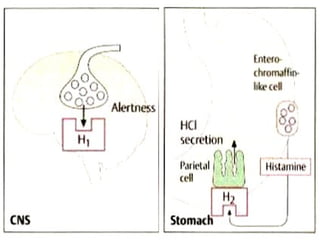
H 1 and H 2 Receptors
ANTIHISTAMINES
(H1 BLOCKERS)
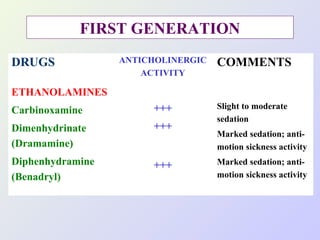
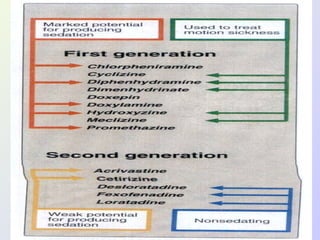
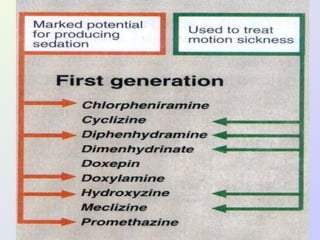
FIRST GENERATION
DRUGS

ANTICHOLINERGIC
ACTIVITY

COMMENTS

Carbinoxamine

+++

Dimenhydrinate
(Dramamine)

+++

Slight to moderate
sedation

Diphenhydramine
(Benadryl)

+++

ETHANOLAMINES

Marked sedation; antimotion sickness activity
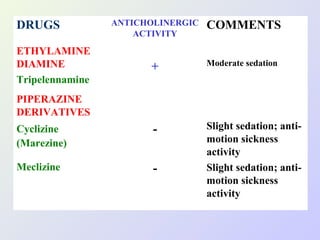
DRUGS

ANTICHOLINERGIC
ACTIVITY

COMMENTS

+

Moderate sedation

Cyclizine
(Marezine)

-

Meclizine

-

Slight sedation; antimotion sickness
activity
Slight sedation; antimotion sickness
activity

ETHYLAMINE
DIAMINE
Tripelennamine
PIPERAZINE
DERIVATIVES
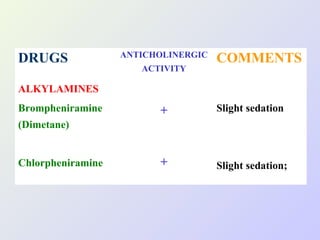
DRUGS

ANTICHOLINERGIC
ACTIVITY

COMMENTS

ALKYLAMINES
Brompheniramine

+

Slight sedation

+

Slight sedation;

(Dimetane)
Chlorpheniramine
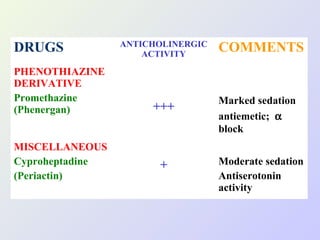
DRUGS
PHENOTHIAZINE
DERIVATIVE
Promethazine
(Phenergan)
MISCELLANEOUS
Cyproheptadine
(Periactin)

ANTICHOLINERGIC
ACTIVITY

+++

+

COMMENTS

Marked sedation
antiemetic; α
block
Moderate sedation
Antiserotonin
activity
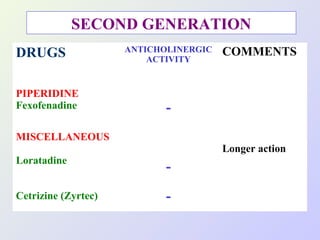
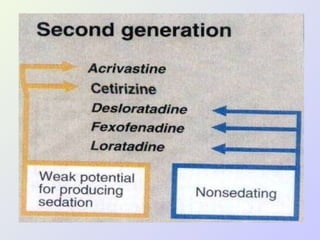
SECOND GENERATION
DRUGS
PIPERIDINE
Fexofenadine

ANTICHOLINERGIC
ACTIVITY

COMMENTS

-

MISCELLANEOUS

Longer action

Loratadine

-

Cetrizine (Zyrtec)

-
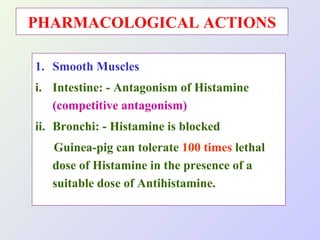
PHARMACOLOGICAL ACTIONS
1. Smooth Muscles
i. Intestine: - Antagonism of Histamine
(competitive antagonism)
ii. Bronchi: - Histamine is blocked
Guinea-pig can tolerate 100 times lethal
dose of Histamine in the presence of a
suitable dose of Antihistamine.
2. Blood Pressure
The initial rapid hypotensive effect is
antagonized by H1 blockers. The hypotensive
effect in the second phase is antagonized by
H2 blockers.
3. HCl secretion: No effect
4.

CNS
The first generation induces sedation.
Central excitation is the striking effect of
Poisoning.

5.

Anticholinergic actions
Atropine like actions. The second
generation has no such effects.
6. Local anesthetic action
Promethazine
Pyrilamine
However, large doses are required.
7. Blockade of α 1 Adrenergic receptors
Promethazine  Hypotension
8.

Other Effects
i. Capillary Permeability and Edema
H1 antagonists strongly block the action
of Histamine, that results in increased
capillary permeability and formation of
edema and wheal.
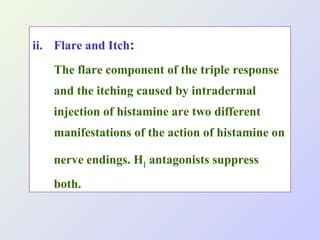
ii. Flare and Itch:
The flare component of the triple response
and the itching caused by intradermal
injection of histamine are two different
manifestations of the action of histamine on
nerve endings. H1 antagonists suppress
both.
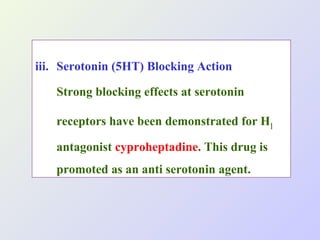
iii. Serotonin (5HT) Blocking Action
Strong blocking effects at serotonin
receptors have been demonstrated for H1
antagonist cyproheptadine. This drug is
promoted as an anti serotonin agent.
THERAPEUTIC USES
I. ALLERGIC DISORDERS
1. Pruritis (Itching)
2. Urticaria
3. Vasomotor Rhinitis
4. Allergic responses to insect bites, chemicals
5. Allergic responses to Drugs
6. Common cold
II.

MOTION SICKNESS (Prophylaxis)
Promethazine strongest in the group,

because of anticholinergic effect (See
Scopolamine).
III.

NAUSEA & VOMITING
Dimenhydrinate (Drammamine)
Cyclizine HCl (Marezine)
Vestibular Disturbance; Meniere’s Disease
IV. SEDATION (CNS DEPRESSION)
Diphenhydramine (Benadryl)
V.

ANAPHYLACTIC SHOCK
1. Edema & Itch  Blocked
2. Hypotension  Controlled to a lesser
extent
3. Bronchospasm  No Effect
Note: - Other substances involved.
SIDE EFFECTS
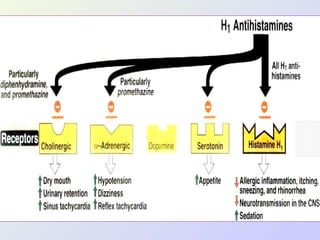
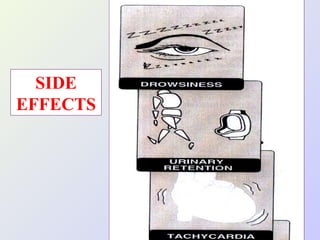
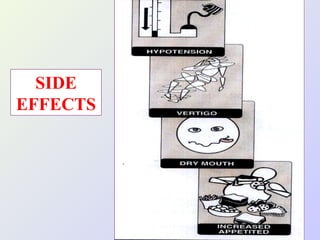
1. ANTIMUSCARINIC EFFECTS
i) Dryness of mouth
ii) Retention of urine
iii) Dryness of respiratory passages.
These effects are not seen with Second
Generation.
2. CENTRAL ACTIONS (CNS)
i) Sedation (not 2nd generation). May be
useful effect in some cases.
ii) Other central actions.
Dizziness; Tinnitus; Lassitude*; Euphoria;
Tremors; Nervousness
_______________________________________
* Laziness, Sluggishness
3. DIGESTIVE TRACT
Loss of Appetite; Epigastric distress
4. POLYMORPHIC VENTRICULAR
TACHYCARDIA
Terfenadine  Withdrawn
5. OTHER EFFECTS
Mutagenecity; Leukopenia; Agranulocytosis
ACUTE POISONING
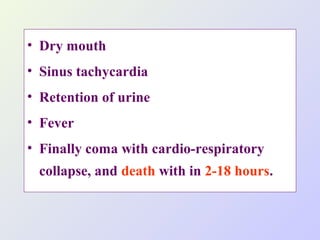
• Effects strikingly resemble acute
Atropine poisoning.
• Central excitatory effect
• Dilated pupils
• Flushed face
• Dry mouth
• Sinus tachycardia
• Retention of urine
• Fever
• Finally coma with cardio-respiratory
collapse, and death with in 2-18 hours.
SIDE
EFFECTS
SIDE
EFFECTS
QUESTIONS
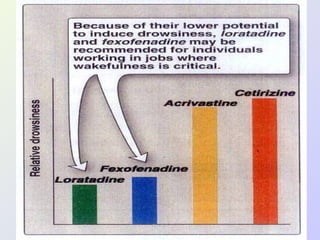
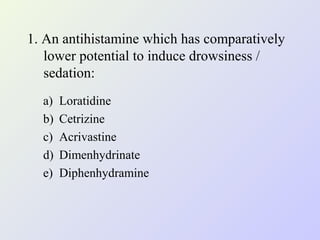
1. An antihistamine which has comparatively
lower potential to induce drowsiness /
sedation:
a)
b)
c)
d)
e)

Loratidine
Cetrizine
Acrivastine
Dimenhydrinate
Diphenhydramine
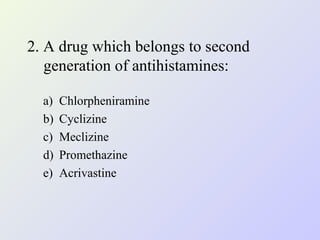
2. A drug which belongs to second
generation of antihistamines:
a)
b)
c)
d)
e)

Chlorpheniramine
Cyclizine
Meclizine
Promethazine
Acrivastine
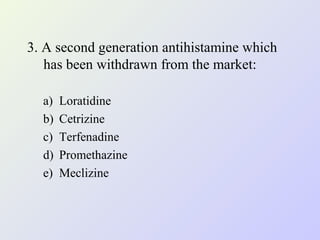
3. A second generation antihistamine which
has been withdrawn from the market:
a)
b)
c)
d)
e)

Loratidine
Cetrizine
Terfenadine
Promethazine
Meclizine
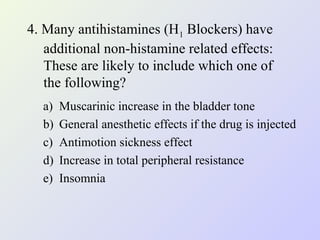
4. Many antihistamines (H1 Blockers) have
additional non-histamine related effects:
These are likely to include which one of
the following?
a)
b)
c)
d)
e)

Muscarinic increase in the bladder tone
General anesthetic effects if the drug is injected
Antimotion sickness effect
Increase in total peripheral resistance
Insomnia

Autacoids (i)