PHARMACODYNAMICS
(II)
AIMS AND OBJECTIVES
The topics discussed in this lecture: -
i. Graded dose response curves
ii. Potency and Efficacy
iii.Therapeutic index
iv.Types of antagonism
v. Important definitions
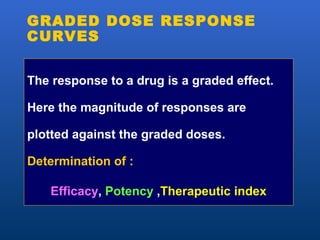
GRADED DOSE RESPONSE
CURVES
The response to a drug is a graded effect.
Here the magnitude of responses are
plotted against the graded doses.
Determination of :
Efficacy, Potency ,Therapeutic index
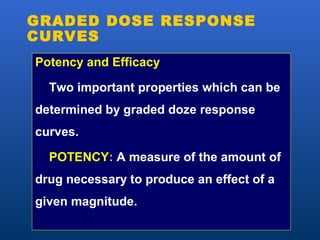
Potency and Efficacy
Two important properties which can be
determined by graded doze response
curves.
POTENCY: A measure of the amount of
drug necessary to produce an effect of a
given magnitude.
GRADED DOSE RESPONSE
CURVES
EFFICACY
The magnitude of the response after
occupation of the receptors.
GRADED DOSE RESPONSE
CURVES
CBA
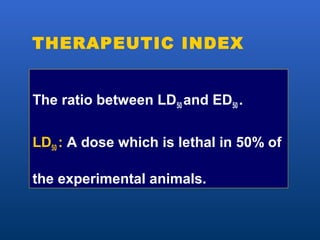
THERAPEUTIC INDEX
The ratio between LD50 and ED50 .
LD50 : A dose which is lethal in 50% of
the experimental animals.
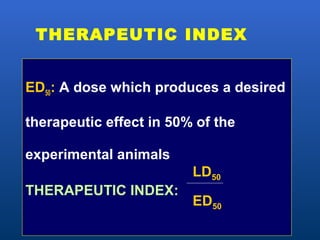
ED50: A dose which produces a desired
therapeutic effect in 50% of the
experimental animals
THERAPEUTIC INDEX:
LD50
ED50
THERAPEUTIC INDEX
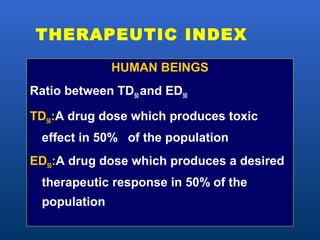
HUMAN BEINGS
Ratio between TD50 and ED50
TD50:A drug dose which produces toxic
effect in 50% of the population
ED50:A drug dose which produces a desired
therapeutic response in 50% of the
population
THERAPEUTIC INDEX
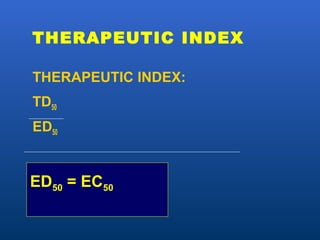
THERAPEUTIC INDEX:
TD50
ED50
ED50 = EC50
THERAPEUTIC INDEX
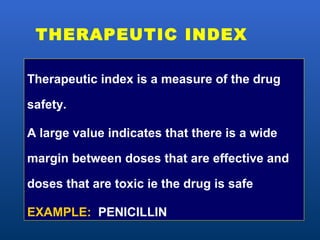
Therapeutic index is a measure of the drug
safety.
A large value indicates that there is a wide
margin between doses that are effective and
doses that are toxic ie the drug is safe
EXAMPLE: PENICILLIN
THERAPEUTIC INDEX
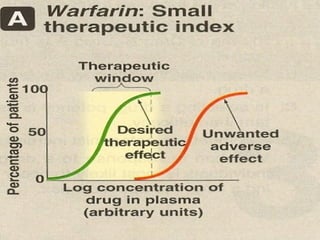
A small value indicates that the margin
between the toxic and effective doses is
small.
The drug can produce toxic effects with
slight increase in the dose
EXAMPLE: WARFARIN
THERAPEUTIC INDEX
CHEMICAL
ANTAGONISM
DIMERCAPROL
ANTACIDS
PROTAMINE
DEFEROXAMINE
HEAVY METALS
HCl (stomach)
HEPARIN
IRON
Chemical interaction
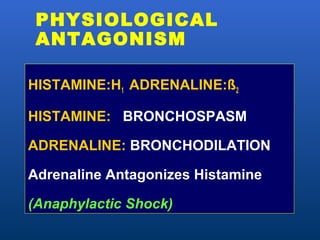
PHYSIOLOGICAL
ANTAGONISM
HISTAMINE:H1 ADRENALINE:ß2
HISTAMINE: BRONCHOSPASM
ADRENALINE: BRONCHODILATION
Adrenaline Antagonizes Histamine
(Anaphylactic Shock)
AGONIST ANTAGONIST
Histamine
Acetylcholine
Epinephrine
Norepinephrine
Chlorpheniramine
Atropine
Propranolol
Tolazoline
The agonist and antagonist compete
for the same receptors
PHARMACOLOGICA
L
ANTAGONISM
PHARMACOLOGICAL
ANTAGONISM
Competitive: Maximum effect can be
obtained in the presence of Antagonist
NE TOLAZOLINE
Non competitive: Maximum effect can not
be obtained
NE  DIBENAMINE
TOLAZOLINE DIBENAMINE
BIOCHEMICAL
ANTAGONISM
ENZYME INDUCERS
DRUGS DRUGS AFFECTED
Rifampin
Phenytoin
Griseofulvin
Warfarin
Oral contraceptives
Cortisol
Warfarin
Phenobarbital
The factors affecting drug actions:
Drug preparations, route of
administration, interaction,
individual difference, allergic
reaction, physiologic and pathologic
status, drug-resistance and
environmental factors.
IMPORTANT
DEFINITIONS
1. TOLERANCE: Responsiveness
decreases as a consequence of
continued drug administration.
Morphine; Opium
2. TACHYPHYLAXIS: Rapidly developing
tolerance. Ephedrine
Ο Ο Ο Ο Ο
DOG’s BLOOD PRESSURE: EPHEDRINE, THE
SAME DOSE REPEATED AFTER SHORT
INTERVALS
3. IDIOSYNCRASY: Abnormal responses to
drugs due to genetic abnormalities
4. HYPERSENSITIVITY: Allergic
(immunological) responses to drugs
Drug acts as an antigen; TYPE I, II, III, IV
5. HYPER REACTIVITY: When the intensity
of the effect of a drug is increased in
comparison to most individuals
Epinephrine → Thyrotoxicosis
6. HYPO REACTIVITY: When the intensity
of the effect of a drug is decreased in
comparison to most individuals
Epinephrine → Myxoedeme
TOLERANCE,
REFARACTORINESS,
RESISTANCE
CAUSES:
o Changes in the sensitivity of receptors
o Exhaustion of mediators
o Increased metabolic degradation
o Increased elimination
QUESTIONS
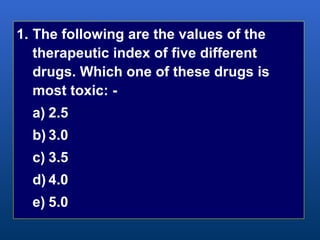
1. The following are the values of the
therapeutic index of five different
drugs. Which one of these drugs is
most toxic: -
a) 2.5
b) 3.0
c) 3.5
d) 4.0
e) 5.0
2. In human beings, the value of
Therapeutic index is expressed by
the ration: -
a) LD50 / ED50
b) ED50 / LD50
c) TD50 / ED50
d) ED50 / TD50
e) TD50 / LD50
3. The mechanism of action of antagonism of
Heparin by Protamine is similar to the
mechanism involved in the antagonism of : -
a) Iron by Deferoxamine
b) Histamine by Omeprazole
c) Acetylcholine by Atropine
d) Histamine by Epinephrine
e) Norepinephrine by Tolazoline
4. The antagonism of NE by Tolazoline
is an example of: -
a) Noncompetitive antagonism
b) Competitive antagonism
c) Chemical antagonism
d) Biochemical antagonism
e) Physiological antagonism

Pharmacodynamics 2