ANTIDIURETICS
DR.G.VANITHA.M.D
INTRODUCTION
 DEFINITION:
Reduce the urine volume(DI)
ANTIDIURETICS
Antidiuretic hormone and Its analogues
Vasopressin (ADH)
Desmopressin
Lypressin
Terlipression
NATRIURETICS
Thiazide
amiloride
MISCELLANEOUS
Carbamazepine
Chlorpropammide
Indomethacin
ANTIDIURETIC HORMONE (Arginine
Vasopressin-AVP)
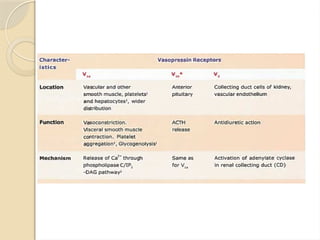
RECEPTORS DISTRIBUTION
 G protein coupled cell membrane receptors
 V1 Receptors
 phospholipase C- lP/ DAG pathway
 1.vasoconstriction
 2. visceral smooth muscle contraction
 3.glycogenolysis
 4.platelet aggregation,
 5.ACTH
 DAG mediated protein kinase C activation
PHARMACOLOGICAL ACTIONS
KIDNEY
Blood vessel
BLOOD
CNS
UTERUS
GIT
KIDNEY-CD(principle cell)
 BLOODVESSEL
VI receptors
Increases peripheral resistance
vascular smooth muscle hypertrophy.
 GIT
Increased peristalsis in Gut
 UTERUS
contracted AVP acting on oxytocin receptor
CNS
Peptide neurotransmitter brain and spinal cord.
Regulation of body temperature
Systemic circulation,
ACTH release,
BLOOD
AV P induces platelet aggregation
FactorVIII and von Willebrand's factor (V2 receptors)
PharmacokInetics
ROUTES
1.PARENTRAL(i.m,s.c,i.v)
2.INTRANASAL
Inactive orally (trypsin)
METABOLISM
Liver-Enzymatic cleavage
kidney
t½ is short ~ 25 min
VASOPRESSIN ANALOGUES
1.Vasopressin
2. Lypressin
3.Terlipressin
4.Desmopressin (dDAVP)
5.Felypressin
 Vasopressin(V1,V2)
 Short duration(20min)
 Any route
 Lypressin ( 8-lysine vasopressin)
 V1
 Longest action 4-6hrs (i.m,s.c)
 Terlipressin
 Prodrug
 Bleeding esophageal varices
 Less severe adverse effects
 Longer acting
 Felypressin -V1
 Short duration(20min)
 Vasoconstriction+local anaesthetics
prolong action
Desmopressin (dDAVP)
V2 agonist
More potent ,Longer acting
Negligible vasoconstrictor
 Desmopressin is the preparation of
choice for V2 receptor related indication

 The intranasal route is preferred IO to
20%
 oral formulation bioavailability of 1- 2%;
oral dose is 10-15 times higher than the
intranasal dose
 oral tablet more convenient
Uses
 Based onV2 actions (Desmopressin is the
drug of choice)
 I . Diabetes insipidus
DI of pituitary origin (neurogenic) is the
most important indication
Ineffective in renal (nephrogenic)
Dose of desmopressin is individualized by
measuring 24 hour urine volume.
 2. Bedwetting in children and nocturia in
adults
 lntra nasal or oral desmopressin at
bedtime
 3.Renal concentration test
 i.m. of aqueous vasopressin or
desmopressin maximum urinary
concentration urinary specific gravity.
 4. Haemophilia, von Willebrand's disease
Based onV1 actions
 I. Bleeding esophageal varices Vasoprcssin/
terlipressin mesenteric blood vessels
allowing clot formation
Sclerotherapy
 2. Before abdominal radiography
lypressin -drive out gases from bowel
Adverse effects
 Transient headache / flushing
 local application
Nasal irritation, congestion, rhinitis , ulceration and
epistaxis
 Systemic :
 belching, nausea,
 urge to defecate
 seizures. Children are more susceptible
 Bradycardia
 Precipitate angina by constricting coronary vessels.
 Urticaria
VASOPRESSIN ANTAGONISTS
 Tolvaptan
 orally hyponatraemia due to C HF,
 cirrhosis of liver
 (SIADH).
 thrombotic complications due to
haemoeoncentralion, thirst and dry mouth
 CYP3A4
 Mozavaptan (V2)
 Conivaptan (V1+V2 )
THIAZIDES
 Neurogenic and Nephrogenic DI
 Hydrochlorothiazide 25- 50 mg TDS
Amiloride
lithiuminduced nephrogenic DI
block entry of Na+ in the principal cells of
CD, it also blocks Li entry
Indomethacin
renal DI reducing renal PG synthesis
Antidiuretics .pptx.....................

Antidiuretics .pptx.....................