ANTIDIURETICS
Dr. Ajay Kumar
M. Pharm., PhD
INTRODUCTION
 Definition: These are drugs that reduce urine volume.
 Specially used in condition like diabetes insipidus (DI).
 Classification of Anti diureticAgents:
 1 Antidiuretic hormone: (ADH,Vasopressin),Desmopressin,Lypressin,
Terlipressin
 2 Thiazide diuretics:Amiloride.
 3 Miscellaneous: Indomethacin, Chlorpropamide, Carbamazepine
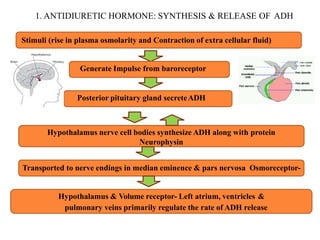
1. ANTIDIURETIC HORMONE: SYNTHESIS & RELEASE OF ADH
Stimuli (rise in plasma osmolarity and Contraction of extra cellular fluid)
Generate Impulse from baroreceptor
Posterior pituitary gland secreteADH
Hypothalamus nerve cell bodies synthesize ADH along with protein
Neurophysin
Transported to nerve endings in median eminence & pars nervosa Osmoreceptor-
Hypothalamus & Volume receptor- Left atrium, ventricles &
pulmonary veins primarily regulate the rate of ADH release
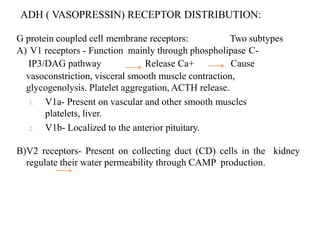
ADH ( VASOPRESSIN) RECEPTOR DISTRIBUTION:
G protein coupled cell membrane receptors: Two subtypes
A) V1 receptors - Function mainly through phospholipase C-
IP3/DAG pathway Release Ca+ Cause
vasoconstriction, visceral smooth muscle contraction,
glycogenolysis. Platelet aggregation, ACTH release.
1. V1a- Present on vascular and other smooth muscles
platelets, liver.
2. V1b- Localized to the anterior pituitary.
B)V2 receptors- Present on collecting duct (CD) cells in the kidney
regulate their water permeability through CAMP production.
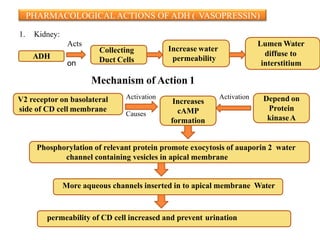
PHARMACOLOGICAL ACTIONS OF ADH ( VASOPRESSIN)
ADH
Collecting
Duct Cellson
Increase water
permeability
1. Kidney:
Acts Lumen Water
diffuse to
interstitium
Mechanism of Action 1
V2 receptor on basolateral
side of CD cell membrane
Increases
cAMP
formation
Activation
Causes
Activation Depend on
Protein
kinaseA
Phosphorylation of relevant protein promote exocytosis of auaporin 2 water
channel containing vesicles in apical membrane
More aqueous channels inserted in to apical membrane Water
permeability of CD cell increased and prevent urination
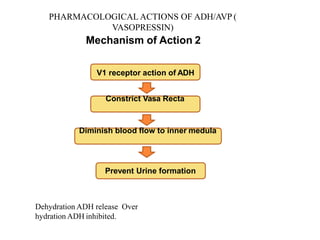
Mechanism of Action 2
V1 receptor action of ADH
Constrict Vasa Recta
Diminish blood flow to inner medula
Prevent Urine formation
PHARMACOLOGICAL ACTIONS OF ADH/AVP (
VASOPRESSIN)
Dehydration ADH release Over
hydration ADH inhibited.
PHARMACOLOGICAL ACTIONS OF ADH( VASOPRESSIN)
2. Blood Vessels:
ADH acts on V1 receptor
Constriction of blood vessels ( Hence name Vasopressin)
Increases blood pressure
2. Other action:
•Smooth muscles- Constricted
•Gut- Increased peristalsis, evacuation and expulsion of gase
•Uterus- Constricted
•CNS- ADH not penetrate BBB
•Lever- Glyconeogenesis
 Absorption- Orally inactive because destroyed by trypsin
 Metabolism- Liver
 Excretion- Kidney
ANALOGUES OF ADH/AVP ( VASOPRESSIN)
 Lypressin- 8-lysin analogues; acts on both receptor;
longer duration of action;
 Terlipressin- Synthetic prodrug; mainly used for bleeding
esophageal varices.
 Desmopressin- Synthetic peptide; selective V2 agonist;
12times more potent than all;
But produces systemic side effects which are overcomes
by nasal application.
PHARMACOKINETICS OF ADH( VASOPRESSIN)
USES:
A. Based on V2 action:
1. Diabetes insipidus (DI)- DI of pituitary origin (neurogenic) important
indication for vasopressin but ineffective in renal DI (nephrogenic).
2. Bedwetting in children & nocturia in adults- Desmopressin reduceurine
volume resulting control nocturia condition.
3. Renal concentration test- 5-10 U i/m causes maximum urineretention and
urine concentration.
4. Haemophilia, Von Willebrand’s disease- It is genetic disorder where
missing or defective vonWillebrand factor (VWF), a clotting proteinis
observed. While ADP releases clottingfactor.
B. Based on V1 action:
1. Bleeding esophageal varices: Vasopressin stops the bleeding by constricting
mesenteric blood vesscles and reducing blood flow though liver & allowing
clot formation.
2. Before abdominal radiography: Lypressin used to drive out gases form bowel
facilitate easy abdominal radiography.
ADVERSE DRUG EFFECT:
Vasopressin, lypressin or terlipressin are nonselsctive derivatives so shows more
side effects as compaire to desmopressin (V2 selective).
• Transient headache and flusing- common.
• Nasal irritation, congestion, rhinitis, ulceration and epistaxis(nose
bleeding)
• Systemic effects- belching, nausea, abdominal cramps, pallor, urgeto
defecate, backache in females (due to uterine contraction).
• Fluid retention and hyponatraemia.
• ADP causes bradycardia, increase cardiac afterload and precipitate
angina by constricting coronary vessels.
CONTRAINDICATION:
• Patients with;
• Ischemic heart disease,
• Hypertension,
• chronic nephritis
• psychogenic polydipsia.
• Urticaria and other allergies
2.THIAZIDES DERIVATIVES:
Actually thiazide and high ceiling diuretics are diuretic drug but
which provides antidiuretic effect in Diabetes insipidus. high
ceiling diuretics are not used because is having short and strong
action.
Thiazides reduce urine volume in both pituitary origin and renal
Diabetes insipidus.
Used when ADH is ineffective.
Mechanism of Action
Actual mechanism is unknown; But thiazides may induce sustained
electrolyte depletion . Thiazides reduces g.f.r. and produce fluid
load on tubules.
3. MISCELLANEOUS DERIVATIVES:
These all are supportive derivatives for antidiuretic activity:
Amloride hydrochloride is a pyrazine-carbonyl-guanidine it is a drug of
choice for lithium induced nephrogenic Diabetes insipidus.
Indomethacin: Reduce polyuria in renal Diabetes insipidus.
Chlorpropamide: It sensitizes ADH to acts on kidneycells.
Thank you

Antidiuretics

  • 1.
  • 2.
    INTRODUCTION  Definition: Theseare drugs that reduce urine volume.  Specially used in condition like diabetes insipidus (DI).  Classification of Anti diureticAgents:  1 Antidiuretic hormone: (ADH,Vasopressin),Desmopressin,Lypressin, Terlipressin  2 Thiazide diuretics:Amiloride.  3 Miscellaneous: Indomethacin, Chlorpropamide, Carbamazepine
  • 3.
    1. ANTIDIURETIC HORMONE:SYNTHESIS & RELEASE OF ADH Stimuli (rise in plasma osmolarity and Contraction of extra cellular fluid) Generate Impulse from baroreceptor Posterior pituitary gland secreteADH Hypothalamus nerve cell bodies synthesize ADH along with protein Neurophysin Transported to nerve endings in median eminence & pars nervosa Osmoreceptor- Hypothalamus & Volume receptor- Left atrium, ventricles & pulmonary veins primarily regulate the rate of ADH release
  • 4.
    ADH ( VASOPRESSIN)RECEPTOR DISTRIBUTION: G protein coupled cell membrane receptors: Two subtypes A) V1 receptors - Function mainly through phospholipase C- IP3/DAG pathway Release Ca+ Cause vasoconstriction, visceral smooth muscle contraction, glycogenolysis. Platelet aggregation, ACTH release. 1. V1a- Present on vascular and other smooth muscles platelets, liver. 2. V1b- Localized to the anterior pituitary. B)V2 receptors- Present on collecting duct (CD) cells in the kidney regulate their water permeability through CAMP production.
  • 5.
    PHARMACOLOGICAL ACTIONS OFADH ( VASOPRESSIN) ADH Collecting Duct Cellson Increase water permeability 1. Kidney: Acts Lumen Water diffuse to interstitium Mechanism of Action 1 V2 receptor on basolateral side of CD cell membrane Increases cAMP formation Activation Causes Activation Depend on Protein kinaseA Phosphorylation of relevant protein promote exocytosis of auaporin 2 water channel containing vesicles in apical membrane More aqueous channels inserted in to apical membrane Water permeability of CD cell increased and prevent urination
  • 6.
    Mechanism of Action2 V1 receptor action of ADH Constrict Vasa Recta Diminish blood flow to inner medula Prevent Urine formation PHARMACOLOGICAL ACTIONS OF ADH/AVP ( VASOPRESSIN) Dehydration ADH release Over hydration ADH inhibited.
  • 7.
    PHARMACOLOGICAL ACTIONS OFADH( VASOPRESSIN) 2. Blood Vessels: ADH acts on V1 receptor Constriction of blood vessels ( Hence name Vasopressin) Increases blood pressure 2. Other action: •Smooth muscles- Constricted •Gut- Increased peristalsis, evacuation and expulsion of gase •Uterus- Constricted •CNS- ADH not penetrate BBB •Lever- Glyconeogenesis
  • 8.
     Absorption- Orallyinactive because destroyed by trypsin  Metabolism- Liver  Excretion- Kidney ANALOGUES OF ADH/AVP ( VASOPRESSIN)  Lypressin- 8-lysin analogues; acts on both receptor; longer duration of action;  Terlipressin- Synthetic prodrug; mainly used for bleeding esophageal varices.  Desmopressin- Synthetic peptide; selective V2 agonist; 12times more potent than all; But produces systemic side effects which are overcomes by nasal application. PHARMACOKINETICS OF ADH( VASOPRESSIN)
  • 9.
    USES: A. Based onV2 action: 1. Diabetes insipidus (DI)- DI of pituitary origin (neurogenic) important indication for vasopressin but ineffective in renal DI (nephrogenic). 2. Bedwetting in children & nocturia in adults- Desmopressin reduceurine volume resulting control nocturia condition. 3. Renal concentration test- 5-10 U i/m causes maximum urineretention and urine concentration. 4. Haemophilia, Von Willebrand’s disease- It is genetic disorder where missing or defective vonWillebrand factor (VWF), a clotting proteinis observed. While ADP releases clottingfactor. B. Based on V1 action: 1. Bleeding esophageal varices: Vasopressin stops the bleeding by constricting mesenteric blood vesscles and reducing blood flow though liver & allowing clot formation. 2. Before abdominal radiography: Lypressin used to drive out gases form bowel facilitate easy abdominal radiography.
  • 10.
    ADVERSE DRUG EFFECT: Vasopressin,lypressin or terlipressin are nonselsctive derivatives so shows more side effects as compaire to desmopressin (V2 selective). • Transient headache and flusing- common. • Nasal irritation, congestion, rhinitis, ulceration and epistaxis(nose bleeding) • Systemic effects- belching, nausea, abdominal cramps, pallor, urgeto defecate, backache in females (due to uterine contraction). • Fluid retention and hyponatraemia. • ADP causes bradycardia, increase cardiac afterload and precipitate angina by constricting coronary vessels. CONTRAINDICATION: • Patients with; • Ischemic heart disease, • Hypertension, • chronic nephritis • psychogenic polydipsia. • Urticaria and other allergies
  • 11.
    2.THIAZIDES DERIVATIVES: Actually thiazideand high ceiling diuretics are diuretic drug but which provides antidiuretic effect in Diabetes insipidus. high ceiling diuretics are not used because is having short and strong action. Thiazides reduce urine volume in both pituitary origin and renal Diabetes insipidus. Used when ADH is ineffective. Mechanism of Action Actual mechanism is unknown; But thiazides may induce sustained electrolyte depletion . Thiazides reduces g.f.r. and produce fluid load on tubules.
  • 12.
    3. MISCELLANEOUS DERIVATIVES: Theseall are supportive derivatives for antidiuretic activity: Amloride hydrochloride is a pyrazine-carbonyl-guanidine it is a drug of choice for lithium induced nephrogenic Diabetes insipidus. Indomethacin: Reduce polyuria in renal Diabetes insipidus. Chlorpropamide: It sensitizes ADH to acts on kidneycells.
  • 13.