ANTI-DIURETIC
By
16DUIROO50
R.AKHILA
CONTENTS
* INTRODUCTION
* VIEW ON KIDNEY
* PATHOPHYSIOLOGY OF ADH
* CLASSIFICATION
* MECHANISM OF ACTION
* USES
INTRODUCTION
• Anti- Diuretics are the agents that inhibit the process
of diuretics to maintain body's water balance, There
also reffered as Anti_Aquaretices as they prevent the
loss of water from the body with out disturbing the
process of elemination of salts they are primarly used
for treating Diabetes Insipidus it is a condition in
which ecessive quantities of very dilute urine is
excreted due to impairment in the synthesis and
secretion of vasopressin by the Hypothalamus and
Posterior primarly respectively or due to the failure
of kidneys to respond to VASOPRESSIN.
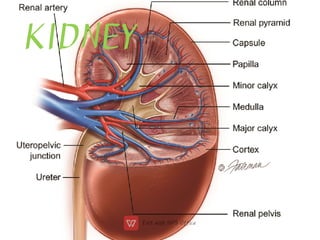
KIDNEY
VIEW ON KIDNEY
•
•
•
•
•
•
•
•
Kidneys are a pair of Bean shaped organs on either side of our
spine of below the Ribs and behind the Belly.
Each kidney is about 4 or 5 Inches long its main function is to
Filter our Blood.
MAIN FUNCTION
Regulation of Osmolarity
Regulation of Ion concentration
Regulation of PH
Excretion of waste and Toxins
Production of Hormones .
CAUSES OF KIDNEY FAILURE
•
•
•
•
•
•
Physical injury or other disorders High blood pressure
and Diabetes or to most common causes of kidney
failure .
Chronic Glomerulonephritis( kidney damage )
High blood sugar ( diabetes mellitus)
Polycystic kidney disease
It blocks urinary tract
Kidney infections.ETC...............
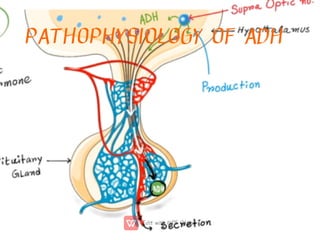
PATHOPHYSIOLOGY OF ADH
CIRCUMSTANCES TO NEED CONSERVE
WATER
•
•
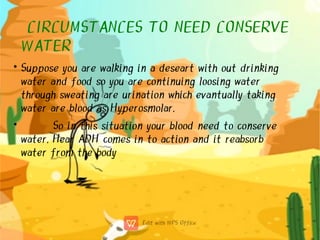
Suppose you are walking in a deseart with out drinking
water and food so you are continuing loosing water
through sweating are urination which evantually taking
water are blood as Hyperosmolar.
So in this situation your blood need to conserve
water. Hear ADH comes in to action and it reabsorb
water from the body
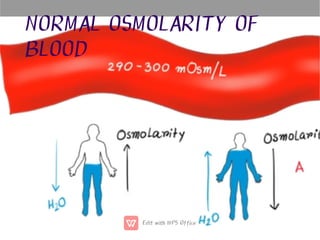
NORMAL OSMOLARITY OF
BLOOD
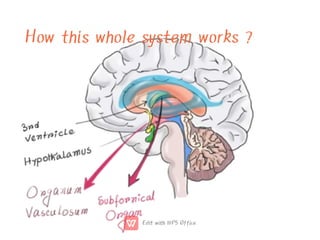
How this whole system works ?
WE MUST KNOWING ABOUT
OSMOLARITY
•
•
•
Here they're is Hypothalamus and 3 ventricular having
some osmoreceptors which we can sence Osmolarity of
blood.
When we comes through specialised structures there
is subfornical organs and organum vasculosum
Blood Brain Barriers can easily sense the Osmolarity
of Blood and gives signal to Hypothalamus per ADH
secressions.
How ADH WORKS?
•
•
•
ADH is also called as VASOPRESSIN it causes vasoconstriction .
At low cosentration it act as Anti-diuretics
At high concentration it act as vasoconstriction
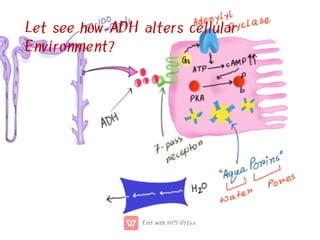
Let see how ADH alters cellular
Environment?
•
•
•
Hence this part of Nephron have receptor for ADH
there certainreseptor are 7pass reseptor are there
ADH binds with 7 pass reseptor which stimulates inter
cellular G -protien and inter cellular G- protien
stimulates Adenylyl cyclase which casess ATPinto cyclic
AMP
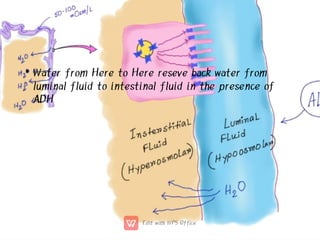
There are some inter cellular vesicules having special
protien chanaless called AQA porins thus water can
pass throught it
•
•
•
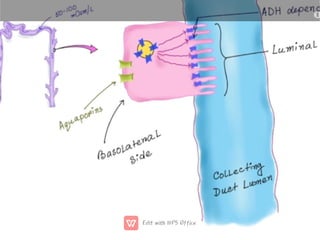
There are different sites of Aqua porins channels
which are presenting basolateral side and lumen side
are different
Only lumen side of Aqua protiens are regulated by
ADH
In the prasence of ADH aqua porin channnels are
present on the luminal side of nephron so ADH makes
this portion as water permeable
• Water from Here to Here reseve back water from
luminal fluid to intestinal fluid in the presence of
ADH
How it works as vasoconstriction?
•
•
•
•
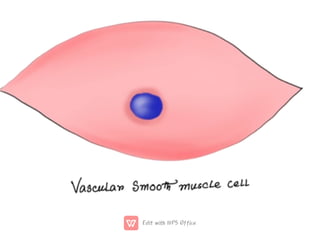
Receptor present in vascular smooth muscle cells
called V1
Receptor present in Renal epithelium cells called V2
When activated V1 receptors caused vasoconstriction of
Arterioles and increase total peripheral resistance
V2 receptors involved in water reabsorption in
collecting ducts and the maintainance of body fluids as
Osmolarity.
•
•
•
•
•
When ADH binds to V1 receptors it activates G protien
couple active receptors
It is Gq but in case of renal epithelium it is Gs or G
stimulation now activated Gq receptor stimulates
phospholipase breaks phospho Adenyl Diphosphate .
This Adenyl Diphosphate breaks into idonisyl tri
phosphate (IP3) and Diadenyl Glyserol[DAG)
In Endoplasmic reticulum of cytoplasm they have
IP3synthetising pumps produce calcium and responsible
for smooth muscle construction .
SO ADH ACT AS A VASOCONSTRICTION.
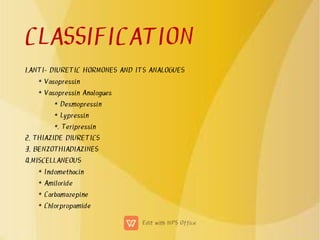
CLASSIFICATION
1.ANTI- DIURETIC HORMONES AND ITS ANALOGUES
* Vasopressin
* Vasopressin Analogues
* Desmopressin
* Lypressin
*. Teripressin
2. THIAZIDE DIURETICS
3. BENZOTHIADIAZINES
4.MISCELLANEOUS
* Indomethacin
* Amiloride
* Carbamazepine
* Chlorpropamide
Vasopressin
•
•
•
•
•
•
Vasopressin is a pituitary hormone that acts to promote
retention of water by the kidneys and increase blood
pressure.
Mechanism of Action
It acts on renal collecting duct via V2 receptor to
increase water permeability which leads to decrease urine
formation
Uses
Used to manage anti diuretic hormone defficiency .
Used in treatment of Gastro intestinal bleeding .
Vasopressin Analouges
•
•
•
•
•
•
•
Are chemicals simlar in function but not necessarily similar in
structure to vasopressin such as desmopressin .
Desmopressin
It is aform of vasopressin and used to replace low level of
vasopressin
Mechanism of Action
It exerts haemostatis effect by inducing synthesisof von
willevarnd. Factor by endothelial cells
Uses
It also used to control Night time bet wetting in children's.k
LYPRESSIN
•
•
•
•
•
Is one of the member of vasopressin family being
comprised of Nine Amino Acids.
mechanism of Action
It increase water reabsorption in the kidney by
increasing the cellular permeability of collecting ducts
with increase in urine Osmolarity with decrease in
urine out put
Uses
To prevent or to control frequent urination
TERLIPRESSIN
•
•
•
•
•
Is an analogue of vasopressin used as a vaso active drug
in the management of low blood pressure it has been
found to be effective when Nor epinephrine does not help
Mechanism of action
Selectively causes splanchnic and external
vasoconstriction by stimulation of V1 receptor which are
predominantly located in smooth muscles in splanchnic
region and reduces splanchnic blood flow
Uses
Helps to prevent urination
THIAZIDE DIURETICS
•
•
•
•
•
•
•
•
•
Are drugs of choice for uncomplicated hypertension due to their action
Mechanism of Action
It controls hypertension in part by inhibiting re absorption of sodium
and chloride ion from the Distilled convoluted tubules
Uses
Used when vasopressin theraphy is in effective
BENZOTHIADIAZINES
Effective in treating both Nephrogenic and central diabetes Insipidus
They decrease the glomerular filteration rate and regulate of sodium
balance this increase urine concentration and decrease urine volume
It decreases efficacy
MISCELLANEOUS
•
•
•
•
•
•
•
•
•
•
•
•
•
•
•
•
•
Amiloride
Non steriodal organic base
Used as first line drug in treating lithium induced Nephrogenic Diabetes Insipidus
It is taken orally but only 1/4 of dose is observed and it's plasma half life is 20 hours
Side effects
Head ache, nausea and Diarrhoea
CARBAMAZEPINE
Anti epileptic drug at higher doses used for treating central diabetes Insipidus
It acts by enhancing the realise of vasopressin from posterior pituitary and its action reanal
tubular
Causes
Diarrhoea ,vommiting ,ETC......,
Dose
400 to 600 mg per day
CHLORPROMIDE
Oral hypoglycemic agent for treating central diabetes Insipidus
Dose
250 to 500 mg per day
Anti diuretics

Anti diuretics

  • 1.
  • 2.
    CONTENTS * INTRODUCTION * VIEWON KIDNEY * PATHOPHYSIOLOGY OF ADH * CLASSIFICATION * MECHANISM OF ACTION * USES
  • 3.
    INTRODUCTION • Anti- Diureticsare the agents that inhibit the process of diuretics to maintain body's water balance, There also reffered as Anti_Aquaretices as they prevent the loss of water from the body with out disturbing the process of elemination of salts they are primarly used for treating Diabetes Insipidus it is a condition in which ecessive quantities of very dilute urine is excreted due to impairment in the synthesis and secretion of vasopressin by the Hypothalamus and Posterior primarly respectively or due to the failure of kidneys to respond to VASOPRESSIN.
  • 4.
  • 5.
    VIEW ON KIDNEY • • • • • • • • Kidneysare a pair of Bean shaped organs on either side of our spine of below the Ribs and behind the Belly. Each kidney is about 4 or 5 Inches long its main function is to Filter our Blood. MAIN FUNCTION Regulation of Osmolarity Regulation of Ion concentration Regulation of PH Excretion of waste and Toxins Production of Hormones .
  • 6.
    CAUSES OF KIDNEYFAILURE • • • • • • Physical injury or other disorders High blood pressure and Diabetes or to most common causes of kidney failure . Chronic Glomerulonephritis( kidney damage ) High blood sugar ( diabetes mellitus) Polycystic kidney disease It blocks urinary tract Kidney infections.ETC...............
  • 7.
  • 8.
    CIRCUMSTANCES TO NEEDCONSERVE WATER • • Suppose you are walking in a deseart with out drinking water and food so you are continuing loosing water through sweating are urination which evantually taking water are blood as Hyperosmolar. So in this situation your blood need to conserve water. Hear ADH comes in to action and it reabsorb water from the body
  • 9.
  • 10.
    How this wholesystem works ?
  • 11.
    WE MUST KNOWINGABOUT OSMOLARITY • • • Here they're is Hypothalamus and 3 ventricular having some osmoreceptors which we can sence Osmolarity of blood. When we comes through specialised structures there is subfornical organs and organum vasculosum Blood Brain Barriers can easily sense the Osmolarity of Blood and gives signal to Hypothalamus per ADH secressions.
  • 12.
    How ADH WORKS? • • • ADHis also called as VASOPRESSIN it causes vasoconstriction . At low cosentration it act as Anti-diuretics At high concentration it act as vasoconstriction
  • 13.
    Let see howADH alters cellular Environment?
  • 14.
    • • • Hence this partof Nephron have receptor for ADH there certainreseptor are 7pass reseptor are there ADH binds with 7 pass reseptor which stimulates inter cellular G -protien and inter cellular G- protien stimulates Adenylyl cyclase which casess ATPinto cyclic AMP There are some inter cellular vesicules having special protien chanaless called AQA porins thus water can pass throught it
  • 16.
    • • • There are differentsites of Aqua porins channels which are presenting basolateral side and lumen side are different Only lumen side of Aqua protiens are regulated by ADH In the prasence of ADH aqua porin channnels are present on the luminal side of nephron so ADH makes this portion as water permeable
  • 17.
    • Water fromHere to Here reseve back water from luminal fluid to intestinal fluid in the presence of ADH
  • 19.
    How it worksas vasoconstriction? • • • • Receptor present in vascular smooth muscle cells called V1 Receptor present in Renal epithelium cells called V2 When activated V1 receptors caused vasoconstriction of Arterioles and increase total peripheral resistance V2 receptors involved in water reabsorption in collecting ducts and the maintainance of body fluids as Osmolarity.
  • 20.
    • • • • • When ADH bindsto V1 receptors it activates G protien couple active receptors It is Gq but in case of renal epithelium it is Gs or G stimulation now activated Gq receptor stimulates phospholipase breaks phospho Adenyl Diphosphate . This Adenyl Diphosphate breaks into idonisyl tri phosphate (IP3) and Diadenyl Glyserol[DAG) In Endoplasmic reticulum of cytoplasm they have IP3synthetising pumps produce calcium and responsible for smooth muscle construction . SO ADH ACT AS A VASOCONSTRICTION.
  • 21.
    CLASSIFICATION 1.ANTI- DIURETIC HORMONESAND ITS ANALOGUES * Vasopressin * Vasopressin Analogues * Desmopressin * Lypressin *. Teripressin 2. THIAZIDE DIURETICS 3. BENZOTHIADIAZINES 4.MISCELLANEOUS * Indomethacin * Amiloride * Carbamazepine * Chlorpropamide
  • 22.
    Vasopressin • • • • • • Vasopressin is apituitary hormone that acts to promote retention of water by the kidneys and increase blood pressure. Mechanism of Action It acts on renal collecting duct via V2 receptor to increase water permeability which leads to decrease urine formation Uses Used to manage anti diuretic hormone defficiency . Used in treatment of Gastro intestinal bleeding .
  • 23.
    Vasopressin Analouges • • • • • • • Are chemicalssimlar in function but not necessarily similar in structure to vasopressin such as desmopressin . Desmopressin It is aform of vasopressin and used to replace low level of vasopressin Mechanism of Action It exerts haemostatis effect by inducing synthesisof von willevarnd. Factor by endothelial cells Uses It also used to control Night time bet wetting in children's.k
  • 24.
    LYPRESSIN • • • • • Is one ofthe member of vasopressin family being comprised of Nine Amino Acids. mechanism of Action It increase water reabsorption in the kidney by increasing the cellular permeability of collecting ducts with increase in urine Osmolarity with decrease in urine out put Uses To prevent or to control frequent urination
  • 25.
    TERLIPRESSIN • • • • • Is an analogueof vasopressin used as a vaso active drug in the management of low blood pressure it has been found to be effective when Nor epinephrine does not help Mechanism of action Selectively causes splanchnic and external vasoconstriction by stimulation of V1 receptor which are predominantly located in smooth muscles in splanchnic region and reduces splanchnic blood flow Uses Helps to prevent urination
  • 26.
    THIAZIDE DIURETICS • • • • • • • • • Are drugsof choice for uncomplicated hypertension due to their action Mechanism of Action It controls hypertension in part by inhibiting re absorption of sodium and chloride ion from the Distilled convoluted tubules Uses Used when vasopressin theraphy is in effective BENZOTHIADIAZINES Effective in treating both Nephrogenic and central diabetes Insipidus They decrease the glomerular filteration rate and regulate of sodium balance this increase urine concentration and decrease urine volume It decreases efficacy
  • 27.
    MISCELLANEOUS • • • • • • • • • • • • • • • • • Amiloride Non steriodal organicbase Used as first line drug in treating lithium induced Nephrogenic Diabetes Insipidus It is taken orally but only 1/4 of dose is observed and it's plasma half life is 20 hours Side effects Head ache, nausea and Diarrhoea CARBAMAZEPINE Anti epileptic drug at higher doses used for treating central diabetes Insipidus It acts by enhancing the realise of vasopressin from posterior pituitary and its action reanal tubular Causes Diarrhoea ,vommiting ,ETC......, Dose 400 to 600 mg per day CHLORPROMIDE Oral hypoglycemic agent for treating central diabetes Insipidus Dose 250 to 500 mg per day