Dr. Nikhilkumar S Sakle
Assistant Professor
Department of Pharmacology
Y. B. Chavan College of Pharmacy,Aurangabad
Anti-diuretics
 Antidiuretics (more precisely ‘anti-aquaretics’,
because they inhibit water excretion without affecting
salt excretion) are drugs that reduce urine volume,
particularly in diabetes insipidus (DI) which is their
primary indication.
ANTIDIURETIC HORMONE
(Arginine Vasopressin—AVP)
 The human antidiuretic hormone (ADH) is 8-arginine vasopressin
(AVP), which is a nonapeptide secreted by posterior pituitary
(neurohypophysis) along with oxytocin.
 It is synthesized in the hypothalamic (supraoptic and
paraventricular) nerve cell bodies as a large precursor peptide along
with its binding protein ‘neurophysin’. Both are transported down the
axons to the nerve endings in the median eminence and pars nervosa.
 Osmoreceptors present in hypothalamus and volume receptors
present in left atrium, ventricles and pulmonary veins primarily
regulate the rate of ADH release governed by body hydration.
 Osmoreceptors are also present in the hepatic portal system which
sense ingested salt and release ADH even before plasma osmolarity is
increased by the ingested salt.
 Impulses from baroreceptors and higher centres also impinge
on the nuclei synthesizingADH and affect its release.
 The two main physiological stimuli for ADH release are rise
in plasma osmolarity and contraction of e.c.f. volume.
ADH (Vasopressin) receptors
 These are G protein coupled cell membrane
receptors; two subtypes V1 and V2 have been
identified, cloned and structurally characterized.
 V1 Receptors All vasopressin receptors except those
on renal collecting duct (CD) cells, thick ascending
limb of loop of henle (TAL) cells and vascular
endothelium are of the V1 type. These are further
divided into V1a and V1b subtypes:
 V1a receptors are present on vascular smooth muscle
(including that of vasa recta in renal medulla), uterine
and other visceral smooth muscles, interstitial cells in
renal medulla, cortical CD cells, adipose tissue, brain,
platelets, liver, etc.
 The V1b receptors are localized to the anterior
pituitary, certain areas in brain and in pancreas.
 The V1 receptors function mainly through the phospholipase C–
IP3/DAG pathway— release Ca2+
from intracellular stores—
causing vasoconstriction, visceral smooth muscle contraction,
glycogenolysis, platelet aggregation, ACTH release, etc. These
actions are augmented by enhanced influx of Ca2+
through Ca2+
channels as well as by DAG mediated protein kinase C activation
which phosphorylates relevant proteins.
 V1 receptors, in addition, activate phospholipase A2—release
arachidonic acid resulting in generation of PGs and other
eicosanoids which contribute to many of the V1 mediated effects.
 Persistent V1 receptor stimulation activates protooncogenes
(possibly through IP3/DAG pathway) resulting in growth
(hypertrophy) of vascular smooth muscle and other responsive cells.
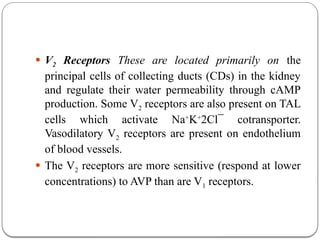
 V2 Receptors These are located primarily on the
principal cells of collecting ducts (CDs) in the kidney
and regulate their water permeability through cAMP
production. Some V2 receptors are also present on TAL
cells which activate Na+
K+
2Cl¯ cotransporter.
Vasodilatory V2 receptors are present on endothelium
of blood vessels.
 The V2 receptors are more sensitive (respond at lower
concentrations) to AVP than are V1 receptors.
Actions
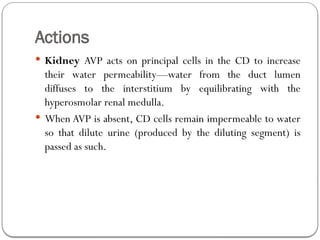
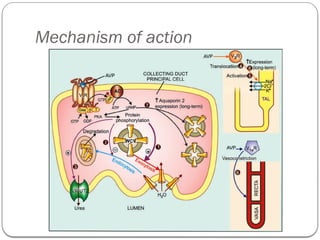
 Kidney AVP acts on principal cells in the CD to increase
their water permeability—water from the duct lumen
diffuses to the interstitium by equilibrating with the
hyperosmolar renal medulla.
 When AVP is absent, CD cells remain impermeable to water
so that dilute urine (produced by the diluting segment) is
passed as such.
Mechanism of action
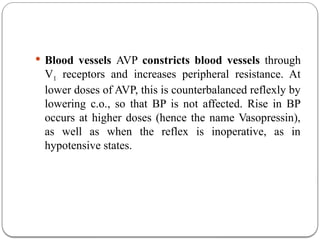
 Blood vessels AVP constricts blood vessels through
V1 receptors and increases peripheral resistance. At
lower doses of AVP, this is counterbalanced reflexly by
lowering c.o., so that BP is not affected. Rise in BP
occurs at higher doses (hence the name Vasopressin),
as well as when the reflex is inoperative, as in
hypotensive states.
 Other actions Most visceral smooth muscles contract. Increased
peristalsis in gut (especially large bowel), results in evacuation of bowels
and expulsion of gases.
 Uterus is contracted by AVP acting on oxytocin receptors. In the nonpregnant
and early pregnancy uterus, AVP is equipotent to oxytocin. Only at term
sensitivity to oxytocin increases selectively.
 CNS Exogenously administered AVP does not penetrate blood-brain barrier.
However, it is now recognized to be a peptide neurotransmitter in many
areas of brain and spinal cord. AVP may be involved in regulation of body
temperature, systemic circulation,ACTH release, and in learning of tasks.
 AVP induces platelet aggregation and hepatic glycogenolysis. It releases
coagulation factor VIII and von Willebrand’s factor from vascular
endothelium by acting onV2 receptors.
VASOPRESSIN ANALOGUES
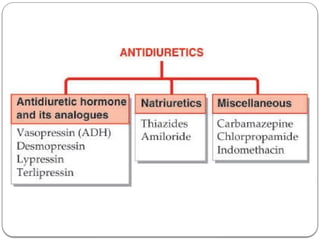
 Lypressin It is 8-lysine vasopressin. Though somewhat
less potent than AVP, it acts on bothV1 andV2 receptors and
has longer duration of action (4–6 hours). It is being used in
place of AVP—mostly forV1 receptor mediated actions.
 Terlipressin This synthetic prodrug of vasopressin is
specifically used for bleeding esophageal varices, and appears
to produce less severe adverse effects than lypressin. It is also
longer acting.
 Desmopressin (dDAVP) This synthetic peptide is a
selectiveV2 agonist; 12 times more potent antidiuretic than AVP,
but has negligible vasoconstrictor activity. It is also longer acting
because enzymatic degradation is slow; t½ 1–2 hours, and the
duration of action is 8–12 hours. Desmopressin is the preparation
of choice for all V2 receptor related indications. The intranasal
route is preferred, though bioavailability is only 10–20%.An oral
formulation has been marketed with a bioavailability of 1–2%;
oral dose is 10–15 times higher than the intranasal dose, but
systemic effects are produced and nasal side effects are avoided.
Many patients find oral tablet more convenient.
Uses
 A. Based onV2 actions:
 1. Diabetes insipidus:
 2. Bedwetting in children and nocturia in adults:
 3. Renal concentration test:
 4. Haemophilia, vonWillebrand’s disease
 B. Based onV1 actions:
 1. Bleeding esophageal varices:
 2. Before abdominal radiography:
Adverse effects
 Because of V2 selectivity, desmopressin produces fewer adverse effects than
vasopressin, lypressin or terlipressin. However, transient headache and flushing
are frequent. Nasal irritation, congestion, rhinitis, ulceration and epistaxis can
occur on local application. Systemic side effects are: belching, nausea, abdominal
cramps, pallor, urge to defecate, backache in females (due to uterine
contraction).
 Fluid retention and hyponatraemia may develop. Symptoms of hyponatremia are
due to shift of water intracellularly resulting in cerebral edema producing
headache, mental confusion, lassitude, nausea, vomiting and even seizures.
Children are more susceptible.
 AVP can cause bradycardia, increase cardiac afterload and precipitate angina by
constricting coronary vessels. It is contraindicated in patients with ischaemic
heart disease, hypertension, chronic nephritis and in psychogenic polydipsia.
 Urticaria and other allergies are possible with any preparation.
THIAZIDES
 Diuretic thiazides paradoxically exert an antidiuretic effect in
DI. High ceiling diuretics are also effective but are less
desirable because of their short and brisk action. Thiazides
reduce urine volume in both pituitary origin as well as renal
DI. They are especially valuable for the latter in which
AVP/desmopressin is ineffective.
 However, efficacy of thiazides is low; urine can never become
hypertonic as can occur with AVP in neurogenic DI.
 The mechanism of action is not well understood, the possible explanation is:
 Thiazides induce a state of sustained electrolyte depletion so that glomerular
filtrate is more completely reabsorbed iso-osmotically in PT. Further, because
of reduced salt reabsorption in the cortical diluting segment, a smaller volume
of less dilute urine is presented to the CDs and the same is passed out. That
salt estriction has a similar effect, substantiates this mechanism of action.
Secondly, thiazides reduce g.f.r. and thus the fluid load on tubules.
 Hydrochlorothiazide 25–50 mg TDS or equivalent dose of a longer acting
agent is commonly used.Though less effective than AVP, it is more convenient
and cheap even for pituitary origin DI; may reduce polyuria to some extent.
 K+
supplements are needed.
 Amiloride is the drug of choice for lithium induced nephrogenic
DI, because along with blocking entry of Na+ in the principal
cells of CD, it also blocks Li+ entry.
 Indomethacin has also been found to reduce polyuria in renal
DI to some extent by reducing renal PG synthesis. It can be
combined with a thiazide ± amiloride in nephrogenic DI.
Other NSAIDs are less active.
 Chlorpropamide It is a long-acting sulfonylurea oral
hypoglycaemic, found to reduce urine volume in DI of
pituitary origin but not in renal DI. It sensitizes the kidney to
ADH action.
 Carbamazepine It is an antiepileptic which reduces urine
volume in DI of pituitary origin, but mechanism of action is
not clear. Higher doses are needed; adverse effects are
marked; it is of little value in treatment of DI.
VASOPRESSIN ANTAGONISTS
 Tolvaptan It is an orally active nonpeptide selectiveV2 receptor antagonist that
has been recently introduced for the treatment of hyponatraemia due to
CHF, cirrhosis of liver or syndrome of inappropriate ADH secretion
(SIADH).
 It increases free water clearance by the kidney (aquaretic) and helps to
correct the low plasma Na+ levels. In clinical trials symptoms of worsening
heart failure were improved. However, too rapid correction of
hyponatraemia should not be attempted, because thrombotic complications
can occur due to haemoconcentration.The most frequent side effect is thirst
and dry mouth. Others are fever, g.i. upset and hyperglycaemia.
 Tolvaptan is metabolized by CYP3A4; should not be given to patients
receiving inhibitors of this isoenzyme.The t½ is 6–8 hours, and it is given
once daily.
 Mozavaptan (V2 selective antagonist) and Conivaptan (V1a+V2 antagonist)
are the other vasopressin antagonists that are in clinical use.