Unit – 2 Anti-diuretics
Saiyed Mubarak
Patel Shreyas
pharmacology of drug action on urinary system
CHAPTER-2
• Anti Diueretics are drugs that reduce urine volume
• Specially used in condition like
Diabetes insipidus (DI).
What is Anti-diuretics ?
Interconnection of Things or Objects or Mac
hines, e.g., sensors, actuators, mobile phon
es, electronic devices, home appliances, an
y existing items and interact with each othe
r via Internet.
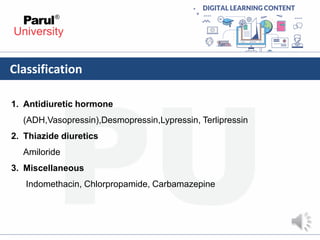
Classification
1. Antidiuretic hormone
(ADH,Vasopressin),Desmopressin,Lypressin, Terlipressin
2. Thiazide diuretics
Amiloride
3. Miscellaneous
Indomethacin, Chlorpropamide, Carbamazepine
(1) AntiDiuretic Hormone
• It is also called as Argenine Vasopressin (AVP)
• It is a nonapeptide secreted by posterior pituitary (neurohypophysis)
along with oxytocin
(A) ADH (Vasopressin) receptors :-
• It is G-protein couple Receptor
• two subtypes
- V1 Receptor
- V1a Receptor
- V2b Receptor
- V2 Receptor
Image source : Google
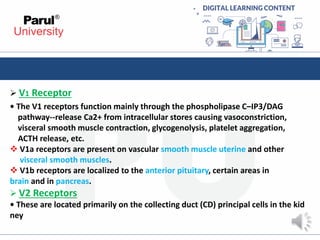
 V1 Receptor
• The V1 receptors function mainly through the phospholipase C–IP3/DAG
pathway--release Ca2+ from intracellular stores causing vasoconstriction,
visceral smooth muscle contraction, glycogenolysis, platelet aggregation,
ACTH release, etc.
 V1a receptors are present on vascular smooth muscle uterine and other
visceral smooth muscles.
 V1b receptors are localized to the anterior pituitary, certain areas in
brain and in pancreas.
 V2 Receptors
• These are located primarily on the collecting duct (CD) principal cells in the kid
ney
Pharmacological Action of ADH
ADH
1. Kidney :-
Act
on
Collecting
Duct cell
Increase water
permeability
Lumen Water diffu
se to intersitium
Mechanism of action :-
V2 receptor on basolateral
side of CD cell membrane
Increase c
AMP forma
tion
Depend on P
rotein kinase
A
Activation
Causes
Activation
Phosphorylation ofr relevant protin promote exocytosis of auaporin 2 wat
er channel containing vesicles in apical membrane
more aqueous channels get inserted into the apical membrane
Water permeability of CD cell increased and prevent urination
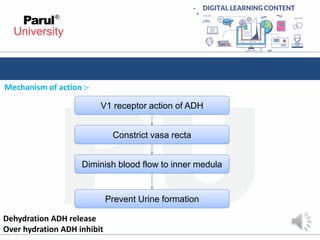
V1 receptor action of ADH
Mechanism of action :-
Constrict vasa recta
Diminish blood flow to inner medula
Prevent Urine formation
Dehydration ADH release
Over hydration ADH inhibit
2. Blood Vessels :-
AVP constricts blood vessels through V1 receptors and can raise BP
3. Other action :-
 Smooth Muscles – Constricted
 Gut – Increase Peristalsis
 Uterus – Constricted
 CNS – ADH not penetrate BBB
 Lever - Glyconeogenesis
Pharmacokinetics
 Absorption – Orally
 Metabolism – Liver
Drug
 Excretion – Kidney
1. Lypressin :-
 It is 8-lysine vasopressin.
it acts on both V1 and V2 receptors and has longer duration of action (4-
6 hours).
2. Terlipressin :-
 it is synthetic prodrug
 used for bleeding esophageal varices
3. Demopressin :-
 It is synthetic peptide is a selective V2 agonist; 12 times more potent
AntiDiuretic than all.
Use
A . Bsae on V2 action :-
 Diabetes insipidus
 Bedwetting in children & nocturia in adults
 Renal concentration test
 Haemophilia, Von Willebrand’s disease
B . Base on V1 Action :-
 It is synthetic peptide is a selective V2 agonist; 12 times more potent
AntiDiuretic than all.
Adverse Drug Effect
 Transient headache and flusing- common
 Nasal irritation, congestion, rhinitis, ulceration
 Systemic effects- belching, nausea, abdominal cramps, pallor
(2) Thiazide Diuretic
• It is also called as High Ceiling diuretic.
• Thiazide is reduce urine volume in both pituitary origin and renal
Diabetes insipidus .
• It is used when ADH is ineffective.
Image source : Google
Induce sustained electrolyte depletion resulting Glomerular filtrate complete
ly reabsorbed
Mechanism of action :-
Continuous electrolyte loss causes decreases plasma osmolarity
AntiDiuretic action
Drug
Amiloride :-
 it is a drug of choice for lithium induced nephrogenic Diabetes insipidus
(3). Miscellaneous
Indomethacin :-
 it is reduce polyuria in renal diabetes insipidus
Chlorpropamide :-
 It is a long-acting sulfonylurea oral hypoglycaemic
 it is not active when ADH is totally absent
Carbamazepine :-
 It is an antiepileptic which reduces urine volume in DI of pituitary origin
 mechanism of action is not clear.
 Higher doses are needed
Reference
K.D.Tripathi. EssentialsofMedical Pharmacolo
gy,,JAYPEEBrothersMedicalPublishers (P)Ltd,
NewDelhi, section -9 drugs acting on kidney, c
hapter - 42 Anti diuretic, pg no :-593-598
www.paruluniversity.ac.in

Anti diuretic

  • 1.
    Unit – 2Anti-diuretics Saiyed Mubarak Patel Shreyas
  • 2.
    pharmacology of drugaction on urinary system CHAPTER-2
  • 3.
    • Anti Diuereticsare drugs that reduce urine volume • Specially used in condition like Diabetes insipidus (DI). What is Anti-diuretics ? Interconnection of Things or Objects or Mac hines, e.g., sensors, actuators, mobile phon es, electronic devices, home appliances, an y existing items and interact with each othe r via Internet.
  • 4.
    Classification 1. Antidiuretic hormone (ADH,Vasopressin),Desmopressin,Lypressin,Terlipressin 2. Thiazide diuretics Amiloride 3. Miscellaneous Indomethacin, Chlorpropamide, Carbamazepine
  • 5.
    (1) AntiDiuretic Hormone •It is also called as Argenine Vasopressin (AVP) • It is a nonapeptide secreted by posterior pituitary (neurohypophysis) along with oxytocin (A) ADH (Vasopressin) receptors :- • It is G-protein couple Receptor • two subtypes - V1 Receptor - V1a Receptor - V2b Receptor - V2 Receptor Image source : Google
  • 6.
     V1 Receptor •The V1 receptors function mainly through the phospholipase C–IP3/DAG pathway--release Ca2+ from intracellular stores causing vasoconstriction, visceral smooth muscle contraction, glycogenolysis, platelet aggregation, ACTH release, etc.  V1a receptors are present on vascular smooth muscle uterine and other visceral smooth muscles.  V1b receptors are localized to the anterior pituitary, certain areas in brain and in pancreas.  V2 Receptors • These are located primarily on the collecting duct (CD) principal cells in the kid ney
  • 7.
    Pharmacological Action ofADH ADH 1. Kidney :- Act on Collecting Duct cell Increase water permeability Lumen Water diffu se to intersitium Mechanism of action :- V2 receptor on basolateral side of CD cell membrane Increase c AMP forma tion Depend on P rotein kinase A Activation Causes Activation Phosphorylation ofr relevant protin promote exocytosis of auaporin 2 wat er channel containing vesicles in apical membrane more aqueous channels get inserted into the apical membrane Water permeability of CD cell increased and prevent urination
  • 8.
    V1 receptor actionof ADH Mechanism of action :- Constrict vasa recta Diminish blood flow to inner medula Prevent Urine formation Dehydration ADH release Over hydration ADH inhibit
  • 9.
    2. Blood Vessels:- AVP constricts blood vessels through V1 receptors and can raise BP 3. Other action :-  Smooth Muscles – Constricted  Gut – Increase Peristalsis  Uterus – Constricted  CNS – ADH not penetrate BBB  Lever - Glyconeogenesis
  • 10.
    Pharmacokinetics  Absorption –Orally  Metabolism – Liver Drug  Excretion – Kidney 1. Lypressin :-  It is 8-lysine vasopressin. it acts on both V1 and V2 receptors and has longer duration of action (4- 6 hours).
  • 11.
    2. Terlipressin :- it is synthetic prodrug  used for bleeding esophageal varices 3. Demopressin :-  It is synthetic peptide is a selective V2 agonist; 12 times more potent AntiDiuretic than all.
  • 12.
    Use A . Bsaeon V2 action :-  Diabetes insipidus  Bedwetting in children & nocturia in adults  Renal concentration test  Haemophilia, Von Willebrand’s disease B . Base on V1 Action :-  It is synthetic peptide is a selective V2 agonist; 12 times more potent AntiDiuretic than all.
  • 13.
    Adverse Drug Effect Transient headache and flusing- common  Nasal irritation, congestion, rhinitis, ulceration  Systemic effects- belching, nausea, abdominal cramps, pallor
  • 14.
    (2) Thiazide Diuretic •It is also called as High Ceiling diuretic. • Thiazide is reduce urine volume in both pituitary origin and renal Diabetes insipidus . • It is used when ADH is ineffective. Image source : Google Induce sustained electrolyte depletion resulting Glomerular filtrate complete ly reabsorbed Mechanism of action :- Continuous electrolyte loss causes decreases plasma osmolarity AntiDiuretic action
  • 15.
    Drug Amiloride :-  itis a drug of choice for lithium induced nephrogenic Diabetes insipidus (3). Miscellaneous Indomethacin :-  it is reduce polyuria in renal diabetes insipidus Chlorpropamide :-  It is a long-acting sulfonylurea oral hypoglycaemic  it is not active when ADH is totally absent
  • 16.
    Carbamazepine :-  Itis an antiepileptic which reduces urine volume in DI of pituitary origin  mechanism of action is not clear.  Higher doses are needed
  • 17.
    Reference K.D.Tripathi. EssentialsofMedical Pharmacolo gy,,JAYPEEBrothersMedicalPublishers(P)Ltd, NewDelhi, section -9 drugs acting on kidney, c hapter - 42 Anti diuretic, pg no :-593-598
  • 18.