ANTI-CHOLINERGIC
DRUGS
For BSN 1st Year
Dr. Pravin Prasad
2nd Year Resident, MD Clinical Pharmacology
Maharajgunj Medical Campus
22nd February, 2017 (Falgun 11, 2073), Wednesday
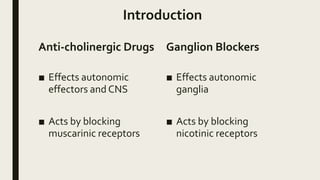
Introduction
Anti-cholinergic Drugs
■ Effects autonomic
effectors and CNS
■ Acts by blocking
muscarinic receptors
Ganglion Blockers
■ Effects autonomic
ganglia
■ Acts by blocking
nicotinic receptors
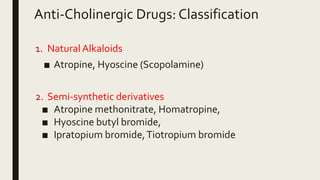
Anti-Cholinergic Drugs: Classification
1. NaturalAlkaloids
■ Atropine, Hyoscine (Scopolamine)
2. Semi-synthetic derivatives
■ Atropine methonitrate, Homatropine,
■ Hyoscine butyl bromide,
■ Ipratopium bromide,Tiotropium bromide
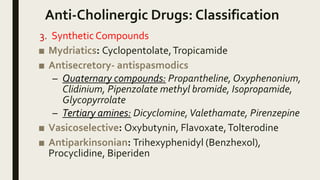
Anti-Cholinergic Drugs: Classification
3. Synthetic Compounds
■ Mydriatics: Cyclopentolate,Tropicamide
■ Antisecretory- antispasmodics
– Quaternary compounds: Propantheline, Oxyphenonium,
Clidinium, Pipenzolate methyl bromide, Isopropamide,
Glycopyrrolate
– Tertiary amines: Dicyclomine,Valethamate, Pirenzepine
■ Vasicoselective: Oxybutynin, Flavoxate,Tolterodine
■ Antiparkinsonian: Trihexyphenidyl (Benzhexol),
Procyclidine, Biperiden
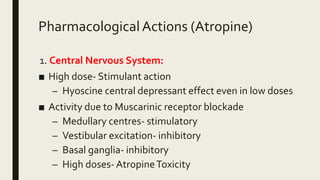
PharmacologicalActions (Atropine)
1. Central Nervous System:
■ High dose- Stimulant action
– Hyoscine central depressant effect even in low doses
■ Activity due to Muscarinic receptor blockade
– Medullary centres- stimulatory
– Vestibular excitation- inhibitory
– Basal ganglia- inhibitory
– High doses- AtropineToxicity
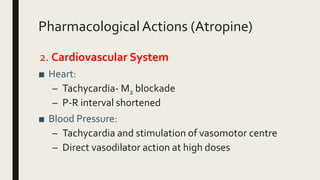
PharmacologicalActions (Atropine)
2. Cardiovascular System
■ Heart:
– Tachycardia- M2 blockade
– P-R interval shortened
■ Blood Pressure:
– Tachycardia and stimulation of vasomotor centre
– Direct vasodilator action at high doses
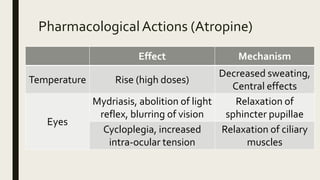
PharmacologicalActions (Atropine)
Effect Mechanism
Temperature Rise (high doses)
Decreased sweating,
Central effects
Eyes
Mydriasis, abolition of light
reflex, blurring of vision
Relaxation of
sphincter pupillae
Cycloplegia, increased
intra-ocular tension
Relaxation of ciliary
muscles
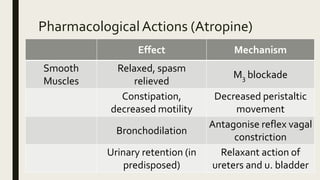
PharmacologicalActions (Atropine)
Effect Mechanism
Smooth
Muscles
Relaxed, spasm
relieved
M3 blockade
Constipation,
decreased motility
Decreased peristaltic
movement
Bronchodilation
Antagonise reflex vagal
constriction
Urinary retention (in
predisposed)
Relaxant action of
ureters and u. bladder
PharmacologicalActions (Atropine)
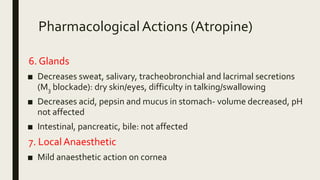
6. Glands
■ Decreases sweat, salivary, tracheobronchial and lacrimal secretions
(M3 blockade): dry skin/eyes, difficulty in talking/swallowing
■ Decreases acid, pepsin and mucus in stomach- volume decreased, pH
not affected
■ Intestinal, pancreatic, bile: not affected
7. LocalAnaesthetic
■ Mild anaesthetic action on cornea
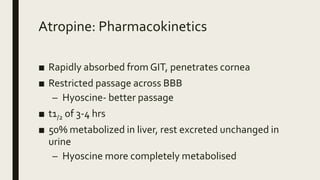
Atropine: Pharmacokinetics
■ Rapidly absorbed from GIT, penetrates cornea
■ Restricted passage across BBB
– Hyoscine- better passage
■ t1/2 of 3-4 hrs
■ 50% metabolized in liver, rest excreted unchanged in
urine
– Hyoscine more completely metabolised
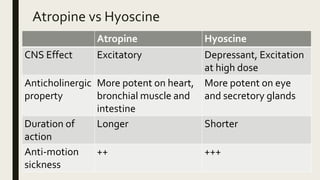
Atropine vs Hyoscine
Atropine Hyoscine
CNS Effect Excitatory Depressant, Excitation
at high dose
Anticholinergic
property
More potent on heart,
bronchial muscle and
intestine
More potent on eye
and secretory glands
Duration of
action
Longer Shorter
Anti-motion
sickness
++ +++
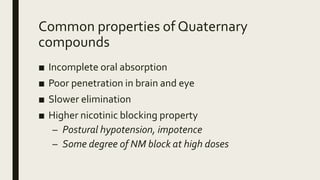
Common properties of Quaternary
compounds
■ Incomplete oral absorption
■ Poor penetration in brain and eye
■ Slower elimination
■ Higher nicotinic blocking property
– Postural hypotension, impotence
– Some degree of NM block at high doses
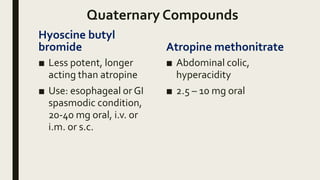
Quaternary Compounds
Hyoscine butyl
bromide
■ Less potent, longer
acting than atropine
■ Use: esophageal or GI
spasmodic condition,
20-40 mg oral, i.v. or
i.m. or s.c.
Atropine methonitrate
■ Abdominal colic,
hyperacidity
■ 2.5 – 10 mg oral
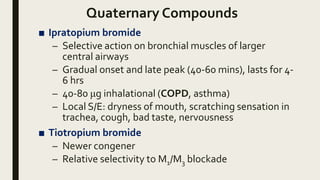
Quaternary Compounds
■ Ipratopium bromide
– Selective action on bronchial muscles of larger
central airways
– Gradual onset and late peak (40-60 mins), lasts for 4-
6 hrs
– 40-80 μg inhalational (COPD, asthma)
– Local S/E: dryness of mouth, scratching sensation in
trachea, cough, bad taste, nervousness
■ Tiotropium bromide
– Newer congener
– Relative selectivity to M1/M3 blockade
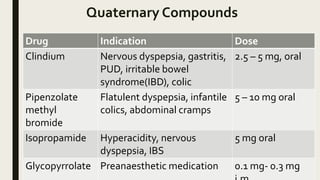
Quaternary Compounds
Drug Indication Dose
Clindium Nervous dyspepsia, gastritis,
PUD, irritable bowel
syndrome(IBD), colic
2.5 – 5 mg, oral
Pipenzolate
methyl
bromide
Flatulent dyspepsia, infantile
colics, abdominal cramps
5 – 10 mg oral
Isopropamide Hyperacidity, nervous
dyspepsia, IBS
5 mg oral
Glycopyrrolate Preanaesthetic medication 0.1 mg- 0.3 mg
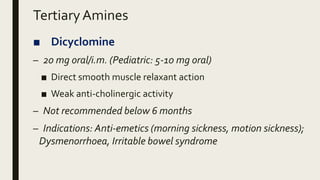
TertiaryAmines
■ Dicyclomine
– 20 mg oral/i.m. (Pediatric: 5-10 mg oral)
■ Direct smooth muscle relaxant action
■ Weak anti-cholinergic activity
– Not recommended below 6 months
– Indications: Anti-emetics (morning sickness, motion sickness);
Dysmenorrhoea, Irritable bowel syndrome
TertiaryAmines
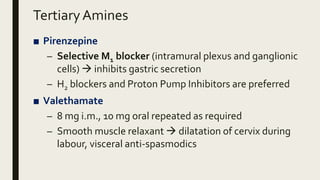
■ Pirenzepine
– Selective M1 blocker (intramural plexus and ganglionic
cells)  inhibits gastric secretion
– H2 blockers and Proton Pump Inhibitors are preferred
■ Valethamate
– 8 mg i.m., 10 mg oral repeated as required
– Smooth muscle relaxant  dilatation of cervix during
labour, visceral anti-spasmodics
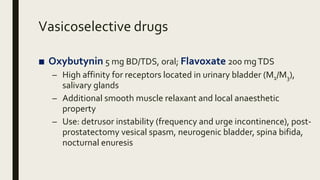
Vasicoselective drugs
■ Oxybutynin 5 mg BD/TDS, oral; Flavoxate 200 mgTDS
– High affinity for receptors located in urinary bladder (M1/M3),
salivary glands
– Additional smooth muscle relaxant and local anaesthetic
property
– Use: detrusor instability (frequency and urge incontinence), post-
prostatectomy vesical spasm, neurogenic bladder, spina bifida,
nocturnal enuresis
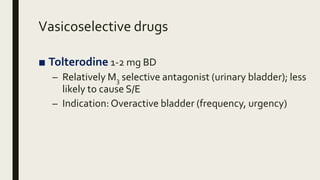
Vasicoselective drugs
■ Tolterodine 1-2 mg BD
– Relatively M3 selective antagonist (urinary bladder); less
likely to cause S/E
– Indication: Overactive bladder (frequency, urgency)
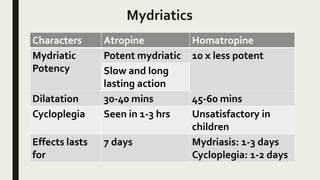
Mydriatics
Characters Atropine Homatropine
Mydriatic
Potency
Potent mydriatic 10 x less potent
Slow and long
lasting action
Dilatation 30-40 mins 45-60 mins
Cycloplegia Seen in 1-3 hrs Unsatisfactory in
children
Effects lasts
for
7 days Mydriasis: 1-3 days
Cycloplegia: 1-2 days
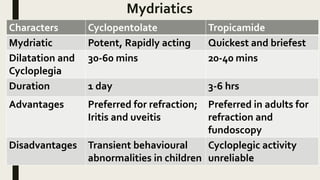
Mydriatics
Characters Cyclopentolate Tropicamide
Mydriatic Potent, Rapidly acting Quickest and briefest
Dilatation and
Cycloplegia
30-60 mins 20-40 mins
Duration 1 day 3-6 hrs
Advantages Preferred for refraction;
Iritis and uveitis
Preferred in adults for
refraction and
fundoscopy
Disadvantages Transient behavioural
abnormalities in children
Cycloplegic activity
unreliable
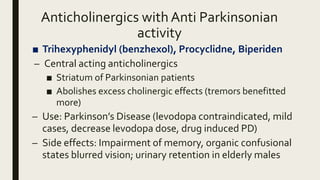
Anticholinergics with Anti Parkinsonian
activity
■ Trihexyphenidyl (benzhexol), Procyclidne, Biperiden
– Central acting anticholinergics
■ Striatum of Parkinsonian patients
■ Abolishes excess cholinergic effects (tremors benefitted
more)
– Use: Parkinson’s Disease (levodopa contraindicated, mild
cases, decrease levodopa dose, drug induced PD)
– Side effects: Impairment of memory, organic confusional
states blurred vision; urinary retention in elderly males
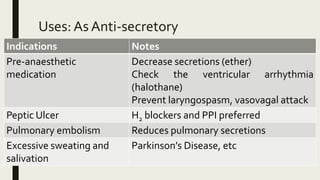
Uses: As Anti-secretory
Indications Notes
Pre-anaesthetic
medication
Decrease secretions (ether)
Check the ventricular arrhythmia
(halothane)
Prevent laryngospasm, vasovagal attack
Peptic Ulcer H2 blockers and PPI preferred
Pulmonary embolism Reduces pulmonary secretions
Excessive sweating and
salivation
Parkinson’s Disease, etc
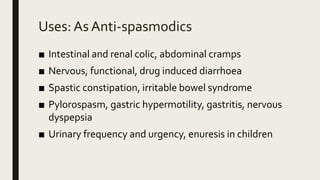
Uses: As Anti-spasmodics
■ Intestinal and renal colic, abdominal cramps
■ Nervous, functional, drug induced diarrhoea
■ Spastic constipation, irritable bowel syndrome
■ Pylorospasm, gastric hypermotility, gastritis, nervous
dyspepsia
■ Urinary frequency and urgency, enuresis in children
Uses: BronchialAsthma, Asthmatic
Bronchitis, COPD
■ Blocks reflex vagal activity
■ Administered by inhalation
■ Ipratopium bromide,Tiotropium bromide
– Aerosols (inhaled): effective in asthmatic bronchitis and
COPD (regular prophylactic use)
Uses: As Mydriatic and Cycloplegic
Diagnostic
■ Testing error of refraction
– Tropicamide
– Atropine in children (<5yrs)
■ Fundoscopy
– Phenylephrine with
Tropicamide
– Phenylephnephrine in
elderly
Therapeutic
■ Iritis, iridocyclitis,
choroiditis, keratitis, corneal
ulcer: atropine (long lasting
mydriatic-cycloplegic action
and local anodyne action on
cornea)
■ Prevent/break adhesions
Uses: Central Action
■ In Parkinson’s Disease
■ Motion sickness
– Hyoscine : susceptible individuals, vigorous
motions, prophylactic
■ Oral andTransdermal patch available
■ S/E: rare but sedation and dry mouth can occur
■ Dicyclomine
Uses: Atropine
■ CardiacVagolytic
– To counteract sinus bradycardia, partial heart block
(due to vagal tone)
– Myocardial Infarction, DigitalisToxicity
– S/E: Cardiac arrhythmia, ischemia
■ As antidote
– Anti-ChE, mushroom poisoning, block muscarinic action
of neostigmine in MG, decurarization or cobra
envenomation
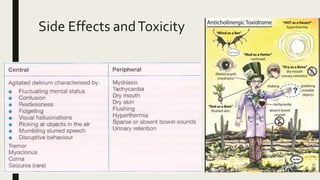
Side Effects andToxicity
■ Any queries??
■ Next Class will be on Adrenergic Drugs

Anti cholinergic drugs-2017

  • 1.
    ANTI-CHOLINERGIC DRUGS For BSN 1stYear Dr. Pravin Prasad 2nd Year Resident, MD Clinical Pharmacology Maharajgunj Medical Campus 22nd February, 2017 (Falgun 11, 2073), Wednesday
  • 2.
    Introduction Anti-cholinergic Drugs ■ Effectsautonomic effectors and CNS ■ Acts by blocking muscarinic receptors Ganglion Blockers ■ Effects autonomic ganglia ■ Acts by blocking nicotinic receptors
  • 3.
    Anti-Cholinergic Drugs: Classification 1.NaturalAlkaloids ■ Atropine, Hyoscine (Scopolamine) 2. Semi-synthetic derivatives ■ Atropine methonitrate, Homatropine, ■ Hyoscine butyl bromide, ■ Ipratopium bromide,Tiotropium bromide
  • 4.
    Anti-Cholinergic Drugs: Classification 3.Synthetic Compounds ■ Mydriatics: Cyclopentolate,Tropicamide ■ Antisecretory- antispasmodics – Quaternary compounds: Propantheline, Oxyphenonium, Clidinium, Pipenzolate methyl bromide, Isopropamide, Glycopyrrolate – Tertiary amines: Dicyclomine,Valethamate, Pirenzepine ■ Vasicoselective: Oxybutynin, Flavoxate,Tolterodine ■ Antiparkinsonian: Trihexyphenidyl (Benzhexol), Procyclidine, Biperiden
  • 5.
    PharmacologicalActions (Atropine) 1. CentralNervous System: ■ High dose- Stimulant action – Hyoscine central depressant effect even in low doses ■ Activity due to Muscarinic receptor blockade – Medullary centres- stimulatory – Vestibular excitation- inhibitory – Basal ganglia- inhibitory – High doses- AtropineToxicity
  • 6.
    PharmacologicalActions (Atropine) 2. CardiovascularSystem ■ Heart: – Tachycardia- M2 blockade – P-R interval shortened ■ Blood Pressure: – Tachycardia and stimulation of vasomotor centre – Direct vasodilator action at high doses
  • 7.
    PharmacologicalActions (Atropine) Effect Mechanism TemperatureRise (high doses) Decreased sweating, Central effects Eyes Mydriasis, abolition of light reflex, blurring of vision Relaxation of sphincter pupillae Cycloplegia, increased intra-ocular tension Relaxation of ciliary muscles
  • 8.
    PharmacologicalActions (Atropine) Effect Mechanism Smooth Muscles Relaxed,spasm relieved M3 blockade Constipation, decreased motility Decreased peristaltic movement Bronchodilation Antagonise reflex vagal constriction Urinary retention (in predisposed) Relaxant action of ureters and u. bladder
  • 9.
    PharmacologicalActions (Atropine) 6. Glands ■Decreases sweat, salivary, tracheobronchial and lacrimal secretions (M3 blockade): dry skin/eyes, difficulty in talking/swallowing ■ Decreases acid, pepsin and mucus in stomach- volume decreased, pH not affected ■ Intestinal, pancreatic, bile: not affected 7. LocalAnaesthetic ■ Mild anaesthetic action on cornea
  • 10.
    Atropine: Pharmacokinetics ■ Rapidlyabsorbed from GIT, penetrates cornea ■ Restricted passage across BBB – Hyoscine- better passage ■ t1/2 of 3-4 hrs ■ 50% metabolized in liver, rest excreted unchanged in urine – Hyoscine more completely metabolised
  • 11.
    Atropine vs Hyoscine AtropineHyoscine CNS Effect Excitatory Depressant, Excitation at high dose Anticholinergic property More potent on heart, bronchial muscle and intestine More potent on eye and secretory glands Duration of action Longer Shorter Anti-motion sickness ++ +++
  • 12.
    Common properties ofQuaternary compounds ■ Incomplete oral absorption ■ Poor penetration in brain and eye ■ Slower elimination ■ Higher nicotinic blocking property – Postural hypotension, impotence – Some degree of NM block at high doses
  • 13.
    Quaternary Compounds Hyoscine butyl bromide ■Less potent, longer acting than atropine ■ Use: esophageal or GI spasmodic condition, 20-40 mg oral, i.v. or i.m. or s.c. Atropine methonitrate ■ Abdominal colic, hyperacidity ■ 2.5 – 10 mg oral
  • 14.
    Quaternary Compounds ■ Ipratopiumbromide – Selective action on bronchial muscles of larger central airways – Gradual onset and late peak (40-60 mins), lasts for 4- 6 hrs – 40-80 μg inhalational (COPD, asthma) – Local S/E: dryness of mouth, scratching sensation in trachea, cough, bad taste, nervousness ■ Tiotropium bromide – Newer congener – Relative selectivity to M1/M3 blockade
  • 15.
    Quaternary Compounds Drug IndicationDose Clindium Nervous dyspepsia, gastritis, PUD, irritable bowel syndrome(IBD), colic 2.5 – 5 mg, oral Pipenzolate methyl bromide Flatulent dyspepsia, infantile colics, abdominal cramps 5 – 10 mg oral Isopropamide Hyperacidity, nervous dyspepsia, IBS 5 mg oral Glycopyrrolate Preanaesthetic medication 0.1 mg- 0.3 mg
  • 16.
    TertiaryAmines ■ Dicyclomine – 20mg oral/i.m. (Pediatric: 5-10 mg oral) ■ Direct smooth muscle relaxant action ■ Weak anti-cholinergic activity – Not recommended below 6 months – Indications: Anti-emetics (morning sickness, motion sickness); Dysmenorrhoea, Irritable bowel syndrome
  • 17.
    TertiaryAmines ■ Pirenzepine – SelectiveM1 blocker (intramural plexus and ganglionic cells)  inhibits gastric secretion – H2 blockers and Proton Pump Inhibitors are preferred ■ Valethamate – 8 mg i.m., 10 mg oral repeated as required – Smooth muscle relaxant  dilatation of cervix during labour, visceral anti-spasmodics
  • 18.
    Vasicoselective drugs ■ Oxybutynin5 mg BD/TDS, oral; Flavoxate 200 mgTDS – High affinity for receptors located in urinary bladder (M1/M3), salivary glands – Additional smooth muscle relaxant and local anaesthetic property – Use: detrusor instability (frequency and urge incontinence), post- prostatectomy vesical spasm, neurogenic bladder, spina bifida, nocturnal enuresis
  • 19.
    Vasicoselective drugs ■ Tolterodine1-2 mg BD – Relatively M3 selective antagonist (urinary bladder); less likely to cause S/E – Indication: Overactive bladder (frequency, urgency)
  • 20.
    Mydriatics Characters Atropine Homatropine Mydriatic Potency Potentmydriatic 10 x less potent Slow and long lasting action Dilatation 30-40 mins 45-60 mins Cycloplegia Seen in 1-3 hrs Unsatisfactory in children Effects lasts for 7 days Mydriasis: 1-3 days Cycloplegia: 1-2 days
  • 21.
    Mydriatics Characters Cyclopentolate Tropicamide MydriaticPotent, Rapidly acting Quickest and briefest Dilatation and Cycloplegia 30-60 mins 20-40 mins Duration 1 day 3-6 hrs Advantages Preferred for refraction; Iritis and uveitis Preferred in adults for refraction and fundoscopy Disadvantages Transient behavioural abnormalities in children Cycloplegic activity unreliable
  • 22.
    Anticholinergics with AntiParkinsonian activity ■ Trihexyphenidyl (benzhexol), Procyclidne, Biperiden – Central acting anticholinergics ■ Striatum of Parkinsonian patients ■ Abolishes excess cholinergic effects (tremors benefitted more) – Use: Parkinson’s Disease (levodopa contraindicated, mild cases, decrease levodopa dose, drug induced PD) – Side effects: Impairment of memory, organic confusional states blurred vision; urinary retention in elderly males
  • 23.
    Uses: As Anti-secretory IndicationsNotes Pre-anaesthetic medication Decrease secretions (ether) Check the ventricular arrhythmia (halothane) Prevent laryngospasm, vasovagal attack Peptic Ulcer H2 blockers and PPI preferred Pulmonary embolism Reduces pulmonary secretions Excessive sweating and salivation Parkinson’s Disease, etc
  • 24.
    Uses: As Anti-spasmodics ■Intestinal and renal colic, abdominal cramps ■ Nervous, functional, drug induced diarrhoea ■ Spastic constipation, irritable bowel syndrome ■ Pylorospasm, gastric hypermotility, gastritis, nervous dyspepsia ■ Urinary frequency and urgency, enuresis in children
  • 25.
    Uses: BronchialAsthma, Asthmatic Bronchitis,COPD ■ Blocks reflex vagal activity ■ Administered by inhalation ■ Ipratopium bromide,Tiotropium bromide – Aerosols (inhaled): effective in asthmatic bronchitis and COPD (regular prophylactic use)
  • 26.
    Uses: As Mydriaticand Cycloplegic Diagnostic ■ Testing error of refraction – Tropicamide – Atropine in children (<5yrs) ■ Fundoscopy – Phenylephrine with Tropicamide – Phenylephnephrine in elderly Therapeutic ■ Iritis, iridocyclitis, choroiditis, keratitis, corneal ulcer: atropine (long lasting mydriatic-cycloplegic action and local anodyne action on cornea) ■ Prevent/break adhesions
  • 27.
    Uses: Central Action ■In Parkinson’s Disease ■ Motion sickness – Hyoscine : susceptible individuals, vigorous motions, prophylactic ■ Oral andTransdermal patch available ■ S/E: rare but sedation and dry mouth can occur ■ Dicyclomine
  • 28.
    Uses: Atropine ■ CardiacVagolytic –To counteract sinus bradycardia, partial heart block (due to vagal tone) – Myocardial Infarction, DigitalisToxicity – S/E: Cardiac arrhythmia, ischemia ■ As antidote – Anti-ChE, mushroom poisoning, block muscarinic action of neostigmine in MG, decurarization or cobra envenomation
  • 29.
  • 30.
    ■ Any queries?? ■Next Class will be on Adrenergic Drugs

Editor's Notes

  • #5 Others: TCA, antidepressants, phenothiazine, antihistamines, disopyramide
  • #6 Maps to the functions of Parasympathetic Nervous System Stronger effects on organs having predominant parasympathetic supply Blocks all Muscarinic receptor (Antagonist) Activity due to Muscarinic receptor blockade Stimulates medullary centres (vagal, respiratory, vasomotor) Depresses vestibular excitation (anti motion sickness property) Blocks cholinergic overactivity in basal ganglia  tremor and rigidity in Parkinson’s disease supressed High doses: cortical excitation, restlessness, disorientation, hallucination, delirium, respiratory depression, coma (ATROPINE TOXICITY)
  • #7 Blood Pressure: Rises due to tachycardia and stimulation of vasomotor centre Falls due to direct vasodilator action at high doses
  • #8 3. Body Temperature Rise of temperature at high doses (decreased sweating, stimulation of temperature regulating centre in hypothalamus) 4. Eyes (topical instillation) Mydriasis, abolition of light reflex, due to relaxation of sphincter pupillae leading to blurring of vision Cycloplegia and increase in intra ocular tension (more in closed angle glaucoma) due to relaxation of ciliary muscles 5. Smooth Muscles Relaxed by atropine (M3 blockade): spasm relieved Decreased peristaltic movement: prolonged transit time of chyme, constipation Bronchodilation (COPD and Asthma) by antagonising reflex vagal constriction Ureter and urinary bladder: urinary retention; beneficial in neurogenic bladder, enuresis
  • #12 Chief source Atropa belladonna, Datura stramonium Hyoscyamys niger
  • #13 Incomplete oral absorption Poor penetration in brain and eye, central and ocular effects not seen after oral/iv administration Slower elimination, longer acting than atropine Higher nicotinic blocking property: postural hypotension, impotence Some degree of NM block at high doses
  • #15 Ipratopium bromide Selective action on bronchial muscles of larger central airways(respiratory secretions and mucociliary clearance unaltered) Gradual onset and late peak (40-60 mins), lasts for 4-6 hrs– better for prophylactic treatment 40-80 μg inhalational (COPD, asthma) Local S/E: dryness of mouth, scratching sensation in trachea, cough, bad taste, nervousness Tiotropium bromide Newer congener, relative selectivity to M1/M3 blockade; long lasting effect
  • #16 Propantheline, oxyphenonium  Peptic ulcer disease(PUD). Gastritis  Replaced by H2 blockers Glycopyrrolate 0.1-0.3 mg i.m. Rapidly acting antimuscarinic with no central effects, preanaesthetic medication and during general anaesthesia
  • #17 Dicyclomine 20 mg oral/i.m. (Pediatric: 5-10 mg oral) Direct smooth muscle relaxant action in addition to weak anti-cholinergic activity  anti-spasmodic actions without atropine side effects Not recommended below 6 months (chance of atropine like side effects) Other indications: Anti-emetics (morning sickness, motion sickness); Dysmenorrhoea, Irritable bowel syndrome
  • #18 Pirenzepine Selective M1 blocker (intramural plexus and ganglionic cells)  inhibits gastric secretion (without any atropine side effects) H2 blockers and Proton Pump Inhibitors are preferred over them for peptic ulcer
  • #19 Oxybutynin 5 mg BD/TDS, oral; Flavoxate 200 mg TDS High affinity for receptors located in urinary bladder (M1/M3), salivary glands; additional smooth muscle relaxant and local anaesthetic property Use: detrusor instability (frequency and urge incontinence), post-prostatectomy vesical spasm, neurogenic bladder, spina bifida, nocturnal enuresis Oral dosing: S/E common; Intra-vasical instillation: fewer S/E Metabolised by CYP3A4
  • #20 Oxybutynin 5 mg BD/TDS, oral; Flavoxate 200 mg TDS High affinity for receptors located in urinary bladder (M1/M3), salivary glands; additional smooth muscle relaxant and local anaesthetic property Use: detrusor instability (frequency and urge incontinence), post-prostatectomy vesical spasm, neurogenic bladder, spina bifida, nocturnal enuresis Oral dosing: S/E common; Intra-vasical instillation: fewer S/E Metabolised by CYP3A4 Tolterodine 1-2 mg BD Relatively M3 selective antagonist (urinary bladder); less likely to cause S/E Indication: overactive bladder (frequency, urgency) Metabolised by CYP3A4 Drotaverin: non anticholinergic smooth muscle anti spasmodic  acts by inhibiting phosphodiesterase 4 (PDE 4) [selective for smooth muscle) PDE4 inhibition  elevated intracellular cAMP/cGMP  smooth muscle relaxation Oral, parenteral formulations for intestinal, renal, biliary colic, irritable bowel syndrome, uterine spasm, etc. No anticholinergic s/e; headache, dizziness, constipation and flushing seen, fall in BP on i.v. injection
  • #23 Trihexyphenidyl (benzhexol), Procyclidne, Biperiden Central acting anticholinergics with higher central:peripheral anticholinergic action ratio Reduces the unbalanced cholinergic activity in the striatum of Parkinsonian patients - tremor benefitted more; sialorrhoea controlled by peripheral action Effects lasts for 4-8 hrs after dosing: daily dose given in divided doses Cheap and produce less s/e than levodopa Use: Alone in Mild Cases Levodopa contraindicated In combination with levodopa for reducing dose of levodopa Side effects: Impairment of memory, organic confusional states blurred vision; urinary retention in elderly males
  • #24 Pre-anaesthetic medication To check the increased secretions from salivary glands and tracheobronchial tree due to irritant general anaesthetics (ether); and hence also prevent laryngospasm To check the ventricular arrhythmia by blocking the activity of vagus nerve (halothane sensitizes the heart to Noradrenaline/Norepinephrine mediated ventricular arrhythmia) Peptic Ulcer Effective doses produces side effects: H2 blockers and PPI preferred Pulmonary embolism Reduces pulmonary secretions evoked reflexly by embolism Excessive sweating and salivation (Parkinson’s Disease, etc)
  • #25 Intestinal and renal colic, abdominal cramps Mechanical obstruction should be ruled out Renal colic: opioids preferred Biliary colic: less effective Nervous, functional, drug induced diarrhoea Rule out infective diarrhoea Spastic constipation, irritable bowel syndrome Pylorospasm, gastric hypermotility, gastritis, nervous dyspepsia Urinary frequency and urgency, enuresis in children Dysmeonrrhoea: NSAIDs preferred
  • #27 Diagnostic Testing error of refraction Tropicamide Insufficient Cycloplegia: more potent drugs required in children Fundoscopy Combination of phenylephrine and tropicamide Due to risk of glaucoma, phenylephrine is used in elderly