Prepared By:
Nehal V. Trambadiya
Asst. Professor
Smt. N. M. Padalia Pharmacy College
 Conventionally, anticholinergic drugs are
those which block actions of ACh on
autonomic effectors and in the CNS exerted
through muscarinic receptors.
 Though nicotinic antagonists also block
certain actions of ACh, they are generally
referred to as ‘ganglion blockers’ and
‘neuromuscular blockers’.
 Atropine, the prototype drug of this class, is
highly selective for muscarinic receptors
Anticholinergic drugs
1) Natural alkaloid:
-Atropine
-Hyoscine (scopolamine)
2) Semi synthetic derivatives:
- Homatropine
-Atropine methonitrate
-Hyoscine butyl bromide
-Iperatropium bromide
-Tiotropium bromide
3) Synthetic compound:
a) Mydriatics:
-Cyclophosphamide
-Tropicamide
b) Antisycretory and antispasmodics:
 -Quaternary compound
-Propantheline
-Oxyphenonium
-Clidinium
-Pipenzolate methyl bromide
-Isopropamide
-Glycopyrolate
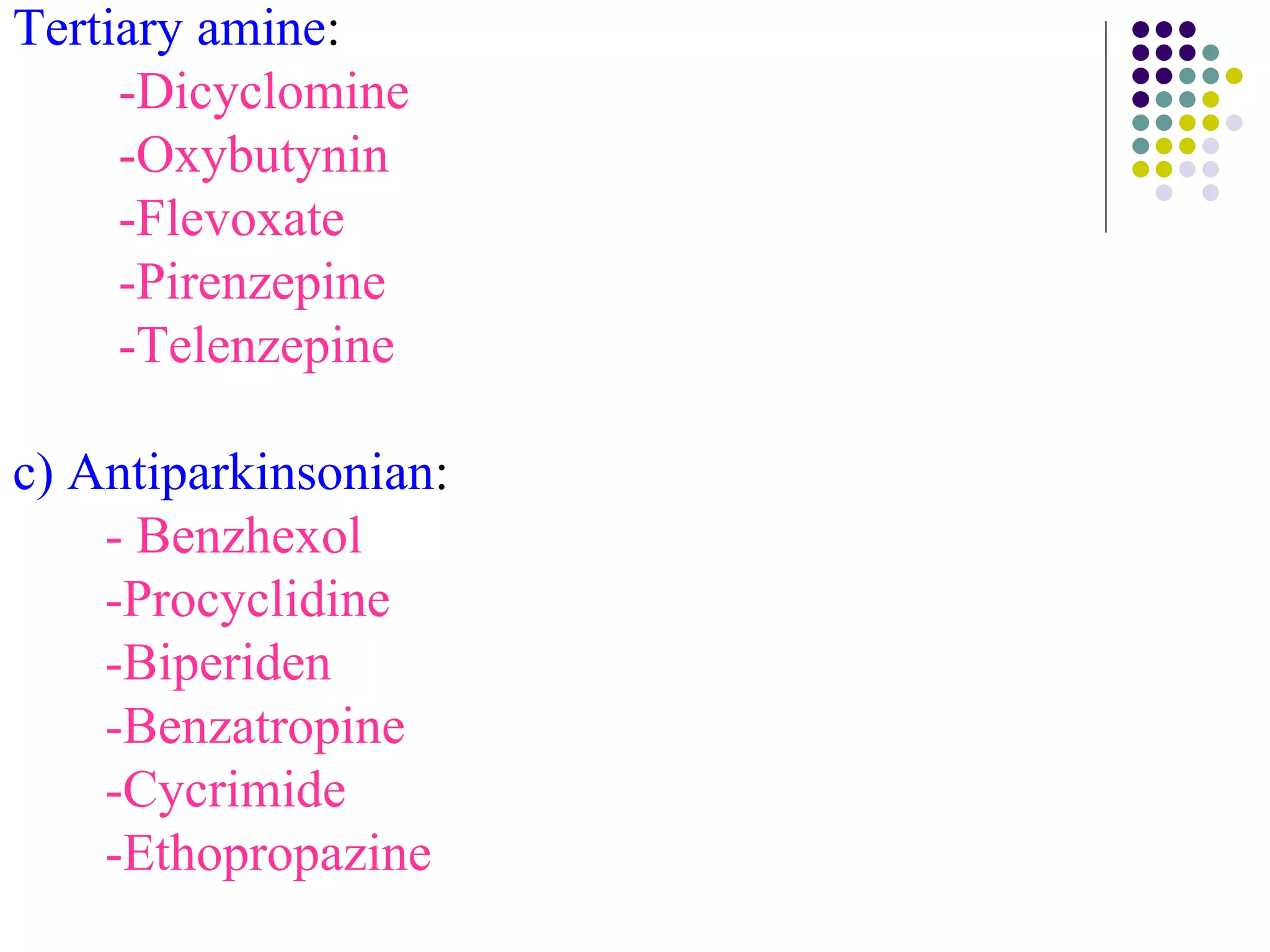
Tertiary amine:
-Dicyclomine
-Oxybutynin
-Flevoxate
-Pirenzepine
-Telenzepine
c) Antiparkinsonian:
- Benzhexol
-Procyclidine
-Biperiden
-Benzatropine
-Cycrimide
-Ethopropazine
Atropine:
B.S: Atropa belladonna
Family: Solanaceae
L-isomer is more potent than d-isomer
Mode of action:
Pharmacological action:
1) CNS:
-Stimulates cerebral cortex and the medulla.
This stimulation is followed by depression,
stupor(impaired consciousness) and coma.
-On small dose  Stimulates respiration
-On large dose  depression of respiration
-Depresses vestibular excitation hence use in
antimotion sickness property.
-By blocking cholinergic over activity in basal
ganglia  suppresses tremor, rigidity of
parkinsonism.
2) CVS:
 The most prominent effect of atropine is to cause
tachycardia. It is due to blockade of M2 receptors
on SA node through which vagal tone decreases
HR.
 -Atropine produces no significant changes in the
blood pressure.
-But large dose postural hypotension  due to
peripheral vascular pooling.
-Large dose  vasodilatation of superficial skin
vessels specially on face and neck  “ATROPINE
FLUSH”  due to direct dilator or histamine
release
3) Gastro intestinal tract:
-Small dose  decrease gastric acid secretion and
reduction motor activity of intestine.
-Relaxes the gall bladder and bile duct.
4) Smooth muscle:
-Relaxes bronchi and bronchioles  resulting
widening of the airway.
-Bronchial secretion are dried up  lead to mucous
plug formation and obstruction.
-Ureter  Tone and contraction is decreases.
-Detrusor muscle of bladder is relaxes.
 urinary retention can occur in older males with prostatic
hypertrophy
5) Effect on secretion:
-Markedly decrease the sweat, salivary,
tracheobronchial and lachrymal secretion by M3
receptor blocking. (Hexahydrosiladifenidol, Darifenacin)
-Skin and eye become dry.
-Talking and swallowing become difficult.
6) Effect on eye:
-Intrinsic muscle of eye have a dual nerve supply.
1) Parasympathetic carried via oculomotor nerve
 stimulate the constrictor (sphincter) pupillae 
miosis.
2) Sympathetic carried via superior cervical ganglia
 stimulate the dilator pupillae  mydriasis.
 Mydriasis produces by atropine pushes the mass of
iris muscle against the cornea and blocking the
cornea iris angle where drainage canal of schelmm
lies  reduces the efficacy of drainage of ciliary
fluid  IOP rises Glaucoma.
7) Body temp:
-On higher dose  body temp. rises due to
inhibition of sweating as well as stimulation of
temp. regulating center in the hypothalamus.
PHARMACOKINETICS
 Atropine and hyoscine are rapidly absorbed
from g.i.t. Applied to eyes they freely
penetrate cornea.
 Passage across blood-brain barrier is
somewhat restricted.
 About 50% of atropine is metabolized in liver
and rest is excreted unchanged in urine.
 It has a t½ of 3–4 hours.
Therapeutic use:
CNS disorder  motion sickness, parkinson’s
disease
Antispasmodic  relaxes intestinal, biliary and
urinary tract, Bronchodilator in bronchial asthma
Antisecretory agent  reduces the gastric acid
secretion, sweating
Ophthalmic use  produces mydriasis and
cycloplegia(paralysis of ciliary muscle- loss of
accomodation), in corneal ulcer (homatropine)
Cardiac stimulant use to treat the heart block due
to digitalis toxicity.
As antidote in anticholinesterase poisoning.
Adverse effects:
Dryness of mouth and throat
Skin is dry, hot and red
Body temp. rise
Blurred vision due to paralysis of accommodation
Urinary retention
Tachycardia and palpitation
Constipation
Atropine / belladonna poisoning:
Due to over dose of atropine (1gm)
 Symptoms:
Severely dryness of mouth
Wide pupillary dilatation
Dysphasia
Tachycardia
Redness of skin, Rise body temp.
Muscle inccordination
Delirium, hallucination
Stupor, coma
Respiratory collapse
 Diagnosis Methacholine 5 mg or neostigmine
1 mg s.c. fails to induce typical muscarinic
effects.
Treatment:
Physostigmine salicylate (tertiary amine) crosses
the BBB control the delirium and coma
Hyperpyrexia and delirium may be treated by ice
cap and cold sponging
Respiratory stimulant like caffeine and Na benzoate
or O2-CO2 mixtures
Artificial respiration
Diazepam may be used if mental symptoms are
disturbing. (Delirium)
ATROPINE HYOSCINE
CNS effect
Low dose
High dose
Excitatory
Mild
Strong
Depressant
Excitation
Anticholinergic
Property
More potent on
heart, bronchial
muscle and intestine
More potent on
eye, secretary
gland
Duration of
action
Longer Shorter
Antimotion
sickness
++ +++
Drug Rout Dose Use
Hyoscine
butyl
bromide
Oral 20-40 mg Esophageal
and
gastrointestin
al spastic
condition
Atropine
methonitrate
Oral 2.5-10 mg Bronchial
asthma and
asthmatic
bronchitis
Ipratropium
bromide
Inhalation 40-80 µg COPD
Propanthelin Oral 15-30 mg Peptic ulcer
and gastritis
Oxyphenonium oral 5-10 mg Peptic ulcer and
gastrointestinal
hyper motility
Clidinium oral 2.5-5 mg Peptic ulcer,
irritable colon
nervous
dyspepsia
Pipenzolate
methyl bromide
oral 5-10 mg Infantile colics,
gastrointestinal
spasm
Isopropamide oral 5 mg Hyper acidity
nervous dyspepsia,
irritable bowel
Glycopyrolate Oral
I.V.
1-2 mg
0.1-
0.2mg
Preanesthetic
medication
Tertiary amines
Dicyclomine oral 20 mg Motion sickness
oxybutinin oral 5 mg Nocturnal enuresis
Pirenzepine,
Telenzepine
(m1 blocker)
Oral 100-
150mg/d
ay
In peptic ulcer, COPD
Mydriatics
Homatropine
Cyclopentolate
Tropicamide
DRUGS ACTING On
AUTONOMIC GANGLIA
 Acetylcholine is the primary excitatory
neurotransmitter in both sympathetic and
parasympathetic ganglia.
 Drugs which inhibit synthesis
(hemicholinium) or release (botulinus toxin,
procaine) of ACh can interfere with ganglionic
transmission, but drugs which act on
cholinergic receptors in the ganglia are more
selective.
 Drugs can either stimulate or block the
ganglia
 Ganglionic stimulants
 Selective nicotinic agonists
 Nicotine (small dose)
 Lobeline, Dimethyl phenyl piperazinium
(DMPP)
 Nonselective/muscarinic agonists
 Acetylcholine
 Carbachol
 Pilocarpine
 Nicotine (from Nicotiana tabacum) is important
in the context of smoking or chewing tobacco, but
there is no clinical application of ganglionic
stimulant
 Nicotine transdermal has recently become
available for treatment of nicotine dependence
and as an aid to smoking cessation
Ganglion Blocking Agent
 A) Competitive blockers
Quaternary ammonium compounds
-Hexamethonium
Monosulfonium compounds
-Trimethophan
 Amines (secondary/tertiary)
Mecamylamine
 B. Persistent depolarising blockers
 Nicotine (large dose)
 Anticholinesterases (large dose)
 The competitive ganglion blockers were used
in the 1950s for hypertension and peptic
ulcer, but have been totally replaced now
because they produce a number of
intolerable side effects
Newer drugs:
Tripitamine:- -Newer m2 selective antagonist.
-Use in treating vagal bradycardia
Derifenacin:- -m3 selective antagonist
-Use in smooth muscle, glandular
overactivity disorder
Drotaverine:- novel anticholinergic smooth muscle
antispasmodic which act by inhibiting
phosphodiesterase-4(PDE-4).
-Elevation of intracellular cAMP/ cGMP  smooth
muscle relaxation
Parasympatholytics - Pharmacology

Parasympatholytics - Pharmacology

  • 1.
    Prepared By: Nehal V.Trambadiya Asst. Professor Smt. N. M. Padalia Pharmacy College
  • 2.
     Conventionally, anticholinergicdrugs are those which block actions of ACh on autonomic effectors and in the CNS exerted through muscarinic receptors.  Though nicotinic antagonists also block certain actions of ACh, they are generally referred to as ‘ganglion blockers’ and ‘neuromuscular blockers’.  Atropine, the prototype drug of this class, is highly selective for muscarinic receptors
  • 3.
    Anticholinergic drugs 1) Naturalalkaloid: -Atropine -Hyoscine (scopolamine) 2) Semi synthetic derivatives: - Homatropine -Atropine methonitrate -Hyoscine butyl bromide -Iperatropium bromide -Tiotropium bromide
  • 4.
    3) Synthetic compound: a)Mydriatics: -Cyclophosphamide -Tropicamide b) Antisycretory and antispasmodics:  -Quaternary compound -Propantheline -Oxyphenonium -Clidinium -Pipenzolate methyl bromide -Isopropamide -Glycopyrolate
  • 5.
    Tertiary amine: -Dicyclomine -Oxybutynin -Flevoxate -Pirenzepine -Telenzepine c) Antiparkinsonian: -Benzhexol -Procyclidine -Biperiden -Benzatropine -Cycrimide -Ethopropazine
  • 6.
    Atropine: B.S: Atropa belladonna Family:Solanaceae L-isomer is more potent than d-isomer Mode of action:
  • 8.
    Pharmacological action: 1) CNS: -Stimulatescerebral cortex and the medulla. This stimulation is followed by depression, stupor(impaired consciousness) and coma. -On small dose  Stimulates respiration -On large dose  depression of respiration -Depresses vestibular excitation hence use in antimotion sickness property. -By blocking cholinergic over activity in basal ganglia  suppresses tremor, rigidity of parkinsonism.
  • 9.
    2) CVS:  Themost prominent effect of atropine is to cause tachycardia. It is due to blockade of M2 receptors on SA node through which vagal tone decreases HR.  -Atropine produces no significant changes in the blood pressure. -But large dose postural hypotension  due to peripheral vascular pooling. -Large dose  vasodilatation of superficial skin vessels specially on face and neck  “ATROPINE FLUSH”  due to direct dilator or histamine release
  • 10.
    3) Gastro intestinaltract: -Small dose  decrease gastric acid secretion and reduction motor activity of intestine. -Relaxes the gall bladder and bile duct. 4) Smooth muscle: -Relaxes bronchi and bronchioles  resulting widening of the airway. -Bronchial secretion are dried up  lead to mucous plug formation and obstruction. -Ureter  Tone and contraction is decreases. -Detrusor muscle of bladder is relaxes.  urinary retention can occur in older males with prostatic hypertrophy
  • 11.
    5) Effect onsecretion: -Markedly decrease the sweat, salivary, tracheobronchial and lachrymal secretion by M3 receptor blocking. (Hexahydrosiladifenidol, Darifenacin) -Skin and eye become dry. -Talking and swallowing become difficult. 6) Effect on eye: -Intrinsic muscle of eye have a dual nerve supply. 1) Parasympathetic carried via oculomotor nerve  stimulate the constrictor (sphincter) pupillae  miosis.
  • 12.
    2) Sympathetic carriedvia superior cervical ganglia  stimulate the dilator pupillae  mydriasis.  Mydriasis produces by atropine pushes the mass of iris muscle against the cornea and blocking the cornea iris angle where drainage canal of schelmm lies  reduces the efficacy of drainage of ciliary fluid  IOP rises Glaucoma. 7) Body temp: -On higher dose  body temp. rises due to inhibition of sweating as well as stimulation of temp. regulating center in the hypothalamus.
  • 13.
    PHARMACOKINETICS  Atropine andhyoscine are rapidly absorbed from g.i.t. Applied to eyes they freely penetrate cornea.  Passage across blood-brain barrier is somewhat restricted.  About 50% of atropine is metabolized in liver and rest is excreted unchanged in urine.  It has a t½ of 3–4 hours.
  • 14.
    Therapeutic use: CNS disorder motion sickness, parkinson’s disease Antispasmodic  relaxes intestinal, biliary and urinary tract, Bronchodilator in bronchial asthma Antisecretory agent  reduces the gastric acid secretion, sweating Ophthalmic use  produces mydriasis and cycloplegia(paralysis of ciliary muscle- loss of accomodation), in corneal ulcer (homatropine) Cardiac stimulant use to treat the heart block due to digitalis toxicity. As antidote in anticholinesterase poisoning.
  • 15.
    Adverse effects: Dryness ofmouth and throat Skin is dry, hot and red Body temp. rise Blurred vision due to paralysis of accommodation Urinary retention Tachycardia and palpitation Constipation
  • 16.
    Atropine / belladonnapoisoning: Due to over dose of atropine (1gm)  Symptoms: Severely dryness of mouth Wide pupillary dilatation Dysphasia Tachycardia Redness of skin, Rise body temp. Muscle inccordination Delirium, hallucination Stupor, coma Respiratory collapse
  • 17.
     Diagnosis Methacholine5 mg or neostigmine 1 mg s.c. fails to induce typical muscarinic effects.
  • 18.
    Treatment: Physostigmine salicylate (tertiaryamine) crosses the BBB control the delirium and coma Hyperpyrexia and delirium may be treated by ice cap and cold sponging Respiratory stimulant like caffeine and Na benzoate or O2-CO2 mixtures Artificial respiration Diazepam may be used if mental symptoms are disturbing. (Delirium)
  • 19.
    ATROPINE HYOSCINE CNS effect Lowdose High dose Excitatory Mild Strong Depressant Excitation Anticholinergic Property More potent on heart, bronchial muscle and intestine More potent on eye, secretary gland Duration of action Longer Shorter Antimotion sickness ++ +++
  • 20.
    Drug Rout DoseUse Hyoscine butyl bromide Oral 20-40 mg Esophageal and gastrointestin al spastic condition Atropine methonitrate Oral 2.5-10 mg Bronchial asthma and asthmatic bronchitis Ipratropium bromide Inhalation 40-80 µg COPD Propanthelin Oral 15-30 mg Peptic ulcer and gastritis
  • 21.
    Oxyphenonium oral 5-10mg Peptic ulcer and gastrointestinal hyper motility Clidinium oral 2.5-5 mg Peptic ulcer, irritable colon nervous dyspepsia Pipenzolate methyl bromide oral 5-10 mg Infantile colics, gastrointestinal spasm
  • 22.
    Isopropamide oral 5mg Hyper acidity nervous dyspepsia, irritable bowel Glycopyrolate Oral I.V. 1-2 mg 0.1- 0.2mg Preanesthetic medication
  • 23.
    Tertiary amines Dicyclomine oral20 mg Motion sickness oxybutinin oral 5 mg Nocturnal enuresis Pirenzepine, Telenzepine (m1 blocker) Oral 100- 150mg/d ay In peptic ulcer, COPD
  • 24.
  • 25.
    DRUGS ACTING On AUTONOMICGANGLIA  Acetylcholine is the primary excitatory neurotransmitter in both sympathetic and parasympathetic ganglia.  Drugs which inhibit synthesis (hemicholinium) or release (botulinus toxin, procaine) of ACh can interfere with ganglionic transmission, but drugs which act on cholinergic receptors in the ganglia are more selective.
  • 26.
     Drugs caneither stimulate or block the ganglia  Ganglionic stimulants  Selective nicotinic agonists  Nicotine (small dose)  Lobeline, Dimethyl phenyl piperazinium (DMPP)  Nonselective/muscarinic agonists  Acetylcholine  Carbachol  Pilocarpine
  • 27.
     Nicotine (fromNicotiana tabacum) is important in the context of smoking or chewing tobacco, but there is no clinical application of ganglionic stimulant  Nicotine transdermal has recently become available for treatment of nicotine dependence and as an aid to smoking cessation
  • 28.
    Ganglion Blocking Agent A) Competitive blockers Quaternary ammonium compounds -Hexamethonium Monosulfonium compounds -Trimethophan  Amines (secondary/tertiary) Mecamylamine
  • 29.
     B. Persistentdepolarising blockers  Nicotine (large dose)  Anticholinesterases (large dose)  The competitive ganglion blockers were used in the 1950s for hypertension and peptic ulcer, but have been totally replaced now because they produce a number of intolerable side effects
  • 30.
    Newer drugs: Tripitamine:- -Newerm2 selective antagonist. -Use in treating vagal bradycardia Derifenacin:- -m3 selective antagonist -Use in smooth muscle, glandular overactivity disorder Drotaverine:- novel anticholinergic smooth muscle antispasmodic which act by inhibiting phosphodiesterase-4(PDE-4). -Elevation of intracellular cAMP/ cGMP  smooth muscle relaxation