ANTI- ULCER AGENT
Presented by:
1.Harshada R. khandewal
B.Pharm 7th semester
Presented by:
2.Anil Keshav Pawar
B.Pharm 7th semister
Peptic ulcer:
It is -
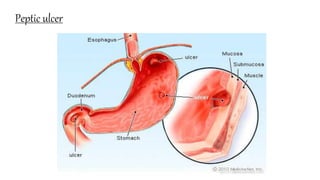
• Erosion in the lining of the stomach or the first part of the small
intestine, an area called the duodenum.
• Ulcers damage the mucosa of the alimentary tract, which extends
through the muscularis mucosa into the sub mucosa or deeper.
• Ulcers that form in the stomach are called gastric ulcers; in the
duodenum, they are called duodenal ulcers. Both types are referred
to as peptic ulcers.
Peptic ulcer
•It results probably due to an imbalance between the two factors
1.Aggressive - (acid , pepsin, bile and H.pylori )
2.Defensive - ( gastric mucus and bicarbonate secretions, PGs, innate
resistance of the mucosal cells ).
• In gastric ulcer generally acid secretion is normal or low.
• In duodenal ulcer acid secretion is high in half of the patients but normal
in the rest.
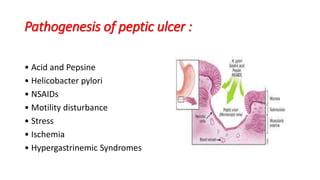
Pathogenesis of peptic ulcer :
• Acid and Pepsine
• Helicobacter pylori
• NSAIDs
• Motility disturbance
• Stress
• Ischemia
• Hypergastrinemic Syndromes
Regulation of gastric acid secretion
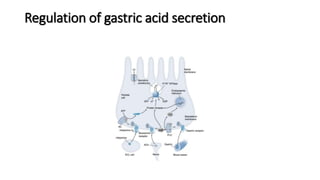
• The terminal enzymes H+K+ATPase which secretes H+ ions in the parietal
cells can be activated by histamine, Ach and gastrin acting via their own
receptors located on the basolateral membrane of these cells.
• Histamine acting through H2 receptors, plays the dominant role, because
the other two, gastrin and Ach partly directly and to a greater extent
indirectly by releasing histamine from ‘ histaminocytes’ located in the
oxyntic glands.
• While H2 receptors activate H+K+ATPase by generating cAMP,
muscarinic and gastrin receptors appear to function through
the phospholipase C IP3 – DAG pathway that mobilizes
intracellular Ca+2.
• The cAMP mediated proton pump activation also involves
ca+2.
• The secretomotor response to gastrin and cholinergic agonists
is expressed fully only in the presence of cAMP generated by H2 activation.
• Histamine participates in the acid response to gastrin , ACh at
more than one levels, and H2antagonists suppress not only
histamine, but also Ach and in fact any other gastric secretion
stimulus.
• Gastrin is secreted from the antrum in response to rise in antral
pH, food constituents and vagally mediated reflexes. The
dominant muscarinic receptor mediating vagal responses is of
The M1 subtype.
• Vagus releases Ach in close proximity to histaminocytes and
gastrin secreting cells.
• Prostaglandins have been a ‘cytoprotective’ role in
the gastric mucosa by augmenting mucus and bicarbonate
secretion, as well as other actions.
• PGE2, produced by gastric mucosa, inhibits acid secretion by
opposing cAMP generation ( in parietal cells ) and gastrin
release ( from antral cells ).
Symptoms
• Epigastric pain after meal or during meal
• Upper dyspeptic syndrome – loss of appetite, nausea, vomiting.
• Vomiting brings relief
• Reduced nutrition
• Loss of weight
• Oral flatulence, bloating, distension and intolerance of fatty food
• Heartburn
• Pain radiating to the back
APPROACHES FOR THE REDUCTION OF PEPTIC ULCER
1. Reduction of gastric acid secretion
2. Neutralization of gastric acid ( antacids )
3. Ulcer protectives
4. Anti- H.Pylori drugs
Reduction of gastric acid secretion
1. H2 Antihistamins : cimetidin, rantidine, famotidine, roxatidine.
2. Proton pump inhibitors : omeprazole, lansoprazole, pantoprazole,
rabeprazole, esomeprazole.
3. Anticholinergics : pirenzepine, propantheline, oxyphenonium.
4. Prostaglandin analogue : misoprostol.
Neutralization of gastric acid (antacids)
1. Systemic : sodium bicarbonate, sod. Citrate
2. Nonsystemic : magnesium hydroxide, mag.Trisilicate, aluminium hydroxide
gel, calcium carbonate
Ulcer protectives
Sucralfate , colloidal bismuth subcitrate (CBS)
Anti H-pylori drugs
Amoxicillin, clarithromycin, Metronidazole, trinidazole, tetracycline.
1. H2 Antagonist
• Eg: Cimetidine ,ranitidine etc.
• First class of highly effective drugs.
Mechanisam of action:
1. H2 Blockade : Cimetidine and other H2 antagonists block histamine- induced
gastric secretion, cardiac stimulaton ,uternine relaxation , bronchial realaxation.
Attenuate Fall in BP due to histamine, especially the late phase response seen with
high doses.
2. Gastric secretion : All phases of secretion are suppressed dose-dependently, but
the basal nocturnal secretion is suppressed completely. Secretory responses to not
only histamine but all other stimuli i.e Ach , gastrin, food, alcohol are seen.
Pharmacokinetics
• Absorbed orally , bioavailibility is 60-80%. Absorption not interfered by presence
of food in stomach.
• Cross placenta and reaches milk
• Dose reduction- in case of renal failure.
Adverse effects
• CNS effects like confusional state, restlessness, convulsions and coma have
occurred infrequently in elderly persons with renal impairment with large doses
infused i.v
• Headach, dizziness, bowel upset, dry mouth, rashes.
• Cemetidine - Anti androgenic action.Increases plasma prolactin and inhibit
degradation of estradiol by liver.
• High dose for long time - gynaecomastia, loss of libido, impotence and temporary
decrease in sperm count
Use
Used in conditions in which it is profitable to suppress gastric acid
secretion.
• 1. Duodenal ulcer
• 2. Gastric ulcer
• 3. Stress ulcers and gastritis
• 4. Zollingers-Ellison syndrome
• 5. Gastroesophagel reflux disease
PROTON PUMP INHIBITORS
Mechanism of action :Proton pump inhibitors act by irreversibly blocking
the hydrogen/potassium adenosine triphosphatase enzyme system of the
gastric parietal cells.
• The proton pump is the terminal stage in gastric acid secretion
• Omeprazole: is inactive at neutral pH, but at pH<5 rearranges to two charged
cationic forms that react covalently with SH groups of the H+ K+ ATPase enzyme
and inactivate it irreversibly, especially when two molecules of omeprazole react
with one molecule of the enzyme
• SIDE EFFECTS: Stomach pain, Diarrhea,Constipation,Dizziness,Pain,Hives,
Itching,seizures
Prostaglandin Analogs
MISOPROSTOL
Mechanism:
Misoprostol acts upon gastric parietal cells, inhibiting the secretion of gastric acid
via G-protein coupled receptor-mediated inhibition of adenylate cyclase, which
leads to decreased intracellular cyclic AMP levels and decreased pump activity at
the apical surface of the parietal cell
Side effects: Diarrhea, abdominal ,pain, nausea, flatulence, headache, dyspepsia,
vomiting, and constipation.
ANTACIDS
a) SYSTEMIC ANTACIDS:
Eg: SODIUM BICARBONATE : It is water soluble , acts instantaneously, but the
duration of action is short. It is a potent neutralizer, pH may rise above 7.
However it has several demerits
a) Absorbed systemically , large doses will induce alkalosis.
b) Produces carbon dioxide in stomach which creates discomfort, risk of ulcer
perforation.
c) Acid rebound
b)Nonsystemic antacids
Eg:Magnesium hydroxide : Has low water solubility ; its aqueous suspension has
low concentration of OH- ions and thus low alkalinity.
However it reacts with HCL and is an efficacious antacid.
• MILK OF MAGNESIA- 0.4 g / 5 ml suspension.
ULCER PROTECTIVES
SUCRALFATE
• Mechenism: Sucralfate is a locally acting substance that in an acidic
environment (pH < 4), reacts with HCL in the stomach to form a crosslinking,
viscous, paste-like material capable of acting as an acid buffer. It also attaches to
proteins on the surface of ulcers, such as albumin and fibrinogen, to form stable
insoluble complexes. These complexes serve as protective barriers at the ulcer
surface, preventing further damage from acid, pepsin, and bile.
• Side effects: constipation , nausea , headach, dry mouth.
ANTI H.PYLORI DRUGS
• Anti microbials that have been found clinically effective against
H.pylori are: amoxicillin, clarithromycin, tetracycline and
metronidazole.
• A combination regimen is preferred, using gastric acid inhibitors and
antibiotics.
Example:
A proton pump inhibitor or H2 blocker + amoxicillin + clarithromycin or
metronidazole .
ANTI- ULCER AGENT
ANTI- ULCER AGENT
ANTI- ULCER AGENT