EPIDEMIOLOGY/COMMUNICABLEEPIDEMIOLOGY/COMMUNICABLE
DISEASE PROJECTDISEASE PROJECT
Sheryl Super RNSheryl Super RN
Metropolitan State University of DenverMetropolitan State University of Denver
Nursing 4000Nursing 4000
Spring 2014Spring 2014
IntroductionIntroduction
 A gram positive rod shaped bacteria foundA gram positive rod shaped bacteria found
naturally in the environment is callednaturally in the environment is called
bacillus anthracis. The bacteria producebacillus anthracis. The bacteria produce
spores which can lie dormant for decades.spores which can lie dormant for decades.
When the bacteria enter an animal orWhen the bacteria enter an animal or
human being, they become active growinghuman being, they become active growing
cells. The cells multiply and producecells. The cells multiply and produce
toxins, which is the disease anthrax.toxins, which is the disease anthrax.
IntroductionIntroduction
 Animals become infected when theyAnimals become infected when they
breathe contaminated plants, soil, orbreathe contaminated plants, soil, or
water. Animals can be vaccinated againstwater. Animals can be vaccinated against
anthrax. People become infected whenanthrax. People become infected when
they breathe in spores, eat contaminatedthey breathe in spores, eat contaminated
food, drink contaminated water, or whenfood, drink contaminated water, or when
spores enter a cut or scrape on their skin.spores enter a cut or scrape on their skin.
IntroductionIntroduction
 Anthrax is not contagious like a cold or flu.Anthrax is not contagious like a cold or flu.
I became interested in anthrax when II became interested in anthrax when I
learned that men in the United Stateslearned that men in the United States
used to become infected from theirused to become infected from their
shaving brushes made out of cow hairs,shaving brushes made out of cow hairs,
and when I learned anthrax can be usedand when I learned anthrax can be used
as a terrorist weapon.as a terrorist weapon.
EpidemiologyEpidemiology
 Anthrax is currently very rare in the United States. It isAnthrax is currently very rare in the United States. It is
recommended that livestock in the United States arerecommended that livestock in the United States are
vaccinated for anthrax yearly.vaccinated for anthrax yearly.
 Anthrax spores typically take 1 to 6 days to becomeAnthrax spores typically take 1 to 6 days to become
activated, but some spores can remain in the body for 60activated, but some spores can remain in the body for 60
days or more before they become activated.days or more before they become activated.
 2001 is the last time there were any cases of anthrax in2001 is the last time there were any cases of anthrax in
the United States. Powdered anthrax spores were sentthe United States. Powdered anthrax spores were sent
through the United States postal service as a weapon.through the United States postal service as a weapon.
22 people were infected. Five of the 22 people died.22 people were infected. Five of the 22 people died.
EpidemiologyEpidemiology
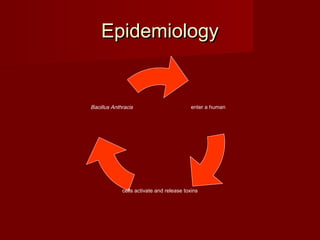
enter a human
cells activate and release toxins
Bacillus Anthracis
Chain of infectionChain of infection
 Risk categories include:Risk categories include:
 Working with animal hair, hides or wool.Working with animal hair, hides or wool.
 Eating raw or undercooked meat.Eating raw or undercooked meat.
 Injecting drugs.Injecting drugs.
Chain of infectionChain of infection
 There are four routes of entry by which humansThere are four routes of entry by which humans
obtain anthrax.obtain anthrax.
 Cutaneous, entering from a cut or scrape on theCutaneous, entering from a cut or scrape on the
skin.skin.
 Gastrointestinal, entering when raw orGastrointestinal, entering when raw or
undercooked contaminated meat is eaten.undercooked contaminated meat is eaten.
 Inhalation, entering from inhalation of spores.Inhalation, entering from inhalation of spores.
 Injection, entering when drugs are injected.Injection, entering when drugs are injected.
Patho-physiologyPatho-physiology
 Cutaneous Anthrax Symptoms:Cutaneous Anthrax Symptoms:
 A small group of blisters or bumps thatA small group of blisters or bumps that
may itch appear.may itch appear.
 A painless ulcer with a black centerA painless ulcer with a black center
appears later, most often on the face,appears later, most often on the face,
neck, arms or hands.neck, arms or hands.
 Swelling can occur around the ulcer.Swelling can occur around the ulcer.
Patho-physiologyPatho-physiology
 Gastrointestinal Anthrax Symptoms:Gastrointestinal Anthrax Symptoms:
 Diarrhea which may be bloodyDiarrhea which may be bloody
 FaintingFainting
 Fever and chillsFever and chills
 Flushing of faceFlushing of face
 HeadacheHeadache
 HoarsenessHoarseness
 Nausea and vomitingNausea and vomiting
 Red eyesRed eyes
 Sore throatSore throat
 Stomach painStomach pain
 Swelling of abdomenSwelling of abdomen
 Swelling of neck or neck glandsSwelling of neck or neck glands
Patho-physiologyPatho-physiology
 Inhalation Anthrax Symptoms:Inhalation Anthrax Symptoms:
 Body achesBody aches
 Chest discomfortChest discomfort
 ConfusionConfusion
 CoughCough
 DizzinessDizziness
 FatigueFatigue
 Fever and chillsFever and chills
 HeadacheHeadache
 Nausea and vomitingNausea and vomiting
 Shortness of breathShortness of breath
 Stomach painsStomach pains
 SweatsSweats
Patho-physiologyPatho-physiology
 Injection Anthrax Symptoms:Injection Anthrax Symptoms:
 A small group of blisters or bumps thatA small group of blisters or bumps that
may itch appear at injection site.may itch appear at injection site.
 A painless ulcer with a black centerA painless ulcer with a black center
appears later, most often on the face,appears later, most often on the face,
neck, arms or hands.neck, arms or hands.
 Swelling can occur around the ulcer.Swelling can occur around the ulcer.
 Abscesses deep under the skin atAbscesses deep under the skin at
injection site.injection site.
Patho-physiologyPatho-physiology
 SUSPECTED CASE:SUSPECTED CASE:
 An illness suggestive of a clinical form ofAn illness suggestive of a clinical form of
anthrax.anthrax.
 No epidemiologic or laboratory evidence.No epidemiologic or laboratory evidence.
Patho-physiologyPatho-physiology
 PROBABLE CASE:PROBABLE CASE:
 Epidemiological link to a documented exposure.Epidemiological link to a documented exposure.
 B. anthracisB. anthracis DNA evidence found in clinicalDNA evidence found in clinical
specimens.specimens.
 A positive result from QuickELISATM Anthrax-A positive result from QuickELISATM Anthrax-
PA kit.PA kit.
 Detection of Lethal Factor (LF) found in clinicalDetection of Lethal Factor (LF) found in clinical
specimens.specimens.
 A positive result from RedLine Alert test.A positive result from RedLine Alert test.
Patho-physiologyPatho-physiology
 CONFIRMED CASE:CONFIRMED CASE:
 A clinically compatible illness along with one of theA clinically compatible illness along with one of the
following:following:
 Culture and identification ofCulture and identification of B. anthracisB. anthracis from clinicalfrom clinical
specimens.specimens.
 Demonstration ofDemonstration of B. anthracisB. anthracis in tissues byin tissues by
immunohistochemical staining.immunohistochemical staining.
 Evidence of four-fold rise in antibodies to protectiveEvidence of four-fold rise in antibodies to protective
antigen using IgG ELISA testingantigen using IgG ELISA testing
 Documented environmental exposure AND evidence ofDocumented environmental exposure AND evidence of
B. anthracisB. anthracis DNA from clinical specimens.DNA from clinical specimens.
Patient SafetyPatient Safety
 AFTER EXPOSURE:AFTER EXPOSURE:
 Ciprofloxacin is taken for 60 days. Common side effects are anxiety,Ciprofloxacin is taken for 60 days. Common side effects are anxiety,
agitation, blurred vision, dizziness, drowsiness, insomnia, nausea,agitation, blurred vision, dizziness, drowsiness, insomnia, nausea,
nightmares and vomiting.nightmares and vomiting.
 Doxycycline is taken for 60 days. Common side effects are diarrhea,Doxycycline is taken for 60 days. Common side effects are diarrhea,
nausea, skin rash, upset stomach and vaginal yeast infection.nausea, skin rash, upset stomach and vaginal yeast infection.
 AFTER ANTHRAX TOXINS ARE RELEASED IN THE BODY:AFTER ANTHRAX TOXINS ARE RELEASED IN THE BODY:
 Antitoxin used with:Antitoxin used with:
 Other treatment options such as continuous fluid drainage and mechanicalOther treatment options such as continuous fluid drainage and mechanical
ventilation breathing.ventilation breathing.
 It is a reportable disease.It is a reportable disease.
Patient SafetyPatient Safety
 VACCINATION:VACCINATION:
 Anthrax Vaccine Adsorbed (AVA) protectsAnthrax Vaccine Adsorbed (AVA) protects
against cutaneous and inhalation anthrax.against cutaneous and inhalation anthrax.
 For at risk adults (ages 18-65) BEFOREFor at risk adults (ages 18-65) BEFORE
exposure.exposure.
 Not approved for use AFTER exposure.Not approved for use AFTER exposure.
 5 injections are given intramuscularly over5 injections are given intramuscularly over
18 months.18 months.
Chain of infection/Patient SafetyChain of infection/Patient Safety
 At risk adults include:At risk adults include:
 Some laboratory workers who work withSome laboratory workers who work with
anthrax.anthrax.
 Some workers who handle animals orSome workers who handle animals or
animal products.animal products.
 Some members of the military.Some members of the military.
Patient SafetyPatient Safety
 People who should not receive thePeople who should not receive the
vaccine:vaccine:
 History of previous allergic reaction to anHistory of previous allergic reaction to an
AVA dose.AVA dose.
 History of allergic reaction to anyHistory of allergic reaction to any
component of AVA.component of AVA.
 Pregnant women.Pregnant women.
Patient SafetyPatient Safety
 Emergency use of AVA:Emergency use of AVA:
 AFTER EXPOSURE.AFTER EXPOSURE.
 3 injections of AVA in 30 days.3 injections of AVA in 30 days.
 60 days of antibiotics.60 days of antibiotics.
Chain of Infection/Patient SafetyChain of Infection/Patient Safety
 Bacillus anthracisBacillus anthracis can be used as acan be used as a
weapon.weapon.
 It is easily found is nature, can beIt is easily found is nature, can be
produced in a laboratory, and can beproduced in a laboratory, and can be
stored for a long time.stored for a long time.
 It could be used to sicken and kill crops,It could be used to sicken and kill crops,
livestock and people.livestock and people.
 It could be released into water and food.It could be released into water and food.
Patient SafetyPatient Safety
 Bacillus anthracisBacillus anthracis is designated as a Tieris designated as a Tier
1 toxin. It is at the highest level of risk for1 toxin. It is at the highest level of risk for
misuse with significant potential for massmisuse with significant potential for mass
casualties, devastation to criticalcasualties, devastation to critical
infrastructure, the economy, and publicinfrastructure, the economy, and public
confidence.confidence.
 It takes only a small amount of anthrax toIt takes only a small amount of anthrax to
infect a large number of people.infect a large number of people.
REFERENCESREFERENCES
 www.cdc.gov/anthrax/www.cdc.gov/anthrax/
 www.rxlist.comwww.rxlist.com

EPI COMM POWER POINT 2014-3

  • 1.
    EPIDEMIOLOGY/COMMUNICABLEEPIDEMIOLOGY/COMMUNICABLE DISEASE PROJECTDISEASE PROJECT SherylSuper RNSheryl Super RN Metropolitan State University of DenverMetropolitan State University of Denver Nursing 4000Nursing 4000 Spring 2014Spring 2014
  • 2.
    IntroductionIntroduction  A grampositive rod shaped bacteria foundA gram positive rod shaped bacteria found naturally in the environment is callednaturally in the environment is called bacillus anthracis. The bacteria producebacillus anthracis. The bacteria produce spores which can lie dormant for decades.spores which can lie dormant for decades. When the bacteria enter an animal orWhen the bacteria enter an animal or human being, they become active growinghuman being, they become active growing cells. The cells multiply and producecells. The cells multiply and produce toxins, which is the disease anthrax.toxins, which is the disease anthrax.
  • 3.
    IntroductionIntroduction  Animals becomeinfected when theyAnimals become infected when they breathe contaminated plants, soil, orbreathe contaminated plants, soil, or water. Animals can be vaccinated againstwater. Animals can be vaccinated against anthrax. People become infected whenanthrax. People become infected when they breathe in spores, eat contaminatedthey breathe in spores, eat contaminated food, drink contaminated water, or whenfood, drink contaminated water, or when spores enter a cut or scrape on their skin.spores enter a cut or scrape on their skin.
  • 4.
    IntroductionIntroduction  Anthrax isnot contagious like a cold or flu.Anthrax is not contagious like a cold or flu. I became interested in anthrax when II became interested in anthrax when I learned that men in the United Stateslearned that men in the United States used to become infected from theirused to become infected from their shaving brushes made out of cow hairs,shaving brushes made out of cow hairs, and when I learned anthrax can be usedand when I learned anthrax can be used as a terrorist weapon.as a terrorist weapon.
  • 5.
    EpidemiologyEpidemiology  Anthrax iscurrently very rare in the United States. It isAnthrax is currently very rare in the United States. It is recommended that livestock in the United States arerecommended that livestock in the United States are vaccinated for anthrax yearly.vaccinated for anthrax yearly.  Anthrax spores typically take 1 to 6 days to becomeAnthrax spores typically take 1 to 6 days to become activated, but some spores can remain in the body for 60activated, but some spores can remain in the body for 60 days or more before they become activated.days or more before they become activated.  2001 is the last time there were any cases of anthrax in2001 is the last time there were any cases of anthrax in the United States. Powdered anthrax spores were sentthe United States. Powdered anthrax spores were sent through the United States postal service as a weapon.through the United States postal service as a weapon. 22 people were infected. Five of the 22 people died.22 people were infected. Five of the 22 people died.
  • 6.
    EpidemiologyEpidemiology enter a human cellsactivate and release toxins Bacillus Anthracis
  • 7.
    Chain of infectionChainof infection  Risk categories include:Risk categories include:  Working with animal hair, hides or wool.Working with animal hair, hides or wool.  Eating raw or undercooked meat.Eating raw or undercooked meat.  Injecting drugs.Injecting drugs.
  • 8.
    Chain of infectionChainof infection  There are four routes of entry by which humansThere are four routes of entry by which humans obtain anthrax.obtain anthrax.  Cutaneous, entering from a cut or scrape on theCutaneous, entering from a cut or scrape on the skin.skin.  Gastrointestinal, entering when raw orGastrointestinal, entering when raw or undercooked contaminated meat is eaten.undercooked contaminated meat is eaten.  Inhalation, entering from inhalation of spores.Inhalation, entering from inhalation of spores.  Injection, entering when drugs are injected.Injection, entering when drugs are injected.
  • 9.
    Patho-physiologyPatho-physiology  Cutaneous AnthraxSymptoms:Cutaneous Anthrax Symptoms:  A small group of blisters or bumps thatA small group of blisters or bumps that may itch appear.may itch appear.  A painless ulcer with a black centerA painless ulcer with a black center appears later, most often on the face,appears later, most often on the face, neck, arms or hands.neck, arms or hands.  Swelling can occur around the ulcer.Swelling can occur around the ulcer.
  • 10.
    Patho-physiologyPatho-physiology  Gastrointestinal AnthraxSymptoms:Gastrointestinal Anthrax Symptoms:  Diarrhea which may be bloodyDiarrhea which may be bloody  FaintingFainting  Fever and chillsFever and chills  Flushing of faceFlushing of face  HeadacheHeadache  HoarsenessHoarseness  Nausea and vomitingNausea and vomiting  Red eyesRed eyes  Sore throatSore throat  Stomach painStomach pain  Swelling of abdomenSwelling of abdomen  Swelling of neck or neck glandsSwelling of neck or neck glands
  • 11.
    Patho-physiologyPatho-physiology  Inhalation AnthraxSymptoms:Inhalation Anthrax Symptoms:  Body achesBody aches  Chest discomfortChest discomfort  ConfusionConfusion  CoughCough  DizzinessDizziness  FatigueFatigue  Fever and chillsFever and chills  HeadacheHeadache  Nausea and vomitingNausea and vomiting  Shortness of breathShortness of breath  Stomach painsStomach pains  SweatsSweats
  • 12.
    Patho-physiologyPatho-physiology  Injection AnthraxSymptoms:Injection Anthrax Symptoms:  A small group of blisters or bumps thatA small group of blisters or bumps that may itch appear at injection site.may itch appear at injection site.  A painless ulcer with a black centerA painless ulcer with a black center appears later, most often on the face,appears later, most often on the face, neck, arms or hands.neck, arms or hands.  Swelling can occur around the ulcer.Swelling can occur around the ulcer.  Abscesses deep under the skin atAbscesses deep under the skin at injection site.injection site.
  • 13.
    Patho-physiologyPatho-physiology  SUSPECTED CASE:SUSPECTEDCASE:  An illness suggestive of a clinical form ofAn illness suggestive of a clinical form of anthrax.anthrax.  No epidemiologic or laboratory evidence.No epidemiologic or laboratory evidence.
  • 14.
    Patho-physiologyPatho-physiology  PROBABLE CASE:PROBABLECASE:  Epidemiological link to a documented exposure.Epidemiological link to a documented exposure.  B. anthracisB. anthracis DNA evidence found in clinicalDNA evidence found in clinical specimens.specimens.  A positive result from QuickELISATM Anthrax-A positive result from QuickELISATM Anthrax- PA kit.PA kit.  Detection of Lethal Factor (LF) found in clinicalDetection of Lethal Factor (LF) found in clinical specimens.specimens.  A positive result from RedLine Alert test.A positive result from RedLine Alert test.
  • 15.
    Patho-physiologyPatho-physiology  CONFIRMED CASE:CONFIRMEDCASE:  A clinically compatible illness along with one of theA clinically compatible illness along with one of the following:following:  Culture and identification ofCulture and identification of B. anthracisB. anthracis from clinicalfrom clinical specimens.specimens.  Demonstration ofDemonstration of B. anthracisB. anthracis in tissues byin tissues by immunohistochemical staining.immunohistochemical staining.  Evidence of four-fold rise in antibodies to protectiveEvidence of four-fold rise in antibodies to protective antigen using IgG ELISA testingantigen using IgG ELISA testing  Documented environmental exposure AND evidence ofDocumented environmental exposure AND evidence of B. anthracisB. anthracis DNA from clinical specimens.DNA from clinical specimens.
  • 16.
    Patient SafetyPatient Safety AFTER EXPOSURE:AFTER EXPOSURE:  Ciprofloxacin is taken for 60 days. Common side effects are anxiety,Ciprofloxacin is taken for 60 days. Common side effects are anxiety, agitation, blurred vision, dizziness, drowsiness, insomnia, nausea,agitation, blurred vision, dizziness, drowsiness, insomnia, nausea, nightmares and vomiting.nightmares and vomiting.  Doxycycline is taken for 60 days. Common side effects are diarrhea,Doxycycline is taken for 60 days. Common side effects are diarrhea, nausea, skin rash, upset stomach and vaginal yeast infection.nausea, skin rash, upset stomach and vaginal yeast infection.  AFTER ANTHRAX TOXINS ARE RELEASED IN THE BODY:AFTER ANTHRAX TOXINS ARE RELEASED IN THE BODY:  Antitoxin used with:Antitoxin used with:  Other treatment options such as continuous fluid drainage and mechanicalOther treatment options such as continuous fluid drainage and mechanical ventilation breathing.ventilation breathing.  It is a reportable disease.It is a reportable disease.
  • 17.
    Patient SafetyPatient Safety VACCINATION:VACCINATION:  Anthrax Vaccine Adsorbed (AVA) protectsAnthrax Vaccine Adsorbed (AVA) protects against cutaneous and inhalation anthrax.against cutaneous and inhalation anthrax.  For at risk adults (ages 18-65) BEFOREFor at risk adults (ages 18-65) BEFORE exposure.exposure.  Not approved for use AFTER exposure.Not approved for use AFTER exposure.  5 injections are given intramuscularly over5 injections are given intramuscularly over 18 months.18 months.
  • 18.
    Chain of infection/PatientSafetyChain of infection/Patient Safety  At risk adults include:At risk adults include:  Some laboratory workers who work withSome laboratory workers who work with anthrax.anthrax.  Some workers who handle animals orSome workers who handle animals or animal products.animal products.  Some members of the military.Some members of the military.
  • 19.
    Patient SafetyPatient Safety People who should not receive thePeople who should not receive the vaccine:vaccine:  History of previous allergic reaction to anHistory of previous allergic reaction to an AVA dose.AVA dose.  History of allergic reaction to anyHistory of allergic reaction to any component of AVA.component of AVA.  Pregnant women.Pregnant women.
  • 20.
    Patient SafetyPatient Safety Emergency use of AVA:Emergency use of AVA:  AFTER EXPOSURE.AFTER EXPOSURE.  3 injections of AVA in 30 days.3 injections of AVA in 30 days.  60 days of antibiotics.60 days of antibiotics.
  • 21.
    Chain of Infection/PatientSafetyChain of Infection/Patient Safety  Bacillus anthracisBacillus anthracis can be used as acan be used as a weapon.weapon.  It is easily found is nature, can beIt is easily found is nature, can be produced in a laboratory, and can beproduced in a laboratory, and can be stored for a long time.stored for a long time.  It could be used to sicken and kill crops,It could be used to sicken and kill crops, livestock and people.livestock and people.  It could be released into water and food.It could be released into water and food.
  • 22.
    Patient SafetyPatient Safety Bacillus anthracisBacillus anthracis is designated as a Tieris designated as a Tier 1 toxin. It is at the highest level of risk for1 toxin. It is at the highest level of risk for misuse with significant potential for massmisuse with significant potential for mass casualties, devastation to criticalcasualties, devastation to critical infrastructure, the economy, and publicinfrastructure, the economy, and public confidence.confidence.  It takes only a small amount of anthrax toIt takes only a small amount of anthrax to infect a large number of people.infect a large number of people.
  • 23.