Leishmaniasis
Dr. Sachin Adukia
Dept. of Internal Medicine
Leishmaniasis: Introduction
Definition
• Encompassing a complex group of disorders,
leishmaniasis is caused by unicellular eukaryotic
obligatory intracellular protozoa of the genus
Leishmania and primarily affects the host's
reticuloendothelial system.
• Leishmania species produce widely varying clinical
syndromes ranging from self-healing cutaneous ulcers
to fatal visceral disease.
• These syndromes fall into three broad categories:
visceral leishmaniasis (VL), cutaneous leishmaniasis

(CL), and mucosal leishmaniasis (ML).
LeishmaniasisLeishmaniasis
Leishmania donovani (complex) (VL)*
Leishmania tropica (CL)**
Leishmania major (CL)
Leishmania aethiopica (CL)
Leishmania mexicana (Complex) (CL)
Leishmania brazilliensis (complex) (MCL)***
Leishmania peruriana
* VL – visceral leishm.
**CL – cutaneous leishm.
***MCL - muco-cut. Leishm.
Epidemiology
Visceral Leishmaniasis
• VL (also known as kala-azar, a Hindi term meaning
"black fever") is caused by the L. donovani complex,
which includes L. donovani and L. infantum (the latter
designated L. chagasi in the New World); these
species are responsible for anthroponotic and
zoonotic transmission, respectively. India and
neighboring Nepal, Bangladesh, Sudan, and Brazil
are the four largest foci of VL and account for 90% of
the world's VL burden, with India the worst affected
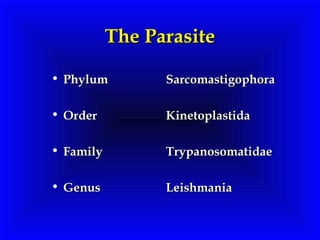
The ParasiteThe Parasite
• PhylumPhylum
• OrderOrder
• FamilyFamily
• GenusGenus
SarcomastigophoraSarcomastigophora
KinetoplastidaKinetoplastida
TrypanosomatidaeTrypanosomatidae
LeishmaniaLeishmania
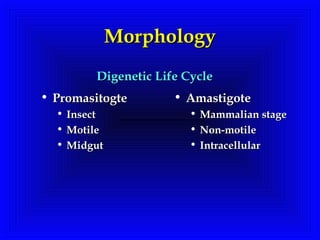
MorphologyMorphology
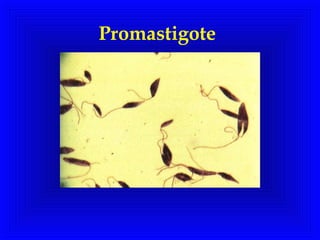
• PromasitogtePromasitogte
• InsectInsect
• MotileMotile
• MidgutMidgut
• AmastigoteAmastigote
• Mammalian stageMammalian stage
• Non-motileNon-motile
• IntracellularIntracellular
Digenetic Life CycleDigenetic Life Cycle
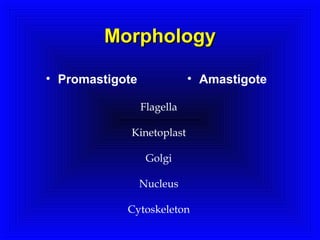
MorphologyMorphology
• Promastigote • Amastigote
Flagella
Kinetoplast
Golgi
Nucleus
Cytoskeleton
Promastigote
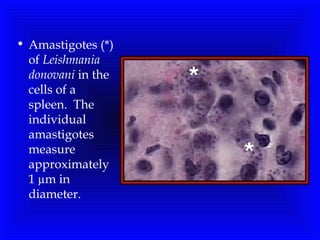
• Amastigotes (*)
of Leishmania
donovani in the
cells of a
spleen.  The
individual
amastigotes
measure
approximately
1 µm in
diameter. 
1
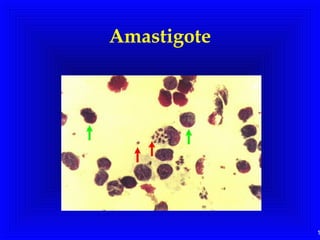
Amastigote
1
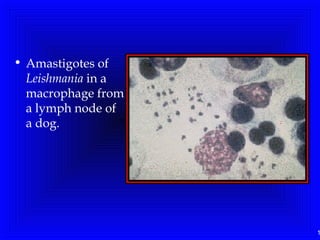
• Amastigotes of
Leishmania in a
macrophage from
a lymph node of
a dog. 
1
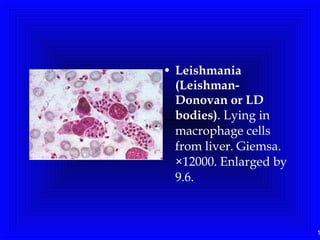
• Leishmania
(Leishman-
Donovan or LD
bodies). Lying in
macrophage cells
from liver. Giemsa.
×12000. Enlarged by
9.6.
1
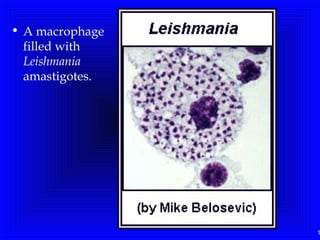
• A macrophage
filled with
Leishmania
amastigotes.
1
Life cycleLife cycle
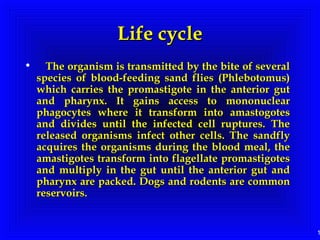
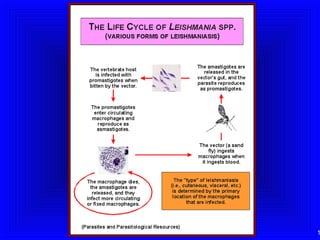
• The organism is transmitted by the bite of severalThe organism is transmitted by the bite of several
species of blood-feeding sand flies (Phlebotomus)species of blood-feeding sand flies (Phlebotomus)
which carries the promastigote in the anterior gutwhich carries the promastigote in the anterior gut
and pharynx. It gains access to mononuclearand pharynx. It gains access to mononuclear
phagocytes where it transform into amastogotesphagocytes where it transform into amastogotes
and divides until the infected cell ruptures. Theand divides until the infected cell ruptures. The
released organisms infect other cells. The sandflyreleased organisms infect other cells. The sandfly
acquires the organisms during the blood meal, theacquires the organisms during the blood meal, the
amastigotes transform into flagellate promastigotesamastigotes transform into flagellate promastigotes
and multiply in the gut until the anterior gut andand multiply in the gut until the anterior gut and
pharynx are packed. Dogs and rodents are commonpharynx are packed. Dogs and rodents are common
reservoirs.reservoirs.
1
1
Mammalian HostsMammalian Hosts
• RodentsRodents
• GerbilsGerbils
• HyraxesHyraxes
• BatsBats
• PorcupinesPorcupines
• OpossumsOpossums
• SlothsSloths
• PrimatesPrimates
• DogsDogs
• FoxesFoxes
• AnteatersAnteaters
• othersothers
1
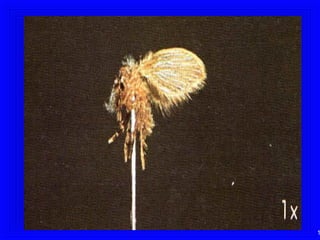
VectorsVectors
Phlebotomine SandfliesPhlebotomine Sandflies
6 genera with world wide distribution6 genera with world wide distribution
Genus :Phlebotomus & LutzomiaGenus :Phlebotomus & Lutzomia
500 species500 species
1
1
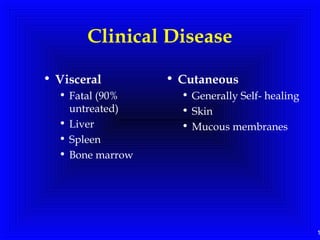
Clinical Disease
• Visceral
• Fatal (90%
untreated)
• Liver
• Spleen
• Bone marrow
• Cutaneous
• Generally Self- healing
• Skin
• Mucous membranes
2
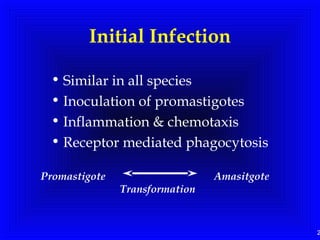
Initial Infection
• Similar in all species
• Inoculation of promastigotes
• Inflammation & chemotaxis
• Receptor mediated phagocytosis
Promastigote Amasitgote
Transformation
2
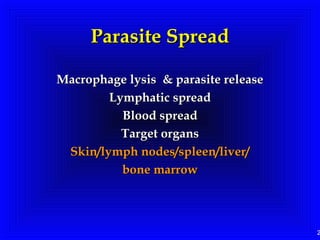
Parasite SpreadParasite Spread
Macrophage lysis & parasite releaseMacrophage lysis & parasite release
Lymphatic spreadLymphatic spread
Blood spreadBlood spread
Target organsTarget organs
Skin/lymph nodes/spleen/liver/Skin/lymph nodes/spleen/liver/
bone marrowbone marrow
2
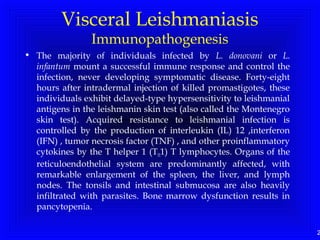
Visceral Leishmaniasis
Immunopathogenesis
• The majority of individuals infected by L. donovani or L.
infantum mount a successful immune response and control the
infection, never developing symptomatic disease. Forty-eight
hours after intradermal injection of killed promastigotes, these
individuals exhibit delayed-type hypersensitivity to leishmanial
antigens in the leishmanin skin test (also called the Montenegro
skin test). Acquired resistance to leishmanial infection is
controlled by the production of interleukin (IL) 12 ,interferon
(IFN) , tumor necrosis factor (TNF) , and other proinflammatory
cytokines by the T helper 1 (TH1) T lymphocytes. Organs of the
reticuloendothelial system are predominantly affected, with
remarkable enlargement of the spleen, the liver, and lymph
nodes. The tonsils and intestinal submucosa are also heavily
infiltrated with parasites. Bone marrow dysfunction results in
pancytopenia.
2
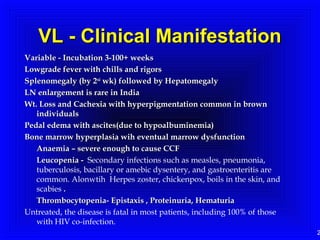
VL - Clinical ManifestationVL - Clinical Manifestation
Variable - Incubation 3-100+ weeksVariable - Incubation 3-100+ weeks
Lowgrade fever with chills and rigorsLowgrade fever with chills and rigors
Splenomegaly (by 2Splenomegaly (by 2ndnd
wk) followed by Hepatomegalywk) followed by Hepatomegaly
LN enlargement is rare in IndiaLN enlargement is rare in India
Wt. Loss and Cachexia with hyperpigmentation common in brownWt. Loss and Cachexia with hyperpigmentation common in brown
individualsindividuals
Pedal edema with ascites(due to hypoalbuminemia)Pedal edema with ascites(due to hypoalbuminemia)
Bone marrow hyperplasia wih eventual marrow dysfunctionBone marrow hyperplasia wih eventual marrow dysfunction
Anaemia – severe enough to cause CCFAnaemia – severe enough to cause CCF
Leucopenia -Leucopenia - Secondary infections such as measles, pneumonia,
tuberculosis, bacillary or amebic dysentery, and gastroenteritis are
common. Alonwtih Herpes zoster, chickenpox, boils in the skin, and
scabies ..
Thrombocytopenia- Epistaxis , Proteinuria, HematuriaThrombocytopenia- Epistaxis , Proteinuria, Hematuria
Untreated, the disease is fatal in most patients, including 100% of those
with HIV co-infection.
2
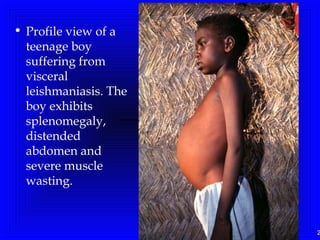
• Profile view of a
teenage boy
suffering from
visceral
leishmaniasis. The
boy exhibits
splenomegaly,
distended
abdomen and
severe muscle
wasting. 
2
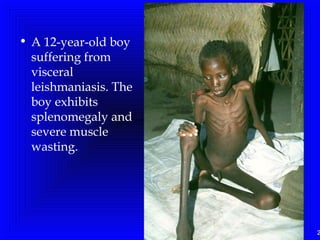
• A 12-year-old boy
suffering from
visceral
leishmaniasis. The
boy exhibits
splenomegaly and
severe muscle
wasting.
2
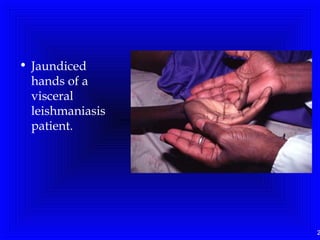
• Jaundiced
hands of a
visceral
leishmaniasis
patient. 
2
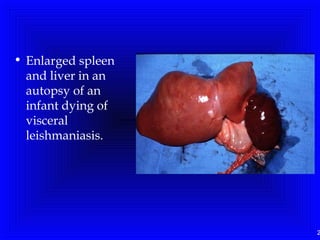
• Enlarged spleen
and liver in an
autopsy of an
infant dying of
visceral
leishmaniasis.
2
Post Kala Azar DermalPost Kala Azar Dermal
Leishmanoid (PKDL)Leishmanoid (PKDL)
Normally develops <2 years afterNormally develops <2 years after
recoveryrecovery
RecrudescenceRecrudescence
Restricted to skinRestricted to skin
Rare but varies geographicallyRare but varies geographically
2
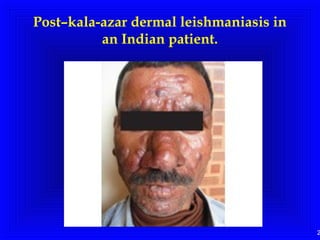
Post–kala-azar dermal leishmaniasis in
an Indian patient.
3
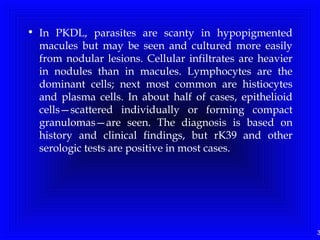
• In PKDL, parasites are scanty in hypopigmented
macules but may be seen and cultured more easily
from nodular lesions. Cellular infiltrates are heavier
in nodules than in macules. Lymphocytes are the
dominant cells; next most common are histiocytes
and plasma cells. In about half of cases, epithelioid
cells—scattered individually or forming compact
granulomas—are seen. The diagnosis is based on
history and clinical findings, but rK39 and other
serologic tests are positive in most cases.
3
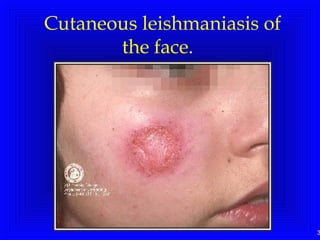
Cutaneous leishmaniasis of
the face. 
3
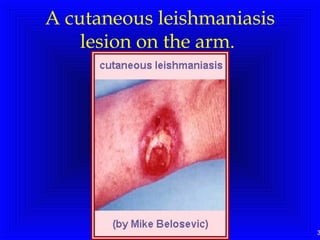
A cutaneous leishmaniasis
lesion on the arm.
3
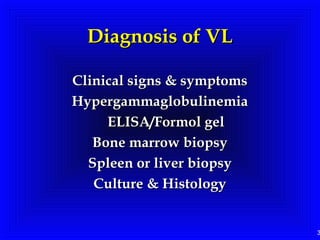
Diagnosis of VLDiagnosis of VL
Clinical signs & symptomsClinical signs & symptoms
HypergammaglobulinemiaHypergammaglobulinemia
ELISA/Formol gelELISA/Formol gel
Bone marrow biopsyBone marrow biopsy
Spleen or liver biopsySpleen or liver biopsy
Culture & HistologyCulture & Histology
3
TreatmentTreatment
Good nursingGood nursing
DietDiet
Antibiotics*Antibiotics*
Pentavalent antimony compunds*Pentavalent antimony compunds*
New drugsNew drugs
* With emphasis on current recommended pharmacotherapy only* With emphasis on current recommended pharmacotherapy only
3
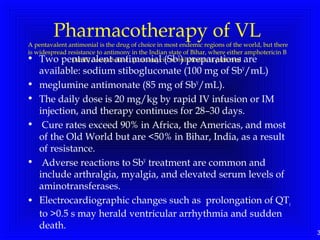
Pharmacotherapy of VL
A pentavalent antimonial is the drug of choice in most endemic regions of the world, but there
is widespread resistance to antimony in the Indian state of Bihar, where either amphotericin B
(AmB) deoxycholate , parmomycin or miltefosine is preferred• Two pentavalent antimonial (SbV
) preparations are
available: sodium stibogluconate (100 mg of SbV
/mL)
• meglumine antimonate (85 mg of SbV
/mL).
• The daily dose is 20 mg/kg by rapid IV infusion or IM
injection, and therapy continues for 28–30 days.
• Cure rates exceed 90% in Africa, the Americas, and most
of the Old World but are <50% in Bihar, India, as a result
of resistance.
• Adverse reactions to SbV
treatment are common and
include arthralgia, myalgia, and elevated serum levels of
aminotransferases.
• Electrocardiographic changes such as prolongation of QTc
to >0.5 s may herald ventricular arrhythmia and sudden
death.
3
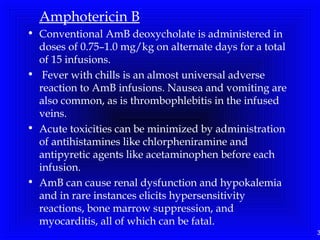
Amphotericin B
• Conventional AmB deoxycholate is administered in
doses of 0.75–1.0 mg/kg on alternate days for a total
of 15 infusions.
• Fever with chills is an almost universal adverse
reaction to AmB infusions. Nausea and vomiting are
also common, as is thrombophlebitis in the infused
veins.
• Acute toxicities can be minimized by administration
of antihistamines like chlorpheniramine and
antipyretic agents like acetaminophen before each
infusion.
• AmB can cause renal dysfunction and hypokalemia
and in rare instances elicits hypersensitivity
reactions, bone marrow suppression, and
myocarditis, all of which can be fatal.
3
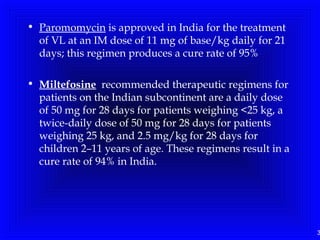
• Paromomycin is approved in India for the treatment
of VL at an IM dose of 11 mg of base/kg daily for 21
days; this regimen produces a cure rate of 95%
• Miltefosine recommended therapeutic regimens for
patients on the Indian subcontinent are a daily dose
of 50 mg for 28 days for patients weighing <25 kg, a
twice-daily dose of 50 mg for 28 days for patients
weighing 25 kg, and 2.5 mg/kg for 28 days for
children 2–11 years of age. These regimens result in a
cure rate of 94% in India.
3
ControlControl
• Vector controlVector control
• Reservoir controlReservoir control
• Treatment of active casesTreatment of active cases
• VaccinationVaccination
3
Thank you…!

Leishmaniasis

  • 1.
  • 2.
    Leishmaniasis: Introduction Definition • Encompassinga complex group of disorders, leishmaniasis is caused by unicellular eukaryotic obligatory intracellular protozoa of the genus Leishmania and primarily affects the host's reticuloendothelial system. • Leishmania species produce widely varying clinical syndromes ranging from self-healing cutaneous ulcers to fatal visceral disease. • These syndromes fall into three broad categories: visceral leishmaniasis (VL), cutaneous leishmaniasis (CL), and mucosal leishmaniasis (ML).
  • 3.
    LeishmaniasisLeishmaniasis Leishmania donovani (complex)(VL)* Leishmania tropica (CL)** Leishmania major (CL) Leishmania aethiopica (CL) Leishmania mexicana (Complex) (CL) Leishmania brazilliensis (complex) (MCL)*** Leishmania peruriana * VL – visceral leishm. **CL – cutaneous leishm. ***MCL - muco-cut. Leishm.
  • 4.
    Epidemiology Visceral Leishmaniasis • VL(also known as kala-azar, a Hindi term meaning "black fever") is caused by the L. donovani complex, which includes L. donovani and L. infantum (the latter designated L. chagasi in the New World); these species are responsible for anthroponotic and zoonotic transmission, respectively. India and neighboring Nepal, Bangladesh, Sudan, and Brazil are the four largest foci of VL and account for 90% of the world's VL burden, with India the worst affected
  • 5.
    The ParasiteThe Parasite •PhylumPhylum • OrderOrder • FamilyFamily • GenusGenus SarcomastigophoraSarcomastigophora KinetoplastidaKinetoplastida TrypanosomatidaeTrypanosomatidae LeishmaniaLeishmania
  • 6.
    MorphologyMorphology • PromasitogtePromasitogte • InsectInsect •MotileMotile • MidgutMidgut • AmastigoteAmastigote • Mammalian stageMammalian stage • Non-motileNon-motile • IntracellularIntracellular Digenetic Life CycleDigenetic Life Cycle
  • 7.
    MorphologyMorphology • Promastigote •Amastigote Flagella Kinetoplast Golgi Nucleus Cytoskeleton
  • 8.
  • 9.
    • Amastigotes (*) ofLeishmania donovani in the cells of a spleen.  The individual amastigotes measure approximately 1 µm in diameter. 
  • 10.
  • 11.
    1 • Amastigotes of Leishmaniain a macrophage from a lymph node of a dog. 
  • 12.
    1 • Leishmania (Leishman- Donovan orLD bodies). Lying in macrophage cells from liver. Giemsa. ×12000. Enlarged by 9.6.
  • 13.
    1 • A macrophage filledwith Leishmania amastigotes.
  • 14.
    1 Life cycleLife cycle •The organism is transmitted by the bite of severalThe organism is transmitted by the bite of several species of blood-feeding sand flies (Phlebotomus)species of blood-feeding sand flies (Phlebotomus) which carries the promastigote in the anterior gutwhich carries the promastigote in the anterior gut and pharynx. It gains access to mononuclearand pharynx. It gains access to mononuclear phagocytes where it transform into amastogotesphagocytes where it transform into amastogotes and divides until the infected cell ruptures. Theand divides until the infected cell ruptures. The released organisms infect other cells. The sandflyreleased organisms infect other cells. The sandfly acquires the organisms during the blood meal, theacquires the organisms during the blood meal, the amastigotes transform into flagellate promastigotesamastigotes transform into flagellate promastigotes and multiply in the gut until the anterior gut andand multiply in the gut until the anterior gut and pharynx are packed. Dogs and rodents are commonpharynx are packed. Dogs and rodents are common reservoirs.reservoirs.
  • 15.
  • 16.
    1 Mammalian HostsMammalian Hosts •RodentsRodents • GerbilsGerbils • HyraxesHyraxes • BatsBats • PorcupinesPorcupines • OpossumsOpossums • SlothsSloths • PrimatesPrimates • DogsDogs • FoxesFoxes • AnteatersAnteaters • othersothers
  • 17.
    1 VectorsVectors Phlebotomine SandfliesPhlebotomine Sandflies 6genera with world wide distribution6 genera with world wide distribution Genus :Phlebotomus & LutzomiaGenus :Phlebotomus & Lutzomia 500 species500 species
  • 18.
  • 19.
    1 Clinical Disease • Visceral •Fatal (90% untreated) • Liver • Spleen • Bone marrow • Cutaneous • Generally Self- healing • Skin • Mucous membranes
  • 20.
    2 Initial Infection • Similarin all species • Inoculation of promastigotes • Inflammation & chemotaxis • Receptor mediated phagocytosis Promastigote Amasitgote Transformation
  • 21.
    2 Parasite SpreadParasite Spread Macrophagelysis & parasite releaseMacrophage lysis & parasite release Lymphatic spreadLymphatic spread Blood spreadBlood spread Target organsTarget organs Skin/lymph nodes/spleen/liver/Skin/lymph nodes/spleen/liver/ bone marrowbone marrow
  • 22.
    2 Visceral Leishmaniasis Immunopathogenesis • Themajority of individuals infected by L. donovani or L. infantum mount a successful immune response and control the infection, never developing symptomatic disease. Forty-eight hours after intradermal injection of killed promastigotes, these individuals exhibit delayed-type hypersensitivity to leishmanial antigens in the leishmanin skin test (also called the Montenegro skin test). Acquired resistance to leishmanial infection is controlled by the production of interleukin (IL) 12 ,interferon (IFN) , tumor necrosis factor (TNF) , and other proinflammatory cytokines by the T helper 1 (TH1) T lymphocytes. Organs of the reticuloendothelial system are predominantly affected, with remarkable enlargement of the spleen, the liver, and lymph nodes. The tonsils and intestinal submucosa are also heavily infiltrated with parasites. Bone marrow dysfunction results in pancytopenia.
  • 23.
    2 VL - ClinicalManifestationVL - Clinical Manifestation Variable - Incubation 3-100+ weeksVariable - Incubation 3-100+ weeks Lowgrade fever with chills and rigorsLowgrade fever with chills and rigors Splenomegaly (by 2Splenomegaly (by 2ndnd wk) followed by Hepatomegalywk) followed by Hepatomegaly LN enlargement is rare in IndiaLN enlargement is rare in India Wt. Loss and Cachexia with hyperpigmentation common in brownWt. Loss and Cachexia with hyperpigmentation common in brown individualsindividuals Pedal edema with ascites(due to hypoalbuminemia)Pedal edema with ascites(due to hypoalbuminemia) Bone marrow hyperplasia wih eventual marrow dysfunctionBone marrow hyperplasia wih eventual marrow dysfunction Anaemia – severe enough to cause CCFAnaemia – severe enough to cause CCF Leucopenia -Leucopenia - Secondary infections such as measles, pneumonia, tuberculosis, bacillary or amebic dysentery, and gastroenteritis are common. Alonwtih Herpes zoster, chickenpox, boils in the skin, and scabies .. Thrombocytopenia- Epistaxis , Proteinuria, HematuriaThrombocytopenia- Epistaxis , Proteinuria, Hematuria Untreated, the disease is fatal in most patients, including 100% of those with HIV co-infection.
  • 24.
    2 • Profile viewof a teenage boy suffering from visceral leishmaniasis. The boy exhibits splenomegaly, distended abdomen and severe muscle wasting. 
  • 25.
    2 • A 12-year-oldboy suffering from visceral leishmaniasis. The boy exhibits splenomegaly and severe muscle wasting.
  • 26.
    2 • Jaundiced hands ofa visceral leishmaniasis patient. 
  • 27.
    2 • Enlarged spleen andliver in an autopsy of an infant dying of visceral leishmaniasis.
  • 28.
    2 Post Kala AzarDermalPost Kala Azar Dermal Leishmanoid (PKDL)Leishmanoid (PKDL) Normally develops <2 years afterNormally develops <2 years after recoveryrecovery RecrudescenceRecrudescence Restricted to skinRestricted to skin Rare but varies geographicallyRare but varies geographically
  • 29.
  • 30.
    3 • In PKDL,parasites are scanty in hypopigmented macules but may be seen and cultured more easily from nodular lesions. Cellular infiltrates are heavier in nodules than in macules. Lymphocytes are the dominant cells; next most common are histiocytes and plasma cells. In about half of cases, epithelioid cells—scattered individually or forming compact granulomas—are seen. The diagnosis is based on history and clinical findings, but rK39 and other serologic tests are positive in most cases.
  • 31.
  • 32.
  • 33.
    3 Diagnosis of VLDiagnosisof VL Clinical signs & symptomsClinical signs & symptoms HypergammaglobulinemiaHypergammaglobulinemia ELISA/Formol gelELISA/Formol gel Bone marrow biopsyBone marrow biopsy Spleen or liver biopsySpleen or liver biopsy Culture & HistologyCulture & Histology
  • 34.
    3 TreatmentTreatment Good nursingGood nursing DietDiet Antibiotics*Antibiotics* Pentavalentantimony compunds*Pentavalent antimony compunds* New drugsNew drugs * With emphasis on current recommended pharmacotherapy only* With emphasis on current recommended pharmacotherapy only
  • 35.
    3 Pharmacotherapy of VL Apentavalent antimonial is the drug of choice in most endemic regions of the world, but there is widespread resistance to antimony in the Indian state of Bihar, where either amphotericin B (AmB) deoxycholate , parmomycin or miltefosine is preferred• Two pentavalent antimonial (SbV ) preparations are available: sodium stibogluconate (100 mg of SbV /mL) • meglumine antimonate (85 mg of SbV /mL). • The daily dose is 20 mg/kg by rapid IV infusion or IM injection, and therapy continues for 28–30 days. • Cure rates exceed 90% in Africa, the Americas, and most of the Old World but are <50% in Bihar, India, as a result of resistance. • Adverse reactions to SbV treatment are common and include arthralgia, myalgia, and elevated serum levels of aminotransferases. • Electrocardiographic changes such as prolongation of QTc to >0.5 s may herald ventricular arrhythmia and sudden death.
  • 36.
    3 Amphotericin B • ConventionalAmB deoxycholate is administered in doses of 0.75–1.0 mg/kg on alternate days for a total of 15 infusions. • Fever with chills is an almost universal adverse reaction to AmB infusions. Nausea and vomiting are also common, as is thrombophlebitis in the infused veins. • Acute toxicities can be minimized by administration of antihistamines like chlorpheniramine and antipyretic agents like acetaminophen before each infusion. • AmB can cause renal dysfunction and hypokalemia and in rare instances elicits hypersensitivity reactions, bone marrow suppression, and myocarditis, all of which can be fatal.
  • 37.
    3 • Paromomycin isapproved in India for the treatment of VL at an IM dose of 11 mg of base/kg daily for 21 days; this regimen produces a cure rate of 95% • Miltefosine recommended therapeutic regimens for patients on the Indian subcontinent are a daily dose of 50 mg for 28 days for patients weighing <25 kg, a twice-daily dose of 50 mg for 28 days for patients weighing 25 kg, and 2.5 mg/kg for 28 days for children 2–11 years of age. These regimens result in a cure rate of 94% in India.
  • 38.
    3 ControlControl • Vector controlVectorcontrol • Reservoir controlReservoir control • Treatment of active casesTreatment of active cases • VaccinationVaccination
  • 39.