
Bio-reactors for Plant
Cell Culture
1
BIOREACTORS
• A bioreactor is a vessel in which a chemical process is
carried out which involves organisms or biochemically
active substances derived from such organisms.
2
Types of cell cultures
• Continuous culture
• Batch culture
• Immobilized cell lines
3
Types of Bio-reactors Used in Plant
Cultures
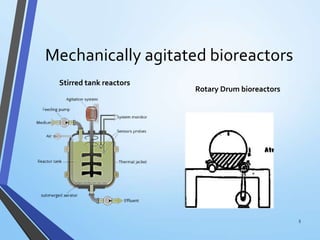
• Mechanically agitated bioreactors
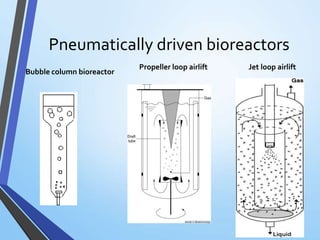
• Pneumatically driven bioreactors
• Hydro dynamically driven disposable bioreactors
• Non-Agitated bioreactor
4
Mechanically agitated bioreactors
5
Stirred tank reactors
Rotary Drum bioreactors
Pneumatically driven bioreactors
6
Bubble column bioreactor
Propeller loop airlift Jet loop airlift
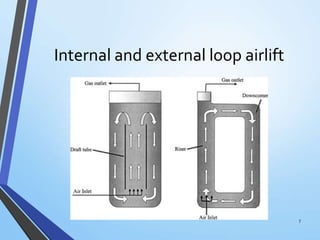
Internal and external loop airlift
7
Disposable bioreactors
• Disposable bioreactors represent modern alternatives to such
traditional cultivation systems.These bioreactors consist of a
sterile plastic chamber that is partially filled with media(10% to
55%) , inoculated with cells and discarded after harvest.
• The single use chamber eliminating any need for cleaning or
sterilization is made of FDA-approval biocompatible plastic
such as polyethylene, polystyrene and polypropylene.
Usually, the disposable bioreactors are low cost, simple to
operate and guarantee high process security
8
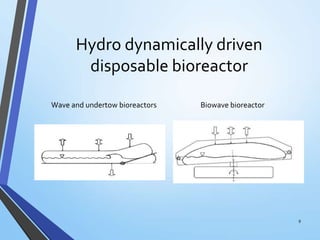
Hydro dynamically driven
disposable bioreactor
9
Wave and undertow bioreactors Biowave bioreactor
Non agitated bioreactors
• Various types of membrane reactor were configured
namely Hollow fiber reactor,Tubular membrane
reactor, Flat plate membrane reactor with one side or two
side flow, Multimembrane reactor
• Fluidized bed reactor
10
Uses and advantages
• These bioreactors are mostly used in suspension culture
for large scale production of secondary metabolites.
• They are used in biotransformation of compounds
• Reduces labour
• More utilization in pharmaceutical industry
• More successful biomass production than the use of plant
as bio factories
11
Disadvantage
• Instability of the productive cell lines,
• The slowness of the cell growth and production phase
• Limited knowledge about the secondary metabolite
pathways.
12
Thank you
13

Bioreactors for plant cell cultures

  • 1.
  • 2.
    BIOREACTORS • A bioreactoris a vessel in which a chemical process is carried out which involves organisms or biochemically active substances derived from such organisms. 2
  • 3.
    Types of cellcultures • Continuous culture • Batch culture • Immobilized cell lines 3
  • 4.
    Types of Bio-reactorsUsed in Plant Cultures • Mechanically agitated bioreactors • Pneumatically driven bioreactors • Hydro dynamically driven disposable bioreactors • Non-Agitated bioreactor 4
  • 5.
    Mechanically agitated bioreactors 5 Stirredtank reactors Rotary Drum bioreactors
  • 6.
    Pneumatically driven bioreactors 6 Bubblecolumn bioreactor Propeller loop airlift Jet loop airlift
  • 7.
    Internal and externalloop airlift 7
  • 8.
    Disposable bioreactors • Disposablebioreactors represent modern alternatives to such traditional cultivation systems.These bioreactors consist of a sterile plastic chamber that is partially filled with media(10% to 55%) , inoculated with cells and discarded after harvest. • The single use chamber eliminating any need for cleaning or sterilization is made of FDA-approval biocompatible plastic such as polyethylene, polystyrene and polypropylene. Usually, the disposable bioreactors are low cost, simple to operate and guarantee high process security 8
  • 9.
    Hydro dynamically driven disposablebioreactor 9 Wave and undertow bioreactors Biowave bioreactor
  • 10.
    Non agitated bioreactors •Various types of membrane reactor were configured namely Hollow fiber reactor,Tubular membrane reactor, Flat plate membrane reactor with one side or two side flow, Multimembrane reactor • Fluidized bed reactor 10
  • 11.
    Uses and advantages •These bioreactors are mostly used in suspension culture for large scale production of secondary metabolites. • They are used in biotransformation of compounds • Reduces labour • More utilization in pharmaceutical industry • More successful biomass production than the use of plant as bio factories 11
  • 12.
    Disadvantage • Instability ofthe productive cell lines, • The slowness of the cell growth and production phase • Limited knowledge about the secondary metabolite pathways. 12
  • 13.