Why social
advocacy?By: JONALYN M. SHENTON
Why Social Advocacy?
Social Advocacy
One of the mandates of social work
is to advance the interests of social
justice, particularly on behalf of
populations or groups that have
been disadvantaged,
disempowered, or discriminated
against. Social advocacy can help
us to influence social policy
(including governmental decision-
makers) for the purposes of
advancing social justice.
What is Advocacy and How
do we Use it in Social
Work?
Advocacy … promotes equality,
social justice and social inclusion.
It can empower people to speak up
for themselves. Advocacy can help
people become more aware of
their own rights, to exercise those
rights and be involved in and
influence decisions that are being
made about their future.
What is Advocacy and How
do we Use it in Social
Work?
We see here that
advocacy involves
ensuring that service
users are able to have a
voice in decisions that
concern their lives – to
make their views known
and be heard.
The notion of advocacy as a
mechanism to promote social
justice is an element of other
advocacy definitions from
various sources. Social justice
reflects the activism of advocacy
and has been explained as ‘an idea
that mobilizes people to act in
order to bring about change’
(Newman and Yeates, 2008: 2)[Advocacy is] a crucial element in
achieving social justice. It is a way to
ensure that everyone matters and
everyone is heard – including people
who are at risk of exclusion and people
who have particular difficulties in
making their views known. (SIAA, 2010:
Case (or issue-based) and systemic (or cause) advocacy
This model identifies two elements of advocacy:
Case or issue-based advocacy (where work is focused
with individuals or small groups such as families in a task-
centred way).
Systemic or cause advocacy (where knowledge from
individual cases contributes to collective advocacy for
systemic change to legislation, policy or practice).
For many social workers case
advocacy is more likely to be
part of their day-to-day
practice. The empowering
potential of advocacy can best
be understood in terms of the
relationship between case and
systemic advocacy, which
identifies how advocacy can
contribute to changes at both
individual (case) and structural
(systemic) levels.
Advocacy is a process for
change, a process for learning.
It stimulates respect for
children’s and young people’s
rights and promotes
participation in the planning and
challenging of the systems that
impact on their lives. Acting on
children’s and young people’s
experiences and views, the
advocacy extends beyond
individual casework. (UCAN,
2005)
Combining the promotion of rights with changes in policy and
practice required the advocacy project to:
• Listen to and hear the views of individual young people who had
presented
feedback about their experiences of case advocacy, the
advocacy service and the
systems they were involved in.
• Use the views of young people to inform cause or systemic
advocacy.
• Liaise closely with the child protection co-ordinator, independent
chairs of
Child Protection Conferences and social work teams.
• Work together with project staff to facilitate practical ways of
working towards
greater participation of children and young people.
[Advocacy is] a crucial
element in achieving social
justice. It is a way to ensure
that everyone matters and
everyone is heard –
including people who are at
risk of exclusion and people
who have particular
difficulties in making their
views known.
SIAA, 2010: 4)
The Goal of Social Advocacy?
Promotes social inclusion
Speak up for themselves
Exercise rights and influence
decisions
Promotes equality, justice
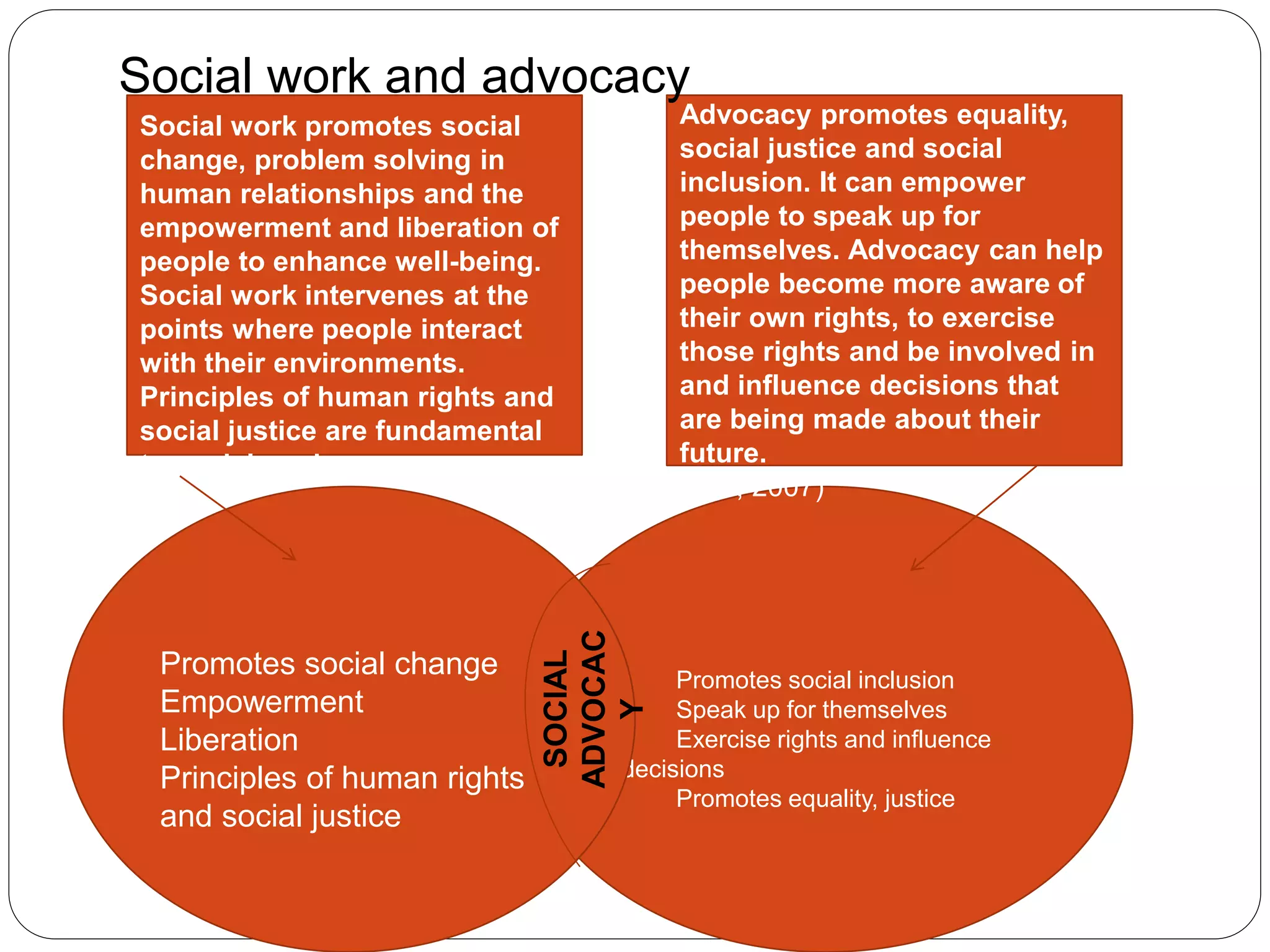
Social work promotes social
change, problem solving in
human relationships and the
empowerment and liberation of
people to enhance well-being.
Social work intervenes at the
points where people interact
with their environments.
Principles of human rights and
social justice are fundamental
to social work.
Advocacy promotes equality,
social justice and social
inclusion. It can empower
people to speak up for
themselves. Advocacy can help
people become more aware of
their own rights, to exercise
those rights and be involved in
and influence decisions that
are being made about their
future.
(Lee, 2007)
Promotes social change
Empowerment
Liberation
Principles of human rights
and social justice
SOCIAL
ADVOCAC
Y
Social work and advocacy
Adams et al. (2009a) note that three dimensions of
social work can be seen in the international
definition, which also equate to Payne’s (2006)
account of approaches to social work:
Promoting social change.
Promoting problem solving.
Empowerment and liberation.
The Goal of Social Advocacy?
Promoting social
change
The first dimension (social change) relates
to transformational social work ,
educators, law makers, and policy
makers. These advocacies also involve
and enable people to understand the
oppression and disadvantage they face
and to use facts and information to
promote change. Work with groups or
communities. It brings people together for
mutual help and support to promote social
transformation through changing
structures and challenging inequality and
injustice in society. This aspect of
advocacy is less about direct advocacy
and more about supporting self- or
collective advocacy with service users
and careers and attempts to mobilize
Promoting problem
solving.
The second dimension (promoting
problem solving) is the process of
providing help, advice, support and
packages of services to enable people
to manage the difficulties they face in
their lives. Social advocacators here
involves supporting service users and
carers to participate in decision making
and ensuring that their wishes and
feelings are promoted within health
and social services (Payne, 2009b). A
number of advocacy definitions
recognise that empowerment and
Empowerment and
liberation.
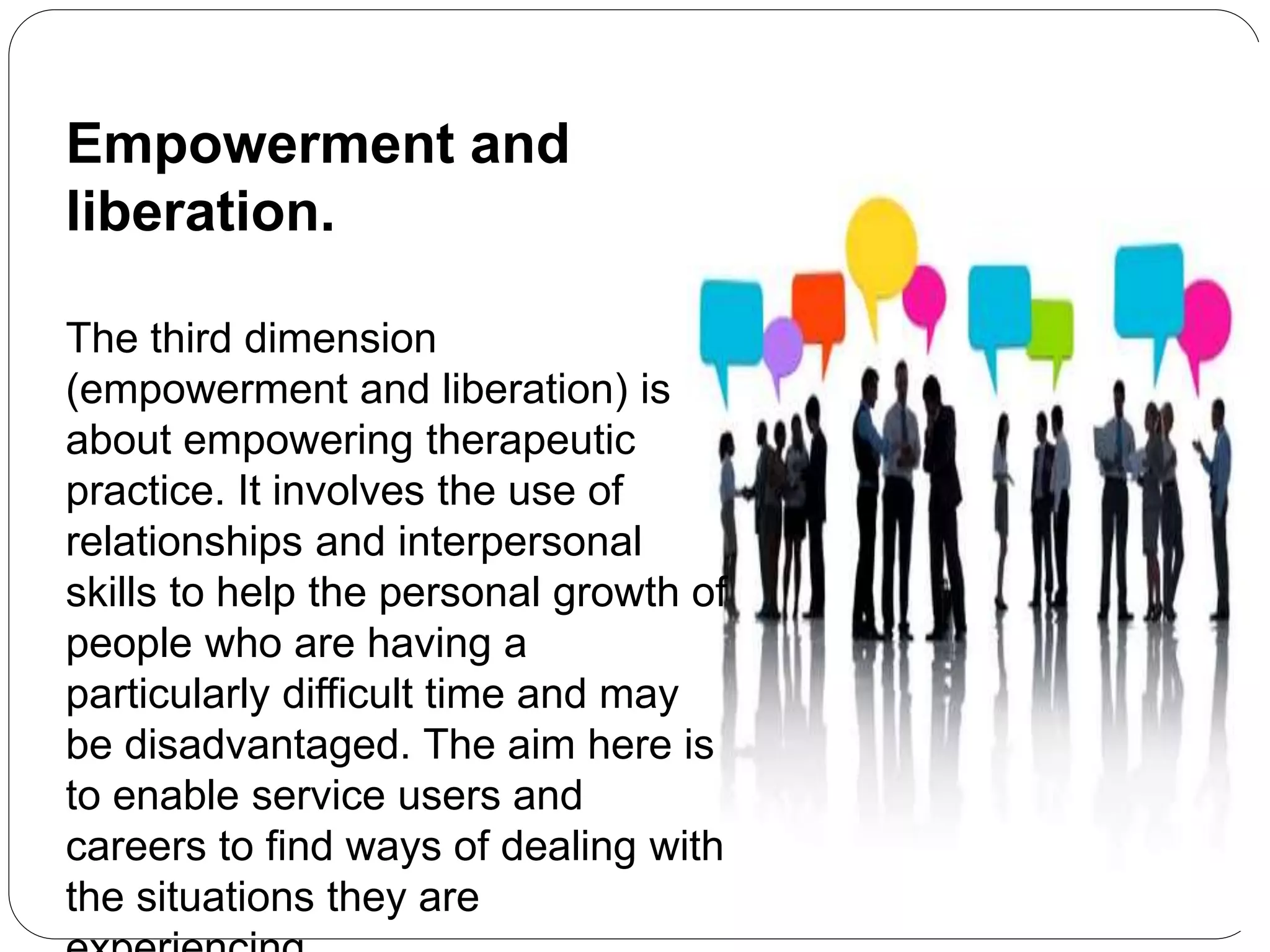
The third dimension
(empowerment and liberation) is
about empowering therapeutic
practice. It involves the use of
relationships and interpersonal
skills to help the personal growth of
people who are having a
particularly difficult time and may
be disadvantaged. The aim here is
to enable service users and
careers to find ways of dealing with
the situations they are
Advocacy and empowerment
Advocacy involves a person(s), either a
vulnerable individual or group or their agreed
representative, effectively pressing their case with
influential others, about situations which either
affect them directly or, and more usually, trying to
prevent proposed changes which will leave them
worse off. Both the intent and the outcome of
such advocacy should increase the individual’s
sense of power; help them to feel more confident,
to become more assertive and to gain increased
choices. (Brandon, 1995: 1)
Advocacy and empowerment
Many people in society are disempowered by
systems which have a significant effect on almost
every aspect of their lives. These are people who are
disempowered to such an extent that they are
unlikely to be able to fulfill their basic human needs,
or demand their basic human rights. A person’s
initial hopes and dreams can be severely limited by
this. Independent advocacy can help to widen a
person’s horizons and enable them to become active
members of society. (Advocacy 2000, 2002: 49)
Advocacy and empowerment
When people are denied or unable to gain access to a fair
share of what’s on offer in society- when they are denied
information or opportunities to take part in decisions
concerning their lives – when they are dispossessed of
insight, dignity, self confidence – then it becomes necessary
in a caring society for more powerful people to act with
integrity on their behalf or wherever possible to enable them
to move to a point where they can retrieve control for
themselves. (Advocacy in Action, 1990)
Social Advocacy Groups - Example
American Civil Liberties Union
Antidefamation League (combating anti-
Semitism)
Human Rights Campaign (gay and lesbian
issues)
Human Rights Watch (international)
NAACP (National Association for the
Advancement of Colored People)
National Association of Social Workers (includes
great links for current issues, how to contact
legislators, and position papers)
National Center for Lesbian Rights
National Coalition for the Homeless
NOW (National Organization for Women)
TASH (people with disabilities)
Good governance advocates /Tuwid na Daan- PNOY’S
ADVOCACY
 www.sagepub.com/sites/default/files/.../58102_Dalrymple_&_Boylan.pd..
 https://www.fau.edu/ssw/socadvocacy.php
 http://www.sagepub.com/sites/default/files/upm-
binaries/58102_Dalrymple_&_Boylan.pdf
 Brandon, B. and Brandon, T. (2001) Advocacy in Social Work. Birmingham:
Venture Press.
 Schnieder, R. and Lester, L. (2001) Social Work Advocacy: A New Framework
for Action. Belmont, CA: Brooks/Cole.
 Wilks, T. (2012) Advocacy and Social Work Practice. Maidenhead: Open
University Press.

Why social advocacy

  • 1.
  • 2.
    Why Social Advocacy? SocialAdvocacy One of the mandates of social work is to advance the interests of social justice, particularly on behalf of populations or groups that have been disadvantaged, disempowered, or discriminated against. Social advocacy can help us to influence social policy (including governmental decision- makers) for the purposes of advancing social justice.
  • 3.
    What is Advocacyand How do we Use it in Social Work? Advocacy … promotes equality, social justice and social inclusion. It can empower people to speak up for themselves. Advocacy can help people become more aware of their own rights, to exercise those rights and be involved in and influence decisions that are being made about their future.
  • 4.
    What is Advocacyand How do we Use it in Social Work? We see here that advocacy involves ensuring that service users are able to have a voice in decisions that concern their lives – to make their views known and be heard.
  • 5.
    The notion ofadvocacy as a mechanism to promote social justice is an element of other advocacy definitions from various sources. Social justice reflects the activism of advocacy and has been explained as ‘an idea that mobilizes people to act in order to bring about change’ (Newman and Yeates, 2008: 2)[Advocacy is] a crucial element in achieving social justice. It is a way to ensure that everyone matters and everyone is heard – including people who are at risk of exclusion and people who have particular difficulties in making their views known. (SIAA, 2010:
  • 6.
    Case (or issue-based)and systemic (or cause) advocacy This model identifies two elements of advocacy: Case or issue-based advocacy (where work is focused with individuals or small groups such as families in a task- centred way). Systemic or cause advocacy (where knowledge from individual cases contributes to collective advocacy for systemic change to legislation, policy or practice).
  • 7.
    For many socialworkers case advocacy is more likely to be part of their day-to-day practice. The empowering potential of advocacy can best be understood in terms of the relationship between case and systemic advocacy, which identifies how advocacy can contribute to changes at both individual (case) and structural (systemic) levels.
  • 8.
    Advocacy is aprocess for change, a process for learning. It stimulates respect for children’s and young people’s rights and promotes participation in the planning and challenging of the systems that impact on their lives. Acting on children’s and young people’s experiences and views, the advocacy extends beyond individual casework. (UCAN, 2005)
  • 9.
    Combining the promotionof rights with changes in policy and practice required the advocacy project to: • Listen to and hear the views of individual young people who had presented feedback about their experiences of case advocacy, the advocacy service and the systems they were involved in. • Use the views of young people to inform cause or systemic advocacy. • Liaise closely with the child protection co-ordinator, independent chairs of Child Protection Conferences and social work teams. • Work together with project staff to facilitate practical ways of working towards greater participation of children and young people.
  • 10.
    [Advocacy is] acrucial element in achieving social justice. It is a way to ensure that everyone matters and everyone is heard – including people who are at risk of exclusion and people who have particular difficulties in making their views known. SIAA, 2010: 4)
  • 11.
    The Goal ofSocial Advocacy?
  • 13.
    Promotes social inclusion Speakup for themselves Exercise rights and influence decisions Promotes equality, justice Social work promotes social change, problem solving in human relationships and the empowerment and liberation of people to enhance well-being. Social work intervenes at the points where people interact with their environments. Principles of human rights and social justice are fundamental to social work. Advocacy promotes equality, social justice and social inclusion. It can empower people to speak up for themselves. Advocacy can help people become more aware of their own rights, to exercise those rights and be involved in and influence decisions that are being made about their future. (Lee, 2007) Promotes social change Empowerment Liberation Principles of human rights and social justice SOCIAL ADVOCAC Y Social work and advocacy
  • 14.
    Adams et al.(2009a) note that three dimensions of social work can be seen in the international definition, which also equate to Payne’s (2006) account of approaches to social work: Promoting social change. Promoting problem solving. Empowerment and liberation. The Goal of Social Advocacy?
  • 15.
    Promoting social change The firstdimension (social change) relates to transformational social work , educators, law makers, and policy makers. These advocacies also involve and enable people to understand the oppression and disadvantage they face and to use facts and information to promote change. Work with groups or communities. It brings people together for mutual help and support to promote social transformation through changing structures and challenging inequality and injustice in society. This aspect of advocacy is less about direct advocacy and more about supporting self- or collective advocacy with service users and careers and attempts to mobilize
  • 16.
    Promoting problem solving. The seconddimension (promoting problem solving) is the process of providing help, advice, support and packages of services to enable people to manage the difficulties they face in their lives. Social advocacators here involves supporting service users and carers to participate in decision making and ensuring that their wishes and feelings are promoted within health and social services (Payne, 2009b). A number of advocacy definitions recognise that empowerment and
  • 17.
    Empowerment and liberation. The thirddimension (empowerment and liberation) is about empowering therapeutic practice. It involves the use of relationships and interpersonal skills to help the personal growth of people who are having a particularly difficult time and may be disadvantaged. The aim here is to enable service users and careers to find ways of dealing with the situations they are
  • 18.
    Advocacy and empowerment Advocacyinvolves a person(s), either a vulnerable individual or group or their agreed representative, effectively pressing their case with influential others, about situations which either affect them directly or, and more usually, trying to prevent proposed changes which will leave them worse off. Both the intent and the outcome of such advocacy should increase the individual’s sense of power; help them to feel more confident, to become more assertive and to gain increased choices. (Brandon, 1995: 1)
  • 19.
    Advocacy and empowerment Manypeople in society are disempowered by systems which have a significant effect on almost every aspect of their lives. These are people who are disempowered to such an extent that they are unlikely to be able to fulfill their basic human needs, or demand their basic human rights. A person’s initial hopes and dreams can be severely limited by this. Independent advocacy can help to widen a person’s horizons and enable them to become active members of society. (Advocacy 2000, 2002: 49)
  • 20.
    Advocacy and empowerment Whenpeople are denied or unable to gain access to a fair share of what’s on offer in society- when they are denied information or opportunities to take part in decisions concerning their lives – when they are dispossessed of insight, dignity, self confidence – then it becomes necessary in a caring society for more powerful people to act with integrity on their behalf or wherever possible to enable them to move to a point where they can retrieve control for themselves. (Advocacy in Action, 1990)
  • 21.
    Social Advocacy Groups- Example American Civil Liberties Union Antidefamation League (combating anti- Semitism) Human Rights Campaign (gay and lesbian issues) Human Rights Watch (international) NAACP (National Association for the Advancement of Colored People) National Association of Social Workers (includes great links for current issues, how to contact legislators, and position papers) National Center for Lesbian Rights National Coalition for the Homeless NOW (National Organization for Women) TASH (people with disabilities)
  • 22.
    Good governance advocates/Tuwid na Daan- PNOY’S ADVOCACY
  • 24.
     www.sagepub.com/sites/default/files/.../58102_Dalrymple_&_Boylan.pd..  https://www.fau.edu/ssw/socadvocacy.php http://www.sagepub.com/sites/default/files/upm- binaries/58102_Dalrymple_&_Boylan.pdf  Brandon, B. and Brandon, T. (2001) Advocacy in Social Work. Birmingham: Venture Press.  Schnieder, R. and Lester, L. (2001) Social Work Advocacy: A New Framework for Action. Belmont, CA: Brooks/Cole.  Wilks, T. (2012) Advocacy and Social Work Practice. Maidenhead: Open University Press.