By: JONALYN M. SHENTON
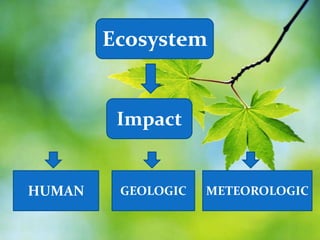
Ecosystem
Impact
HUMAN GEOLOGIC METEOROLOGIC
METEOROLOGY
weather science: the scientific study of the
Earth's atmosphere, especially its patterns of
climate and weather
Changing Sun, Changing Climate?
The Sun so greatly dominates the skies that the first scientific
speculations about different climates asked only how sunlight falls on the
Earth in different places. When scientists began to ponder the possibility
of climate change, their thoughts naturally turned to the Sun.
• Sunspots affect the
climate of the Earth.
Rainfall and storms increase.
Human influence has been detected in warming of the atmosphere
and the ocean, in changes in the global water cycle, in reductions
in snow and ice, in global mean sea level rise, and in changes in
some climate extremes.
Although humans exist and operate within ecosystems, their cumulative
effects are large enough to influence external factors like climate.[8]
climate change and associated impacts will
vary from region to region around the globe.
Global Warming used to refer to increases in average
temperature of the air and sea at Earth's
surface.
THE EFFECT OF AN INCREASE IN GLOBAL TEMPRETURE
1. A rise in sea levels and a change in the amount and
pattern of precipitation, as well as probable
expansion of subtropical desert.
2. Warming is expected to be strongest in the Arctic,
with the continuing retreat of glaciers, permafrost,
and sea ice. Other likely effects of the warming
include more frequent extreme weather events
including heat waves, droughts and heavy rainfalls
3. Ocean acidification
4. Species extinctions due to shifting temperature
regimes.
5. Threat to food security from decreasing crop yields.
6. Loss of habitat from inundation.
Solar activity not a key cause of climate
change, study shows
Climate change has not been strongly influenced by variations in heat
from the sun, a new scientific study shows. The findings overturn a
widely held scientific view that lengthy periods of warm and cold weather
in the past might have been caused by periodic fluctuations in solar
activity.
Research examining the causes of climate
change in the northern hemisphere over the
past 1000 years has shown that until the year
1800, the key driver of periodic changes in
climate was volcanic eruptions.
These tend to prevent sunlight reaching
Earth, causing cool, drier weather.
Since 1900, greenhouse gases have been the
primary cause of climate change.
GEOLOGICAL ACTIVITIES
Plate tectonics
In the 1960s, a series of discoveries, the most
important of which was seafloor spreading,
showed that the Earth's lithosphere, which
includes the crust and rigid uppermost
portion of the upper mantle, is separated
into a number of tectonic plates that move
across the plastically deforming, solid, upper
mantle, which is called the asthenosphere.
This coupling between rigid plates moving
on the surface of the Earth and the
converting mantle is called plate tectonics.
Philippine Sea Plate or Philippine Plate is a tectonic plate comprising
oceanic lithosphere that lies beneath the Philippine Sea, to the east of
the Philippines. Most segments of the Philippines, including
northern Luzon, are part of the Philippine Mobile Belt, which is
geologically and tectonically separate from the Philippine Sea Plate.
The Valley Fault System and formerly as the Marikina Valley Fault System is a
group of dextral strike-slip[1] fault which extends from San Mateo, Rizal to Taguig
Cityon the south; running through
the cities of Makati, Marikina, Parañaque, Pasig andTaguig.[2]
The fault possesses a threat of a large scale earthquake with
a magnitude of 7 or higher[3][4] within the Manila Metropolitan
Area with death toll predicted to be as high as 35,000[3][4] and some
120,000 or higher[3] injured[4] and more than three million needed to be
evacuated.[5]
Geology
is the science comprising the study of solid Earth, the rocks of which it is
composed, and the processes by which they change.
Geology gives insight into the history of the Earth by providing the
primary evidence for plate tectonics, the evolutionary history of life, and
past climates.
In modern times, geology is commercially important
for mineral and hydrocarbon exploration / exploitation as well as for
evaluating water resources.
It is publicly important for the prediction and understanding of natural hazards,
the remediation of environmental problems, and for providing insights into
past climate change.
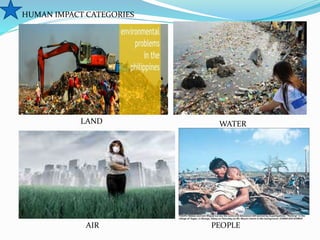
HUMAN IMPACT CATEGORIES
PEOPLE
WATER
AIR
LAND
These impacts together with day-to-day human activity,
cause destruction to the Earth’s surface and near-surface
environment and upset the balance of sustainable
development
Environment of the
Philippines
From Wikipedia, the free encyclopedia
The Philippines is prone to natural disasters, particularly typhoons,
floods, landslides, volcanic eruptions, earthquakes, and tsunamis,
lying as it does astride the typhoon belt, in the active volcanic
region known as the “Pacific Ring of Fire,” and in the geologically
unstable region between the Pacific and Eurasian tectonic plates.
The Philippines also suffers major human-caused environmental
degradation aggravated by a high annual population growth rate,
including loss of agricultural lands, deforestation, soil erosion, air
and water pollution, improper disposal of solid and toxic wastes,
loss of coral reefs, mismanagement and abuse of coastal
resources, and overfishing.
Ecosystem management
aims to conserve major ecological services and
restore natural resources while meeting the
socioeconomic, political and cultural and needs of
current and future generations.
The principal objective of ecosystem management is the
efficient maintenance, and ethical use of natural
resources.
It is a multifaceted and holistic approach which requires
a significant change in how the natural and human
environments are identified. Several approaches to
effective ecosystem management engage conservation
efforts at both a local or landscape level and involves:
adaptive management, natural resource management,
strategic management, and command and control
management.
NATURAL DISASTER REDUCTION:
NATIONAL RESPONSE AND INTERNATIONAL COOPERATION
. Legal Framework for Disaster Prevention and Response
A set of laws and regulations have established the standards and safeguards essential for
preventing damage and death due to disasters. The most important laws include
following:
a.PD 957 or The Subdivision Law, which regulate land developments
for housing and commercial use;
b. PD 1096 or The Building Code, which prescribes all pertinent
requirements and standards for building structures;
c. PD 1151 or The Environmental Policy Law, which protect natural
endowments that serve as protection from erosion, strong winds and
floods;
d. PD 1185 or the Fire Code, which provided for fire prevention and
protection measures;
e. PD 1515 or the Watersheds Law, which provided for the preservation
of natural watersheds and allowances for public easement in seas,
rivers and lakes.
Disaster preparedness is an
essential element of the disaster management
program. Disaster management plans of key agencies
and organizations have been prepared, reviewed and
updated. These plans are properly documented and
are regularly tested for continuing relevance.
Public information before, during and after disasters is an important aspect
of disaster management in the Philippines.
PAGASA and PHIVOLCS undertake related to National Disaster Reduction:
PAGASA
1.Special Tropical Cyclone Reconnaissance Information Dissemination and
Damage Evaluation (STRIFE) - a quick response team (QRT) to conduct in
the spot investigation in areas affected by landfilling TC's, tornadoes,
storm surges etc.
2.Provision of Farm-Weather Forecast and Warning Services-Provides
Weather Information related to plant growth/development and farming
operations including livestock and crop production.
3.Information and Education Campaign (IEC) Program for Natural
Disaster Reduction. Include the level of awareness/preparedness of the
people on natural hazards and disasters through the development of hi-
tech audio-visual and multi-media technology, conducts
seminar/workshops, lectures and training's throughout the country.
PHIVOLCS
1. Volcanic Hazards Identification and Mapping-identify, catalogue and
characterize activities and potentially active volcanoes.
2. Hazardous Volcanic Products and Processes - to map the extent of
emplacement, thickness of deposition, stratigraphy and source vents
to these hazardous volcanic products which may give an overview of
the anticipated hazards and risks from future eruptive episodes.
3. National Lahar Mapping Program - this involves mapping out the
possible extent of emplacement and distribution of lahar deposits from
past explosive eruption.
The ultimate aim of this program is to generate lahar hazard maps for
selected active volcanoes which shall identify possible routes and
areas that can be affected during a particular lahar flow incidents.
Initiatives
1.Brigada Kontra Baha. This is a concerted multisectoral initiative to
declog critical esteros and waterways, drainage system and tributaries
floods and to mitigate their effects on the people and communities.
2.Oplan Bangun Mindanaw. Around 985,000 families have suffered from
situation in Southern and Central Mindanaw due to the impact of the El
Niño Phenomenon.
3.Laban La Niña. With the anticipated impact of La Niña Phenomenon,
War Plans of vulnerable regions and communities were being formulated
and simulated in pilot areas.
4.Linis Bayan Program. As embodied m Administrative Order No. 32 by
the President of the Philippines, this is the institutionalization of a
nationwide clean-up campaign to encourage the promotion and practice of
cleanliness in all government offices, schools, communities and homes
aimed at declogging of critical esteros, elimination of mosquito larvae (kiti-
kiti) and breeding sites, and cleaning of offices, schools, public grounds and
roads, among others.
SOLID WASTE MANAGEMENT
IN THE PHILIPPINES
PHILIPPINES RECENT TRENDS IN THE FIELD OF
WASTE MANAGEMENT
Creation of Solid Waste Management Plan (SWMP)
•Waste characterization
• Proper waste collection and transfer
• Waste processing
• Waste reduction at source
• Recycling
• Source for final waste disposal
PHILIPPINES RECENT TRENDS IN THE FIELD OF
WASTE MANAGEMENT
-Establishment of Materials Recovery Facility (MRF) in
Barangay and City level
-Composting of Biodegradable Waste to be used as organic
fertilizer
- Innovative way of Recycling of Non-biodegradable waste
- Segregation at source Household level
-Innovative way of collecting segregated waste using
dumptrucks, tricycles and pedicabs
- Construction of Sanitary Landfill
The Philippine government grants Mineral Production Sharing
Agreements on condition that the mining activities are managed in a
technically, financially, socially, culturally and environmentally
responsible manner to enhance the national growth and welfare of
the Philippines.
The Department of Environment and Natural Resources requires an
Environmental Clearance Certificate for any mining activity at a
more advanced stage than mineral exploration. The ECC is issued by
the DENR based on an Environmental Impact Statement prepared
by the company in accordance with the procedures under the
Environmental Impact Assessment System. A completed ecological
profile of the proposed mining area is required as part of these
procedures.
Environmental Impact
Assessment in the Philippines
Legal Background
The 1987 Philippine Constitution
“The State shall protect and advance the right of the
people to a balanced and healthful ecology in accord
with the rhythm and harmony of nature.”
- Article II, Section 16
PD 1151 (1977): Philippine Environmental Policy
• Required sponsors of all government and private
projects affecting the quality of the environment to
prepare an assessment of the project’s environmental
Impacts
• “urgent need to formulate an intensive, integrated
program of environmental protection that will bring
about a concerted effort towards the protection of the
entire spectrum of the environment through a
requirement of environmental impact assessments
and statements.”
3rd Whereas Clause of P.D. 1151
PD 1152 (1977): Philippine Environmental Code
• Required all land use management regulating
or enforcing agencies to consider significant
environmental impacts, as well as other
aspects of locating industries.
PD 1586 (1978): Philippine EIA System
• Establishing an Environmental Impact Statement
System including Other Environmental
Management related Measures and for Other
Purposes
• Centralized the EIS System under the (then)
National Environmental Protection Council
(NEPC), and authorized the President and the
NEPC to proclaim projects and activities subject
to the EIS system; placed the Pollution
Adjudication Board (PAB) (created by PD 984)
under NEPC
(1979)IRR-PD 1586
• Defined the parameters for EIS; established
penalty structures for non-compliance; created
the EIA review committee; set the procedures
for implementing the EIS system; provided for
exempt-ions, & established procedures for
public hearings related to an EIS.
(1981) PP 2146 ECAs and ECPs
• Proclaimed certain areas and types of projects
as environmentally critical (ECAs & ECPs) and
within the scope of the EIS system
(1983) NEPC Office Circular No. 3
• Provided a technical definition and scope for
environmentally critical projects and areas
Environmentally Critical / Sensitive Areas
A. Areas declared by law as
A1. national parks
A2. watershed reserves
A3. wildlife preserves
A4. sanctuaries
B. Areas set aside as aesthetic potential tourist spots
C. Areas which constitute habitat for any endangered or
threatened species of Philippine wildlife (flora and
fauna).
D. Areas of unique historic, archeological, geological, or
scientific interests
E. Areas which are traditionally occupied by cultural
communities or tribes
Environmentally Critical / Sensitive Areas
F. Areas frequently visited and or hard-hit by natural calamities
F1. geologic hazards
F2. floods
F3. typhoons
F4. volcanic activities
G. Areas with critical slope
H. Areas classified as prime agricultural lands
I. Recharged areas of aquifers
J. Water bodies
K. Mangrove Areas
L. Coral Reefs
Monitoring, Validation and Evaluation
What should be monitored?
1. Project compliance with the
conditions stipulated in the ECC
and the EMP;
2. Proponent’s conduct of self-
3. Complaints, and recommended
measures to address the complaint
4. Preparation, integration and
dissemination of simplified
validation reports to community
Stakeholders
Who should monitor?
Project Proponent/Company
Multi-partite Monitoring Team
Environmental Management Bureau
Self monitoring
MVE Schemes
1. Compliance Monitoring
2. Field Validation
3. Effectiveness of Environmental
Management Measures
Objectives
The primary objective is to increase fish stocks by 10 percent in the four targeted
implementation areas by 2010. Supporting objectives include the following:
Capacity Increases for Fisheries Management
•Register and license municipal fishers.
•Train law enforcement units, prosecutors, and judiciary members in fisheries law
enforcement.
•Implement effort restrictions on fishing.
•Establish or improve management of Marine Protected Areas to protect critical
habitats, migration routes, and spawning areas.
•Facilitate the adoption of coastal resource management by local government.
•Facilitate the signing of agreements and plans supporting local ecosystem-based
fisheries management policies.
•Improve or implement reproductive health and/or population programs.
Thank You
39

Ecosystem impact and planning

  • 1.
  • 2.
  • 3.
    METEOROLOGY weather science: thescientific study of the Earth's atmosphere, especially its patterns of climate and weather
  • 4.
    Changing Sun, ChangingClimate? The Sun so greatly dominates the skies that the first scientific speculations about different climates asked only how sunlight falls on the Earth in different places. When scientists began to ponder the possibility of climate change, their thoughts naturally turned to the Sun.
  • 5.
    • Sunspots affectthe climate of the Earth. Rainfall and storms increase.
  • 6.
    Human influence hasbeen detected in warming of the atmosphere and the ocean, in changes in the global water cycle, in reductions in snow and ice, in global mean sea level rise, and in changes in some climate extremes. Although humans exist and operate within ecosystems, their cumulative effects are large enough to influence external factors like climate.[8]
  • 7.
    climate change andassociated impacts will vary from region to region around the globe. Global Warming used to refer to increases in average temperature of the air and sea at Earth's surface.
  • 8.
    THE EFFECT OFAN INCREASE IN GLOBAL TEMPRETURE 1. A rise in sea levels and a change in the amount and pattern of precipitation, as well as probable expansion of subtropical desert. 2. Warming is expected to be strongest in the Arctic, with the continuing retreat of glaciers, permafrost, and sea ice. Other likely effects of the warming include more frequent extreme weather events including heat waves, droughts and heavy rainfalls 3. Ocean acidification 4. Species extinctions due to shifting temperature regimes. 5. Threat to food security from decreasing crop yields. 6. Loss of habitat from inundation.
  • 9.
    Solar activity nota key cause of climate change, study shows Climate change has not been strongly influenced by variations in heat from the sun, a new scientific study shows. The findings overturn a widely held scientific view that lengthy periods of warm and cold weather in the past might have been caused by periodic fluctuations in solar activity.
  • 10.
    Research examining thecauses of climate change in the northern hemisphere over the past 1000 years has shown that until the year 1800, the key driver of periodic changes in climate was volcanic eruptions. These tend to prevent sunlight reaching Earth, causing cool, drier weather. Since 1900, greenhouse gases have been the primary cause of climate change. GEOLOGICAL ACTIVITIES
  • 11.
    Plate tectonics In the1960s, a series of discoveries, the most important of which was seafloor spreading, showed that the Earth's lithosphere, which includes the crust and rigid uppermost portion of the upper mantle, is separated into a number of tectonic plates that move across the plastically deforming, solid, upper mantle, which is called the asthenosphere. This coupling between rigid plates moving on the surface of the Earth and the converting mantle is called plate tectonics.
  • 12.
    Philippine Sea Plateor Philippine Plate is a tectonic plate comprising oceanic lithosphere that lies beneath the Philippine Sea, to the east of the Philippines. Most segments of the Philippines, including northern Luzon, are part of the Philippine Mobile Belt, which is geologically and tectonically separate from the Philippine Sea Plate.
  • 13.
    The Valley FaultSystem and formerly as the Marikina Valley Fault System is a group of dextral strike-slip[1] fault which extends from San Mateo, Rizal to Taguig Cityon the south; running through the cities of Makati, Marikina, Parañaque, Pasig andTaguig.[2] The fault possesses a threat of a large scale earthquake with a magnitude of 7 or higher[3][4] within the Manila Metropolitan Area with death toll predicted to be as high as 35,000[3][4] and some 120,000 or higher[3] injured[4] and more than three million needed to be evacuated.[5]
  • 14.
    Geology is the sciencecomprising the study of solid Earth, the rocks of which it is composed, and the processes by which they change. Geology gives insight into the history of the Earth by providing the primary evidence for plate tectonics, the evolutionary history of life, and past climates.
  • 15.
    In modern times,geology is commercially important for mineral and hydrocarbon exploration / exploitation as well as for evaluating water resources. It is publicly important for the prediction and understanding of natural hazards, the remediation of environmental problems, and for providing insights into past climate change.
  • 16.
  • 17.
    These impacts togetherwith day-to-day human activity, cause destruction to the Earth’s surface and near-surface environment and upset the balance of sustainable development
  • 18.
    Environment of the Philippines FromWikipedia, the free encyclopedia The Philippines is prone to natural disasters, particularly typhoons, floods, landslides, volcanic eruptions, earthquakes, and tsunamis, lying as it does astride the typhoon belt, in the active volcanic region known as the “Pacific Ring of Fire,” and in the geologically unstable region between the Pacific and Eurasian tectonic plates. The Philippines also suffers major human-caused environmental degradation aggravated by a high annual population growth rate, including loss of agricultural lands, deforestation, soil erosion, air and water pollution, improper disposal of solid and toxic wastes, loss of coral reefs, mismanagement and abuse of coastal resources, and overfishing.
  • 19.
    Ecosystem management aims toconserve major ecological services and restore natural resources while meeting the socioeconomic, political and cultural and needs of current and future generations. The principal objective of ecosystem management is the efficient maintenance, and ethical use of natural resources. It is a multifaceted and holistic approach which requires a significant change in how the natural and human environments are identified. Several approaches to effective ecosystem management engage conservation efforts at both a local or landscape level and involves: adaptive management, natural resource management, strategic management, and command and control management.
  • 20.
    NATURAL DISASTER REDUCTION: NATIONALRESPONSE AND INTERNATIONAL COOPERATION . Legal Framework for Disaster Prevention and Response A set of laws and regulations have established the standards and safeguards essential for preventing damage and death due to disasters. The most important laws include following: a.PD 957 or The Subdivision Law, which regulate land developments for housing and commercial use; b. PD 1096 or The Building Code, which prescribes all pertinent requirements and standards for building structures; c. PD 1151 or The Environmental Policy Law, which protect natural endowments that serve as protection from erosion, strong winds and floods; d. PD 1185 or the Fire Code, which provided for fire prevention and protection measures; e. PD 1515 or the Watersheds Law, which provided for the preservation of natural watersheds and allowances for public easement in seas, rivers and lakes.
  • 21.
    Disaster preparedness isan essential element of the disaster management program. Disaster management plans of key agencies and organizations have been prepared, reviewed and updated. These plans are properly documented and are regularly tested for continuing relevance.
  • 22.
    Public information before,during and after disasters is an important aspect of disaster management in the Philippines. PAGASA and PHIVOLCS undertake related to National Disaster Reduction: PAGASA 1.Special Tropical Cyclone Reconnaissance Information Dissemination and Damage Evaluation (STRIFE) - a quick response team (QRT) to conduct in the spot investigation in areas affected by landfilling TC's, tornadoes, storm surges etc. 2.Provision of Farm-Weather Forecast and Warning Services-Provides Weather Information related to plant growth/development and farming operations including livestock and crop production. 3.Information and Education Campaign (IEC) Program for Natural Disaster Reduction. Include the level of awareness/preparedness of the people on natural hazards and disasters through the development of hi- tech audio-visual and multi-media technology, conducts seminar/workshops, lectures and training's throughout the country.
  • 23.
    PHIVOLCS 1. Volcanic HazardsIdentification and Mapping-identify, catalogue and characterize activities and potentially active volcanoes. 2. Hazardous Volcanic Products and Processes - to map the extent of emplacement, thickness of deposition, stratigraphy and source vents to these hazardous volcanic products which may give an overview of the anticipated hazards and risks from future eruptive episodes. 3. National Lahar Mapping Program - this involves mapping out the possible extent of emplacement and distribution of lahar deposits from past explosive eruption. The ultimate aim of this program is to generate lahar hazard maps for selected active volcanoes which shall identify possible routes and areas that can be affected during a particular lahar flow incidents.
  • 24.
    Initiatives 1.Brigada Kontra Baha.This is a concerted multisectoral initiative to declog critical esteros and waterways, drainage system and tributaries floods and to mitigate their effects on the people and communities. 2.Oplan Bangun Mindanaw. Around 985,000 families have suffered from situation in Southern and Central Mindanaw due to the impact of the El Niño Phenomenon. 3.Laban La Niña. With the anticipated impact of La Niña Phenomenon, War Plans of vulnerable regions and communities were being formulated and simulated in pilot areas. 4.Linis Bayan Program. As embodied m Administrative Order No. 32 by the President of the Philippines, this is the institutionalization of a nationwide clean-up campaign to encourage the promotion and practice of cleanliness in all government offices, schools, communities and homes aimed at declogging of critical esteros, elimination of mosquito larvae (kiti- kiti) and breeding sites, and cleaning of offices, schools, public grounds and roads, among others.
  • 25.
    SOLID WASTE MANAGEMENT INTHE PHILIPPINES PHILIPPINES RECENT TRENDS IN THE FIELD OF WASTE MANAGEMENT Creation of Solid Waste Management Plan (SWMP) •Waste characterization • Proper waste collection and transfer • Waste processing • Waste reduction at source • Recycling • Source for final waste disposal
  • 26.
    PHILIPPINES RECENT TRENDSIN THE FIELD OF WASTE MANAGEMENT -Establishment of Materials Recovery Facility (MRF) in Barangay and City level -Composting of Biodegradable Waste to be used as organic fertilizer - Innovative way of Recycling of Non-biodegradable waste - Segregation at source Household level -Innovative way of collecting segregated waste using dumptrucks, tricycles and pedicabs - Construction of Sanitary Landfill
  • 27.
    The Philippine governmentgrants Mineral Production Sharing Agreements on condition that the mining activities are managed in a technically, financially, socially, culturally and environmentally responsible manner to enhance the national growth and welfare of the Philippines. The Department of Environment and Natural Resources requires an Environmental Clearance Certificate for any mining activity at a more advanced stage than mineral exploration. The ECC is issued by the DENR based on an Environmental Impact Statement prepared by the company in accordance with the procedures under the Environmental Impact Assessment System. A completed ecological profile of the proposed mining area is required as part of these procedures.
  • 28.
  • 29.
    Legal Background The 1987Philippine Constitution “The State shall protect and advance the right of the people to a balanced and healthful ecology in accord with the rhythm and harmony of nature.” - Article II, Section 16
  • 30.
    PD 1151 (1977):Philippine Environmental Policy • Required sponsors of all government and private projects affecting the quality of the environment to prepare an assessment of the project’s environmental Impacts • “urgent need to formulate an intensive, integrated program of environmental protection that will bring about a concerted effort towards the protection of the entire spectrum of the environment through a requirement of environmental impact assessments and statements.” 3rd Whereas Clause of P.D. 1151
  • 31.
    PD 1152 (1977):Philippine Environmental Code • Required all land use management regulating or enforcing agencies to consider significant environmental impacts, as well as other aspects of locating industries.
  • 32.
    PD 1586 (1978):Philippine EIA System • Establishing an Environmental Impact Statement System including Other Environmental Management related Measures and for Other Purposes • Centralized the EIS System under the (then) National Environmental Protection Council (NEPC), and authorized the President and the NEPC to proclaim projects and activities subject to the EIS system; placed the Pollution Adjudication Board (PAB) (created by PD 984) under NEPC
  • 33.
    (1979)IRR-PD 1586 • Definedthe parameters for EIS; established penalty structures for non-compliance; created the EIA review committee; set the procedures for implementing the EIS system; provided for exempt-ions, & established procedures for public hearings related to an EIS.
  • 34.
    (1981) PP 2146ECAs and ECPs • Proclaimed certain areas and types of projects as environmentally critical (ECAs & ECPs) and within the scope of the EIS system (1983) NEPC Office Circular No. 3 • Provided a technical definition and scope for environmentally critical projects and areas
  • 35.
    Environmentally Critical /Sensitive Areas A. Areas declared by law as A1. national parks A2. watershed reserves A3. wildlife preserves A4. sanctuaries B. Areas set aside as aesthetic potential tourist spots C. Areas which constitute habitat for any endangered or threatened species of Philippine wildlife (flora and fauna). D. Areas of unique historic, archeological, geological, or scientific interests E. Areas which are traditionally occupied by cultural communities or tribes
  • 36.
    Environmentally Critical /Sensitive Areas F. Areas frequently visited and or hard-hit by natural calamities F1. geologic hazards F2. floods F3. typhoons F4. volcanic activities G. Areas with critical slope H. Areas classified as prime agricultural lands I. Recharged areas of aquifers J. Water bodies K. Mangrove Areas L. Coral Reefs
  • 37.
    Monitoring, Validation andEvaluation What should be monitored? 1. Project compliance with the conditions stipulated in the ECC and the EMP; 2. Proponent’s conduct of self- 3. Complaints, and recommended measures to address the complaint 4. Preparation, integration and dissemination of simplified validation reports to community Stakeholders Who should monitor? Project Proponent/Company Multi-partite Monitoring Team Environmental Management Bureau Self monitoring MVE Schemes 1. Compliance Monitoring 2. Field Validation 3. Effectiveness of Environmental Management Measures
  • 38.
    Objectives The primary objectiveis to increase fish stocks by 10 percent in the four targeted implementation areas by 2010. Supporting objectives include the following: Capacity Increases for Fisheries Management •Register and license municipal fishers. •Train law enforcement units, prosecutors, and judiciary members in fisheries law enforcement. •Implement effort restrictions on fishing. •Establish or improve management of Marine Protected Areas to protect critical habitats, migration routes, and spawning areas. •Facilitate the adoption of coastal resource management by local government. •Facilitate the signing of agreements and plans supporting local ecosystem-based fisheries management policies. •Improve or implement reproductive health and/or population programs.
  • 39.