

 Presented to: Sir Zaheer Ahmad
 Presented by: Zeeshan Amin
Rashid ullah
Najib ullah
Topic: order Cetartiodactyla


 The even-toed ungulates are the most successful group
of large herbivores on earth today
 Artiodactyls found in every zoogeographic region
(including several species on Sulawesi and other islands
in the Australasian region);
 Many species have been introduced into areas outside of
their natural range, including Australia, New Guinea, and
the islands of Oceania.
 The approximately 240 ungulate members of this order
show incredible diversity in size, form, dietary
preferences, and climatic tolerance. This order contains
the majority of domesticated mammal species, including
cattle, reindeer, camels, pigs, goats, and sheep.
Order Cetartiodactyla

Scientific
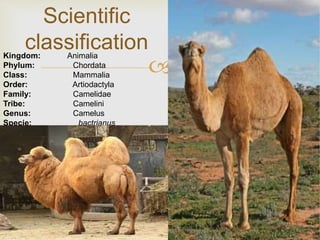
classificationKingdom: Animalia
Phylum: Chordata
Class: Mammalia
Order: Artiodactyla
Family: Camelidae
Tribe: Camelini
Genus: Camelus
Specie: bactrianus

Ungulates
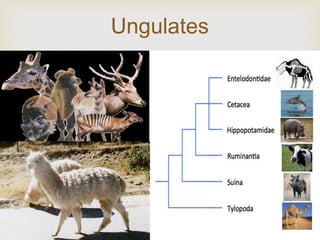
 Cetartiodactyla is a group comprised of two orders
 These orders are Artiodactyla, even-toed ungulates,
including animals such as cows (Bovidae), camels
(Camelidae), and deer (Cervidae), and Cetacea, a group
of mammals that are highly specialized for an aquatic
lifestyle, including baleen whales and toothed whales.
 Recent molecular evidence suggests that Cetacea
evolved from artiodactyl ancestors, making Artiodactyla
non-monophyletic unless Cetacea is included.

 Cetartiodactyls are found the world over, from north of the Arctic
Circle to the waters surrounding Antarctica.
 Artiodactyls are native to all continents except Antarctica and
Australia, and some artiodactyls are domesticated and have
been introduced around the world by humans.
 Cetaceans inhabit all of the world's oceans and some
freshwater lakes and rivers in South America, North America,
and Asia.
 Biogeographic Regions: nearctic ( introduced , native ) ;
palearctic ( introduced , native ) ; oriental ( introduced , native )
; ethiopian ( introduced , native ) ; neotropical ( introduced ,
native ) ; australian ( introduced ) ; arctic ocean ( native ) ;
indian ocean ( native ) ; atlantic ocean ( native ) ; pacific ocean
( native ) ; mediterranean sea ( native )
 Other Geographic Terms: holarctic ; cosmopolitan
Geographic Range

 Habitat
 Most artiodactyls live entirely on land and reside in a range of terrestrial
habitats, such as savannah, forest, mountains, desert, and farmland.
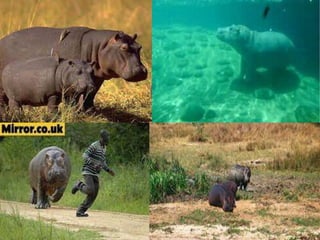
 One artiodactyl family, Hippopotamidae, is semi-aquatic and can be found
in freshwater lakes, ponds, streams, and rivers. Cetaceans, on the other
hand, are exclusively aquatic and inhabit the world's oceans, as well as
some freshwater rivers and streams.
 Habitat Regions: temperate ; tropical ; polar ; terrestrial ; saltwater or
marine ; freshwater
 Terrestrial Biomes: tundra ; taiga ; desert or dune ; savanna or grassland
; chaparral ; forest ; rainforest ; scrub forest ; mountains
 Aquatic Biomes: pelagic ; lakes and ponds ; rivers and streams ; coastal
 Other Habitat Features: agricultural ; riparian ; estuarine
Habitat

 Physical Description
 highly specialized for their aquatic lifestyle,
 they bear little resemblance to their artiodactyl ancestors.
 They have nearly hairless, fusiform bodies.
 There skulls are highly modified so that the nares are located on the top of the
head. On the other hand, most artiodactyls are specialized for cursorial
locomotion, with long, hoofed limbs, and they lack the extreme aquatic
specializations found in cetaceans.
 Large body size,Blue whales, Balaenoptera musculus, are the largest animals
on earth, growing over 27 meters in length and weighing over 190,000 kg,
 whereas the smallest artiodactyl, the lesser mouse deer (Tragulus javanicus), is
just 45 cm long and weighs 2 kg.
 Exhibit sexual dimorphism, with males larger than females or vice versa.
 Male artiodactyls often bear antlers or large horns, and some male
cetartiodactyls
 Other Physical Features: endothermic ; homoiothermic ; bilateral symmetry
 Sexual Dimorphism: sexes alike ; female larger ; male larger ; ornamentation
Physical Description

 Reproduction
 Cetartiodactyls are monogamous, polyandrous,
polygynandrous, or polygynous. Polygyny, in which social
groupings consist of adult females and their young and
one or a few adult males, is a common cetartiodactyl
strategy. It occurs in species as different as elk (Cervus
elaphus) and killer whales (Orcinus orca).
 Sexual dimorphism in ornamentation (such as antlers)
and body size indicates intense male-male competition for
mates in many species.
Reproduction

 Mating System : monogamous ; polyandrous ;
polygynous ; polygynandrous (promiscuous)
 Giving birth to just one or two young every one or
two years. However, some members of the family
Suidae may have 12 or more young at a time.
 Breeding may be either seasonal or year-round.
 Age at sexual maturity varies widely as well, from 5
months to more than 10 years.
Mating System

 Lifespan/Longevity
 Cetartiodactyls are relatively long-lived mammals.
 Most species live for at least a decade in the wild,
and captivity usually prolongs life expectancy by
several years.
 Cetaceans are especially long-lived; 116-year-old fin
whales (Balaenoptera physalus) have been reported
from the wild and bowhead whales (Balaena
mysticetus) may live up to 200 years.
Lifespan

 Communication and Perception
 through visual, tactile, auditory, and chemical means.
 Terrestrial cetartiodactyls often communicate with scent; many
species, such as those in the family Cervidae, have specialized
glands for doing so. Communication in cetaceans is
accomplished largely by sound, as sound waves travel well in
water,may travel for hundreds of kilometers, allowing individuals
to communicate with one another over great distances.
 Communication Channels: visual ; tactile ; acoustic ; chemical
 Other Communication Modes: scent marks
 Perception Channels: visual ; tactile ; acoustic ; echolocation ;
chemical
Communication

 Food Habits
 As a group, cetartiodactyls consume a wide array of terrestrial
and aquatic food items. Most artiodactyls are herbivores,
consuming grass, leaves, bark, and other plant parts. Those in
the family Suidae are omnivorous, and eat small mammals,
reptiles, amphibians, insects and other invertebrates, fruit,
bulbs, rhizomes, fungi, carrion, and bird eggs. Cetaceans
consume plankton, fish, squid, crustaceans, and aquatic birds
and mammals (including other cetaceans.
 Primary Diet: carnivore ( eats terrestrial vertebrates , piscivore
, eats eggs , insectivore , eats non-insect arthropods ,
molluscivore , scavenger ) ; herbivore ( folivore , frugivore ,
lignivore ) ; omnivore ; planktivore ; mycophage
Food Habits

 Predation
 Artiodactyls are an important food source for many
large mammalian carnivores, notably felids, canids,
and ursids. Cetaceans, on the other hand, have few
natural predators, save other cetaceans (killer
whales, Orcinus orca), sharks, and occasionally
walruses (Odobenus rosmarus). Group living ("safety
in numbers") and camouflage are two defenses often
employed by cetartiodactyls against predation.
Predation

 Conservation Status
 Currently, the IUCN classifies 54 cetartiodactyl
species as data deficient, 146 as lower risk, 40 as
vulnerable, 32 as endangered, 14 as critically
endangered, 7 as extinct, and 2 as extinct in the wild.
Conservation Status

 Economic Importance for Humans: Positive
 Cetartiodactyls are of immense economic importance to humans.
They have been hunted for thousands of years, for food, for sport,
and for various body parts. They are important for ecotourism.
 Several artiodactyl species have been domesticated for thousands
of years and are used to produce meat, milk, leather and wool, and
their dung is used as a fertilizer. Cetaceans are sometimes kept in
captivity and taught to perform tricks. Many cetartiodactyls are the
focus of research programs that help us to better understand many
aspects of evolution, physiology, and behavior.
 Positive Impacts: food ; body parts are source of valuable
material ; ecotourism ; research and education ; produces fertilizer
Economic Importance for
Humans: Positive

 Economic Importance for Humans: Negative
 Artiodactyls, especially domesticated species,
sometimes carry diseases that are transmissible to
humans or other domestic animals. Wild artiodactyls
sometimes interfere with farming operations by
eating crops.
 Negative Impacts: injures humans ( carries human
disease ) ; crop pest ; causes or carries domestic
animal disease
Economic Importance for
Humans: Negative


0rder catariodactyla

  • 1.
  • 2.
      Presented to:Sir Zaheer Ahmad  Presented by: Zeeshan Amin Rashid ullah Najib ullah Topic: order Cetartiodactyla
  • 3.
  • 4.
      The even-toedungulates are the most successful group of large herbivores on earth today  Artiodactyls found in every zoogeographic region (including several species on Sulawesi and other islands in the Australasian region);  Many species have been introduced into areas outside of their natural range, including Australia, New Guinea, and the islands of Oceania.  The approximately 240 ungulate members of this order show incredible diversity in size, form, dietary preferences, and climatic tolerance. This order contains the majority of domesticated mammal species, including cattle, reindeer, camels, pigs, goats, and sheep. Order Cetartiodactyla
  • 5.
     Scientific classificationKingdom: Animalia Phylum: Chordata Class:Mammalia Order: Artiodactyla Family: Camelidae Tribe: Camelini Genus: Camelus Specie: bactrianus
  • 6.
  • 7.
     Cetartiodactyla isa group comprised of two orders  These orders are Artiodactyla, even-toed ungulates, including animals such as cows (Bovidae), camels (Camelidae), and deer (Cervidae), and Cetacea, a group of mammals that are highly specialized for an aquatic lifestyle, including baleen whales and toothed whales.  Recent molecular evidence suggests that Cetacea evolved from artiodactyl ancestors, making Artiodactyla non-monophyletic unless Cetacea is included.
  • 8.
      Cetartiodactyls arefound the world over, from north of the Arctic Circle to the waters surrounding Antarctica.  Artiodactyls are native to all continents except Antarctica and Australia, and some artiodactyls are domesticated and have been introduced around the world by humans.  Cetaceans inhabit all of the world's oceans and some freshwater lakes and rivers in South America, North America, and Asia.  Biogeographic Regions: nearctic ( introduced , native ) ; palearctic ( introduced , native ) ; oriental ( introduced , native ) ; ethiopian ( introduced , native ) ; neotropical ( introduced , native ) ; australian ( introduced ) ; arctic ocean ( native ) ; indian ocean ( native ) ; atlantic ocean ( native ) ; pacific ocean ( native ) ; mediterranean sea ( native )  Other Geographic Terms: holarctic ; cosmopolitan Geographic Range
  • 9.
      Habitat  Mostartiodactyls live entirely on land and reside in a range of terrestrial habitats, such as savannah, forest, mountains, desert, and farmland.  One artiodactyl family, Hippopotamidae, is semi-aquatic and can be found in freshwater lakes, ponds, streams, and rivers. Cetaceans, on the other hand, are exclusively aquatic and inhabit the world's oceans, as well as some freshwater rivers and streams.  Habitat Regions: temperate ; tropical ; polar ; terrestrial ; saltwater or marine ; freshwater  Terrestrial Biomes: tundra ; taiga ; desert or dune ; savanna or grassland ; chaparral ; forest ; rainforest ; scrub forest ; mountains  Aquatic Biomes: pelagic ; lakes and ponds ; rivers and streams ; coastal  Other Habitat Features: agricultural ; riparian ; estuarine Habitat
  • 10.
  • 11.
     Physical Description highly specialized for their aquatic lifestyle,  they bear little resemblance to their artiodactyl ancestors.  They have nearly hairless, fusiform bodies.  There skulls are highly modified so that the nares are located on the top of the head. On the other hand, most artiodactyls are specialized for cursorial locomotion, with long, hoofed limbs, and they lack the extreme aquatic specializations found in cetaceans.  Large body size,Blue whales, Balaenoptera musculus, are the largest animals on earth, growing over 27 meters in length and weighing over 190,000 kg,  whereas the smallest artiodactyl, the lesser mouse deer (Tragulus javanicus), is just 45 cm long and weighs 2 kg.  Exhibit sexual dimorphism, with males larger than females or vice versa.  Male artiodactyls often bear antlers or large horns, and some male cetartiodactyls  Other Physical Features: endothermic ; homoiothermic ; bilateral symmetry  Sexual Dimorphism: sexes alike ; female larger ; male larger ; ornamentation Physical Description
  • 12.
      Reproduction  Cetartiodactylsare monogamous, polyandrous, polygynandrous, or polygynous. Polygyny, in which social groupings consist of adult females and their young and one or a few adult males, is a common cetartiodactyl strategy. It occurs in species as different as elk (Cervus elaphus) and killer whales (Orcinus orca).  Sexual dimorphism in ornamentation (such as antlers) and body size indicates intense male-male competition for mates in many species. Reproduction
  • 13.
      Mating System: monogamous ; polyandrous ; polygynous ; polygynandrous (promiscuous)  Giving birth to just one or two young every one or two years. However, some members of the family Suidae may have 12 or more young at a time.  Breeding may be either seasonal or year-round.  Age at sexual maturity varies widely as well, from 5 months to more than 10 years. Mating System
  • 14.
      Lifespan/Longevity  Cetartiodactylsare relatively long-lived mammals.  Most species live for at least a decade in the wild, and captivity usually prolongs life expectancy by several years.  Cetaceans are especially long-lived; 116-year-old fin whales (Balaenoptera physalus) have been reported from the wild and bowhead whales (Balaena mysticetus) may live up to 200 years. Lifespan
  • 15.
      Communication andPerception  through visual, tactile, auditory, and chemical means.  Terrestrial cetartiodactyls often communicate with scent; many species, such as those in the family Cervidae, have specialized glands for doing so. Communication in cetaceans is accomplished largely by sound, as sound waves travel well in water,may travel for hundreds of kilometers, allowing individuals to communicate with one another over great distances.  Communication Channels: visual ; tactile ; acoustic ; chemical  Other Communication Modes: scent marks  Perception Channels: visual ; tactile ; acoustic ; echolocation ; chemical Communication
  • 16.
      Food Habits As a group, cetartiodactyls consume a wide array of terrestrial and aquatic food items. Most artiodactyls are herbivores, consuming grass, leaves, bark, and other plant parts. Those in the family Suidae are omnivorous, and eat small mammals, reptiles, amphibians, insects and other invertebrates, fruit, bulbs, rhizomes, fungi, carrion, and bird eggs. Cetaceans consume plankton, fish, squid, crustaceans, and aquatic birds and mammals (including other cetaceans.  Primary Diet: carnivore ( eats terrestrial vertebrates , piscivore , eats eggs , insectivore , eats non-insect arthropods , molluscivore , scavenger ) ; herbivore ( folivore , frugivore , lignivore ) ; omnivore ; planktivore ; mycophage Food Habits
  • 17.
      Predation  Artiodactylsare an important food source for many large mammalian carnivores, notably felids, canids, and ursids. Cetaceans, on the other hand, have few natural predators, save other cetaceans (killer whales, Orcinus orca), sharks, and occasionally walruses (Odobenus rosmarus). Group living ("safety in numbers") and camouflage are two defenses often employed by cetartiodactyls against predation. Predation
  • 18.
      Conservation Status Currently, the IUCN classifies 54 cetartiodactyl species as data deficient, 146 as lower risk, 40 as vulnerable, 32 as endangered, 14 as critically endangered, 7 as extinct, and 2 as extinct in the wild. Conservation Status
  • 19.
      Economic Importancefor Humans: Positive  Cetartiodactyls are of immense economic importance to humans. They have been hunted for thousands of years, for food, for sport, and for various body parts. They are important for ecotourism.  Several artiodactyl species have been domesticated for thousands of years and are used to produce meat, milk, leather and wool, and their dung is used as a fertilizer. Cetaceans are sometimes kept in captivity and taught to perform tricks. Many cetartiodactyls are the focus of research programs that help us to better understand many aspects of evolution, physiology, and behavior.  Positive Impacts: food ; body parts are source of valuable material ; ecotourism ; research and education ; produces fertilizer Economic Importance for Humans: Positive
  • 20.
      Economic Importancefor Humans: Negative  Artiodactyls, especially domesticated species, sometimes carry diseases that are transmissible to humans or other domestic animals. Wild artiodactyls sometimes interfere with farming operations by eating crops.  Negative Impacts: injures humans ( carries human disease ) ; crop pest ; causes or carries domestic animal disease Economic Importance for Humans: Negative
  • 21.