KINDS OF BEHAVIOR
Innate Behavior
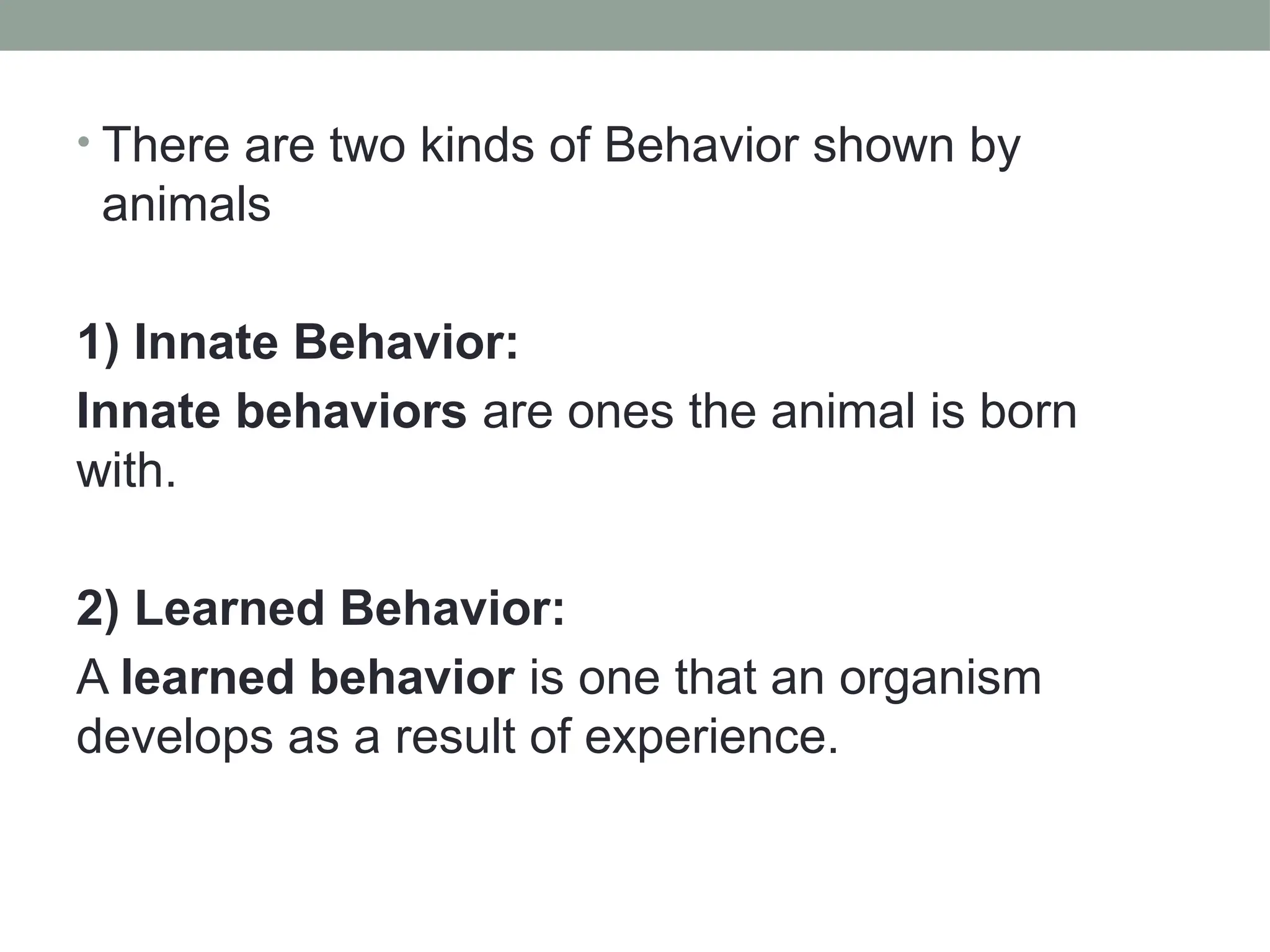
• There are two kinds of Behavior shown by
animals
1) Innate Behavior:
Innate behaviors are ones the animal is born
with.
2) Learned Behavior:
A learned behavior is one that an organism
develops as a result of experience.
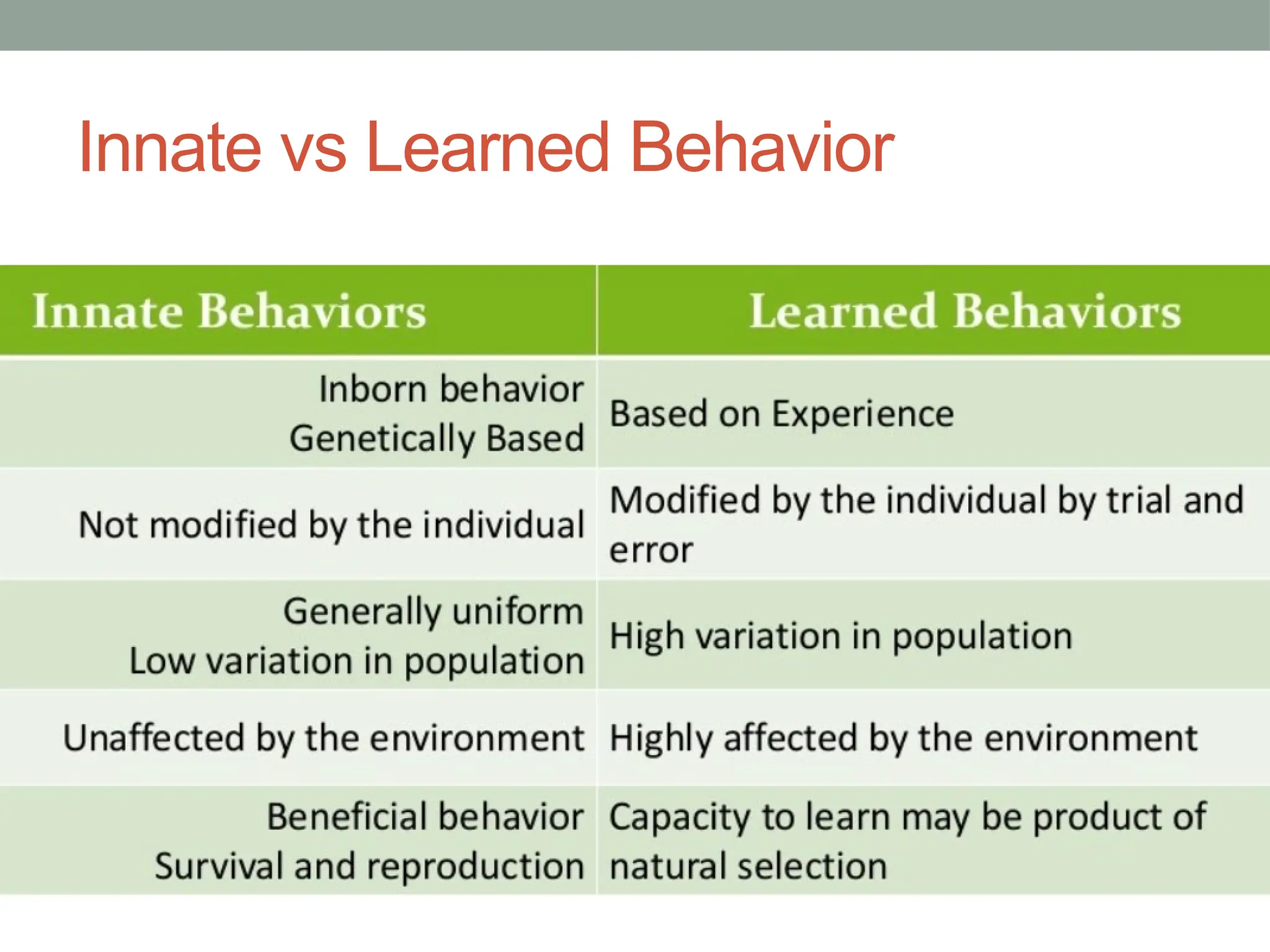
Innate vs Learned Behavior
Innate Behavior
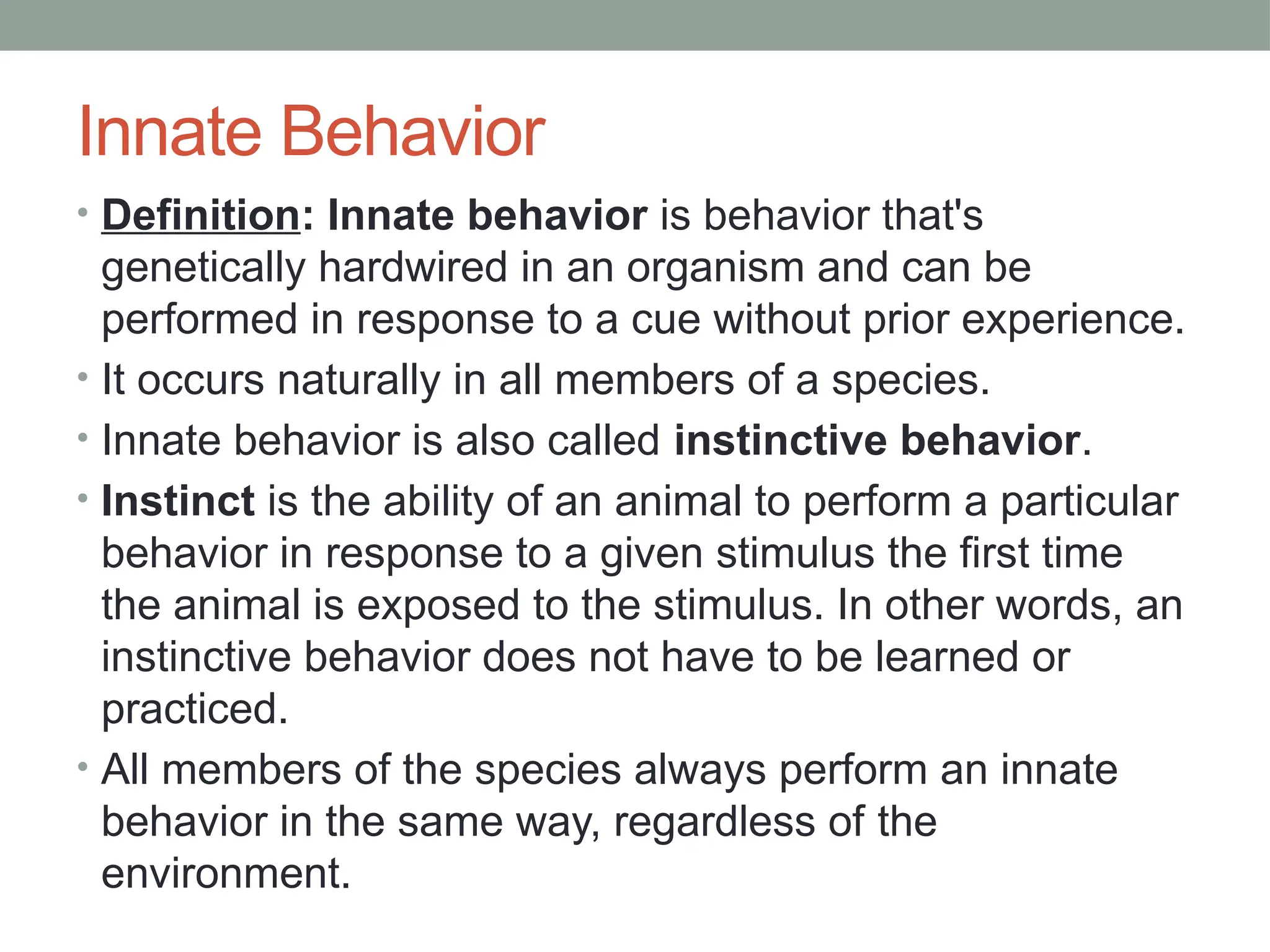
• Definition: Innate behavior is behavior that's
genetically hardwired in an organism and can be
performed in response to a cue without prior experience.
• It occurs naturally in all members of a species.
• Innate behavior is also called instinctive behavior.
• Instinct is the ability of an animal to perform a particular
behavior in response to a given stimulus the first time
the animal is exposed to the stimulus. In other words, an
instinctive behavior does not have to be learned or
practiced.
• All members of the species always perform an innate
behavior in the same way, regardless of the
environment.
Examples of Innate behavior
• The following behaviors are examples of innate behaviors:
• Web making in spiders.
• Nest building in birds.
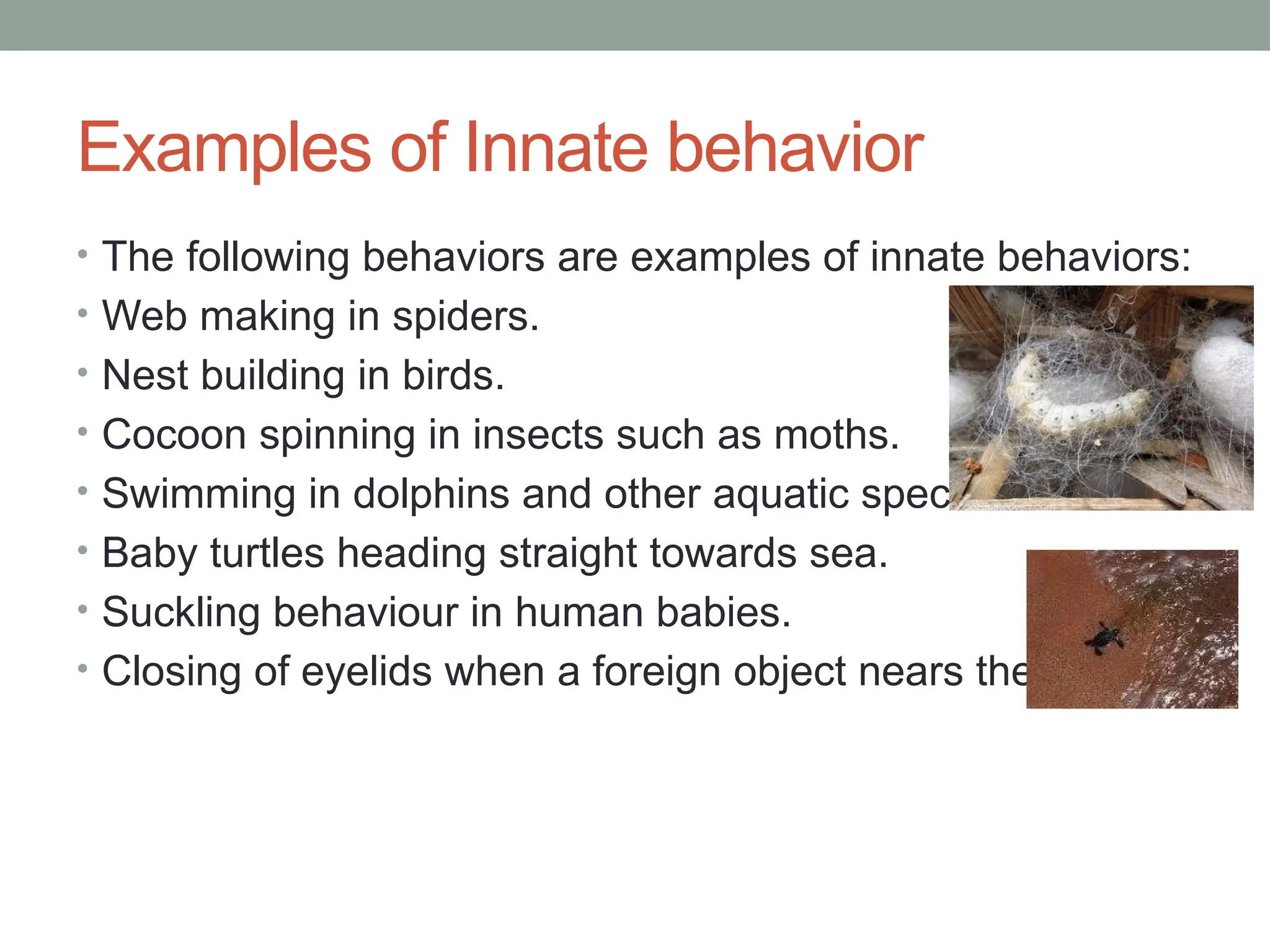
• Cocoon spinning in insects such as moths.
• Swimming in dolphins and other aquatic species.
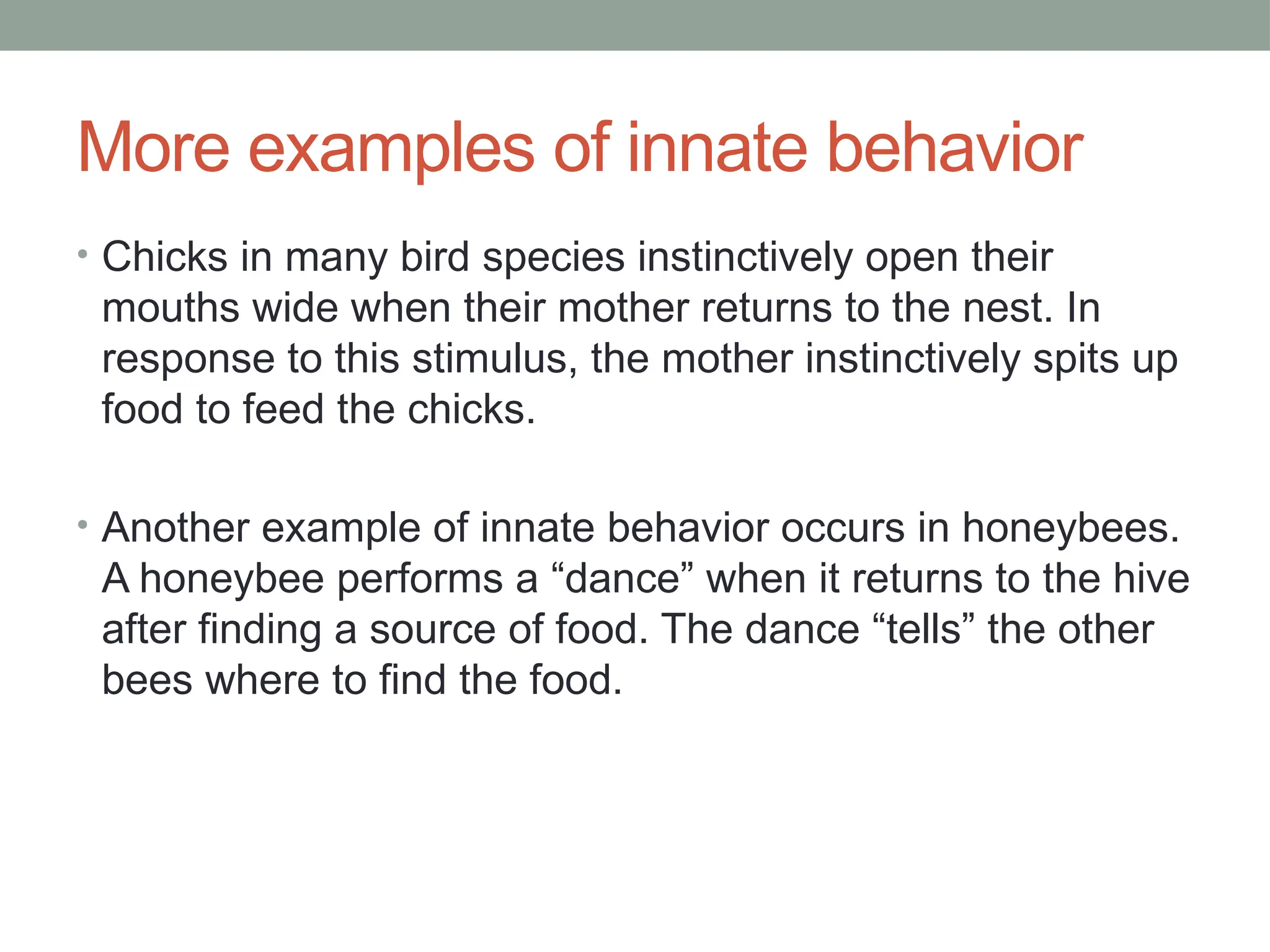
• Baby turtles heading straight towards sea.
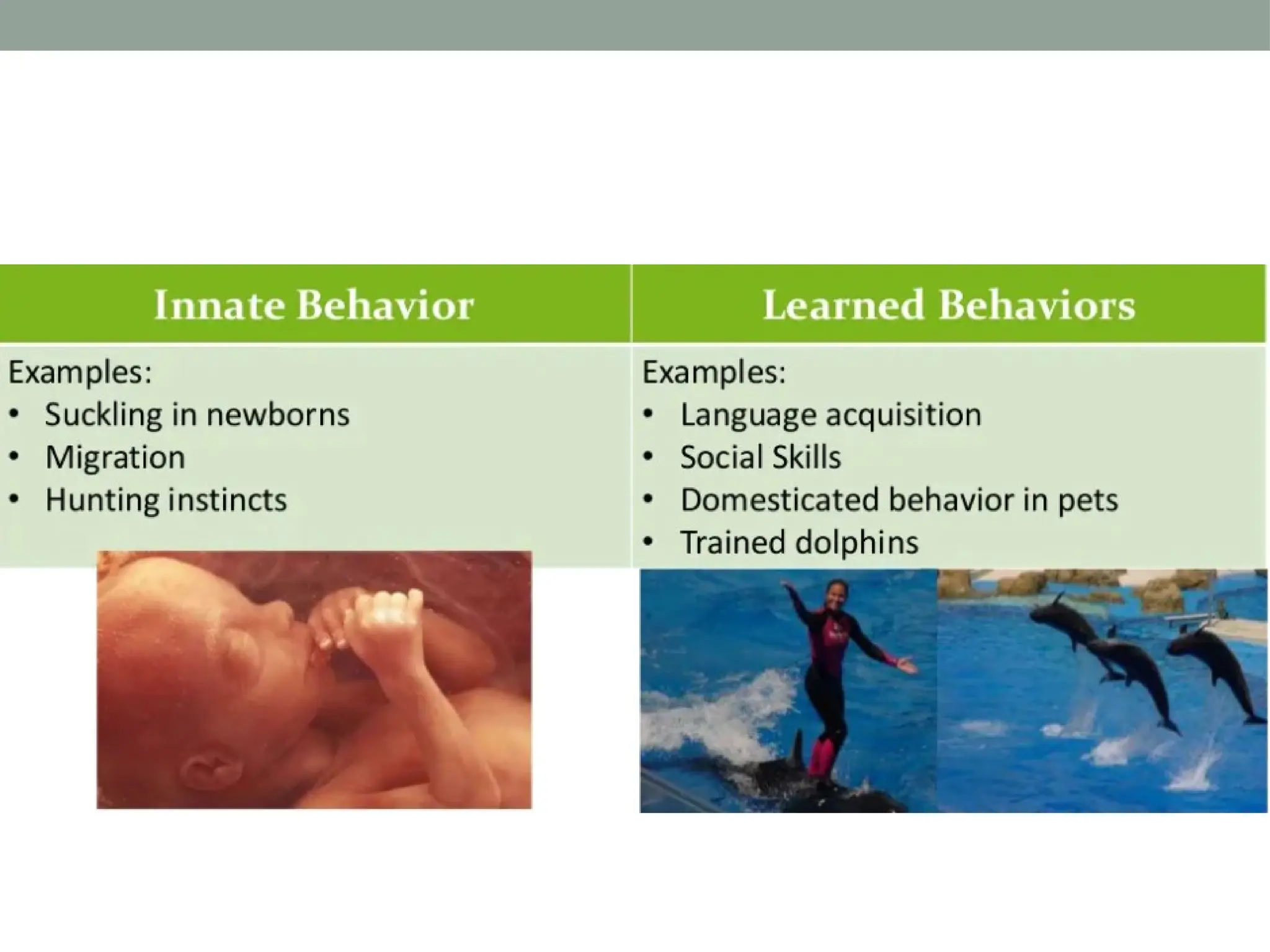
• Suckling behaviour in human babies.
• Closing of eyelids when a foreign object nears the eye.
More examples of innate behavior
• Chicks in many bird species instinctively open their
mouths wide when their mother returns to the nest. In
response to this stimulus, the mother instinctively spits up
food to feed the chicks.
• Another example of innate behavior occurs in honeybees.
A honeybee performs a “dance” when it returns to the hive
after finding a source of food. The dance “tells” the other
bees where to find the food.
Categories of Innate Behavior
• There are mainly four categories of Innate
Behavior.
1) Kinesis
2) Taxis
3) Reflex
4) Fixed Action Pattern
1) KINESIS
• Kinesis, is a non-directional movement or activity of an
organism in response to a stimulus.
• The animal does not move toward or away from the stimulus
but moves at either a slow or fast rate depending on its
"comfort zone.“
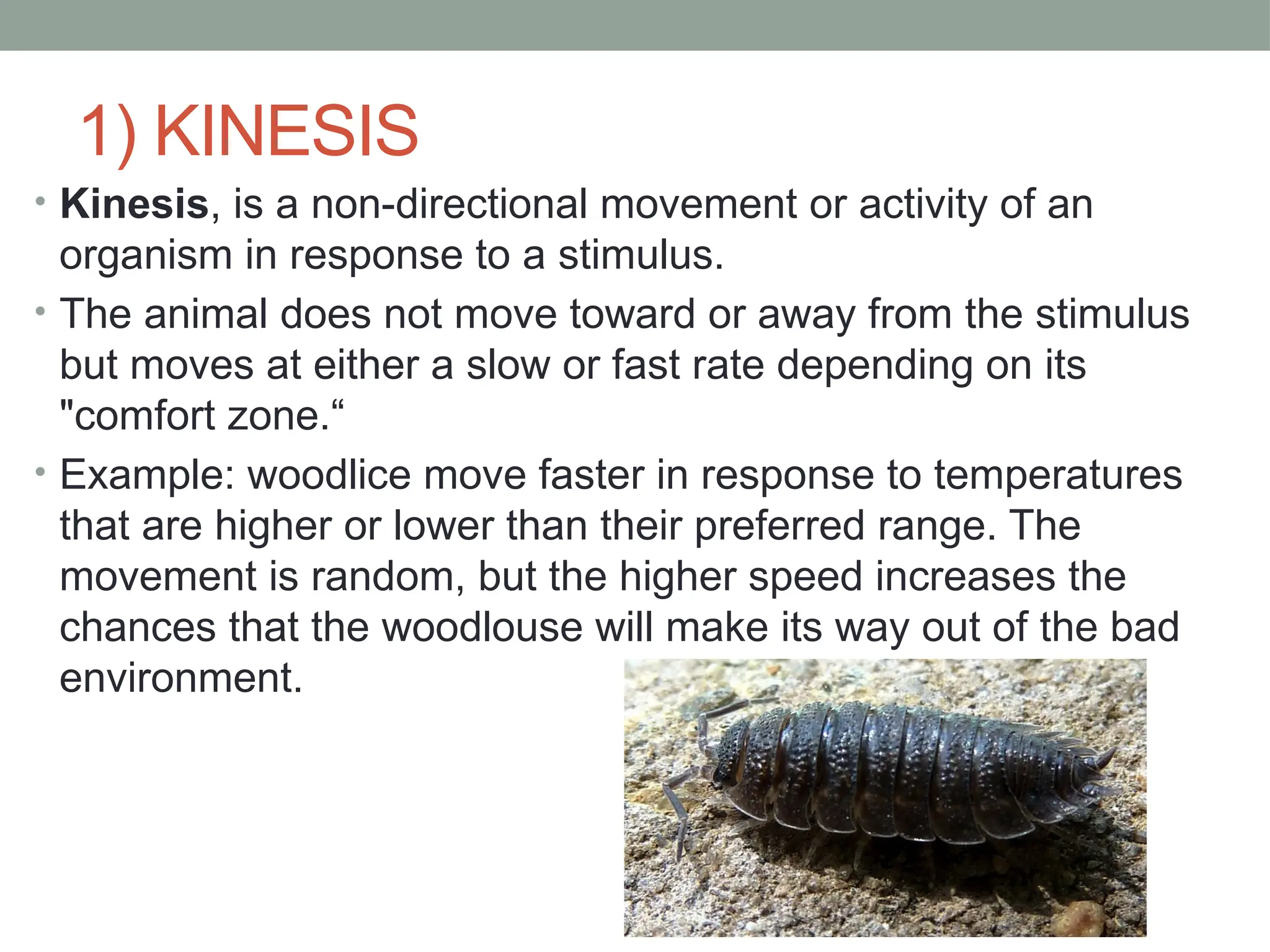
• Example: woodlice move faster in response to temperatures
that are higher or lower than their preferred range. The
movement is random, but the higher speed increases the
chances that the woodlouse will make its way out of the bad
environment.
2) TAXIS
• Taxis is directed movement toward or away from
a stimulus.
• Can be positive (+) or negative (-)
• Phototaxis: movement toward or away from light
+ Phototaxis – toward light
Example: movement of moths or flies
towards light source
- Phototaxis – away from light
Example: cockroach running for cover when
lights are turned on
• Chemotaxis: Movement in response to chemical
signals.
• The example of chemotaxis in animals is Euglena
have negative chemotaxis for salt and have
positive chemotaxis for glucose.
• Geotaxis: The movement of a cell or
microorganism in response to gravity.
• For example, certain cnidarian larvae that swim
towards the seabed exhibit positive geotaxis.
3) Reflex
• A reflex is an involuntary response that always
occurs when a certain stimulus is present.
• For example, a human infant will grasp an object,
such as a finger, that is placed in its palm. The
infant has no control over this reaction because it is
innate.
• Another example is when someone who touches a
hot stove instinctually pulls his or her hand away.
4) Fixed Action Pattern
• A fixed action pattern is a series of movements evoke by a
stimulus such that even when the stimulus is removed, the
pattern goes on to completion.
• Best example is the female graylag goose. If one of her eggs
rolls out of the nest, a female graylag goose will instinctively
use her bill to push the egg back into the nest. The sight of
the egg outside the nest triggers the behavior. But if the egg
that rolls out of the nest is picked up and taken away, the
goose will keep moving her head as though pushing an
imaginary egg. The goose will also try to push any egg-
shaped object, such as a golf ball, if it is placed near the nest.

Kinds of Behavior (Innate Behavior).pptx

  • 1.
  • 2.
    • There aretwo kinds of Behavior shown by animals 1) Innate Behavior: Innate behaviors are ones the animal is born with. 2) Learned Behavior: A learned behavior is one that an organism develops as a result of experience.
  • 3.
  • 5.
    Innate Behavior • Definition:Innate behavior is behavior that's genetically hardwired in an organism and can be performed in response to a cue without prior experience. • It occurs naturally in all members of a species. • Innate behavior is also called instinctive behavior. • Instinct is the ability of an animal to perform a particular behavior in response to a given stimulus the first time the animal is exposed to the stimulus. In other words, an instinctive behavior does not have to be learned or practiced. • All members of the species always perform an innate behavior in the same way, regardless of the environment.
  • 6.
    Examples of Innatebehavior • The following behaviors are examples of innate behaviors: • Web making in spiders. • Nest building in birds. • Cocoon spinning in insects such as moths. • Swimming in dolphins and other aquatic species. • Baby turtles heading straight towards sea. • Suckling behaviour in human babies. • Closing of eyelids when a foreign object nears the eye.
  • 7.
    More examples ofinnate behavior • Chicks in many bird species instinctively open their mouths wide when their mother returns to the nest. In response to this stimulus, the mother instinctively spits up food to feed the chicks. • Another example of innate behavior occurs in honeybees. A honeybee performs a “dance” when it returns to the hive after finding a source of food. The dance “tells” the other bees where to find the food.
  • 8.
    Categories of InnateBehavior • There are mainly four categories of Innate Behavior. 1) Kinesis 2) Taxis 3) Reflex 4) Fixed Action Pattern
  • 9.
    1) KINESIS • Kinesis,is a non-directional movement or activity of an organism in response to a stimulus. • The animal does not move toward or away from the stimulus but moves at either a slow or fast rate depending on its "comfort zone.“ • Example: woodlice move faster in response to temperatures that are higher or lower than their preferred range. The movement is random, but the higher speed increases the chances that the woodlouse will make its way out of the bad environment.
  • 10.
    2) TAXIS • Taxisis directed movement toward or away from a stimulus. • Can be positive (+) or negative (-) • Phototaxis: movement toward or away from light + Phototaxis – toward light Example: movement of moths or flies towards light source - Phototaxis – away from light Example: cockroach running for cover when lights are turned on
  • 11.
    • Chemotaxis: Movementin response to chemical signals. • The example of chemotaxis in animals is Euglena have negative chemotaxis for salt and have positive chemotaxis for glucose. • Geotaxis: The movement of a cell or microorganism in response to gravity. • For example, certain cnidarian larvae that swim towards the seabed exhibit positive geotaxis.
  • 12.
    3) Reflex • Areflex is an involuntary response that always occurs when a certain stimulus is present. • For example, a human infant will grasp an object, such as a finger, that is placed in its palm. The infant has no control over this reaction because it is innate. • Another example is when someone who touches a hot stove instinctually pulls his or her hand away.
  • 13.
    4) Fixed ActionPattern • A fixed action pattern is a series of movements evoke by a stimulus such that even when the stimulus is removed, the pattern goes on to completion. • Best example is the female graylag goose. If one of her eggs rolls out of the nest, a female graylag goose will instinctively use her bill to push the egg back into the nest. The sight of the egg outside the nest triggers the behavior. But if the egg that rolls out of the nest is picked up and taken away, the goose will keep moving her head as though pushing an imaginary egg. The goose will also try to push any egg- shaped object, such as a golf ball, if it is placed near the nest.