3. RECEPTION, RESPONSE
AND CO-ORDINATION IN PLANTS AND
ANIMALS.
Definition of terms.
1. Reception- Art of receiving signals of
changes through various organs.
2. Stimulus (plural-stimuli)- this is a
condition in the environment which
produces a change in the activity of part or
the whole organism.
3. External stimuli-condition in the
external environment (surrounding of the
whole organism) which produces a change
in the activity of part or the whole
organism e.g. temperature, light, pH,
humidity, mineral salt concentration,
population density, absence/ presence of
predators.
4. Internal stimuli-condition in the
internal environment (surrounding
of the cells) which produces a
change in the activity of part or the
whole organism e.g. accumulation
of wastes, concentration of gases,
presence of internal parasites,
changes in temperature and
glucose concentration.
5. Response- change in an activity
of an organism.
25-Mar-21
1
Š Sam obare
6. Irritability/Responsiveness
/Sensitivity- Ability of an
organism to detect and respond
to changes in the environment/
stimulus.
7. Receptors –parts of the body
which receive the stimulus.
8. Effectors- parts of the body
which bring about response.
9. Co-ordination- This is the
working together of different
parts of the body in an orderly
manner to bring about better
performance of physiological,
physical or metabolic actions of
the body.
Types of responses.
A. Tropisms/tropic
responses/movements.
B. Taxis/tactic
responses/movements.
C. Nastisms/nastic
responses/movements.
25-Mar-21
2
Š Sam obare
A. Tropic responses/ tropisms.
 Tropism refers to a growth
curvature in response to
unidirectional external stimulus.
Tropic responses are controlled by
auxins hence they are usually slow.
 Growth response towards a stimulus
is called positive tropism while
growth response away from the
stimulus is called negative
tropism.
Types of tropisms/tropic
responses
1. Phototropism- this is growth
curvature in response to
unidirectional light.
• Growth towards light is called
positive phototropism e.g.
shoots are positively phototropic.
Growth away from light is called
negative phototropism e.g.
roots are negatively phototropic.
25-Mar-21
3
Š Sam obare
2. Chemotropism- this is a
growth curvature in response
to chemical concentration e.g.
growth of pollen tube towards
chemical secreted by the
embryo sac hence it is said to
be positively chemotropic.
3. Geotropism/gravitotropi
sm- this is growth curvature
in response to gravity e.g. root
tips/radicles are positively
geotropic while shoot
tips/plumules are negatively
geotropic.
4. Hydrotropism- this is
growth curvature in response
to water/moisture e.g. roots
are positively hydrotropic.
5. Haptotropism/thigmotro
pism- this is growth
curvature in response to
contact e.g. tendrils are
positively thigmo/haptotropic
and roots are negatively
thigmo/haptotropic.
25-Mar-21
4
Š Sam obare
Survival values/ importance
of tropisms.
1. Phototropism exposes the leaves
in position for maximum light
absorption for photosynthesis.
2. Hydrotropism enables the plant
roots to seek for water.
3. Thigmo/haptotropism enables
plants with weak stems
(herbaceous plants) to get support
so as to expose leaves to
photosynthesis, flowers to
pollination and fruits/ seeds for
dispersal.
4. Gravito/geotropism enables
plant roots to grow deep into
the soil thus providing firm
support/anchorage in the soil
and enables the shoot to grow
upwards so as to expose leaves
to sunlight for photosynthesis.
5. Chemotropism enables the
growth of pollen tube towards
the embryo sac facilitating
fertilization.
25-Mar-21
5
Š Sam obare
B. Taxis/Tactic
responses/movements.
 It refers to the movement of the whole
organism/motile/mobile gamete in
response to a unidirectional external
stimulus. It is common in animals.
 Movement towards the stimulus is called
positive taxis while movement away
from the stimulus is called negative
taxis.
Types of taxes.
1. Phototaxis-this is response to
variation in light intensity and
direction e.g. moth, euglena,
chlamydomonas, spirogyra and
fruit flies move toward light
hence are positively phototactic.
Earthworms, maggots, termites
move away from light hence are
negatively phototactic.
25-Mar-21
6
Š Sam obare
2. Chemotaxis- this is response to
variation in chemicals e.g. male gamete
swim towards the chemicals secreted by
the ovum hence positively chemotactic.
Mosquitoes fly away from insect
repellants hence negatively
chemotactic.
3. Aerotaxis- this is response to variation
in oxygen concentration e.g. amoeba
moves from an area of low oxygen
concentration to an area of high oxygen
concentration hence positive aerotactic.
4. Thermotaxis- this is response
to changes in temperature e.g.
paramecium moves from a region
of lower temperature to a region
of moderate temperature hence
show positive thermotaxis.
5. Osmotaxis- this is response to
changes/ variation in osmotic
pressure e.g. marine crabs
burrow in sand to avoid dilution
of body fluids hence show
negative osmotaxis.
25-Mar-21
7
Š Sam obare
6. Rheotaxis- this is response to
variation in direction of water and
air currents e.g. fish moves against
water currents hence show
negative rheotaxis. Butterflies and
moths flow into air/wind to
detect the scent of flowers hence
show positive rheotaxis).
7. Hydrotaxis- movement of
whole organism in response to
moisture.
Importance/survival values of
taxes
1. Enable organisms to escape from
harmful stimuli e.g. excessive
heat/ dessication and predators.
2. Enable organisms to seek
favorable habitats and acquire
resources e.g. nutrients and
mates.
3. Chemotaxis enables fertilization
to take place.
25-Mar-21
8
Š Sam obare
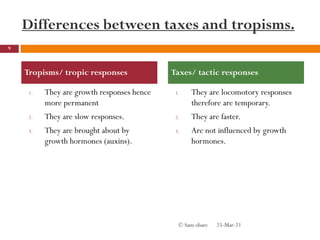
Differences between taxes and tropisms.
1. They are growth responses hence
more permanent
2. They are slow responses.
3. They are brought about by
growth hormones (auxins).
1. They are locomotory responses
therefore are temporary.
2. They are faster.
3. Are not influenced by growth
hormones.
25-Mar-21
9
Š Sam obare
Tropisms/ tropic responses Taxes/ tactic responses
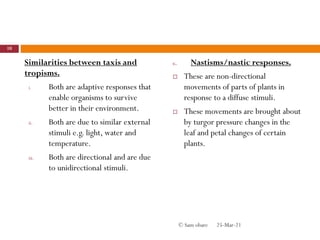
Similarities between taxis and
tropisms.
i. Both are adaptive responses that
enable organisms to survive
better in their environment.
ii. Both are due to similar external
stimuli e.g. light, water and
temperature.
iii. Both are directional and are due
to unidirectional stimuli.
c. Nastisms/nastic responses.
 These are non-directional
movements of parts of plants in
response to a diffuse stimuli.
 These movements are brought about
by turgor pressure changes in the
leaf and petal changes of certain
plants.
25-Mar-21
10
Š Sam obare
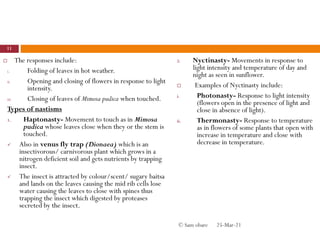
 The responses include:
i. Folding of leaves in hot weather.
ii. Opening and closing of flowers in response to light
intensity.
iii. Closing of leaves of Mimosa pudica when touched.
Types of nastisms
1. Haptonasty- Movement to touch as in Mimosa
pudica whose leaves close when they or the stem is
touched.
 Also in venus fly trap (Dionaea) which is an
insectivorous/ carnivorous plant which grows in a
nitrogen deficient soil and gets nutrients by trapping
insect.
 The insect is attracted by colour/scent/ sugary baitsa
and lands on the leaves causing the mid rib cells lose
water causing the leaves to close with spines thus
trapping the insect which digested by proteases
secreted by the insect.
2. Nyctinasty- Movements in response to
light intensity and temperature of day and
night as seen in sunflower.
 Examples of Nyctinasty include:
i. Photonasty- Response to light intensity
(flowers open in the presence of light and
close in absence of light).
ii. Thermonasty- Response to temperature
as in flowers of some plants that open with
increase in temperature and close with
decrease in temperature.
25-Mar-21
11
Š Sam obare
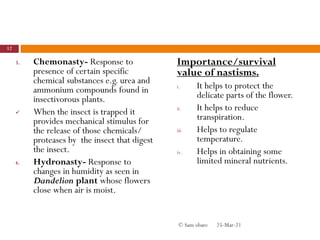
3. Chemonasty- Response to
presence of certain specific
chemical substances e.g. urea and
ammonium compounds found in
insectivorous plants.
 When the insect is trapped it
provides mechanical stimulus for
the release of those chemicals/
proteases by the insect that digest
the insect.
4. Hydronasty- Response to
changes in humidity as seen in
Dandelion plant whose flowers
close when air is moist.
Importance/survival
value of nastisms.
i. It helps to protect the
delicate parts of the flower.
ii. It helps to reduce
transpiration.
iii. Helps to regulate
temperature.
iv. Helps in obtaining some
limited mineral nutrients.
25-Mar-21
12
Š Sam obare
Study question
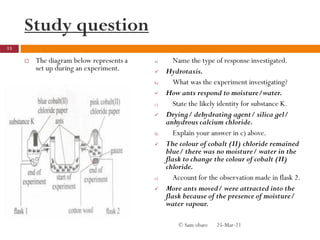
 The diagram below represents a
set up during an experiment.
a) Name the type of response investigated.
 Hydrotaxis.
b) What was the experiment investigating?
 How ants respond to moisture/water.
c) State the likely identity for substance K.
 Drying/ dehydrating agent/ silica gel/
anhydrous calcium chloride.
d) Explain your answer in c) above.
 The colour of cobalt (II) chloride remained
blue/ there was no moisture/ water in the
flask to change the colour of cobalt (II)
chloride.
e) Account for the observation made in flask 2.
 More ants moved/ were attracted into the
flask because of the presence of moisture/
water vapour.
25-Mar-21
13
Š Sam obare
Co-ordination in plants.
 Plant growth responses are co-
ordinated by plat hormones e.g.
auxins, gibberelins, cytokinins and
florigens.Tropisms are influenced
by auxins.
Role of auxins (e.g. Indole acetic
acid) in tropisms.
 Auxins are produced at the tips of
the roots and shoots (apical
meristems).
 They diffuse away from the tips to
the region of cell elongation where
they bring about growth in the
region of cell elongation.
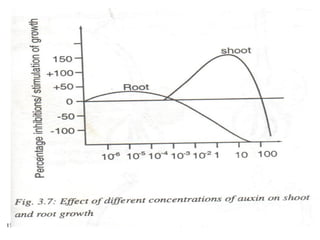
 The concentration/amount of the
auxins present influence how the
shoots and roots grow.
 The concentration that stimulates
growth in the shoots is higher than
the concentration that influences
growth in the roots.
 In shoots, the high auxin
concentration stimulates faster
growth up to a given optimum
while low auxin concentration has
little effect on the growth.
 In roots, low auxin concentration
stimulates rapid/ faster growth
while high concentration inhibits
growth.
25-Mar-21
14
Š Sam obare
25-Mar-21
Š Sam obare
15
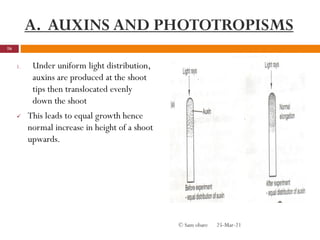
A. AUXINS AND PHOTOTROPISMS
1. Under uniform light distribution,
auxins are produced at the shoot
tips then translocated evenly
down the shoot
 This leads to equal growth hence
normal increase in height of a shoot
upwards.
25-Mar-21
16
Š Sam obare
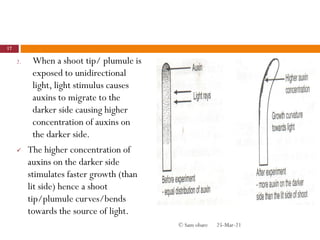
2. When a shoot tip/ plumule is
exposed to unidirectional
light, light stimulus causes
auxins to migrate to the
darker side causing higher
concentration of auxins on
the darker side.
 The higher concentration of
auxins on the darker side
stimulates faster growth (than
lit side) hence a shoot
tip/plumule curves/bends
towards the source of light.
25-Mar-21
17
Š Sam obare
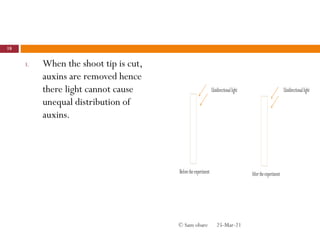
3. When the shoot tip is cut,
auxins are removed hence
there light cannot cause
unequal distribution of
auxins.
25-Mar-21
18
Š Sam obare
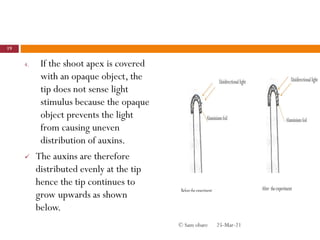
4. If the shoot apex is covered
with an opaque object, the
tip does not sense light
stimulus because the opaque
object prevents the light
from causing uneven
distribution of auxins.
 The auxins are therefore
distributed evenly at the tip
hence the tip continues to
grow upwards as shown
below.
25-Mar-21
19
Š Sam obare
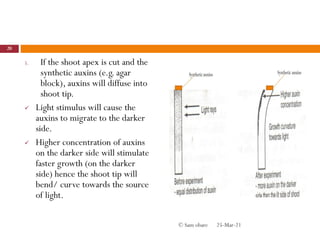
5. If the shoot apex is cut and the
synthetic auxins (e.g. agar
block), auxins will diffuse into
shoot tip.
 Light stimulus will cause the
auxins to migrate to the darker
side.
 Higher concentration of auxins
on the darker side will stimulate
faster growth (on the darker
side) hence the shoot tip will
bend/ curve towards the source
of light.
25-Mar-21
20
Š Sam obare
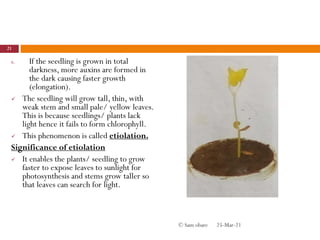
6. If the seedling is grown in total
darkness, more auxins are formed in
the dark causing faster growth
(elongation).
 The seedling will grow tall, thin, with
weak stem and small pale/ yellow leaves.
This is because seedlings/ plants lack
light hence it fails to form chlorophyll.
 This phenomenon is called etiolation.
Significance of etiolation
 It enables the plants/ seedling to grow
faster to expose leaves to sunlight for
photosynthesis and stems grow taller so
that leaves can search for light.
25-Mar-21
21
Š Sam obare
Study question
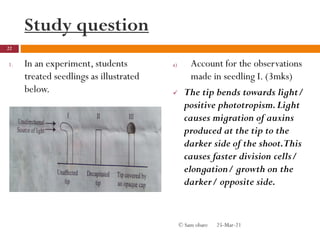
1. In an experiment, students
treated seedlings as illustrated
below.
a) Account for the observations
made in seedling I. (3mks)
 The tip bends towards light/
positive phototropism.Light
causes migration of auxins
produced at the tip to the
darker side of the shoot.This
causes faster division cells/
elongation/ growth on the
darker/ opposite side.
25-Mar-21
22
Š Sam obare
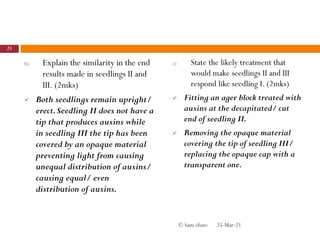
b) Explain the similarity in the end
results made in seedlings II and
III. (2mks)
 Both seedlings remain upright/
erect.Seedling II does not have a
tip that produces auxins while
in seedling III the tip has been
covered by an opaque material
preventing light from causing
unequal distribution of auxins/
causing equal/ even
distribution of auxins.
c) State the likely treatment that
would make seedlings II and III
respond like seedling I. (2mks)
 Fitting an ager block treated with
auxins at the decapitated/ cut
end of seedling II.
 Removing the opaque material
covering the tip of seedling III/
replacing the opaque cap with a
transparent one.
25-Mar-21
23
Š Sam obare
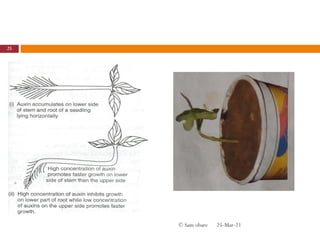
B. AUXINS AND GEO/
GRAVITOTROPISM
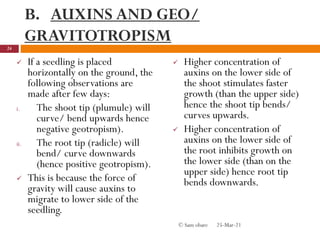
 If a seedling is placed
horizontally on the ground, the
following observations are
made after few days:
i. The shoot tip (plumule) will
curve/ bend upwards hence
negative geotropism).
ii. The root tip (radicle) will
bend/ curve downwards
(hence positive geotropism).
 This is because the force of
gravity will cause auxins to
migrate to lower side of the
seedling.
 Higher concentration of
auxins on the lower side of
the shoot stimulates faster
growth (than the upper side)
hence the shoot tip bends/
curves upwards.
 Higher concentration of
auxins on the lower side of
the root inhibits growth on
the lower side (than on the
upper side) hence root tip
bends downwards.
25-Mar-21
24
Š Sam obare
25-Mar-21
25
Š Sam obare
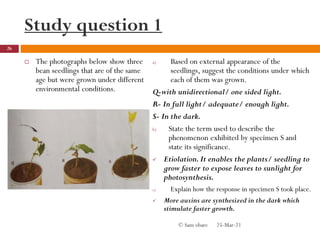
Study question 1
 The photographs below show three
bean seedlings that are of the same
age but were grown under different
environmental conditions.
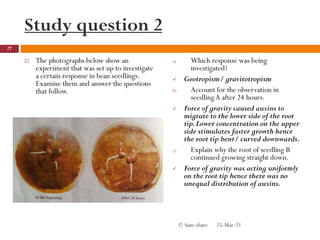
a) Based on external appearance of the
seedlings, suggest the conditions under which
each of them was grown.
Q-with unidirectional/ one sided light.
R- In full light/ adequate/ enough light.
S- In the dark.
b) State the term used to describe the
phenomenon exhibited by specimen S and
state its significance.
 Etiolation. It enables the plants/ seedling to
grow faster to expose leaves to sunlight for
photosynthesis.
c) Explain how the response in specimen S took place.
 More auxins are synthesized in the dark which
stimulate faster growth.
25-Mar-21
26
Š Sam obare
Study question 2
 The photographs below show an
experiment that was set up to investigate
a certain response in bean seedlings.
Examine them and answer the questions
that follow.
a) Which response was being
investigated?
 Geotropism/ gravitotropism
b) Account for the observation in
seedlingA after 24 hours.
 Force of gravity caused auxins to
migrate to the lower side of the root
tip.Lower concentration on the upper
side stimulates faster growth hence
the root tip bent/ curved downwards.
c) Explain why the root of seedling B
continued growing straight down.
 Force of gravity was acting uniformly
on the root tip hence there was no
unequal distribution of auxins.
25-Mar-21
27
Š Sam obare
C. AUXINS ANDTHIGMOTROPISM/
HAPTOTROPISM.
 When a tendril/ a climbing stem
comes into contact with a solid hard
object, contact causes auxins to
migrate from the side of contact to
the opposite side.
 Higher auxin concentration on the
outer/ opposite side stimulates
faster growth than on the point of
contact hence the shoot tip coils/
grows around the support structure.
25-Mar-21
28
Š Sam obare
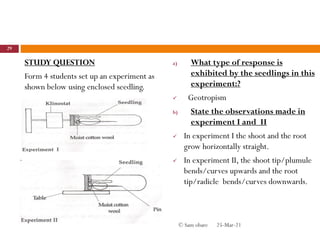
STUDY QUESTION
Form 4 students set up an experiment as
shown below using enclosed seedling.
a) What type of response is
exhibited by the seedlings in this
experiment:?
 Geotropism
b) State the observations made in
experiment I and II
 In experiment I the shoot and the root
grow horizontally straight.
 In experiment II, the shoot tip/plumule
bends/curves upwards and the root
tip/radicle bends/curves downwards.
25-Mar-21
29
Š Sam obare
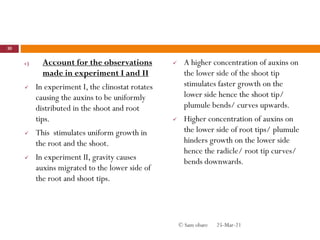
c) Account for the observations
made in experiment I and II
 In experiment I, the clinostat rotates
causing the auxins to be uniformly
distributed in the shoot and root
tips.
 This stimulates uniform growth in
the root and the shoot.
 In experiment II, gravity causes
auxins migrated to the lower side of
the root and shoot tips.
 A higher concentration of auxins on
the lower side of the shoot tip
stimulates faster growth on the
lower side hence the shoot tip/
plumule bends/ curves upwards.
 Higher concentration of auxins on
the lower side of root tips/ plumule
hinders growth on the lower side
hence the radicle/ root tip curves/
bends downwards.
25-Mar-21
30
Š Sam obare
d) Give a reason why
seedlings were enclosed.
 Helps to prevent exposure to:
i. Wind which may increase the
rate of water loss.
ii. Wind or other external factors
which may shift the alignment
of plant seedlings.
iii. Pests and other insects which
may damage the seedlings thus
interfere with the responses.
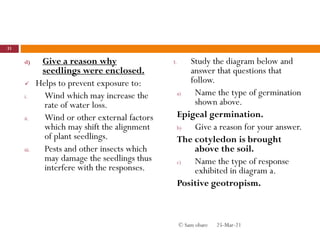
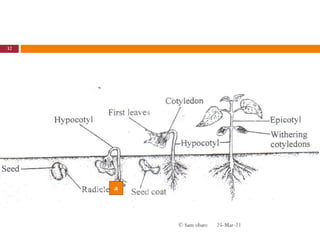
3. Study the diagram below and
answer that questions that
follow.
a) Name the type of germination
shown above.
Epigeal germination.
b) Give a reason for your answer.
The cotyledon is brought
above the soil.
c) Name the type of response
exhibited in diagram a.
Positive geotropism.
25-Mar-21
31
Š Sam obare
25-Mar-21
Š Sam obare
32
a
d) Explain the response named
above.
 Gravity pulls the auxins
downwards. Higher
concentration of auxins on
the lower side
hinders/inhibits growth on
the lower side than on the
upper side.This causes the
hypocotyl to curve/bend
downwards.
RECEPTION, RESPONSE AND CO-
ORDINATION IN ANIMALS.
 Animals detect changes in the
external and internal environment/
receive the stimulus through
receptor organs that have special
cells called receptor/ receptor
cells.
 Receptor organs include: Eyes,
Ears, Nose,Tongue, Skin and
Hypothalamus
25-Mar-21
33
Š Sam obare
 The eyes have photoreceptors that
detect light.
 The skin has thermoreceptors that
detect temperature,
mechanoreceptors that detect
pressure.
 Ears have receptors that detect sound,
gravity and orientation of the body.
 Hypothalamus has osmoreceptors
that detect osmotic pressure.
 Response in animals is brought
about by organs called effectors.
 Effectors/effector organs include:
i. Glands e.g. salivary
glands.
ii. Muscles e.g. skeletal
muscles.
 The receptors and effectors are
linked by a co-ordinating centre.
 The co-ordinating centre consists
of:
A. Nervous system.
B. Endocrine system.
25-Mar-21
34
Š Sam obare
A. NERVOUS SYSTEM
 This is a system consisting of
specialized cells called nerve
cells/neurons for
transmission of electrical
impulses.
 The neurones are linked to one
another and to the receptors and
effectors.
 An electrical impulse is an
electrical signal transmitted
within the nerve cell
fibre/axon.
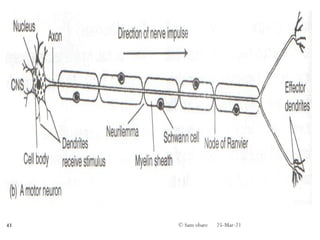
Parts of a neurone
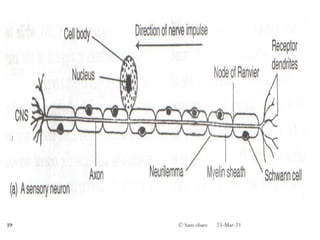
A. Cell body/centron- has a
cytoplasm enclosing a nucleus.
B. Dendrons- they are extensions
that arise from the cell body and
they transmit impulses
towards the cell body.
C. Axon/nerve fibre- this is the
longest dendron which arises
from the cell body and it
transmits impulses from the
cell body.
D. Dendrites- they are extensions
that arise from the dendrons.
25-Mar-21
35
Š Sam obare
 The axon contains a cytoplasm
called axoplasm which extends
from the cytoplasm of the cell
body.
 It is also covered with myelin /
medullated sheath- which
insulates it and enhances
the speed of impulse
transmission.
 The myelin sheath is
constricted to form junctions
called nodes of ranvier-
which propagate and
promote faster transmission
of impulse.
 On the outer part of the myelin
sheath are cells called
schwann cells- which give
rise to the myelin sheath.
The schwann cells have a
membrane called neurilemma
N/B. Several axons and dendrons
joined together form a nerve.
25-Mar-21
36
Š Sam obare
Structural adaptations of the
neurone to enable it carry out its
functions.
1. It has long axon to
transmit/conduct impulses.
2. The axon is enclosed by a myelin
sheath which insulates the axon
and for faster transmission of
impulses.
3. The myelin sheath has junctions
called nodes of ranvier to
enhance the speed of conduction
of the impulse.
4. It has schwann cells for
secretion of myelin sheath.
5. It has numerous dendrites
which receive/ deliver
impulses from neighboring
neurones through synaptic
connections.
6. The cell body has a nucleus
for transmission of impulses.
25-Mar-21
37
Š Sam obare
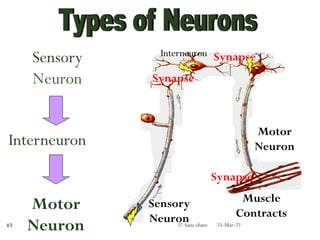
TYPES OF NEURONES
1. Sensory/afferent/receptor neurone.
2. Motor/efferent/effector neurone.
3. Relay/intermediate neurone.
1. SENSORY NEURONE/ RECEPTOR
NEURONE/ AFFERENT NEURONE.
 It is joined to the sense organs e.g. eyes, skin,
nose, tongues and carries impulses from the
receptors/receptor cells/ sense organs to the
central nervous system (CNS).
 It has one dendron which arises from the cell
body to form axon hence said to be
unipolar.
 The cell body is situated along but off the
axon and outside the central nervous system
(CNS).
 The dendron transmits impulse from the
receptor to the cell body and the axon
transmits the impulse from the cell body to
the CNS.
 The receptor dendrites are located in the
sense organ and the terminal dendrites are
located in the CNS.The cell body is closer to
the CNS.
 The sensory neurones which transmit
impulses from the internal/visceral organs
e.g. lungs and heart are called visceral
sensory neurones.
 The sensory neurones which transmit
impulses from the skin, skeletal muscles,
joints and bones are called somatic sensory
neurones.
25-Mar-21
38
Š Sam obare
25-Mar-21
Š Sam obare
39
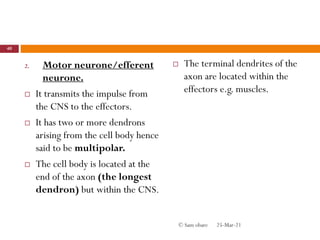
2. Motor neurone/efferent
neurone.
 It transmits the impulse from
the CNS to the effectors.
 It has two or more dendrons
arising from the cell body hence
said to be multipolar.
 The cell body is located at the
end of the axon (the longest
dendron) but within the CNS.
 The terminal dendrites of the
axon are located within the
effectors e.g. muscles.
25-Mar-21
40
Š Sam obare
25-Mar-21
Š Sam obare
41
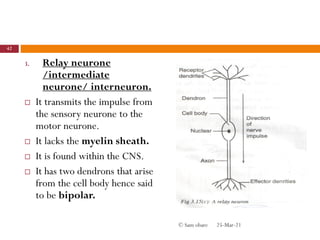
3. Relay neurone
/intermediate
neurone/ interneuron.
 It transmits the impulse from
the sensory neurone to the
motor neurone.
 It lacks the myelin sheath.
 It is found within the CNS.
 It has two dendrons that arise
from the cell body hence said
to be bipolar.
25-Mar-21
42
Š Sam obare
Sensory
Neuron
Interneuron
Motor
Neuron
Sensory
Neuron
Interneuron
Motor
Neuron
Muscle
Contracts
Synapse
Synapse
Synapse
25-Mar-21
Š Sam obare
43
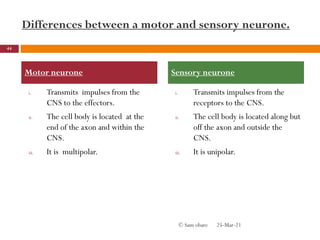
Differences between a motor and sensory neurone.
i. Transmits impulses from the
CNS to the effectors.
ii. The cell body is located at the
end of the axon and within the
CNS.
iii. It is multipolar.
i. Transmits impulses from the
receptors to the CNS.
ii. The cell body is located along but
off the axon and outside the
CNS.
iii. It is unipolar.
25-Mar-21
44
Š Sam obare
Motor neurone Sensory neurone
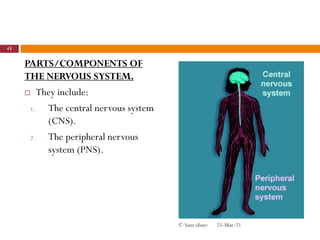
PARTS/COMPONENTS OF
THE NERVOUS SYSTEM.
 They include:
1. The central nervous system
(CNS).
2. The peripheral nervous
system (PNS).
25-Mar-21
45
Š Sam obare
1. THE CENTRAL
NERVOUS SYSTEM
(CNS)
 It receives and interprets the
impulses hence called a
coordinating centre.
 It consists of:
A. The brain
B. Spinal cord and
associated nerves
A. THE BRAIN
 This is the anterior part (towards the
head) of the central nervous system.
 It is enclosed by protective membranes called
meninges.
 The meninges include:
i. Dura matter- the outermost layer
covering the brain and spinal cord. It is
composed of connective tissue and rich
network of capillaries.
ii. Pia matter- the innermost layer covering
the brain and spinal cord.
 The infection of the meninges causes
meningitis.
25-Mar-21
46
Š Sam obare
 The space between the dura
and pia matter is called
Arachnoid layer which is
filled with a fluid called
cerebrospinal fluid which
is secreted by blood.
 It contains oxygen and
nutrients e.g. glucose/blood
sugar, amino acids.
Functions/ roles of the
cerebrospinal fluid.
i. It supplies oxygen and
nutrients to the brain cells.
ii. It removes waste products
from the brain cells.
iii. It maintains pressure of the
brain.
iv. It acts as a shock
absorber/protects the brain
from shock/mechanical
damage.
25-Mar-21
47
Š Sam obare
PARTS OFTHE BRAIN.
 The brain is made up of two halves
called hemispheres i.e. right and
left hemispheres.
 The two hemispheres are
interconnected by a group of nerves
called corpus callosum.
 The left hemisphere controls the
activities of the right side of the
body while the right hemisphere
controls the activities of the left side
of the body.
 The innermost part of the brain and
spinal cord is called grey matter
and the outer part is called white
matter.
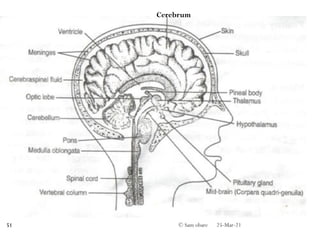
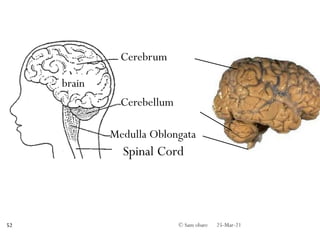
1. Cerebrum-This is the largest part of the brain
it is divided into the left and right hemisphere.
 It has many folds on its outer layer to increase
the surface area for packing of neurones.
 If the plasmodium parasite enters the brain and
affects the cerebrum, it causes cerebral malaria.
Functions/roles.
i. It controls learning, imagination, thinking,
personality, hearing, vision and taste.
ii. It controls voluntary body movements/
controls contraction of skeletal muscles e.g.
walking, dancing, movement of lips/ chewing,
movement of the neck/ nodding and
movement sideways.
25-Mar-21
48
Š Sam obare
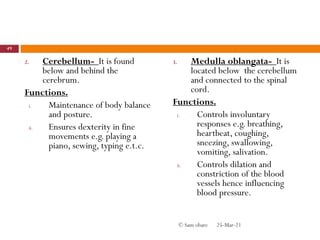
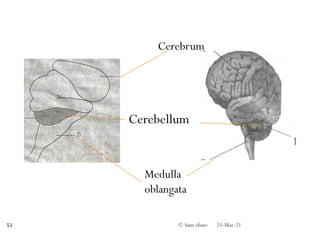
2. Cerebellum- It is found
below and behind the
cerebrum.
Functions.
i. Maintenance of body balance
and posture.
ii. Ensures dexterity in fine
movements e.g. playing a
piano, sewing, typing e.t.c.
3. Medulla oblangata- It is
located below the cerebellum
and connected to the spinal
cord.
Functions.
i. Controls involuntary
responses e.g. breathing,
heartbeat, coughing,
sneezing, swallowing,
vomiting, salivation.
ii. Controls dilation and
constriction of the blood
vessels hence influencing
blood pressure.
25-Mar-21
49
Š Sam obare
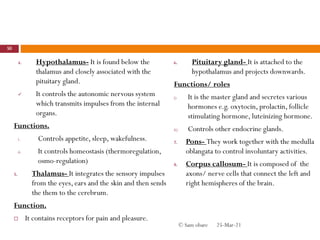
4. Hypothalamus- It is found below the
thalamus and closely associated with the
pituitary gland.
 It controls the autonomic nervous system
which transmits impulses from the internal
organs.
Functions.
i. Controls appetite, sleep, wakefulness.
ii. It controls homeostasis (thermoregulation,
osmo-regulation)
5. Thalamus- It integrates the sensory impulses
from the eyes, ears and the skin and then sends
the them to the cerebrum.
Function.
 It contains receptors for pain and pleasure.
6. Pituitary gland- It is attached to the
hypothalamus and projects downwards.
Functions/ roles
i) It is the master gland and secretes various
hormones e.g. oxytocin, prolactin, follicle
stimulating hormone, luteinizing hormone.
ii) Controls other endocrine glands.
7. Pons- They work together with the medulla
oblangata to control involuntary activities.
8. Corpus callosum- It is composed of the
axons/ nerve cells that connect the left and
right hemispheres of the brain.
25-Mar-21
50
Š Sam obare
25-Mar-21
Š Sam obare
51
Cerebrum
brain
Spinal Cord
Cerebellum
Cerebrum
Medulla Oblongata
25-Mar-21
Š Sam obare
52
Cerebrum
Cerebellum
Medulla
oblangata
25-Mar-21
Š Sam obare
53
B. SPINAL CORD
 This is the posterior/back
extension of the CNS from the
brain to the tail.
 It is enclosed by the meninges
that protect it against mechanical
damage.
 It is also protected by the
vertebral column/back
bone.
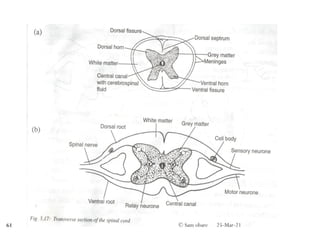
 It is made of the grey matter the
white matter.
 There is a narrow canal called
the central canal which runs
down the spinal cord.
 The central canal is filled with
cerebrospinal fluid.
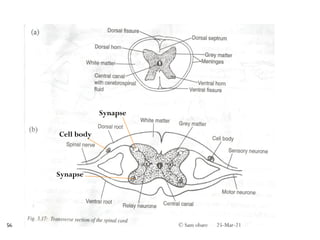
 The grey matter is H-shaped and
is surrounded by the white
matter.
 It is grey/dark in colour because
it consists of the cell bodies of
the motor and relay neurones,
dendrites and synapses.
Functions of spinal cord.
i. Coordinates some automatic
responses/reflex actions.
ii. It links the nerves of the
peripheral nervous system
and the brain.
25-Mar-21
54
Š Sam obare
 The white matter
surrounds the grey matter
and consists of the axons of
the sensory and motor
neurones.
 The myelin sheaths/
medulated sheath/
myelinated sheath of
neurons/ axons which are
made up of fats that make it a
shiny appearance.
SYNAPSE
 This is a gap between two
adjacent neurones
 The substance that transmits
the impulse within the
synapse/from one synapse to
the other is called
acetylcholine which is
broken down by enzyme
acetylcholinesterase/
cholinesterase/
acetylhydrolase into acetic
acid and choline.
25-Mar-21
55
Š Sam obare
Cell body
Synapse
Synapse
25-Mar-21
Š Sam obare
56
2. PERIPHERAL NERVOUS
SYSTEM (PNS)
 This is the system of nerves that
connect the CNS and other parts
of the body.
 It consists of Cranial nerves and
Spinal nerves.
1. Cranial nerves- They
transmit impulses from the
sense organs and muscles of
the head and neck.They arise
from the brain and innervate
organs such as ears and
eyes. Examples of such
nerves include:
i. Optic nerves- which innervate
the eyes.
ii. Olfatory nerves- which
innervate the nose.
iii. Auditory nerves- which
innervate the ears.
2. Spinal nerves- They are nerves
that arise from the spinal cord and
innervate the surrounding parts
of the body such as hands, legs,
ribs, abdomen e.t.c.
25-Mar-21
57
Š Sam obare
Parts/ components of the
peripheral nervous system (PNS)
a) Voluntary (somatic) nervous
system- It consists of nerves
that control voluntary activities
of the body e.g. raising of the leg,
nodding the head e.t.c.
b) Involuntary (autonomic)
nervous system- It consists of
nerves that control involuntary
activities of the body e.g. beating
of the heart, secretion of
hormones and enzymes, gut
movements e.t.c.
Parts/ components of the
involuntary/ autonomic
nervous system.
1. Parasympathetic nervous
system- Its stimulation is aimed
at energy conservation activities
e.g. Slowing of the heart beat,
Stimulation of the digestive
tract/gut, Decreased force of
muscle contraction.
25-Mar-21
58
Š Sam obare
2. Sympathetic nervous system-
Its stimulation produces effects
that prepare the animal for
emergency e.g. Increased
heartbeat rate to supply enough
blood containing oxygen to the
muscles and remove carbon (IV)
oxide from the muscles, Increased
blood pressure for faster
movement of blood, Dilation of
the pupil to locate the enemy,
Closing of the sphincter muscles
of the anus and bladder and
conversion of glycogen into
glucose in the liver.
REFLEX ACTION.
 This is a rapid/ faster and
automatic/ involuntary response to a
stimulus.
 It is processed in the spinal cord not
in the brain.
 It helps protect the body
before the brain knows what is
going on.
Types of reflex action
a) Simple reflex action.
b) Conditioned reflex action.
25-Mar-21
59
Š Sam obare
A. SIMPLE REFLEX ACTION.
 Simple reflex actions e.g. withdrawal
of finger from a hot or sharp object, is
an automatic response to a specific
stimulus.
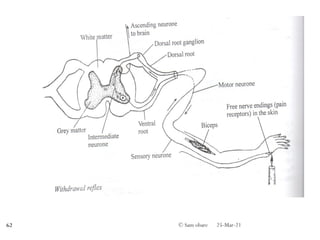
 During simple reflex action, an
impulse passes through a reflex arc.
 A reflex arc refers to the path taken
by the impulse during a reflex action.
 A reflex arc consists of sensory,
intermediate and motor neurons.
 When a finger touches a sharp/hot
object, the stimulus/ heat/ pain is
detected by temperature/
thermoreceptors/ pain receptors in
the skin/ dermis.
 An impulse is generated which is
transmitted along the sensory neurone
to the grey matter/ central nervous
system/ spinal cord.
 The chemical transmission of impulse
is done across a synapse to relay
neurone and through another synapse
to motor neurone and across another
synapse to muscles/ effectors/ biceps
muscles.
 The biceps muscles contract and the
hand is withdrawn.
25-Mar-21
60
Š Sam obare
25-Mar-21
Š Sam obare
61
25-Mar-21
Š Sam obare
62
B. CONDITIONED REFLEX
ACTION
 Conditional reflex actions e.g.
salivation of a dog/humans/students
in response to sound, is an automatic
response evoked from an animal by
unrelated stimulus, substituted for
the one which normally elicits the
response.
 It develops from past experience,
and involves modification of
behaviour/learning.
 It weakens with time, and must be
reinforced by repeating the related
original/primary stimulus.
 Dogs/Students salivate when the
bell for meals rings because they
have learned to associate the ringing
of the bell at meal time with food,
every time it rings, they are offered
food.
25-Mar-21
63
Š Sam obare
Differences between simple reflex action and conditioned
reflex action.
1. It is not learned/ it is
inborn/ requires no
experience.
2. Primary/ related stimulus is
involved.
3. Impulse follows appropriate
sensory and motor neurone
or sensory and motor
components are the same all
times.
4. A single stimulus brings
about a desired response.
1. It is learned/ requires
experience.
2. Secondary/ unrelated stimulus
is involved.
3. Impulse follows inappropriate
motor neurone or primary
sensory component is replaced
by secondary component but
the motor component remains
unchanged.
4. Repeated stimulus is needed to
bring about response.
25-Mar-21
64
Š Sam obare
Simple reflex action Conditioned reflex action
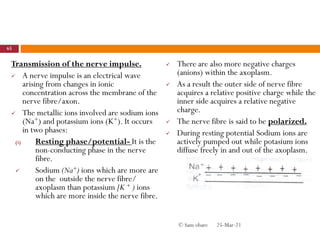
Transmission of the nerve impulse.
 A nerve impulse is an electrical wave
arising from changes in ionic
concentration across the membrane of the
nerve fibre/axon.
 The metallic ions involved are sodium ions
(Na+) and potassium ions (K+). It occurs
in two phases:
(i) Resting phase/potential- It is the
non-conducting phase in the nerve
fibre.
 Sodium (Na+) ions which are more are
on the outside the nerve fibre/
axoplasm than potassium [K + ) ions
which are more inside the nerve fibre.
 There are also more negative charges
(anions) within the axoplasm.
 As a result the outer side of nerve fibre
acquires a relative positive charge while the
inner side acquires a relative negative
charge.
 The nerve fibre is said to be polarized.
 During resting potential Sodium ions are
actively pumped out while potasium ions
diffuse freely in and out of the axoplasm.
25-Mar-21
65
Š Sam obare
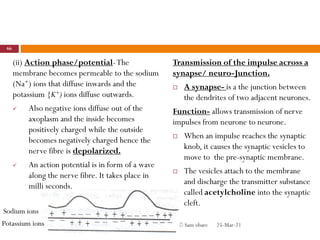
(ii) Action phase/potential-The
membrane becomes permeable to the sodium
(Na+) ions that diffuse inwards and the
potassium {K+) ions diffuse outwards.
 Also negative ions diffuse out of the
axoplasm and the inside becomes
positively charged while the outside
becomes negatively charged hence the
nerve fibre is depolarized.
 An action potential is in form of a wave
along the nerve fibre. It takes place in
milli seconds.
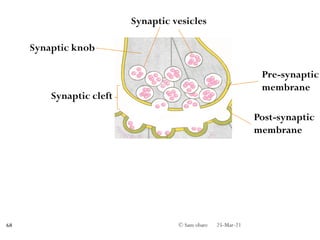
Transmission of the impulse across a
synapse/ neuro-Junction.
 A synapse- is a the junction between
the dendrites of two adjacent neurones.
Function- allows transmission of nerve
impulses from neurone to neurone.
 When an impulse reaches the synaptic
knob, it causes the synaptic vesicles to
move to the pre-synaptic membrane.
 The vesicles attach to the membrane
and discharge the transmitter substance
called acetylcholine into the synaptic
cleft.
25-Mar-21
66
Š Sam obare
Sodium ions
Potassium ions
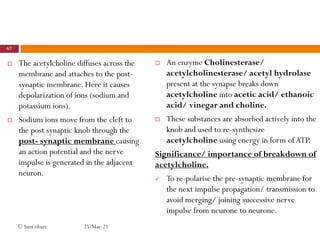
 The acetylcholine diffuses across the
membrane and attaches to the post-
synaptic membrane. Here it causes
depolarization of ions (sodium and
potassium ions).
 Sodium ions move from the cleft to
the post synaptic knob through the
post- synaptic membrane causing
an action potential and the nerve
impulse is generated in the adjacent
neuron.
 An enzyme Cholinesterase/
acetylcholinesterase/ acetyl hydrolase
present at the synapse breaks down
acetylcholine into acetic acid/ ethanoic
acid/ vinegar and choline.
 These substances are absorbed actively into the
knob and used to re-synthesize
acetylcholine using energy in form of ATP.
Significance/ importance of breakdown of
acetylcholine.
 To re-polarise the pre-synaptic membrane for
the next impulse propagation/ transmission to
avoid merging/ joining successive nerve
impulse from neurone to neurone.
25-Mar-21
67
Š Sam obare
Synaptic vesicles
Synaptic cleft
Pre-synaptic
membrane
Post-synaptic
membrane
Synaptic knob
25-Mar-21
Š Sam obare
68
B. ENDOCRINE SYSTEM
 It consists of glands which are
ductless that produce hormones.
 Hormones are organic compounds
which are either protein or steroids
in nature secreted by ductless glands
and shed into the blood stream.
 They are produced in small
quantities and transported by blood
to other parts of the body/ target
organs where they cause a response.
 In animals , hormones regulate
growth and development, control
the behavior during breeding and
control proper performance of cells.
 Secretion of hormones is controlled
by the nervous system.
 The main glands include:
A. Pituitary gland.
B. Adrenal gland.
C. Thyroid gland.
25-Mar-21
69
Š Sam obare
A. PITUITARY GLAND
 It secretes the following hormones:
1. Thyroid stimulating hormone
(thyrotropin)- which stimulates the
thyroid gland to secrete thyroxine
hormone.
2. Gonadotropins e.g. FSH and LH.
3. Adrenocorticotropic hormone
(ACTH)-which stimulates the
adrenal cortex to produce
adrenaline.
4. Growth hormone
(somatotrophin).
5. Antidiuretic hormone-
which enhances the re-
absorption of water in the
kidney tubules.
6. Oxytocin- which stimulates the
contraction of muscles of uterus
during birth and muscles of milk
ducts to allow milk let-down.
7. Prolactin-stimulates milk
production and is responsible for
maternal instinct.
25-Mar-21
70
Š Sam obare
B. ADRENAL GLANDS.
 It is located above kidneys. It
consists of adrenal cortex (on the
outside and adrenal medulla (on
the inside).
 Adrenal cortex secretes
aldosterone- which stimulates the
reabsorption of sodium ions.
 Adrenal medulla receives nerve
impulse from the brain and secretes
adrenaline.
 Adrenaline is secreted during
anxiety, excitement/emergency
hence called fight/flight
hormone.
Effects of adrenaline.
1. Increases heart beat, increasing the rate of
blood circulation.
2. Stimulates the conversion of glycogen to
glucose in the liver hence increasing blood
sugar level.
3. It increases metabolic rate.
4. It causes constriction of arterioles to the skin
and digestive system.
5. Breathing rate becomes faster and deeper.
6. Fats are converted into fatty acids which are
made available for muscle contraction.
7. It stimulates the skeletal muscles to contract
and relax causing movement.
25-Mar-21
71
Š Sam obare
Effects of over secretion of
adrenaline.
1. Hypertension/high blood
pressure.
2. Severe headache.
3. Racing heart.
4. Sweating.
5. Faintness.
6. Aging of major body organs e.g.
kidney, heart and liver.
Effects of undersecretion/
underproduction of adrenaline.
1. Reduced metabolism.
2. Decreased heart beat rate.
3. Reduced rate of breathing.
4. Reduced activity of the animal.
25-Mar-21
72
Š Sam obare
C. THYROID GLAND
 It is stimulated by thyroid
stimulating hormone to secrete
thyroxine.
 Thyroxine is a complex organic
compound that contains iodine.
Functions of thyroxine.
1. Controls basal metabolic rate by
increasing glucose oxidation.
2. Enhances the effect of growth
hormone (somatotrophin) ensuring
normal growth and mental
development.
3. Works together with adrenaline to
control involuntary activities e.g.
increased blood circulation.
Effects of under-secretion of thyroxine
/hypothyroidism.
 Under-secretion of thyroxine may be due to
insufficient iodine in the diet or defective
enzymatic reactions concerned with iodine
production. Iodine is a component of
thyroxine.
 Under-secretion leads to Cretinism in
children and Myxoedema in adults.
1. Cretin children have the following
characteristics:
i. Poor mental development/ low intelligence.
ii. Deformed legs.
iii. Dry leathery skin.
iv. General body sluggishness.
v. Large tongue.
25-Mar-21
73
Š Sam obare
2. Myxoedema causes goitre / swelling of
thyroid gland.This is due to overworking
of thyroid gland in an attempt to
synthesize enough thyroxine.
3. Reduced metabolic rate shown by
reduced heart beat, reduced breathing
rate and low body temperature.
4. Individuals are mentally and physically
sluggish which can lead to obesity and
oedema (swelling of feet).
 Under-secretion is controlled by use of
balanced diet supplemented by iodinised
salt and administration of iodine tablets.
Effects of over-secretion of
thyroxine/ hyperthyroidism
• Overproduction of thyroxine
may result from defective
enzymatic activity.
i. Increased body temperature.
ii. Increased breathing rate.
iii. Increased body metabolism
leading to body weight loss.
iv. Excessive energy production.
v. Extreme can lead to heart failure
(thyrotoxicosis).
• It is controlled by surgical
removal of a part of thyroid gland
and use of antithyroid drugs.
25-Mar-21
74
Š Sam obare
Functional differences between nervous and endocrine system.
1. Uses hormones to bring about
response.
2. Hormones are transported in
blood.
3. Responses are slow and affect
several parts of the body.
4. Effects are long-lasting.
5. Responses take place
involuntarily.
1. Uses electrical impulses to bring about
response.
2. Impulses are transported through
neurons.
3. Responses are quick, specific and
localised.
4. Effects short-lived.
5. Responses take place voluntarily and
involuntarily.
25-Mar-21
75
Š Sam obare
Endocrine system. Nervous system.
Similarities between endocrine
and nervous system.
1. Both provide a means of
communication and
coordination within the body of
an organism.
2. Both involve response to a
stimulus.
3. Both bring about survival
response.
4. In both chemical transmission is
involved.
5. The target organs of hormones
are like the effector organs.
DRUG ABUSE
 A drug- this is a chemical substance
which when taken has psychological
and physiological effects in the body.
Drugs taken to cure diseases are
called medicinal drugs.
 Drug addiction-This is the state
of being mentally and physically
dependent on drugs.Addiction
requires increase in dosage to
experience the desired feelings.
 Drug abuse- This refers to use of
the drug for the purpose not meant
for it to bring about
physical/physiological effects which
are not curative.
25-Mar-21
76
Š Sam obare
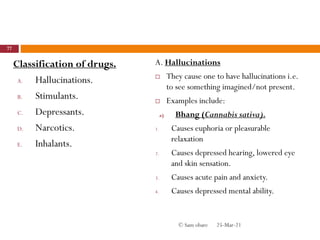
Classification of drugs.
A. Hallucinations.
B. Stimulants.
C. Depressants.
D. Narcotics.
E. Inhalants.
A. Hallucinations
 They cause one to have hallucinations i.e.
to see something imagined/not present.
 Examples include:
a) Bhang (Cannabis sativa).
1. Causes euphoria or pleasurable
relaxation
2. Causes depressed hearing, lowered eye
and skin sensation.
3. Causes acute pain and anxiety.
4. Causes depressed mental ability.
25-Mar-21
77
Š Sam obare
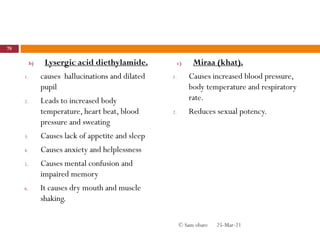
b) Lysergic acid diethylamide.
1. causes hallucinations and dilated
pupil
2. Leads to increased body
temperature, heart beat, blood
pressure and sweating
3. Causes lack of appetite and sleep
4. Causes anxiety and helplessness
5. Causes mental confusion and
impaired memory
6. It causes dry mouth and muscle
shaking.
c) Miraa (khat).
1. Causes increased blood pressure,
body temperature and respiratory
rate.
2. Reduces sexual potency.
25-Mar-21
78
Š Sam obare
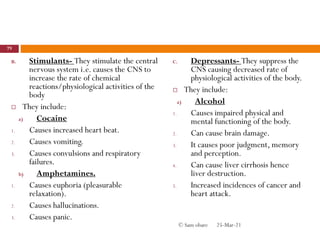
B. Stimulants- They stimulate the central
nervous system i.e. causes the CNS to
increase the rate of chemical
reactions/physiological activities of the
body
 They include:
a) Cocaine
1. Causes increased heart beat.
2. Causes vomiting.
3. Causes convulsions and respiratory
failures.
b) Amphetamines.
1. Causes euphoria (pleasurable
relaxation).
2. Causes hallucinations.
3. Causes panic.
C. Depressants- They suppress the
CNS causing decreased rate of
physiological activities of the body.
 They include:
a) Alcohol
1. Causes impaired physical and
mental functioning of the body.
2. Can cause brain damage.
3. It causes poor judgment, memory
and perception.
4. Can cause liver cirrhosis hence
liver destruction.
5. Increased incidences of cancer and
heart attack.
25-Mar-21
79
Š Sam obare
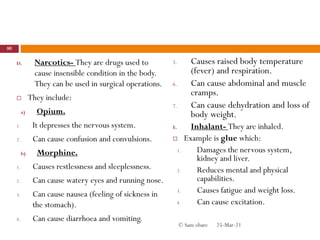
D. Narcotics- They are drugs used to
cause insensible condition in the body.
They can be used in surgical operations.
 They include:
a) Opium.
1. It depresses the nervous system.
2. Can cause confusion and convulsions.
b) Morphine.
1. Causes restlessness and sleeplessness.
2. Can cause watery eyes and running nose.
3. Can cause nausea (feeling of sickness in
the stomach).
4. Can cause diarrhoea and vomiting.
5. Causes raised body temperature
(fever) and respiration.
6. Can cause abdominal and muscle
cramps.
7. Can cause dehydration and loss of
body weight.
E. Inhalant- They are inhaled.
 Example is glue which:
1. Damages the nervous system,
kidney and liver.
2. Reduces mental and physical
capabilities.
3. Causes fatigue and weight loss.
4. Can cause excitation.
25-Mar-21
80
Š Sam obare
GENERAL EFFECTS OF DRUG ABUSE
1. Reduced appetite and poor feeding
leading to emaciation.
2. Poor absorption of vitamin K and E
leading to sterility and blindness.
3. Lowered nervous co-ordination leading
to loss of posture and balance hence
poor performance in sports and manual
activity.
4. Irritation of lungs and respiratory tracts
leading to frequent coughs and
infections.
5. It may lead to cancer of lungs, throat and
urinary bladder.
6. It may lead to stomach ulcers.
7. Damage to the heart and liver leading to
heart attack and liver cirrhosis.
8. Interference with temperature
regulation leading to excessive heat loss.
9. Damage to the brain causing
sleeplessness (insomnia), hallucinations,
madness and loss of memory (amnesia).
10. Poor foetal development and pregnancy
complications in women.
11. Damage to vital body organs leading to
death.
12. Impaired/ poor judgment leading to
accidents and infections e.g. HIV/AIDS
25-Mar-21
81
Š Sam obare
 Effects of drugs on the society
include:
1. Marital conflict.
2. Violence.
3. Theft to sustain the habit.
4. Reduced productivity at
work.
5. Loss of jobs/income.
6. Misuse of family
resources.
Study questions
1. Explain how drug abuse exposes one to
the dangers of HIV/AIDS infection.
Answers.
 Drugs impair reasoning hence heightening sexual
arousal.
 Drugs impair judgment leading to indiscriminate
sex.
 Impaired judgment leads to engaging in
unprotected sex.
 Intoxicated persons are likely to engage in sexual
perversions e.g. rape and homosexuality.
 Intoxicated persons may lose strength and become
victims of sexual abuse.
25-Mar-21
82
Š Sam obare
2. Discuss the socio- economic
problems associated with drug
abuse.
Answers
a) At family:
 Wastage of family resources and theft
to acquire drugs.
 Lack of family care including poor
care of children and spouses.
 Family break-up due to tensions,
poverty and lack of love.
b) In schools:
 Lateness, indecent behavior, poor
study habits and failure in
examinations.
 Violence against students, teachers
and community.
 Riots and strikes.
c) Increased crime.
d) Premature termination of careers
and other professions
25-Mar-21
83
Š Sam obare
SENSE ORGANS.
A. THE EYE
 This is a sense organ for sight.
 It is spherical in shape and
located within the socket in the
orbit found within the skull.
 It has photoreceptors stimulated
by light from the object.
 The image of the object is
formed inside the eye,
transmitted to the brain as an
electrical impulse through the
optic nerve where it is
interpreted.
External structure.
 It consists of the following parts:
1. Eyelids.
Adaptation to function.
i. They are made of folds of skin
covering the eye ball protecting
it against mechanical /physical
damage.
ii. Have sweat glands and
sebaceous gland for oily
secretions that keep the eye
moist.
iii. Have eye lashes that trap dust
particles preventing them from
entering the eye.
25-Mar-21
84
Š Sam obare
2. Tear/Lachrymal glands.
Adaptation to function-
They secrete tears that clean,
moisten, lubricate the eye,
wash foreign materials out of
the eye.Tears also have
lysozyme hormone that
protect the eye against
infections / bacteria/diseases.
3. Eyebrows- are thickly
covered with hair to prevent
sweat and dust from
entering the eye.
25-Mar-21
85
Š Sam obare
Internal parts of the eye.
1. Conjunctiva
2. Sclera/sclerotic layer
3. Cornea
4. Choroid layer
5. Retina
6. Yellow spot
7. Blind spot
8. Optic nerve
9. Lens
10. Ciliary body
11. Suspensory ligaments
12. Iris
13. Pupil
14. Aqueous humour
15. Vitreous humour
25-Mar-21
86
Š Sam obare
25-Mar-21
Š Sam obare
87
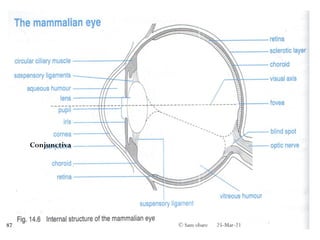
Conjunctiva
1. Conjunctiva.
 It is a thin epithelium to protect the cornea.
 It is transparent to allow light pass through.
 It is glandular/ has goblet cells which secrete
mucus for lubrication.
2. Sclerotic layer/sclera layer- It
contains tough fibres/ inelastic collagen
fibres/ it is fibrous to maintain the shape
of the eyeball and protect inner parts of
the eye/ eye ball.
3. Cornea.
 It is transparent to allow light pass through.
 It is curved to refract/ bend light rays onto
the retina.
4. Choroid layer.
 It is rich in blood vessels/ highly
vascularized/ has numerous capillaries
to supply the retina/ eye with nutrients
and oxygen (nourish the eye) and
remove metabolic wastes.
 It has pigmented/ black cells to prevent
reflection of light in the eye
5. Retina- It is the innermost layer of
the eye ball.
 It contains photoreceptors/ cones and
rods to perceive light/ where the image
is formed/ focused/ image formation.
 It has cones for colour vision, bright
light vision, colour perception and rods
for dim light vision.
25-Mar-21
88
Š Sam obare
6. Fovea centralis-Has numerous
cones only for accurate vision/
visual acuity.
7. Blind spot- It lacks
photoreceptors / cones and rods
to allow passage of blood vessels
and for exit of optic nerve.
8. Optic nerve-it has sensory
neurons/ nerve cells that transmit
impulse to the brain
9. Lens.
 It is biconvex to refract/ focus light
rays onto the retina.
 It is transparent to allow light pass
through.
 It is elastic to allow adjustment of
the shape of lens.
10. Ciliary body.
 It is made up of ciliary muscles that
contract and relax/ are contractile
to change the shape of the lens
during accommodation.
 It is glandular/has secretory cells to
produce/ secrete aqueous humour.
25-Mar-21
89
Š Sam obare
11. Suspensory ligaments- They
are inelastic and hold the lens in
position to the ciliary body.
12. Iris- This is the coloured part of
the eye.
 It has radial and circular muscles to
control the size of the pupil.
 It has melanin to absorb strong light
and prevent blurred vision.
13. Pupil-This is an opening on the
iris through which light passes
into the eye.
14. Aqueous humour- It the fluid
found at the front chamber of
the eye
 It is jelly like which maintains the
shape of the eye ball.
 It contains oxygen and nutrients
for the cornea and the lens.
 It is transparent to allow light to
pass through and refract it onto
the retina.
15. Vitreous humour- This is a
clear fluid at the back of the eye.
 It is jelly-like to maintain the shape
of the eye ball.
 It is transparent to allow light to
pass through and refract it onto the
retina.
25-Mar-21
90
Š Sam obare
PHOTORECEPTORS.
 They are sensitive to light stimulus.
They include Cones and Rods.
a) Cones-They contain a
photochemical pigment called
iodopsin which perceives light of
high intensity, perception of fine
details and for colour vision.
 Cones are highly concentrated on the
fovea centralis.
 When strong light rays from the
object strike the iodopsin it is
broken down to iodine and opsin
thus initiating a nerve impulse.
 The nerve impulse is then
transmitted to the brain for
interpretation through the optic
nerve.
 Iodopsin is resynthesised by the
energy produced by the
mitochondria in the
photoreceptors.
25-Mar-21
91
Š Sam obare
 Each cone has its own bipolar
neurone which in turn links it
with the optic nerve fibre i.e.
lack retinal convergence.
 This enables them to have high
visual acuity (ability of the eye
to distinguish objects that lie close
to each other).
 We shift our eyes when observing
objects so that the light rays from
the object can fall on the fovea for
them to be clear.
b) Rods.
 They are used for vision under light of
low intensity.They have a pigment
called rhodopsin which is sensitive to
light of low intensity.
 When light of low intensity strikes the
rod, rhodopsin splits into opsin and
retinine thus initiating an impulse.
 The impulse is transmitted to the brain
through the optic nerve for
interpretation. Retinine is a derivative
of vitamin A whose lack leads to
night blindness.
25-Mar-21
92
Š Sam obare
 The broken down rhodopsin is
re-synthesised slowly in the dark
light for continued photochemical
reactions in the rods.
 This is experienced when one
enters a dimly lit room from bright
light.
 At first the room looks dark and
nothing is visible but gradually
things start becoming visible.
 Rods have retinal convergence
i.e. several rods converge/
joined to one neurone
therefore they have low visual
acuity hence cannot distinguish
fine detail.
 Retinal convergence also enables any
little stimulation of several rods to
initiate/generate an impulse.
 Rods are in greater concentration
round the periphery of the retina and
are absent in the fovea centralis.
 At night is possible to see an object
clearly when looking from the corner
of the eye.
 This is because when one looks at the
object directly the light rays falls on
the fovea centralis which has cones
only which are operational at light of
strong intensity.
25-Mar-21
93
Š Sam obare
 Nocturnal animals e.g. cat, owl have
are capable of seeing at night
because of;
i) High concentration of rods than
cones in the retina that are
sensitive to low light intensity.
ii) Retinal convergence of rods to
enable any little stimulation of
rods to generate an impulse.
 At night the low light intensity is
not able to activate the cones.
 By looking from the corner of
the eye the light rays from the
object fall on the periphery of
the retina outside the fovea.
 The periphery contains only rods
which are sensitive to light of low
intensity hence enabling one to
see the object clearly.
25-Mar-21
94
Š Sam obare
Retinal convergence
25-Mar-21
Š Sam obare
95
Advantages of having two eyes in
human beings/ binocular vision.
1. Clarity of vision/better focus/
Improved visual acuity.
2. Three dimensional vision/
more accurate assessment of
distance, depth, height and
width of an object.
3. Larger visual field.
4. If one eye is damaged the
human being is not blinded.
RESPONSE TO LIGHT INTENSITY.
 It is brought about the iris that
controls the size of the pupil.
 The iris has circular and radial
muscles that are antagonistic i.e. do
not contract and relax at the same
time.
a) In bright light.
 The circular muscles in the iris
contract and the radial muscles
relax.
 As a result the pupil becomes
smaller in size/ constricts
preventing excess light from
entering which can destroy the
retina.
25-Mar-21
96
Š Sam obare
b) In dim light.
 The circular muscles in the iris
relax while the radial muscles
contract.
 As a result the pupil becomes
larger to allow more light into
the eye.
25-Mar-21
97
Š Sam obare
ACCOMMODATION OFTHE
EYE.
 Eye accommodation is the ability
of the eye to focus both near and
distant objects on the retina or
 It is the adjustment of the eye
structures to bring the image
from a near or far objects into
sharp focus on the retina.
 This is achieved by adjusting the
curvature or the shape of the lens
and size of the pupil.
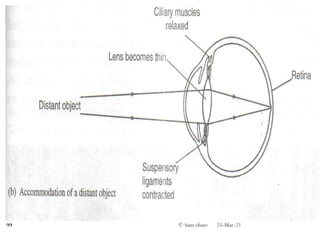
a) Eye accommodation to far/distant
objects.
 When light rays from a distant object strike the
eye, the following events take place:
i. Ciliary muscles relax.
ii. Suspensory ligaments become taut/pulled.
iii. Lens decrease in curvature/ becomes thinner
and long increasing focal length.
iv. Radial muscles of iris contract and circular
muscles relax.
v. The pupil size increases/ dilates.
vi. Light rays from distant objects are refracted
onto the retina.
25-Mar-21
98
Š Sam obare
25-Mar-21
Š Sam obare
99
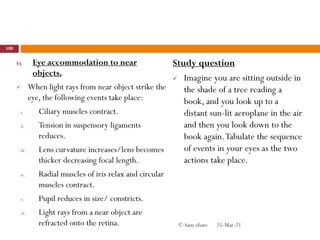
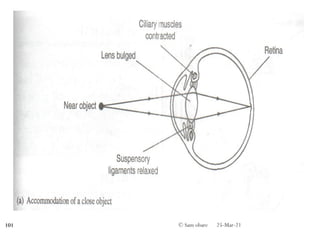
b) Eye accommodation to near
objects.
 When light rays from near object strike the
eye, the following events take place:
i. Ciliary muscles contract.
ii. Tension in suspensory ligaments
reduces.
iii. Lens curvature increases/lens becomes
thicker decreasing focal length.
iv. Radial muscles of iris relax and circular
muscles contract.
v. Pupil reduces in size/ constricts.
vi. Light rays from a near object are
refracted onto the retina.
Study question
 Imagine you are sitting outside in
the shade of a tree reading a
book, and you look up to a
distant sun-lit aeroplane in the air
and then you look down to the
book again.Tabulate the sequence
of events in your eyes as the two
actions take place.
25-Mar-21
100
Š Sam obare
25-Mar-21
Š Sam obare
101
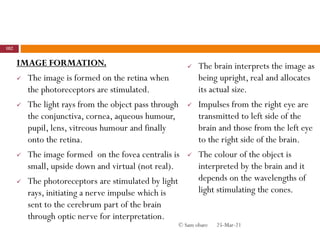
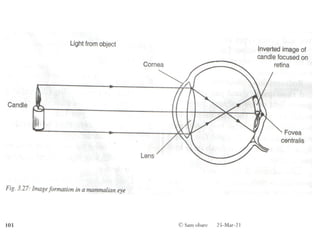
IMAGE FORMATION.
 The image is formed on the retina when
the photoreceptors are stimulated.
 The light rays from the object pass through
the conjunctiva, cornea, aqueous humour,
pupil, lens, vitreous humour and finally
onto the retina.
 The image formed on the fovea centralis is
small, upside down and virtual (not real).
 The photoreceptors are stimulated by light
rays, initiating a nerve impulse which is
sent to the cerebrum part of the brain
through optic nerve for interpretation.
 The brain interprets the image as
being upright, real and allocates
its actual size.
 Impulses from the right eye are
transmitted to left side of the
brain and those from the left eye
to the right side of the brain.
 The colour of the object is
interpreted by the brain and it
depends on the wavelengths of
light stimulating the cones.
25-Mar-21
102
Š Sam obare
25-Mar-21
Š Sam obare
103
EYE DEFECTS ANDTHEIR CORRECTION
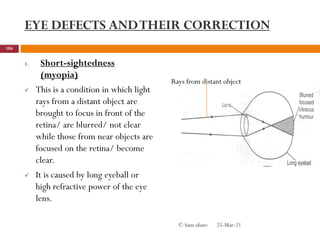
1. Short-sightedness
(myopia)
 This is a condition in which light
rays from a distant object are
brought to focus in front of the
retina/ are blurred/ not clear
while those from near objects are
focused on the retina/ become
clear.
 It is caused by long eyeball or
high refractive power of the eye
lens.
25-Mar-21
104
Š Sam obare
Rays from distant object
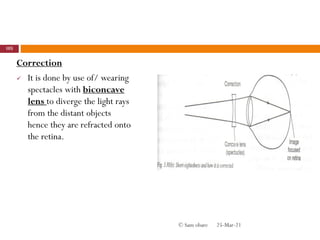
Correction
 It is done by use of/ wearing
spectacles with biconcave
lens to diverge the light rays
from the distant objects
hence they are refracted onto
the retina.
25-Mar-21
105
Š Sam obare
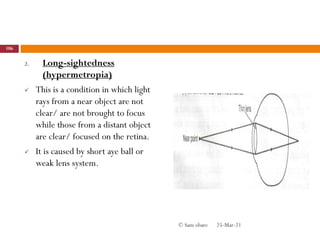
2. Long-sightedness
(hypermetropia)
 This is a condition in which light
rays from a near object are not
clear/ are not brought to focus
while those from a distant object
are clear/ focused on the retina.
 It is caused by short aye ball or
weak lens system.
25-Mar-21
106
Š Sam obare
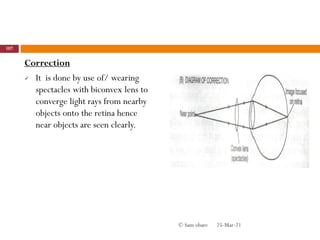
Correction
 It is done by use of/ wearing
spectacles with biconvex lens to
converge light rays from nearby
objects onto the retina hence
near objects are seen clearly.
25-Mar-21
107
Š Sam obare
3. Astigmatism-This is a congenital defect
whereby the curvature of the cornea is
uneven/not smooth.
 Light rays are refracted differently leading
to blurred vision. It is corrected by use of
spectacles with even lens/astigmatic lens.
4. Squintedness- this is a condition where
external muscles of the eye do not co-
ordinate hence the eye balls face different
directions affecting accommodation.The
defect is difficult to correct.
5. Old sight/presbyopia- This is a
defect where the ability of the lens to
change its thickness is affected which
affects aye accommodation.
 This is caused by hardening of the lens. It is
corrected by use of bifocal lens (containing
both convex and concave lens.
6. Cataracts-This is a defect whereby
the lens becomes stiff and opaque as
a result of damage by the ultraviolet
rays from the sun.
 The defective lens is called a cataract
which causes blurred
vision/blindness. It is caused by old
age, eye injury or diabetes mellitus.
 It is corrected by surgical
replacement of the defective lens.
7. Color blindness- this is a genetic
defect in which individuals are not
able to distinguish colors e.g. red
and green colors.
 This is because the retina lacks cones
with pigments that respond to red and
green colors.
25-Mar-21
108
Š Sam obare
B. MAMMALIAN EAR.
 It performs the following functions:
i. Hearing.
ii. Maintenance of balance and posture.
 It is composed of three main parts:
A. Outer ear.
B. Middle ear.
C. Inner ear.
A. Outer ear
 It consists of:
1. Pinna- It is large and funnel shaped to
collect and concentrate sound waves to
the external auditory meatus /canal/
tube.
2. Auditory canal/meatus/tube-
It is tubular to direct sound waves
into the ear drum/tympanic
membrane.
 It also has hairs to trap solid particles
preventing then from entering the
ear.
 It has wax secreting cells which
secrete wax that traps dust and
prevents entry of solid particles.Wax
also maintains the flexibility of the
ear drum.
 It has sebaceous gland that secrete
sebum which softens the canal/keeps
it supple.
 Sound velocity is highest/fastest in
the auditory canal.
25-Mar-21
109
Š Sam obare
25-Mar-21
Š Sam obare
110
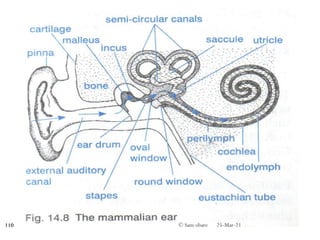
B. Middle ear
 It consists of:
1. Ear drum/tympanic membrane- It is
a thin membrane consisting of connective
tissue which vibrates and transforms
sound waves into vibrations.
 It then transmits the vibrations to the ear
ossicles.
2. Ear ossicles (malleus, incus and
stapes)- They are bony structures
attached to each other and suspended in
the cavity by the muscles.
 The muscles prevent excessive vibrations
which could damage the inner delicate
parts.
 They form a system of levers
which amplifies and transmits the
vibrations from the tympanic
membrane to the oval window.
3. Oval and round window-
They are membranes that cover
the small holes that lead to the
inner ear.
 They vibrate and transmit sound
vibrations to endolymph and
perilymph of the cochlea.
25-Mar-21
111
Š Sam obare
4. Eustachian tube- This is the
tube that connects the
pharynx/nasal cavity and the
middle ear. It is normally closed
but opens during swallowing,
yawning and chewing.
Function
i. The Eustachian tube can provide
passage of pathogens from the
pharynx to the middle ear causing
ear infections.
ii. It equalizes the air pressure
between the inner ear and the
outer ear/ atmosphere to prevent
distortion of the ear drum.
 For example, if you go higher up in
an aeroplane, the atmospheric air
pressure outside falls below that of
the middle ear.This causes the ear
drum to bulge outwards. The
condition is rectified by yawing or
swallowing.This opens the
Eustachian tube to equalize the
pressure on both sides of ear drum.
25-Mar-21
112
Š Sam obare
C. Inner ear.
 It consists of 3 semi-circular canals,
Cochlea andAuditory nerve.
1. Semi-circular canals- They
are 3 tubular cavities containing
the fluid and located at right
angles to each other.
 They open into the
utricule/utriculus which in
turn opens to the
saccule/sacculus then the
succulus opens into the cochlea.
 The utricule and saccule are
collectively called vestibular
apparatus/ vestibule.
 The vestibule and 3 semi-
circular canals are used to
maintain balance and posture.These
cavities in the inner ear are filled
with fluids called perilymph and
endolymph.
 The fluids conduct sound vibrations
from the middle ear to the cochlea
for hearing.The displacement of
fluids in the vestibule and 3 semi-
circular canals leads to restoration of
body balance.
 The fluids also absorb mechanical
shock hence protect the delicate
sensory structures.
25-Mar-21
113
Š Sam obare
2. Cochlea- This is a coiled tube
consisting of canals, membranes
and sensory cells.The canals are
filled with endolymph and
perilymph which transmit sound
vibrations.
 It is highly coiled to increase the
surface area for attachment sensory
cells for hearing.The sensory
receptors/cells are sensitive to
sound waves, generate impulse
which is transmitted to the brain
through auditory nerve.
3. Auditory nerve- It is made up
of several nerve cells to transmit
impulses to the brain for
interpretation.
THE PROCESS OF HEARING.
 The pinna concentrates sound waves
into the ear canal/ meatus.
 The sound waves strike the ear drum
causing it to vibrate and transform
sound waves into vibrations.
 Vibrations from the eardrum are
transmitted to the malleus which
amplifies and transmits to the incus
up to the stapes.
 The stapes vibrates, amplifies and
passes the vibrations to the oval
window.
 From the oval window the vibrations
are transmitted to the perilymph of
the cochlea.
25-Mar-21
114
Š Sam obare
 Vibrations in the fluids of the
cochlea disturbs the sensory hair
cells which generate nerve impulses.
 These impulses are transmitted to
the brain through the auditory
nerve.
 The brain interprets the impulses as
sound of different pitches.
Example
 When one spins and then stops
suddenly the person feels dizzy.
 This is because the endolymph
is still in motion and
continuous stimulating the
sensory cells.
MAINTENANCE OF BALANCE
AND POSTURE.
 Balance and posture are brought
about by the 3 semi-circular
canals and vestibule. The 3
semi-circular canals and vestibule
are collectively called vestibular
apparatus.
 The 3 semi-circular canals are
cavities filled with endolymph and
lie at right angles to each other.
 Each semi-circular canal has a
swelling called ampulla at one end
containing sensory hair cells
projecting out to form cupula.
 The hairs are disturbed by the fluid/
endolymph.
25-Mar-21
115
Š Sam obare
 The 3 semi-circular canals maintain
body balance and posture in relation
to change in position of the head.
 Change of head position causes the
movement of endolymph which
stimulates the sensory hairs initiating
a nerve impulse which is transmitted
to the brain for interpretation.
 The brain sends impulses the
muscles of the body to restore the
body balance.
 The vestibule consists of utriculus
and sacculus which contain chalky
granules called otoliths attached to
the fine sensory hairs of sensory
cells.
 The vestibule (sacculus and
utriculus) maintain body balance and
posture in relation to gravity.
 The change of body posture disturbs
the chalky granules causing
stimulation of the sensory hairs.
 This initiates a nerve impulse which
is transmitted to the brain for
interpretation.
 The brain interprets the impulse
according to the position of the
body in relation to gravity.
 The brain then sends impulse to the
muscles through motor neurone to
restore the correct posture.
25-Mar-21
116
Š Sam obare
DEFECTS OFTHE EAR.
1. Deafness.- Deafness is a hearing
defect in which an individual is
unable to perceive sound.This
may be temporary/partial or
permanent.
 Partial deafness is caused by:
i. Blockage of external auditory
canal by a layer of wax or
foreign objects which can be
corrected by removal of the wax
or foreign object.
ii. Damage to eardrum by
injection, perforation using
sharp objects or its thickening
which causes rigidity.
iii. Abnormal growth of
connective tissues (fibrosis) in
the ear ossicles which interferes
with their movement.
 Partial deafness can be corrected by
surgery or by using a hearing aid.
 Permanent deafness results due to
damage of the cochlea.
 This may be due to overdose of the
antibiotics or exposure to loud
sounds.
 This damages the sensory cells in the
cochlea.The individual can be
assisted by use of sign language.
25-Mar-21
117
Š Sam obare
2. Vertigo- This is a condition
where an individual has a
problem with maintenance of
balance and posture. It may be
as a result of infection to the
vestibular apparatus or
receiving many impulses on
balance and posture. It is
corrected through proper
medical care.
3. Absence of pinna- This is a
hereditary defect where the
child is born without the
pinna. It is corrected by fitting
artificial pinna.
4. Tinnitus. This is a defect
characterized by hissing/ringing
sound of the ear which leads to
distortion of sound perception.
 It is caused by infections of the
outer and middle ear.
 It is corrected by use of hearing
aids and treatment of ear
infections.
5. Presbycusis- This is loss of
hearing due to old age which
results from wearing out of the
cochlea hairs and ossicles.
 It is corrected by use of hearing
aids.
25-Mar-21
118
Š Sam obare

3. Reception, response and co-ordination.pdf

  • 1.
    3. RECEPTION, RESPONSE ANDCO-ORDINATION IN PLANTS AND ANIMALS. Definition of terms. 1. Reception- Art of receiving signals of changes through various organs. 2. Stimulus (plural-stimuli)- this is a condition in the environment which produces a change in the activity of part or the whole organism. 3. External stimuli-condition in the external environment (surrounding of the whole organism) which produces a change in the activity of part or the whole organism e.g. temperature, light, pH, humidity, mineral salt concentration, population density, absence/ presence of predators. 4. Internal stimuli-condition in the internal environment (surrounding of the cells) which produces a change in the activity of part or the whole organism e.g. accumulation of wastes, concentration of gases, presence of internal parasites, changes in temperature and glucose concentration. 5. Response- change in an activity of an organism. 25-Mar-21 1 Š Sam obare
  • 2.
    6. Irritability/Responsiveness /Sensitivity- Abilityof an organism to detect and respond to changes in the environment/ stimulus. 7. Receptors –parts of the body which receive the stimulus. 8. Effectors- parts of the body which bring about response. 9. Co-ordination- This is the working together of different parts of the body in an orderly manner to bring about better performance of physiological, physical or metabolic actions of the body. Types of responses. A. Tropisms/tropic responses/movements. B. Taxis/tactic responses/movements. C. Nastisms/nastic responses/movements. 25-Mar-21 2 © Sam obare
  • 3.
    A. Tropic responses/tropisms.  Tropism refers to a growth curvature in response to unidirectional external stimulus. Tropic responses are controlled by auxins hence they are usually slow.  Growth response towards a stimulus is called positive tropism while growth response away from the stimulus is called negative tropism. Types of tropisms/tropic responses 1. Phototropism- this is growth curvature in response to unidirectional light. • Growth towards light is called positive phototropism e.g. shoots are positively phototropic. Growth away from light is called negative phototropism e.g. roots are negatively phototropic. 25-Mar-21 3 © Sam obare
  • 4.
    2. Chemotropism- thisis a growth curvature in response to chemical concentration e.g. growth of pollen tube towards chemical secreted by the embryo sac hence it is said to be positively chemotropic. 3. Geotropism/gravitotropi sm- this is growth curvature in response to gravity e.g. root tips/radicles are positively geotropic while shoot tips/plumules are negatively geotropic. 4. Hydrotropism- this is growth curvature in response to water/moisture e.g. roots are positively hydrotropic. 5. Haptotropism/thigmotro pism- this is growth curvature in response to contact e.g. tendrils are positively thigmo/haptotropic and roots are negatively thigmo/haptotropic. 25-Mar-21 4 Š Sam obare
  • 5.
    Survival values/ importance oftropisms. 1. Phototropism exposes the leaves in position for maximum light absorption for photosynthesis. 2. Hydrotropism enables the plant roots to seek for water. 3. Thigmo/haptotropism enables plants with weak stems (herbaceous plants) to get support so as to expose leaves to photosynthesis, flowers to pollination and fruits/ seeds for dispersal. 4. Gravito/geotropism enables plant roots to grow deep into the soil thus providing firm support/anchorage in the soil and enables the shoot to grow upwards so as to expose leaves to sunlight for photosynthesis. 5. Chemotropism enables the growth of pollen tube towards the embryo sac facilitating fertilization. 25-Mar-21 5 Š Sam obare
  • 6.
    B. Taxis/Tactic responses/movements.  Itrefers to the movement of the whole organism/motile/mobile gamete in response to a unidirectional external stimulus. It is common in animals.  Movement towards the stimulus is called positive taxis while movement away from the stimulus is called negative taxis. Types of taxes. 1. Phototaxis-this is response to variation in light intensity and direction e.g. moth, euglena, chlamydomonas, spirogyra and fruit flies move toward light hence are positively phototactic. Earthworms, maggots, termites move away from light hence are negatively phototactic. 25-Mar-21 6 © Sam obare
  • 7.
    2. Chemotaxis- thisis response to variation in chemicals e.g. male gamete swim towards the chemicals secreted by the ovum hence positively chemotactic. Mosquitoes fly away from insect repellants hence negatively chemotactic. 3. Aerotaxis- this is response to variation in oxygen concentration e.g. amoeba moves from an area of low oxygen concentration to an area of high oxygen concentration hence positive aerotactic. 4. Thermotaxis- this is response to changes in temperature e.g. paramecium moves from a region of lower temperature to a region of moderate temperature hence show positive thermotaxis. 5. Osmotaxis- this is response to changes/ variation in osmotic pressure e.g. marine crabs burrow in sand to avoid dilution of body fluids hence show negative osmotaxis. 25-Mar-21 7 Š Sam obare
  • 8.
    6. Rheotaxis- thisis response to variation in direction of water and air currents e.g. fish moves against water currents hence show negative rheotaxis. Butterflies and moths flow into air/wind to detect the scent of flowers hence show positive rheotaxis). 7. Hydrotaxis- movement of whole organism in response to moisture. Importance/survival values of taxes 1. Enable organisms to escape from harmful stimuli e.g. excessive heat/ dessication and predators. 2. Enable organisms to seek favorable habitats and acquire resources e.g. nutrients and mates. 3. Chemotaxis enables fertilization to take place. 25-Mar-21 8 Š Sam obare
  • 9.
    Differences between taxesand tropisms. 1. They are growth responses hence more permanent 2. They are slow responses. 3. They are brought about by growth hormones (auxins). 1. They are locomotory responses therefore are temporary. 2. They are faster. 3. Are not influenced by growth hormones. 25-Mar-21 9 Š Sam obare Tropisms/ tropic responses Taxes/ tactic responses
  • 10.
    Similarities between taxisand tropisms. i. Both are adaptive responses that enable organisms to survive better in their environment. ii. Both are due to similar external stimuli e.g. light, water and temperature. iii. Both are directional and are due to unidirectional stimuli. c. Nastisms/nastic responses.  These are non-directional movements of parts of plants in response to a diffuse stimuli.  These movements are brought about by turgor pressure changes in the leaf and petal changes of certain plants. 25-Mar-21 10 © Sam obare
  • 11.
     The responsesinclude: i. Folding of leaves in hot weather. ii. Opening and closing of flowers in response to light intensity. iii. Closing of leaves of Mimosa pudica when touched. Types of nastisms 1. Haptonasty- Movement to touch as in Mimosa pudica whose leaves close when they or the stem is touched.  Also in venus fly trap (Dionaea) which is an insectivorous/ carnivorous plant which grows in a nitrogen deficient soil and gets nutrients by trapping insect.  The insect is attracted by colour/scent/ sugary baitsa and lands on the leaves causing the mid rib cells lose water causing the leaves to close with spines thus trapping the insect which digested by proteases secreted by the insect. 2. Nyctinasty- Movements in response to light intensity and temperature of day and night as seen in sunflower.  Examples of Nyctinasty include: i. Photonasty- Response to light intensity (flowers open in the presence of light and close in absence of light). ii. Thermonasty- Response to temperature as in flowers of some plants that open with increase in temperature and close with decrease in temperature. 25-Mar-21 11 © Sam obare
  • 12.
    3. Chemonasty- Responseto presence of certain specific chemical substances e.g. urea and ammonium compounds found in insectivorous plants.  When the insect is trapped it provides mechanical stimulus for the release of those chemicals/ proteases by the insect that digest the insect. 4. Hydronasty- Response to changes in humidity as seen in Dandelion plant whose flowers close when air is moist. Importance/survival value of nastisms. i. It helps to protect the delicate parts of the flower. ii. It helps to reduce transpiration. iii. Helps to regulate temperature. iv. Helps in obtaining some limited mineral nutrients. 25-Mar-21 12 Š Sam obare
  • 13.
    Study question  Thediagram below represents a set up during an experiment. a) Name the type of response investigated.  Hydrotaxis. b) What was the experiment investigating?  How ants respond to moisture/water. c) State the likely identity for substance K.  Drying/ dehydrating agent/ silica gel/ anhydrous calcium chloride. d) Explain your answer in c) above.  The colour of cobalt (II) chloride remained blue/ there was no moisture/ water in the flask to change the colour of cobalt (II) chloride. e) Account for the observation made in flask 2.  More ants moved/ were attracted into the flask because of the presence of moisture/ water vapour. 25-Mar-21 13 © Sam obare
  • 14.
    Co-ordination in plants. Plant growth responses are co- ordinated by plat hormones e.g. auxins, gibberelins, cytokinins and florigens.Tropisms are influenced by auxins. Role of auxins (e.g. Indole acetic acid) in tropisms.  Auxins are produced at the tips of the roots and shoots (apical meristems).  They diffuse away from the tips to the region of cell elongation where they bring about growth in the region of cell elongation.  The concentration/amount of the auxins present influence how the shoots and roots grow.  The concentration that stimulates growth in the shoots is higher than the concentration that influences growth in the roots.  In shoots, the high auxin concentration stimulates faster growth up to a given optimum while low auxin concentration has little effect on the growth.  In roots, low auxin concentration stimulates rapid/ faster growth while high concentration inhibits growth. 25-Mar-21 14 © Sam obare
  • 15.
  • 16.
    A. AUXINS ANDPHOTOTROPISMS 1. Under uniform light distribution, auxins are produced at the shoot tips then translocated evenly down the shoot  This leads to equal growth hence normal increase in height of a shoot upwards. 25-Mar-21 16 Š Sam obare
  • 17.
    2. When ashoot tip/ plumule is exposed to unidirectional light, light stimulus causes auxins to migrate to the darker side causing higher concentration of auxins on the darker side.  The higher concentration of auxins on the darker side stimulates faster growth (than lit side) hence a shoot tip/plumule curves/bends towards the source of light. 25-Mar-21 17 Š Sam obare
  • 18.
    3. When theshoot tip is cut, auxins are removed hence there light cannot cause unequal distribution of auxins. 25-Mar-21 18 Š Sam obare
  • 19.
    4. If theshoot apex is covered with an opaque object, the tip does not sense light stimulus because the opaque object prevents the light from causing uneven distribution of auxins.  The auxins are therefore distributed evenly at the tip hence the tip continues to grow upwards as shown below. 25-Mar-21 19 Š Sam obare
  • 20.
    5. If theshoot apex is cut and the synthetic auxins (e.g. agar block), auxins will diffuse into shoot tip.  Light stimulus will cause the auxins to migrate to the darker side.  Higher concentration of auxins on the darker side will stimulate faster growth (on the darker side) hence the shoot tip will bend/ curve towards the source of light. 25-Mar-21 20 Š Sam obare
  • 21.
    6. If theseedling is grown in total darkness, more auxins are formed in the dark causing faster growth (elongation).  The seedling will grow tall, thin, with weak stem and small pale/ yellow leaves. This is because seedlings/ plants lack light hence it fails to form chlorophyll.  This phenomenon is called etiolation. Significance of etiolation  It enables the plants/ seedling to grow faster to expose leaves to sunlight for photosynthesis and stems grow taller so that leaves can search for light. 25-Mar-21 21 Š Sam obare
  • 22.
    Study question 1. Inan experiment, students treated seedlings as illustrated below. a) Account for the observations made in seedling I. (3mks)  The tip bends towards light/ positive phototropism.Light causes migration of auxins produced at the tip to the darker side of the shoot.This causes faster division cells/ elongation/ growth on the darker/ opposite side. 25-Mar-21 22 Š Sam obare
  • 23.
    b) Explain thesimilarity in the end results made in seedlings II and III. (2mks)  Both seedlings remain upright/ erect.Seedling II does not have a tip that produces auxins while in seedling III the tip has been covered by an opaque material preventing light from causing unequal distribution of auxins/ causing equal/ even distribution of auxins. c) State the likely treatment that would make seedlings II and III respond like seedling I. (2mks)  Fitting an ager block treated with auxins at the decapitated/ cut end of seedling II.  Removing the opaque material covering the tip of seedling III/ replacing the opaque cap with a transparent one. 25-Mar-21 23 Š Sam obare
  • 24.
    B. AUXINS ANDGEO/ GRAVITOTROPISM  If a seedling is placed horizontally on the ground, the following observations are made after few days: i. The shoot tip (plumule) will curve/ bend upwards hence negative geotropism). ii. The root tip (radicle) will bend/ curve downwards (hence positive geotropism).  This is because the force of gravity will cause auxins to migrate to lower side of the seedling.  Higher concentration of auxins on the lower side of the shoot stimulates faster growth (than the upper side) hence the shoot tip bends/ curves upwards.  Higher concentration of auxins on the lower side of the root inhibits growth on the lower side (than on the upper side) hence root tip bends downwards. 25-Mar-21 24 Š Sam obare
  • 25.
  • 26.
    Study question 1 The photographs below show three bean seedlings that are of the same age but were grown under different environmental conditions. a) Based on external appearance of the seedlings, suggest the conditions under which each of them was grown. Q-with unidirectional/ one sided light. R- In full light/ adequate/ enough light. S- In the dark. b) State the term used to describe the phenomenon exhibited by specimen S and state its significance.  Etiolation. It enables the plants/ seedling to grow faster to expose leaves to sunlight for photosynthesis. c) Explain how the response in specimen S took place.  More auxins are synthesized in the dark which stimulate faster growth. 25-Mar-21 26 © Sam obare
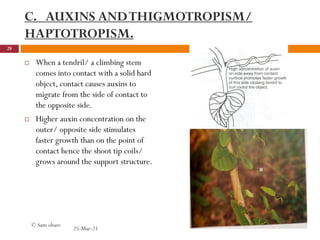
  • 27.
    Study question 2 The photographs below show an experiment that was set up to investigate a certain response in bean seedlings. Examine them and answer the questions that follow. a) Which response was being investigated?  Geotropism/ gravitotropism b) Account for the observation in seedlingA after 24 hours.  Force of gravity caused auxins to migrate to the lower side of the root tip.Lower concentration on the upper side stimulates faster growth hence the root tip bent/ curved downwards. c) Explain why the root of seedling B continued growing straight down.  Force of gravity was acting uniformly on the root tip hence there was no unequal distribution of auxins. 25-Mar-21 27 © Sam obare
  • 28.
    C. AUXINS ANDTHIGMOTROPISM/ HAPTOTROPISM. When a tendril/ a climbing stem comes into contact with a solid hard object, contact causes auxins to migrate from the side of contact to the opposite side.  Higher auxin concentration on the outer/ opposite side stimulates faster growth than on the point of contact hence the shoot tip coils/ grows around the support structure. 25-Mar-21 28 © Sam obare
  • 29.
    STUDY QUESTION Form 4students set up an experiment as shown below using enclosed seedling. a) What type of response is exhibited by the seedlings in this experiment:?  Geotropism b) State the observations made in experiment I and II  In experiment I the shoot and the root grow horizontally straight.  In experiment II, the shoot tip/plumule bends/curves upwards and the root tip/radicle bends/curves downwards. 25-Mar-21 29 Š Sam obare
  • 30.
    c) Account forthe observations made in experiment I and II  In experiment I, the clinostat rotates causing the auxins to be uniformly distributed in the shoot and root tips.  This stimulates uniform growth in the root and the shoot.  In experiment II, gravity causes auxins migrated to the lower side of the root and shoot tips.  A higher concentration of auxins on the lower side of the shoot tip stimulates faster growth on the lower side hence the shoot tip/ plumule bends/ curves upwards.  Higher concentration of auxins on the lower side of root tips/ plumule hinders growth on the lower side hence the radicle/ root tip curves/ bends downwards. 25-Mar-21 30 Š Sam obare
  • 31.
    d) Give areason why seedlings were enclosed.  Helps to prevent exposure to: i. Wind which may increase the rate of water loss. ii. Wind or other external factors which may shift the alignment of plant seedlings. iii. Pests and other insects which may damage the seedlings thus interfere with the responses. 3. Study the diagram below and answer that questions that follow. a) Name the type of germination shown above. Epigeal germination. b) Give a reason for your answer. The cotyledon is brought above the soil. c) Name the type of response exhibited in diagram a. Positive geotropism. 25-Mar-21 31 Š Sam obare
  • 32.
  • 33.
    d) Explain theresponse named above.  Gravity pulls the auxins downwards. Higher concentration of auxins on the lower side hinders/inhibits growth on the lower side than on the upper side.This causes the hypocotyl to curve/bend downwards. RECEPTION, RESPONSE AND CO- ORDINATION IN ANIMALS.  Animals detect changes in the external and internal environment/ receive the stimulus through receptor organs that have special cells called receptor/ receptor cells.  Receptor organs include: Eyes, Ears, Nose,Tongue, Skin and Hypothalamus 25-Mar-21 33 © Sam obare
  • 34.
     The eyeshave photoreceptors that detect light.  The skin has thermoreceptors that detect temperature, mechanoreceptors that detect pressure.  Ears have receptors that detect sound, gravity and orientation of the body.  Hypothalamus has osmoreceptors that detect osmotic pressure.  Response in animals is brought about by organs called effectors.  Effectors/effector organs include: i. Glands e.g. salivary glands. ii. Muscles e.g. skeletal muscles.  The receptors and effectors are linked by a co-ordinating centre.  The co-ordinating centre consists of: A. Nervous system. B. Endocrine system. 25-Mar-21 34 © Sam obare
  • 35.
    A. NERVOUS SYSTEM This is a system consisting of specialized cells called nerve cells/neurons for transmission of electrical impulses.  The neurones are linked to one another and to the receptors and effectors.  An electrical impulse is an electrical signal transmitted within the nerve cell fibre/axon. Parts of a neurone A. Cell body/centron- has a cytoplasm enclosing a nucleus. B. Dendrons- they are extensions that arise from the cell body and they transmit impulses towards the cell body. C. Axon/nerve fibre- this is the longest dendron which arises from the cell body and it transmits impulses from the cell body. D. Dendrites- they are extensions that arise from the dendrons. 25-Mar-21 35 © Sam obare
  • 36.
     The axoncontains a cytoplasm called axoplasm which extends from the cytoplasm of the cell body.  It is also covered with myelin / medullated sheath- which insulates it and enhances the speed of impulse transmission.  The myelin sheath is constricted to form junctions called nodes of ranvier- which propagate and promote faster transmission of impulse.  On the outer part of the myelin sheath are cells called schwann cells- which give rise to the myelin sheath. The schwann cells have a membrane called neurilemma N/B. Several axons and dendrons joined together form a nerve. 25-Mar-21 36 © Sam obare
  • 37.
    Structural adaptations ofthe neurone to enable it carry out its functions. 1. It has long axon to transmit/conduct impulses. 2. The axon is enclosed by a myelin sheath which insulates the axon and for faster transmission of impulses. 3. The myelin sheath has junctions called nodes of ranvier to enhance the speed of conduction of the impulse. 4. It has schwann cells for secretion of myelin sheath. 5. It has numerous dendrites which receive/ deliver impulses from neighboring neurones through synaptic connections. 6. The cell body has a nucleus for transmission of impulses. 25-Mar-21 37 Š Sam obare
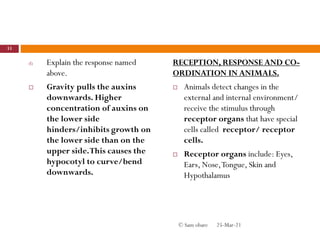
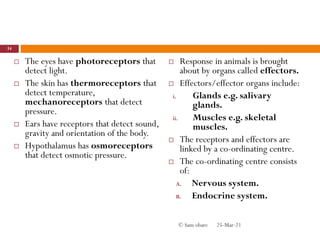
  • 38.
    TYPES OF NEURONES 1.Sensory/afferent/receptor neurone. 2. Motor/efferent/effector neurone. 3. Relay/intermediate neurone. 1. SENSORY NEURONE/ RECEPTOR NEURONE/ AFFERENT NEURONE.  It is joined to the sense organs e.g. eyes, skin, nose, tongues and carries impulses from the receptors/receptor cells/ sense organs to the central nervous system (CNS).  It has one dendron which arises from the cell body to form axon hence said to be unipolar.  The cell body is situated along but off the axon and outside the central nervous system (CNS).  The dendron transmits impulse from the receptor to the cell body and the axon transmits the impulse from the cell body to the CNS.  The receptor dendrites are located in the sense organ and the terminal dendrites are located in the CNS.The cell body is closer to the CNS.  The sensory neurones which transmit impulses from the internal/visceral organs e.g. lungs and heart are called visceral sensory neurones.  The sensory neurones which transmit impulses from the skin, skeletal muscles, joints and bones are called somatic sensory neurones. 25-Mar-21 38 © Sam obare
  • 39.
  • 40.
    2. Motor neurone/efferent neurone. It transmits the impulse from the CNS to the effectors.  It has two or more dendrons arising from the cell body hence said to be multipolar.  The cell body is located at the end of the axon (the longest dendron) but within the CNS.  The terminal dendrites of the axon are located within the effectors e.g. muscles. 25-Mar-21 40 © Sam obare
  • 41.
  • 42.
    3. Relay neurone /intermediate neurone/interneuron.  It transmits the impulse from the sensory neurone to the motor neurone.  It lacks the myelin sheath.  It is found within the CNS.  It has two dendrons that arise from the cell body hence said to be bipolar. 25-Mar-21 42 © Sam obare
  • 43.
  • 44.
    Differences between amotor and sensory neurone. i. Transmits impulses from the CNS to the effectors. ii. The cell body is located at the end of the axon and within the CNS. iii. It is multipolar. i. Transmits impulses from the receptors to the CNS. ii. The cell body is located along but off the axon and outside the CNS. iii. It is unipolar. 25-Mar-21 44 Š Sam obare Motor neurone Sensory neurone
  • 45.
    PARTS/COMPONENTS OF THE NERVOUSSYSTEM.  They include: 1. The central nervous system (CNS). 2. The peripheral nervous system (PNS). 25-Mar-21 45 © Sam obare
  • 46.
    1. THE CENTRAL NERVOUSSYSTEM (CNS)  It receives and interprets the impulses hence called a coordinating centre.  It consists of: A. The brain B. Spinal cord and associated nerves A. THE BRAIN  This is the anterior part (towards the head) of the central nervous system.  It is enclosed by protective membranes called meninges.  The meninges include: i. Dura matter- the outermost layer covering the brain and spinal cord. It is composed of connective tissue and rich network of capillaries. ii. Pia matter- the innermost layer covering the brain and spinal cord.  The infection of the meninges causes meningitis. 25-Mar-21 46 © Sam obare
  • 47.
     The spacebetween the dura and pia matter is called Arachnoid layer which is filled with a fluid called cerebrospinal fluid which is secreted by blood.  It contains oxygen and nutrients e.g. glucose/blood sugar, amino acids. Functions/ roles of the cerebrospinal fluid. i. It supplies oxygen and nutrients to the brain cells. ii. It removes waste products from the brain cells. iii. It maintains pressure of the brain. iv. It acts as a shock absorber/protects the brain from shock/mechanical damage. 25-Mar-21 47 Š Sam obare
  • 48.
    PARTS OFTHE BRAIN. The brain is made up of two halves called hemispheres i.e. right and left hemispheres.  The two hemispheres are interconnected by a group of nerves called corpus callosum.  The left hemisphere controls the activities of the right side of the body while the right hemisphere controls the activities of the left side of the body.  The innermost part of the brain and spinal cord is called grey matter and the outer part is called white matter. 1. Cerebrum-This is the largest part of the brain it is divided into the left and right hemisphere.  It has many folds on its outer layer to increase the surface area for packing of neurones.  If the plasmodium parasite enters the brain and affects the cerebrum, it causes cerebral malaria. Functions/roles. i. It controls learning, imagination, thinking, personality, hearing, vision and taste. ii. It controls voluntary body movements/ controls contraction of skeletal muscles e.g. walking, dancing, movement of lips/ chewing, movement of the neck/ nodding and movement sideways. 25-Mar-21 48 © Sam obare
  • 49.
    2. Cerebellum- Itis found below and behind the cerebrum. Functions. i. Maintenance of body balance and posture. ii. Ensures dexterity in fine movements e.g. playing a piano, sewing, typing e.t.c. 3. Medulla oblangata- It is located below the cerebellum and connected to the spinal cord. Functions. i. Controls involuntary responses e.g. breathing, heartbeat, coughing, sneezing, swallowing, vomiting, salivation. ii. Controls dilation and constriction of the blood vessels hence influencing blood pressure. 25-Mar-21 49 Š Sam obare
  • 50.
    4. Hypothalamus- Itis found below the thalamus and closely associated with the pituitary gland.  It controls the autonomic nervous system which transmits impulses from the internal organs. Functions. i. Controls appetite, sleep, wakefulness. ii. It controls homeostasis (thermoregulation, osmo-regulation) 5. Thalamus- It integrates the sensory impulses from the eyes, ears and the skin and then sends the them to the cerebrum. Function.  It contains receptors for pain and pleasure. 6. Pituitary gland- It is attached to the hypothalamus and projects downwards. Functions/ roles i) It is the master gland and secretes various hormones e.g. oxytocin, prolactin, follicle stimulating hormone, luteinizing hormone. ii) Controls other endocrine glands. 7. Pons- They work together with the medulla oblangata to control involuntary activities. 8. Corpus callosum- It is composed of the axons/ nerve cells that connect the left and right hemispheres of the brain. 25-Mar-21 50 © Sam obare
  • 51.
  • 52.
  • 53.
  • 54.
    B. SPINAL CORD This is the posterior/back extension of the CNS from the brain to the tail.  It is enclosed by the meninges that protect it against mechanical damage.  It is also protected by the vertebral column/back bone.  It is made of the grey matter the white matter.  There is a narrow canal called the central canal which runs down the spinal cord.  The central canal is filled with cerebrospinal fluid.  The grey matter is H-shaped and is surrounded by the white matter.  It is grey/dark in colour because it consists of the cell bodies of the motor and relay neurones, dendrites and synapses. Functions of spinal cord. i. Coordinates some automatic responses/reflex actions. ii. It links the nerves of the peripheral nervous system and the brain. 25-Mar-21 54 © Sam obare
  • 55.
     The whitematter surrounds the grey matter and consists of the axons of the sensory and motor neurones.  The myelin sheaths/ medulated sheath/ myelinated sheath of neurons/ axons which are made up of fats that make it a shiny appearance. SYNAPSE  This is a gap between two adjacent neurones  The substance that transmits the impulse within the synapse/from one synapse to the other is called acetylcholine which is broken down by enzyme acetylcholinesterase/ cholinesterase/ acetylhydrolase into acetic acid and choline. 25-Mar-21 55 © Sam obare
  • 56.
  • 57.
    2. PERIPHERAL NERVOUS SYSTEM(PNS)  This is the system of nerves that connect the CNS and other parts of the body.  It consists of Cranial nerves and Spinal nerves. 1. Cranial nerves- They transmit impulses from the sense organs and muscles of the head and neck.They arise from the brain and innervate organs such as ears and eyes. Examples of such nerves include: i. Optic nerves- which innervate the eyes. ii. Olfatory nerves- which innervate the nose. iii. Auditory nerves- which innervate the ears. 2. Spinal nerves- They are nerves that arise from the spinal cord and innervate the surrounding parts of the body such as hands, legs, ribs, abdomen e.t.c. 25-Mar-21 57 © Sam obare
  • 58.
    Parts/ components ofthe peripheral nervous system (PNS) a) Voluntary (somatic) nervous system- It consists of nerves that control voluntary activities of the body e.g. raising of the leg, nodding the head e.t.c. b) Involuntary (autonomic) nervous system- It consists of nerves that control involuntary activities of the body e.g. beating of the heart, secretion of hormones and enzymes, gut movements e.t.c. Parts/ components of the involuntary/ autonomic nervous system. 1. Parasympathetic nervous system- Its stimulation is aimed at energy conservation activities e.g. Slowing of the heart beat, Stimulation of the digestive tract/gut, Decreased force of muscle contraction. 25-Mar-21 58 Š Sam obare
  • 59.
    2. Sympathetic nervoussystem- Its stimulation produces effects that prepare the animal for emergency e.g. Increased heartbeat rate to supply enough blood containing oxygen to the muscles and remove carbon (IV) oxide from the muscles, Increased blood pressure for faster movement of blood, Dilation of the pupil to locate the enemy, Closing of the sphincter muscles of the anus and bladder and conversion of glycogen into glucose in the liver. REFLEX ACTION.  This is a rapid/ faster and automatic/ involuntary response to a stimulus.  It is processed in the spinal cord not in the brain.  It helps protect the body before the brain knows what is going on. Types of reflex action a) Simple reflex action. b) Conditioned reflex action. 25-Mar-21 59 Š Sam obare
  • 60.
    A. SIMPLE REFLEXACTION.  Simple reflex actions e.g. withdrawal of finger from a hot or sharp object, is an automatic response to a specific stimulus.  During simple reflex action, an impulse passes through a reflex arc.  A reflex arc refers to the path taken by the impulse during a reflex action.  A reflex arc consists of sensory, intermediate and motor neurons.  When a finger touches a sharp/hot object, the stimulus/ heat/ pain is detected by temperature/ thermoreceptors/ pain receptors in the skin/ dermis.  An impulse is generated which is transmitted along the sensory neurone to the grey matter/ central nervous system/ spinal cord.  The chemical transmission of impulse is done across a synapse to relay neurone and through another synapse to motor neurone and across another synapse to muscles/ effectors/ biceps muscles.  The biceps muscles contract and the hand is withdrawn. 25-Mar-21 60 Š Sam obare
  • 61.
  • 62.
  • 63.
    B. CONDITIONED REFLEX ACTION Conditional reflex actions e.g. salivation of a dog/humans/students in response to sound, is an automatic response evoked from an animal by unrelated stimulus, substituted for the one which normally elicits the response.  It develops from past experience, and involves modification of behaviour/learning.  It weakens with time, and must be reinforced by repeating the related original/primary stimulus.  Dogs/Students salivate when the bell for meals rings because they have learned to associate the ringing of the bell at meal time with food, every time it rings, they are offered food. 25-Mar-21 63 © Sam obare
  • 64.
    Differences between simplereflex action and conditioned reflex action. 1. It is not learned/ it is inborn/ requires no experience. 2. Primary/ related stimulus is involved. 3. Impulse follows appropriate sensory and motor neurone or sensory and motor components are the same all times. 4. A single stimulus brings about a desired response. 1. It is learned/ requires experience. 2. Secondary/ unrelated stimulus is involved. 3. Impulse follows inappropriate motor neurone or primary sensory component is replaced by secondary component but the motor component remains unchanged. 4. Repeated stimulus is needed to bring about response. 25-Mar-21 64 Š Sam obare Simple reflex action Conditioned reflex action
  • 65.
    Transmission of thenerve impulse.  A nerve impulse is an electrical wave arising from changes in ionic concentration across the membrane of the nerve fibre/axon.  The metallic ions involved are sodium ions (Na+) and potassium ions (K+). It occurs in two phases: (i) Resting phase/potential- It is the non-conducting phase in the nerve fibre.  Sodium (Na+) ions which are more are on the outside the nerve fibre/ axoplasm than potassium [K + ) ions which are more inside the nerve fibre.  There are also more negative charges (anions) within the axoplasm.  As a result the outer side of nerve fibre acquires a relative positive charge while the inner side acquires a relative negative charge.  The nerve fibre is said to be polarized.  During resting potential Sodium ions are actively pumped out while potasium ions diffuse freely in and out of the axoplasm. 25-Mar-21 65 Š Sam obare
  • 66.
    (ii) Action phase/potential-The membranebecomes permeable to the sodium (Na+) ions that diffuse inwards and the potassium {K+) ions diffuse outwards.  Also negative ions diffuse out of the axoplasm and the inside becomes positively charged while the outside becomes negatively charged hence the nerve fibre is depolarized.  An action potential is in form of a wave along the nerve fibre. It takes place in milli seconds. Transmission of the impulse across a synapse/ neuro-Junction.  A synapse- is a the junction between the dendrites of two adjacent neurones. Function- allows transmission of nerve impulses from neurone to neurone.  When an impulse reaches the synaptic knob, it causes the synaptic vesicles to move to the pre-synaptic membrane.  The vesicles attach to the membrane and discharge the transmitter substance called acetylcholine into the synaptic cleft. 25-Mar-21 66 © Sam obare Sodium ions Potassium ions
  • 67.
     The acetylcholinediffuses across the membrane and attaches to the post- synaptic membrane. Here it causes depolarization of ions (sodium and potassium ions).  Sodium ions move from the cleft to the post synaptic knob through the post- synaptic membrane causing an action potential and the nerve impulse is generated in the adjacent neuron.  An enzyme Cholinesterase/ acetylcholinesterase/ acetyl hydrolase present at the synapse breaks down acetylcholine into acetic acid/ ethanoic acid/ vinegar and choline.  These substances are absorbed actively into the knob and used to re-synthesize acetylcholine using energy in form of ATP. Significance/ importance of breakdown of acetylcholine.  To re-polarise the pre-synaptic membrane for the next impulse propagation/ transmission to avoid merging/ joining successive nerve impulse from neurone to neurone. 25-Mar-21 67 © Sam obare
  • 68.
  • 69.
    B. ENDOCRINE SYSTEM It consists of glands which are ductless that produce hormones.  Hormones are organic compounds which are either protein or steroids in nature secreted by ductless glands and shed into the blood stream.  They are produced in small quantities and transported by blood to other parts of the body/ target organs where they cause a response.  In animals , hormones regulate growth and development, control the behavior during breeding and control proper performance of cells.  Secretion of hormones is controlled by the nervous system.  The main glands include: A. Pituitary gland. B. Adrenal gland. C. Thyroid gland. 25-Mar-21 69 © Sam obare
  • 70.
    A. PITUITARY GLAND It secretes the following hormones: 1. Thyroid stimulating hormone (thyrotropin)- which stimulates the thyroid gland to secrete thyroxine hormone. 2. Gonadotropins e.g. FSH and LH. 3. Adrenocorticotropic hormone (ACTH)-which stimulates the adrenal cortex to produce adrenaline. 4. Growth hormone (somatotrophin). 5. Antidiuretic hormone- which enhances the re- absorption of water in the kidney tubules. 6. Oxytocin- which stimulates the contraction of muscles of uterus during birth and muscles of milk ducts to allow milk let-down. 7. Prolactin-stimulates milk production and is responsible for maternal instinct. 25-Mar-21 70 Š Sam obare
  • 71.
    B. ADRENAL GLANDS. It is located above kidneys. It consists of adrenal cortex (on the outside and adrenal medulla (on the inside).  Adrenal cortex secretes aldosterone- which stimulates the reabsorption of sodium ions.  Adrenal medulla receives nerve impulse from the brain and secretes adrenaline.  Adrenaline is secreted during anxiety, excitement/emergency hence called fight/flight hormone. Effects of adrenaline. 1. Increases heart beat, increasing the rate of blood circulation. 2. Stimulates the conversion of glycogen to glucose in the liver hence increasing blood sugar level. 3. It increases metabolic rate. 4. It causes constriction of arterioles to the skin and digestive system. 5. Breathing rate becomes faster and deeper. 6. Fats are converted into fatty acids which are made available for muscle contraction. 7. It stimulates the skeletal muscles to contract and relax causing movement. 25-Mar-21 71 © Sam obare
  • 72.
    Effects of oversecretion of adrenaline. 1. Hypertension/high blood pressure. 2. Severe headache. 3. Racing heart. 4. Sweating. 5. Faintness. 6. Aging of major body organs e.g. kidney, heart and liver. Effects of undersecretion/ underproduction of adrenaline. 1. Reduced metabolism. 2. Decreased heart beat rate. 3. Reduced rate of breathing. 4. Reduced activity of the animal. 25-Mar-21 72 Š Sam obare
  • 73.
    C. THYROID GLAND It is stimulated by thyroid stimulating hormone to secrete thyroxine.  Thyroxine is a complex organic compound that contains iodine. Functions of thyroxine. 1. Controls basal metabolic rate by increasing glucose oxidation. 2. Enhances the effect of growth hormone (somatotrophin) ensuring normal growth and mental development. 3. Works together with adrenaline to control involuntary activities e.g. increased blood circulation. Effects of under-secretion of thyroxine /hypothyroidism.  Under-secretion of thyroxine may be due to insufficient iodine in the diet or defective enzymatic reactions concerned with iodine production. Iodine is a component of thyroxine.  Under-secretion leads to Cretinism in children and Myxoedema in adults. 1. Cretin children have the following characteristics: i. Poor mental development/ low intelligence. ii. Deformed legs. iii. Dry leathery skin. iv. General body sluggishness. v. Large tongue. 25-Mar-21 73 © Sam obare
  • 74.
    2. Myxoedema causesgoitre / swelling of thyroid gland.This is due to overworking of thyroid gland in an attempt to synthesize enough thyroxine. 3. Reduced metabolic rate shown by reduced heart beat, reduced breathing rate and low body temperature. 4. Individuals are mentally and physically sluggish which can lead to obesity and oedema (swelling of feet).  Under-secretion is controlled by use of balanced diet supplemented by iodinised salt and administration of iodine tablets. Effects of over-secretion of thyroxine/ hyperthyroidism • Overproduction of thyroxine may result from defective enzymatic activity. i. Increased body temperature. ii. Increased breathing rate. iii. Increased body metabolism leading to body weight loss. iv. Excessive energy production. v. Extreme can lead to heart failure (thyrotoxicosis). • It is controlled by surgical removal of a part of thyroid gland and use of antithyroid drugs. 25-Mar-21 74 © Sam obare
  • 75.
    Functional differences betweennervous and endocrine system. 1. Uses hormones to bring about response. 2. Hormones are transported in blood. 3. Responses are slow and affect several parts of the body. 4. Effects are long-lasting. 5. Responses take place involuntarily. 1. Uses electrical impulses to bring about response. 2. Impulses are transported through neurons. 3. Responses are quick, specific and localised. 4. Effects short-lived. 5. Responses take place voluntarily and involuntarily. 25-Mar-21 75 Š Sam obare Endocrine system. Nervous system.
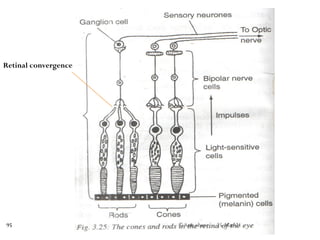
  • 76.
    Similarities between endocrine andnervous system. 1. Both provide a means of communication and coordination within the body of an organism. 2. Both involve response to a stimulus. 3. Both bring about survival response. 4. In both chemical transmission is involved. 5. The target organs of hormones are like the effector organs. DRUG ABUSE  A drug- this is a chemical substance which when taken has psychological and physiological effects in the body. Drugs taken to cure diseases are called medicinal drugs.  Drug addiction-This is the state of being mentally and physically dependent on drugs.Addiction requires increase in dosage to experience the desired feelings.  Drug abuse- This refers to use of the drug for the purpose not meant for it to bring about physical/physiological effects which are not curative. 25-Mar-21 76 Š Sam obare
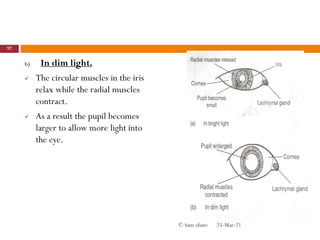
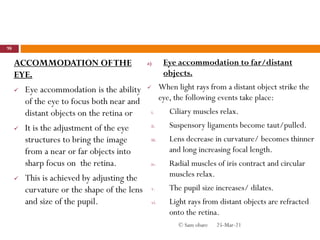
  • 77.
    Classification of drugs. A.Hallucinations. B. Stimulants. C. Depressants. D. Narcotics. E. Inhalants. A. Hallucinations  They cause one to have hallucinations i.e. to see something imagined/not present.  Examples include: a) Bhang (Cannabis sativa). 1. Causes euphoria or pleasurable relaxation 2. Causes depressed hearing, lowered eye and skin sensation. 3. Causes acute pain and anxiety. 4. Causes depressed mental ability. 25-Mar-21 77 © Sam obare
  • 78.
    b) Lysergic aciddiethylamide. 1. causes hallucinations and dilated pupil 2. Leads to increased body temperature, heart beat, blood pressure and sweating 3. Causes lack of appetite and sleep 4. Causes anxiety and helplessness 5. Causes mental confusion and impaired memory 6. It causes dry mouth and muscle shaking. c) Miraa (khat). 1. Causes increased blood pressure, body temperature and respiratory rate. 2. Reduces sexual potency. 25-Mar-21 78 Š Sam obare
  • 79.
    B. Stimulants- Theystimulate the central nervous system i.e. causes the CNS to increase the rate of chemical reactions/physiological activities of the body  They include: a) Cocaine 1. Causes increased heart beat. 2. Causes vomiting. 3. Causes convulsions and respiratory failures. b) Amphetamines. 1. Causes euphoria (pleasurable relaxation). 2. Causes hallucinations. 3. Causes panic. C. Depressants- They suppress the CNS causing decreased rate of physiological activities of the body.  They include: a) Alcohol 1. Causes impaired physical and mental functioning of the body. 2. Can cause brain damage. 3. It causes poor judgment, memory and perception. 4. Can cause liver cirrhosis hence liver destruction. 5. Increased incidences of cancer and heart attack. 25-Mar-21 79 © Sam obare
  • 80.
    D. Narcotics- Theyare drugs used to cause insensible condition in the body. They can be used in surgical operations.  They include: a) Opium. 1. It depresses the nervous system. 2. Can cause confusion and convulsions. b) Morphine. 1. Causes restlessness and sleeplessness. 2. Can cause watery eyes and running nose. 3. Can cause nausea (feeling of sickness in the stomach). 4. Can cause diarrhoea and vomiting. 5. Causes raised body temperature (fever) and respiration. 6. Can cause abdominal and muscle cramps. 7. Can cause dehydration and loss of body weight. E. Inhalant- They are inhaled.  Example is glue which: 1. Damages the nervous system, kidney and liver. 2. Reduces mental and physical capabilities. 3. Causes fatigue and weight loss. 4. Can cause excitation. 25-Mar-21 80 © Sam obare
  • 81.
    GENERAL EFFECTS OFDRUG ABUSE 1. Reduced appetite and poor feeding leading to emaciation. 2. Poor absorption of vitamin K and E leading to sterility and blindness. 3. Lowered nervous co-ordination leading to loss of posture and balance hence poor performance in sports and manual activity. 4. Irritation of lungs and respiratory tracts leading to frequent coughs and infections. 5. It may lead to cancer of lungs, throat and urinary bladder. 6. It may lead to stomach ulcers. 7. Damage to the heart and liver leading to heart attack and liver cirrhosis. 8. Interference with temperature regulation leading to excessive heat loss. 9. Damage to the brain causing sleeplessness (insomnia), hallucinations, madness and loss of memory (amnesia). 10. Poor foetal development and pregnancy complications in women. 11. Damage to vital body organs leading to death. 12. Impaired/ poor judgment leading to accidents and infections e.g. HIV/AIDS 25-Mar-21 81 Š Sam obare
  • 82.
     Effects ofdrugs on the society include: 1. Marital conflict. 2. Violence. 3. Theft to sustain the habit. 4. Reduced productivity at work. 5. Loss of jobs/income. 6. Misuse of family resources. Study questions 1. Explain how drug abuse exposes one to the dangers of HIV/AIDS infection. Answers.  Drugs impair reasoning hence heightening sexual arousal.  Drugs impair judgment leading to indiscriminate sex.  Impaired judgment leads to engaging in unprotected sex.  Intoxicated persons are likely to engage in sexual perversions e.g. rape and homosexuality.  Intoxicated persons may lose strength and become victims of sexual abuse. 25-Mar-21 82 © Sam obare
  • 83.
    2. Discuss thesocio- economic problems associated with drug abuse. Answers a) At family:  Wastage of family resources and theft to acquire drugs.  Lack of family care including poor care of children and spouses.  Family break-up due to tensions, poverty and lack of love. b) In schools:  Lateness, indecent behavior, poor study habits and failure in examinations.  Violence against students, teachers and community.  Riots and strikes. c) Increased crime. d) Premature termination of careers and other professions 25-Mar-21 83 Š Sam obare
  • 84.
    SENSE ORGANS. A. THEEYE  This is a sense organ for sight.  It is spherical in shape and located within the socket in the orbit found within the skull.  It has photoreceptors stimulated by light from the object.  The image of the object is formed inside the eye, transmitted to the brain as an electrical impulse through the optic nerve where it is interpreted. External structure.  It consists of the following parts: 1. Eyelids. Adaptation to function. i. They are made of folds of skin covering the eye ball protecting it against mechanical /physical damage. ii. Have sweat glands and sebaceous gland for oily secretions that keep the eye moist. iii. Have eye lashes that trap dust particles preventing them from entering the eye. 25-Mar-21 84 Š Sam obare
  • 85.
    2. Tear/Lachrymal glands. Adaptationto function- They secrete tears that clean, moisten, lubricate the eye, wash foreign materials out of the eye.Tears also have lysozyme hormone that protect the eye against infections / bacteria/diseases. 3. Eyebrows- are thickly covered with hair to prevent sweat and dust from entering the eye. 25-Mar-21 85 Š Sam obare
  • 86.
    Internal parts ofthe eye. 1. Conjunctiva 2. Sclera/sclerotic layer 3. Cornea 4. Choroid layer 5. Retina 6. Yellow spot 7. Blind spot 8. Optic nerve 9. Lens 10. Ciliary body 11. Suspensory ligaments 12. Iris 13. Pupil 14. Aqueous humour 15. Vitreous humour 25-Mar-21 86 Š Sam obare
  • 87.
  • 88.
    1. Conjunctiva.  Itis a thin epithelium to protect the cornea.  It is transparent to allow light pass through.  It is glandular/ has goblet cells which secrete mucus for lubrication. 2. Sclerotic layer/sclera layer- It contains tough fibres/ inelastic collagen fibres/ it is fibrous to maintain the shape of the eyeball and protect inner parts of the eye/ eye ball. 3. Cornea.  It is transparent to allow light pass through.  It is curved to refract/ bend light rays onto the retina. 4. Choroid layer.  It is rich in blood vessels/ highly vascularized/ has numerous capillaries to supply the retina/ eye with nutrients and oxygen (nourish the eye) and remove metabolic wastes.  It has pigmented/ black cells to prevent reflection of light in the eye 5. Retina- It is the innermost layer of the eye ball.  It contains photoreceptors/ cones and rods to perceive light/ where the image is formed/ focused/ image formation.  It has cones for colour vision, bright light vision, colour perception and rods for dim light vision. 25-Mar-21 88 Š Sam obare
  • 89.
    6. Fovea centralis-Hasnumerous cones only for accurate vision/ visual acuity. 7. Blind spot- It lacks photoreceptors / cones and rods to allow passage of blood vessels and for exit of optic nerve. 8. Optic nerve-it has sensory neurons/ nerve cells that transmit impulse to the brain 9. Lens.  It is biconvex to refract/ focus light rays onto the retina.  It is transparent to allow light pass through.  It is elastic to allow adjustment of the shape of lens. 10. Ciliary body.  It is made up of ciliary muscles that contract and relax/ are contractile to change the shape of the lens during accommodation.  It is glandular/has secretory cells to produce/ secrete aqueous humour. 25-Mar-21 89 Š Sam obare
  • 90.
    11. Suspensory ligaments-They are inelastic and hold the lens in position to the ciliary body. 12. Iris- This is the coloured part of the eye.  It has radial and circular muscles to control the size of the pupil.  It has melanin to absorb strong light and prevent blurred vision. 13. Pupil-This is an opening on the iris through which light passes into the eye. 14. Aqueous humour- It the fluid found at the front chamber of the eye  It is jelly like which maintains the shape of the eye ball.  It contains oxygen and nutrients for the cornea and the lens.  It is transparent to allow light to pass through and refract it onto the retina. 15. Vitreous humour- This is a clear fluid at the back of the eye.  It is jelly-like to maintain the shape of the eye ball.  It is transparent to allow light to pass through and refract it onto the retina. 25-Mar-21 90 Š Sam obare
  • 91.
    PHOTORECEPTORS.  They aresensitive to light stimulus. They include Cones and Rods. a) Cones-They contain a photochemical pigment called iodopsin which perceives light of high intensity, perception of fine details and for colour vision.  Cones are highly concentrated on the fovea centralis.  When strong light rays from the object strike the iodopsin it is broken down to iodine and opsin thus initiating a nerve impulse.  The nerve impulse is then transmitted to the brain for interpretation through the optic nerve.  Iodopsin is resynthesised by the energy produced by the mitochondria in the photoreceptors. 25-Mar-21 91 Š Sam obare
  • 92.
     Each conehas its own bipolar neurone which in turn links it with the optic nerve fibre i.e. lack retinal convergence.  This enables them to have high visual acuity (ability of the eye to distinguish objects that lie close to each other).  We shift our eyes when observing objects so that the light rays from the object can fall on the fovea for them to be clear. b) Rods.  They are used for vision under light of low intensity.They have a pigment called rhodopsin which is sensitive to light of low intensity.  When light of low intensity strikes the rod, rhodopsin splits into opsin and retinine thus initiating an impulse.  The impulse is transmitted to the brain through the optic nerve for interpretation. Retinine is a derivative of vitamin A whose lack leads to night blindness. 25-Mar-21 92 Š Sam obare
  • 93.
     The brokendown rhodopsin is re-synthesised slowly in the dark light for continued photochemical reactions in the rods.  This is experienced when one enters a dimly lit room from bright light.  At first the room looks dark and nothing is visible but gradually things start becoming visible.  Rods have retinal convergence i.e. several rods converge/ joined to one neurone therefore they have low visual acuity hence cannot distinguish fine detail.  Retinal convergence also enables any little stimulation of several rods to initiate/generate an impulse.  Rods are in greater concentration round the periphery of the retina and are absent in the fovea centralis.  At night is possible to see an object clearly when looking from the corner of the eye.  This is because when one looks at the object directly the light rays falls on the fovea centralis which has cones only which are operational at light of strong intensity. 25-Mar-21 93 Š Sam obare
  • 94.
     Nocturnal animalse.g. cat, owl have are capable of seeing at night because of; i) High concentration of rods than cones in the retina that are sensitive to low light intensity. ii) Retinal convergence of rods to enable any little stimulation of rods to generate an impulse.  At night the low light intensity is not able to activate the cones.  By looking from the corner of the eye the light rays from the object fall on the periphery of the retina outside the fovea.  The periphery contains only rods which are sensitive to light of low intensity hence enabling one to see the object clearly. 25-Mar-21 94 Š Sam obare
  • 95.
  • 96.
    Advantages of havingtwo eyes in human beings/ binocular vision. 1. Clarity of vision/better focus/ Improved visual acuity. 2. Three dimensional vision/ more accurate assessment of distance, depth, height and width of an object. 3. Larger visual field. 4. If one eye is damaged the human being is not blinded. RESPONSE TO LIGHT INTENSITY.  It is brought about the iris that controls the size of the pupil.  The iris has circular and radial muscles that are antagonistic i.e. do not contract and relax at the same time. a) In bright light.  The circular muscles in the iris contract and the radial muscles relax.  As a result the pupil becomes smaller in size/ constricts preventing excess light from entering which can destroy the retina. 25-Mar-21 96 Š Sam obare
  • 97.
    b) In dimlight.  The circular muscles in the iris relax while the radial muscles contract.  As a result the pupil becomes larger to allow more light into the eye. 25-Mar-21 97 Š Sam obare
  • 98.
    ACCOMMODATION OFTHE EYE.  Eyeaccommodation is the ability of the eye to focus both near and distant objects on the retina or  It is the adjustment of the eye structures to bring the image from a near or far objects into sharp focus on the retina.  This is achieved by adjusting the curvature or the shape of the lens and size of the pupil. a) Eye accommodation to far/distant objects.  When light rays from a distant object strike the eye, the following events take place: i. Ciliary muscles relax. ii. Suspensory ligaments become taut/pulled. iii. Lens decrease in curvature/ becomes thinner and long increasing focal length. iv. Radial muscles of iris contract and circular muscles relax. v. The pupil size increases/ dilates. vi. Light rays from distant objects are refracted onto the retina. 25-Mar-21 98 Š Sam obare
  • 99.
  • 100.
    b) Eye accommodationto near objects.  When light rays from near object strike the eye, the following events take place: i. Ciliary muscles contract. ii. Tension in suspensory ligaments reduces. iii. Lens curvature increases/lens becomes thicker decreasing focal length. iv. Radial muscles of iris relax and circular muscles contract. v. Pupil reduces in size/ constricts. vi. Light rays from a near object are refracted onto the retina. Study question  Imagine you are sitting outside in the shade of a tree reading a book, and you look up to a distant sun-lit aeroplane in the air and then you look down to the book again.Tabulate the sequence of events in your eyes as the two actions take place. 25-Mar-21 100 Š Sam obare
  • 101.
  • 102.
    IMAGE FORMATION.  Theimage is formed on the retina when the photoreceptors are stimulated.  The light rays from the object pass through the conjunctiva, cornea, aqueous humour, pupil, lens, vitreous humour and finally onto the retina.  The image formed on the fovea centralis is small, upside down and virtual (not real).  The photoreceptors are stimulated by light rays, initiating a nerve impulse which is sent to the cerebrum part of the brain through optic nerve for interpretation.  The brain interprets the image as being upright, real and allocates its actual size.  Impulses from the right eye are transmitted to left side of the brain and those from the left eye to the right side of the brain.  The colour of the object is interpreted by the brain and it depends on the wavelengths of light stimulating the cones. 25-Mar-21 102 Š Sam obare
  • 103.
  • 104.
    EYE DEFECTS ANDTHEIRCORRECTION 1. Short-sightedness (myopia)  This is a condition in which light rays from a distant object are brought to focus in front of the retina/ are blurred/ not clear while those from near objects are focused on the retina/ become clear.  It is caused by long eyeball or high refractive power of the eye lens. 25-Mar-21 104 Š Sam obare Rays from distant object
  • 105.
    Correction  It isdone by use of/ wearing spectacles with biconcave lens to diverge the light rays from the distant objects hence they are refracted onto the retina. 25-Mar-21 105 Š Sam obare
  • 106.
    2. Long-sightedness (hypermetropia)  Thisis a condition in which light rays from a near object are not clear/ are not brought to focus while those from a distant object are clear/ focused on the retina.  It is caused by short aye ball or weak lens system. 25-Mar-21 106 Š Sam obare
  • 107.
    Correction  It isdone by use of/ wearing spectacles with biconvex lens to converge light rays from nearby objects onto the retina hence near objects are seen clearly. 25-Mar-21 107 Š Sam obare
  • 108.
    3. Astigmatism-This isa congenital defect whereby the curvature of the cornea is uneven/not smooth.  Light rays are refracted differently leading to blurred vision. It is corrected by use of spectacles with even lens/astigmatic lens. 4. Squintedness- this is a condition where external muscles of the eye do not co- ordinate hence the eye balls face different directions affecting accommodation.The defect is difficult to correct. 5. Old sight/presbyopia- This is a defect where the ability of the lens to change its thickness is affected which affects aye accommodation.  This is caused by hardening of the lens. It is corrected by use of bifocal lens (containing both convex and concave lens. 6. Cataracts-This is a defect whereby the lens becomes stiff and opaque as a result of damage by the ultraviolet rays from the sun.  The defective lens is called a cataract which causes blurred vision/blindness. It is caused by old age, eye injury or diabetes mellitus.  It is corrected by surgical replacement of the defective lens. 7. Color blindness- this is a genetic defect in which individuals are not able to distinguish colors e.g. red and green colors.  This is because the retina lacks cones with pigments that respond to red and green colors. 25-Mar-21 108 Š Sam obare
  • 109.
    B. MAMMALIAN EAR. It performs the following functions: i. Hearing. ii. Maintenance of balance and posture.  It is composed of three main parts: A. Outer ear. B. Middle ear. C. Inner ear. A. Outer ear  It consists of: 1. Pinna- It is large and funnel shaped to collect and concentrate sound waves to the external auditory meatus /canal/ tube. 2. Auditory canal/meatus/tube- It is tubular to direct sound waves into the ear drum/tympanic membrane.  It also has hairs to trap solid particles preventing then from entering the ear.  It has wax secreting cells which secrete wax that traps dust and prevents entry of solid particles.Wax also maintains the flexibility of the ear drum.  It has sebaceous gland that secrete sebum which softens the canal/keeps it supple.  Sound velocity is highest/fastest in the auditory canal. 25-Mar-21 109 © Sam obare
  • 110.
  • 111.
    B. Middle ear It consists of: 1. Ear drum/tympanic membrane- It is a thin membrane consisting of connective tissue which vibrates and transforms sound waves into vibrations.  It then transmits the vibrations to the ear ossicles. 2. Ear ossicles (malleus, incus and stapes)- They are bony structures attached to each other and suspended in the cavity by the muscles.  The muscles prevent excessive vibrations which could damage the inner delicate parts.  They form a system of levers which amplifies and transmits the vibrations from the tympanic membrane to the oval window. 3. Oval and round window- They are membranes that cover the small holes that lead to the inner ear.  They vibrate and transmit sound vibrations to endolymph and perilymph of the cochlea. 25-Mar-21 111 © Sam obare
  • 112.
    4. Eustachian tube-This is the tube that connects the pharynx/nasal cavity and the middle ear. It is normally closed but opens during swallowing, yawning and chewing. Function i. The Eustachian tube can provide passage of pathogens from the pharynx to the middle ear causing ear infections. ii. It equalizes the air pressure between the inner ear and the outer ear/ atmosphere to prevent distortion of the ear drum.  For example, if you go higher up in an aeroplane, the atmospheric air pressure outside falls below that of the middle ear.This causes the ear drum to bulge outwards. The condition is rectified by yawing or swallowing.This opens the Eustachian tube to equalize the pressure on both sides of ear drum. 25-Mar-21 112 Š Sam obare
  • 113.
    C. Inner ear. It consists of 3 semi-circular canals, Cochlea andAuditory nerve. 1. Semi-circular canals- They are 3 tubular cavities containing the fluid and located at right angles to each other.  They open into the utricule/utriculus which in turn opens to the saccule/sacculus then the succulus opens into the cochlea.  The utricule and saccule are collectively called vestibular apparatus/ vestibule.  The vestibule and 3 semi- circular canals are used to maintain balance and posture.These cavities in the inner ear are filled with fluids called perilymph and endolymph.  The fluids conduct sound vibrations from the middle ear to the cochlea for hearing.The displacement of fluids in the vestibule and 3 semi- circular canals leads to restoration of body balance.  The fluids also absorb mechanical shock hence protect the delicate sensory structures. 25-Mar-21 113 © Sam obare
  • 114.
    2. Cochlea- Thisis a coiled tube consisting of canals, membranes and sensory cells.The canals are filled with endolymph and perilymph which transmit sound vibrations.  It is highly coiled to increase the surface area for attachment sensory cells for hearing.The sensory receptors/cells are sensitive to sound waves, generate impulse which is transmitted to the brain through auditory nerve. 3. Auditory nerve- It is made up of several nerve cells to transmit impulses to the brain for interpretation. THE PROCESS OF HEARING.  The pinna concentrates sound waves into the ear canal/ meatus.  The sound waves strike the ear drum causing it to vibrate and transform sound waves into vibrations.  Vibrations from the eardrum are transmitted to the malleus which amplifies and transmits to the incus up to the stapes.  The stapes vibrates, amplifies and passes the vibrations to the oval window.  From the oval window the vibrations are transmitted to the perilymph of the cochlea. 25-Mar-21 114 Š Sam obare
  • 115.
     Vibrations inthe fluids of the cochlea disturbs the sensory hair cells which generate nerve impulses.  These impulses are transmitted to the brain through the auditory nerve.  The brain interprets the impulses as sound of different pitches. Example  When one spins and then stops suddenly the person feels dizzy.  This is because the endolymph is still in motion and continuous stimulating the sensory cells. MAINTENANCE OF BALANCE AND POSTURE.  Balance and posture are brought about by the 3 semi-circular canals and vestibule. The 3 semi-circular canals and vestibule are collectively called vestibular apparatus.  The 3 semi-circular canals are cavities filled with endolymph and lie at right angles to each other.  Each semi-circular canal has a swelling called ampulla at one end containing sensory hair cells projecting out to form cupula.  The hairs are disturbed by the fluid/ endolymph. 25-Mar-21 115 Š Sam obare
  • 116.
     The 3semi-circular canals maintain body balance and posture in relation to change in position of the head.  Change of head position causes the movement of endolymph which stimulates the sensory hairs initiating a nerve impulse which is transmitted to the brain for interpretation.  The brain sends impulses the muscles of the body to restore the body balance.  The vestibule consists of utriculus and sacculus which contain chalky granules called otoliths attached to the fine sensory hairs of sensory cells.  The vestibule (sacculus and utriculus) maintain body balance and posture in relation to gravity.  The change of body posture disturbs the chalky granules causing stimulation of the sensory hairs.  This initiates a nerve impulse which is transmitted to the brain for interpretation.  The brain interprets the impulse according to the position of the body in relation to gravity.  The brain then sends impulse to the muscles through motor neurone to restore the correct posture. 25-Mar-21 116 Š Sam obare
  • 117.
    DEFECTS OFTHE EAR. 1.Deafness.- Deafness is a hearing defect in which an individual is unable to perceive sound.This may be temporary/partial or permanent.  Partial deafness is caused by: i. Blockage of external auditory canal by a layer of wax or foreign objects which can be corrected by removal of the wax or foreign object. ii. Damage to eardrum by injection, perforation using sharp objects or its thickening which causes rigidity. iii. Abnormal growth of connective tissues (fibrosis) in the ear ossicles which interferes with their movement.  Partial deafness can be corrected by surgery or by using a hearing aid.  Permanent deafness results due to damage of the cochlea.  This may be due to overdose of the antibiotics or exposure to loud sounds.  This damages the sensory cells in the cochlea.The individual can be assisted by use of sign language. 25-Mar-21 117 Š Sam obare
  • 118.
    2. Vertigo- Thisis a condition where an individual has a problem with maintenance of balance and posture. It may be as a result of infection to the vestibular apparatus or receiving many impulses on balance and posture. It is corrected through proper medical care. 3. Absence of pinna- This is a hereditary defect where the child is born without the pinna. It is corrected by fitting artificial pinna. 4. Tinnitus. This is a defect characterized by hissing/ringing sound of the ear which leads to distortion of sound perception.  It is caused by infections of the outer and middle ear.  It is corrected by use of hearing aids and treatment of ear infections. 5. Presbycusis- This is loss of hearing due to old age which results from wearing out of the cochlea hairs and ossicles.  It is corrected by use of hearing aids. 25-Mar-21 118 Š Sam obare