ANEURYSM
• A rtd. Colnel, chronic smoker presented to ER of
chronic chest pain
• His vitals and ECG changes were with in normal
ranges.
• Admitted for observation and evaluation, and was
planned for discharged.
• On very next day, while doing his daily chores, his
symptom reoccurred, even worst and, this time he
couldn’t even make to hospital.
• Retrospectively, on autopsy he had massive
haemothorax secondary rupture aortic aneurysm
Histology
• Normal aorta derives its elasticity and tensile strength from the
medial layer, which contains approximately 45 to 55 lamellae
of elastin, collagen, smooth muscle cells, and ground
substance.
• Elastin content is highest within the ascending aorta, as would
be expected because of its compliant nature, and decreases
distally into the descending and abdominal aorta.
• Maintenance of the aortic matrix involves complex
interactions among smooth muscle cells, macrophages,
proteases, and protease inhibitors.
• Any alteration in this delicate balance can lead to aortic
disease
Aortic aneurysm
Defined as a permanent, localized dilatation of
the aorta to a diameter that is at least 50%
greater than is normal at that anatomic level.
CLASSIFICATION
ANATOMICALLY:
1. True aneurysm: Involve all three layers of the vessel
wall
I. Fusiform aneurysms are more common and can be
described as symmetrical, smooth, circumferential
dilatations of the aorta.
II. Saccular aneurysms are localized outpouchings of the
aorta.
2. False aneurysms: also called pseudoaneurysms, are
leaks in the aortic wall that are contained by the outer
layer of the aorta and/or the periaortic tissue; they are
caused by disruption of the aortic wall and lead blood
to collect in pouches of fibrotic tissue.
Incidence
• May occur anywhere along the aorta, from the
aortic root to the bifurcation.
Incidence
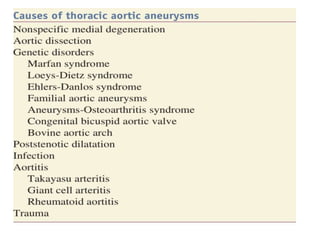
– Thoracic aortic aneurysms is estimated to
be 5.9 per 100,000 persons
– Abdominal aortic aneurysm (AAA), is
estimated to range from 3% to 10%.
(based on large screening studies)
Pathogenesis
Although these disparate pathologic processes
differ in biochemical and histologic terms, they
share the final common pathway of
progressive aortic expansion and eventual
rupture.
Hemodynamic factors clearly contribute to the
process of aortic dilatation.
The vicious cycle of increasing diameter and
increasing wall tension, as characterized by
Laplace’s law
– (tension = pressure × radius), is well established.
Turbulent blood flow is also recognized as a factor.
– Poststenotic aortic dilatation, for example, occurs in
some patients with aortic valve stenosis or coarctation
of the descending thoracic aorta.
• Hemodynamic derangements, however, are only
one piece of a complex puzzle
Molecular mechanisms of aortic wall
degeneration and dilatation.
– For example, imbalances between proteolytic
enzymes (e.g., matrix metalloproteinases) and
their inhibitors contribute to abdominal aortic
aneurysm formation
Thoracic aorta aneurysm
Nice to know
 Marfan syndrome :
 Marfan syndrome typically includes a tall stature, high palate, joint hypermobility, eye
lens disorders, mitral valve prolapse, and aortic aneurysms.
 The aortic wall is weakened by fragmentation of elastic fibers and deposition of
extensive amounts of mucopolysaccharides (a process previously called cystic medial
degeneration or cystic medial necrosis).
 Patients with Marfan syndrome have a mutation in the fibrillin gene located on the long
arm of chromosome 15.
 Loeys-Dietz syndrome:
 triad of arterial tortuosity and aneurysms, hypertelorism (widely spaced eyes), and bifid
uvula or cleft palate.
 young children—are at increased risk of aortic rupture and aortic dissection
 Ehlers-Danlos syndrome:
 defect in type III collagen synthesis, which can have life-threatening cardiovascular
manifestations.
 Spontaneous arterial rupture, usually involving the mesenteric vessels
 Infection: most common causative organisms are Staphylococcus aureus,
Staphylococcus epidermidis, Salmonella, and Streptococcus
Clinical history
Thoracic aneurysms, which classically is characterized
as
– progressive aortic dilatation and
– Eventual dissection or rupture,
– Or both.
An analysis by Elefteriades of data from 1600 patients
with thoracic aortic disease has helped quantify these
well-recognized risks
• Average expansion rates were
– 0.07 cm/y in ascending aortic aneurysms and
– 0.19 cm/y in descending thoracic aortic aneurysms
• .)
Aortic diameter was a strong predictor of
rupture, dissection, and mortality.
– When thoracic aortic aneurysms >6 cm in
diameter, annual rates of catastrophic
complications were
• 3.6% for rupture, 3.7% for dissection, and 10.8% for
death.
– Critical diameters, at which the incidence of
expected complications significantly increased
• 6.0 cm for aneurysms of the ascending aorta and
• 7.0 cm for aneurysms of the descending thoracic
aorta;
– the corresponding risks of rupture after reaching these
diameters were 31% and 43%, respectively
• Aneurysms in patients with Marfan or Loeys-
Dietz syndrome dilate at an accelerated rate
and rupture or dissect at smaller diameters
than non–connective tissue disorder-related
aneurysm.
Clinical Manifestations
• Discovered incidentally when imaging studies
are performed for unrelated reasons.
– patients often are asymptomatic at the time of
diagnosis.
– Eventually create symptoms and signs that
correspond with the segment of aorta that is
involved, symptom ranging from
• Compression or erosion of adjacent structures,
• Aortic valve regurgitation,
• Distal embolism, and
• Rupture
Ascending aortic aneurysms is
– Anterior chest discomfort: the pain is frequently
precordial in location but may radiate to the neck and
jaw, mimicking angina
– Compression of the superior vena cava, the
pulmonary artery, the airway, or the sternum
• If aneurysms erode into the superior vena cava or right
atrium, causing acute high-output failure.
– Aortic valve regurgitation:
• displacement of the aortic valve commissures and
annular dilatation leading to progressive heart failure.
– Rupture:
• Severe anterior chest pain
• Bleed into pericardial space producing acute cardiac
tamponade and death
Descending thoracic and thoracoabdominal aneurysms:
– Frequent back pain localized between the scapulae.
– Thoracic or lumbar vertebral body erosion typically
causes severe, chronic back pain spinal instability and
neurologic deficits from spinal cord compression.
– various degrees of airway obstruction, manifesting as
cough, wheezing, stridor, or pneumonitis.
– Pulmonary or airway erosion presents as hemoptysis.
– Compression and erosion of the esophagus cause
dysphagia and hematemesis, respectively.
– Thoracoabdominal aortic aneurysms can cause duodenal
obstruction.
– Thrombus may embolize distally, causing occlusion
and thrombosis of the visceral, renal, or lower
extremity branches.
• Rupture
– Severe Upper back or left chest (descending thoracic
aorta),
– Severe Left flank or abdomen (thoracoabdominal
aorta.
– Descending thoracic aortic aneurysms rupture into
the pleural cavity, producing a combination of
severe hemorrhagic shock and respiratory
compromise.
• Diagnosis
• Plain radiograph: CXRs may reveal
– Convexity in the right superior mediastinum,
– Loss of the retrosternal space, or
– Widening of the descending thoracic aortic shadow,
which may be highlighted by a rim of calcification
outlining the dilated aneurysmal aortic wall.
Echocardiography :
– Transthoracic and Transesophageal echocardiography
provide excellent visualization of the ascending aorta,
including the aortic root.
– Transesophageal echocardiography also allows
visualization of the descending thoracic aorta but is not
ideal for evaluating the transverse aortic arch (which is
obscured by air in the tracheobronchial tree) or the upper
abdominal aorta.
Computed Tomography. (CT) scanning is
– Widely available,
– Provides visualization of the entire thoracic and
abdominal aorta, and
– Permits multiplanar and 3-dimensional aortic
reconstructions.
– Most common—and arguably the most useful—
imaging modality for evaluating thoracic aortic
aneurysm
major disadvantage of CECT scanning is the
possibility of contrast-induced acute renal failure.
If possible, surgery is performed ≥1 day after contrast
administration to allow time to observe renal function and to
permit diuresis of the contrast agent
• CT provides information about
– Aneurysm’s location, extent, anatomic anomalies,
and relationship to major branch vessels. detects
aortic calcification.
– Contrast-enhanced CT provides information about
• the aortic lumen and
• can detect mural thrombus,
• aortic dissection,
• inflammatory periaortic fibrosis,
• mediastinal or retroperitoneal hematoma due to
contained aortic rupture
Magnetic Resonance Angiography:
excellent visualization of branch vessel details,
and it is useful in detecting branch vessel
stenosis.
MRA is limited by
– high expense and
– susceptibility to artifacts created by ferromagnetic
materials
– Gadolinium be linked to nephrogenic systemic
fibrosis and acute renal failure in patients with
advanced renal insufficiency
Treatment
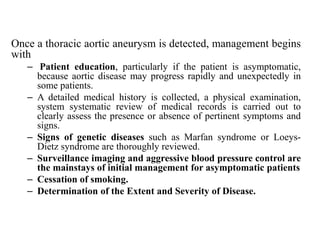
Once a thoracic aortic aneurysm is detected, management begins
with
– Patient education, particularly if the patient is asymptomatic,
because aortic disease may progress rapidly and unexpectedly in
some patients.
– A detailed medical history is collected, a physical examination,
system systematic review of medical records is carried out to
clearly assess the presence or absence of pertinent symptoms and
signs.
– Signs of genetic diseases such as Marfan syndrome or Loeys-
Dietz syndrome are thoroughly reviewed.
– Surveillance imaging and aggressive blood pressure control are
the mainstays of initial management for asymptomatic patients
– Cessation of smoking.
– Determination of the Extent and Severity of Disease.
Indications for Operation
Thoracic aortic aneurysms are repaired to
prevent fatal rupture.
practice guidelines for thoracic aortic disease
recommend elective operation
1. Asymptomatic patients when the diameter of an
ascending aortic aneurysm is >5.5 cm, when the
diameter of a descending thoracic aortic aneurysm is
>6.0 cm, or when the rate of dilatation is >0.5 cm/y
2. In patients with connective tissue disorders such as
Marfan and Loeys-Dietz syndromes, the threshold for
operation is based on a smaller aortic diameter (4.0–5.0
cm for the ascending aorta and 5.5 to 6.0 cm for the
descending thoracic aorta
3. For women with connective tissue disorders who are
considering pregnancy, prophylactic aortic root
replacement is considered because the risk of aortic
dissection or rupture increases at an aortic diameter of
4.0 cm or greater.
4. For low risk patients with chronic aortic dissection,
descending thoracic repair is recommended at an aortic
diameter of 5.5 cm or greater.
5. For patients undergoing aortic valve replacement or repair,
smaller ascending aortic aneurysms (>4.5 cm) are considered
for concomitant repair.
6. patients who present with symptoms may need urgent
operation. Symptomatic patients are at increased risk of
rupture and warrant expeditious evaluation.
7. The onset of new pain in patients with known aneurysms
is especially concerning, because it may herald significant
expansion, leakage, or impending rupture.
Preoperative Assessment and
Preparation
All patients undergo a thorough evaluation—with emphasis on cardiac,
pulmonary, and renal function—before undergoing elective surgery.
Cardiac Evaluation:
– Transthoracic echocardiography is a satisfactory noninvasive
method for evaluating both valvular and biventricular function.
– Dipyridamole-thallium myocardial scanning identifies regions of
myocardium that have reversible ischemia.
– Cardiac catheterization and coronary arteriography are performed
in patients who have evidence of coronary disease—as indicated by
either the patient’s history or the results of noninvasive studies or
who have a left ventricular ejection fraction of ≤30%.
• If significant valvular or coronary artery disease is identified before a
proximal aortic operation, the disease can be addressed directly during the
procedure
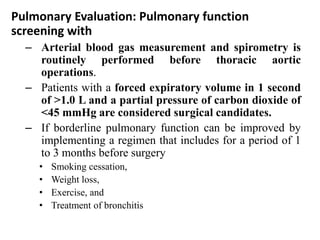
Pulmonary Evaluation: Pulmonary function
screening with
– Arterial blood gas measurement and spirometry is
routinely performed before thoracic aortic
operations.
– Patients with a forced expiratory volume in 1 second
of >1.0 L and a partial pressure of carbon dioxide of
<45 mmHg are considered surgical candidates.
– If borderline pulmonary function can be improved by
implementing a regimen that includes for a period of 1
to 3 months before surgery
• Smoking cessation,
• Weight loss,
• Exercise, and
• Treatment of bronchitis
surgery is not withheld from patients with symptomatic aortic
aneurysms and poor pulmonary function, adjustments in operative
technique should be made to maximize these patients’ chances of
recovery.
Renal Evaluation:
Renal function is assessed
– preoperatively by measuring serum electrolyte,
blood urea nitrogen, and creatinine levels.
– Information about kidney size and perfusion can be
obtained from the imaging studies used to
evaluate the aorta
Operative Repair
• Open Repair
• Endovascular Repair: Practice guidelines
recommend that endovascular repair be strongly
considered for
– Patients with descending thoracic aneurysm at an
aortic diameter of 5.5 cm (which is slightly below the
6.0-cm threshold for open repair).
– The proximal and distal neck diameters should fall
within a range that will allow proper sealing. Also,
– The proximal and distal landing zones should ideally
be at least 20 mm long so that an appropriate seal
can be made.
Proximal Thoracic Aortic Aneurysms
Open Repair:
– Traditional open operations to repair proximal
aortic aneurysms—which involve the ascending
aorta, transverse aortic arch, or both
– Are performed through a midsternal incision and
– It require cardiopulmonary bypass.
– The best choice of aortic replacement technique
depends on the extent of the aneurysm and the
condition of the aortic valve
Endovascular Repair:
Experience with purely endovascular treatment of
proximal aortic disease remains limited and only
investigational.
• In 1999, Inoue and colleagues reported placing
a triple-branched stent graft in a patient with an
aneurysm of the aortic arch.
– The three brachiocephalic branches were positioned
by placing percutaneous wires in the right brachial,
left carotid, and left brachial arteries.
Hybrid Repair:
• hybrid repairs of the aortic arch have entered
the mainstream clinical arena, although they
remain controversial.
• Hybrid arch repairs involve some form of
“debranching” of the brachiocephalic vessels
(which are not unlike Y-graft approaches),
followed by endovascular exclusion of some or
all of the aortic arch
• Advantage: of using a hybrid approach to treat
aortic arch aneurysms include
– The elimination of cardiopulmonary bypass,
circulatory arrest, and cardiac ischemia.
• Disadvantage: Procedure-related risks include
the
– Risk of embolization and stroke due to wire and
device manipulation within the aortic arch
– Retrograde acute aortic dissection,
– Type I endoleak
– Paraplegia
Distal Thoracic Aortic Aneurysms
• Open Repair: Surgical repair of
thoracoabdominal aortic aneurysms is
categorized by the extent of aortic
replacement according to the Crawford
classification scheme
• Extent I thoracoabdominal aortic aneurysm
repairs involve most of the descending thoracic
aorta, usually beginning near the left subclavian
artery, and extend down into the suprarenal
abdominal aorta.
• Extent II repairs also begin near the left
subclavian artery but extend distally into the
infrarenal abdominal aorta, and they often reach
the aortic bifurcation.
• Extent III repairs extend from the lower
descending thoracic aorta (below the sixth rib)
and into the abdomen.
• Extent IV repairs begin at the diaphragmatic
hiatus and often involve the entire abdominal
aorta
Open repair
• Descending thoracic aortic aneurysms are repaired
through a left thoracotomy.
• Transperitoneal exposure of the thoracoabdominal
aorta is achieved by performing medial visceral
rotation and circumferential division of the
diaphragm
• During a period of aortic clamping, the diseased
segment is replaced with a polyester tube graft.
Important branch arteries—including intercostal
arteries and the celiac, superior mesenteric, and renal
arteries— are reattached to openings made in the
side of the graft
• Clamping the descending thoracic aorta causes
ischemia of the spinal cord and abdominal
viscera.
• Clinically significant manifestations of hepatic,
pancreatic, and bowel ischemia are relatively
uncommon.
• However, both acute renal failure and spinal
cord injury resulting in paraplegia or
paraparesis remain major causes of morbidity
and mortality after these
• Other complication:
– Extensive repairs is pulmonary dysfunction
– Left subclavian artery, the vagus and left recurrent
laryngeal nerves are often adherent to the aortic
wall and thus are susceptible to injury
– Vocal cord paralysis
– Injury to the esophagus during the proximal
anastomosis can have catastrophic consequences.
– clamping proximal to the left subclavian artery can
precipitate severe myocardial ischemia and
cardiac arrest
• Endovascular Repair
– Become an accepted treatment option for
selected patient
– Elderly patients with severe comorbidity and
patients who have undergone previous complex
thoracic aortic procedures.
Postoperative Considerations
Open Procedures
• Aortic anastomoses are often extremely fragile during the early
postoperative period. Even brief episodes of postoperative
hypertension can disrupt suture lines and precipitate severe
bleeding or pseudoaneurysm formation. Therefore, during the
initial 24 to 48 hours, meticulous blood pressure control is
maintained to protect the integrity of the anastomoses. Generally,
we liberally use IV vasoactive agents to keep the mean arterial
blood pressure between 80 and
• 90 mmHg. In patients with extremely friable aortic tissue, such as
those with Marfan syndrome, we lower the target range to
• between 70 and 80 mmHg
Endovascular Aneurism Repair (EVAR)
• First reported by Parodi and colleagues in 1991
• Widely adopted since the first Food and Drug
Administration (FDA)–approved devices for EVAR,
the AneuRx (Medtronic, Minneapolis, Minn) and
the Ancure (Guidant Corporation, Menlo Park,
Calif), became available in 1999
• EVAR more frequently performed in recent years
than open surgical repair for aneurysms with
suitable anatomy.
• EVAR has advantage.
– Shorter length of stay,
– Lower 30-day morbidity and mortality Does not improve quality of life beyond 3
months or survival beyond 2 years
• Early, periprocedural complications include
– Endoleak; access-related complications, which occur in up to 3% of cases.
– Hematoma,
– Pseudoaneurysm,
– Arterial occlusion or dissection, and Iliac artery rupture or transection;
– Peripheral embolization;
– Renal insufficiency;
– Local wound complications;
– Inadvertentrenal or hypogastric artery occlusion; and
– Rare occurrences, such as colon or spine ischemia
Late complication
– Rupture, which occurs rarely but at a higher rate than after open repair;
– Graft limb occlusion;
– Endoleak or sac enlargement
– Graft infections
Endoleak
• An endoleak occurs when there is a persistent
flow of blood (visible on radiologic imaging)
into the aneurysm sac, and it may occur during
the initial procedure or develop over time.
• A relatively common complication.
• They are not benign, because they lead to
continual pressurization of the sac, which can
cause expansion or even rupture.
Enodleak
To be continued………

Aneurysm & THORACIC ANEURYSM

  • 1.
  • 2.
    • A rtd.Colnel, chronic smoker presented to ER of chronic chest pain • His vitals and ECG changes were with in normal ranges. • Admitted for observation and evaluation, and was planned for discharged. • On very next day, while doing his daily chores, his symptom reoccurred, even worst and, this time he couldn’t even make to hospital. • Retrospectively, on autopsy he had massive haemothorax secondary rupture aortic aneurysm
  • 4.
    Histology • Normal aortaderives its elasticity and tensile strength from the medial layer, which contains approximately 45 to 55 lamellae of elastin, collagen, smooth muscle cells, and ground substance. • Elastin content is highest within the ascending aorta, as would be expected because of its compliant nature, and decreases distally into the descending and abdominal aorta. • Maintenance of the aortic matrix involves complex interactions among smooth muscle cells, macrophages, proteases, and protease inhibitors. • Any alteration in this delicate balance can lead to aortic disease
  • 8.
    Aortic aneurysm Defined asa permanent, localized dilatation of the aorta to a diameter that is at least 50% greater than is normal at that anatomic level.
  • 9.
    CLASSIFICATION ANATOMICALLY: 1. True aneurysm:Involve all three layers of the vessel wall I. Fusiform aneurysms are more common and can be described as symmetrical, smooth, circumferential dilatations of the aorta. II. Saccular aneurysms are localized outpouchings of the aorta. 2. False aneurysms: also called pseudoaneurysms, are leaks in the aortic wall that are contained by the outer layer of the aorta and/or the periaortic tissue; they are caused by disruption of the aortic wall and lead blood to collect in pouches of fibrotic tissue.
  • 11.
    Incidence • May occuranywhere along the aorta, from the aortic root to the bifurcation. Incidence – Thoracic aortic aneurysms is estimated to be 5.9 per 100,000 persons – Abdominal aortic aneurysm (AAA), is estimated to range from 3% to 10%. (based on large screening studies)
  • 12.
    Pathogenesis Although these disparatepathologic processes differ in biochemical and histologic terms, they share the final common pathway of progressive aortic expansion and eventual rupture.
  • 13.
    Hemodynamic factors clearlycontribute to the process of aortic dilatation. The vicious cycle of increasing diameter and increasing wall tension, as characterized by Laplace’s law – (tension = pressure × radius), is well established. Turbulent blood flow is also recognized as a factor. – Poststenotic aortic dilatation, for example, occurs in some patients with aortic valve stenosis or coarctation of the descending thoracic aorta. • Hemodynamic derangements, however, are only one piece of a complex puzzle
  • 14.
    Molecular mechanisms ofaortic wall degeneration and dilatation. – For example, imbalances between proteolytic enzymes (e.g., matrix metalloproteinases) and their inhibitors contribute to abdominal aortic aneurysm formation
  • 15.
  • 17.
    Nice to know Marfan syndrome :  Marfan syndrome typically includes a tall stature, high palate, joint hypermobility, eye lens disorders, mitral valve prolapse, and aortic aneurysms.  The aortic wall is weakened by fragmentation of elastic fibers and deposition of extensive amounts of mucopolysaccharides (a process previously called cystic medial degeneration or cystic medial necrosis).  Patients with Marfan syndrome have a mutation in the fibrillin gene located on the long arm of chromosome 15.  Loeys-Dietz syndrome:  triad of arterial tortuosity and aneurysms, hypertelorism (widely spaced eyes), and bifid uvula or cleft palate.  young children—are at increased risk of aortic rupture and aortic dissection  Ehlers-Danlos syndrome:  defect in type III collagen synthesis, which can have life-threatening cardiovascular manifestations.  Spontaneous arterial rupture, usually involving the mesenteric vessels  Infection: most common causative organisms are Staphylococcus aureus, Staphylococcus epidermidis, Salmonella, and Streptococcus
  • 18.
    Clinical history Thoracic aneurysms,which classically is characterized as – progressive aortic dilatation and – Eventual dissection or rupture, – Or both. An analysis by Elefteriades of data from 1600 patients with thoracic aortic disease has helped quantify these well-recognized risks • Average expansion rates were – 0.07 cm/y in ascending aortic aneurysms and – 0.19 cm/y in descending thoracic aortic aneurysms • .)
  • 19.
    Aortic diameter wasa strong predictor of rupture, dissection, and mortality. – When thoracic aortic aneurysms >6 cm in diameter, annual rates of catastrophic complications were • 3.6% for rupture, 3.7% for dissection, and 10.8% for death. – Critical diameters, at which the incidence of expected complications significantly increased • 6.0 cm for aneurysms of the ascending aorta and • 7.0 cm for aneurysms of the descending thoracic aorta; – the corresponding risks of rupture after reaching these diameters were 31% and 43%, respectively
  • 20.
    • Aneurysms inpatients with Marfan or Loeys- Dietz syndrome dilate at an accelerated rate and rupture or dissect at smaller diameters than non–connective tissue disorder-related aneurysm.
  • 21.
    Clinical Manifestations • Discoveredincidentally when imaging studies are performed for unrelated reasons. – patients often are asymptomatic at the time of diagnosis. – Eventually create symptoms and signs that correspond with the segment of aorta that is involved, symptom ranging from • Compression or erosion of adjacent structures, • Aortic valve regurgitation, • Distal embolism, and • Rupture
  • 22.
    Ascending aortic aneurysmsis – Anterior chest discomfort: the pain is frequently precordial in location but may radiate to the neck and jaw, mimicking angina – Compression of the superior vena cava, the pulmonary artery, the airway, or the sternum • If aneurysms erode into the superior vena cava or right atrium, causing acute high-output failure. – Aortic valve regurgitation: • displacement of the aortic valve commissures and annular dilatation leading to progressive heart failure. – Rupture: • Severe anterior chest pain • Bleed into pericardial space producing acute cardiac tamponade and death
  • 23.
    Descending thoracic andthoracoabdominal aneurysms: – Frequent back pain localized between the scapulae. – Thoracic or lumbar vertebral body erosion typically causes severe, chronic back pain spinal instability and neurologic deficits from spinal cord compression. – various degrees of airway obstruction, manifesting as cough, wheezing, stridor, or pneumonitis. – Pulmonary or airway erosion presents as hemoptysis. – Compression and erosion of the esophagus cause dysphagia and hematemesis, respectively. – Thoracoabdominal aortic aneurysms can cause duodenal obstruction.
  • 24.
    – Thrombus mayembolize distally, causing occlusion and thrombosis of the visceral, renal, or lower extremity branches. • Rupture – Severe Upper back or left chest (descending thoracic aorta), – Severe Left flank or abdomen (thoracoabdominal aorta. – Descending thoracic aortic aneurysms rupture into the pleural cavity, producing a combination of severe hemorrhagic shock and respiratory compromise.
  • 25.
  • 26.
    • Plain radiograph:CXRs may reveal – Convexity in the right superior mediastinum, – Loss of the retrosternal space, or – Widening of the descending thoracic aortic shadow, which may be highlighted by a rim of calcification outlining the dilated aneurysmal aortic wall.
  • 27.
    Echocardiography : – Transthoracicand Transesophageal echocardiography provide excellent visualization of the ascending aorta, including the aortic root. – Transesophageal echocardiography also allows visualization of the descending thoracic aorta but is not ideal for evaluating the transverse aortic arch (which is obscured by air in the tracheobronchial tree) or the upper abdominal aorta.
  • 28.
    Computed Tomography. (CT)scanning is – Widely available, – Provides visualization of the entire thoracic and abdominal aorta, and – Permits multiplanar and 3-dimensional aortic reconstructions. – Most common—and arguably the most useful— imaging modality for evaluating thoracic aortic aneurysm major disadvantage of CECT scanning is the possibility of contrast-induced acute renal failure. If possible, surgery is performed ≥1 day after contrast administration to allow time to observe renal function and to permit diuresis of the contrast agent
  • 29.
    • CT providesinformation about – Aneurysm’s location, extent, anatomic anomalies, and relationship to major branch vessels. detects aortic calcification. – Contrast-enhanced CT provides information about • the aortic lumen and • can detect mural thrombus, • aortic dissection, • inflammatory periaortic fibrosis, • mediastinal or retroperitoneal hematoma due to contained aortic rupture
  • 31.
    Magnetic Resonance Angiography: excellentvisualization of branch vessel details, and it is useful in detecting branch vessel stenosis. MRA is limited by – high expense and – susceptibility to artifacts created by ferromagnetic materials – Gadolinium be linked to nephrogenic systemic fibrosis and acute renal failure in patients with advanced renal insufficiency
  • 32.
  • 33.
    Once a thoracicaortic aneurysm is detected, management begins with – Patient education, particularly if the patient is asymptomatic, because aortic disease may progress rapidly and unexpectedly in some patients. – A detailed medical history is collected, a physical examination, system systematic review of medical records is carried out to clearly assess the presence or absence of pertinent symptoms and signs. – Signs of genetic diseases such as Marfan syndrome or Loeys- Dietz syndrome are thoroughly reviewed. – Surveillance imaging and aggressive blood pressure control are the mainstays of initial management for asymptomatic patients – Cessation of smoking. – Determination of the Extent and Severity of Disease.
  • 34.
    Indications for Operation Thoracicaortic aneurysms are repaired to prevent fatal rupture. practice guidelines for thoracic aortic disease recommend elective operation
  • 35.
    1. Asymptomatic patientswhen the diameter of an ascending aortic aneurysm is >5.5 cm, when the diameter of a descending thoracic aortic aneurysm is >6.0 cm, or when the rate of dilatation is >0.5 cm/y 2. In patients with connective tissue disorders such as Marfan and Loeys-Dietz syndromes, the threshold for operation is based on a smaller aortic diameter (4.0–5.0 cm for the ascending aorta and 5.5 to 6.0 cm for the descending thoracic aorta 3. For women with connective tissue disorders who are considering pregnancy, prophylactic aortic root replacement is considered because the risk of aortic dissection or rupture increases at an aortic diameter of 4.0 cm or greater.
  • 36.
    4. For lowrisk patients with chronic aortic dissection, descending thoracic repair is recommended at an aortic diameter of 5.5 cm or greater. 5. For patients undergoing aortic valve replacement or repair, smaller ascending aortic aneurysms (>4.5 cm) are considered for concomitant repair. 6. patients who present with symptoms may need urgent operation. Symptomatic patients are at increased risk of rupture and warrant expeditious evaluation. 7. The onset of new pain in patients with known aneurysms is especially concerning, because it may herald significant expansion, leakage, or impending rupture.
  • 37.
    Preoperative Assessment and Preparation Allpatients undergo a thorough evaluation—with emphasis on cardiac, pulmonary, and renal function—before undergoing elective surgery. Cardiac Evaluation: – Transthoracic echocardiography is a satisfactory noninvasive method for evaluating both valvular and biventricular function. – Dipyridamole-thallium myocardial scanning identifies regions of myocardium that have reversible ischemia. – Cardiac catheterization and coronary arteriography are performed in patients who have evidence of coronary disease—as indicated by either the patient’s history or the results of noninvasive studies or who have a left ventricular ejection fraction of ≤30%. • If significant valvular or coronary artery disease is identified before a proximal aortic operation, the disease can be addressed directly during the procedure
  • 38.
    Pulmonary Evaluation: Pulmonaryfunction screening with – Arterial blood gas measurement and spirometry is routinely performed before thoracic aortic operations. – Patients with a forced expiratory volume in 1 second of >1.0 L and a partial pressure of carbon dioxide of <45 mmHg are considered surgical candidates. – If borderline pulmonary function can be improved by implementing a regimen that includes for a period of 1 to 3 months before surgery • Smoking cessation, • Weight loss, • Exercise, and • Treatment of bronchitis
  • 39.
    surgery is notwithheld from patients with symptomatic aortic aneurysms and poor pulmonary function, adjustments in operative technique should be made to maximize these patients’ chances of recovery. Renal Evaluation: Renal function is assessed – preoperatively by measuring serum electrolyte, blood urea nitrogen, and creatinine levels. – Information about kidney size and perfusion can be obtained from the imaging studies used to evaluate the aorta
  • 40.
    Operative Repair • OpenRepair • Endovascular Repair: Practice guidelines recommend that endovascular repair be strongly considered for – Patients with descending thoracic aneurysm at an aortic diameter of 5.5 cm (which is slightly below the 6.0-cm threshold for open repair). – The proximal and distal neck diameters should fall within a range that will allow proper sealing. Also, – The proximal and distal landing zones should ideally be at least 20 mm long so that an appropriate seal can be made.
  • 41.
    Proximal Thoracic AorticAneurysms Open Repair: – Traditional open operations to repair proximal aortic aneurysms—which involve the ascending aorta, transverse aortic arch, or both – Are performed through a midsternal incision and – It require cardiopulmonary bypass. – The best choice of aortic replacement technique depends on the extent of the aneurysm and the condition of the aortic valve
  • 44.
    Endovascular Repair: Experience withpurely endovascular treatment of proximal aortic disease remains limited and only investigational. • In 1999, Inoue and colleagues reported placing a triple-branched stent graft in a patient with an aneurysm of the aortic arch. – The three brachiocephalic branches were positioned by placing percutaneous wires in the right brachial, left carotid, and left brachial arteries.
  • 45.
    Hybrid Repair: • hybridrepairs of the aortic arch have entered the mainstream clinical arena, although they remain controversial. • Hybrid arch repairs involve some form of “debranching” of the brachiocephalic vessels (which are not unlike Y-graft approaches), followed by endovascular exclusion of some or all of the aortic arch
  • 47.
    • Advantage: ofusing a hybrid approach to treat aortic arch aneurysms include – The elimination of cardiopulmonary bypass, circulatory arrest, and cardiac ischemia. • Disadvantage: Procedure-related risks include the – Risk of embolization and stroke due to wire and device manipulation within the aortic arch – Retrograde acute aortic dissection, – Type I endoleak – Paraplegia
  • 48.
    Distal Thoracic AorticAneurysms • Open Repair: Surgical repair of thoracoabdominal aortic aneurysms is categorized by the extent of aortic replacement according to the Crawford classification scheme
  • 51.
    • Extent Ithoracoabdominal aortic aneurysm repairs involve most of the descending thoracic aorta, usually beginning near the left subclavian artery, and extend down into the suprarenal abdominal aorta. • Extent II repairs also begin near the left subclavian artery but extend distally into the infrarenal abdominal aorta, and they often reach the aortic bifurcation.
  • 52.
    • Extent IIIrepairs extend from the lower descending thoracic aorta (below the sixth rib) and into the abdomen. • Extent IV repairs begin at the diaphragmatic hiatus and often involve the entire abdominal aorta
  • 53.
    Open repair • Descendingthoracic aortic aneurysms are repaired through a left thoracotomy. • Transperitoneal exposure of the thoracoabdominal aorta is achieved by performing medial visceral rotation and circumferential division of the diaphragm • During a period of aortic clamping, the diseased segment is replaced with a polyester tube graft. Important branch arteries—including intercostal arteries and the celiac, superior mesenteric, and renal arteries— are reattached to openings made in the side of the graft
  • 54.
    • Clamping thedescending thoracic aorta causes ischemia of the spinal cord and abdominal viscera. • Clinically significant manifestations of hepatic, pancreatic, and bowel ischemia are relatively uncommon. • However, both acute renal failure and spinal cord injury resulting in paraplegia or paraparesis remain major causes of morbidity and mortality after these
  • 55.
    • Other complication: –Extensive repairs is pulmonary dysfunction – Left subclavian artery, the vagus and left recurrent laryngeal nerves are often adherent to the aortic wall and thus are susceptible to injury – Vocal cord paralysis – Injury to the esophagus during the proximal anastomosis can have catastrophic consequences. – clamping proximal to the left subclavian artery can precipitate severe myocardial ischemia and cardiac arrest
  • 57.
    • Endovascular Repair –Become an accepted treatment option for selected patient – Elderly patients with severe comorbidity and patients who have undergone previous complex thoracic aortic procedures.
  • 59.
    Postoperative Considerations Open Procedures •Aortic anastomoses are often extremely fragile during the early postoperative period. Even brief episodes of postoperative hypertension can disrupt suture lines and precipitate severe bleeding or pseudoaneurysm formation. Therefore, during the initial 24 to 48 hours, meticulous blood pressure control is maintained to protect the integrity of the anastomoses. Generally, we liberally use IV vasoactive agents to keep the mean arterial blood pressure between 80 and • 90 mmHg. In patients with extremely friable aortic tissue, such as those with Marfan syndrome, we lower the target range to • between 70 and 80 mmHg
  • 60.
    Endovascular Aneurism Repair(EVAR) • First reported by Parodi and colleagues in 1991 • Widely adopted since the first Food and Drug Administration (FDA)–approved devices for EVAR, the AneuRx (Medtronic, Minneapolis, Minn) and the Ancure (Guidant Corporation, Menlo Park, Calif), became available in 1999 • EVAR more frequently performed in recent years than open surgical repair for aneurysms with suitable anatomy.
  • 61.
    • EVAR hasadvantage. – Shorter length of stay, – Lower 30-day morbidity and mortality Does not improve quality of life beyond 3 months or survival beyond 2 years • Early, periprocedural complications include – Endoleak; access-related complications, which occur in up to 3% of cases. – Hematoma, – Pseudoaneurysm, – Arterial occlusion or dissection, and Iliac artery rupture or transection; – Peripheral embolization; – Renal insufficiency; – Local wound complications; – Inadvertentrenal or hypogastric artery occlusion; and – Rare occurrences, such as colon or spine ischemia Late complication – Rupture, which occurs rarely but at a higher rate than after open repair; – Graft limb occlusion; – Endoleak or sac enlargement – Graft infections
  • 62.
    Endoleak • An endoleakoccurs when there is a persistent flow of blood (visible on radiologic imaging) into the aneurysm sac, and it may occur during the initial procedure or develop over time. • A relatively common complication. • They are not benign, because they lead to continual pressurization of the sac, which can cause expansion or even rupture.
  • 63.
  • 65.