Dr. BIKASH CHANDRA SAH
JR (2ND YEAR)
Content….
• Embryology
• Anatomy
• Physiology
• Pathology
• Treatment
Embryology .
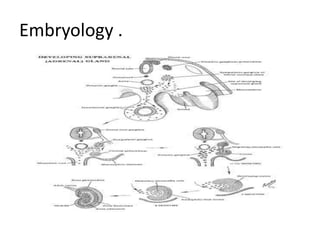
Embryology
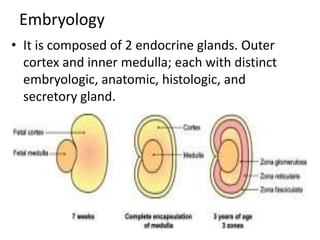
• It is composed of 2 endocrine glands. Outer
cortex and inner medulla; each with distinct
embryologic, anatomic, histologic, and
secretory gland.
Adrenal cortex:
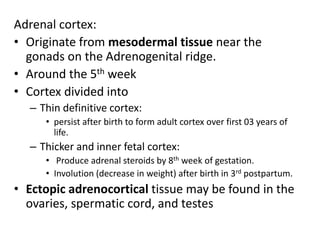
• Originate from mesodermal tissue near the
gonads on the Adrenogenital ridge.
• Around the 5th week
• Cortex divided into
– Thin definitive cortex:
• persist after birth to form adult cortex over first 03 years of
life.
– Thicker and inner fetal cortex:
• Produce adrenal steroids by 8th week of gestation.
• Involution (decrease in weight) after birth in 3rd postpartum.
• Ectopic adrenocortical tissue may be found in the
ovaries, spermatic cord, and testes
Adrenal medulla
• Ectodermal origin and
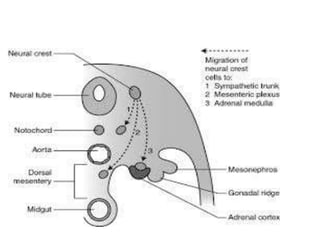
• Arises from neural crest 5th-6th WOG.
• Neural crest cells migrate to the paraaortic and
paravertebral areas and toward the medial aspect of
the developing cortex to form the medulla.
• Most extra-adrenal neural tissue regresses but may
persist at several sites.
– Adrenal medullary tissue also may be found in neck,
urinary bladder and para-aortic regions
• Some factors for adrenal development: IGF2; GIP;
dosage sensitve, sex reserve adrenal hypoplasia
(DAX1) gene.
Anatomy
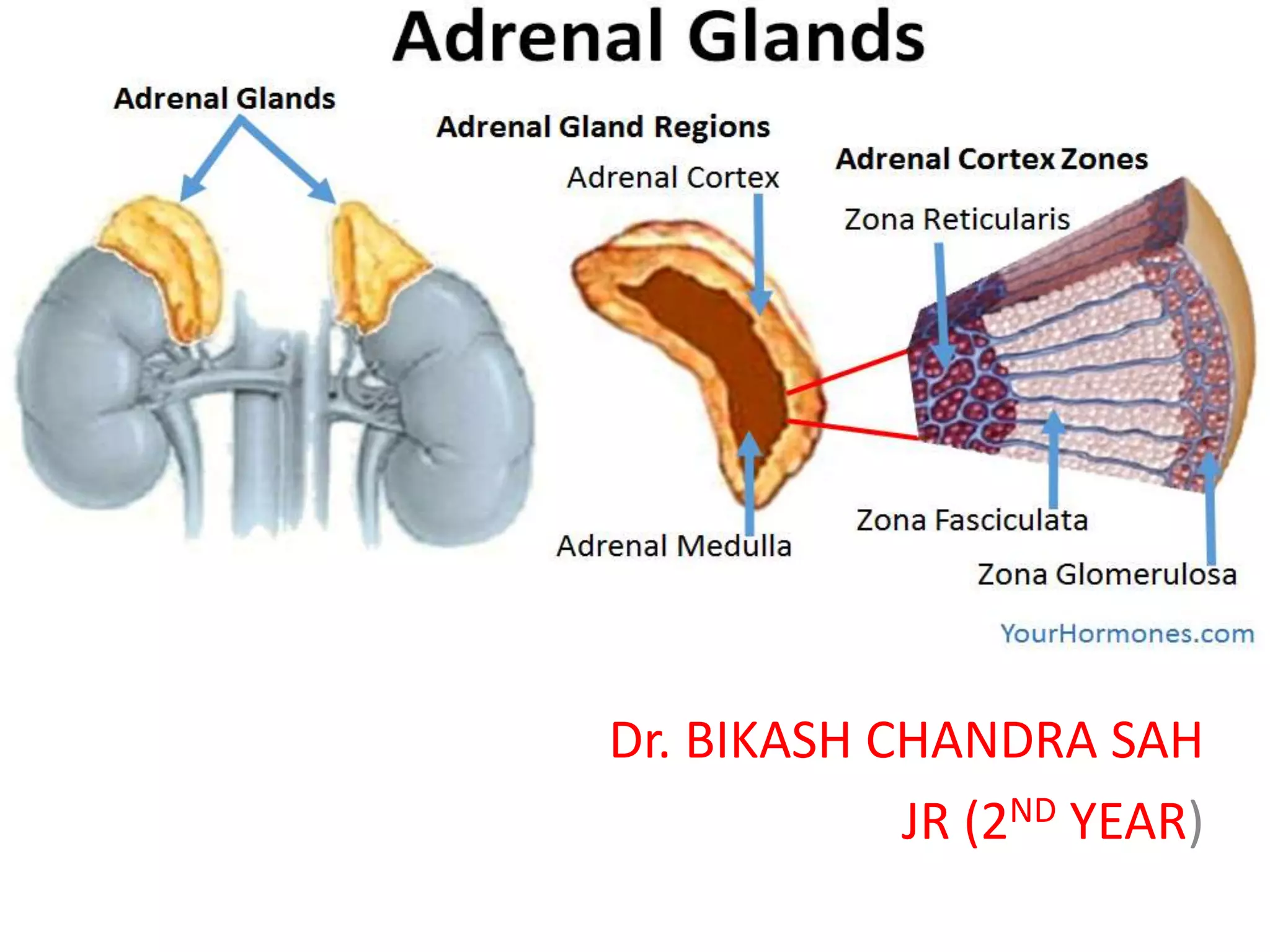
• Each kidney is caped by adrenal gland
• 2 Glands; Each 4 -5g.
• Right pyramidal.
• Left crescent shaped.
• Enclosed within Gerota’s( perirenal fascia)
• Composed of cortex and medulla.
• The adrenals are among the most highly perfused
organs in the body, receiving 2000 mL/kg/min of
blood, after only the kidney and thyroid.
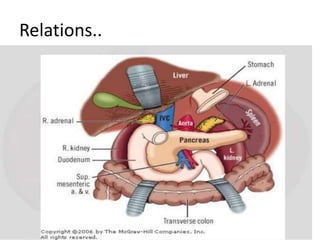
Relations..
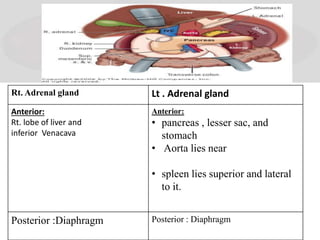
Rt. Adrenal gland Lt . Adrenal gland
Anterior:
Rt. lobe of liver and
inferior Venacava
Anterior:
• pancreas , lesser sac, and
stomach
• Aorta lies near
• spleen lies superior and lateral
to it.
Posterior :Diaphragm Posterior : Diaphragm
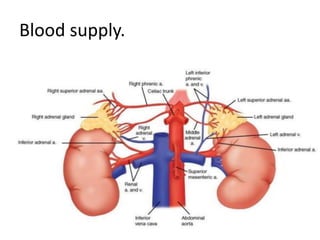
Blood supply.
Artery supply: 03 arteries
– Superior adrenal arteries derived from inferior
Phrenic artery
– Middle adrenal arteries derived from the aorta itself
– Inferior adrenal arteries derived from the renal
artery.
• Note: arteries divide into about 50 arterioles to form rich plexus
beneath glandular capsule require careful dissection and ligation
during adrenalectomy.
Lymphatics:
• The lymphatic vessels accompany the suprarenal vein and drain
into the lumbar lymph nodes.
Venous drainage:
– Right adrenal vein: short and drains into IVC
– Left adrenal vein: longer and empties into Lt
renal vein.
• Accessory vein:
– Rt side in 5-10% cases and drains into Rt. hepatic
or rt. renal vein.
– Lt accessory vein drains directly into lt. renal vein.
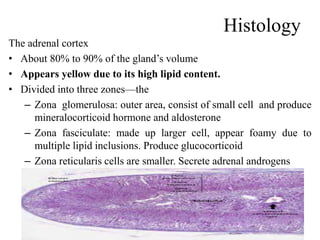
Histology
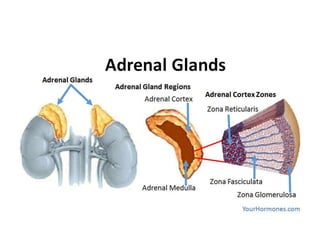
The adrenal cortex
• About 80% to 90% of the gland’s volume
• Appears yellow due to its high lipid content.
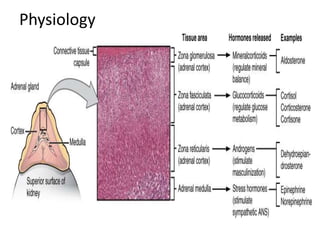
• Divided into three zones—the
– Zona glomerulosa: outer area, consist of small cell and produce
mineralocorticoid hormone and aldosterone
– Zona fasciculate: made up larger cell, appear foamy due to
multiple lipid inclusions. Produce glucocorticoid
– Zona reticularis cells are smaller. Secrete adrenal androgens
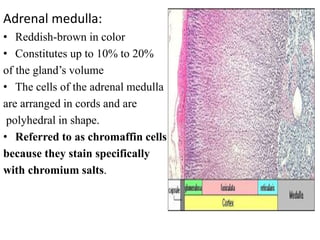
Adrenal medulla:
• Reddish-brown in color
• Constitutes up to 10% to 20%
of the gland’s volume
• The cells of the adrenal medulla
are arranged in cords and are
polyhedral in shape.
• Referred to as chromaffin cells
because they stain specifically
with chromium salts.
Physiology
• Adrenal cortex produce steroid hormones,
• Cholesterol being precursor are generally
derived from plasma or synthesized in adrenal
cortex
Mineralocorticoids
• Major mineralcorticoids are 11- deoxycorticosterone
(DOC), and cortisol
• Aldosterone secretion is regulated primarily by the
renin-angiotensin system.
– Renin release from juxtaglomerular cells are stimulated by
• Decreased renal blood flow,
• Decreased plasma sodium,
• Increased sympathetic tone
• Angiotensin II, not only a potent vasoconstrictor, but also leads to
increased aldosterone synthesis and release.
• Stimulator of aldosterone synthesis
– Hyperkalemia (potent,)
– whereas ACTH, pituitary pro-opiomelanocortin, and
antidiuretic hormone are weak stimulators.
Kinetics
• Secreted at a rate of 50 to 250 μg/d (depending on sodium intake)
• Circulates in plasma
– Chiefly as a complex with albumin.
• Small amounts of the hormone bind to corticosteroid-binding globulin, and
– Circulates in a free form approximately 30% to 50% of secreted
aldosterone.
• Half-life of only 15 to 20 minutes.
• Excretion: rapidly cleared via the liver and kidney.
– A small quantity of free aldosterone also is excreted in the urine also.
• Mechanism of action: Mineralocorticoids cross the cell membrane
and bind to cytosolic receptors. The receptor-ligand complex
subsequently is transported into the nucleus where it induces the
transcription and translation of specific genes.
• Function:
– Mainly to increase sodium reabsorption and
potassium and hydrogen ion excretion at the
level of the renal distal convoluted tubule.
– Less commonly, aldosterone increases sodium
absorption in salivary glands and GI mucosal
surfaces.
Glucocorticoids:
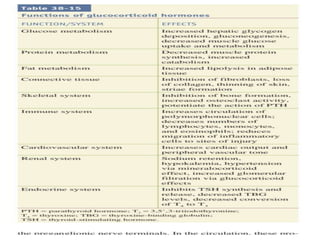
• Cortisol, major glucocorticoids
• Regulated by ACTH secreted by the anterior pituitary,
which, in turn.
• 39-amino-acid protein, which is derived by cleavage from a larger
precursor, pro-opiomelanocortin.
• Has trophic action for the adrenal glands.
• Secretion may be stimulated by pain, stress, hypoxia, hypothermia,
trauma, and hypoglycemia.
• Secretion fluctuates, peaking in the morning and reaching nadir
levels in the late afternoon.
• Shows a diurnal variation in the secretion of cortisol,
– Peak cortisol excretion also occurring in the early morning
and
– Declining during the day to its lowest levels in the evening.
Kinetics
• Circulation in plasma
– Bound primarily to corticosteroid-binding globulin (75%) and albumin
(15%).
– Approximately 10% of circulating freely and is the biologically active
component.
• Half-life : 60 to 90 minutes
– Determined by the extent of binding and rate of inactivation.
• Converted to di- and tetrahydrocortisol and cortisone metabolites in
the liver and the kidney.
• Excretion: The majority (95%) of cortisol and cortisone metabolites
are conjugated with glucuronic acid in the liver, thus facilitating their
renal excretion.
– A small amount of unmetabolized cortisol is excreted unchanged in the
urine
Mechanism of action:
• Glucocorticoid hormones enter the cell and bind
cytosolic steroid receptors. The activated receptor-
ligand complex is then transported to the nucleus
where it stimulates the transcription of specific
target genes via a “zinc finger” DNA binding
element.
• Cortisol also binds the mineralocorticoid
receptor with an affinity similar to aldosterone.
• However, the specificity of mineralocorticoid action
is maintained by the production of 11β-
hydroxysteroid dehydrogenase, an enzyme that
inactivates cortisol to cortisone in the kidney
Sex Steroids:
• Adrenal androgens are produced in the zona
fasciculata and reticularis from 17-
hydroxypregnenolone in response to ACTH
stimulation.
• They include
– Dehydroepiandrosterone (DHEA) and its sulfated
counterpart (DHEAS),
– Androstenedione, and
– Small amounts of testosterone and estrogen.
• Adrenal androgens are weakly bound to
plasma albumin.
• They exert their effects
– Major effects by peripheral conversion to the
more potent testosterone and dihydrotestosterone ,
– Also have weak intrinsic androgen activity.
• Androgen metabolites are conjugated as
glucuronides or sulfates.
• Excreted in the urine.
• Function:
– During fetal development, adrenal androgens
promote the formation of male genitalia.
– In normal adult males, the contribution of adrenal
androgens is minimal;
– They are responsible for the development of
secondary sexual characteristics at puberty.
– Adrenal androgen excess leads to
• Precocious puberty in boys and
• Virilization, acne, and hirsutism in girls and women.
Catecholamine
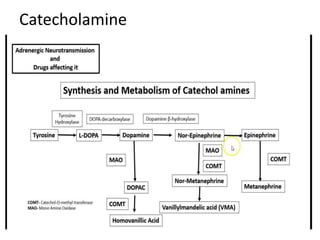
• Catecholamine hormones: Epinephrine,
norepinephrine, and dopamine
• Produced in
• In the central and sympathetic nervous system
• The adrenal medulla.
• The substrate, tyrosine, is converted to catecholamines via a
series of steps
• Phenylethanolamine N-methyltransferase, which converts
norepinephrine to epinephrine, is only present in the
adrenal medulla and the organ of Zuckerkandl.
– Chromogranins: When catecholamines are stored in
granules in combination with other neuropeptides, ATP,
calcium, magnesium, and water-soluble proteins called
Chromogranins.
Secretion stimulated by
• Various stress stimulus.
• And mediated by the release of acetylcholine at preganglionic nerve
terminals.
– In circulation: are bound to albumin and other proteins.
– Excretion: Catecholamines are cleared by several
mechanisms including
• Reuptake by sympathetic nerve endings,
• Peripheral inactivation by catechol O-methyltransferase and
monoamine oxidase, and
• Direct excretion by the kidneys.
•
– Metabolism:
• Takes place primarily in the liver and kidneys.
• Leads to the formation of metabolites such as metanephrines,
normetanephrines, and VMA.
• which may undergo further glucuronidation or sulfation
before being excreted in the urine
Metabolism:
• Takes place primarily in the liver and kidneys.
• Leads to the formation of metabolites such as
metanephrines, normetanephrines, and VMA.
• which may undergo further glucuronidation or
sulfation before being excreted in the urine
Mechanism of action:
– Adrenergic receptors are transmembrane-spanning
molecules that are coupled to G proteins.
– Subdivided into α and β subtypes.
• The receptor affinities for
• α receptors are—epinephrine > norepinephrine>>
isoproterenol;
• β1 receptors—isoproterenol > epinephrine =
norepinephrine; ands
• β2 receptors—isoproterenol > epinephrine >>
norepinephrine.
•
Adrenal Gland- Basic.

Adrenal Gland- Basic.

  • 1.
    Dr. BIKASH CHANDRASAH JR (2ND YEAR)
  • 2.
    Content…. • Embryology • Anatomy •Physiology • Pathology • Treatment
  • 3.
  • 4.
    Embryology • It iscomposed of 2 endocrine glands. Outer cortex and inner medulla; each with distinct embryologic, anatomic, histologic, and secretory gland.
  • 5.
    Adrenal cortex: • Originatefrom mesodermal tissue near the gonads on the Adrenogenital ridge. • Around the 5th week • Cortex divided into – Thin definitive cortex: • persist after birth to form adult cortex over first 03 years of life. – Thicker and inner fetal cortex: • Produce adrenal steroids by 8th week of gestation. • Involution (decrease in weight) after birth in 3rd postpartum. • Ectopic adrenocortical tissue may be found in the ovaries, spermatic cord, and testes
  • 6.
    Adrenal medulla • Ectodermalorigin and • Arises from neural crest 5th-6th WOG. • Neural crest cells migrate to the paraaortic and paravertebral areas and toward the medial aspect of the developing cortex to form the medulla. • Most extra-adrenal neural tissue regresses but may persist at several sites. – Adrenal medullary tissue also may be found in neck, urinary bladder and para-aortic regions • Some factors for adrenal development: IGF2; GIP; dosage sensitve, sex reserve adrenal hypoplasia (DAX1) gene.
  • 8.
    Anatomy • Each kidneyis caped by adrenal gland • 2 Glands; Each 4 -5g. • Right pyramidal. • Left crescent shaped. • Enclosed within Gerota’s( perirenal fascia) • Composed of cortex and medulla. • The adrenals are among the most highly perfused organs in the body, receiving 2000 mL/kg/min of blood, after only the kidney and thyroid.
  • 10.
  • 11.
    Rt. Adrenal glandLt . Adrenal gland Anterior: Rt. lobe of liver and inferior Venacava Anterior: • pancreas , lesser sac, and stomach • Aorta lies near • spleen lies superior and lateral to it. Posterior :Diaphragm Posterior : Diaphragm
  • 12.
  • 13.
    Artery supply: 03arteries – Superior adrenal arteries derived from inferior Phrenic artery – Middle adrenal arteries derived from the aorta itself – Inferior adrenal arteries derived from the renal artery. • Note: arteries divide into about 50 arterioles to form rich plexus beneath glandular capsule require careful dissection and ligation during adrenalectomy. Lymphatics: • The lymphatic vessels accompany the suprarenal vein and drain into the lumbar lymph nodes.
  • 14.
    Venous drainage: – Rightadrenal vein: short and drains into IVC – Left adrenal vein: longer and empties into Lt renal vein. • Accessory vein: – Rt side in 5-10% cases and drains into Rt. hepatic or rt. renal vein. – Lt accessory vein drains directly into lt. renal vein.
  • 15.
    Histology The adrenal cortex •About 80% to 90% of the gland’s volume • Appears yellow due to its high lipid content. • Divided into three zones—the – Zona glomerulosa: outer area, consist of small cell and produce mineralocorticoid hormone and aldosterone – Zona fasciculate: made up larger cell, appear foamy due to multiple lipid inclusions. Produce glucocorticoid – Zona reticularis cells are smaller. Secrete adrenal androgens
  • 16.
    Adrenal medulla: • Reddish-brownin color • Constitutes up to 10% to 20% of the gland’s volume • The cells of the adrenal medulla are arranged in cords and are polyhedral in shape. • Referred to as chromaffin cells because they stain specifically with chromium salts.
  • 17.
  • 18.
    • Adrenal cortexproduce steroid hormones, • Cholesterol being precursor are generally derived from plasma or synthesized in adrenal cortex
  • 19.
    Mineralocorticoids • Major mineralcorticoidsare 11- deoxycorticosterone (DOC), and cortisol • Aldosterone secretion is regulated primarily by the renin-angiotensin system. – Renin release from juxtaglomerular cells are stimulated by • Decreased renal blood flow, • Decreased plasma sodium, • Increased sympathetic tone • Angiotensin II, not only a potent vasoconstrictor, but also leads to increased aldosterone synthesis and release. • Stimulator of aldosterone synthesis – Hyperkalemia (potent,) – whereas ACTH, pituitary pro-opiomelanocortin, and antidiuretic hormone are weak stimulators.
  • 20.
    Kinetics • Secreted ata rate of 50 to 250 μg/d (depending on sodium intake) • Circulates in plasma – Chiefly as a complex with albumin. • Small amounts of the hormone bind to corticosteroid-binding globulin, and – Circulates in a free form approximately 30% to 50% of secreted aldosterone. • Half-life of only 15 to 20 minutes. • Excretion: rapidly cleared via the liver and kidney. – A small quantity of free aldosterone also is excreted in the urine also. • Mechanism of action: Mineralocorticoids cross the cell membrane and bind to cytosolic receptors. The receptor-ligand complex subsequently is transported into the nucleus where it induces the transcription and translation of specific genes.
  • 21.
    • Function: – Mainlyto increase sodium reabsorption and potassium and hydrogen ion excretion at the level of the renal distal convoluted tubule. – Less commonly, aldosterone increases sodium absorption in salivary glands and GI mucosal surfaces.
  • 22.
    Glucocorticoids: • Cortisol, majorglucocorticoids • Regulated by ACTH secreted by the anterior pituitary, which, in turn. • 39-amino-acid protein, which is derived by cleavage from a larger precursor, pro-opiomelanocortin. • Has trophic action for the adrenal glands. • Secretion may be stimulated by pain, stress, hypoxia, hypothermia, trauma, and hypoglycemia. • Secretion fluctuates, peaking in the morning and reaching nadir levels in the late afternoon. • Shows a diurnal variation in the secretion of cortisol, – Peak cortisol excretion also occurring in the early morning and – Declining during the day to its lowest levels in the evening.
  • 23.
    Kinetics • Circulation inplasma – Bound primarily to corticosteroid-binding globulin (75%) and albumin (15%). – Approximately 10% of circulating freely and is the biologically active component. • Half-life : 60 to 90 minutes – Determined by the extent of binding and rate of inactivation. • Converted to di- and tetrahydrocortisol and cortisone metabolites in the liver and the kidney. • Excretion: The majority (95%) of cortisol and cortisone metabolites are conjugated with glucuronic acid in the liver, thus facilitating their renal excretion. – A small amount of unmetabolized cortisol is excreted unchanged in the urine
  • 24.
    Mechanism of action: •Glucocorticoid hormones enter the cell and bind cytosolic steroid receptors. The activated receptor- ligand complex is then transported to the nucleus where it stimulates the transcription of specific target genes via a “zinc finger” DNA binding element. • Cortisol also binds the mineralocorticoid receptor with an affinity similar to aldosterone. • However, the specificity of mineralocorticoid action is maintained by the production of 11β- hydroxysteroid dehydrogenase, an enzyme that inactivates cortisol to cortisone in the kidney
  • 26.
    Sex Steroids: • Adrenalandrogens are produced in the zona fasciculata and reticularis from 17- hydroxypregnenolone in response to ACTH stimulation. • They include – Dehydroepiandrosterone (DHEA) and its sulfated counterpart (DHEAS), – Androstenedione, and – Small amounts of testosterone and estrogen.
  • 27.
    • Adrenal androgensare weakly bound to plasma albumin. • They exert their effects – Major effects by peripheral conversion to the more potent testosterone and dihydrotestosterone , – Also have weak intrinsic androgen activity. • Androgen metabolites are conjugated as glucuronides or sulfates. • Excreted in the urine.
  • 28.
    • Function: – Duringfetal development, adrenal androgens promote the formation of male genitalia. – In normal adult males, the contribution of adrenal androgens is minimal; – They are responsible for the development of secondary sexual characteristics at puberty. – Adrenal androgen excess leads to • Precocious puberty in boys and • Virilization, acne, and hirsutism in girls and women.
  • 29.
  • 30.
    • Catecholamine hormones:Epinephrine, norepinephrine, and dopamine • Produced in • In the central and sympathetic nervous system • The adrenal medulla. • The substrate, tyrosine, is converted to catecholamines via a series of steps • Phenylethanolamine N-methyltransferase, which converts norepinephrine to epinephrine, is only present in the adrenal medulla and the organ of Zuckerkandl. – Chromogranins: When catecholamines are stored in granules in combination with other neuropeptides, ATP, calcium, magnesium, and water-soluble proteins called Chromogranins.
  • 31.
    Secretion stimulated by •Various stress stimulus. • And mediated by the release of acetylcholine at preganglionic nerve terminals. – In circulation: are bound to albumin and other proteins. – Excretion: Catecholamines are cleared by several mechanisms including • Reuptake by sympathetic nerve endings, • Peripheral inactivation by catechol O-methyltransferase and monoamine oxidase, and • Direct excretion by the kidneys. • – Metabolism: • Takes place primarily in the liver and kidneys. • Leads to the formation of metabolites such as metanephrines, normetanephrines, and VMA. • which may undergo further glucuronidation or sulfation before being excreted in the urine
  • 32.
    Metabolism: • Takes placeprimarily in the liver and kidneys. • Leads to the formation of metabolites such as metanephrines, normetanephrines, and VMA. • which may undergo further glucuronidation or sulfation before being excreted in the urine
  • 33.
    Mechanism of action: –Adrenergic receptors are transmembrane-spanning molecules that are coupled to G proteins. – Subdivided into α and β subtypes. • The receptor affinities for • α receptors are—epinephrine > norepinephrine>> isoproterenol; • β1 receptors—isoproterenol > epinephrine = norepinephrine; ands • β2 receptors—isoproterenol > epinephrine >> norepinephrine. •